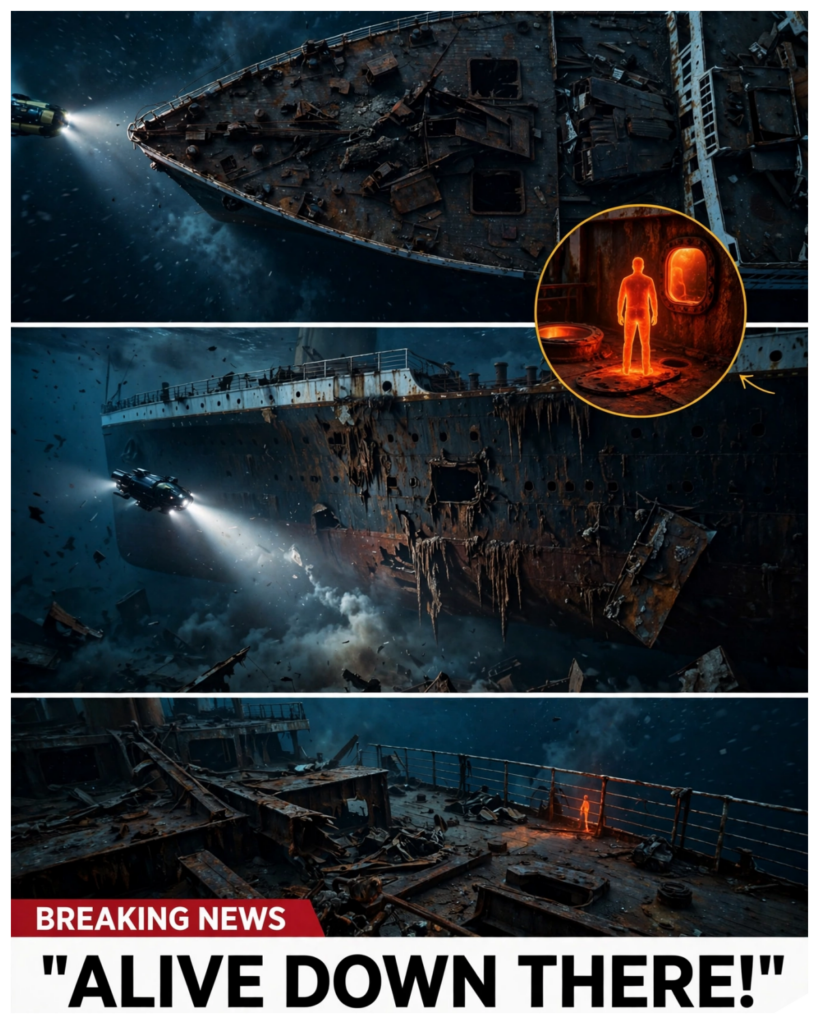
Could see their way to the lifeboats.
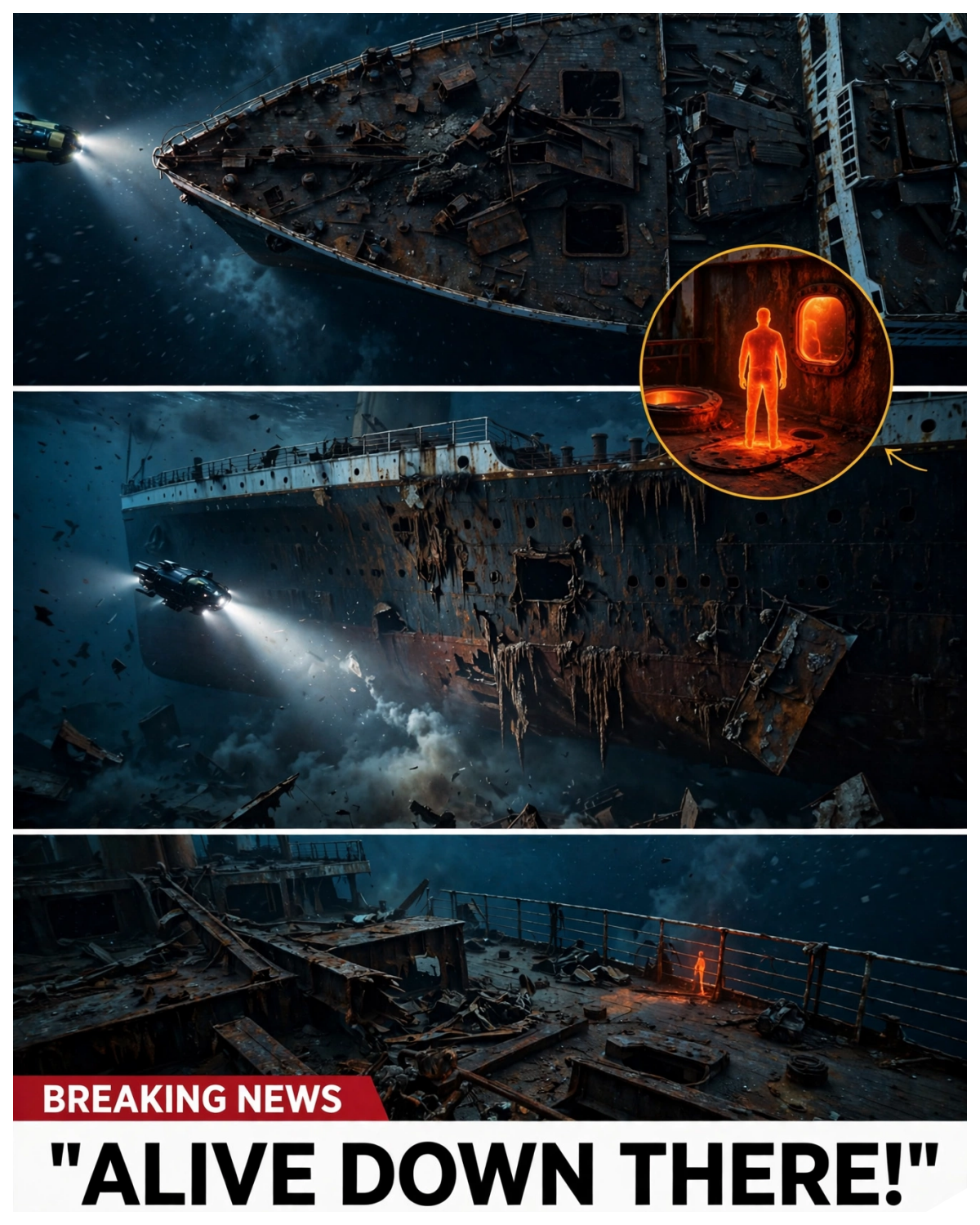
Not one of those engineers survived.
The same study also ran a computer simulation of the collision.
It suggested the fatal damage may have been a row of narrow openings, each about the size of a sheet of paper.
That sounds far too small to sink a giant ship.
But Simon Benson, a naval architecture lecturer at Newcastle University, explained why it was enough.
The opening stretched along a long part of the hull, so water crept in slowly through all of them at once.
The watertight compartments filled up one after another and spilled over into the next.
The same design that earned her the name Unsinkable was the thing that let her drown slowly.
Now, back to that safe.
A year after Alvin failed to open it, a French expedition lifted a safe off the seabed.
Researchers who traced it say it was the same one.
On October 28th, 1987, it was opened live on television in Paris.
The actor, Telly Savile, hosted, wearing a tuxedo with guards and experts standing.
Bye.
The whole world waited, and the back of the safe had simply rusted away.
Between that safe and a leather bag opened the same night, the hall was a few coins, some soggy paper money, and a little jewelry.
The locked box held almost nothing.
The real secret was never in a safe.
It was out in the open, on the mud the whole time, and it took decades for anyone to say out loud what it meant.
To understand it, we have to leave the wreck and go back to the surface to the days right after the sinking.
A cable ship from Halifax named the McKay Bennett was sent to bring the dead home.
She carried all the inbalming fluid the city could spare around 100 coffins, 100 tons of ice, and 12 tons of iron bars to weigh down bodies that had to be buried at sea.
When the crew reached the area, they found the water dotted with the dead.
At nightfall, they had to stop working and wait for morning.
Over the next week, they recovered 306 bodies.
They buried 116 of them at sea because the inbalming supplies ran out.
Many of those buried at sea were crew members and third class.
Passengers, often identified only by their clothes.
The wealthier dead were more likely to be carried home.
Band leader Wallace Hartley was found with his instrument still strapped to his body.
One of the bodies was a little boy no one could name.
The sailors were so moved that they paid for his funeral themselves.
They fixed a small plaque to his coffin with two words on it.
Our babe.
Almost a century later in 2007, tests finally revealed who he was.
His name was Sydney Leslie Goodwin.
He was 19 months old.
His whole family died with him.
All the ships that searched put together recovered fewer than 340 bodies.
Some of the missing floated away in their life jackets and were scattered by a storm that came in after the sinking.
But many more went down with the ship.
Ballard said it bluntly.
When those bodies went down, he said, they stayed down.
Think about those numbers for a second.
Hundreds of families waited on the docks and by the telegraph offices of two continents.
Some got a body to bury.
Most got nothing at all.
They were left with a name on a list and a question that no one could answer.
That question is the one the robots would try to answer a lifetime later.
So when the cameras finally touched the bottom, the explorers braced themselves.
They thought they would see the dead.
Instead, in 1986, Ballard saw shoes, pairs of them, lying in the mud, side by side, placed exactly the way a person’s feet would rest.
Among them was a small pair beside a larger one, what looked like a mother and a child.
No skeleton, no skull, no bone of any kind.
Years later, he looked at a photo of boots lying on the deck near the stern and told a reporter that there used to be bodies in those shoes.
Think about how that feels.
The shoes were not scattered or tossed around.
They were set down like someone had stepped out of them, as if the person had been there one moment and simply gone the next.
So where did everyone go?
The answer comes in two stages, and both are hard to hear.
First, the scavengers.
Creatures of the deep sea arrived and stripped away the soft tissue.
After that, the ocean itself finished the work.
The Titanic lies below a boundary that scientists call the calcium carbonate compensation depth.
Below that line, seawater dissolves material rich in calcium, like shells and bones, instead of preserving it.
Once the creatures eat the flesh and uncover the bones, Ballard said, the bones dissolve.
Imagine a piece of chalk dropped into vinegar, slowly fizzing away until nothing is left.
The deep sea acts much the same way, patiently dissolving whatever the scavengers leave behind.
The shoes survived for a different reason.
The tannon used to tan the leather seems to have kept bacteria away, so the leather stayed right where the feet once were.
And this is what makes it so haunting.
The ship itself was never the only thing to be preserved.
In a quiet way, the ocean kept a list of everyone who had stood on that deck.
It simply wrote it in leather instead of names.
Hold on, because I want to pause here with one more request.
If you think the ocean has more secrets than we’ll ever know, share this video with someone who loves true stories from the deep.
And if you want more investigations that stick to the record, the dives, the photographs, and the court filings, subscribe and turn on notifications.
The next story goes somewhere even darker.
Now, let’s test this theory properly because it isn’t as simple as it sounds.
Bones have been found on plenty of other shipwrecks.
Human remains were recovered from the Air France jet that crashed into the deep Atlantic in 2009.
So, why not here?
The difference is depth and time.
Most older wrecks lie in shallower water above the level where bone starts to dissolve.
And this Air France jet had been on the bottom for only a couple of years when searchers reached it.
At the Titanic’s depth, a century is more than enough time for bone to vanish completely.
But then comes the photograph.
In 2004, an expedition led by Ballard and the American agency Noa, photographed a coat and a pair of boots lying in the sediment.
They were arranged just as they would be if someone had come to rest there wearing them.
In 2012, James Delgato, a maritime archaeologist who worked for Noa, studied that image.
As an archaeologist, he said he would call it human remains.
He believed traces of that person were very likely buried in the sediment below.
James Cameron strongly disagreed.
After all his dives, he said he had seen many pairs of shoes, which suggested a body had once been there, but he had never seen a single human remain.
So there you have it.
Two serious experts, one coat, one pair of boots, opposite conclusions.
Neither is careless.
Both have spent years studying this site.
They simply read the same evidence through different professional eyes.
And there is a third possibility even more unsettling.
Lorie Johnston, a microbiologist who joined Cameron’s 2001 expedition, has argued that remains could still exist inside the wreck or out in the debris field in small pockets where there is very little oxygen.
Think about what that means.
There are parts of that ship no robot has ever reached, and they might be holding the one thing a century of cameras has never shown us.
Nobody has gone looking.
And the question of whether anyone should end up in a federal courtroom.
In 2020, RMS Titanic Incorporated, the company that holds the salvage rights, planned to recover the Maronei wireless set.
That is the very equipment those young operators used on the night of the sinking.
To reach it, an unmanned submersible would have to slip through a skylight or cut into the corroded roof above the radio room.
Then, a suction tool would clear away silt and robotic arms would cut the cables.
A federal judge approved the plan.
The United States government went to court to stop it.
Government lawyers pointed to an agreement with Britain that treats the wreck as a memorial.
Its purpose, they said, is to keep the hull, the artifacts, and any human remains undisturbed.
The company answered that after roughly 200 dives, someone would have noticed remains by now.
Archaeologists on the government side replied that remains must exist.
They pointed to whale bones found at similar depths and to the human remains recovered from the Air France crash.
So that people who know this wreck best cannot agree on whether it is still a grave in the most literal sense.
And the secrecy around the site is so deep that even its treasures disappear.
Remember the bronze statue of Diana?
The company says its location stayed unknown for decades.
Then during an expedition in 2024, it was found again, still standing upright in the debris field.
Every journey to this place also carries a price.
In June of 2023, that price became human.
A tourist submersible named Titan imploded on its way down to the wreck.
All five people on board were killed.
One of them was Paul Henri Narle, the company’s director of underwater research.
He had piloted the French submarine noil on dives to this very wreck.
Even trips that go perfectly can do harm.
Henrietta man, a scientist at Delhauszy University in Halifax, the same city that sent out the Mai Bennett, says that every submersible speeds up the decay.
Their propellers stir up bacteria and hand them fresh steel to settle on.
So, the honest position is uncomfortable.
Cutting into that radio room for a museum piece risks disturbing whatever might still be inside.
But the cameras are not innocent either.
Every dive feeds the very life that is eating the ship.
We are documenting a grave that is disappearing.
And it is disappearing faster than anyone hoped.
That brings us back to the rusticles, the orange icicles Ballard named in 1986.
They look like decoration.
They are not.
In 2010, man and her colleagues identified a brand new species of bacteria living inside them.
They named it Halamonus Titanic.
Each rusticle is a living colony, a spongy structure full of tiny channels built by at least 27 kinds of bacteria working together.
Their job is to eat the iron in the hull and turn it into rust.
Some grow as tall as a grown person.
Picture a microscopic city, organized and endless, quietly turning the world’s most famous ship into dust.
The Titanic is around 50,000 tons of steel and the bacteria are working through every ton.
Nobody even knows if they arrived with the ship or found her after she sank.
Back in 1995, man predicted that the Titanic had about 30 years left.
We have now passed that mark.
The ship still stands, but it is losing pieces.
Structures that were photographed whole only a few years ago are now crumbling into shapeless debris.
The 2024 expedition found that a large section of the famous railing around the bow, still standing in 2022, had collapsed.
Now, think about what lasts longest down there.
The bones disappeared first.
The steel is vanishing now, one rusticle at a time.
And the tanned leather that kept those shoes whole has already outlasted both, which means the final trace of the people who died that night may not be the ship at all.
It may be their shoes still lying in pairs in the dark, right where they came to rest.
They are not scraps on the seabed.
They are the last small footprints of 1500 lives waiting in silence 2 and a half miles below us.
The ocean keeps its records in strange places.
And sometimes the saddest record of all is a pair of shoes that someone once stepped out of side by side and then carry one away.
But we already know that moving a clock changes how it ticks.
And the amount it changes depends on the speed of light.
Again, every method runs into the same wall.
You need to know the one-way speed to measure the one-way speed.
This is not a secret.
Physicists have known about it for more than a century.
Many of them agree that the number we use is a convention, a choice.
Einstein himself said so.
It is a choice that makes the equations tidy and it leads to predictions that match every experiment.
But it is a choice, not a measured fact.
And that opens a door.
If the one-way speed is a convention, then maybe, just maybe, there is a different way to describe the world in which light behaves differently on the way out and on the way back.
There is a second reason to be suspicious and it is even more curious.
Speed is simple.
It is distance divided by time.
Everyone who measures the speed of light in any state of motion gets the same answer.
Everyone except one observer.
The light itself.
Think about what relativity says.
The faster something goes, the slower its clock ticks.
At the limit, at full light.
Speed.
The clock stops completely and the lengths along its path shrink to nothing.
So what does a photon experience on a trip across 10 m?
It experiences no time at all and it sees the 10 m squashed down to zero.
Now try to calculate a speed.
10 m / 0 seconds.
You cannot divide by 0.
The answer blows up toward infinity.
Or if you use the squashed length, you get 0 m / 0 seconds, which is meaningless.
Either way, you never get that famous number.
When your math falls apart at exactly one point of view, it is a sign that you may be asking the wrong question.
So John says, why not accept what the math is hinting at?
Let the photon be instant.
From its own view, it crosses any distance in no time at all and let the speed limit appear only when other people look at it.
Let me pause here for a moment because I want this to stay a conversation.
If you have followed me this far, tell me in the comments which assumption feels the most believable to you so far.
Is it time as a direction or light is instant?
And if you want to keep exploring ideas like this, press subscribe and turn on the bell so you never miss the next one.
Now let us put the pieces together and see what happens.
Imagine two people standing in a field.
Let us call them Maya and Leo.
In the four-dimensional map, each of them is a line shooting outward from the big bang point.
Because everything spreads out from the same starting spot, their lines do not run perfectly parallel.
They point just slightly away from each other.
Notice something already.
Without adding any extra push, any dark energy, they drift apart.
They are simply following straight lines that began at the same place.
An object in motion stays in motion.
That is an old and trusted idea from Isaac Newton.
The expansion is built into the picture.
Now Maya sends a photon to Leo.
In this model, the photon travels instantly from her point of view.
It leaves her line and lands on Leo’s line in 0 seconds of Maya’s time.
But Leo does not see it that way.
His direction of time is slightly different from hers.
On his timeline, the photon took a little while to arrive.
He did not see it leave at the same moment she did.
For him, the trip had a duration.
Even though the photon itself felt nothing.
Now Leo sends one back.
And here is the key.
He is now using his own direction of time as the reference.
And the photon is instant in his view.
But when we look from Maya’s side, the return photon takes time to reach her.
Now picture each of them trying to measure the speed of light the oldfashioned way.
They know the distance.
They time the round trip.
They divide by two.
And out comes the same famous number in every direction for everyone.
But hidden under that average, the outward trip and the return trip were not the same.
One was shorter, one was longer.
The average hides it.
And that in this model is why light seems to have a fixed speed limit.
It is not a limit built into light.
It is the way that tilted timelines make instant trips look slow.
Some sharp viewers might notice something here.
The return trip covers a slightly longer distance than the outward one.
Does that sound wrong?
It is actually what we see in the real universe.
We normally explain it by saying that space grew a little while the light was traveling.
In this model, it comes from the angles themselves.
So far, so tidy.
But the real test of an idea is what it does with the hard cases.
Take red shift and time dilation.
Now, picture an object very far away.
Its line is tilted much more steeply from ours.
Remember, each line has its own direction of time.
Because of that steep angle, only the photons it sent out very early in its life can ever reach us.
Later photons miss our line altogether.
And the farther away the object is, the more this is true.
Now, think about what happens to a steady stream of photons that leaves such an object once every second by its own clock.
When those photons land on our line, they hit it much farther apart.
We have to travel a long way along our own timeline between one arrival and the next.
So, the stream looks stretched, slowed down.
If the signal is a wave, the waves are stretched, too.
And stretched light waves look redder.
That is red shift coming straight out of the geometry.
So a distant quazar flickering five times slower than expected is not a puzzle.
It is a prediction of the angle.
And the same angle makes distant things appear to race away from us.
The farther they are, the steeper the angle and the faster they seem to flee.
And this works for everyone.
Wherever you stand in the universe, the same pattern would hold for you.
Distant things would look slow.
Distant things would look like they were rushing away.
No special center, no special place.
There is one more consequence, and it is a dramatic one.
If a line points 90° or more away from yours, none of its photons can ever reach you.
So in this model, we can only ever see the half of the universe that lies within 90° of us.
The other half is permanently hidden.
Keep the thought.
We will come back to it because it may explain one of the biggest mysteries in physics.
But first, let me show you how this model handles one of relativity’s most famous brain teasers.
Using a story with a train.
Imagine a train that is 100 meters long.
And imagine a tunnel that is only 50 meters long with a door at each end.
On a normal day, there’s no way to fit that train inside that tunnel.
It is twice too long.
Now, let the train rush through at an enormous fraction of the speed of light.
Relativity says that to someone standing beside the tunnel, the train will appear shortened, squeezed along its direction of travel.
At the right speed, it looks only 50 m long.
For one instant, the whole train can sit inside the tunnel, and both doors can be slammed shut at the same time.
That is the first half of the puzzle.
Here is the second half and it is where heads begin to spin.
Think about what the train driver sees.
To the driver, the train is at rest and the tunnel is the thing rushing past.
So the tunnel is the one that appears squeezed.
It is now only 25 m long.
There is no way a 100 m train fits in that.
So how can both doors close with the train fully inside?
This is the famous paradox.
And the traditional answer is that simultaneity is not universal.
The tunnel worker says both doors closed at the same moment.
The driver says, “No, the doors closed at different moments.
The back door shut first and the front door shut later after the front of the train had already left.”
Both are right in their own frame.
It works, but it can feel like a magic trick.
Why should events lose their shared timing?
Here is how the geometric model explains it.
Think of the train as a long row of tiny atoms.
Look only at two of them, one at the very front and one at the very back.
Each is a line on our four-dimensional map.
At first, the train is at rest relative to the tunnel.
Their lines are parallel and the distance between them is 100 m.
Now the train accelerates.
Acceleration in this model means changing your reference frame.
Your direction of time swings around a little.
After the change, the front atom and the back atom both begin a new journey, both starting at the same moment according to the train’s clock.
But the tunnel has a different direction of time.
When the tunnel looks at that same journey, the two atoms are not lined up with each other.
The back atom is further along its own timeline than the front atom.
The two events which were simultaneous for the train are now spread out across the tunnel’s view.
If you take a snapshot using the tunnel’s slices of time, you get a shorter cross-section of the train.
It really does fit inside.
That is length contraction.
And it comes from nothing more than a tilt.
Now flip it.
Draw the same journey, but this time use the train’s slices of time.
The doors of the tunnel are no longer in step.
The back door closes first.
The front door closes later.
That is the loss of simultaneity.
And again, it comes from a tilt.
So you see the paradox is not a paradox at all.
It is just two different ways of slicing the same fixed picture.
Even the slowing of time for the train is there.
When you follow the train’s line from start to finish, it has covered less distance along the tunnel’s time direction.
It experienced less time overall just like the airplane clocks.
And when the train slows down and stops, its frame changes again.
The length contraction vanishes because it was never squeezing the train itself.
It was a feature of how the train’s slice of time cuts across the tunnel slices.
Now that is a lot of special relativity explained with only lines and angles.
But John says there is more.
Let us talk about one of the strangest holes in our knowledge.
Antimatter.
For every kind of particle there is a mirror partner called its antiparticle.
They have the same mass but opposite charge.
When a particle meets its antiparticle, both vanish in a burst of energy.
Now here is the problem.
According to our best theories, the Big Bang should have made equal amounts of matter and antimatter.
If that had happened, they would have wiped each other out and nothing would be left.
No stars, no planets, no U.
But we exist.
So somehow a tiny bit more matter survived.
Physicists have ideas, but no complete answer.
Where did all the antimatter go?
There is a fascinating clue.
Some theorists have suggested that antimatter behaves like matter.
Moving backward in time.
And here the geometry offers a surprising twist.
Remember those lines that point more than 90 degrees away from us?
Their direction of time compared to ours has flipped.
They are from our point of view running in reverse.
John’s suggestion is that this hidden half of the universe is the missing antimatter.
It is not gone.
It is simply on the other side of the angle, forever out of sight.
It is a wild idea, and it comes with a chilling side note.
If we could ever reach it, we would apparently be annihilated.
Here’s my last ask, and it is a small one.
If this video taught you even one thing you did not know, share it with someone who loves space.
Then come tell me in the comments what you would test first.
Your question might become the next video.
Now, why can nothing with mass reach the speed of light?
Standard physics says it would take infinite energy.
This model offers a picture.
Everything with mass is already traveling outward along its time arrow.
Adding sideways motion tilts the arrow, but never flattens it.
It is like lengthening.
One side of a triangle.
You can make it enormous, yet the angle barely moves.
The closer you get, the less each extra push gives you.
What about time travel?
Objects with mass seem locked to their outward path.
Photons never turn backward either, but the model leaves one door a jar.
Maybe some unknown particle can link points at more than 90°.
If so, it might hint at why quantum events sometimes seem to reach across distance or even across time.
That is pure speculation, and John admits it.
Then comes the deepest question.
Does free will survive?
If the whole map exists at once, every path is already drawn, and that sounds like fate.
But there is a gap.
The map does not explain why we move along it.
What carries us from one moment to the next?
Perhaps something above time itself.
If so, maybe choice lives there.
Finally, gravity.
John imagines all matter as vibrations on tiny strings that fill the four-dimensional map.
When a string vibrates, it pulls inward a little, like a guitar string, shortening as it shakes.
A heavy object pulls on the web around it, shortening distances in space and in time.
Nearby lines bend toward it.
Mass tells the web how to curve, and the web tells matter how to move.
Einstein would recognize that sentence.
So, have we found a new theory of everything?
No, not yet.
And we should be honest about why.
The standard picture of the expanding universe is not just a story.
It rests on supernova measurements, the afterglow of the Big Bang, and the patterns of galaxies across billions of light years.
Any rival must match all of that to high precision.
So far, this model describes the ideas and words and drawings.
It has no full mathematics and it has not made a prediction that anyone could check and possibly prove wrong.
The last point matters most.
Science does not ask whether an idea is beautiful.
It asks whether it can fail.
A great theory sticks its neck out.
It says, “If you look here, you will find this number.
And if you do not, I am wrong.
Until this model does that, it remains a promising sketch, not a discovery.
There are also real puzzles.
Why should the angles be set exactly as they are?
How does the picture produce the precise cosmic numbers we observe?
How does it reproduce quantum behavior in detail?
And what exactly moves us along the arrows, but do not dismiss it too quickly.
Many of the best ideas in history began as a strange picture in someone’s mind.
Einstein wrote a beam of light in his imagination long before he wrote an equation.
The point is not whether this sketch is right.
The point is that it asks the right kind of question.
What if the weirdness is a clue, not a flaw?
Think about the clocks on those planes.
Think about a quazar flickering in slow motion across billions of years.
Think about a photon that feels no time at all.
Each one is a hint that time and space are not what they seem.
Maybe the universe is not complicated.
Maybe it is simple and we are still learning how to look at it.
Maybe the next great idea will not come from a giant laboratory, but from someone sketching lines on a page, asking one more question than everyone else.
So, keep asking, keep wondering, because the day we stop being amazed by the universe is the day we stop understanding it.
And tonight, when you look up at the stars, remember this.
Every point of light is a message that has crossed a hidden map and you’re standing on a line traveling through it right