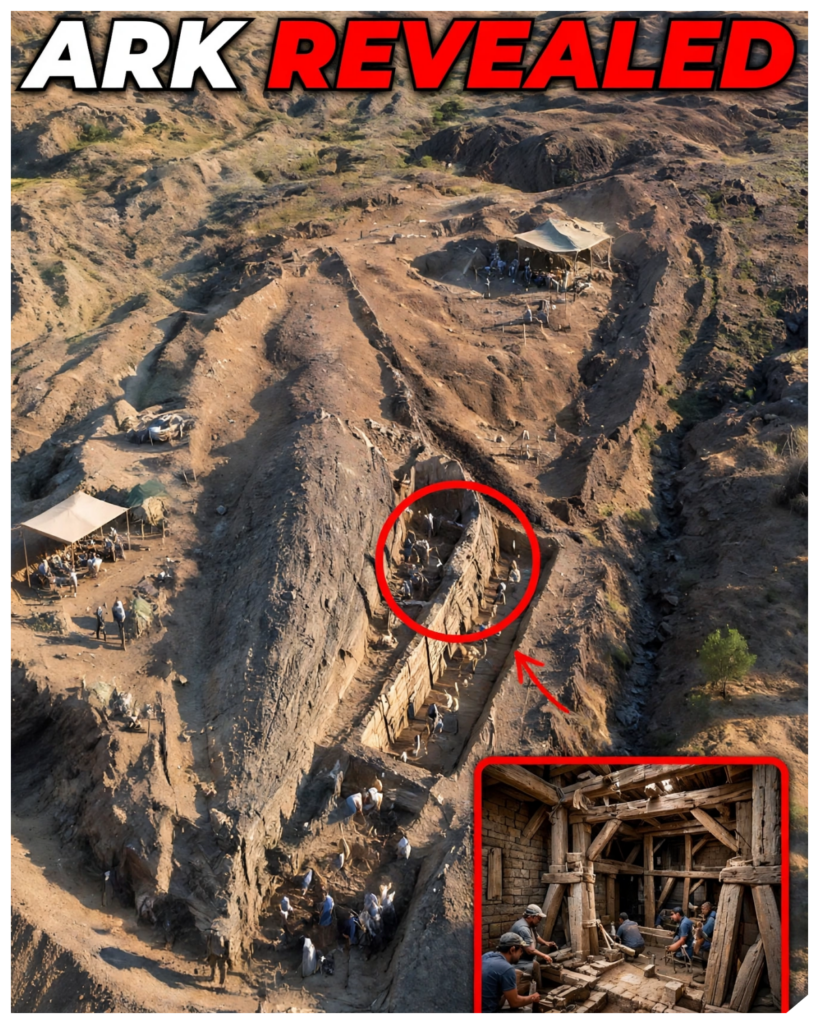
About four or five meters under a mountain side in eastern Turkey, the drill hit something it could not cut.
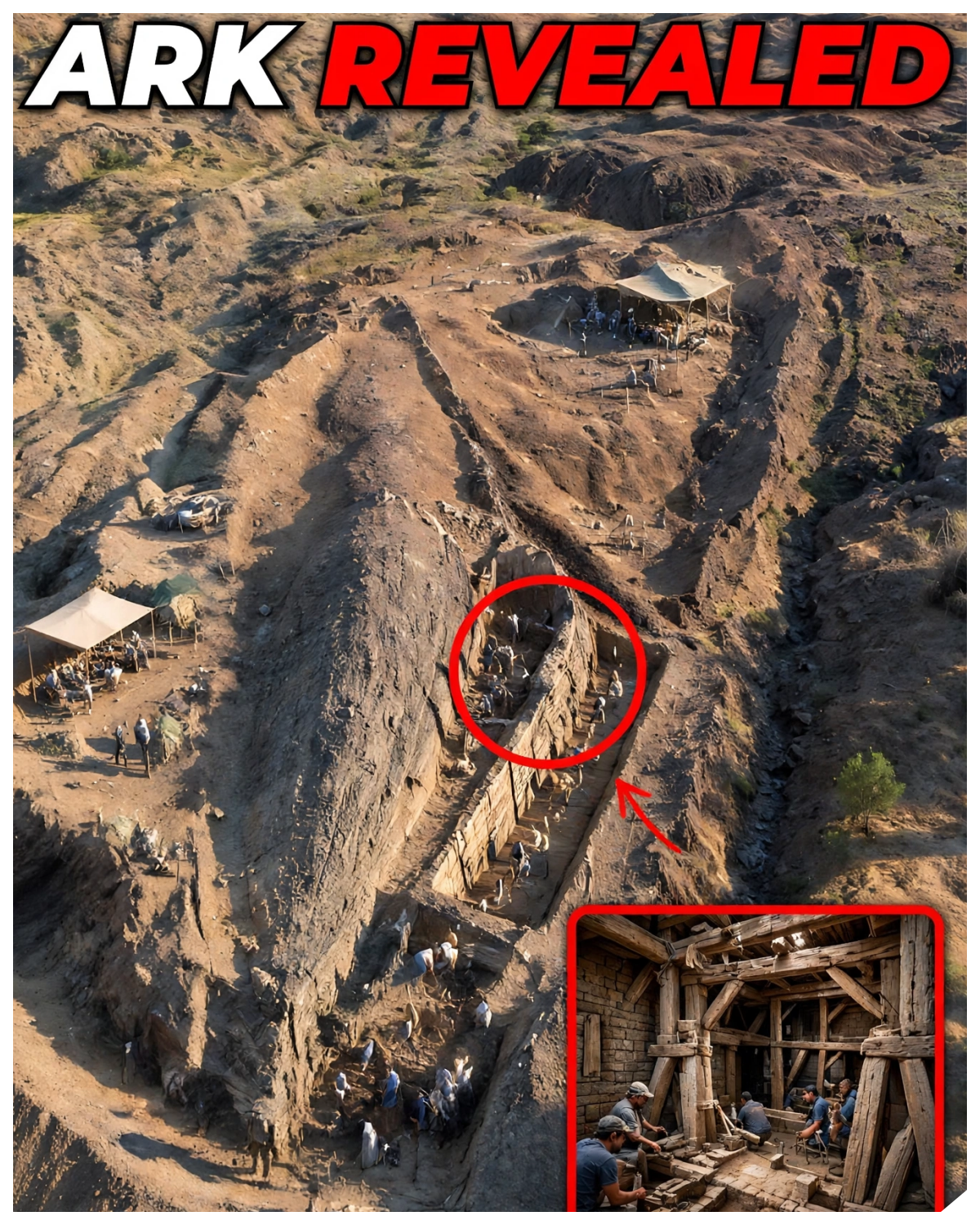
It was September of 2026 and a core rig was boring into a boat-shaped mound of earth some 18 mi south of the summit of Mount Ararat.
The layer was so hard that the drill bit broke.
Andrew Jones, who founded a group called Noah’s Ark Scans, believes this mound holds the buried remains of Noah’s Ark.
It is a story millions of people already half know that the ark came to rest on Ararat and is still up there somewhere waiting to be found.
Within days, headlines said the site was 100% confirmed.
Then came the part the headlines skipped.
Nothing from the new cores had been tested yet.
And the last time rock from this mound went under a microscope.
A geologist from California published what it actually was in 2016.
Above the drill holes, the long outline still curves across the slope, the same shape a Turkish Air Force camera caught from the sky in 1959.
The story begins with a number, and the number comes from the book of Genesis.
The ark is 300 cubits long, 50 wide, and 30 high.
A cubit is roughly a forearms length.
So depending on whose forearm is used, the ark runs somewhere between about 450 and 510 ft.
Genesis says it came to rest on the mountains of Ararat.
Over the centuries, that line hardened into a picture of one peak.
The obvious candidate stands on the far eastern edge of Turkey near the borders of Iran and Armenia.
Greater Ararat rises 16,854 ft, a dormant volcano capped with ice.
Its Turkish name, Agriagi, means mountain of pain.
It last erupted on July 2nd, 1840.
The first recorded climb to its summit came on October 9th, 1829.
About 18 mi south of that summit on the slope of a different mountain, lies the shape at the center of the story.
By one account, heavy rain and three earthquakes on May 19th, 1948 stripped it bare, and a Kurdish shepherd named Rashett Sarhan came across it.
11 years later, a Turkish Air Force photograph taken for a NATO mapping mission caught it from above, and an army captain named Ilhan Durupanar saw that it looked like a ship.
The site still carries his name.
In 1960, Life magazine published the pictures.
The mound is long and pointed.
The team working there now measures it at about 515 ft.
Earlier measurers made it 538 laid out on a field that is longer than one and a half football fields close enough to the Genesis figure to make people stop and look twice.
The man most invested in that closeness today is Andrew Jones.
He is a software developer by trade and he runs Noah’s Arc Scans, a group based in the United States whose documented scanning at the site reaches back to at least 2019.
He says plainly what he thinks.
In a press release on September 23rd, 2026, he put it this way.
I believe this is Noah’s Ark.
That’s why I’m putting the Droopin site through the most rigorous testing possible.
The work is paid for by donors, and the group’s fundraiser, Lauren Witzky, described his devotion in the same release.
No American in his right mind would spend 30 years in the mountains of eastern Turkey guarding a pile of rocks.
That is the story as millions met it in the fall of 2026.
The trouble is that the first people to walk this mound with a scientific eye had already given their answer 66 years earlier and it did not stay settled for long.
In September of 1960, a team from the archaeological research foundation came to see the ship in the photograph for themselves.
With them were George Vanderman and Arthur Brandenburgger, a professor at Ohio State University who worked in photoggramometry, the science of measuring the ground from pictures taken above it.
They spent about two days on the mound.
Their report was blunt.
There were no visible archaeological remains and the formation was a freak of nature and not man-made.
For almost two decades, that was that.
Then in 1977, a nurse and estadist raised in Gatlinburg, Tennessee named Ron Wyatt, picked the story back up.
Wyatt, by his own count, made more than 100 trips to the Middle East.
At Durupanar, he claimed to find petrified timber, iron brackets, and rivets, and stones he called the arks anchors.
Those claims became the legend that still circulates today.
In 1985, two more men joined him.
David Fold was a former merchant marine officer from Chicago who ran a salvage business in Key West and had worked with treasure hunters.
John Bombgardner was a geoysicist from Los Alamos National Laboratory.
They brought ground penetrating radar which sends radio pulses into the earth and times the echoes that bounce back wherever the material changes.
It works a little like shouting into a canyon.
The echo tells you a wall is out there somewhere and it tells you nothing about what the wall is made of.
Facult also carried a device he called a frequency generator meant to trace lines of buried iron.
He measured the mound at 538 ft and set that beside 300 cubits in the long royal cubit of ancient Egypt about 515 ft.
In 1988, he published a book, The Ark of Noah.
Turkey had already taken notice.
In 1987, according to the creationist geologist Andrew Snelling, a Turkish commission declared that the site had historical value and deserved protection.
The declaration concerned heritage and it gave the story an official frame.
The next summer from July 28th to August 7th, 1988, a team including Bombgardner and Sali by Raktutan of Adaturk University drilled four narrow core holes each 3 and 1/2 in across.
Only one reached about 10 m, a little over 30 ft.
What those cores showed depends on who tells it.
Snelling wrote in 1992 that the drilling hit solid basement rock beneath a surface layer of mud flow.
The team drilling in 2026 says the old holes were shallow and the samples were spoiled by water.
Bombgardner himself came to see the mound as natural mud that had flowed around rock.
One line attributed to him still hangs over every drill rig on the site.
Core drilling is severely limited in its ability to find buried archaeological structure.
By rectutin by one report was less sure.
There is something anomalous there.
He is quoted as saying radar could find edges.
A narrow core could find layers.
Neither could answer the simplest question on the mound.
What the dark fragments people were carrying away actually were.
For that, someone needed to slice them thin enough to see light through.
The man who made those slices was Lawrence Collins, a geology professor at California State University, Northridge, and his partner was the least likely name in the story.
It was David Fold.
In September of 1994, Fold walked the site with the Australian geologist Ian Plamer.
He came away with a sentence that ended his own campaign.
I believe this may be the oldest running hoax in history.
Two years later in 1996, Collins and Fel published a peer-reviewed paper in the journal of geocscience education under a title that left no room for doubt.
It called the site a bogus Noah’s Ark exposed as a common geological structure.
Their explanation starts with the rock layers.
The mound, they argued, is a doubly plunging sinkline, a fold where layers of rock sag into a trough that also dips down at both ends.
Picture pressing a canoe into a stack of blankets, then shaving the top off the pile.
What remains is a pointed oval of curved stripes, and from the air, it looks remarkably like a hull.
Then came the pieces.
The iron rivets turned out to be granules of lemonite, a rusty iron mineral held in a paste of calsite, clay, and quartz.
The deck timbers were pebbles of andesite and bassalt, both volcanic rock.
Even an iron fitting that Bombgardner had judged man-made iron in 1985 failed the test because its titanium content varied in a way smelted metal does not.
The paper added one more test and it was the hardest to argue with.
Channels of fossil bearing limestone cut across the supposed ark, so the shape was already there before those deposits formed.
In the author’s words, the supposed arc is older than the deposits of the supposed Noakian flood.
And this relationship in itself conclusively refutes the hypothesis.
20 years later, in December of 2016, Collins went back to the question in perspectives on science and Christian faith, a journal published by scientists who share a Christian faith.
He had samples of the so-called petrified woodground into thin sections, slices of rock so fine that light passes through them.
Real petrified wood keeps the ghost of its cells and growth rings.
Under a magnifier, a thin slice of it looks like a sponge.
A thin slice of lava rock looks more like a brick wall.
Crystals locked together edge to edge.
Collins found the brick wall, long narrow crystals of plagicclass feldspar and no cells at all.
Every black rock at the ark, he wrote, was volcanic.
He closed with a sentence aimed at believers as much as skeptics.
Remains from Noah’s ark may someday be found in another location, but they are not at this site in eastern Turkey.
Fos had gone further still.
In April of 1997, testifying under oath in an Australian court case, he called the ark claim absolute BS.
He died of cancer the following April at 59.
That record stood for three decades.
Then on June 29th, 2026, a different kind of study began.
Its coordinator was Tinker Atila, a professor of archaeology at Civas Junhurat University, working under Turkish permits with Jones as one of his deputies.
The project stated its aim with care.
The work is not based on the assumption that a ship lies underground.
It set out to learn whether the shape is entirely geological or whether any trace of human activity survives in or around it.
The size of the effort shows in its numbers.
About 20 scientists and students from five countries worked the mound until September 11th, some 90 days of fieldwork and all.
By press accounts, they gathered nearly 1,000 soil samples from about 150 spots across the formation.
Then around September 21st, the drill went in aiming for cores 18 m deep, about 60 ft, roughly the height of a sixstory building.
In one hole inside the outline at 4 to 5 m, a little deeper than a two-story house is tall.
The bit broke.
The team’s release reports that the holes inside the shape found no bedrock and no solid limestone.
It describes several cavities, one filling steadily with water and layers rich in organic material.
None of it has been through a laboratory.
That is a field report preliminary and the release itself calls the hard layer only a possible layer of petrified wood.
The last time something from this mound was called petrified wood, the microscope called it bazalt.
The newer case for an arc at Durupanar rests on three things gathered over the last few years.
Soil, radar, and dates.
The dates came first.
In December of 2022, researchers from Istanbul Technical University, a university in Agri Province and Andrews University in Michigan, took rock and soil samples around the formation.
In October of 2023, they presented results at a symposium in Istanbul devoted to Mount Ararat and Noah’s Ark.
One accounts 30 samples, another more than two dozen.
They reported clay, marine deposits, and the remains of mollisks, dates of roughly 3,500 to 5,000 years, and pottery fragments that had been fired.
The reports do not say what exactly was dated or by what method.
That gap matters.
Radiocarbon, the standard method, measures how much carbon 14 remains in something that once lived and it dates that thing, a seed or a scrap of charcoal.
It does not date the ground around it.
And a symposium talk has not been through peer review.
One of those researchers, Farooqa, vice director of the university in a drew the line himself.
With the dating, it is not possible to say that the ship is here.
He said.
By his reading, the early results pointed to human activity in the region since the calcic, the age when copper tools first joined stone.
Jones own team had been working toward the same question for years.
In 2019, its thermal and radar survey reported linear structures and right angles under the surface down to about 7 m.
That survey was published by the group itself on its own website.
Next came the chemistry.
In 2024, Jones team took soil from 22 points inside and outside the outline.
By one account, 88 samples were labeled only with letters and numbers and sent to Adaturk University.
So, the laboratory would not know which came from inside the shape.
By the team’s account, the soil inside held about three times as much organic matter, though one report put it at double about 38% more potassium, and a difference in acidity the team described as eight times.
Decaying wood can raise organic matter and shift both potassium and acidity.
Organic matter was three times more inside the boat shape versus the soil just right outside, Jones said.
His team calculated less than a 5% chance that the difference was random.
These results are unpublished, and no outside laboratory has repeated them.
Put together, the numbers behind the newer case sound large.
Dates of 3,500 to 5,000 years, 22 sampling points, three times the organic matter, 38% more potassium.
A tunnel 13 meters long, about the length of a city bus, and radar lines six or seven meters down, deeper than a two-story house, is tall.
Every one of those figures comes from a presentation, a press release, an interview, or the group’s own website, then the radar.
In May of 2025, the team described angular structures reaching about 6 m down, a tunnel some 13 meters long running through the center, and three distinct layers the team read as possible decks.
By April of 2026, reports spoke of rectangular rooms.
By September, of a hallway more than 250 ft long.
None of it has appeared in a peer-reviewed journal.
Then came the headlines.
In late September, one outlet attributed the phrase 100% confirmed to Jones.
Read closely, the claim was that the mound is man-made.
One report noted that he stopped short of confirming it is the ark itself.
He told the Daily Mail the findings destroy the theory that the site is a solid limestone block shaped by glaciers and weathering and refute the idea that it is bedrock with mud flowing around it.
I firmly believe the Dupinar formation represents the buried remains of Noah’s ark.
He said that is a belief stated honestly as one.
A headline added the words after 4,300 years a figure drawn from a traditional reading of scripture and never measured at this site.
The group’s fundraiser went further on social media.
Core drilling has begun and the big bang evolutionists are already on damage control mode.
Lauren Whitzky wrote on September 21st and later she promised that Darwinism will be dismantled.
Set beside all of that, the project’s own director sounded like a different investigation.
Tanker Atilla spoke of findings that increase our interest in the possibility that this formation may preserve evidence related to Noah’s ark.
Increased interest in a possibility and 100% confirmed described the same holes in the same mountainside drilled in the same week.
And the sharpest answer to 100% did not come from people who doubt Genesis.
It came from people who teach it.
Andrew Snelling is a geologist who believes the flood of Genesis was real.
And in 1992, he took the Dupinar arc apart himself.
Writing for answers in Genesis, he found that the metal detector hotspots were bassalt boulders scattered at random, rich in iron oxides.
The frequency generator, he wrote, worked like a divining rod, with no result anyone could repeat.
The famous laboratory tests on Wyatt’s samples run by Golbra Laboratories in Knoxville had checked only calcium, iron, and carbon far too little to identify wood or worked metal.
Collins later added that Wyatt had misread those reports, taking percentages of elements and minerals as if they were pure metals.
Snelling also made a point that cuts against the whole search.
Even if the ark had landed here, he wrote, there’s every reason to expect they dismantled the ark to salvage timber.
A creationist geologist, in other words, does not expect a hole to be waiting in the ground at all.
In 2025, Snelling answered the new evidence, too, and his case is the strongest one the descent has.
The rock inside the outline is limestone, he noted, while the ground outside is mudflow debris, so the soil should differ without any rotting wood at all.
The radar lines, he suggested, may be joints and layering in that limestone, and even a tunnel or cave dissolved out by water.
His warning applies to everyone on the slope.
Any interpretation always involves assumptions, not least an expectation or prior concept of what one is hoping to find.
Turkish geologists have reached the same ground by other roads.
At a symposium in 2005, Murat Aiy described the mound as a slumped block of limestone riding a great earth flow down the mountain side.
In June of 2025, the geological engineer Ezref Adabay called it a formation made by a landslide.
In April of 2026, two Christian scholars went public.
“It looks like a boat to me, just doesn’t amount to real evidence,” said Wesley Huff.
“Jeremiah Johnston used the very number that would soon fill the headlines.”
“The one thing all of us get along about is 100% certainty,” he said.
“This geological formation in eastern Turkey is not the spot of Noah’s ark.
The older legend fares no better under dates.”
Wyatt’s anchor stones turned out to be local volcanic rock, and Collins counted up to 23 carved crosses on them, far more than the eight that believers had matched to Noah’s family.
The famous length match depends on choosing the long Egyptian cubit and the right measurement of a mound that measures disagree about by more than 20 ft.
The story also gets its own scripture wrong.
Genesis says the mountains of Ararat, plural.
Ararat is the Assyrian name.
Uratu, a kingdom around Lake Van.
And the idea that the ark sat on the one peak called Ararat took hold as late as the beginning of the second millennium AD.
Earlier Syrian and Eastern tradition placed the landing on Mount Judy, far to the south.
The real record holds something older and stranger than a boat on a hill.
In the British Museum sits a clay tablet from the 7th century BC, found at Nineveh in the library of King Asherbanal.
It tells how the god I warned a man named Utnapishtim to build a vessel.
How the storm raged for 6 days and how a raven was sent out and never came back.
It caused a sensation in the 19th century because it read so much like Genesis seen that way.
The outline in the 1959 photograph is a fold of rock that a mountain made.
The kind of thing the earth does on its own.
What happens next is decided somewhere else by people with something riding on the answer.
Whatever the cores contain, the ground they came from answers to Turkish law.
The site has been protected since 1987 by one account.
And in 2011, Turkeykey’s Grand National Assembly handed control over Noah’s Arc investigations to the cultural center board of a university in Agri province.
Every drill hole in 2026 went in under those permits and under university oversight, which is why this season can produce evidence worth weighing at all.
The newest development is also the least finished.
On September 23rd, 2026, the team announced that its samples were headed for laboratory tests of composition, organic content, layering, minerals, and microscope structure with results expected over the winter of 2026 into 2027.
The team plans to return in 2027 and to send a robot it calls Gopher down into the cavities.
Papers, it says, will be submitted for peer review.
The one thing to watch is simple.
When the laboratory names the hard layer at 4 to 5 m, wood, mineralized wood or stone, and when radiocarbon dates the organic layers, the question moves from belief to record, it will matter whether those results reach a peer-reviewed journal with the raw radar data open for others to read.
Until then, the ledger reads like this.
Settled, the rivets are lonite, the timbers from the 1980s are volcanic rock, and published geology explains the outline as a fold and an earth flow.
Argued whether the new differences in soil and radar come from decayed organic material or from different rock and water inside the shape.
What would settle it?
A laboratory identification of that hard layer, dated samples and publication that other scientists can check.
There’s also a question of who gains while the old story stands.
The project raises its money from donors through a site called Give Send Go and every headline about 100% reaches the people who give.
The motive in the record is conviction and conviction can outrun a laboratory.
The people most worried by that are believers.
In June of 2025, Ken Ham of Answers in Genesis wrote a sentence that belongs beside every headline from this season.
When Christians use poor, easily disproven or inconclusive evidence for the truth of God’s word, it makes it easier for skeptics to dismiss everything.
Farukqa, looking at the early dates in 2023, said something shorter.
We need to work for a long time.
Three years later, the work is finally at the depth where it can answer, and the answer is still on its way to the laboratory.
For Attilla, this season is the one his team calls the first officially permitted university overseen study in the site’s history.
For Jones, it is the test he spent years asking for.
For the geologists who published against the ark, it is a chance to see their fold tested with a drill instead of a camera.
All three are waiting on the same slices of the same cores.
On the slope below Ararat, the long outline that the camera first framed in 1959 still lies where the mountain left it.
The snow on the peak to the north has been shrinking for decades.
For now, what archaeologists unearthed there does not match what millions were told about Noah’s Ark.
Which side are you on?
Is the Dupinar mound a buried ship waiting on its laboratory results or a fold of volcanic mountainside that the microscope already explained?
Put your answer in the comments and subscribe for the next place where the record and the legend stop agreeing.


