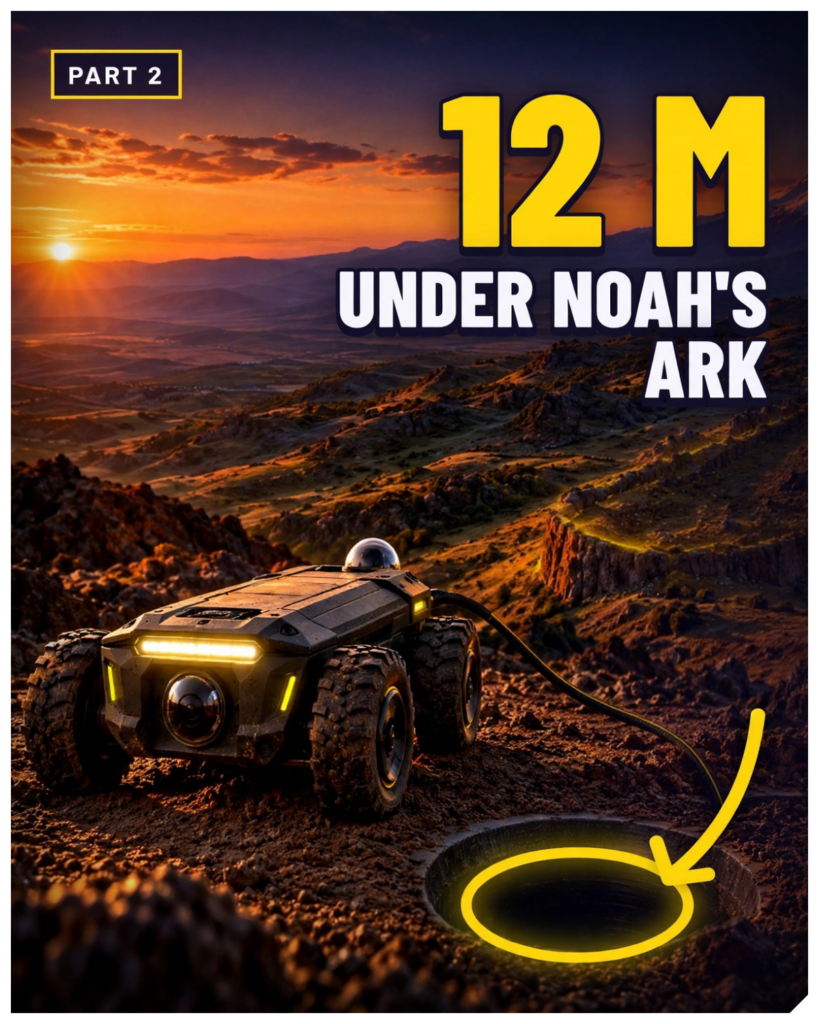
This is a hole drilled into a hill in eastern Turkey.
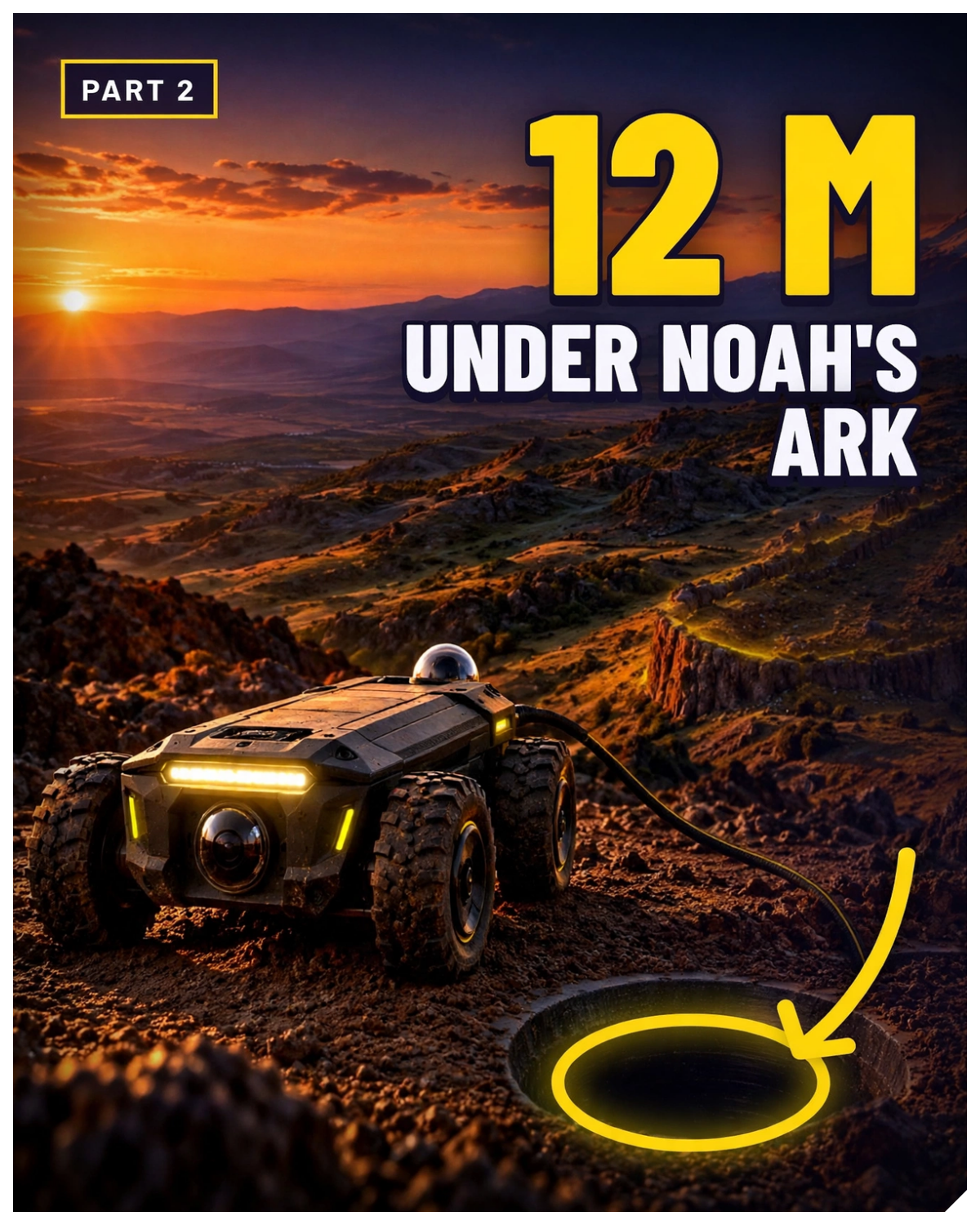
A hill that some people believe is Noah’s ark.
And this robot was built to go where people can’t, down the hole.
In part one, the drill broke on something hard four or 5 m down.
Since then, a camera has gone into the ground.
The radar team says there are corridors and chambers down there.
And the man in charge of the dig says they could still be rock.
So, what did the robot actually see?
Let’s find out.
[music] Quick catch up.
This hill is shaped like a boat about 157 m long, almost exactly the length Genesis gives the ark.
This year for the first time a team led by SA’s Jump Huriat University drilled into it and four to 5 m down the drill bit broke on something nobody could identify.
At the end of part one I asked you aruck keep your answer in mind.
By the end of this video you might want to change it.
One correction first.
In part one I said about a,000 samples.
The university’s own count is 366.
Core drilling started on the 21st of September.
A percussion drill punching straight down into the hill.
Every core came up as one long tube and was cut into slices 50 cm long.
In total, they drilled 12 holes inside the boat shape and four outside it.
Those outside holes matter.
They are the control.
If the soil inside looks the same as the soil outside, the boat shape is just a shape.
The main natural explanation says this hill is a block of rock.
So, the team expected to hit solid bedrock.
Again and again, they didn’t.
There were small rocks about 1 and 12 to 2 m down, boulders in places, but no continuous layer of rock.
The original plan was one hole 75 m deep.
After the radar results, they switched to many shallower holes instead.
The deepest went down about 18 to 20 m, over 60 ft, still mainly soil.
Some holes broke into cavities, empty spaces under the ground.
One of them filled with mud and water.
They pulled up a sample of that mud.
It is now in cold storage at a lab in Turkey.
And the hard layer that broke the drill bit, they never got a piece of it.
The spot was marked with GPS and left for next season.
Earlier tests found about three times more organic material inside the formation than outside.
What that hard thing could be, we’ll come back to.
First, the robot.
This part of the story starts with wombats.
In Australia, scientists wanted to see inside their burrows.
So in 2021, engineer Robert Ross at Latroe University built a small robot to crawl in.
He called it Wombbot.
He later printed a version for armadillo burrows in South America.
Then the Noah’s Arc team asked for something smaller, something that could go down a boar hole.
He built Gopher.
Gopher is light and driven by remote waterproof wide-angle cameras on the front and the back.
Environmental sensors and it can collect data up to 25 meters underground.
In late July, it left Australia bound for eastern Turkey.
On the 25th of September, it went into its first hole and it got stuck.
The sediment was so loose its wheels just spun.
So, they tried again.
On the second mission, Gopher went deeper, about 12 m down, roughly the height of a four-story building underground.
And here is what it saw.
Loose soil, small stones, water on the walls in the section it reached.
No solid rock, no bedrock.
So, did it see a wooden wall, a beam, a room?
No.
Nothing like that has been reported from the footage.
And here’s the catch.
A camera can show you soil.
It can’t tell you what that soil is made of.
And it never brought back a piece of the hard layer.
Its builder says this could be the archaeological discovery of the century.
But remember, he built the robot, proving what’s down there is the lab’s job.
Now, the big claim, ground penetrating radar sends pulses into the ground and listens for the echoes.
Those echoes come back as lines, not photos.
A person reads those lines and decides what they mean.
The radar here was run by an engineer named Kasro Baxter and his company Back to Radar.
His preliminary report describes repeating straight lines and angles and spaces he compares to corridors, chambers, and hallways running along the length of the boat shape.
He also scanned the valley around it and says he found nothing like those patterns there.
The team reported possible voids about 3 to 4 m down and again at around 13 m.
And they say the radar reached 70 m or more without finding a clear layer of bedrock.
Then came the line that went viral.
If it were geological, he said we would not have seen it at all.
But here’s what the headlines left out.
Because of heavy rain and other limits, the radar team only had seven days on site.
On the 23rd of October, according to the project, lead archaeologist Janker Attilla reviewed the preliminary report and approved it for the official record.
But he also said this, the spaces the radar found could still have a geological explanation.
Nature makes empty spaces, too.
And this hill sits on the slopes of a volcano.
The full radar report is due in November.
That’s the first date to watch.
The next clue goes back to the Cold War.
Mount Ararat sat right on the border between Turkey and the Soviet Union.
In 1949, a US Air Force flight filmed a dark shape in the ice high on Ararat itself.
It became known as the Ararat anomaly.
The film was classified in 1995.
Six frames were released to a university professor under the Freedom of Information Act.
Spy planes and satellites photographed that mountain for decades.
The anomaly is still argued about, but it’s not our hill.
Our hill is about 29 km south of Ararat’s summit, and it has its own spy photos.
The team says declassified images taken between about 1955 and 1984 show the land around the formation changing.
Mud flows shifting around it decade after decade while the boat shape itself stays largely in place.
Andrew [snorts] Jones says that challenges the idea that a mud flow shaped it.
Other researchers still favor a natural origin and staying still doesn’t tell you what something is made of.
And this is not the first time someone has said found.
In 1955, a French explorer named Fernandin Naver climbed high on Ararat.
In a wall of ice at about 4,200 m, he cut out a piece of old handworked wood.
Labs ran radiocarbon tests on it.
Most results came back between about 600 and 800 AD.
Old wood, but thousands of years too young for Noah.
In 2010, a team in Hong Kong announced they had found wood on Ararat dated to 4,800 years.
99% sure, they said.
They described wooden structures high on the mountain inside the ice.
But an archaeologist who had worked with them withdrew.
A leaked email suggested the wood may have been planted.
Nothing was ever confirmed.
1955, [music] 2010, and now 2026.
This September, Andrew Jones said it was 100% confirmed as man-made.
No peer-reviewed study has shown that.
It’s also worth knowing that the scanning group runs tours to the site.
That doesn’t make them wrong.
It’s just why we wait for the lab.
So what’s in the lab?
First, pieces that might be petrified wood sent to SAS to be identified and carbon dated.
They are not confirmed as wood.
A tourist also found a piece of petrified wood at the back of the formation.
Where it came from is unknown.
Petrified wood is wood that is turned to stone.
Water carries minerals into it and they replace the wood cell by cell and that creates a problem.
Radioarbon dating needs the original carbon.
If the wood has fully turned to stone, there may be little or none left to date.
So, the first test is simpler.
Under a microscope, is there wood structure inside or just rock?
The soil samples have gone to several labs including Ankara Ujerum Beaazat University and Bar Ilan University in Israel and an ancient DNA company has joined the project.
Animals leave traces of DNA in soil.
Hair skin waste some of it can survive for a very long time.
In 2022, scientists read DNA about 2 million years old from soil in Greenland.
It showed mastadons and reindeer once lived there.
If the soil inside this hill holds the same local animals as the soil outside, that tells us little.
If it holds something very different, that’s a real question.
[music] And there’s more.
Pottery has been found beside the formation, not inside it, and there’s an ancient settlement right next to it that has never been excavated.
Then things got strange.
In late September, Andrew Jones said his apartment was broken into and computers and memory cards were taken.
He said the data had already been coped.
Adventurer Bear Grills visited the site.
Two international documentaries were filmed.
And then the field team packed up.
The season was over.
So here’s what happens next.
November, the full radar report.
March to May 2027, the soil results and a final report expected around the middle of 2027.
For season two, they want new tools.
One is muon imaging.
Muons are particles from space that pass through rock.
In 2017, they revealed a hidden void inside the great pyramid.
Put detectors under this hill and you could see inside the whole thing without digging.
They also plan seismic, magnetic, and gravity surveys and a dig at that ancient settlement.
And they’re going back to the hole where the drill broke with a wider drill to pull out the broken bit and whatever it hit.
So, what is it?
Petrified wood or just a hard block of rock?
Right now, nobody knows.
So, has Noah’s ark been found?
Not yet.
Nobody has pulled a single confirmed plank of ancient wood out of this hill, but that hard thing is still down there, 4 to 5 m under the surface, marked with GPS, waiting.
When the first lab result lands, part three goes up that same week.
So, subscribe and turn on notifications and tell me in the comments after everything in this video, Ark or Rock.
[music] [music]