
And we’re here in Jubel, Saudi Arabia at the site of one of the oldest standing churches on the planet.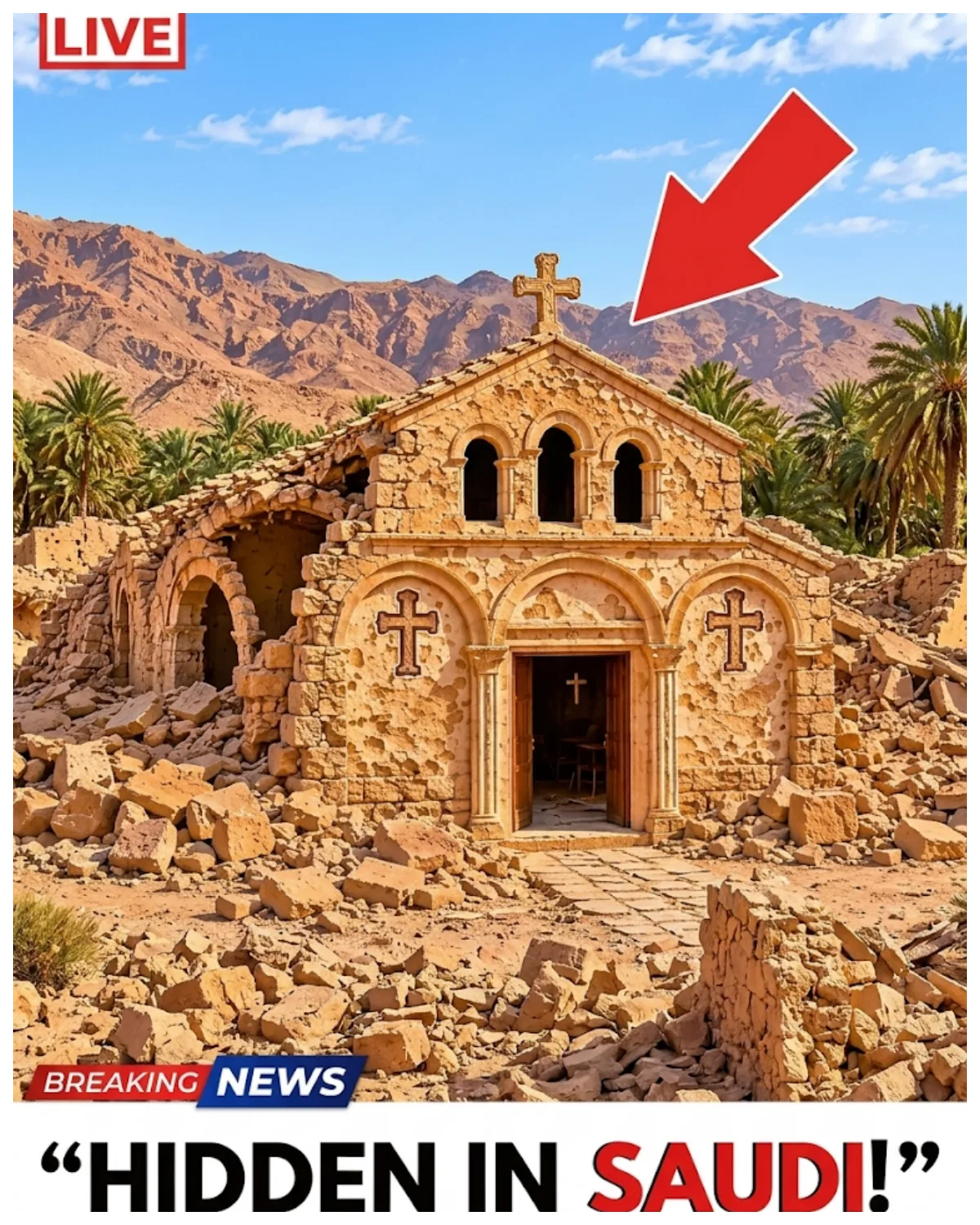
An Assyrian church from the 4th century.
For centuries, the Arabian Peninsula has been associated with the rise of Islam, the [music] ancient trade routes that crossed its deserts, and the sacred cities that shaped the history of the Middle East.
But what if this familiar picture leaves out an extraordinary chapter of the past?
What if the land we now recognize as Saudi Arabia once contained Christian communities whose faith, traditions, and places of worship existed long before Islam emerged.
Imagine standing in the vast Arabian landscape, surrounded by dry earth and endless horizons, knowing that beneath this seemingly silent environment lie traces of a world that has almost disappeared from popular memory.
These are not merely stories preserved in ancient [music] manuscripts.
One discovery in particular has attracted attention because it challenges the assumption that Christianity was largely absent from the Arabian Peninsula before the 7th century.
Its story reaches back to a period when merchants crossed [music] the Gulf.
Christianity spread through trade networks and communities developed connections with distant religious centers.
But how did Christianity reach this part of Arabia?
Who built this ancient place of worship?
And what can its surviving remains tell us about the people who lived there before the rise of Islam?
Before we uncover this remarkable chapter of history, please subscribe to Prophecy and Stone and turn on notifications for more fascinating discoveries connecting archaeology, biblical history, and the ancient world.
To understand the significance of this discovery, we must first look beyond the modern borders and religious identities of the Arabian Peninsula.
Long before the emergence of Islam in the 7th century, Arabia was connected to a much larger network of civilizations.
Merchants traveled between the Mediterranean world, [music] Mesopotamia, Persia, and the Indian Ocean, carrying spices, textiles, pearls, and other valuable goods.
Along these routes, people exchanged not only products but also languages, ideas, religious beliefs, [music] and cultural traditions.
Christianity had already spread far beyond the Roman Empire.
Christian communities existed [music] in parts of Persia and Mesopotamia, while churches and monasteries appeared across regions connected to the Arabian Gulf.
The Gulf itself provided a natural corridor for these connections.
Coastal settlements depended on fishing, pearl diving, maritime trade, and relationships with neighboring territories.
Through these networks, Christian teachings could reach communities living far from the major cities of the Mediterranean.
Historical evidence also points to Christian communities in different parts of Arabia before Islam.
The precise character of these communities varied by location, and not every settlement followed the same religious traditions.
This is important because the history of Arabia was never as isolated as its deserts might suggest.
The peninsula was a crossroads where different cultures met, traded, and influenced one another.
Among the most intriguing archaeological sites associated [music] with early Christianity in Eastern Arabia is the ancient structure commonly known as the Jubel Church.
Located near Jubel in Saudi Arabia’s eastern province, the site is generally dated to approximately the 4th century CE.
Although its precise chronology and interpretation depend on archaeological evidence.
If this dating is correct, the building existed roughly three centuries before the rise of Islam [music] in the 7th century.
That historical distance is remarkable.
The church belongs to a period when Christianity was developing across the Near East and [music] different Christian communities maintained connections with religious centers throughout the region.
Yet, the survival of a Christian building in modern Saudi Arabia can surprise people who are unfamiliar with the peninsula’s religious diversity before Islam.
The site’s discovery brought renewed attention to this overlooked history.
Its remains [music] provided physical evidence that a Christian community had established a place of worship in Eastern Arabia during late antiquity.
However, an important distinction must be made.
The building is not evidence that Christianity once dominated [music] the entire Arabian Peninsula.
Nor does it establish that every nearby settlement was Christian.
Instead, it offers a valuable glimpse [music] into the presence of Christianity in a particular region during a particular historical period.
Archaeology becomes most powerful when we allow the evidence to reveal what it can demonstrate without forcing it to answer questions beyond its limits.
One of the greatest mysteries surrounding the Jubel church concerns the people who built and used it.
They lived during a time when Christianity was spreading through several interconnected regions, [music] including Mesopotamia and Persia.
The Gulf Coast linked [music] these territories through maritime trade, making the movement of merchants, religious ideas, [music] and cultural practices possible.
Some Christian communities in the broader region were associated with traditions that developed outside the Roman Empire.
Their religious lives were shaped by the political and cultural environments in which they lived, and their connections extended across territories that are now divided among several modern countries.
The Christians of Eastern Arabia would have inhabited a landscape very different from the one we see today.
Coastal settlements supported livelihoods connected to the sea, while trade linked local communities to distant markets.
It is reasonable to recognize these connections as part of the historical environment surrounding the church.
However, the identities of its builders, their languages, and their precise denominational affiliations cannot all be established with certainty from the surviving structure alone.
Their story reminds us that religious history rarely follows the simple boundaries drawn on modern maps.
The chronological significance of the Jubel church is central to its importance.
Islam emerged in the 7th century CE beginning with the prophetic ministry of Muhammad in western Arabia.
The Jubel church commonly dated several centuries earlier belongs to a period when Christianity was already present in parts of the peninsula.
This does not mean that the building contradicts the history of Islam.
Rather, it demonstrates that the religious landscape of Arabia before the 7th century was more diverse than many people realize.
Different communities followed different beliefs and their histories sometimes overlapped through trade, migration, and political relationships.
Recognizing this earlier Christian presence adds depth to our understanding of the region.
It allows us to see Arabia not simply as the setting for one major religious transformation, but as a place with a longer and more complex history of cultural and spiritual exchange.
For students of biblical history, the discovery also provides a reminder that the world surrounding the biblical narrative continued to develop long after the events [music] described in scripture.
The early Christian movement expanded into new territories, encountered different cultures, and established communities far beyond the places where Jesus and [music] his earliest disciples lived.
Today, the remains of the Jubel church stand as a powerful reminder that the history of Arabia stretches far beyond the chapters most people know.
Long before Islam emerged, Christian communities existed in parts of the Arabian Peninsula, connected to the wider Neareastern world through trade, travel, and shared religious traditions.
[music] The church does not reveal every detail of their lives, but it preserves something invaluable.
Physical evidence that their story was real.
And perhaps that is the most fascinating lesson of all.
History is not always waiting in famous monuments or carefully preserved manuscripts.
Sometimes its most revealing evidence survives in the remains of an ordinary building that has endured for centuries.
[music] The Arabian desert may appear silent, but its archaeological record continues to challenge assumptions and uncover forgotten connections between civilizations.
What other traces of ancient religious communities remain undiscovered across [music] this vast landscape?
What might future excavations reveal about the people who lived, worshiped, and traveled through Arabia before the world entered a new historical age?
Only further research can answer those questions.
Thank you for watching Prophecy and Stone, and we see you in the next video.