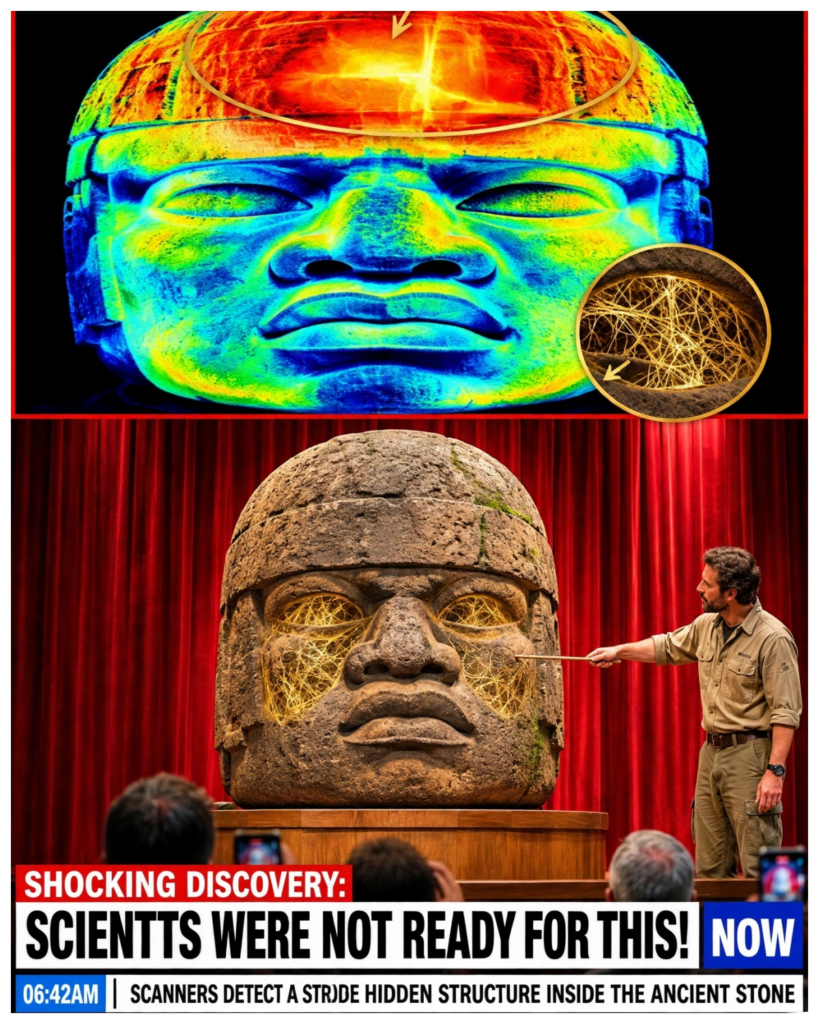
Everything we thought we knew about the neck heads just changed overnight.
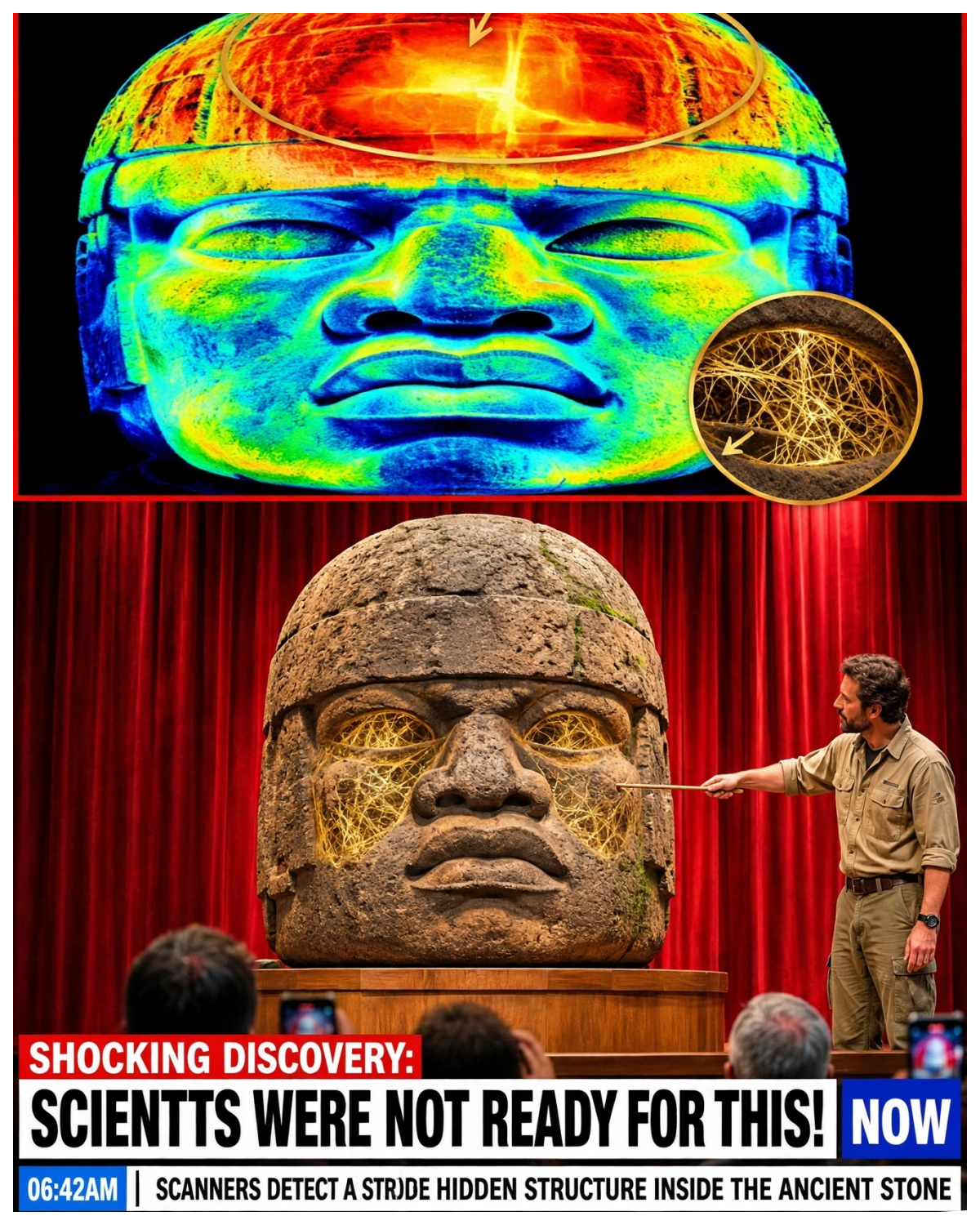
For decades, archaeologists have told us one simple story.
These stone giants, some weighing 20 to 25 tons, and the largest reaching a staggering 50 tons, were carved with stone hammers and grit.
No metal tools, no machines, no hidden secrets, just muscle, sand, and endless patience.
These huge carved human heads which can be on a scale of up to 20 to 25 tons in weight and which have curious features.
And honestly, that story made sense.
It made perfect sense until now because a new scan using high-tech imaging has just looked inside the rock for the very first time and it found something that was never supposed to be there.
We are talking about geometric voids, magnetic anomalies, and a level of precision that rivals modern machines.
This is no longer just a story about ancient art.
The data suggests these stones were engineered for a function we are only just beginning to understand.
Not decorated, not carved for show, engineered.
So before this video ends, you are going to see a sealed tube hidden deep inside solid basaltt, a perfect circular socket at the base of a head, a magnetic spot sitting exactly where a third eye would be, and a spiral so faint that no human eye could see it for 3,000 years.
And right at the end, I will show you the one discovery that experts found the most disturbing of all because it changes what these faces actually mean.
If you stay until then, you will never look at a stone head the same way again.
And if this is the kind of history that was never taught in school, tap that like button and subscribe right now so this video stays in your feed because the data only gets stranger from here and you will want to be able to come back to it.
And I want you to hold on to one question while we go through this.
If a culture with nothing but stone hammers and sand could do all of this, then who exactly were these people?
Because every answer the scan gives us only opens a bigger question.
And by the time we reach the end, that question will be impossible to ignore.
Here is what makes this different from every other ancient mystery you have seen online.
This did not come from a rumor.
It did not come from a blurry photo or a wild theory on a forum.
It came from data, scanners, lasers, and software that had no opinion and no agenda.
The machines simply measured the stone.
And the stone did not match the story.
But to understand how we got here, we have to start where the discovery started.
Because it began with the simplest, most innocent goal you can imagine.
The mission was never about finding secrets.
It was about saving history.
Researchers wanted to preserve the Mech Heads before acid rain and time erased them forever.
These monuments have stood in the open for thousands of years, and they are slowly dissolving.
So the team brought in portable scanners, laser mappers, and density modeling software to create a digital backup of the ancient stone.
The plan was simple.
Just get a surface map, nothing more.
Scan the outside, save the data, and go home.
And that is what makes the next part so hard to believe.
These researchers were not hunting for a sensation.
They were not chasing a headline.
They were doing the quiet, careful work of documentation.
And they ended up staring at a result that nobody had planned for.
But here is where things went off the rails.
The AI software used to process all that data was trained to do one specific job.
Spot cracks and natural faults in the basalt.
Routine work.
A machine hunting for damage.
Nothing else.
The most striking legacy of the Olme civilization must be the colossal stone heads they produced.
Instead, it flagged a shape that looked way too organized to be natural.
Deep inside the center of one of the heads, the density of the rock drops.
Now, basalt is volcanic, and volcanic rock can contain air bubbles.
So, at first, that sounds harmless.
A pocket of air in a rock, who cares?
But this was not a bubble.
The scan showed a linear tube-like void running vertically near the center of the head.
And here is the thing about nature.
Nature does not make straight lines inside volcanic rock.
Bubbles are round, messy, random.
This was neither.
This looked like a drilled shaft or perhaps a core that had been removed.
And now comes the crazy part.
There is no opening on the outside.
None.
Not a crack, not a hole, not a seam.
Whatever this void is, it is completely sealed within feet of solid heavy rock.
Think about what that means.
Someone created a hollow space in the heart of a massive stone and then left no way in, no way to reach it, no way to see it.
It was meant to be hidden.
Ask yourself why.
Why take the enormous risk of working inside a boulder this size only to seal everything in and hide the work from the world?
A builder who wanted to show off a skill would leave it visible.
A builder who wanted to store something would leave a door.
This has neither.
Which means whatever this void was for, it had nothing to do with being seen.
By now, you may already be forming a theory of your own.
Keep it in mind.
I would genuinely like to see how many of you end up landing on the same one.
This finding completely messes with the timeline.
To create a hollow space inside a 50tonon boulder without cracking it, you need a deep understanding of stress distribution.
And we thought that kind of knowledge was impossible for that era.
The Olme supposedly had no metal drills, no diamond tips, no laser guides.
Yet, the data shows a feature that implies internal engineering.
If this void was intentional, it changes everything about how these heads were made.
It suggests the stone was not simply picked up and carved.
It was selected, prepped, and possibly modified for a specific reason before a single chisel ever touched the surface.
That is putting it lightly.
The implications here are huge because if there is a hollow chamber inside, one question becomes unavoidable.
What is in there?
And what was it for?
To feel how difficult this is, imagine trying to hollow out the inside of a block of hard volcanic stone using nothing but hand tools.
Every strike sends force through the rock.
Every weak point is a place where the stone can split.
The bigger the block, the more dangerous it becomes because the stress has nowhere to go.
A single misjudgment and a monument that took enormous effort to move is ruined forever.
Whoever created this void did not just get lucky.
They understood the stone.
Some theorists believe it could be a resonance chamber.
Sound plays a huge trick in ancient architecture, and ancient builders seem to have known it.
If you clap in front of an Egyptian pyramid, nothing happens because the sound goes away.
But here, the sound comes back.
Why does it sound like a bird?
Don’t ask me that because we don’t know.
We see the same effect in the Mayan pyramids where a clap sounds like a bird.
Now bring basult into the picture.
Strike it and it rings like a bell.
A hollow core would completely change the acoustic properties of the head.
And that means these may not have been statues made to look at.
They might have been instruments designed to vibrate or hum during rituals.
Picture it, a massive stone face standing in front of a crowd, humming from the inside.
Keep that image in your head because the next thing the scanners found is the kind of detail that no archaeologist expected and no textbook has an answer for.
But the scan was not finished with its surprises.
Near the jawline, the computer flagged a series of microabbrasions, tiny parallel scratches completely invisible to the naked eye.
In modern times, you only see marks like this when someone uses a high-speed grinding wheel.
It implies a tool with consistent rapid rotation.
But the neck were only supposed to have stone hammers and sand.
And you simply cannot get that kind of consistency by rubbing sand with a stick.
Every scratch is parallel.
Every line is controlled.
It suggests they had a tool or a technique that we have completely missed in the archaeological record.
Let that sink in.
These are marks smaller than anything a person would notice by looking at the surface.
And they line up in a pattern that only a machine-like motion should produce.
If that is real, then somewhere in the mech world, there was a method of working stone that left behind no tools, no workshop, and no record.
And if that technique existed, the question becomes where it went.
The experts are baffled, and you can see why.
The sheer effort required to hollow out or modify the core of a rock this hard is astronomical.
Basalt is unforgiving.
One wrong hit and the whole block shatters.
To pull this off, you need more than patience.
You need a plan.
You need a blueprint.
And most of all, you need a technology that lets you penetrate the stone without destroying the surface.
The scan results are still being debated, but one thing is certain.
The inside of the head is telling a very different story than the outside.
So, the scan found a hole where there should be solid rock.
Strange, yes.
But what the researchers found on the surface was even stranger.
Because when the AI started doing the math on these faces, it found something that no one expected to see on a 3,000-year-old statue.
It is not just about what is hiding inside.
The outside of the heads is just as confusing when you look at the math.
When the AI analyzed the facial features of the San Lorenzo head, it ran a bilateral symmetry test.
Basically, it folded the face in half digitally to see whether the left side matched the right.
In most handcarved art, even by true masters, there are tiny differences.
A human hand is not a machine.
Somewhere, always, one eye sits a little differently from the other, but the mech head came back with a match rate that was spooky.
The distance from the center of the nose to the pupil of the left eye was identical to the right eye down to a fraction of a millimeter.
The curve of the lips followed a perfect geometric arc.
Stop and think about how unusual that is.
When two sides of a human face are carved by hand, the differences are what make it look alive.
Here, the differences almost disappear.
It is the kind of result you would expect from a measuring system, not from a person with a hammer.
Let that sink in.
This kind of precision is incredibly hard to pull off with freehand carving, especially on a curved surface.
Even today, you would usually need calipers, grid systems, and constant measuring to get this close.
And remember, these carvers were working with stone tools on stone.
They could not just erase a mistake.
If they chipped off too much on the left, the whole face would be ruined.
Months of work gone in a single strike.
Think about the pressure of that.
Every cut had to be right because there was no second chance.
A sculptor working in clay can fix a mistake.
A sculptor working in basaltt cannot.
And yet the symmetry test shows a face that is almost impossibly even.
So here’s the deal.
This level of perfection implies they were not just eyeballing it.
They likely had a template or a projection system.
Some wilder theories suggest they might have used shadow projection using the sun to cast a perfect grid onto the stone to guide every cut.
And that connects to a bigger idea that these people were master mathematicians.
The Maya used a very complicated system of calendars.
They used some 20 calendars altogether.
There were three primary calendars that were critically important to them.
We know later cultures like the Maya were obsessed with numbers and calendars, but it now looks like the Olme may have been the ones who wrote the textbook.
And it goes deeper than one head.
Then there is the issue of the standard.
When the team compared the dimensions of the facial features across different heads found miles apart, they found ratios that repeated.
The width of the nose compared to the width of the mouth followed a specific constant again and again.
Different heads, different locations, same rule.
It is like they were following a standardized manufacturing code.
This was not just art.
It was branding.
A consistent visual language that had to be exact.
Think about how hard that is.
Heads found miles apart, carved in different places, and still following the same proportional rule.
For that to happen, the carvers needed to share a method.
Not just a style, a method.
That is the signature of a trained, organized tradition with standards, not a few artists working alone.
But the most mind-bending detail is still ahead.
The socket anomaly on one of the heads buried near the base where it would have sat in the ground.
The laser mapping found a perfectly circular depression.
It looks like a plug or a socket.
It is far too smooth to be a natural chip.
It suggests something was meant to fit in there.
Maybe a pole to rotate the head or maybe an anchor point for something else.
If these heads were anchored, it means they might have been movable.
Imagine a 50tonon head that could rotate to face the sun or the moon.
And the socket is located at the center of gravity.
When you balance a heavy object perfectly, you can move it with very little force.
If the mech understood fulcrums and balance points this well, they could have made these massive stones turn.
Now picture yourself standing there 3,000 years ago watching a giant stone face slowly turn toward you.
It would have terrified anyone who saw it.
It would look like the stone was alive.
Now ask yourself what a priest, a king, or an ordinary villager would have felt standing in front of that.
This was not a monument sitting quietly in a field.
If the socket means what it appears to mean, this was a monument that could move.
And that is a very different thing to build and a very different thing to believe in.
This mechanical precision does not fit the primitive label we slap on them.
You do not accidentally make a 50tonon rock perfectly symmetrical and mechanically balanced.
This was highlevel engineering disguised as art.
They knew exactly what they were doing and they had the tools to execute it without error.
It makes you wonder if these heads were ever just statues at all or were they parts of a larger machine or an alignment system and we have lost all the other pieces.
The faces were perfect, but what the scanners found embedded in the stone points to a function that goes far beyond simple carving.
And this is where the data stops being strange and starts being unsettling.
Things get really weird when we start looking at the mineral composition.
The team used a scanner that detects elemental signatures.
Basically, it sniffs out what the rock is made of.
They expected pure basaltt.
That is what every geologist would expect.
A heavy block of volcanic rock, the same all the way through.
Nothing special, nothing surprising.
Instead, on one specific head, they found a high concentration of magnetite and hematite focused right in the forehead area.
These are magnetic minerals.
And the weird thing is they were not distributed evenly.
They were clustered in a polished band across the brow.
Now you could say maybe the rock just had a patch of iron in it.
Fair enough.
But think about the odds.
The chances of a carver accidentally placing the only magnetic spot in the entire boulder exactly on the forehead, the third eye spot, are millions to one.
It looks deliberate.
And remember, the carver would have needed to find that spot, mark it, and polish it into a band, all while shaping the face around it.
That is not an accident that happens while you are chipping away at a rock.
That is a decision.
Some researchers think the mech might have used load stones, naturally magnetized rocks, to locate specific anomalies in the stone before they carved it.
Often at the temple, on either side or one side of them, you have a magnetic fluctuation.
And so they were working with magnetism.
We know that for sure.
Or they inlaid magnetic material into the surface.
Either way, the consequence is the same.
If the head is magnetic, it interacts with the Earth’s magnetic field.
And that brings us to the navigation theory.
We know the heads are often aligned to magnetic north.
If the head itself acts like a giant compass needle, it could have served as a geodetic marker.
Imagine these heads acting like pins on a map with invisible forces snapping them into alignment with the planet’s energy grid.
It sounds like science fiction, but birds use magnetism to migrate.
And we know ancient cultures were obsessed with direction.
So if the magnetism was real and deliberate, then every head may have been more than a portrait.
It may have been a marker, a single point on a much bigger map that we are only now beginning to see.
Now, let’s push the theory even further.
What if the magnetism was not about navigation at all?
What if it was about experience?
If you are in a trance state, which was common in Mesoamerican rituals, strong magnetic fields can actually mess with your brain’s temporal loes.
It is called the God helmet effect in modern neuroscience.
So, if a priest stood right in front of that magnetic forehead during a ceremony, they might have hallucinated or felt a presence in the room.
The stone would literally alter their mind.
Think about that for a moment.
A ritual where the statue itself does part of the work, where the stone prepares the mind of the person standing in front of it.
That is not decoration.
That is design.
And it gets crazier.
The scan showed that the grain of the stone in that magnetic area was compressed.
This suggests heavy polishing or friction.
They wanted that spot to be active.
It is almost like a touch point.
Did they touch the forehead to download wisdom?
That changes the head from a statue into an interface.
You engage with it and it does something back to you.
Now, about that spiral I promised you found on the back of the head.
The laser scan found a groove less than a millimeter deep spiraling out five times.
You cannot see it with your eyes because of the weathering, but the laser saw it.
Spirals are classic symbols for energy or water.
But hiding it on the back where no one will ever see it, that is for the object, not the viewer.
It is like a manufacturer’s mark or a circuit trace.
Now, put it all together.
The internal void, the acoustic properties, and this magnetic anomaly.
When you combine them, you are looking at a device.
A device made of stone, powered by the Earth, and tuned to human consciousness.
It is a wild thought, but the data is forcing us to look at these things differently.
We are finding features that have no aesthetic purpose.
They only make sense if they had a functional purpose.
And if you are still with me, you have probably noticed something.
Every new discovery has not weakened the last one.
It has strengthened it.
The void supports the acoustics.
The acoustics support the magnetism.
The magnetism supports the idea of a ritual.
Each piece leans on the next, and the picture keeps getting clearer and stranger.
They might have been magnetic markers, but the evidence suggests something even stranger.
These stones were not new when they became heads.
They had been used before.
And that leads us to the most disturbing part of this entire investigation.
Remember when I said there was one discovery experts found more disturbing than all the rest?
This is it.
And it starts with a simple observation that changes the whole story.
Here is a fact that most textbooks gloss over.
Many of these heads show signs of being something else before they were heads.
The AI analysis of the surface curvature found flat spots that do not fit the round shape of a head.
These flat spots look suspiciously like the sides of a throne or a large rectangular altar.
But as we will see as we move through the mech world, there are many more of these with much more detail.
And these clearly show individuals.
They are not just representations of gods or anything like that.
The actual individual rulers from this part of the world.
The theory is that the ch took massive stone thrones used by their rulers and carved them down into heads.
This is huge because it implies a violent transfer of power.
Imagine a king dies or gets overthrown.
You take his throne, the symbol of his power, and you carve his face into it.
You literally turn his seat of power into a memorial or a prison.
Think about the message that sends.
You do not erase a ruler by destroying his statue.
You do something far more powerful.
You take the very thing that made him king and you turn it into a permanent reminder that he is gone.
The scan shows tool marks that cross over each other.
Older cuts underneath newer cuts.
It confirms the stone was worked on in two completely different time periods.
But the AI found something even more disturbing.
On one head, the facial features, the nose and lips, appear to be flattened, almost pushed in.
For years, archaeologists thought this was just erosion.
The scan says otherwise.
The erosion pattern is uniform on the back but chaotic on the face and that means someone deliberately smashed the face.
They tried to blind the statue and silence its mouth.
In their worldview, the soul of the ruler might have been trapped in the stone.
By smashing the face, they were deactivating the power.
It supports the idea that these were functional ritual objects, not just art.
If you leave the machine on, it might hurt you.
So, you break the interface.
This recycling theory also explains why the heads are so big but truncated at the neck.
They were limited by the size of the original throne.
They had to fit the face into the block they had.
And that makes the engineering even more impressive.
They were not working with a fresh canvas.
They were working with a used block navigating around old cuts and corners and still managed to produce a perfectly symmetrical face.
So, let’s step back and look at everything the scan has shown us.
Because when you see it all in one place, the pattern becomes very hard to deny.
A sealed tube-like void running through solid basaltt with no opening on the outside.
Microscopic parallel scratches that point to a tool we have never found.
Facial symmetry accurate to a fraction of a millimeter.
Ratios that repeat across heads found miles apart.
A perfectly circular socket sitting at the center of gravity.
A band of magnetic minerals placed exactly on the forehead.
A spiral groove less than a millimeter deep hidden on the back.
And faces that were deliberately smashed long after they were carved.
Any one of these could be explained away.
A bubble, a coincidence, a patch of iron, erosion.
But all of them in the same stones built by a culture that supposedly had nothing but hammers and sand.
And that is the question that will not go away.
Not whether one of these features is strange, but whether the odds of all of them landing in the same stones are anything close to reasonable.
A hidden void, a spiral nobody could see, a magnetic band on the brow, a socket at the balance point.
Each of them points to planning.
Together, they point to a purpose.
Maybe the answer is simpler than it looks, and future scans will explain every one of these features.
The scan results are still being debated and good researchers should keep asking hard questions.
But right now, the data is on the table and it says something the old story cannot.
These heads were not just carved, they were designed.
So, what do you think?
Are these internal voids and magnetic spots just accidents of geology?
Or have we stumbled upon a lost technology that the Olme used to engineer their reality?
It seems too precise to be random.
Remember the question I asked at the start.
If a culture with only hammers and sand could do all of this, who were these people?
After everything the scan has shown us, maybe the better question is this.
What did they know that we have forgotten?
Because the old story says these were simple carvings made by simple tools for simple reasons.
The new data says something very different.
It says planning, mathematics, engineering, and purpose.
All hidden inside stone that has been sitting in plain sight for 3,000 years.
I would love to see which of these discoveries made you stop and rethink everything, and what you believe was hiding inside that stone.
Your theory might be closer than anything the experts have said so far.
So, say it below and let others weigh in.
And if this video made you question the story we were told, like it and subscribe because there is far more buried in history than anyone has admitted.
We are just scratching the surface.