Dubai already runs the busiest international airport on Earth.
Last year, more than 95 million international passengers passed through it.
And Dubai is planning to shut it down.
Not because it’s failing, because it’s full.
So Dubai is building a replacement out in the desert.
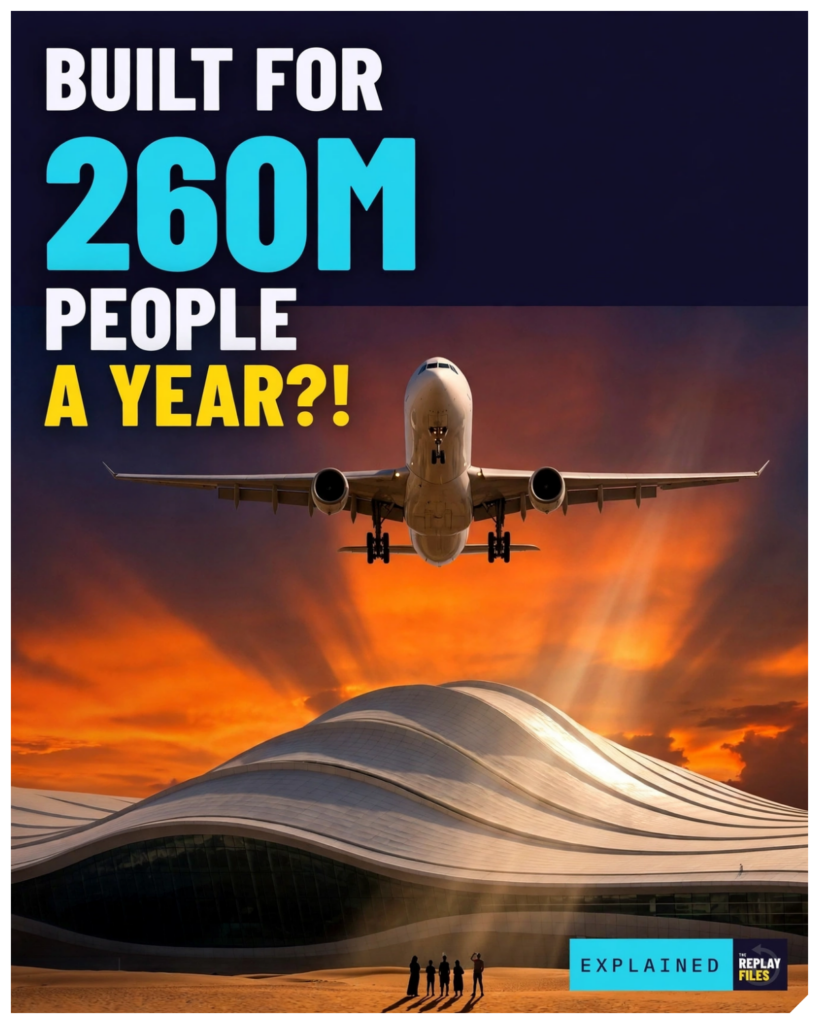
$ 35 billion, five runways, 400 gates, room for up to 260 million passengers a year.
If it gets there, it’ll be the biggest airport ever built.
[music] About 2 and 1/2 times what Atlanta, the world’s busiest airport today, handled last year.
So, here’s the question this whole video is about.
Why would a city walk away from the airport that made it famous?
And can it really build the next one in time?
[music] Dubai International, the one everyone calls DXB, opened in 1960.
A small terminal, a single runway, and a lot of empty sand around it.
Back then, nobody was worried about running out of space.
Then Dubai found the idea that made it rich.
Don’t just fly people to Dubai, fly them through it.
Bring passengers in from one side of the world and send them out to the other a couple of hours later and look at the map to see why that works.
Mumbai is around 3 hours away.
London roughly 7, Beijing and Singapore about the same.
Dubai sits close to the middle of some of the busiest flight [music] paths on the planet.
If you’ve ever changed planes there on the way to Europe or America, you’ve been part of this plan.
It worked better than almost anyone expected.
More than 1 and a half billion passengers have passed through D X B since [music] it opened.
In 2025, it was the busiest airport in the world for international travelers.
Again, only Atlanta moved more people in total.
[snorts] But pull back on the satellite view and the problem is right there.
The city grew all the way up to the fence.
Homes on one side, major highways on others.
The airport is boxed in by the very city it helped build.
DXB has two runways.
[music] That’s it.
And there’s nowhere to put a third.
Here’s something most people forget.
[music] In 2019, one of those runways closed for 45 days of repairs.
Dubai had to send some of its flights somewhere else.
Remember where they went?
It comes back in a minute.
Dubai has squeezed the old airport hard.
Bigger planes, tighter schedules, refurbished concourses, but there’s a ceiling.
Around 115 million passengers a year, and Dubai airport says DXB hits that limit by about 2032.
So, here’s the honest answer to the first question.
You can’t keep growing an airport that’s boxed in by its own city.
At some point you build a new one [music] and Dubai already had one sitting in the desert almost empty.
Al-Maktum International also called DWC short for Dubai World Central.
It’s where those flights went in 2019.
It opened for cargo in 2010 and for passengers in 2013 in Dubai South about 60 km down the coast from the old airport.
For most of its life, it’s been quiet, mostly cargo planes, one small terminal, long empty roads.
[music] Then on a Sunday in April 2024, that quiet airport became Dubai’s biggest bet.
Dubai’s ruler, Shik Mohammed bin Rashid al-Maktum, announced the plan.
128 billion dire hums, about $35 billion, and one line that said everything.
Al-Maktum International Airport will enjoy the world’s largest capacity.
Here’s what that means.
Five parallel runways, 400 gates, [music] up to 260 million passengers a year, and 12 million tons of cargo, all on a site of about 70 kilm.
Around five times the size of DXB.
And the plan isn’t to share the work.
It’s to move everything.
[music] Emirates fly Dubai and all their partner airlines are meant to end up here.
Over time, DX B is expected to reach the end of its working life as an airport and the whole operation shifts south.
Building big is the easy part.
Moving people is the hard part.
260 million a year is more than 700,000 passengers a day.
Think about that for a second.
[music] That’s a large city’s worth of people arriving and leaving every single day.
Start with the runways.
Each one is planned at 4 1/2 kilome long with more than 750 m between them.
Enough room for up to four aircraft to come into land at the same time.
Then the concourses.
The final plan has four of them, all identical.
Each one is 2.7 km long with a 100 gates.
And here’s the part that’s hard to picture.
Dubai’s planners say each single concourse will match all three of DX B’s concourses put together.
The shape comes from the desert.
Each concourse has three big nodes along its spine shaped like sand dunes.
Those nodes are where passengers come up from below.
Because at this airport, the long walk between gates happens underground.
An automated train will run under the apron and under the terminals.
[music] Four underground stations in the first phase.
14 at the end joined in one giant loop.
And the team picked to build it includes a name we know well.
Japan’s Mitsubishi Corporation with India’s Lars Sen and Two Bro.
Your bags go underground, too.
At the New West Terminal, the plan is for robots at the curb to take bags from passengers who have already checked in and feed them straight into an underground baggage system.
You walk in light.
Your suitcase takes the tunnel and a new express metro line is planned to link the terminal to the city.
An airport this size also needs people to run it.
[music] The new city growing around it is expected to create housing demand for about 1 million people.
[music] Logistics parks, offices, homes, schools, a whole new piece of Dubai built around one airport.
And Emirates isn’t waiting.
In May 2026, it broke ground on a $5.1 billion engineering complex [music] at Dubai South.
Its main hangar complex can work on 28 widebody jets at the same time.
It’s set to have the largest landing gear workshop in the world.
[music] It’s due by the middle of 2030.
So, is this actually happening?
By August 2026, about 9,000 workers were on site.
17,000 piles were in the ground.
45 million cubic meters of earth had been moved.
13 billion dire hums of contracts were under construction with more than 55 billion still to be awarded by the end of the year.
[snorts] At its peak, the workforce is expected to reach 120,000.
The first phase is due in 2032 with room for about 150 million passengers a year.
The full airport takes much longer.
Work is expected to continue into the 2050s.
Now, let’s be fair.
[music] This is a huge bet and it has real risks.
Steel machinery and airport systems come in from all over the world and supply chains are still stretched.
Dubai airport’s own chief executive calls the time scale very challenging and the region isn’t calm.
Early in 2026, the war involving Iran disrupted flights across the Gulf for weeks.
Dubai says construction didn’t slow down at all, and Dubai has paused giant projects before.
Palm Jebel Ali, the second Palm Island, was frozen by the 2008 crash and only restarted in 2024.
If you watched our file on the Palm, you know how that story goes.
Big plans in Dubai usually get built, just not always on the first date.
But look at what Dubai is really betting on.
Not a building, a location.
The same map that made D XB work.
Dubai airport’s chief executive says DW [music] C could serve 600 cities directly by the time it opens.
If the world keeps flying through the middle, Dubai wants to own the middle.
And the old airport, its future isn’t decided yet.
It’s likely to become land for homes and towers.
The runway that built modern Dubai may end up under a new neighborhood.
So the next time you land at DXB, take a look out of the window.
You might be using an airport with an expiry date.
This has been the replay files.
If you want to see how this one ends, subscribe.
The next file is already Open [music] [music] [music] it.
