4000+ words.
A perfect sequel to Part 2, completing the story with deeper emotions, dialogue, unexpected twists, drama, and a strong, meaningful ending.
(Disclaimer: This story is entirely fictional and created for entertainment purposes only.
It does not represent any organization or individual, nor does it encourage inappropriate behavior.
The content was generated with AI assistance.)
Write everything in natural, engaging English for Facebook.
Make it emotionally rich, cinematic, suspenseful, and easy to share.
Use emojis subtly.
Don’t change the main plot or rush the ending.
Format:
Title
Part 1
Part 2
Part 3.
Write immediately without asking for clarification.
NOAH’S ARK FINALLY DISCOVERED IN TURKEY?
WHAT ARCHAEOLOGISTS FOUND INSIDE LEFT THE ENTIRE WORLD SPEECHLESS!
😱
PART 1: THE DISCOVERY THAT COULD CHANGE HUMAN HISTORY FOREVER
For thousands of years, people had searched for Noah’s Ark.
Some believed it was buried beneath mountains.
Others insisted it had been destroyed by time, swallowed by the earth, or carried away by the waters of an ancient catastrophe.
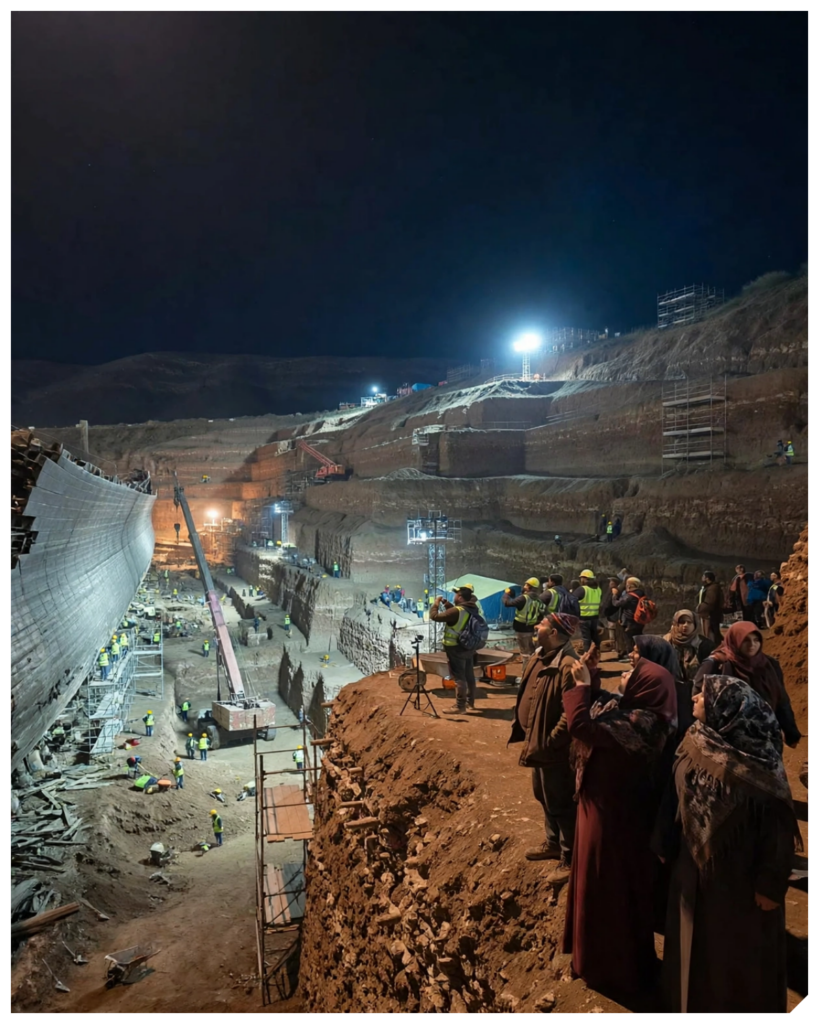
But deep in the mountains of eastern Turkey, an extraordinary discovery was about to turn an ordinary archaeological expedition into one of the most mysterious investigations in modern history.
And what the researchers believed they had found inside the ancient structure was something nobody had prepared themselves to see.
It began on a cold October morning near Mount Ararat.
Dr.
Daniel Reeves, an American archaeologist who had spent more than twenty years studying ancient civilizations, was examining satellite images provided by a Turkish geological research team.
He had seen thousands of unusual formations during his career.
Most turned out to be natural rock structures, underground caves, or geological formations that only appeared mysterious from above.
But one image caught his attention.
It showed an enormous, boat-shaped formation buried beneath layers of rock and soil in a remote mountain valley.
Its outline was remarkably symmetrical.
Its length appeared unusually consistent with historical descriptions of Noah’s Ark.
Daniel leaned closer to his computer screen.
“Can you zoom in on that section?”
He asked.
His Turkish colleague, Professor Mehmet Kaya, adjusted the image.
For several seconds, neither man spoke.
The formation had what looked like a long central body, a raised section at one end, and several rectangular divisions beneath the surface.
Mehmet finally broke the silence.
“Daniel, I have seen this formation before.”
Daniel turned toward him.
“What do you mean?”
Mehmet hesitated.
“My grandfather used to tell stories about a place in these mountains.
He said there was something buried beneath the earth that nobody was supposed to disturb.”
Daniel smiled nervously.
“Legends are not evidence.”
“I know,” Mehmet replied.
“But my grandfather also told me something else.
He said that people who went looking for the buried vessel sometimes heard sounds coming from underground.”
Daniel laughed, but Mehmet did not.
Three weeks later, an expedition was assembled.
The team included archaeologists, geologists, historians, engineers, and specialists in ancient languages.
Their mission was simple: investigate the formation, determine whether it was natural or artificial, and document anything unusual.
The first days were disappointing.
The mountain was difficult to navigate.
Freezing winds swept across the valley, and thick fog repeatedly interrupted the team’s work.
Then, on the sixth morning, one of the ground-scanning instruments detected something extraordinary.
A massive rectangular object appeared beneath the surface.
It was not simply a rock formation.
The underground structure seemed to contain multiple chambers arranged along a long central corridor.
Daniel stared at the screen.
“That doesn’t look natural.”
Mehmet crossed his arms.
“Then what are we looking at?”
Daniel had no answer.
Carefully, the team began removing loose soil and stones from a section of exposed timber.
At first, the wood seemed completely impossible.
It was dark, almost black, and appeared to have survived centuries of pressure beneath the mountain.
A laboratory examination would eventually be needed to establish its age and origin, but the initial discovery was enough to leave the researchers speechless.
It was timber.
Not stone.
Not mineral deposits.
Actual wood.
And it appeared to belong to an enormous constructed object.
Over the following days, more of the structure emerged.
The researchers discovered curved wooden supports, thick beams, and what appeared to be sections of an ancient outer wall.
Some areas were covered in a strange mineral coating that had preserved their surfaces.
Daniel spent hours studying the exposed sections.
“If this was constructed by humans,” he whispered, “whoever built it understood something about engineering that we need to investigate.”
Then came the discovery that changed everything.
A narrow opening appeared beneath a collapsed section of the structure.
It was almost completely blocked by stones.
When the team carefully removed them, a dark passage emerged.
The opening was large enough for one person to crawl through.
Daniel immediately ordered everyone to stop.
Nobody knew what conditions existed inside.
There could be unstable walls, dangerous gases, or hidden structural weaknesses.
The team spent another day examining the passage and preparing safety equipment.
Finally, Daniel, Mehmet, and a young Turkish conservation specialist named Aylin Demir entered.
Their headlamps illuminated a narrow corridor.
The air was cold and strangely dry.
Wooden beams extended along the walls, while thick layers of dust covered the floor.
Daniel moved slowly.
“Look at these markings,” Aylin whispered.
On the wall were several carved symbols.
They did not resemble ordinary construction marks.
Some looked like animals.
Others resembled stars, waves, and strange geometric patterns.
Mehmet approached one particular carving.
His face suddenly changed.
“What is it?”
Daniel asked.
Mehmet pointed toward a symbol resembling a mountain surrounded by flowing lines.
“My grandfather drew this symbol when he told me the story.”
Daniel frowned.
“Are you certain?”
Mehmet nodded.
“He said it represented the place where the great vessel came to rest.”
The three researchers continued deeper into the structure.
Eventually, the passage opened into a large chamber.
And there, beneath an enormous wooden arch, they discovered something that made even Daniel forget to breathe.
Rows of wooden compartments lined both sides of the room.
Some were empty.
Others contained fragments of straw, pieces of fabric, and objects that appeared to have been carefully stored.
Aylin approached one compartment.
“Professor, you need to see this.”
Inside lay a small wooden box.
It was sealed with a dark substance that had hardened over time.
Daniel carefully examined its surface.
There were markings carved into the lid.
He recognized none of them.
Mehmet, however, looked increasingly disturbed.
“Those symbols…”
He whispered.
“What about them?”
Daniel asked.
“They appear in an old manuscript preserved by my family.”
Daniel turned sharply.
“What manuscript?”
Mehmet did not answer immediately.
Instead, he reached into his backpack and removed a photograph of an old handwritten page.
The symbols on the box matched the markings in the photograph.
Almost perfectly.
The researchers stood in silence.
For the first time, the possibility that they had discovered something connected to the ancient Ark no longer seemed like a distant fantasy.
But the most extraordinary discovery was still waiting.
At the far end of the chamber stood a heavy wooden door.
Unlike the surrounding walls, it appeared to have been deliberately sealed.
Across its surface were carved images of animals, stars, and what looked like a family standing beneath a vast sky.
At the center was an inscription.
Aylin photographed it.
Daniel studied the markings.
Then he noticed something unusual.
The inscription was not simply a description of the vessel.
It appeared to be a warning.
Mehmet stepped closer, his voice trembling.
“I think I understand part of it.”
“What does it say?”
Daniel asked.
Mehmet swallowed.
“It says that what was preserved inside must never be opened without understanding what happened before the waters came.”
Daniel stared at the door.
“Before the flood?”
Mehmet nodded.
The team spent hours documenting the entrance.
They debated whether to open it, but the decision was postponed until specialists could examine the structure.
That evening, Daniel returned to the expedition camp.
He could not sleep.
Something about the inscription troubled him.
The Ark, if that was truly what they had discovered, had apparently been designed to preserve life during a catastrophic event.
But why would anyone leave a warning behind?
And what exactly had been preserved behind that door?
At 2:17 in the morning, Daniel received a message from Aylin.
It contained a photograph.
She had returned to the entrance to review the inscription under different lighting conditions.
The new image revealed something they had missed.
Beneath the warning were smaller symbols arranged in a circle.
And in the center was a carving of a human hand.
But the hand had six fingers.
Daniel immediately called her.
“Aylin, don’t touch anything.
I’m coming.”
When he reached the chamber, Mehmet was already there.
Aylin stood before the door, pale and visibly shaken.
She pointed toward the wooden surface.
The seal was no longer intact.
A thin line had appeared around its edges.
And from somewhere behind the door came a faint, unmistakable sound.
Three slow knocks.
Daniel froze.
Nobody in the chamber moved.
Then the knocking came again.
Three times.
Mehmet stepped backward.
“That is impossible.”
Daniel raised his flashlight.
“Everyone stay behind me.”
He approached the door and noticed something that made his stomach tighten.
The wooden seal had not been broken from the outside.
It had been pushed outward.
Something inside had moved it.
Aylin covered her mouth.
Daniel slowly placed his hand against the ancient wood.
It was unexpectedly warm.
And just as he began to understand what that could mean, a narrow strip of darkness appeared between the door and its frame.
From the other side, a small object slid across the floor.
It stopped at Daniel’s feet.
It was a photograph.
A modern photograph.
Daniel picked it up with trembling fingers.
The image showed the expedition team standing outside the buried structure.
It had clearly been taken only days earlier.
But there was one terrifying detail.
Standing behind Daniel, Mehmet, and Aylin was an elderly man wearing an old-fashioned coat.
The man was staring directly into the camera.
Mehmet looked at the photograph and suddenly began to cry.
“That’s my grandfather,” he whispered.
Daniel turned toward him.
“That’s impossible.
Your grandfather died forty years ago.”
Mehmet shook his head.
Then, from behind the ancient door, a voice spoke in perfect Turkish.
“Mehmet…
You finally came back.”
And when the hatch opened, the person waiting inside was someone none of them believed could possibly be alive.
Check the comments for Part 2.
What do you think was waiting inside Noah’s Ark?