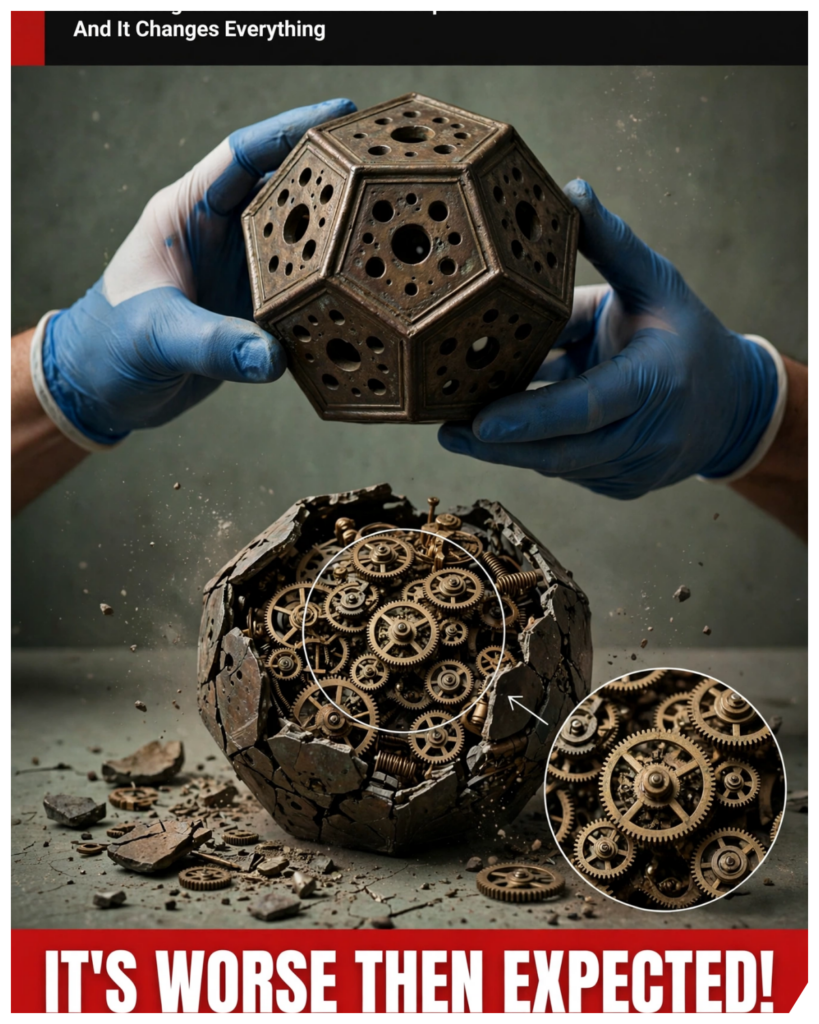
Historians theorize that Roman engineers may have fashioned dodicahedrons using a sophisticated molding process.
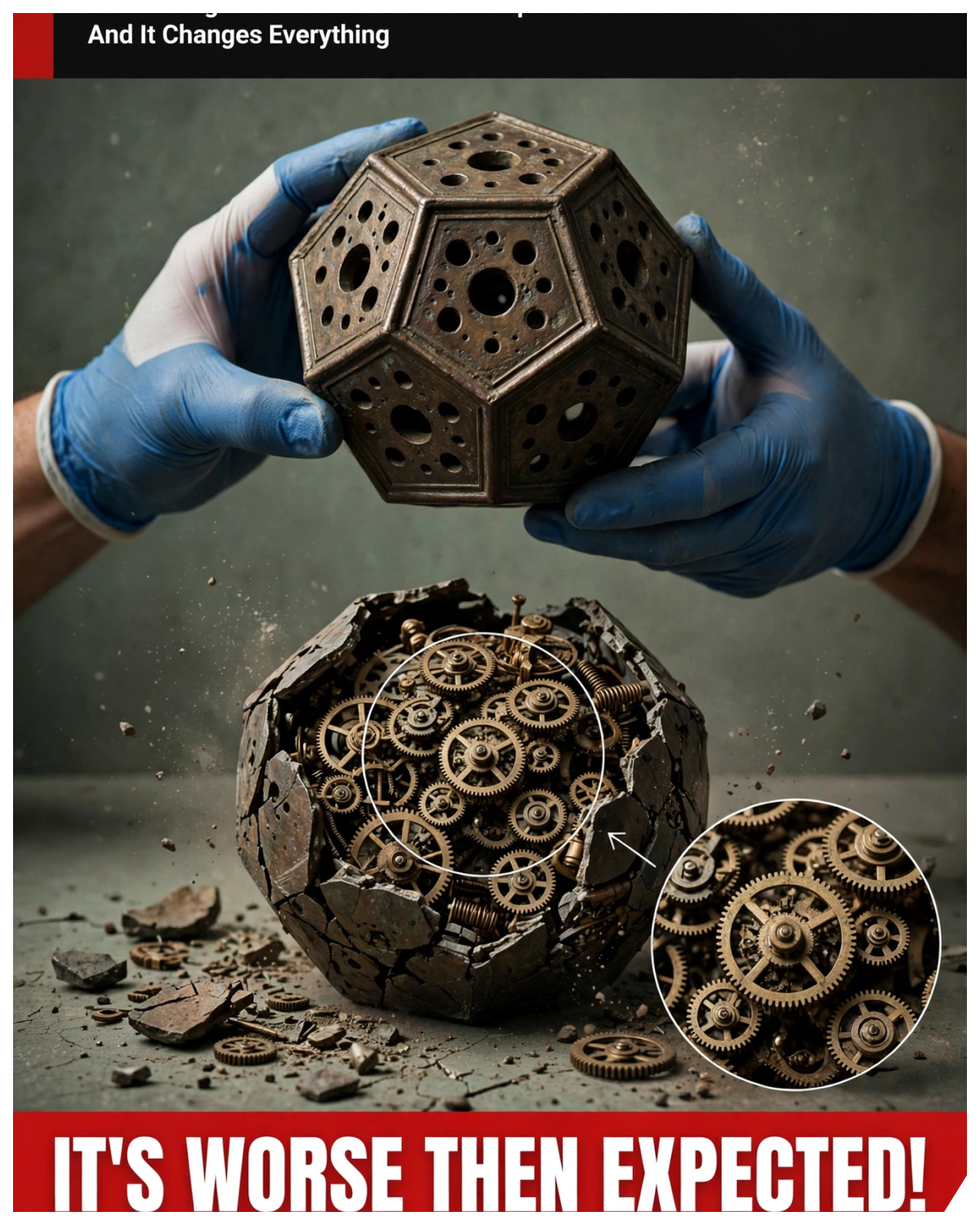
For nearly three centuries, objects like this one have been dug out of European soil, photographed, cataloged, and set behind museum glass.
Beside them sits a label that tells you very little.
A hollow bronze shell, 12 flat faces, a circular hole cut into everyone.
No two quite the same size.
20 small spheres, one at each corner, like studs on a crown.
Around 130 of them have now come out of the ground.
Not one of them comes with an instruction.
Not one has a maker’s name.
And in all the writing that survives from the Roman world, there is not a single sentence that says what they were for.
Every neat explanation has failed.
And lately, a far darker story has been spreading online.
It says a laboratory has finally looked inside one of these objects and found something that rewrites Roman history.
It says museums panicked.
It says an empire buried the truth and the modern world is still helping it stay buried.
Some of that story is built on real facts and those facts are strange enough to keep you awake.
Some of it, as far as anyone can show, has no source at all.
Tonight, we follow the object from the muddy trench where the most perfect example was found.
Through every theory that has crumbled, across a map that makes your skin crawl, and into the lab report that may or may not exist, we will keep the mystery.
We will not keep the lies.
Because before we ask what this thing was for, we have to understand why its silence is such a problem.
A record of silence.
Rome was a civilization that could not stop writing things down.
Think about how much survives.
Vituvius left a full architectural handbook covering everything from water supply to siege machines.
Plenty the Elder produced 37 books of a natural history, an encyclopedia stuffed with metals, medicines, tools, and tall tales.
Fontinas wrote about the aqueducts of Rome and how much water each one delivered.
Military papyrie record who was on guard duty, who was sick, who was owed boots at Vindolanda near Hadrien’s wall.
Wooden writing tablets preserved in wet soil include a soldier’s request for beer and an invitation to a birthday party.
Rome stamped its name on almost everything.
Roof tiles carry the stamp of the legion that fired them.
Lead water pipes are marked with the names of owners and officials.
Bronze military discharge certificates list the soldier and the emperor who granted it.
Even simple weights were often cast with their value and sometimes with the name of the magistrate who checked them.
Now bring in the docahedron.
It is not a crude lump.
To make one, a craftsman needed the lost wax method at a very high level.
He shaped the object in wax, wrapped it in clay, heated the mold until the wax ran out, then poured molten copper alloy into the void.
For a hollow 12-sided form with 20 tiny knobs, every one of those steps had to go right.
The alloy had to flow into each corner.
The clay core had to hold.
One failed pour, and all that bronze and labor was wasted.
The people who study these objects describe them as expensive and the evidence agrees.
Doctoral researcher Lorena Hitchens, who has been cataloging every known Roman docahedron in Europe, is one of the few people alive who has handled a large share of them.
They range from about 4 cm across to around 11.
They have been found from Wales and Eastern England, across Gaul and Germany to Hungary and Romania.
Most date from the 2nd to the 4th century.
Here is where the problem sharpens.
No two are identical.
They differ in size.
They differ in the diameters of the 12 holes.
And on none of them has anyone found a number, a measurement scale, an owner’s mark, or a workshop stamp.
Compare that with a different Roman object that the empire did document.
The Groma, the surveyor’s cross.
We know what it looked like from aerary monument at Iraa in northern [clears throat] Italy that shows a surveyor’s tools and from parts of one recovered at Pompei.
We have texts describing how surveyors laid out roads and towns with it.
There are even Roman 20sided dice made in Egypt with Greek letters carved on every face.
For the docahedron, there is nothing.
No relief, no mosaic, no tombstone, no papyrus, no complaint from a bureaucrat, no recipe from a physician, no joke from a poet.
That absence is real.
Researchers working on these objects repeat it constantly.
And the Norton Disney group itself calls them one of archaeologyy’s great enigmas for exactly this reason.
But here is the question that decides everything.
Is that silence a cover up?
Or is it simply what an object looks like when it belonged to people who did not write or whom Roman writers did not care to describe?
The answer begins in a field in Lincolnshire in a pit that nobody had touched for 17 centuries.
The pit on the hill.
Most Roman docahedra have an unglamorous origin story.
A metal detectorrist sweeps a field.
A plow turns up something green.
A farmer drops it into a shoe box.
By the time a museum hears about it, the soil that could have explained the object is long gone, and often the object itself is broken.
The Norton Disney docahedron was different.
In June 2023, a volunteer group, the Norton Disney History and Archaeology group opened four trenches in a farmer’s field near the village in Lincolnshshire.
A geoysical survey had flagged disturbed ground.
Detectorrists had already pulled Roman coins and brooches from the surface.
The group’s secretary, Richard Parker, was reportedly making a cup of tea when a shout went up from one of the trenches.
Trench four, a large pit, and lying in it complete and gleaming, a hollow copper alloy docahedron about 8 cm across, weighing roughly a quarter of a kilo.
Parker called it the find of a lifetime.
Then he said something that matters more than the excitement.
The object, he said, had been put there deliberately, 1700 years ago, for whatever reason.
Think about what that means.
Someone dug into the top of a hill or used an existing pit and left a whole bronze object inside.
It was not a scrap awaiting the furnace.
It was not a broken piece thrown away with the rubbish.
From its condition and from the dating of the site, it is thought to belong to the 3rd or fourth century.
The surrounding landscape adds weight.
A Roman villa near the site was excavated back in 1935.
The area has produced hundreds of pieces of Roman pottery from the second and third centuries along with earlier Iron Age material.
Skeletal remains from the villa suggest it was occupied in the late Roman period and later reused as a burial ground.
That detail will matter in a moment.
Now consider the economics.
Bronze was money in another form.
Roman metal workers recycled constantly melting damaged fittings, worn tools, and broken statues into new ones.
When archaeologists find a bronze object that has been abandoned whole, they ask why nobody wanted it back.
There are ordinary answers.
Hordes of coins and valuables were commonly buried in dangerous times by owners who meant to return and never did.
That happened across the empire, especially in the unstable 3rd century.
So, a hidden docahedron could simply be a hidden treasure.
But there is a second tradition and it points somewhere more interesting.
Romans and Britains alike gave metal to the earth and water as offerings.
At Coventina’s well beside Hadrien’s wall, excavators in the 19th century recovered thousands of coins along with brooches, pins, and carved stones all dropped into a sacred spring.
Rivers, wells, and pits received gifts for gods.
Giving something valuable to the ground was not strange.
It was a recognized form of worship.
So, the deliberate placement of the Norton Disney piece is genuinely suggestive.
The excavators themselves have leaned toward a religious or ritual reading, and one of the project’s own experts has said so publicly, [music] but suggestive is not proof.
Nobody has recovered a label saying this was an offering.
And the very fact that the Norton Disney docahedron is so unusually intact makes it harder to generalize from.
Most of the others were not found like this.
The excavators also noted that the metal itself is a problem for any practical use.
Parker has described the alloy as leaded and sticky, hard to cast and fragile in texture.
That is not a material you choose for something you plan to hold in your hands every day.
A perfect object buried on purpose made in a way that makes it awkward to use.
It feels like the opening of a conspiracy.
But before we follow that feeling anywhere, we have to deal with the explanations that came first.
Because for a very long time, the textbooks had answers.
How every theory fell.
Walk into the history of the docahedron and you meet a graveyard of confident ideas.
Start with the candle holder.
It looked reasonable.
Some specimens carried traces of wax, and the knobs at the corners could, in principle, hold small candles.
But the shape fights the theory.
12 open holes in every direction mean molten wax would run straight through.
The traces that were found are minimal and inconsistent, and nobody has demonstrated the soot and heat damage a regularly used lamp would leave on the inner surface.
Next, the surveying instrument.
If these were rangefinders or levels, you would expect standardization.
A measuring tool is only useful if it is consistent.
These are not.
Holes vary from object to object and within the same object with no repeating ratio anyone has found.
The Norton Disney team has said it considers the surveying idea among the least likely for exactly this reason.
Then the sewing calendar.
One proposal suggested that the holes could be used to measure the length of daylight, helping Galish farmers decide when to plant winter wheat.
It is clever.
It also falls apart when you notice how much the objects differ and how none of them carries a single marking you could read a date from.
The knitting theory has been very popular online.
People have actually knitted glove fingers using docahedra as a form and it works up to a point but there is a historical wall in the way.
The knitting technique that would suit this tool is not securely attested in Europe until centuries after Rome.
The textile technique Romans actually used nullbinding uses a single needle and does not need such a device.
Next, the gaming die, the scepter head, the decorative weight, the standard bearer’s ornament.
Each has its defenders.
Each fails on the same two points.
These objects are too varied to be standard pieces, and none has been found in a context that clearly confirms any of those uses.
There is one more family of ideas.
Divination, astrology, a tool for communicating with the gods, some kind of religious object.
Here the evidence is thinner, but the theories have not been disproved.
And this quietly is where researchers have drifted.
The Norton Disney Group has said that after consulting experts, it thinks the object most likely served a religious or ritual purpose.
Parker, to his credit, adds the honest part.
Despite all the research, we are no closer to knowing exactly what it was.
Now, look at that sentence again.
Not a single scientist is claiming to have solved this.
Yet, the viral version of the story tells you that a solution has been found and that institutions are hiding it, which gets the logic backwards.
When an object is truly mysterious, the question is not what did it do, but what kind of person made it and why did they not write it down?
And the answer to that is not found by staring at the bronze.
It is found on a map.
The map of where Rome ended place.
Every known docahedron on a map of the Roman world and a shape appears that is hard to ignore.
They are not scattered evenly across the empire.
They concentrate in the north and west in what archaeologists call the Gallow Roman cultural zone along with Roman Britain and the Rine and Danube frontiers.
Britain alone has produced around three dozen with Norton Disney the 33rd and the first from the Midlands.
Across the continent finds cluster in France, Germany, Belgium, the Netherlands, Switzerland, Austria and Hungary.
Now look at where they are not.
Italy, none.
The heartland of Rome produced no dodecahedron at all.
They are essentially absent from Spain, North Africa, Egypt, and the wealthy eastern provinces, places that were rich, literate, and thoroughly documented.
That pattern is real, and it is striking.
It tells us the objects belong to a specific region and a specific culture, not to the empire as a whole.
Now, what lived in that region?
The Gauls and Britons did not vanish when the legions arrived.
They became Gallo Roman, a blend.
Temples built in Roman style were dedicated to gods with Celtic names.
Latin was spoken beside local languages.
Roman cult images were adopted and reshaped in the countryside.
Older religious practices continued under a Roman surface.
So the idea that Docahedra belonged to a provincial hybrid culture is entirely sensible.
That is probably the single most solid inference anyone can draw.
The viral story goes further.
It says the objects cluster at graves, river crossings, wells, and boundary places which Celtic tradition treated as thresholds between the living and the dead.
It is a gorgeous idea, and there is a piece of truth in it.
Wells, springs, and rivers really were sacred places across the Celtic and Roman world, as places like Coventina’s well show.
But the claim that Docahedra systematically turn up at such places goes beyond what has been published.
Their find contexts are actually quite varied.
Many come from settlements and villas.
Some come from military sites.
Some turn up in hordes alongside coins.
A smaller number have been reported from burials, and a great many have no recorded context at all because they were picked up by detectorrists or plowed out of fields.
When most of your data has no context, it is dangerous to announce a context pattern.
Still, pause on the Norton Disney site, a villa, a pit on a hill, a later burial ground nearby.
That is a landscape of ritual, even if it is not proof that this object was used in funerals.
Before we go deeper, a quick word to you.
This channel exists to dig up stories like this one and sort the real from the repeated.
If you want more investigations that follow the evidence all the way down, subscribe and tell me in the comments which mystery object you want us to dig into next.
Now, back to Rome and its anxieties.
The viral story points to Roman law.
And again, it is on to something.
The Lex Cornelia, a law dating to the dictator Salah around 81 BC, dealt with murder and poisoning.
In later centuries, Roman jurists applied that legal tradition to magic, and the punishments could be severe, including execution.
Roman authors also described campaigns against the Druids.
Pliny the Elder writes that the emperor Tiberius suppressed the druids and their kind of priestly healers in Gaul and the emperor Claudius is reported to have banned druidism outright.
The most famous episode is angles in AD60 or 61.
The Roman governor Suatonius Paulinus led an army across the Meni straight to the island of Mona.
The historian Tacitus writing a generation later describes what the soldiers saw on the shore.
Blackroed women running among the ranks with torches and druids raising their hands and calling down curses.
The legions, Tacitus says, stood frozen for a moment, then pushed forward and cut the defenders down, burning the sacred groves.
The attack was interrupted when news arrived of Buudaca’s revolt.
All of that is documented.
So, you can see why someone might connect a silent, strange bronze object to a persecuted native priesthood.
But notice what is missing.
Any ancient text that says the Romans banned this object or that they even knew about it.
The connection is an inference and it deserves to be labeled as one.
Rome did persecute certain religious practices.
It does not follow that silence about a particular object means suppression of that particular object.
There is another possible explanation and a duller one.
Roman authors were an educated Mediterranean elite.
They wrote about what interested them which was politics, war, philosophy and spectacle.
Provincial religion and craft traditions in distant Britannia and Gaul often went entirely unrecorded.
We have only fragments about the daily life of most people in those provinces.
Silence is exactly what you would expect.
So, the map tells us something true and then invites us to say more than it proves.
Which brings us to the heart of the viral story.
The claim that made people sit up, the laboratory.
The lab report.
Here is the version that has racked up millions of views.
After Richard Parker’s team lifted the docahedron from the ground, it went to a laboratory.
[music] In late 2024 and into 2025, scientists used mass spectrometry and isotope analysis on its hollow interior.
They found steric acid, a sign of burned animal fat.
They found pine resin and lavender oil.
And then according to the story they found calcium phosphate fused with carbon particles which isotope analysis identified as the ash of cremated human bone.
The tellings are cinematic.
A lab fluorescent light.
An analyst pulling a print out from a machine, reading it twice, going quiet.
If that were true, it would be one of the most extraordinary results in Roman archaeology in decades.
So, let’s do what any viewer should do.
Let’s ask who published it.
I went looking.
The Norton Disney Group’s own public statements described the object as likely religious or ritual and say plainly that they are no closer to knowing what it was used for.
They announced a return to the site in June 2024 to excavate the pit more fully.
That is the language of a team still working on a puzzle, not one sitting on a shocking lab result.
I searched for a peer-reviewed paper, a university announcement, a museum press release, a named laboratory, a named analyst.
I could not find any of them for this claim.
What I found were video summaries and automated writeups repeating the same story.
Sometimes naming institutions that do not appear to have said anything of the kind.
Each retelling cites the one before it.
Real discoveries leave paper trails.
A team that found cremated human bone inside a bronze object would publish the method, the samples, the instrument, and the uncertainty, and other labs would rush to repeat it.
None of that is visible here.
The story does get one part partly right.
Organic residue analysis is a real and powerful tool, and it has been applied to the Roman dead.
Researchers at the University of Bradford, led by Ria Bratell with Carl Herren, tested residues from dozens of late Roman burials in Britain and found that pine resin, mastic, and even frankincense were used in funeral treatment, masking the smell of decay and carrying symbolic weight.
Those studies cover graves.
They do not report cremated bone inside a docahedron.
So the ingredients in the viral story are not random.
Pine resin really was part of Romanerary practice and burned fat is a normal residue in ancient ritual contexts.
A story built from plausible parts feels true even when its central claim has no source.
There is also a scientific problem.
Calcium phosphate is what bone is made of, but it is also abundant in soil.
After 17 centuries underground, the ground gets into every crevice, and separating contamination from genuine residue is difficult.
A careful team would say so loudly.
To be fair, someone may be analyzing the inside of a docahedron right now, and a real result could appear next year.
If it does, it deserves a careful reading.
But today, the claim that a lab has proven these were burners for human remains is not an established fact.
It is a rumor with an excellent script.
So, set the lab report aside.
Could the objects design itself tell us something?
That is where the story’s most hypnotic section lives, the breathing machine.
The viral version argues that the geometry is not random.
The holes of different sizes, it says, regulate air flow.
The knobs lift the object so air can enter from below, light a fire inside, and smoke would stream out in narrow jets through the 12 openings while flickering pentagonal shadows crawled across the walls of a dark chamber.
Let’s take it seriously as a hypothesis because parts of it are testable.
The 20 knobs do raise the object slightly and make it stable in several orientations.
That is a fact of the shape, though it does not prove they were meant to feed air from below, and a flame inside a hollow body with openings on all sides would indeed throw patterns onto nearby surfaces.
Roman lamps and lanterns with perforated shades were common, and some were made to cast decorative light.
Now, the objections.
The holes differ in size within an object and that variation is not consistent between objects.
If air flow had to be carefully engineered, you would expect a repeating design.
We do not see one.
We also do not see the scorching or soot, a regular burner would leave on thin bronze.
Repeated fire inside a fragile leaded alloy would likely warp or discolor it.
And the Norton Disney piece, by all accounts, looks remarkably clean.
That cleanliness cuts against the burning idea and against heavy use generally.
The object seems barely worn.
Whatever it was, it may have been used rarely, perhaps only once.
Then there is the 12th century manuscript.
The viral version leans on a supposed Latin passage about a sacred sphere pierced on 12 faces and used by priests to hear the voices of those who sleep in stone.
I could not find the manuscript, the monastery, the passage, or a scholar who has cited it.
Even if it existed, it would be separated from these objects by nearly a thousand years.
That is a very long chain of memory to hang a case on.
The honest summary is this.
A smoke and light ritual object is a creative testable hypothesis, and the physical features do not rule it out.
But creativity is not evidence.
Researchers could settle some of it by building replicas, burning materials inside them, and examining real specimens for microscopic heat damage.
If that work were published, it would be big news.
Instead, the story moves from this could have worked to this was designed to work to this proves a forbidden ritual without showing its steps.
Each leap sounds natural and each is unsupported and yet the instinct behind it is not foolish.
These objects are rare, expensive, unlabeled and sometimes deliberately buried.
A ritual role is plausible and the Norton Disney group says so.
The question is how far the evidence lets us go.
That question leads to the final accusation that the institutions holding these objects are covering something up.
The cover up that isn’t the viral story says that when the lab results came in, museums across Europe quietly pulled their docahedra off display.
It says the British museum hid one in storage until 2014.
It says a Dutch museum mislabeled one as a Roman weight to avoid explaining it.
Start with what is publicly visible because it points the opposite direction.
The Norton Disney docahedron was announced in January 2024 and covered by NPR, the Smithsonian, Live Science, and many others.
It went on display at Lincoln Museum from May to early September 2024, close to where it was found.
Then at the National Civil War Center in Newark, where it drew many thousands of visitors, the group published photographs, gave interviews, and wrote for a general audience.
None of that looks like suppression.
It looks like a small volunteer organization excited to share an astonishing discovery.
Now, the storage claims.
Museums keep most of their collections in storage, and objects rotate in and out of display because of space, theme, conservation, and budgets.
A docahedron in a drawer for decades says almost nothing about intent.
I could not find a documented case of museums withdrawing docahedra in 2025 because of a chemical result because I could not find the chemical result.
The Roman weight label is more interesting because mislabeling does happen.
Objects that fit no category get filed under the nearest one.
That is the ordinary habit of guessing and filing, not a conspiracy.
Scholars have always explained mysterious objects with familiar functions.
Surveying when surveying mattered.
Knitting when knitting went viral.
Gaming when someone saw a die.
We project our own world onto the past.
The deeper discomfort the story describes is real in the history of archaeology.
For generations, the provinces were presented as places that simply received civilization from Rome.
Modern scholars now speak of cultural blending and local creativity and the docahedron found where that blending ran deepest may belong to that world.
That reading needs no lab result or conspiracy.
It only requires admitting how little we know.
So what do we actually have?
An object that is real, expensive, and unlabeled.
A distribution that tilts toward the northwestern provinces and is absent from Italy.
At least one spectacular find placed deliberately in a pit that people closest to it think was probably religious, a long list of dead theories, and a Roman world that left no explanation at all.
Everything else is story.
The last image.
Close your eyes and let me paint the picture the way the legend would.
A dark chamber at the edge of the empire.
A single low doorway, something small and bronze at the center of the floor, glowing faintly from within, throwing 12 bright circles across the stone.
Whether that scene ever happened, nobody can say.
But the other scene is real.
A cold June day in Lincolnshire.
Volunteers in muddy boots.
A shout from trench 4, a hollow bronze shape lifted from a pit it had occupied since the age of the late Roman villas, and a man putting down his cup of tea.
That is the true wonder.
Someone 1700 years ago made a thing of extraordinary skill, carried it up a hill, and left it in the ground.
We do not know their name, their language, or what they believed.
We only know they cared enough to spend a small fortune on a mystery.
And the mystery is still open.
Researchers like Lena Hitchens are still cataloging the whole family.
New specimens will turn up.
Better chemistry will be done.
And someday someone may publish an analysis of what once sat inside one of these shells.
When that happens, you will hear about it from sources you can check.
Until then, here is how to survive stories like this one.
When someone says a lab found something shocking, ask for the lab, the paper, the sample, the author.
When someone says an institution is hiding the truth, look at what it has actually said and done in public.
And when a story gives you a thrill in the last 10 seconds, ask whether the thrill came from evidence or from the way it was told.
The Romans left us a silence.
We are allowed to be curious about it, even haunted by it.
We are not allowed to fill it with things we cannot show.
If you made it to the end, you are exactly the kind of viewer this channel is built for.
Subscribe, turn on the bell, and tell me in the comments which part convinced you most.
The deliberate burial, the map, or the missing paper trail.
The real answers whenever they come will be stranger than the legends.
[music] Thanks for watching.