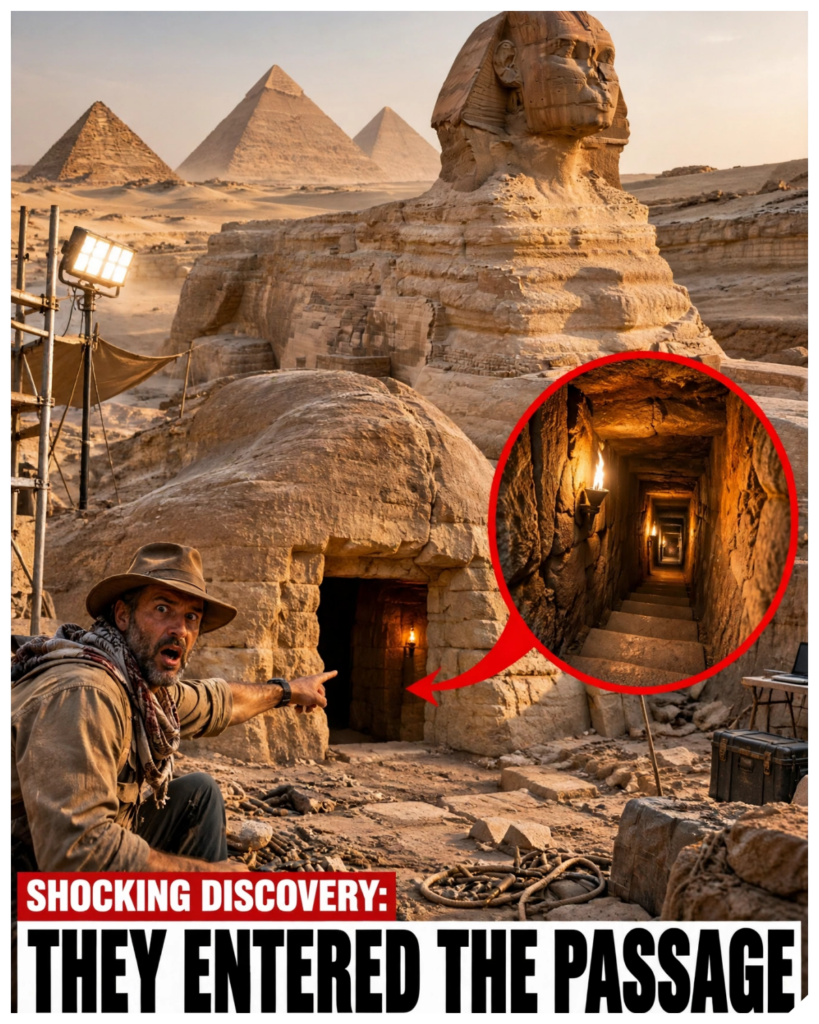
At the back of the Great Sphinx, where the tail curls against the stone, archaeologists lifted a small slab, broke through a plug of gray cement, and lowered themselves into a hole that was never supposed to be found.
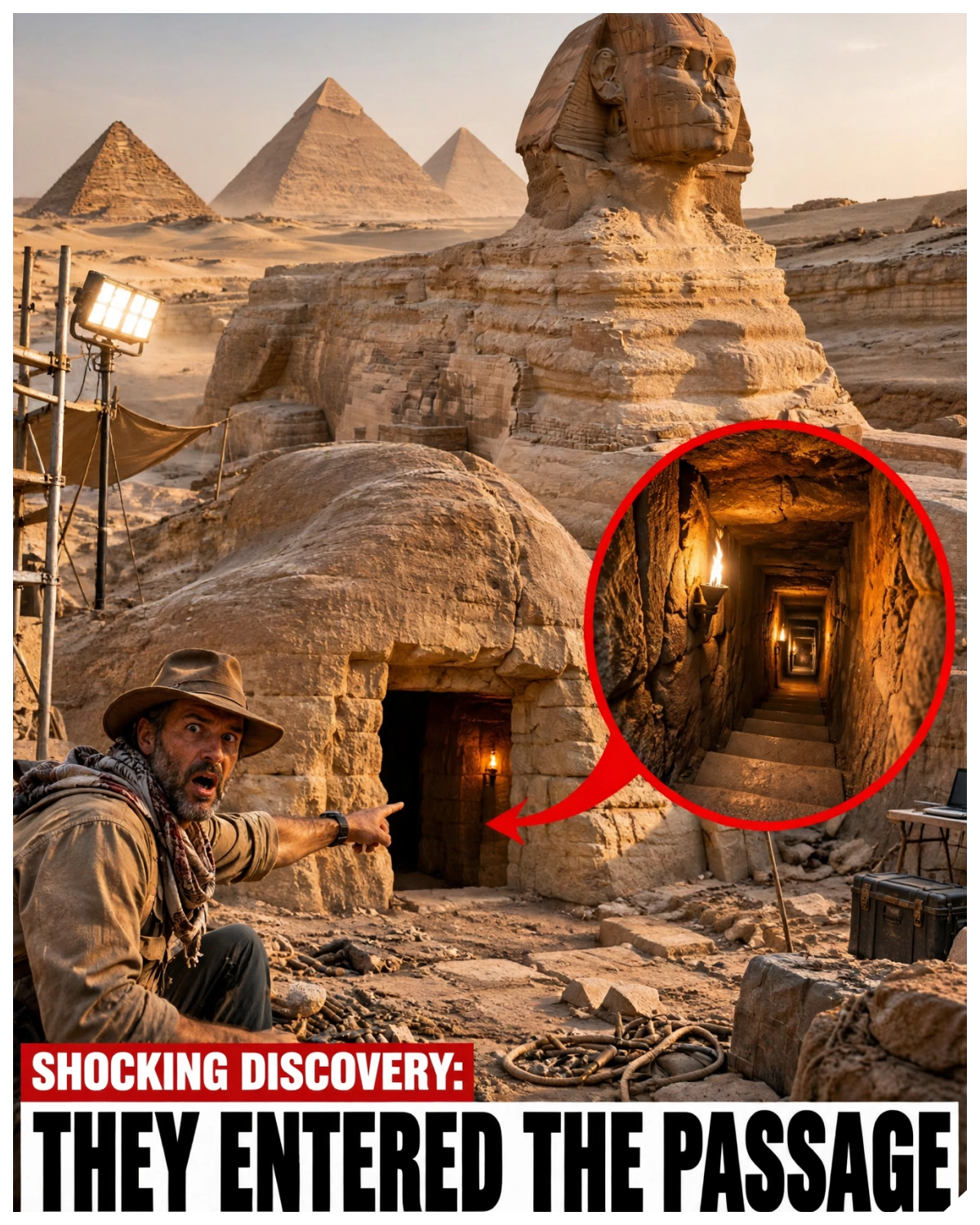
They climbed down into the bedrock beneath the most famous statue on Earth, placing their feet in notches cut into the walls by human hands.
And when they reached the bottom, the floor was wet.
Water was rising up through the stone.
Not rain, not a leak.
Groundwater.
The same hidden water that lies beneath the entire plateau of Giza.
Beneath the Sphinx, beneath the temples, beneath the pyramids themselves.
The passage in the Sphinx’s tail does not end inside the statue.
It goes down.
Down past the body, down past the floor of the quarry, down into the dark water under Giza.
And lying in that wet debris at the bottom, they found a pair of old shoes.
Someone had been down there before them recently.
Someone had climbed into the Sphinx, left their shoes in the water, climbed out, and sealed the entrance with cement so completely that the passage vanished from the record.
No report, no map, not one written word.
But when the archaeologists turned and looked up toward the top of the passage, they saw something far stranger.
The upper end was blocked, not with cement, with ancient masonry.
Fine white limestone blocks cut and laid by Egyptian builders more than 3,000 years ago.
The passage was already there when those blocks went in.
It was found.
It was entered.
It was sealed.
And then it was found and sealed again.
Two ages, two cover-ups, one shaft cut into the body of the Sphinx and pointed straight at the water beneath Giza.
So what were they trying to reach down there?
That is the question this entire investigation turns on.
And it is the one no excavation has ever answered because the passage in the tale is not the only way down.
There is a Greek historian who 24 centuries ago described a royal tomb hidden beneath this plateau standing on an island in underground water.
Scholars called it a fairy tale.
There is a seismic scan that found a sharp rectangular shape buried beneath the Sphinx’s left paw, a shape that has never been opened.
And a short walk from the Sphinx, there is another shaft, one that drops nearly 100 ft into the same bedrock, into the same water.
What weights at its bottom is the reason this story is about far more than a hole in a statue.
Most people walk right past all of it.
They photograph the face and they never once walk around to the back.
Here is what nobody disputes.
The Great Sphinx was carved from the living rock of the Giza Plateau roughly 4 and a half thousand years ago.
A lion’s body with a human head about 240 ft long and 66 ft high crouched inside a quarry cut out around it.
Most Egyptologists agree it was made for the Pharaoh Cafrey whose pyramid rises directly behind it.
And yet the builders left no word about it.
Hundreds of tombs on this plateau are covered in inscriptions from the same age, names, titles, prayers.
Not one of them mentions the Sphinx.
The largest statue of its time arrived in history completely silent and it is not standing on dry ground.
Beneath the Sphinx, the limestone is soaked.
In the early 2010s, the water under the statue and its neighboring temples had risen so high that Egypt’s antiquities authorities with funding from the United States installed a system of 18 wells and powerful pumps around the monument built to pull water out from under the Sphinx every single day.
They called it the Pyramids Plateau groundwater lowering project.
The purpose was preservation.
But think about what it means.
The most famous statue in the world sits on top of a hidden body of water.
And somebody long ago cut a shaft with climbing notches straight down toward it.
Nobody carves a passage into solid rock with footholds by accident.
Somebody believed something was down there worth reaching and somebody else more than once believed it was worth hiding again.
That is the thread we are going to follow through three clues.
The passage in the tale and the extraordinary way it came back from oblivion.
The trail of holes, hatches, and sealed openings that shows how many people have tried to get beneath this statue.
And the modern scans and the second shaft that reveal what the ancient world really meant when it described water beneath the pyramids.
That last clue is the one that changes everything because it shows that the strangest story ever told about Giza was not a story at all.
The passage’s modern history begins with sand.
For most of recorded time, the Sphinx was buried up to its neck.
The desert wind fills its quarry again and again, and for long stretches, only the head stood above the dunes.
In 1926, a French engineer named Emile Barz, working for Egypt’s antiquity service began one of the biggest clearances the monument had ever seen.
A newspaper report from that year describes an army of around 800 Egyptian boys and girls hauling the sand away, basket by basket, bear eyes stayed at the Sphinx for about a decade until 1936.
He cleared it, patched it with cement and limestone, and rebuilt much of its outer casing.
By the end, the statue’s full body, its paws, and the floor of its quarry lay open to the sky for the first time in generations.
Every crack in the Sphinx was exposed.
And this is where the story should have been written down.
Somewhere in that decade, on the north side of the Sphinx’s rump, right where the tail begins to curve, Ber’s crew uncovered an opening, a round hole just beneath the outer masonry leading down into the rock.
Bare eyes looked at it, then he closed it with stones and cement.
He never published it.
He never drew it.
Like much of his work on the Sphinx, it went undocumented.
For more than 50 years, the passage did not exist.
Not on paper, it survived only in the memories of the children who had carried the baskets.
Around 1980, two researchers began the most detailed study of the Sphinx ever attempted.
One was a young Egyptian archaeologist named Zahi Hawas, then chief inspector of the Giza pyramids.
The other was an American, Mark Laner, who would spend years mapping every stone of the monument.
While they worked, three elderly men employed by the antiquities organization at Giza came to them.
As boys, they said they had carried sand for berets, and they remembered a passage under the Sphinx.
One of them, Muhammad Abdal Maud Fed, described it precisely some 57 years after he last laid eyes on it.
A round hole just under the masonry at the back.
The only record of a passage beneath the most studied monument on Earth was the memory of an old man who had seen it as a child.
Hawas and Laner went to the spot.
They lifted one small slab.
Behind it was gray cement, the signature of berets.
They forced a hole through and the floor dropped away into darkness.
Inside were two passages joined at roughly a right angle.
The lower one plunged steeply into the bedrock toward the northeast.
It ran about 4 m across and dropped about 5 m down, the height of a two-story house before ending against natural rock.
It was about 1.3 m wide at the top, narrowing to just over a meter at the bottom.
The walls carried tool marks, and all the way down were those half cup footholds, the same kind Egyptologists find in ancient tomb shafts where workers climbed in and out of the rock.
The upper passage did the opposite.
It climbed up into the body of the statue about 4 meters above the Sphinx’s floor and ended in a small niche roughly 1 m wide and 1.8 m high, big enough for a person to stand inside the Sphinx.
Then they began clearing the fill layer by layer, and the debris told two stories at once.
In the upper layers lay charcoal, broken pottery, tiny snail shells, chips of alabaster and granite, and a cut piece of limestone.
Lower down in nearly a meter and a half of damp fill lay the modern layer, metal foil, lumps of modern cement, the base of a modern clay water jar, and the two old shoes.
As they cleared the bottom, the water came back.
It seeped up through the floor and filled the deepest part of the shaft.
When the team measured it in the early 1980s, the water stood about 15 1/2 m above sea level.
A decade later, the bottom was dry again.
The water beneath the Sphinx was not still.
It was rising and falling, breathing in the dark, connected to something much larger than one small shaft.
The 20th century visitors were easy to name.
The cement, the foil, the shoes.
Bar’s crew, or someone in his era, had climbed down, looked around, and poured cement over the entrance as if nothing had happened.
But that explanation has a problem.
It explains the bottom of the passage.
It does not explain the top.
At the top of the upper passage, the opening was sealed by large, carefully fitted slabs of fine white limestone, the high-grade stone the Egyptians quaried at Turra for their finest work.
Laner had spent years sorting the Sphinx’s layers of ancient repair.
And he knew these blocks.
They belonged to the oldest restoration ever carried out on the statue, a stage he called phase one.
Those ancient masons laid their casing right across the mouth of the passage.
The passage was older than the repair.
Has Laner published their findings carefully.
They noted the footholds so similar to those in tomb shafts and that the top of the passage stops exactly where one layer of bedrock meets another.
They listed the possibilities.
An exploratory shaft, an unfinished tomb, a channel cut by Cafre’s own quarrymen while the statue was still emerging from the rock.
And they left the question open.
Not a myth, not a legend.
A passage measured to the centimeter, cut into the Sphinx by unknown hands, sealed by ancient restorers, found again, and sealed again without a word.
That is the first clue, and it forces the obvious question.
If someone in the ancient world climbed down into the Sphinx toward the water, what did they think was down there?
For that, we have to listen to what the ancient world actually said.
And here is where it gets strange.
Almost 2,000 years ago, the Roman writer Plenny the Elder described the Sphinx in his encyclopedia, The Natural History.
He recorded what the locals told him.
They believed a king named Harme was buried inside it, not beside it, inside it.
But Ply was not the first.
Four centuries before him, around 440 B.CE.
The Greek historian Herododus traveled to Egypt and stood on this same plateau.
He spoke with Egyptian priests and they told him something extraordinary about the king who built the great pyramid.
The king the Greeks called Chops and the Egyptians called Kufu.
Baroditus wrote that the king had underground chambers made on the hill where the pyramids stand, burial chambers for himself, set on an island, and that a channel had been led there from the Nile, so that water surrounded the place where the king lay.
A tomb beneath Giza on an island ringed by water.
For centuries, scholars dismissed it as a traveler’s tale.
Heroditus loved a good story, and the priests loved telling them to Greek visitors.
The Great Pyramids chambers had been explored.
There was no island inside it, no moat, no channel from the river.
So, the passage was filed away as myth, the kind of romantic invention that ancient guides told to foreigners for a better reward.
But read it again, not as a story, but as a description.
Heroditus did not say the water was in the sky or the afterlife.
He said it was underground beneath the hill of the pyramids.
And we now know that there really is water beneath the hill of the pyramids.
Enough of it that modern engineers had to drill 18 wells to hold it back.
Enough of it that it rises into a shaft cut into the Sphinx.
The priests who spoke to Herodotus were not describing a fantasy.
They were describing a place.
A place where you could go down through the rock until you reached water.
They weren’t imagining.
They were remembering.
If it unsettles you that an ancient account everyone called a fairy tale is starting to read like a field report, subscribe now because the trail beneath Giza only gets deeper from here.
Put Ply and Heroditus side by side.
And the people of ancient Egypt are telling us the same thing across 400 years.
That beneath these monuments there were chambers.
That a king lay down there.
That the Sphinx was not solid.
That Giza had a second hidden level under the stone at the water.
That belief never died.
Medieval travelers repeated tales of secret doors and underground halls beneath the plateau.
In the 1930s, an American psychic named Edgar Casey gave it its most famous modern form, claiming that a lost archive he called the Hall of Records lay hidden near the Sphinx’s front paws.
Serious archaeology has no use for psychics.
But here is the twist.
Almost nobody knows.
Mark Laner, the man who mapped the passage in the tale, first came to Giza in the 1970s on a trip organized by the foundation Casey had started.
And that foundation helped support his studies in Cairo.
He arrived looking for the Hall of Records.
He stayed to become one of the most respected scientists on the plateau and he concluded that the hall was not there.
But the people who wanted to get beneath the Sphinx were not only dreamers.
Some of them came with drills.
In 1837, a British army officer named Howard Vise arrived at Giza determined to find hidden chambers.
His engineer, John Pering, boarded straight down into the Sphinx’s back just behind the head.
They drilled about 27 ft, roughly 8 m, into the body of the statue, and then the rod jammed.
It would not come up.
It would not go down.
So they tried to blast it free with gunpowder.
Inside the Sphinx, the attempt failed and they finally abandoned it.
The scar is still known as Pering’s hole.
When Hass cleared it out in 1978, he found no chamber, only a broken piece of the Sphinx’s own headdress fallen into the wound.
Remember that name pairing because that same season at Giza he drew a map and on it he marked something else.
We will come back to it.
Across the Sphinx’s back runs a deep natural fissure up to about 2 m wide.
In the 1850s the French archaeologist Agugust Marott cleared it and found a shaft going down into the body.
Some have read it as the start of an unfinished tomb.
When berets arrived, he lined it, roofed it with iron bars, limestone, and cement, and fitted it with an iron trap door.
Then the head.
Before the 1920s, there was a gaping hole in the top of the Sphinx’s skull about 5 ft square and nearly 6 ft deep.
It may have begun as a socket for a crown and later been dug deeper by treasure hunters searching for a hidden room.
Bares paved it with cement and fitted it with another iron trap door.
A newspaper report from 1926 adds that a similar hole had been bored into the Sphinx’s left forleg.
And in December 1925, at the very start of Ber’s work, a photograph was taken of the Sphinx’s southside near one of the odd stone boxes built against its flank.
In the side of the body, the photograph shows a large dark opening, a gaping entrance in the side of the monument.
During the restoration, it was covered over.
It was photographed.
It was open.
And then it disappeared.
Picture the Sphinx as it really is.
A locked iron hatch on top of its head.
Another on its back, a drill hole in its spine, a hole in its foreg, an opening in its side sealed, a passage under its tail leading down to water.
This is not a solid block of stone.
It is a monument people have been trying to get beneath for thousands of years.
And every opening they made was eventually closed by someone else.
That is the second clue.
The hatches and holes tell us people believed something was down there.
But belief is not evidence.
For that we need instruments that can see through rock.
Then modern science found something that changed everything.
In 1987, a team from Wasida University in Tokyo, led by the Egyptologist Sakuji Yoshimura, brought electromagnetic sounding equipment to Giza.
This was no fringe group.
The same team’s methods would later help locate the buried pit holding the second of Kufu’s great boats beside the Great Pyramid.
They aimed their instruments at the Sphinx and reported a cavity in the bedrock between its front paws, grooves along its sides that suggested a passage running beneath the body, a pit at the statue’s left elbow, and just east of the monument, an underground cavity that the team said seemed to contain stone objects from antiquity.
That last finding caused a stir.
Newspapers reported that Egyptian officials were weighing a plan to drill a hole the width of a finger into the cavity and lower a camera inside.
Cheap, simple, almost no risk.
One look.
No image from inside that cavity has ever entered the published record.
Four years later came a second instrument.
In 1991, the geoysicist Thomas Dobecki and the geologist Robert Choke of Boston University ran a seismic survey across the Sphinx enclosure.
Seismic surveys send sound into the ground and time its return.
Solid rock carries sound fast.
Empty space and loose fill slow it down.
They were not hunting treasure.
They were measuring how deeply the rock had weathered.
But in the data, they found something they had not come looking for.
Beneath the Sphinx’s left front paw, roughly 25 ft down, the sound slowed sharply inside a zone with a strikingly regular rectangular outline.
Not a ragged crack, a rectangle.
Their survey, along with a series of other cavities around the monument, was published in 1992 in the peer-reviewed journal Geoarchchaeology.
Two instruments, two teams, two countries, both pointing beneath the front of the Sphinx.
And then the trail goes cold.
In 1996, a privately funded American group, the Shore Foundation, began seismic and radar work around the Sphinx under a permit from Egypt’s antiquities authorities.
Rumors spread of multiple chambers beneath the monument.
The team returned more than once over 2 years.
Its full results were never published.
A geologist from Florida State University, whose colleagues had been present for part of the work, stated publicly that his team had not read the anomalies as rooms or tunnels.
And that is where the public record stops.
The data exists.
The full findings were never released.
So now there is a passage in the tail leading down to water.
A cavity between the paws, a groove beneath the body, a cavity to the east with objects no one has photographed.
A rectangle under the left paw, every one of them still closed.
Which brings us back to Pering’s map and to the biggest reveal of all.
On the map Pingring drew of Giza in 1837 along the ancient causeway that runs from the temples beside the Sphinx up to the pyramid of Cafre.
He marked a shaft.
He called it simply tomb number one.
A century later in the 1930s, the Egyptian archaeologist Salee Hassan cleared that causeway and found the shaft again cut down through the rock directly beneath the ancient road.
He could not reach the bottom.
It was flooded for generations after that.
The shaft became a local secret.
People from the nearby village climbed down and swam in its clear water.
At one point, a pipe drew water from it to supply a rest house belonging to Cairo University.
A hole beneath the road to the pyramids was being used as a well.
Then at the end of the 1990s, the water table dropped.
And in 1990, Zahi Howas, the same man who had climbed into the passage in the Sphinx’s tail, led a team down to pump out what was left and excavate the shaft completely.
What they found was not one chamber.
It was three levels stacked, one beneath the other, descending nearly 100 ft, about 30 m into the bedrock between the Sphinx and the Pyramid of Cafrey.
The first shaft dropped about 9 mters to an empty chamber.
From there, a second shaft led down to a rectangular room with seven niches carved into its walls.
Two of those niches held enormous stone sarcophagi.
Each one a single block of dark stone lowered into a hole in the earth by people we cannot name.
And then the third level, the deepest.
The water was still there.
As the team cleared it, they uncovered a granite sarcophagus resting on a raised platform of rock.
Around it, the remains of four pillars and around the platform cut into the floor, a channel, a ring of water surrounding the coffin.
A burial deep under the hill of the pyramids, standing on an island surrounded by water, not similar to what Herodotus described, not inspired by it.
The same image, the structure that experts had written off as a Greek traveler’s invention, was sitting under the causeway the whole time, flooded, mapped by pairing, rediscovered by Hassan, swam in by villagers, and only fully opened at the end of the 20th century.
When the discovery was announced in February 2000, sinking water levels had finally made it possible to see.
Among the finds were ancient bones and pottery recovered from the water itself.
Has identified it as the shaft Herododus spoke about.
A symbolic tomb of Osiris, the god of the underworld.
In his words, Osiris is here ruling the underground tunnels of the Giza plateau.
The underground tunnels of the Giza plateau.
Those were the words of the most powerful archaeologist in Egypt.
Now place the two shafts side by side.
One cut into the tail of the sphinx with footholds ending at the water table.
One cut beneath the causeway a short walk away three levels deep ending in water around a stone coffin.
Both carved into the same bedrock.
Both reaching down to the same hidden water.
Both found, lost, and found again.
And the people who told Herododus about an island tomb beneath Giza were not repeating a fairy tale.
They were describing something that was really down there.
So the question changes.
It is no longer whether the ancient Egyptians went beneath Giza.
We know they did.
The question is how far down they went and what else they found when they got there.
And look again at who sealed the passage in the tale.
Laner placed the phase 1 restoration most likely in the 18th dynasty, the age of the great new kingdom pharaohs, more than a thousand years after the Sphinx was carved.
That is the age of the dream stellle, the granite slab still standing between the Sphinx’s paws, where the pharaoh Tutmos IV recorded clearing the sand from the statue’s body around 1400 B.CE.
When that sand came off, the restoers would have seen the opening at the tail, a shaft leading down toward the water.
They did not record it.
They built a wall of fine limestone over it and moved on.
Bares did not invent the habit of silence.
He inherited it.
Now, does any of this prove there is a hidden network of chambers beneath the Sphinx?
Probably not.
And this is the moment to be honest about why.
The strongest counterargument is the rock itself.
Giza is limestone and limestone dissolves.
Over thousands of years, water seeping through cracks carves out pockets, channels, and voids, and the plateau is riddled with them.
As early as 1977, a team from the Stanford Research Institute scanned beneath the Sphinx and reported only the ordinary cracks and fissures expected in limestone.
To a skeptical geoysicist, a rectangle 25 ft under a paw is most likely a natural cavity filled with sand or water, and a groove on a radar scan is most likely a fault.
Mark Laner himself concluded that the passage in the tail was most likely cut by treasure hunters after the statue was finished, not by its builders.
The Osiris shaft, for its part, is generally dated to Egypt’s late period, 2,000 years after Kufu.
So, it cannot be the actual tomb of the king Herododus named.
No passage has ever been found linking it to the Sphinx.
And when a separate team claimed in 2025 that satellite radar had revealed enormous shafts deep beneath the pyramids, Zahi Hawas rejected the claim outright as unverified.
That is a serious position and it deserves respect.
There is no confirmed hall of records.
There is no confirmed tunnel joining these shafts.
But that doesn’t make the discovery ordinary.
Strip away every wild theory and the plain facts are stranger than the fantasy.
A passage with carved footholds cut into the sphinx in the ancient world descending to groundwater.
Sealed by Egyptian restorers more than 3,000 years ago.
Sealed again by a French engineer who never wrote it down.
Remembered only by an old man who carried baskets as a boy.
A three-level shaft a short walk away nearly 100 ft deep holding a stone coffin on an island of rock surrounded by water exactly as a Greek historian was told 24 centuries ago.
You do not need a psychic to find that unsettling.
You only need to read the excavation reports.
If even the grounded version is true, then Giza has two levels.
The one we photograph in the sunlight and another beneath it, cut into the rock and reaching down to the water that the ancient Egyptians knew entered, used, and then deliberately closed.
Every generation that found a way down made the same choice.
Seal it, move on, say nothing.
Our picture of Giza is not a finished portrait.
It is the top floor of a building whose lower floors have been bricked shut.
So here is the question that will not let go.
The first person who cut into the Sphinx’s tail before the restoers before Herodotus before Ber climbed down that shaft by lamplight setting their feet in notches they had carved themselves heading for the water.
They believed something was down there.
What were they trying to reach?
Tonight the Sphinx sits in its quarry as it always has, facing the sunrise, crowds gathered at its face.
Behind it, at the base of its tail, the stone is quiet.
The iron hatches on its head and back are shut.
The rectangle beneath its left paw has never been opened.
A short walk up the causeway, a granite coffin rests on its island in the dark.
And beneath all of it, beneath the statue and the temples and the pyramids, the water is still moving through the rock, rising and falling, exactly where the climbers stopped.