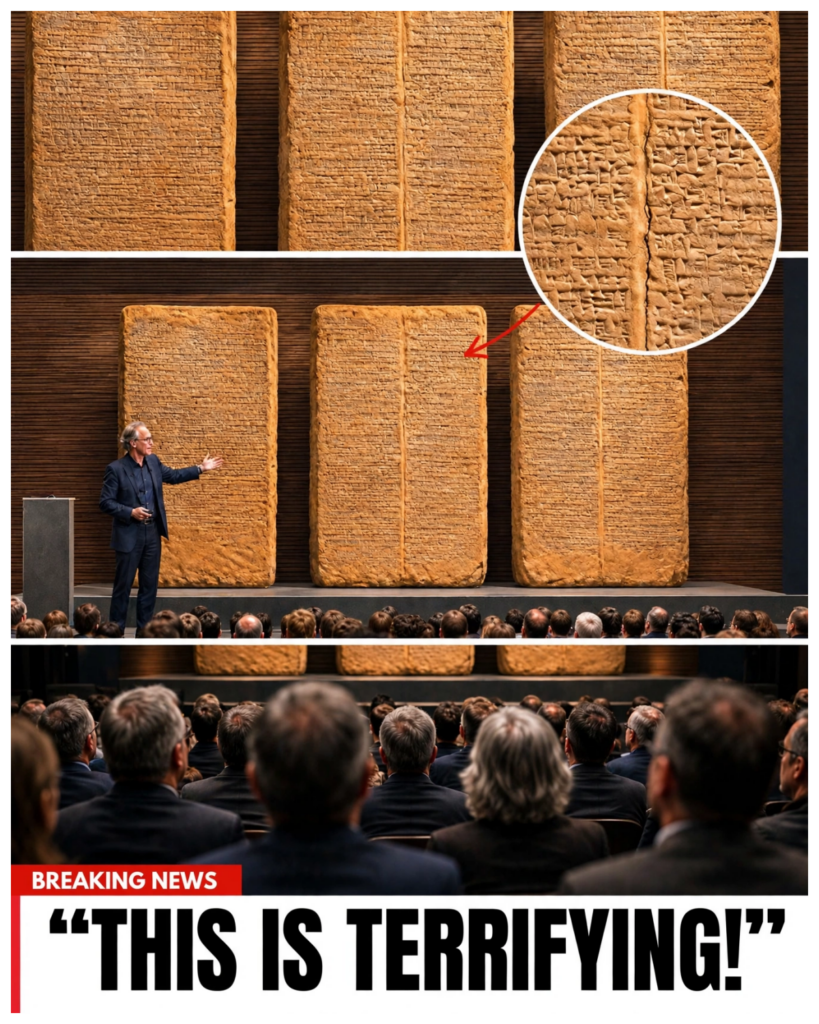
And now I can turn it around and have a look at the writing that’s [music] been hiding underneath.
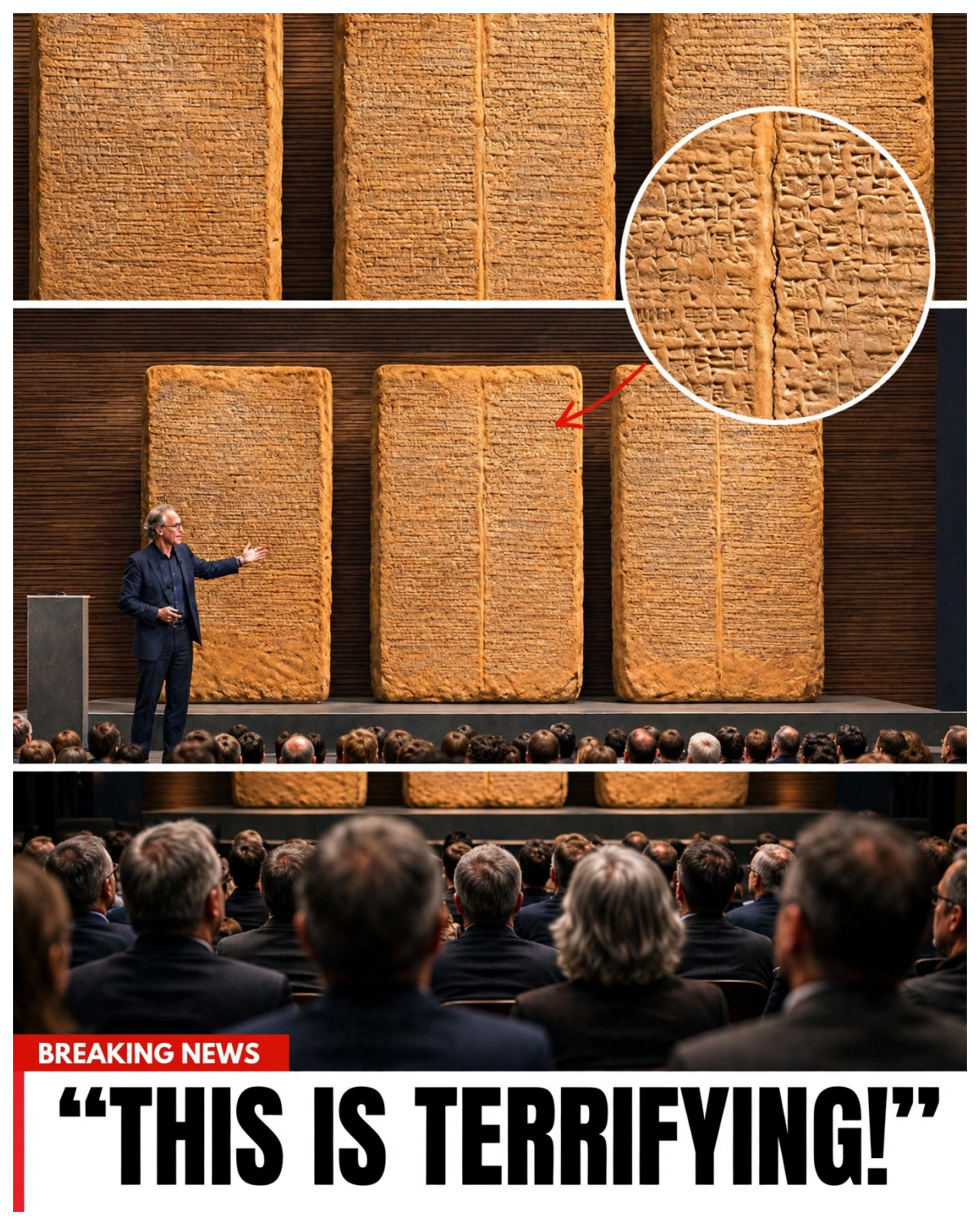
So, no one’s seen that writing for four or 5,000 [music] years.
Yeah.
The only person that’s seen it previously is the one who wrote it.
A sealed black tablet pulled from beneath the ruins of Eridu, the city many call the oldest in the world.
A text that predates writing itself, a machine that read it in 27 seconds, and a first line that sent a chill through the room.
We wrote this for those who would read without tongues.
That is the story racing around the internet.
It claims that a message was left in clay thousands of years ago, not for kings, not for priests, but for a future intelligence that could finally decode it, and that the message was a warning.
Here is what I’m going to do with that story.
I’m going to follow it step by step, claim by claim, and check each one against the record.
Some pieces are real and astonishing.
So stay with me.
By the end, you’ll know what archaeologists have truly found at Aridu, what AI has genuinely done for ancient languages, and why a story built from real ingredients can feel so convincing when the whole is invented.
It begins in a dry, flat stretch of southern Iraq where a mound of mud brick has been waiting for 7,000 years.
The chest in the wall.
In 2025, as foreign teams returned to Iraq after years of upheaval, archaeologists restoring a collapsed temple wall just outside Aridu found a small black chest coated in hardened bumen sealed as if meant to survive flood and fire.
Inside lay a single clay tablet unlike anything found in Sumer with engravings so fine that no hand tools seemed capable of making it.
Radioarbon dating of the seal and surrounding sediment the story says placed it near 5300 B.CEE.
Let’s start with what is real.
Eridu today called Tel Abu Shahin lies in the marshy south of Iraq near the ancient shore of the Persian Gulf.
Excavations led by Fouad Safar and Satan Lloyd in the late 1940s uncovered a sequence of temples stacked one on top of another.
The earliest dating to around 5400 B.CE.
Sumerianss themselves believed it was where kingship first descended from heaven and their king list opens with it.
UNESCO listed the site in 2016 as part of the Awoir of southern Iraq.
And yes, foreign archaeological teams have been returning to Iraq in recent years.
Bammen is real, too.
And it’s a clue that cuts against the story rather than for it.
Mesopotamians used natural asphalt from seeps like those near hit on the Euphrates as a waterproofing glue for boats, baskets, and the walls of buildings.
Finding something coated in bumenumen would be ordinary.
Finding it sealed in a chest [music] and left as a time capsule would not and I can’t find a record of any such object.
Now the dating because it’s where the story quietly falls apart.
Radioarbon measures the decay of carbon in once living material like seeds, charcoal or reeds.
Bitammen is made of ancient geological carbon so old that it has none of the radioactive kind left which means it can’t be dated.
This way at all.
Fired clay can sometimes be dated by thermoluminescence, a different method that measures when it was last heated.
Dating the surrounding sediment tells you when the sediment was laid down, not when the tablet inside it was made.
So, a claim of 5300 B.CE for a tablet would need a very specific published explanation, and none exists.
There is one real parallel that makes the chest feel plausible.
Mesopotamian kings buried inscribed objects in the foundations of temples as messages to the future called foundation deposits.
They placed inscribed clay cones, bronze figurines, and tablets in boxes of brick or bitumen beneath the walls and the texts often asked later rulers to restore the building and cursed anyone who erased the king’s name.
Uramu and Gudea both left them.
So a sealed box in a wall is not impossible.
But those deposits were inscribed in ordinary Sumerian and they date to the 3rd millennium B.CE not the sixth.
The date matters because of what it implies.
The earliest true writing we know of protounea form from the city of Uruk appears around 3350 to 3200 B.CE.
It began as accounting tallies of grain, beer, and sheep with a few signs for names and offices.
The best known early example is a tablet naming a man called Kushim who seems to have been a bookkeeper.
Something written in 5300 B.CE would predate that by about 2,000 years.
That’s a bold claim, and bold claims about early writing have a history.
Archaeologists have long debated whether clay tokens used for counting found in the Near East from roughly 8,000 B.CE.
Were precursors of writing.
Denise Schmant Besserat of the University of Texas argued that they were, but a token system isn’t a text.
The step from counting to a sentence took thousands of years, and it happened in a documented sequence.
So, the sealed chest, the 5300 B.CE date, and the microscopic carving are unverified.
But the story doesn’t rest on them alone.
It reaches for the people who lived at Aridu when the oldest temple was built, and they are very real.
The civilization before the Sumerianss, before Ziggurats, before Cuneaform, before the first Sumerian king, there was the Ubade culture.
This is the part of the story that is true and it deserves attention.
The Ubad period lasted from around 6,500 to 3,800 B.CE.
Named after the small mound of Tel aled near Ur, where the culture was first identified in the 1920s.
Over those 3,000 years, people in southern Mesopotamia learned to farm in a land with almost no rain, which meant digging canals and managing water collectively.
They built mud brick houses and at Aridu a sequence of ever larger shrines.
By the end of the period, some towns had temples on raised platforms, the ancestors of the later ziggurats.
They were not a warm-up act as some books treat them.
Uade pottery painted with geometric bands and dark patterns spread across a huge area from northern Mesopotamia to the Gulf Coast and as far as what is now Oman.
Researchers have debated how without writing or states such a shared style spread.
The leading explanation is trade, intermarriage and a shared religious world around temples, not an outside blueprint.
[music] Archaeologists have found identical looking pottery and similar house plans at distant sites like Tel Eloe and Tell Abada which the viral story calls uncanny.
It is striking but we know of many cases where distant cultures share styles without any writing including the spread of bellbeaker pottery across Europe around 2500 B.CE.
Then there are the figurines.
Ubide sites including Ur and Eridu have produced small clay figures with elongated heads, slit or almond-shaped eyes and riged crowns or hairstyles and some of them hold infants to their chests.
They are often nicknamed lizard-headed and they are real.
The British Museum and the Pen Museum hold examples.
[music] Some writers describe them as aliens.
Archaeologists read them as stylized goddesses or mothers, probably fertility figures with the elongated heads representing quaffures or perhaps head shaping.
The story adds that their clay contained non-local micica, but micica is a common mineral in the clay and rocks of the region, and I haven’t found any analysis that supports a rare or foreign source.
The viral story then claims the tablet’s engraving is closer to ubade iconography than to Sumerian script.
But ubide art has no known writing system.
There are painted designs, seals, and symbols, but nothing that scholars consider a script.
So there is nothing for an AI to have been trained on.
An AI cannot decode an unknown language that has no key, no bilingual text, and no known sounds.
That’s a point we’ll return to because it is the heart of the matter.
Even the idea of a phrase never seen before about those who dug canals and remembered the stars rests on a translation no one has published.
The truth is humbler and in some ways more impressive.
The Ubide people did dig canals and watch the sky and they did it without any writing to leave a record.
Their story survives in mud brick, in pottery, and in the silent bones of their towns.
So, can a machine read a message from a people who never wrote?
Let’s look at what AI can really do with ancient writing.
What AI can really read?
The viral story says researchers trained an experimental AI on more than 400,000 ununiform tablets, fed it a hyperspectral scan of the black tablet, and received a translation in 27 seconds.
It describes the model peeling back layers like a code, finding a linguistic layer and a numerical matrix and spotting prime number intervals that resemble modern error correction.
Start with what’s true.
AI is changing the study of ancient languages.
In 2021, researchers at the University of Chicago’s Oriental Institute unveiled DeepCribe, a system trained on thousands of images from the Pipilus Fortification Archive, an enormous cache of administrative tablets from the Persian Empire written in Elilumite.
It can read signs with accuracy in the 80% range.
In 2023, researchers at Tel Aviv and Ariel universities, including Shy Gordon, published a study in the journal Panas Nexus using neural machine translation to render Aadian Cuneaform into English.
The results were useful for common administrative texts and weaker for literature and poetry.
Platforms like the Cuneaform digital library initiative now hold hundreds of thousands of cataloged objects and many tablets in museum basement have never been read by anyone.
Multisspectral and hyperspectral imaging are real too.
The most famous example is the Archimedes palumst a medieval prayer book written over a lost work of Archimedes.
In the 2000s imaging at the Walters Art Museum in Baltimore recovered text that was invisible to the eye.
So, the idea of scanning a tablet in different wavelengths to reveal hidden detail isn’t science fiction.
But look at where the story goes next.
An AI can only read what it has been taught.
Machine learning for ancient scripts depends on known examples because the system learns to match shapes to sounds and meanings that scholars already understand.
Cuneaform was deciphered by humans first.
The breakthrough came in the 1840s and 1850s when Henry Rollinsson copied the triilingual behon inscription, a cliff carving of Darius the Great, written in old Persian, Elilumite, and Babylonian.
Because old Persian could be read, it unlocked the other two.
In 1857, the Royal Asiatic Society challenged four scholars to translate an unseen text independently, and their results agreed.
That’s what a decipherment looks like.
A key, a method, and independent verification.
For a pre-sumerian script with no known examples, there is no key.
Experts have tried for a century to decipher undeciphered scripts like linear a protoylamite and the indiscript.
And the problem isn’t computing power.
It’s the lack of a bilingual text.
A language model, however large, can’t conjure meaning out of nothing.
And it certainly can’t produce a fluent English sentence like we wrote this for those who would read without tongues from a script no one understands.
The comparison with GPT style models is worth a pause.
The transformer architecture behind those models was introduced in 2017 in a paper by researchers at Google called attention is all you need.
It’s a modern engineering design.
Saying a 7,000-year-old text contains recursive loops used in Transformers would be like saying a medieval cathedral was designed using the principles of the iPhone.
The resemblance is in the telling, not the object, and the prime number detail is a red flag.
Error correcting codes were invented in the 20th century, most famously by Richard Hamming at Bell Labs in 1950.
Numbers that happen to sit at prime positions can be found in almost any large collection of symbols because primes are common among small numbers.
With enough data, any pattern can be found.
A trap statistitians call overfitting.
The real test is prediction and none is offered.
If the machine’s reading is unverified, what about the math the story says it found?
Mathematics in clay.
The story says the AI laid the engravings over a grid and found it matched the foundation plan of the ziggurat of with key angles of 52° lining up with the solstice sunrise at Aridu.
It says the symbols matched cladney patterns, the shapes that sound makes in sand and that the angles encoded an 8-year Earth and 13-year Venus cycle.
It also says the carvings follow a golden spiral and Fibonacci numbers.
Some of these pieces are real and they’re worth knowing.
The base 60 system is genuinely Mesopotamian.
Sexesimal counting developed among the Sumerianss and was refined by the Babylonians.
And it’s the reason an hour has 60 minutes and a circle has 360°.
The mathematicians tablet known as Plimpmpton 3:22 from about 1800 B.CE CE lists numbers that fit the Pythagorean theorem more than a thousand years before Pythagoras.
The Babylonians were sophisticated astronomers and the Venus tablet of Amisaduka copied around 1600 B.CE records the risings and settings of Venus across about 21 years.
Venus and Earth do return to nearly the same alignment about every 8 Earth years, which is roughly 13 Venus years.
That cycle is real and the Babylonians knew of it in some form, but the rest comes apart quickly.
The ziggurat of Ur was built around 2100 B.CE by King Ur Namu, more than 3,000 years after the date given for the tablet.
A tablet from 5,300 B.CE can’t carry the foundation plan of a building that didn’t exist for another 3 millennia, unless the story means the other direction that the builders consulted the tablet.
Nobody has shown that.
The Chiladney claim has a similar problem.
Ernst Cladney described those patterns in 1787 and they’re produced by vibrating a flat plate.
Spirals and hexagons are among the simplest shapes there are.
And they appear in everything from honeycombs to hurricanes.
Matching one to a carved design is easy and the match proves nothing.
And the Fibonacci angle.
The sequence is named after Leonardo of Pisa who introduced it to Europe in 1202.
Though Indian mathematicians such as Viraanka and Pingala had described it much earlier, golden ratio spirals are famously overdetected.
Researchers have found golden ratios in the great pyramid, the parthonon, and even in the Mona Lisa, only to find that the numbers depend heavily on where you choose to measure.
Nature makes spirals constantly.
A spiral on a tablet doesn’t need a mathematical plan.
There’s a more honest way to look at this.
Mesopotamian mathematics is astonishing without any additions.
The same people who counted in base 60 also used a place value system, a concept most of the world adopted much later.
That’s the real story of the tablets.
Ordinarylooking clay that holds sophisticated math.
The viral version, however, pushes further.
It says the same symbols appear across the world, the same symbol on every continent.
The next claim is the most dramatic.
The story says the AI found a jagged lines inside a circle glyph on a stone slab at Paleenke in Mexico on an Indis Valley seal dated to 25,500 B.CE and in the Egyptian book of the dead.
It says the phrase seven watchers of the sky appears across Sumer, the Maya and Hindu texts and that the Aridu tablets clay contains Himalayan micica connecting it to Teayotiwakan.
Let’s weigh these one at a time.
The Indis date is the first problem.
The Indis Valley civilization flourished from around 2600 to,900 B.CE.
A seal dated to 25,500 B.CE would be older than any known farming, let alone a city.
It’s almost certainly a typo or a fabrication off by more than 20,000 years.
And the Indiscript itself remains undeciphered with about 400 signs and no bilingual key.
So nobody can claim to have matched a symbol to a meaning.
Similar shapes in different places prove less than they seem.
Circles, spirals, zigzags, and dots are among the most basic marks a human hand can make.
Scholars call this convergence and it isn’t a dismissal.
It reflects the way human perception and the physical act of drawing produce similar forms.
Geometric patterns called phosphines, which people see when they close their eyes and press on them, have been proposed as a source of recurring designs in rock art worldwide.
A real connection would need a chain of evidence, dated objects, a trade route, and linked styles.
The viral story offers none.
The seven watchers idea draws on real traditions.
The Pletes, a cluster often described as seven stars, appear in myths worldwide.
The Sumerianss, Greeks, Aboriginal Australians, and Native Americans all told stories about them, and so did the Maya.
In Hindu tradition, the Saparishi, the seven sages are associated with the Big Dipper.
But these are different groups of stars with different stories.
Seven is a number humans love because it’s the number of things you can easily see and count in a group.
Many cultures also saw seven visible wandering bodies.
The sun, moon, mercury, Venus, Mars, Jupiter, and Saturn.
That’s why the week has seven days.
It’s a reasonable explanation and it doesn’t need contact between continents.
The Micah is where the story tries to anchor itself in science.
It says the clay contained Himalayan micica found 2,000 km away and used in the Mesoamerican city of Teayotiwakan.
But micah is plentiful across the world including in Mexico itself.
Researchers who’ve studied the micica at Teayotiwakan such as in the so-called Mika temple have traced much of it to sources in Waka and ancient trade networks were real.
Lapis lazuli from Afghanistan reached Mesopotamia by about 3000 B.CEE and the Ubide world traded with the Gulf.
Those routes are documented.
A route between Mesopotamia and Mexico more than 12,000 km across oceans is not.
If there was ever a global network of warnings, we would expect to find it in the way archaeologists usually find connections, shared objects, shared techniques, and dated contacts.
The truth is more modest and more human.
People everywhere watched the same sky and drew with the same hands.
And that brings us to the story’s most unsettling claim, that the tablet carries a countdown, the cosmic timer.
According to the story, hidden numbers in the tablet form intervals of 11,60 years, 5,500 years, and half of that repeating like a pulse.
The AI is said to read them as time remaining, not time past, and links them to the younger Dus, a catastrophic period around 11,000 years ago.
It then points to a phrase about a collapsing magnetic field and projects the next tipping point between 21,000 and 22,000 CE.
The younger Dryus is real.
It was a sudden return to near glacial cold from about 12,900 to 11,700 years ago and a hot topic in science.
One hypothesis blames a comet impact.
Many researchers dispute it and multiple studies including a 2011 paper titled as a reququum for the idea found the evidence unconvincing.
Another view points to a surge of glacial meltwater disrupting Atlantic currents.
Whatever the cause, it didn’t wipe out civilization because it ended thousands of years before the Ubade period began.
And it coincided with the first steps toward farming in the Near East.
The magnetic field is real, too.
And this is where the story leans on facts to sound credible.
The field has weakened by roughly 9% over the past two centuries, according to data from ISA’s swarm satellites.
And a region over the South Atlantic known as the South Atlantic anomaly has grown weaker still.
Past excursions like the Lashamps event about 41,000 years ago were real.
In 2021, a team studying ancient cowry trees in New Zealand reported evidence of a short sharp field collapse that coincided with climate shifts.
That’s an important finding and scientists are still working out its impact.
Here’s the part the story omits.
A full reversal in which north and south trade places happens on average every few hundred,000 years with irregular gaps and takes thousands of years to unfold.
The last complete one was about 780,000 years ago.
During those transitions, the field doesn’t vanish.
It gets weaker and more complex, and the atmosphere still shields us from most radiation.
There is no evidence that a reversal triggered a mass extinction and no reversal has occurred during human history.
A so-called Goththingberg excursion about 13,000 years ago has been proposed from Swedish sediments, but it’s contested.
There’s also a modern danger worth taking seriously.
A strong geomagnetic storm like the Carrington event of 1859 could damage power grids and satellites.
In 1989, a storm knocked out Quebec’s power grid for 9 hours.
Those are real risks and agencies planned for them.
They have nothing to do with a tablet.
As for the prediction that the next tipping point falls between 21,000 and 22,000 CE, a date 19,000 years from now, a countdown that distant can’t be tested, which is precisely why it works as storytelling.
The numbers 11,60 and 5,500 look suspiciously like round figures chosen to fit.
Fit is cheap.
The question is whether the numbers were found or fitted.
All of which raises the question the story saves for last.
If this was real, why haven’t we heard about it?
The vanishing data.
The final section turns into a thriller.
After a short technical paper described the decoding framework, the story says the research website went offline within a week.
Mirrored backups were wiped.
A note blamed a security audit, but a leaked screenshot allegedly revealed that one developer had flagged a line from the deepest layer that the gate of resonance must not be opened before the cycle turns or the ground will remember its fire.
Coordinates embedded in the text supposedly pointed to a basalt heavy patch a few hundred meters southeast of the dig where ground penetrating radar detected a six herz infrasound hum.
The Iraqi Antiquities Authority sealed the area.
Researchers reported being locked out of their servers and warned about civil destabilization potential.
Let’s handle this carefully because it’s where fiction is most tempting.
First, a technical problem.
Ground penetrating radar sends out radio pulses and records their echoes.
It doesn’t detect sound.
An infrasound hum would be recorded by seismometers or microphones, not radar.
So the instrument and the finding don’t match.
6 herz is also within the range of ordinary sources such as wind, waves, distant earthquakes, and machinery.
Also, southern Iraq’s ground is mostly aluvial sediment, not basaltt.
Basaltt is a volcanic rock, and the Mesopotamian plane has none.
Second, a pattern.
Stories about suppressed discoveries usually have the same structure, a hidden document, an anonymous insider, a leaked screenshot that no one can trace, and an authority with a mysterious motive.
The structure is satisfying precisely because it explains the absence of evidence.
If nothing can be found, that proves someone hid it.
But it’s a trap because it makes the claim impossible to disprove.
A real cover up still leaves records, court filings, press statements, named whistleblowers.
This one has none.
There is, however, a very real story hiding behind the fiction, and it’s more troubling.
In April 2003, during the invasion of Iraq, the Iraq Museum in Baghdad was looted.
About 15,000 objects were taken, including thousands of cylinder seals and small tablets.
And the loss was among the worst cultural disasters of the era.
Roughly 10,000 have since been recovered, but thousands remain missing.
Looting at archaeological sites in southern Iraq has been far worse, and satellite photographs show fields of pits where ancient cities once lay.
In 2021, the United States returned about 17,000 looted cuneaoiform tablets and other artifacts to Iraq, including the Gilgamesh dream tablet, which had been bought for a private museum collection.
Some estimates suggest there may be hundreds of thousands of looted tablets in private hands.
That is the true tragedy of this story.
Writing is the most fragile form of memory and we are losing it faster than we’re deciphering it.
A real tablet taken from the ground without record loses its context and with it most of its meaning.
Many are now being read thanks to AI, but only the ones that reached a lab.
What the clay really says.
So, what are we left with?
The sealed black tablet from Eridu doesn’t appear in any excavation report, museum catalog, or journal I can find.
Its date, its decoded text, [music] its mathematical blueprints, its global twins, its countdown, and its coverup all come from a chain of unverified claims, and several of them contradict known facts.
Radioarbon can’t date Bammen.
Ziggurat didn’t exist when the tablet was supposedly made.
Radar can’t hear infrasound, and no AI can decipher a script that no human has deciphered.
Yet, nearly every ingredient is real, which is why the story works.
Eridu is the earliest known city of southern Mesopotamia.
The Ubad people built canals and temples thousands of years before the pyramids.
Base 60 still sits inside every clock.
AI is reading ancient languages.
The Earth’s magnetic field is weakening.
Iraq’s heritage was looted and its tablets sit in basement unread.
[music] Combine those facts, add a mysterious tablet, and you have a story that feels like a revelation.
But the real revelation is quieter.
We don’t need a lost message to the future because the clay is already speaking.
The oldest tablets we have tell us who owed whom barley, who made beer, and who ruled a temple.
They also preserve the earliest known poetry and the name of the first author we can identify and hedana, a priestess of Ur around 2300 B.CE who signed her hymns.
Those voices have been waiting for 4 and a half thousand years and we’re only beginning to listen.
Machines may help us read them faster, but they can only read what people have found, preserved, and understood.
The ending of this story belongs to archaeologists, conservators, and the Iraqis protecting their own heritage.
So, here’s my question for you.
Which part of the viral story did you find most convincing before we checked it?
Tell me in the comments because the answer says a lot about how stories like this spread.
If you want more investigations that follow the evidence wherever it leads, like the video, subscribe, and click the next one on your


