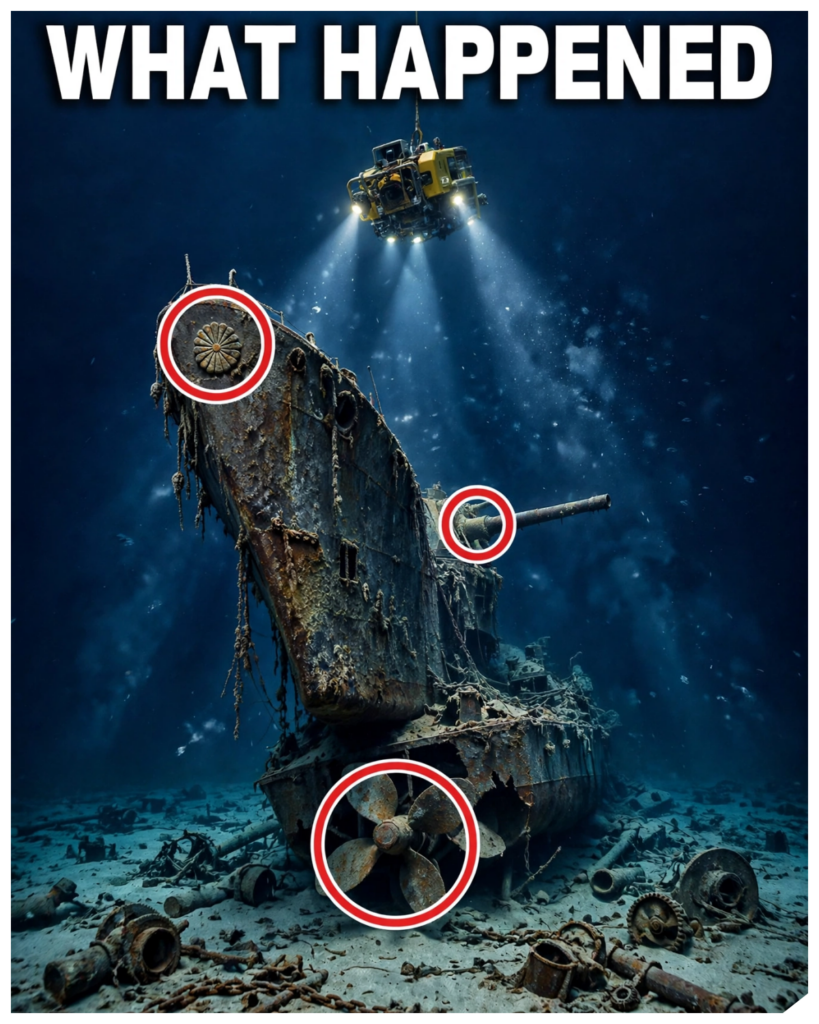
In March 2015, a submersible from Paul Allen’s expedition team found the remains of a Japanese battleship almost a kilometer down in the Sibuan Sea Philippines.
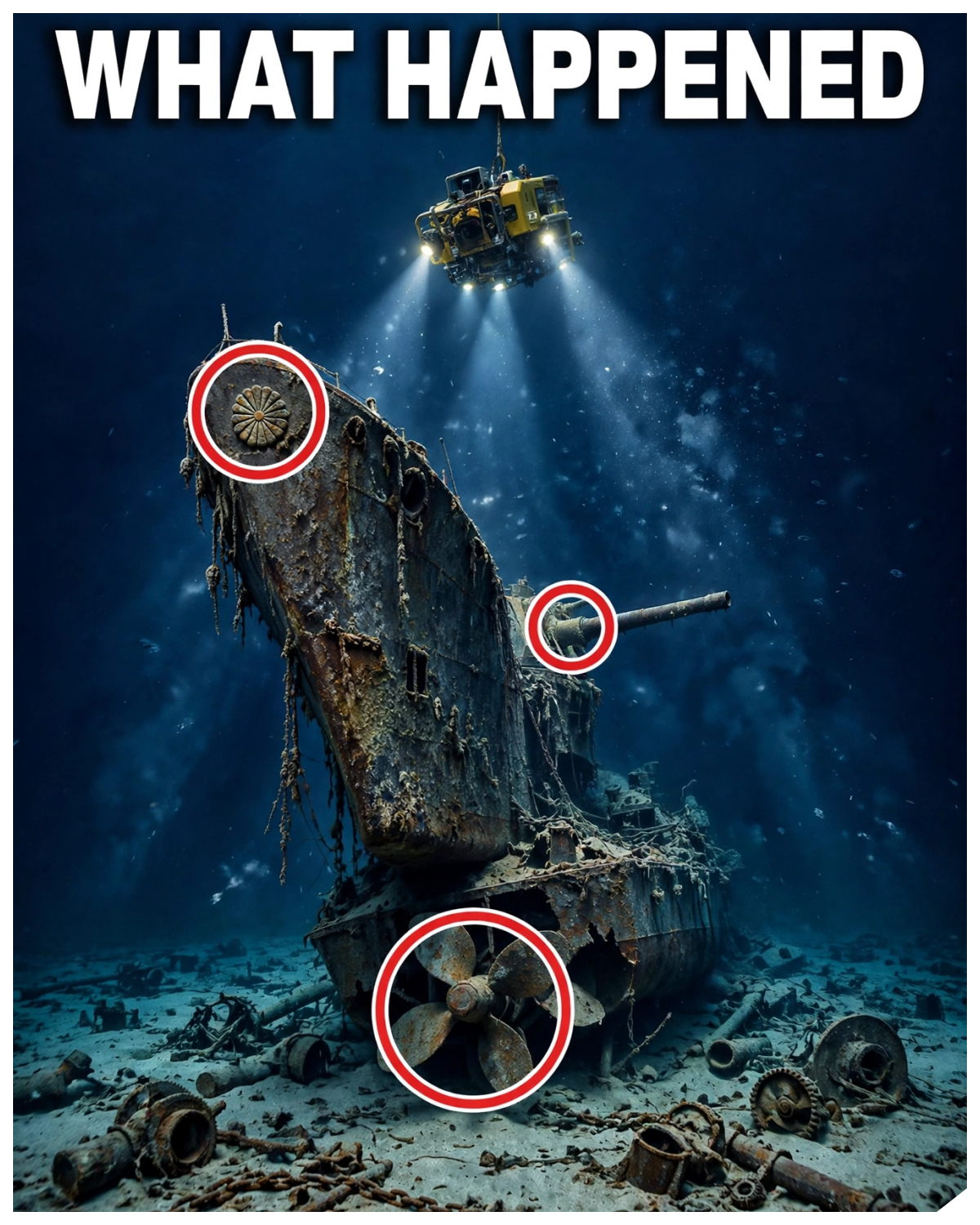
It was Mousashi, one of the two largest battleships ever built, missing since October 24th, 1944.
But the images from the seafloor didn’t show an intact battleship resting on the sand.
The bow was still recognizable.
The stern lay upside down.
Most of the midsection was gone.
And the pieces that had once formed one of the most powerful warships in the world now lay scattered across the ocean floor.
More than 70 years earlier, American planes had dropped an enormous number of bombs and torpedoes on Mousashi, and the ship held on for hours before it rolled over and sank.
Except what turned up in 2015 showed the ship’s destruction had been far more complicated than anything witnessed from the surface.
The question wasn’t how Mousashi sank, which had already been recorded in 1944, but what happened to it after it vanished beneath the surface, and why it took 71 years for anyone to get close to that answer.
By the late 1930s, Japan’s Imperial Navy knew it couldn’t outbuild the United States, so it chose to build battleships bigger, better armed, and better armored than any single opponent they might face.
Mousashi was the second ship of the Yamato class, and construction began at the Mitsubishi shipyard in Nagasaki in 1938, right in the middle of a port city full of civilians, merchants, and even foreign diplomatic offices.
To keep outsiders from seeing the ship take shape, workers put up enormous rope screens around the building slip.
And according to a post-war technical memoir, the rope used weighed more than 400 tons, enough to strain the supply local fishermen depended on.
On November 1st, 1940, Mousashi was launched under tight security, its hull already weighing more than 35,000 tons, a load that demanded technical preparations Nagasaki’s yard had never attempted before.
A battleship [snorts] designed to project national power had to be hidden from the moment it was born.
Mousashi ran 263 m long, displaced more than 72,000 tons fully loaded and carried nine 18.1in main guns that could fire shells weighing more than a ton a piece.
Backed by belt armor, armored decks, and turrets built to take the heaviest blows of a battleship duel.
But what helped Mousashi survive longest under fire wasn’t just thick steel.
Beneath the armor sat a system of more than a thousand watertight compartments along with pumps and valves that could move water or flood specific sections to control listing once the ship was hit.
[music] And the designers expected these systems to keep the battleship fighting even after some compartments were destroyed.
Even so, seawater didn’t need to punch through the thickest armor to sink a ship.
If enough compartments flooded and stability broke down, sheer size couldn’t keep a battleship afloat forever.
That limit would eventually be tested in the Sibuan Sea.
Mousashi was commissioned in August 1942, just 2 months after Japan lost four carriers at Midway.
And the war it was about to join was changing fast with aircraft and carriers taking on an ever bigger role.
Even so, by early 1943, Mousashi had become the flagship of the combined fleet, and Admiral Isaroku Yamamoto flew his flag aboard her.
After Yamamoto was shot down by American planes in April 1943, Mousashi carried his ashes back to Japan.
For most of this time, the battleship shuttled between bases, handling command, transport, and training duties, and the great battleship on battleship clashes it had been designed for never came.
In March 1944, [music] the American submarine USS Tunny torpedoed Mousashi’s bow near Palao.
But the ship survived and returned to Japan for repairs, where it also got heavier anti-aircraft guns.
By the time Mousashi returned to active duty, Japan had suffered another serious defeat at the Battle of the Philippine Sea, and its remaining big ships were facing a war with less and less air cover of their own.
In October 1944, American forces landed at Lee in the Philippines.
And for Japan, losing the Philippines threatened the shipping lanes that carried fuel and raw materials home from Southeast Asia.
Japanese command put together a massive counterattack.
The remaining carriers would serve as a decoy force to [music] the north while a battleship and cruiser force under Admiral Teo Kurita pushed through the central Philippines.
At the heart of that force were Yamato and Mousashi, aiming to cross the Sibuan Sea, pass through the San Bernardino Strait, and reach the American landing ships at Lee.
Yet, Karita’s force had almost no effective air cover of its own, and ships carrying hundreds of anti-aircraft guns were left to defend themselves against wave after wave from American carriers.
October 23rd, American submarines ambushed the fleet in the Palawan Passage, sinking two heavy cruisers and damaging a third, and Karita lost his flagship Atago, forcing him to move his flag to Yamato.
The next morning, the fleet pushed on into the Sabuan Sea, where American reconnaissance planes had already started finding them.
Around 10:30 in the morning, planes from American carriers began attacking Karita’s force, and Mousashi became one of the most obvious targets, both for its sheer size and for how exposed it sat within the Japanese anti-aircraft formation.
Hell Diver dive bombers and Avenger torpedo planes came in from several directions and Japanese anti-aircraft guns opened up, but the torpedoes still got through the barrage and exploded below the water line.
The first hit flooded an area near a boiler room, and Mousashi began to list, but the counter flooding system kicked in as the crew pumped water into the opposite compartments to level the ship.
The list eased.
The engines kept running and Mousashi stayed with the fleet.
The next waves did more damage.
Bombs tore through sections of the deck.
Torpedoes kept letting water in and damage control teams worked non-stop to fight fires, seal off flooded compartments, and keep the battleship running.
By midday, Mousashi had slowed, but it hadn’t lost its fighting ability because the protection Japanese engineers had designed years earlier was still doing its job.
Even though every flooded compartment meant another piece of reserve buoyancy gone, and no amount of counterbalancing could make the water that had already gotten in disappear.
Mousashi was still afloat, but it had started fighting a second battle against the water building up inside its own hull.
As more waves of American planes kept coming, Mousashi lost speed and fell behind the formation and the other ships could still move faster.
While a wounded battleship became easier and easier for fresh groups of aircraft to reach, torpedoes kept hitting both sides.
Bombs wrecked the superructure and gun positions.
Engine and boiler rooms flooded and cut power.
And the bow sections sank lower and lower.
For Cooji Hayakawa, then a very young sailor in the weather division, the battle stopped being planes watched from a distance.
He remembered an explosion near the bridge that sent metal fragments tearing into his group, killing two of his crew mates and wounding him and a friend in [music] the arms.
Meanwhile, Mousashi’s anti-aircraft guns kept firing back, but many [music] of the mounts were already destroyed or out of action.
By the end of the air attacks, the [music] number of bomb and torpedo hits had climbed to an extreme total with naval [music] studies commonly putting the estimate at around 17 bombs and 19 torpedoes.
Mousashi was still on the surface, but it no longer had the speed, steering, or reserve buoyancy to keep operating with Karita’s force.
The major air attacks ended by midafter afternoon, but Mousashi didn’t recover just because the American planes had left.
Water kept spreading through the damaged sections.
The bow sank deeper and stability kept breaking down.
The crew tried a [music] last round of measures to level the ship, flooding other compartments and shifting equipment to the opposite side to [music] limit the list.
But the more areas that flooded, the more reserve buoyancy kept shrinking.
Rear Admiral Toshihira Inaguchi, Mousashi’s captain, tried to [music] steer the ship toward a stretch of coastline to run it ground rather than let it sink in deep water, and the engines that still worked pushed it along slowly, but it couldn’t make it.
Post-war designers explained that flooding in the bow had gone past the limits the ship had been built to handle.
And once the forward deck was underwater, along with compartments beneath the armored belt, Mousashi no longer had the stability left to hold on any longer.
A ship built to take the heaviest naval gunfire was finally being beaten by seawater inside its own hull.
Around 7:15 in the evening, with Mousashi listing badly, the crew got the order to prepare to abandon ship [music] and the remaining officers gathered men on the aft deck while escorting destroyers moved in to help.
In Aguchi, promoted to rear admiral just 9 days earlier, chose to stay aboard Mousashi instead of leaving with the sailors being rescued.
By about 7:35, [music] the list had grown to nearly 30°, and Mousashi started rolling to port, forcing the men still on deck to scramble into the water before the ship went under.
At 7:36 in the evening on October 24th, 1944, Mousashi sank into the Cibian Sea.
And of the 2,399 men aboard, 1,023 died, according [music] to records cited by USNI.
Koji Hayakawa went into the water with wounded arms, fighting [music] to stay afloat in the oil sllicked sea before a destroyer pulled him out.
For Mousashi, the battle was over.
But for many of the survivors, [music] the danger wasn’t.
Japanese destroyers carried the survivors to staging points before they were reassigned to [music] different units and duties.
Some went home to Japan.
Others stayed in the military, including sailors folded into ground defense [music] forces in the Philippines.
About a month after Mousashi went down, more than 400 of the survivors [music] were loaded onto the transport Mju Maru, formerly the Santos Maru, [music] and they were on their way out of the Philippines, when the American submarine USS Atulle attacked the ship on November 25th, 1944.
[music] Mju Maru sank and according to the ship’s movement record about 50 of Mousashi’s [music] former crew died in the attack.
Men who had escaped a massive battleship after hours [music] of air attack went through a second sinking just weeks later.
As the war went on, Mousashi disappeared from the surface entirely.
No wreck site was ever confirmed, and history’s attention drifted toward other major events along with the fate of Yamato.
When Mousashi sank, the survivors knew the ship had gone down in the Sibuan Sea.
But that didn’t give explorers an exact spot to return to decades later.
Records from the Japanese Navy, the American Navy, the log of a rescuing destroyer, and a survivor’s sketch all recorded different positions, [music] and search teams had to cross reference those sources with other clues just to narrow the search area down to hundreds of square nautical miles.
The floor of the Cibian Sea isn’t flat either, with underwater ridges and steep [music] slopes that make depth swing wildly over short distances, which complicates [music] sonar surveying.
Paul Allen, the Microsoft co-founder, and his research team spent more than 8 years searching for Mousashi, drawing on records from four countries, sealoor terrain data, and specialized survey equipment aboard the research vessel Octopus.
By February 2015, the search area had narrowed enough to deploy the Blue Fin 12, an autonomous underwater [music] vehicle capable of surveying the seafloor for extended periods.
On its third dive of this phase, the vehicle picked up an unusual target, and a robot fitted with a highresolution camera was sent down to identify what had shown up on sonar.
The underwater footage confirmed [music] that Paul Allen’s team had found Mousashi.
The bow still sat upright on the seafloor with the mark where the Imperial chrysanthemum crest had once [music] been mounted.
The stern lay upside down.
The forward superructure, the smoke stack, the gun turrets, and other sections had broken away from the hull entirely, [music] and the midsection no longer existed as a single structure with debris scattered across a wide [music] area.
What the camera showed convinced the team that Mousashi had gone through at least one major explosion [music] after it went under, possibly involving its magazines.
And even [music] without direct footage of the blast, the way the wreckage was scattered and its condition backed up that explanation.
From his home in Japan, Chagaru Nakajima, a 94year-old survivor, watched the footage of the ship he’d once [music] served on, and the anchor and the trace of the Imperial crest were what let him recognize Mousashi.
After 71 years, the battleship’s final resting place had been identified at last, along with physical evidence of what happened after it disappeared.
Mousashi now had a confirmed location almost a kilometer down in the Sibuan Sea, but specialized submersibles had only proven that people could reach, observe, and survey the site.
And raising the remains of a battleship that had once displaced more than 72,000 tons was an entirely different matter.
The wreck wasn’t in one piece.
The bow and stern had separated.
The midsection was destroyed [music] and other sections lay scattered across the seafloor.
So recovering [music] it wasn’t a matter of raising one ship, but of handling a massive debris field in a deep [music] sea environment.
The site sits within Philippine waters, governed by underwater cultural heritage regulations, [music] and the Philippine government assigned the National Museum to handle and coordinate matters related to the 2015 [music] discovery.
Mousashi is also the site where more than a thousand [music] sailors died.
And the expedition team treats the wreck as a war grave deserving respect.
Studying the wreck doesn’t require breaking it apart or recovering it because the position and condition of what remains have already helped reconstruct [music] how it sank, broke apart, and settled on the seafloor.
Mousashi was built behind enormous [music] screens in Nagasaki, meant to become one of the most powerful battleships ever to put to sea.
But it never got the great gun duel against American battleships its designers had planned for.
Instead, it was attacked from the air for hours on end, held out as long as it could, [music] and sank when the systems built to protect it finally couldn’t keep the sea from spreading any further.
More than 70 years later, Mousashi was found, but not as a whole battleship.
The bow still sat on the bottom, the stern lay upside [music] down, and other sections were scattered in the dark.
Yamato became the more familiar image in the memory of [music] Japan’s navy, while Mousashi stayed deep in the Cibuan Sea along with the traces of the battle and the men who died in it.
A battleship hidden [music] carefully at its birth in 1940 disappeared without a trace in [music] 1944 and it took exactly 71 years for anyone to reach what was left of it.
A debris field [music] scattered across the deep seafloor.
Yamato is remembered by its own name.
But if you ask what Mousashi is remembered by, the answer is lying right under the mud of the Sibuan Sea.
Where Mousashi rests doesn’t just mark the spot where it went down.
What’s still there has become the final chapter of the story.


