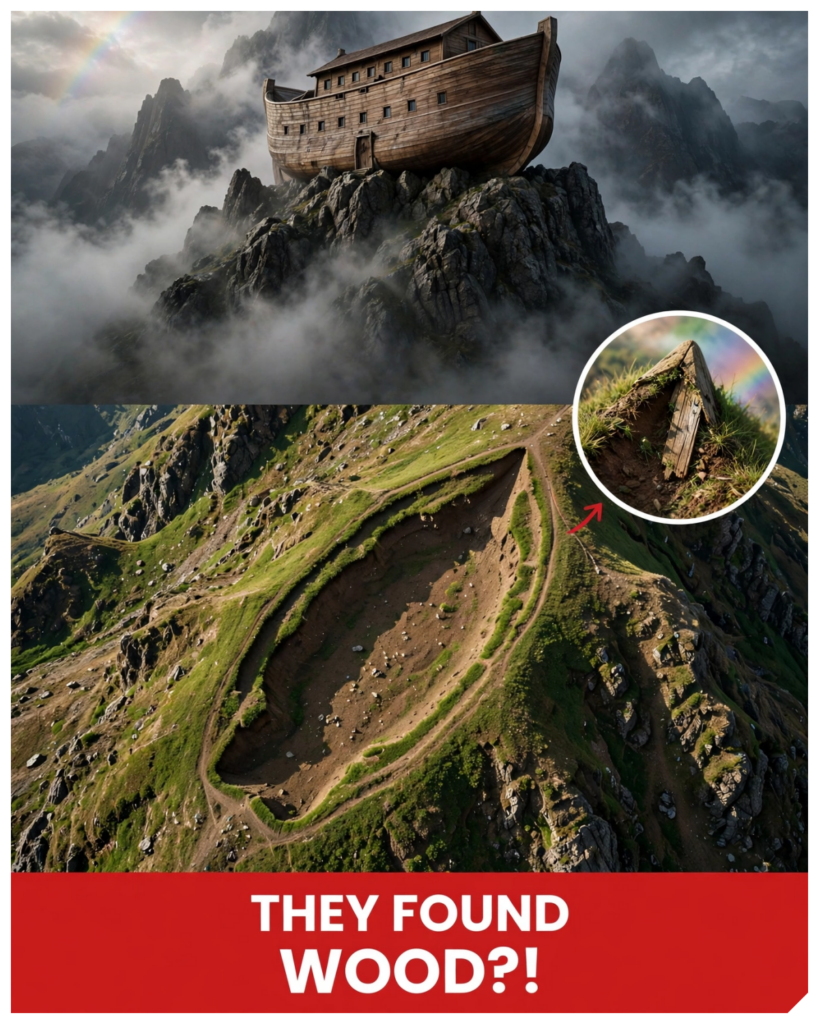
WHAT THE REED BROTHERS FOUND BENEATH THE ARK
Your father was right. The warning was never meant for the world to hear.
Jonathan stared at Gabriel.
“What warning?”
Gabriel did not answer immediately.
The underground camera continued showing the motionless figure standing beside the far wall.
Its face remained hidden in shadow.
Its hand was still pressed against the stone.
Then the image flickered.
The figure disappeared.
Daniel immediately checked the equipment.
“That camera just lost connection.”
“Can you restore it?” Jonathan asked.
“I’m trying.”
Miriam moved closer to the monitor.
“Don’t send it any farther.
We have no idea whether the passage is stable.”
Gabriel remained strangely calm.
Jonathan grabbed his jacket.
“You’re going to explain everything.”
Gabriel looked at him.
“Not here.”
“That’s not an answer.”
“Your brother knows more than I do.”
Jonathan turned toward Michael.
His younger brother stood beside the equipment table, pale and silent.
“Michael?”
Michael looked down.
“There’s something I never told you.”
Jonathan felt his anger return.
“What?”
“Seven years ago, after Dad died, I received a phone call.”
“From whom?”
“I don’t know.
The number was blocked.
The person said Dad had left something unfinished in Turkey.”
Jonathan shook his head.
“You never mentioned that.”
“Because I thought it was a cruel joke.”
“What did the caller say?”
Michael hesitated.
“He said that if I wanted to understand why Dad had spent so many years investigating the mountain, I should return to the place where he first heard the knocks.”
Jonathan stared at him.
“And you came here because of that?”
“Yes.”
“Why didn’t you tell me?”
“Because the caller knew things about Dad that nobody outside our family should have known.”
Michael reached into his bag and removed a small notebook.
Its cover was damaged.
The corners were bent.
A strip of faded tape held the spine together.
Jonathan recognized it.
It belonged to Elias.
“Where did you get that?”
“From Dad’s old storage unit.
I found it last month.”
Jonathan opened the notebook.
The first pages contained familiar research notes.
Maps, sketches, dates, and references to ancient flood traditions.
But toward the back, the handwriting changed.
The letters were smaller.
More hurried.
On one page, Elias had written:
*The greatest danger is not that people will fail to believe.
It is that they will believe without understanding.*
Jonathan read the sentence again.
Below it was a drawing of the underground chamber.
And beside the drawing were two names.
Jonathan. Michael.
Underneath them was another sentence:
Neither son can carry the truth alone.
Jonathan looked up.
“Why did he write our names?”
Gabriel finally answered.
“Because he knew the discovery would eventually bring you both here.”
“How?”
“Your father believed the chamber was designed to preserve a warning.
He thought the people who created it expected future generations to misunderstand what they found.”
Miriam frowned.
“You’re suggesting the inscriptions were deliberately written to prevent someone from claiming the chamber as proof of a particular religious interpretation?”
“That is what Elias believed.”
“Belief is not evidence,” she replied.
“I know.”
Gabriel’s voice had lost its earlier confidence.
For the first time, he sounded less like a wealthy collector and more like an exhausted man who had carried a secret for too long.
“Twenty-two years ago, Elias and I entered the first chamber.
We found the wooden box.
Inside were fragments of writing, a small metal seal, and a document that appeared to contain instructions.”
“What instructions?” Jonathan asked.
“To preserve the message.
To leave the chamber undisturbed.
And to make sure no one used the discovery to claim ownership over the story.”
Miriam considered this.
“Do you still have the document?”
“No.
Your father took it.”
“Then why didn’t he publish it?”
Gabriel looked toward Jonathan.
“Because the document was incomplete.
And because someone had already begun making plans to exploit it.”
Jonathan’s expression hardened.
“Who?”
Gabriel looked at the ground.
“Me.”
The room fell silent.
Michael stepped forward.
“Explain.”
Gabriel removed his glasses.
“I was younger.
I had money, influence, and a reputation for making discoveries that other people couldn’t.
I thought I could protect the site by securing the objects inside it.
I believed that if I controlled the evidence, I could control the people who wanted to destroy it.”
“And Dad disagreed,” Jonathan said.
“He told me that controlling a discovery was another way of destroying it.”
“Then what happened?”
Gabriel looked at the underground monitor.
“Your father found out that I had arranged for a private team to remove the box.
He confronted me.
We argued.
Then the chamber began to collapse.”
Jonathan remembered the photograph.
The three people standing near the entrance.
The missing face.
“Who was the third person?”
Gabriel’s face tightened.
“His name was Daniel Mercer.
He was a researcher who worked with us.
He believed the box contained something that could change the world.
He wanted to sell the contents to the highest bidder.”
“Was he the person in the chamber?”
“I don’t know.”
“You’re telling me someone disappeared underground twenty-two years ago?”
Gabriel nodded.
“We searched for him.
We found no body.
No clothing.
No equipment.
Nothing.”
Miriam shook her head.
“Then why did you tell everyone the chamber was empty?”
“Because the authorities had already been informed that an unauthorized excavation had taken place.
We had no permits for what we were doing.
The site was unstable.
I was afraid that if the truth emerged, the entire area would be sealed permanently.”
“So you lied,” Jonathan said.
“Yes.”
“And Dad carried the consequences.”
Gabriel did not deny it.
Michael’s voice trembled.
“Did you know he was dying?”
Gabriel looked at him.
“Yes.”
“Did you visit him?”
“Once.”
“Why didn’t you tell us?”
“Because he asked me not to.”
Jonathan laughed bitterly.
“Of course he did.
Everyone seems to know something about our father except his own sons.”
Gabriel looked at him with something close to pity.
“Your father was trying to protect you.”
“From what?”
“From the people who would come looking for the chamber.”
Before Jonathan could respond, Daniel shouted from the console.
“I’ve got the camera back!”
The monitor flickered.
The second chamber returned.
The wooden box remained open.
But the wrapped sheets inside were no longer where they had been.
Something had shifted them.
Daniel zoomed in.
A narrow compartment was visible beneath the base of the box.
It appeared to contain another object.
Miriam leaned toward the screen.
“There’s a second layer.”
Jonathan looked at Gabriel.
“Did you know about that?”
Gabriel shook his head.
“No.”
“You’re sure?”
“Yes.”
Daniel adjusted the camera again.
The hidden compartment contained a small rectangular device.
It looked like a metal plate.
Its surface was covered with tiny marks.
But what caught Jonathan’s attention was the object lying beside it.
A folded piece of paper.
It had been placed carefully inside the compartment.
The camera moved closer.
The handwriting became visible.
Jonathan recognized it instantly.
His father’s.
“Can you read it?” he asked.
Miriam enlarged the image.
The paper was fragile, but several lines were still legible.
She began reading slowly.
To my sons.
Jonathan’s heart began pounding.
If you have reached this room together, then the mountain has given you what I could not give you in life.
Michael moved closer.
Miriam continued.
*I have spent too many years believing that a discovery could repair what was broken between us.
I was wrong.
No ancient object can bring a family back together.
No manuscript can replace an apology.
No answer beneath a mountain can change the words we refused to say while we were still together.*
Jonathan lowered his head.
The words felt like a direct accusation.
He remembered the final argument with his father.
He remembered standing beside Elias’s hospital bed, demanding to know why he had wasted so much of his life on an impossible theory.
He remembered leaving before his father could finish speaking.
And he remembered that he had never returned.
Michael continued reading.
*Jonathan, you believed I chose the mountain over my family.
You were not entirely wrong.
I allowed my obsession to take time that belonged to you.*
Jonathan closed his eyes.
*Michael, you believed I trusted your brother more than I trusted you.
That was never true.
I was afraid that your anger would make you carry a burden you did not understand.*
Michael’s hands began to shake.
*My sons, the greatest discovery you can make here is not the identity of the vessel.
It is the truth about the people who built the warning and why they left it behind.*
Miriam paused.
The next section was partly damaged.
She could read only a few words.
Flood.
Memory.
Pride.
Mercy.
Then one final sentence:
Do not let anyone turn a warning against human arrogance into an instrument of arrogance.
Jonathan stared at the screen.
“That’s it?”
Miriam nodded.
“That’s all I can read from this image.”
Gabriel seemed disappointed.
“Where is the rest?”
Daniel moved the camera toward the metal plate.
“Maybe the answer is underneath.”
He adjusted the angle.
The plate reflected the camera light.
A series of small marks appeared across its surface.
Miriam examined them carefully.
“Those aren’t all writing.
Some could be measurements.
Others might be decorative.”
“Can you identify the date?” Jonathan asked.
“Not from this image.
We would need to examine the material and its context.”
Gabriel stepped forward.
“We need to retrieve it.”
Miriam turned sharply.
“We need proper conservation specialists, documentation, and authorization.”
“By the time we arrange that, someone else could find it.”
“Then we secure the site.”
Gabriel looked toward Jonathan.
“Your father wanted you to open the box.
He knew this day would come.”
Jonathan shook his head.
“You don’t get to speak for him.”
“I knew him longer than you think.”
“Then you should know he wouldn’t want you taking anything.”
Gabriel’s expression darkened.
For a moment, the old determination returned.
“Your father is dead, Jonathan.
The world doesn’t stop because he wrote a letter.”
Michael stepped between them.
“And neither does the truth become yours because you have money.”
Gabriel stared at him.
Then he slowly backed away.
The underground camera suddenly began moving.
It turned toward the passage behind the box.
A low scraping sound came through the speaker.
Daniel checked the controls.
“I’m not moving it.”
The camera continued turning.
A section of the rear wall came into view.
There was a narrow opening behind it.
And beyond that opening, something pale was visible.
Not a person.
Not a shadow.
A collection of long, curved wooden beams.
They were arranged in a pattern that suggested part of a much larger structure.
Miriam whispered:
“Is that timber?”
Daniel zoomed in.
The surface appeared dark and heavily mineralized.
Some sections were fractured.
Others seemed to retain a curved shape.
Jonathan leaned toward the screen.
“Could it be part of a vessel?”
Miriam gave him a careful look.
“We cannot determine that from a camera image.
It could be worked timber.
It could be something else entirely.
We need physical analysis before making any claims.”
Gabriel was staring at the screen.
His face had become almost colorless.
“What?” Jonathan asked.
Gabriel pointed toward the beams.
“That’s where the first passage ended.”
“You said the chamber collapsed.”
“It did.”
“Then how is there another passage?”
Gabriel shook his head.
“I don’t know.”
The camera moved closer.
Behind the curved beams was another surface.
A wall covered in writing.
Some of the markings were large.
Others were barely visible.
Miriam began photographing the screen.
“Stop moving it.
We need a stable image.”
Daniel froze the camera.
Miriam enlarged the clearest section.
Then she went silent.
Jonathan turned toward her.
“What is it?”
She pointed to a line of writing.
“I recognize the general form of some of these symbols, but the inscription may contain more than one writing tradition.
We need a specialist before translating it.”
“Can you read any part?”
Miriam hesitated.
“There is a phrase that appears to refer to a great flood.
But I cannot responsibly translate the entire passage from this image.”
Gabriel moved closer.
“Look at the bottom.”
Miriam followed his gaze.
At the lower edge of the wall, a name had been carved into the surface.
It was not Elias Reed.
It was not Gabriel Voss.
It was not a name from an ancient royal list.
It was a modern name.
DANIEL MERCER.
Jonathan looked at Gabriel.
“That’s your missing researcher.”
Gabriel nodded slowly.
“He was here.”
“Twenty-two years ago?”
“I thought so.”
“Then why is his name carved into the wall?”
Gabriel had no answer.
Michael moved closer to the monitor.
“Wait.”
He pointed to a second line beneath the name.
There were several letters.
Some were damaged.
But the final word was clear.
ALIVE.
Nobody spoke.
Elena slowly raised her camera.
Miriam looked toward the entrance.
“That could have been added later.”
“By whom?” Jonathan asked.
No one answered.
Then the underground speaker crackled.
A man’s voice emerged.
“Gabriel.”
Gabriel stepped backward.
The voice came again.
“Gabriel Voss.”
It was weak, but unmistakably human.
Gabriel’s face crumpled.
“Daniel?”
The voice did not answer.
Instead, it spoke again.
“Why did you leave me?”
Gabriel covered his mouth.
Jonathan stared at him.
“Is that him?”
Gabriel nodded.
“Yes.”
The voice came through one more time.
“Bring the brothers.”
Michael looked toward the screen.
“Why us?”
The answer was quiet.
“Because one of them opened the door.”
Jonathan turned toward Michael.
“What does he mean?”
Michael’s face had gone pale.
Then he reached into his bag and removed a small metal object.
It was a circular key.
Its surface carried the same ship-and-waves symbol.
Jonathan recognized it from their father’s notebook.
Michael held it up.
“I found this in Dad’s belongings.”
Gabriel stared at it.
“Where did you get that?”
“His storage unit.”
“Give it to me.”
“No.”
Gabriel stepped forward.
Michael closed his fist around the object.
“Tell us what it opens.”
Gabriel looked at the symbol.
Then at Jonathan.
“Your father said the key should never be used unless both brothers were present.”
Jonathan felt the room shift around him.
“Why?”
“Because the door was designed to open only when two separate mechanisms were activated.”
Miriam frowned.
“Where are those mechanisms?”
Gabriel pointed toward the screen.
“One is inside the box.”
He then pointed toward Michael’s hand.
“And the other is the key.”
Jonathan stared at the monitor.
“So the box is not the final discovery.”
“No,” Gabriel whispered.
“It’s the entrance.”
The Door That Should Never Have Opened
The team spent the next hour securing the equipment and examining the underground passage.
They did not attempt to enter the chamber immediately.
The ceiling had shifted twice, and Daniel warned that sending people into the cavity without additional supports could be fatal.
But the voice from below continued to haunt them.
Every few minutes, a faint sound emerged from the underground speaker.
Sometimes it was a knock.
Sometimes it was a scrape.
Once, it sounded like someone dragging a heavy object across stone.
Jonathan sat beside the equipment table, studying the photograph of his father and Gabriel.
Michael stood nearby.
Neither brother had spoken for almost twenty minutes.
Finally, Jonathan broke the silence.
“Why didn’t you tell me about the key?”
Michael looked at him.
“I told you.
I found it in Dad’s belongings.”
“You knew it matched the symbol.”
“I thought it was something he had collected.”
“You knew he sent you the envelope.”
“Yes.”
“And you still didn’t tell me everything.”
Michael’s expression hardened.
“Neither did you.”
Jonathan looked away.
“What does that mean?”
“You found his notebook before I did.
You read the pages.
You knew he was investigating this place.”
“I didn’t know about the key.”
“You knew he was coming back here.”
Jonathan had no answer.
Michael stepped closer.
“You accused me of abandoning Dad.
You said I wasn’t there when he needed us.”
Jonathan’s jaw tightened.
“That’s not what we’re discussing.”
“That’s exactly what we’re discussing.”
Michael’s voice cracked.
“You think I didn’t want to see him?
You think I didn’t call?
I was afraid, Jonathan.
Every time I heard his voice, he talked about the mountain.
He talked about things I couldn’t understand.
I thought he was slipping away from us.”
Jonathan stared at the floor.
“He was.”
“And I didn’t know how to help him.”
The silence between them grew heavy.
Jonathan finally spoke.
“I should have gone back.”
Michael nodded.
“So should I.”
Neither brother offered an excuse.
Neither tried to win the argument.
For the first time in years, they were not fighting over who had been more wrong.
They were admitting that both had been hurt.
And both had made mistakes.
Miriam approached them quietly.
“Your father left you both a message.
Perhaps it’s time you read the rest.”
She placed the recovered photograph on the table.
The image showed Elias and Gabriel beside the chamber.
Daniel Mercer stood behind them.
But there was something else.
A small detail at the edge of the photograph.
A fourth person.
A woman.
Her face was turned away from the camera.
She appeared to be holding a document.
Miriam enlarged the image.
“Do either of you recognize her?”
Jonathan shook his head.
Michael leaned closer.
Then his expression changed.
“I’ve seen her.”
“Where?” Jonathan asked.
“At Dad’s funeral.”
Jonathan looked at him.
“What?”
“She stood near the back of the church.
She didn’t speak to anyone.
After the service, she left before we could approach her.”
“Did you know who she was?”
“No.”
Gabriel studied the image.
Then he whispered a name.
“Sarah Mercer.”
Miriam turned toward him.
“Daniel’s wife?”
Gabriel nodded.
“She was part of the original expedition.”
“Why didn’t you mention her?”
“Because she disappeared too.”
Jonathan looked at the photograph again.
“You’re telling me two people vanished?”
“Yes.”
“And you never reported it?”
Gabriel’s face was filled with regret.
“I reported that they were missing.
But I didn’t tell the authorities what we had found.”
Miriam looked furious.
“You concealed the existence of a potentially significant archaeological chamber.”
“I thought I was preventing something worse.”
“That is not your decision to make.”
“I know that now.”
Jonathan picked up the photograph.
“Why was she at Dad’s funeral?”
Gabriel stared at the image.
“Because she knew he was dead.
And because she knew the work wasn’t finished.”
Michael took out the key.
“Then let’s finish it.”
Miriam shook her head.
“Not until we have a safe access plan.”
Daniel had been listening from the console.
“I may have a solution.”
He brought up a structural scan of the underground passage.
The chamber was supported by a combination of natural rock and fitted stone.
The newly discovered corridor appeared to connect to an older section beneath the main cavity.
“If we reinforce this section,” he explained, “we can send a small inspection unit through the gap.
It will take several hours.”
Gabriel looked impatient.
“We don’t have several hours.”
Daniel stared at him.
“We don’t have another option.”
Jonathan nodded.
“Do it properly.”
For the first time, Gabriel did not argue.
The Message in the Box
While Daniel worked, Miriam examined the images of the wooden box.
She compared the markings with known examples of ancient Near Eastern writing and later religious inscriptions.
The results were inconclusive.
Some symbols resembled forms found in ancient traditions.
Others appeared to be later additions.
The box itself could not be reliably dated from photographs.
But one detail interested her.
The inscription did not appear to identify the object as Noah’s Ark.
Instead, the clearest phrase referred to a vessel that had survived a great flood.
“That distinction matters,” she explained.
“Why?” Elena asked.
“Because a vessel associated with a flood story is not automatically the biblical Ark.
We need context, material analysis, and independent evidence.
Otherwise, we’re just forcing an interpretation onto an object.”
Jonathan nodded.
“Then what do you think it is?”
Miriam studied the screen.
“I think someone wanted future generations to remember a catastrophe.
I think they wanted the message preserved.
And I think they were afraid people would turn the memory into a claim of power.”
Gabriel sat silently.
Jonathan looked at him.
“You knew that already.”
“I suspected it.”
“Then why did you keep chasing the box?”
Gabriel looked toward the dark opening.
“Because I thought the person who controlled the evidence could control the story.”
Miriam’s expression softened slightly.
“And now?”
Gabriel looked at the brothers.
“Now I understand that the story was never mine.”
A small printer beside the console began producing a series of images.
Daniel had extracted several frames from the underground camera.
One showed the interior of the box.
Another showed the folded paper.
The final image showed a small inscription hidden beneath the metal seal.
Miriam picked it up.
The letters were difficult to distinguish.
She compared them with the image on the monitor.
Then she read the phrase aloud.
“To those who come after the flood.”
She turned the paper over.
There was another line.
“Do not seek the name of the builder before you understand the reason for the vessel.”
Jonathan frowned.
“What does that mean?”
Miriam considered the words.
“Perhaps the original message was about survival, memory, and responsibility.
Not about proving who owned the story.”
She looked toward the brothers.
“Your father may have believed that the chamber contained a warning about what happens when people mistake a symbol for the truth itself.”
Jonathan thought about his father’s final letter.
Do not let anyone turn a warning against human arrogance into an instrument of arrogance.
For the first time, he began to understand why Elias had refused to publish his findings.
He had feared that the discovery would become another battlefield.
Not because the evidence was necessarily false.
But because people could use incomplete evidence to justify almost anything.
The Second Key
By midnight, Daniel had completed the initial reinforcement.
A small inspection unit was sent into the underground passage.
The camera passed through the first chamber and reached the wooden box.
Michael stood beside Jonathan.
The circular key was in his hand.
Miriam examined the mechanism visible beneath the box.
“There is a recessed opening on the lower side.”
Jonathan looked at the screen.
“That’s where the key goes.”
Gabriel stepped forward.
“Then the second mechanism is inside the box.”
Miriam shook her head.
“We don’t know that.
And we should not activate anything until we’ve documented it.”
Jonathan agreed.
But then the underground camera revealed something unexpected.
A small panel had opened beneath the wooden platform.
Inside was a second circular recess.
Its dimensions matched the key.
Michael stared at it.
“That’s it.”
Gabriel moved toward him.
“Give me the key.”
Michael did not move.
“Why?”
“Because I know how the mechanism works.”
“Then explain it.”
Gabriel looked at the brothers.
“Your father showed me the first time we entered.
The key was designed to release a locking pin.
But it only works when the pressure on both sides is equal.”
Daniel frowned.
“Pressure from what?”
Gabriel pointed toward the box.
“The metal plate.”
Miriam looked at the screen.
“Then this may be a mechanical locking system.”
“Exactly.”
Michael held the key tighter.
“Why did Dad tell us to bring it together?”
Gabriel looked at him.
“Because the mechanism requires two people.
One holds the key.
The other releases the locking plate.”
Jonathan understood.
Their father had designed nothing.
He had simply preserved the instructions.
But he had deliberately left the task to his sons.
Not because they were chosen by prophecy.
Not because they possessed special powers.
Because he wanted them to face the discovery together.
Michael looked at Jonathan.
“Are you ready?”
Jonathan nodded.
They moved toward the entrance.
Miriam followed.
“Remember, we are not going to force anything.
If the mechanism resists, we stop.”
Daniel monitored the structural readings.
Elena checked her camera.
Gabriel remained behind them.
When the brothers reached the chamber, the wooden box was visible in the pale light of their equipment.
It looked smaller than it had on the monitor.
Older, too.
The surface was covered in mineral deposits.
The metal band was corroded.
The circular seal seemed to have been repaired at least once.
Jonathan approached the platform.
Michael knelt beside the mechanism.
“Here.”
He placed the key into the recess.
It fitted perfectly.
Jonathan looked at the locking plate.
“Now what?”
Michael turned the key slowly.
Nothing happened.
He tried again.
A faint click sounded beneath the platform.
Daniel checked the readings.
“Something moved.”
Miriam leaned closer.
“Stop.
Wait for the pressure readings.”
The numbers remained stable.
Michael turned the key another fraction.
A second click sounded.
Then the wooden platform shifted.
A narrow compartment opened.
Inside lay a small metal cylinder.
Jonathan carefully lifted it.
It was sealed at both ends.
There were no visible labels.
Miriam examined the surface.
“Don’t open it here.”
Gabriel stepped forward.
“Give it to me.”
Jonathan moved away.
“No.”
Gabriel stopped.
“You’re making a mistake.”
“Then explain why.”
Gabriel looked at the cylinder.
“Because I know what your father put inside.”
Jonathan froze.
“You’ve seen it?”
“No.”
“Then how do you know?”
Gabriel lowered his voice.
“Because I helped him prepare it.”
The brothers stared at him.
“What?” Michael whispered.
Gabriel closed his eyes.
“Twenty-two years ago, after the first chamber collapsed, your father and I recovered a document from the second passage.
It was damaged.
He believed the original text could be misunderstood.
So he created a copy, added his own explanation, and sealed it inside a container.”
“Why?” Jonathan asked.
“Because he wanted a record that could survive even if the original chamber was lost.”
Jonathan looked down at the cylinder.
“Then what’s inside?”
Gabriel’s voice trembled.
“A letter.
And a recording.”
Miriam frowned.
“A recording?”
Gabriel nodded.
“Your father’s voice.”
Jonathan felt his chest tighten.
“Why didn’t you tell us?”
“Because I thought the cylinder had been destroyed.”
Michael examined the seal.
It carried the same symbol as the box.
But beneath it was another marking.
A small date.
Seven years earlier.
The year their father died.
Jonathan looked at Gabriel.
“Did Dad put this here before he died?”
“Yes.”
“Then he knew we would return.”
Gabriel did not answer.
Miriam carefully documented the cylinder.
They transported it to a temporary conservation area under controlled conditions.
No one opened it until the seal and surface had been photographed from every angle.
The process took nearly two hours.
Finally, the cylinder was opened.
Inside was a small memory device wrapped in protective material, a folded letter, and a thin sheet of paper covered in handwriting.
Jonathan recognized the handwriting immediately.
His father’s.
He opened the letter.
It began with a sentence that made his eyes fill with tears.
My sons, if you are reading this together, then I have finally been given the one thing I could never arrange for myself: another chance to speak to both of you at the same time.
Michael turned away.
Jonathan continued.
*I am sorry that I made the mountain more important than the people I loved.
I told myself I was protecting history.
Sometimes I was only protecting my pride.*
Jonathan stopped reading.
His hands trembled.
Michael placed a hand on his shoulder.
“Keep going.”
The next paragraph explained that Elias had spent years studying accounts of ancient floods, surviving communities, and traditions that had preserved memories of catastrophic waters.
He had never possessed conclusive proof that the controversial formation near Mount Ararat was Noah’s Ark.
He had never claimed that the objects inside the chamber could settle every religious question.
But he believed the underground site preserved a historical message that deserved careful investigation.
The letter continued:
*The people who left this message understood that survival is not the same as victory.
They did not write that the survivors were better than everyone else.
They wrote that the survivors had a responsibility to remember.*
Miriam read the line again.
“That’s important.”
Jonathan continued.
*The vessel, if it was a vessel, was only a means of survival.
The real message was what happened afterward.
Would people rebuild with humility?
Would they remember those who were lost?
Would they learn to care for one another?
Or would they use survival as proof that they were superior?*
Michael lowered his head.
The letter ended with a personal message.
*Jonathan, forgive yourself for leaving my room.
Michael, forgive yourself for staying away.
I should have made it easier for you to return.
I should have told you that I needed you.*
Jonathan could no longer hold back his tears.
For years, he had imagined that his father died believing he had failed him.
Now he understood that Elias had spent his final years regretting the same distance.
Michael placed his hand over the letter.
“We should have gone back.”
Jonathan nodded.
“We should have.”
Neither brother tried to comfort the other with easy words.
They simply stood together.
And for the first time since their father’s funeral, they allowed themselves to grieve without turning their grief into blame.
The Recording
The memory device was connected to a secure laptop.
A single audio file appeared.
Its date matched the final months of Elias Reed’s life.
Jonathan pressed play.
At first, there was only static.
Then came a cough.
And then the familiar voice.
“My boys.”
Jonathan closed his eyes.
“If you’re hearing this, then I didn’t get the chance to explain everything.
I’m sorry.”
A long pause followed.
“I spent too much of my life searching for something that I thought would answer every question.
I believed that if I could prove what happened here, I could finally prove that my life had meant something.”
Michael looked down.
“But I learned something,” Elias continued.
“An object can be old and still be misunderstood.
A symbol can be powerful and still be used for the wrong reason.
A story can be sacred to millions of people, and still be damaged by those who claim to own it.”
There was another pause.
“The chamber contains a message.
It does not contain permission to make claims that the evidence cannot support.
It does not prove every detail of the story of Noah.
It does not prove that one person, institution, or nation has the right to control the past.”
Jonathan listened, barely breathing.
“Jesus warned people against pride, hypocrisy, and the temptation to place outward appearances above what is right.
I cannot tell you what every person should believe about this place.
But I know that any discovery that makes us crueler, more arrogant, or more willing to deceive others has already been misunderstood.”
Miriam lowered her eyes.
Elias continued.
“Do not let anyone use my work to create a miracle where the evidence is uncertain.
Do not let anyone use uncertainty to dismiss the possibility of history.
Be honest about what you know.
Be equally honest about what you do not know.”
The recording crackled.
Then his voice became quieter.
“Jonathan, you wanted certainty.
Michael, you wanted freedom from the questions.
I wanted both of you to understand me.
None of us knew how to ask for what we needed.”
Jonathan began crying silently.
“Forgive me,” Elias said.
“And please, if you find the room, don’t take anything that does not belong to you.
Document it.
Protect it.
Let the evidence speak before anyone tries to make it speak for them.”
The recording ended.
For several seconds, nobody moved.
Then Michael whispered:
“He knew.”
Jonathan nodded.
“He knew we would come.”
Gabriel stood apart from the group.
His eyes were wet.
Jonathan looked toward him.
“What did you do with the original document?”
Gabriel slowly reached inside his jacket.
He removed a small, folded sheet.
“I kept a copy.”
Miriam looked at him.
“You had it all this time?”
Gabriel nodded.
“Your father gave it to me after the first expedition.
He told me that if I ever had another chance to protect the site, I should do it without trying to own it.”
Jonathan looked at the paper.
“Why didn’t you give it to us?”
“Because I didn’t trust myself.”
It was the first honest answer Gabriel had given all night.
He placed the document on the table.
Miriam examined it.
The paper was fragile.
The writing was partly faded.
It contained a series of short statements.
Not a royal declaration.
Not a list of treasures.
Not a claim that the vessel belonged to a particular nation.
Instead, it appeared to be a record of people who had survived a great catastrophe.
It described loss.
Hunger.
Separation.
The rebuilding of shelters.
The sharing of food.
The preservation of stories for children who had never seen the waters.
At the bottom was a sentence that Miriam read twice.
“Those who survive must not forget those who did not.”
Nobody spoke.
Outside, the wind moved across the mountain.
And for the first time, the discovery felt less like a mystery about an ancient vessel and more like a message about human responsibility.
The Man Behind the Wall
The next morning, the team returned to the underground chamber.
The camera had recorded a narrow opening behind the curved wooden beams.
They reinforced the passage and sent a second inspection unit through.
This time, the image was clearer.
The chamber beyond contained several objects.
Broken wooden pieces.
Fragments of pottery.
Metal fittings.
A collection of small containers.
None of them could be identified conclusively without laboratory examination.
But there was something else.
A narrow recess in the wall.
And inside it, a human hand.
Elena gasped.
Daniel immediately stopped the camera.
Miriam moved closer.
“Is that a body?”
The camera shifted slightly.
The hand did not move.
Gabriel looked as though he might collapse.
“Daniel.”
No answer came.
Gabriel approached the monitor.
“Daniel Mercer?”
The camera feed revealed a dark shape behind the wall.
A person appeared to be seated in a narrow space.
A torn piece of fabric hung from one shoulder.
The team could not determine whether the remains were recent or ancient.
Daniel checked the air readings and structural stability.
“We need to get specialists in here.
We cannot enter that section without a rescue assessment.”
Gabriel shook his head.
“He’s alive.”
Miriam looked at him.
“How can you know that?”
“I heard him.”
“You heard a voice through an electronic system.
That doesn’t establish that a living person is inside.”
Gabriel stepped closer.
“Daniel!”
The speaker crackled.
A weak voice answered.
“Gabriel?”
Gabriel covered his face.
“Yes.
I’m here.”
A long pause.
Then the voice spoke again.
“You took your time.”
Gabriel began to cry.
Jonathan stared at the monitor.
The man behind the wall had answered.
Daniel immediately contacted the appropriate emergency and rescue authorities through the expedition’s local partners.
The team secured the area and waited for the specialists.
No one attempted a reckless rescue.
The chamber was unstable, and the possible survivor could have been seriously injured.
The rescue team arrived later that day.
They examined the passage, installed additional supports, and carefully widened the opening.
Hours passed.
Every movement was slow.
Every section of stone had to be assessed before it could be removed.
Finally, a narrow gap opened.
A man was visible inside.
He was extremely weak.
His hair was white.
His clothing was damaged.
His face was thin.
But he was breathing.
When the rescue team reached him, he opened his eyes.
Gabriel stood near the entrance.
The man looked at him.
For a moment, neither spoke.
Then the man whispered:
“You came back.”
Gabriel fell to his knees.
“I’m sorry.”
The rescued man was identified as Daniel Mercer.
He was alive.
But his survival was not a supernatural event.
The team could not immediately explain how he had remained in that space or establish the full timeline of what had happened.
His condition required urgent medical attention, and the rescue authorities took control.
Sarah Mercer was contacted through the appropriate channels.
When she arrived, she was older than the woman in the photograph.
She stood outside the medical area, unable to move.
Then Daniel opened his eyes.
“Sarah?”
She covered her mouth.
For a moment, she looked as if she might faint.
Then she rushed to his bedside.
“You promised me you would come home,” she whispered.
Daniel began to cry.
“I tried.”
Sarah held his hand.
“You were gone for twenty-two years.”
He closed his eyes.
“I know.”
Jonathan watched from the doorway.
He thought of his father.
He thought of all the years that had passed while people believed Daniel was dead.
And he understood that the mountain had not simply preserved objects.
It had preserved unfinished lives.
The Truth About Gabriel Voss
After Daniel’s rescue, the expedition was suspended.
The site was secured.
The authorities were informed.
The archaeological materials were placed under proper supervision.
Gabriel Voss was asked to provide a full account of the earlier excavation.
He did not resist.
For the first time, he told the complete story.
Twenty-two years earlier, he had financed a private expedition with Elias Reed and Daniel Mercer.
They had discovered the first underground chamber and the wooden box.
Gabriel had wanted to remove the box.
Elias had refused.
Daniel had become convinced that the chamber contained evidence that would make him famous.
The argument had escalated.
During the confrontation, part of the passage collapsed.
Daniel became trapped.
Elias and Gabriel escaped.
They attempted to return with help, but the passage had shifted.
They could not reach him.
Later, Elias discovered a second route into the chamber.
He found signs that Daniel might still be alive, but the passage was too unstable to enter safely.
Gabriel wanted to close the site permanently.
Elias wanted to preserve it and continue searching for Daniel.
The two men separated.
Elias spent years investigating the chamber.
Gabriel spent years trying to control the consequences of their discovery.
When Elias became seriously ill, he contacted Gabriel one final time.
He asked him to help bring his sons to Turkey.
Gabriel agreed.
But he had not been honest about his motives.
He still hoped to secure the objects before anyone else could claim them.
He wanted the discovery to make him remembered.
And he feared that if he surrendered control, the story would escape him.
Jonathan listened without interrupting.
Finally, he asked:
“Did you ever care about the history?”
Gabriel looked at him.
“Yes.”
“Then why did you treat it like something you could own?”
Gabriel’s eyes lowered.
“Because I confused protecting something with possessing it.”
Michael shook his head.
“You could have told the truth years ago.”
“I know.”
“You could have helped Daniel.”
“I know.”
“You could have helped our father.”
Gabriel closed his eyes.
“I know.”
Jonathan looked at him for a long moment.
Then he said:
“An apology doesn’t erase what happened.”
“No,” Gabriel replied.
“It doesn’t.”
“But it can be the beginning of telling the truth.”
Gabriel nodded.
For the first time, he seemed willing to accept that he could not control what happened next.
What Was Really Inside the Chamber?
In the weeks that followed, the discovery attracted enormous attention.
News outlets reported that an expedition near Mount Ararat had uncovered an underground chamber containing wooden fragments, inscriptions, and a sealed box.
Some headlines immediately declared that Noah’s Ark had been found.
Others claimed that the chamber contained a message connected to Jesus.
A few went further, announcing that scientists had uncovered proof of a biblical mystery that had remained hidden for thousands of years.
Jonathan watched the reports with growing concern.
None of those claims had been established.
The wooden fragments had not yet been dated conclusively.
The inscriptions required further study.
The origin of the box remained uncertain.
The chamber’s relationship to the disputed geological formation was still being investigated.
And there was no verified evidence proving that the site was Noah’s Ark.
Jonathan called a press conference.
Miriam stood beside him.
Daniel and Sarah attended remotely during his recovery.
Michael stood near the back of the room.
Gabriel did not attend.
Jonathan approached the microphones.
“I know many people want a simple answer,” he began.
“Some want us to say that Noah’s Ark has been found.
Others want us to say that the entire discovery is meaningless.”
He paused.
“Neither conclusion would be honest.”
Reporters began raising their hands.
Jonathan continued.
“We have documented an underground chamber.
We have identified objects that require careful examination.
We have recovered inscriptions and personal records.
We have also discovered evidence that an earlier expedition concealed important information.”
A reporter interrupted.
“Are you saying this is Noah’s Ark?”
Jonathan looked directly at the camera.
“No.
We are saying that the site deserves serious investigation.
We are not claiming that the evidence proves the biblical Ark has been found.”
Another reporter asked:
“Does the discovery prove that Jesus warned people about this place?”
Jonathan shook his head.
“We have found no authenticated evidence establishing that Jesus specifically warned anyone about this chamber.
The words in the recovered material appear to reflect a broader warning about pride, memory, and responsibility.
Any connection beyond that would be speculation.”
A third reporter asked:
“Then why call this discovery important?”
Jonathan looked down at the notes in front of him.
“Because history matters even when it doesn’t give us the answer we expected.
Because a possible archaeological discovery should not be turned into a weapon.
And because the people who preserved these records may have wanted future generations to remember something more important than the identity of a vessel.”
He paused.
“That survival creates responsibility.”
The room became quiet.
Jonathan looked toward Michael.
His brother gave him a small nod.
For once, they were standing on the same side of something.
The Final Letter
Three months later, Jonathan returned to his father’s house.
The old study smelled of dust, paper, and cedar wood.
He had avoided the room for years.
Now he entered with Michael beside him.
The shelves were still filled with books.
The desk remained covered with old maps.
A small lamp stood beside a photograph of Elias.
Jonathan opened the bottom drawer.
Inside was a sealed envelope.
His name was written on the front.
Jonathan.
Michael stood behind him.
“Open it.”
Jonathan carefully removed the letter.
It was short.
My dear Jonathan,
If you are reading this, then you have probably found something I spent too many years trying to understand.
I hope you discovered that the mountain was never the most important thing.
I hope you discovered that your brother is still your brother.
And I hope you understand that I never wanted you to inherit my obsession.
I wanted you to inherit my curiosity.
*Ask questions.
Demand evidence.
Respect what you do not understand.
And never allow the desire to be right to become more important than the responsibility to be honest.*
*I loved you both.
Even when I did not know how to show it.*
Dad.
Jonathan folded the letter.
For a long time, he simply held it.
Then Michael sat beside him.
“Do you think he knew we’d make up?”
Jonathan smiled sadly.
“I think he hoped.”
Michael looked at the photograph.
“I wish we had given him more time.”
“So do I.”
Outside, rain began falling against the windows.
The sound reminded Jonathan of the mountain.
Of the chamber.
Of the wooden box.
Of the three knocks that had started everything.
He looked at Michael.
“Do you regret going?”
Michael considered the question.
“No.”
“Even after everything?”
“Especially after everything.”
Jonathan nodded.
They placed the letter beside their father’s photograph.
Then they closed the drawer.
The Last Message from the Mountain
A year after the expedition, the underground chamber remained under controlled archaeological study.
The recovered objects were not placed in a private collection.
The material was documented, examined, and preserved under the supervision of qualified specialists and the relevant authorities.
The wooden fragments were still being analyzed.
No final conclusion had been reached about their age or origin.
The inscriptions remained a subject of scholarly investigation.
And the controversial formation near Mount Ararat continued to be debated.
But one object had changed the Reed brothers more than anything else.
The small metal cylinder containing their father’s letter and recording.
Jonathan kept a copy of the recording.
Michael kept the original letter.
They agreed that neither would ever sell it.
One evening, while reviewing the final expedition footage, Jonathan noticed something he had missed.
The camera had captured the far wall of the chamber shortly before the rescue operation.
At the edge of the image, beneath a layer of sediment, was a small inscription.
It had not been visible in the earlier photographs.
Jonathan enlarged the frame.
The words were faint.
He called Miriam.
She examined the image and compared it with the other inscriptions.
After several minutes, she sent him a message.
I cannot authenticate the entire phrase from this footage, but the final words appear to read: “Remember those who were not saved.”
Jonathan stared at the screen.
It was not a triumphant declaration.
It was not a claim of ownership.
It was not proof that one group had been chosen over another.
It was a reminder of loss.
He thought of Daniel Mercer, who had spent twenty-two years trapped beneath the mountain.
He thought of Sarah, who had waited without knowing whether her husband was alive.
He thought of Gabriel, who had spent decades protecting a secret that ultimately became a prison of his own making.
And he thought of Elias.
A father who had searched for an ancient message while failing to recognize how much his own sons needed to hear him.
The next morning, Jonathan called Michael.
“I found something in the footage.”
“What?”
“Another inscription.”
“What does it say?”
Jonathan looked toward the window.
“I think it says we should remember the people who weren’t saved.”
Michael was silent.
Then he answered:
“Maybe that’s why the message survived.”
Jonathan looked at the old photograph on his desk.
“Maybe.”
A Discovery Bigger Than the Treasure
Months later, Jonathan and Michael returned to Turkey.
They did not go to the mountain as expedition leaders.
They went as visitors.
The area around the excavation had been secured.
The underground chambers were no longer accessible to the public.
Researchers continued working carefully, and the findings were being evaluated without promises of sensational conclusions.
The brothers stood at a distance, looking toward the ridge.
The wind moved across the landscape.
Michael placed his hands inside his jacket.
“Do you ever think about what would have happened if we hadn’t come?”
Jonathan considered the question.
“Daniel might never have been found.”
“And Dad’s message?”
“We might never have understood it.”
Michael looked at the mountain.
“Do you think we found Noah’s Ark?”
Jonathan did not answer immediately.
He had spent years searching for certainty.
Now he understood that certainty was not something a person could demand from history.
“We found something worth studying,” he said.
“But we haven’t proved that it was the Ark.”
Michael nodded.
“And what about the warning?”
Jonathan looked toward the distant mountains.
“I think that part was real.”
“Which part?”
“That people can survive a disaster and still fail to learn from it.
That they can preserve a story and forget its meaning.
That they can discover something important and destroy it by trying to own it.”
Michael smiled faintly.
“Sounds like Dad.”
Jonathan laughed.
“Yes.
It does.”
They stood together for several minutes.
Then Michael spoke again.
“There’s something I want to ask you.”
“What?”
“If we had another chance to do everything differently, would you?”
Jonathan looked at his brother.
“Of course.”
“Would you still have gone into the mountain?”
Jonathan thought about the chamber, the box, the rescue, and the letter.
Then he shook his head.
“I would have spent more time with Dad before he died.”
Michael lowered his eyes.
“Me too.”
Jonathan placed a hand on his brother’s shoulder.
“We can’t change that.”
“No.”
“But we can change what happens next.”
Michael nodded.
And together, they walked away from the mountain.
The Meaning of the Warning
That evening, Jonathan wrote a final entry in his father’s notebook.
He did not write about proving the existence of Noah’s Ark.
He did not write about the possibility of a miracle.
He wrote about the people.
About the two brothers who had spent years allowing grief to separate them.
About the researcher who had been lost underground.
About the wife who had refused to stop hoping.
About the man who had confused possession with protection.
And about the father who had left a message for his sons.
At the bottom of the page, Jonathan wrote:
Perhaps the greatest mystery was never what survived the flood.
Perhaps it was what humanity chose to become afterward.
He closed the notebook.
For the first time in many years, the search was over.
Not because every question had been answered.
But because he had finally understood which questions mattered.
The mountain still held secrets.
The underground chamber still required careful study.
The recovered objects still needed scientific examination.
And the story of Noah’s Ark remained a matter of faith, tradition, history, and continuing debate.
But Jonathan no longer believed that the value of the discovery depended on proving a sensational headline.
He believed the real discovery was the warning preserved in the chamber:
Do not turn survival into superiority.
Do not turn faith into a weapon.
Do not confuse the object with the message.
And do not wait until someone is gone to tell them that you love them.
The final words of his father’s recording returned to him.
*Be honest about what you know.
Be equally honest about what you do not know.*
Jonathan looked at the photograph of Elias.
Then he whispered:
“We finally heard you, Dad.”
And somewhere in the distance, the wind moved across the mountains.
Three soft knocks echoed in his memory.
This time, he did not feel afraid.
He understood that some doors should be opened carefully.
Some mysteries should be approached with humility.
And some warnings should never be forgotten.
Because the greatest discovery beneath the mountain was not a treasure, a relic, or even a vessel.
It was the truth that what humanity saves is meaningless if humanity forgets how to care for one another.


