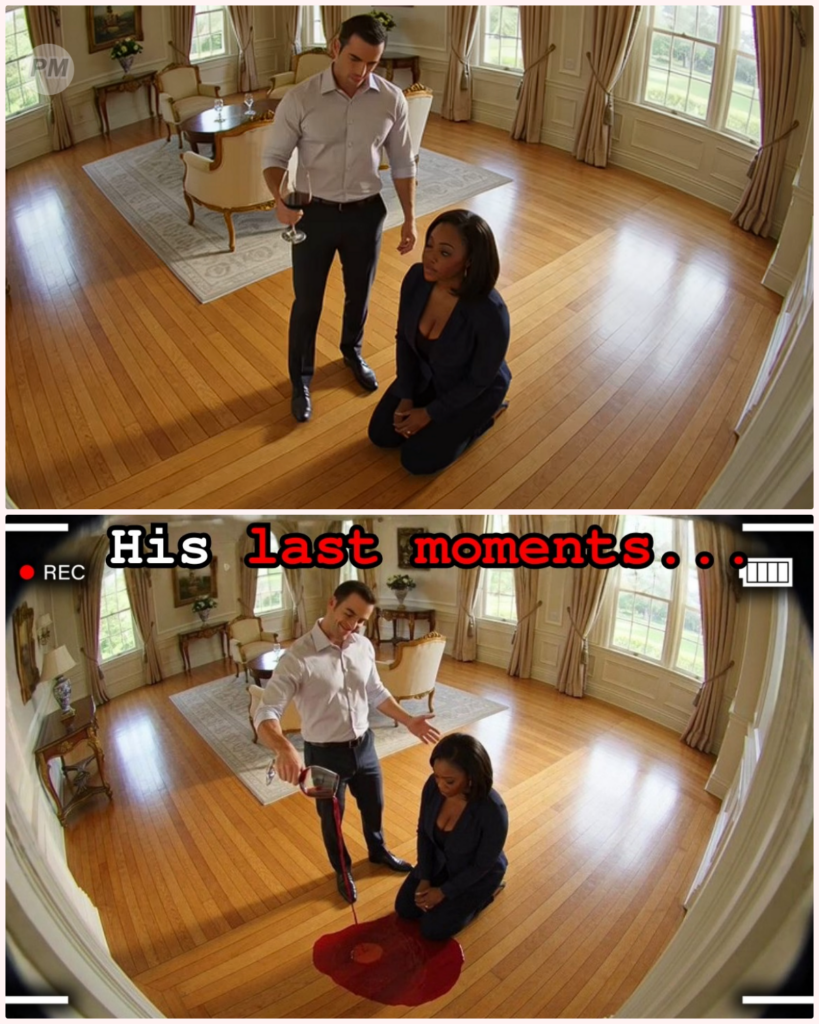
>> Pay attention to this footage. Charleston, South Carolina. A living room inside a mansion.
The camera is mounted high in the corner. Security system. Motion activated. It captures something that was never meant to be seen.
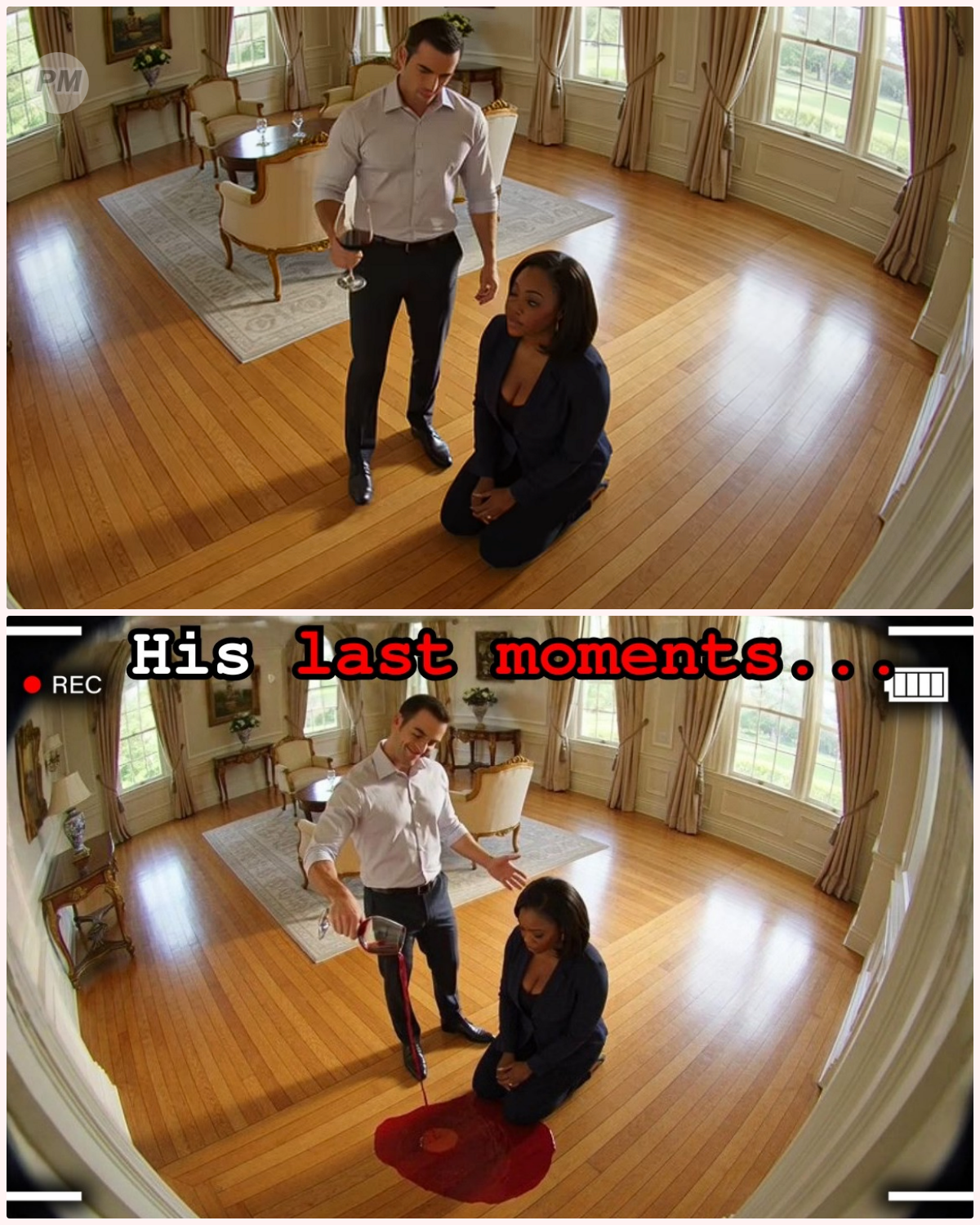
A man standing. A woman on her knees. The man holds a wine glass. He tilts it.
Red wine pours onto the hardwood floor. The liquid spreads. The man gestures at the spill.
He’s smiling. The woman doesn’t move. She stays on her knees, head lowered. This footage is 8 seconds long and it would change everything.
Because the man who installed those cameras saw it. And what he saw made him rewrite his will.
This is the story of Maya. 20 years of servitude. A family that treated her like property.
And the moment everything they owned was taken away. To understand how 8 seconds of footage destroyed a dynasty, you need to go back to the beginning.
Because what happened in that living room wasn’t an isolated incident. It was the result of a system built on silence, exploitation, and the belief that some people don’t matter.
Maya was 35 years old. She had lived in the Sterling mansion for 30 years.
Ever since she was five. The house was in Charleston, South Carolina. A sprawling colonial estate on the edge of the historic district.
White columns. Brick facade. Gardens that required a full-time groundskeeper. The kind of house that appeared in magazines.
The kind of wealth that didn’t announce itself because it didn’t have to. The Sterling family had owned textile mills across the South for four generations.
Cotton. Linen. Fabric that ended up in department stores across the country. By the 2000s, most of the mills were automated or outsourced.
But the money remained. And so did the legacy. The Sterlings were old Charleston. The kind of family that had portraits in the historical society.
Whose names appeared on hospital wings and university buildings. And Maya had grown up in the shadow of that legacy.
But she was never part of it. Her parents had worked at one of the Sterling mills.
Floor workers. 12-hour shifts. Minimum wage. They died in a car accident when Maya was five years old.
A collision on the highway coming home from a night shift. Maya had no other family.
No aunts or uncles who could take her. She was about to enter the foster system when something unexpected happened.
The head of Sterling Industries, William Sterling, made an offer. He would take her in.
Raise her in his home. It was an act of charity, he said. A gesture of goodwill to the family of employees who had served the company faithfully.
The community praised him. The local paper ran a story. Wealthy industrialist opens home to orphaned child of factory workers.
It was a beautiful narrative. And for the first few years, it almost felt true.
Maya grew up alongside William Sterling’s two children, Grant and Claire. They were the same age as her.
Grant was five. Claire was seven. And for a while, they were playmates. They shared toys.
Attended the same private elementary school. Sat at the same dinner table. But as the years passed, the differences became clear.
Grant and Claire were Sterlings. Maya was not. Grant and Claire went to boarding school.
Maya stayed home. Grant and Claire went to Ivy League universities. Maya took online courses at community college while cleaning the house.
Grant and Claire traveled to Europe every summer. Maya stayed behind to manage the staff and keep the estate running.
By the time Maya was 18, the illusion of family had completely dissolved. She wasn’t a sister.
She was help. Unpaid help. William Sterling never paid Maya a salary. There was no contract.
No formal employment. The logic was simple. He had given her a home. Food. Education.
A roof over her head. That was payment enough. And Maya, having grown up in that house, having known no other life, accepted it.
What choice did she have? She had no degree. No work history. No references outside the Sterling household.
She was 35 years old and she had spent her entire adult life as an unpaid servant in the home of the family that had taken her in as a child.
She cooked. She cleaned. She managed the household staff. And when William’s wife, Margaret, began showing signs of Alzheimer’s disease in her early 60s, Maya became her caretaker.
For five years, she bathed her. Fed her. Sat with her through the confusion and the fear.
And when Margaret died in early 2023, Maya was the one who held her hand.
Margaret’s death broke something in William. He had been married to her for 42 years.
And in the months after she died, he began to fade. Not from illness. From grief.
He stopped going to the office. Stopped attending board meetings. He spent his days in his study reviewing old photos, watching home videos, and checking the security footage.
The mansion had cameras installed throughout. William had added them years earlier when Margaret’s condition worsened.
He wanted to monitor her. Make sure she didn’t wander. Make sure the staff was treating her well.
The cameras recorded everything. And in the weeks after Margaret’s death, William reviewed the footage obsessively.
Looking for moments he had missed. Conversations he hadn’t heard. And that’s when he saw it.
The footage from the living room. Grant standing. Maya on her knees. The wine. The smile.
The dismissive gesture. And William watched it. Over and over. And he realized something that maybe he had known all along but had refused to see.
His children were not good people. Think about that moment. You spend your life building an empire.
You raise children you believe will carry your legacy. You tell yourself that the wealth you’ve accumulated will be used for good.
That your family will be remembered not just for what they had, but for what they did with it.
And then you see 8 seconds of footage that destroys all of that. You see your son humiliating a woman who has spent 20 years serving your family without complaint.
Without pay. Without recognition. And you realize that everything you believed about your children was a lie.
That the values you thought you had instilled in them never took root. That they learned cruelty instead of kindness.
Entitlement instead of responsibility. And that realization for someone like William Sterling was worse than death.
Because it meant that everything he had built would be inherited by people who didn’t deserve it.
William called his lawyer three days after watching the footage. His name was Harold Brennan.
He had been the Sterling family attorney for 20 years. He arrived at the mansion the following afternoon.
William met him in the study. The door was closed. They spoke for two hours.
And when Harold left, he was carrying a flash drive. Footage from the security cameras.
Footage that William wanted included as evidence in a new will. A will that would disinherit both of his biological children.
Harold tried to talk him out of it. He said it would be contested. That Grant and Claire would challenge it in court.
That they would argue undue influence or diminished capacity. But William was clear. His mind was sharp.
His decision was final. And if his children wanted to fight it, they would lose.
Because the evidence was irrefutable. He had seen what they were. And he was not going to reward it.
The new will was finalized in April 2023. It was 12 pages long and it stated in clear and unambiguous terms that upon William Sterling’s death, the entirety of his estate would pass to Maya.
The house. The remaining shares of Sterling Industries. The investment portfolio. The offshore accounts. Everything.
Grant and Claire would receive nothing. The will included a clause explaining the decision. It referenced the security footage.
It described years of mistreatment that William had witnessed but failed to stop. And it concluded with a sentence that would haunt Grant and Claire for the rest of their lives.
You were given everything. And you chose cruelty. Maya was given nothing. And she chose kindness.
That is why she deserves what I leave behind. William signed the will on April 18th, 2023.
He died six weeks later. Heart failure. The doctors said it was expected. A man in his 70s.
Grief. Stress. A body that had simply given up. But those who knew him understood the truth.
William Sterling didn’t die from heart failure. He died from heartbreak. And he made sure that his final act would be justice.
The funeral was held at St. Michael’s Church in downtown Charleston. Over 300 people attended.
Business leaders. Politicians. Families whose children had gone to school with Grant and Claire. The obituary in the Charleston Post and Courier described William as a pillar of the community, a devoted husband, a father, a philanthropist.
It didn’t mention Maya. She sat in the back row, alone, wearing a simple black dress she had bought years ago for Margaret’s funeral.
No one acknowledged her. No one thanked her for the years she had spent caring for William and Margaret.
And when the service ended, she walked back to the mansion by herself. Grant and Claire didn’t speak to her.
They didn’t even look at her. Because in their minds, she was still just the help, and they had no idea what was coming.
The will was read 1 week later, June 14th, 2023, at the offices of Brennan and Associates on King Street.
The lawyer, Harold Brennan, sat at the head of a long conference table. Grant sat to his right, Claire to his left.
Maya sat at the far end, uncomfortable, out of place. She had been told to attend, but no one had explained why.
Harold opened the folder. He began to read, and for the first 30 seconds, it seemed routine, the usual legal language, disposition of assets, executor of the estate.
And then Harold reached the section that mattered, and the room went silent. Grant leaned forward.
His face was pale. Claire’s hands gripped the edge of the table. Harold continued reading.
The house, the business, the accounts, all of it, to Maya. Nothing to Grant, nothing to Claire.
The words hung in the air. And then Grant stood up. He said, “This is a [ __ ] joke.”
Harold didn’t respond. He reached into the folder and pulled out a flash drive. He said, “Your father wanted you to see something.”
He plugged it into the laptop, turned the screen toward Grant and Claire, and pressed play.
The footage was from the living room. The camera angle was high, wide. It showed Grant standing, Maya on her knees, the wine, the gesture, the smile.
Harold let it play twice, and then he stopped it. He said, “Your father saw this, among other things, and he made a decision.
You are both disinherited for unworthiness. The estate belongs to Maya.” Grant’s face went from pale to red.
He shouted. He called Harold a liar. He said the will was forged, that his father had been manipulated, that Maya had poisoned him against his own children.
Claire sat in silence, staring at the screen. She didn’t defend her brother. She didn’t argue.
She just looked at Maya, and for the first time in 30 years, there was something close to recognition in her eyes.
Not remorse, not apology, but acknowledgement. She knew what Grant had done. She had seen it, and she had done nothing.
And now they were both paying the price. Charity ends when it’s no longer convenient.
That’s the truth no one wants to say out loud. William Sterling took Maya in because it looked good, because it burnished his reputation as a man who cared about his workers.
But the moment she was no longer a child, the moment she became old enough to serve a purpose, the charity stopped.
She wasn’t adopted. She wasn’t given his name. She wasn’t treated as family. She was kept.
And for 20 years, she worked without pay because she believed she owed him. That’s the insidious thing about unpaid labor dressed up as gratitude.
It makes the victim feel complicit. Maya didn’t ask for a salary because she had been conditioned to believe that asking would be ungrateful, that her presence in that house was itself a gift.
And Grant and Claire exploited that. They treated her like property because they had been raised to believe that some people exist to serve and others to be served.
And their father let it happen until it was almost too late. The will wasn’t justice.
It was guilt. A man trying to correct 30 years of complicity in the last 6 weeks of his life.
Grant left the lawyer’s office in a rage. He got in his car and drove.
He didn’t go home. He went to a bar on East Bay Street, and he drank for hours.
He called Claire. She didn’t answer. He called friends. No one picked up, because word had already spread.
Charleston was a small city, and the Sterlings were known. By that evening, people were talking.
The disinherited son, the will that left everything to the nanny. And Grant sitting alone in that bar realized something.
He had lost. Not just the money, not just the house. He had lost his place in the world.
The Sterling name meant nothing without the Sterling fortune. And now some woman who had cleaned his floors owned it all.
He ordered another drink, and he started thinking about the will, about Maya, about what he could do to fix this.
And the more he drank, the clearer it became. He couldn’t contest the will. The footage was damning.
But his drunk, entitled mind latched onto a desperate idea. He convinced himself that if Maya wasn’t around to claim it, the estate would default back to the family.
It wasn’t how the law worked, but Grant wasn’t thinking like a lawyer. He was thinking like a man who had been robbed.
All he had to do was make sure she didn’t live long enough to take it.
Grant left the bar just after midnight. He was drunk, but not too drunk to drive, not too drunk to think.
He went home, to the house he had grown up in, the house that was no longer his.
He parked a block away, walked through the gardens, entered through the back door. He still had keys.
The house was dark, silent. He moved through the dark hallway toward the dining room, and that’s when he saw her, Maya, sitting at the long mahogany table, a cup of tea in front of her.
She looked up, and she wasn’t surprised. She said, “I knew you’d come.” Grant stared at her.
He had a gun in his jacket. He had brought it thinking he might need it, to threaten her, to force her to sign something.
But now, standing there, looking at her calm face, he realized she had been expecting this, and something in him snapped.
He pulled the gun. He pointed it at her. He said, “You think you can take everything from me?
You think you deserve this?” She stood up slowly. She didn’t run. She said, “I didn’t take anything.
Your father gave it to me, and you know why.” Grant’s hand was shaking. He moved closer.
He said, “Sign it over, all of it, or I’ll kill you right here.” When people believe they are owed something, they will do anything to take it.
Grant Sterling was raised to inherit. It was the foundation of his identity. He didn’t work for the money.
He didn’t earn it. He simply existed, and the wealth was supposed to flow to him because of his last name.
When that was taken away, he didn’t see it as a consequence. He saw it as theft, and in his mind, Maya was the thief, not his father, not himself, her.
And so he decided that the only way to restore what he believed was rightfully his was to erase her.
That’s not desperation. That’s entitlement taken to both illogical extreme, the belief that your existence matters more than someone else’s, that your comfort is worth their life.
Maya didn’t sign anything. She looked at Grant, and she said, “You’re not going to shoot me.
You don’t have the courage.” And that was the wrong thing to say, because Grant, drunk and humiliated and furious, did have the courage, or at least the rage.
He raised the gun. He aimed it at her chest, and Maya moved. She grabbed the teacup from the table and threw it at his face.
The ceramic shattered against his cheek. He stumbled back, fired. The shot went wide, hit the wall.
Maya ran, not toward the front door, toward the kitchen. Grant followed, shouting. He fired again, missed.
She reached the counter, grabbed the first thing she could find, a knife, 8 in stainless steel, the kind used for cutting meat.
She turned. Grant was 3 ft away, gun raised, and she didn’t think. She just moved.
She lunged forward. The knife went into his chest, just below the ribs. He gasped, dropped the gun, stumbled backward.
Maya pulled the knife out, and he fell, hit the floor hard. Blood pooled beneath him, fast.
He tried to speak, couldn’t. His eyes were wide, shocked, like he couldn’t believe this was happening.
And then he stopped moving. Maya stood there, knife in her hand, blood on her clothes.
She was shaking. She dropped the knife. It clattered on the tile. And then she walked to the phone, called 911.
Her voice was calm. She said, “Someone broke into my house. He had a gun.
I defended myself. He’s dead. The operator asked if she was hurt. Maya looked down at herself.
“No,” she said. “I’m not hurt.” The police arrived 14 minutes later. They found Grant’s body in the kitchen, the gun on the floor, two bullet holes in the walls, and Maya sitting in the living room, hands folded, waiting.
She told them everything. Grant had broken in. He had threatened her. He had fired at her.
She had defended herself. The officers took notes, photographed the scene, collected the gun, and then they spoke to Maya’s lawyer.
Harold Brennan arrived within the hour. He had already been briefed. He brought copies of the will, copies of the security footage showing years of abuse, and he made it very clear this was self-defense.
A woman in her own home, attacked by an armed intruder. The fact that the intruder was the former owner’s son was irrelevant.
The investigation took 3 weeks. The forensic evidence supported Maya’s account. Grant’s fingerprints on the gun, gunshot residue on his hands, bullet trajectories consistent with him firing first, blood alcohol level .14, drunk, aggressive, armed.
The district attorney reviewed the case and declined to file charges. It was self-defense, clear and unambiguous.
Stand your ground applied. Castle doctrine applied. A woman had every right to defend herself in her own home, and that was the end of it, legally, but not emotionally, because Maya had killed someone.
And even when it’s justified, even when it’s necessary, taking a life leaves a mark.
She didn’t sleep for weeks. She saw his face every time she closed her eyes.
She heard the sound of the knife going in, the way he fell, the silence after, and she wondered if there had been another way, if she could have run, if she could have called the police before he arrived, if she could have done something, anything, to avoid that moment.
But deep down, she knew the truth. Grant came to kill her, and if she hadn’t fought back, she would be the one on that floor.
Claire contested the will. She filed a lawsuit 3 months after Grant’s death. She argued that their father had been mentally incompetent when he signed it, that Maya had exerted undue influence, that the will should be voided, and the estate divided between her and Grant’s heirs.
But Grant had no heirs, no wife, no children, and the lawsuit went nowhere. Harold Brennan presented the security footage, testimony from William’s doctors confirming he had been lucid and competent, testimony from staff who had witnessed the way Grant and Claire treated Maya.
The judge reviewed everything, and 6 months later, he upheld the will. The estate belonged to Maya, all of it.
Claire’s appeal was denied, and in April 2024, nearly a year after William Sterling’s death, the transfer was finalized.
Maya became the sole owner of the Sterling mansion, the remaining shares of Sterling Industries, the investment accounts, everything.
She was, by any measure, wealthy. But she didn’t feel wealthy. She felt alone. The house was too big, too empty, too full of memories.
Maya thought about selling it, starting over somewhere else, but she didn’t, because leaving felt like running, and she had spent 30 years being invisible in that house.
Now it was hers, and she was going to decide what that meant. She kept two of the long-time staff members, let the rest go with generous severances.
She converted one wing of the house into a foundation office, the Maya Sterling Foundation, dedicated to supporting the children of textile workers, scholarships, child care, legal assistance, the kind of support her parents never had, the kind of support she never had.
She poured William’s money into it, not all of it, but enough, because she understood something that Grant and Claire never did.
Wealth isn’t about what you keep, it’s about what you give away. And for the first time in her life, she had the power to give.
People who inherit cruelty rarely recognize it as such. They see it as tradition, as the natural order.
Grant and Claire were raised in a home where some people served and others were served, and they never questioned it, because questioning it would have required them to see Maya as a person, not as help, not as the orphan their father took in, but as someone with desires and dreams, and a life that mattered as much as theirs.
And they couldn’t do that, because doing that would have meant acknowledging their complicity. Their father saw it in the end, too late to undo the damage, but early enough to try to make it right.
And Maya, who had every reason to be bitter, who had every reason to hate the family that used her, chose something else.
She chose to build, to create, to use the wealth that had been kept from her to help people who had been forgotten the way she had been forgotten.
That’s not revenge. That’s redemption. And it’s the only kind of justice that actually lasts.
Maya still lives in the Sterling mansion. She walks through rooms that once belonged to people who saw her as less than.
She sits at tables where she was never invited to eat. She sleeps in a bedroom that was never meant for her.
And every day, she makes a choice to stay, to build, to remember. The security footage that changed everything still exists.
Harold Brennan has it stored in a secure server. Evidence, a record, proof that what happened in that house was real, proof that William Sterling saw it, and proof that in the end, he chose the right side.
The footage is 8 seconds long. A man standing, a woman on her knees, wine on the floor, a smile.
And that 8 seconds is why Maya owns everything now, because someone finally saw her, and someone finally cared.
Grant Sterling is buried in the family plot at Magnolia Cemetery. His headstone is simple.
Name, dates, nothing more. Claire moved to Atlanta. She married a real estate developer. She doesn’t speak to Maya, doesn’t acknowledge her, and Maya doesn’t care.
Because the people who matter, the people who see her, they know the truth, that she survived, that she endured, and that when she was finally given the chance, she didn’t become the people who had hurt her.
She became something better. The Sterling name still exists, but it doesn’t belong to Grant or Claire anymore.
It belongs to Maya, and she’s going to make sure that when people hear it, they think of something other than old money and cruelty.
They’ll think of second chances, of resilience, of a woman who was supposed to disappear, and didn’t.
