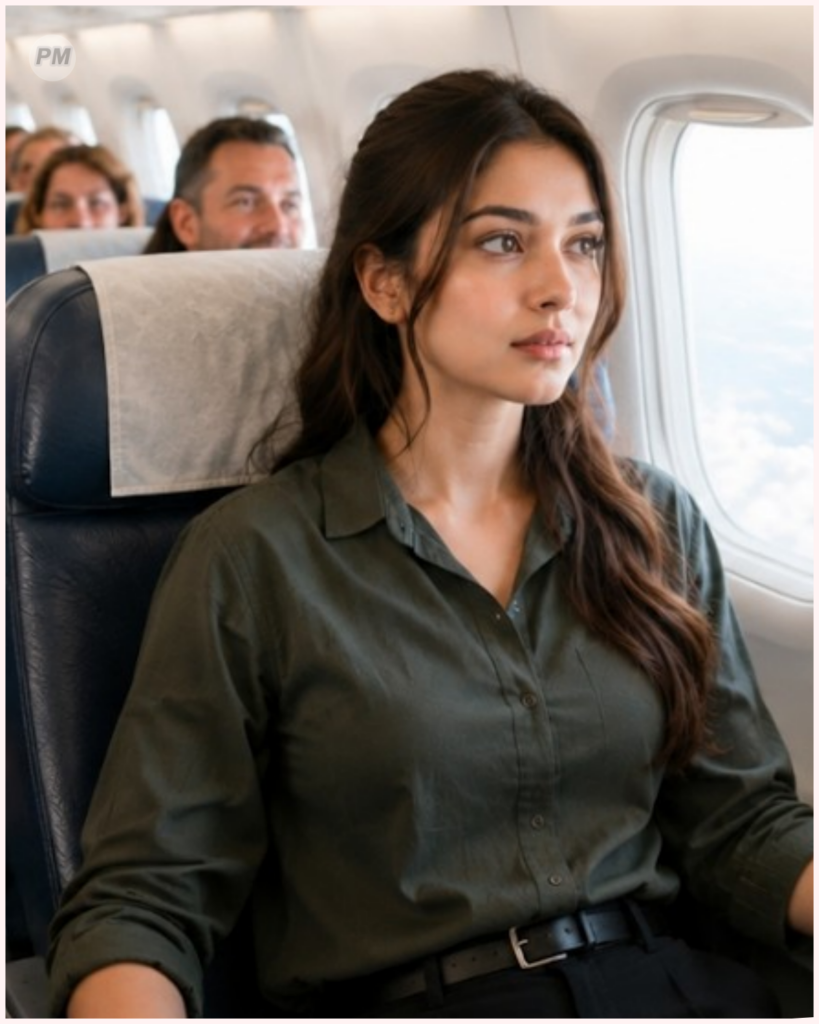
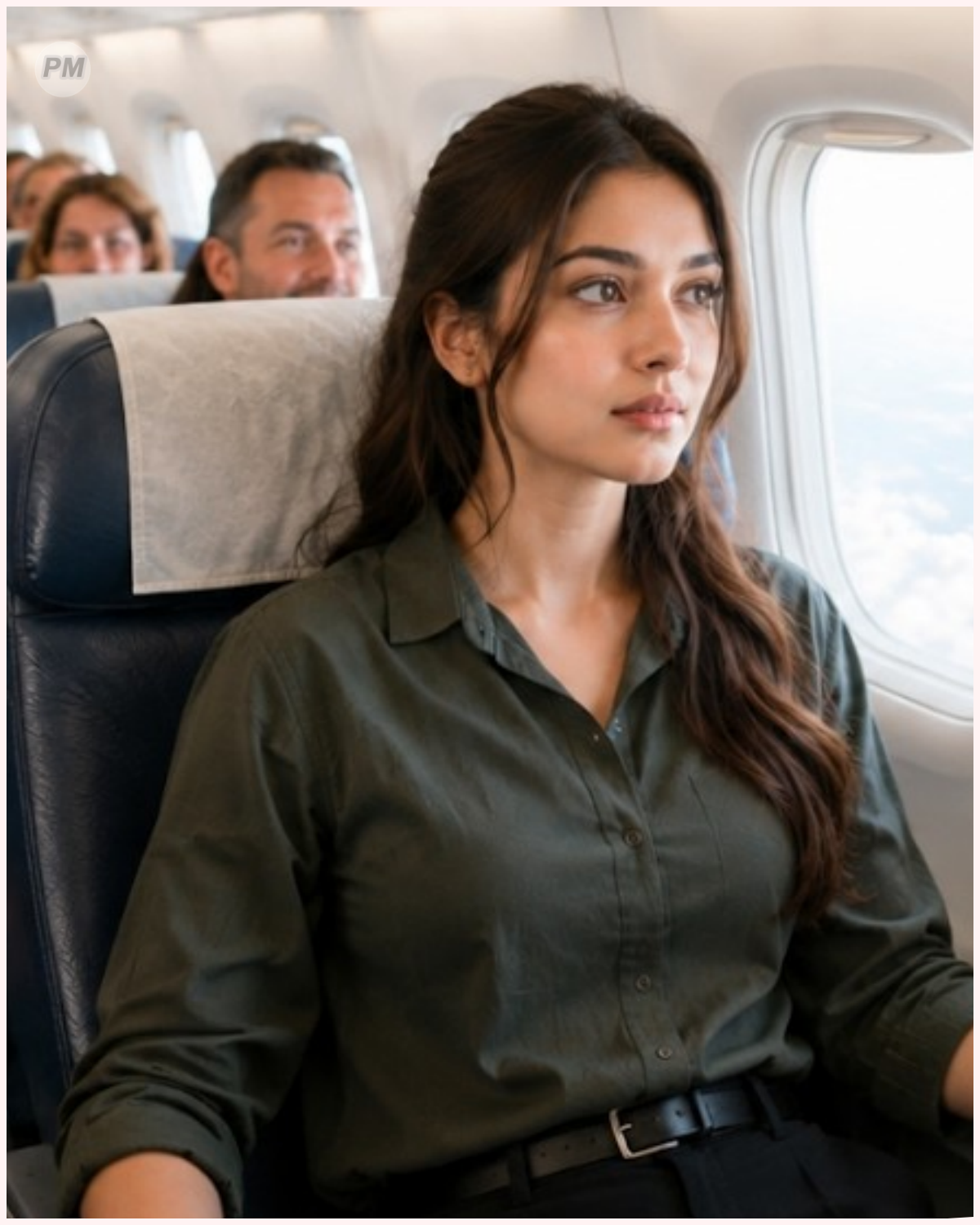
Sarah Chen folded herself into seat 7A of the Boeing 737 with the kind of practiced smallness that came from years of being underestimated.
26 years old, 5’4, wearing an oversized university hoodie and headphones that weren’t even playing music, she looked like exactly what everyone around her assumed she was, a tired grad student flying home for the holidays.
“Excuse me, is this seat taken?” Asked the man settling into 7B, a broad-shouldered businessman in a suit that had cost more than Sarah’s monthly rent.
“No, go ahead,” Sarah said quietly, pulling her hood up slightly and turning toward the window.
She had woken that morning in a studio apartment with one plant, one bookshelf, and a kettle that whistled slightly off key, and she had packed the way she always packed, the way the Air Force had taught her without ever meaning to.
One bag. Everything folded flat. Everything with a place. On top, wrapped in a scarf so it would not break, sat a small tin of jasmine tea for her mother, who claimed the kind sold near her own house tasted like dust and hot water.
Sarah had bought it three weeks earlier and kept it by the door so she would not forget it, because forgetting small things for the people she loved was the one failure she still allowed herself to be angry about.
The drive to the airport had been dark and ordinary. The radio played weather and traffic.
The coffee from the kiosk was too hot and then, all at once, too cold.
She stood in the security line behind a family of five and a man arguing gently with his suitcase, and nobody in that whole slow river of people looked at her twice, and she had felt the familiar, private pleasure of it.
Eight months since she had last been home. Eight months of video calls with her mother’s kitchen in the background, the same chipped tile, the same plant on the sill.
She had told herself this trip would be simple. Fly in. Eat too much. Sleep in her old room with the ceiling stain shaped like a dog.
Fly out. She had believed it completely, the way you believe a forecast in a clear sky.
Two rows back, a group of young men in matching varsity jackets, a college hockey team returning from a tournament, had been loud since boarding.
One of them, noticing Sarah’s small frame and quiet demeanor, nudged his friend and gestured toward her.
“Bet she’s never been on a plane without her mom before,” he snickered just loud enough to carry.
His friend laughed. The hockey players had the loose, loud confidence of young men who had won something recently and had not yet learned what it cost to be wrong in public.
Their jackets matched. Their duffel bags matched. One of them wore a medal on a ribbon around his neck like a joke he had not decided to stop telling.
They had taken over two rows the way weather takes over a valley, without malice and without noticing, and the passengers around them had done what passengers do, which was to shrink slightly and pretend to read.
The tall one with the loud laugh was clearly the captain of more than the team.
When he spoke, the others arranged their faces around his opinion. That was the boy who had noticed Sarah first, the way boys like that always notice the quietest person in any room, as if silence were a dare.
The businessman in 7B was a different species of noise. He had the polished stillness of a man who negotiated for a living and believed the world was mostly a matter of price.
His watch was heavy. His shoes were soft leather. He had asked about the seat the way men like him ask about everything, as a formality over a decision already made, and when Sarah said it was free he had nodded once, with the faintest surprise, as though her voice were a feature he had not expected the seat to come with.
He opened a laptop before the door had even closed, and the screen filled with columns of figures that rose and fell like a skyline.
“Look at her. She looks like she’s going to cry if there’s turbulence.” A third teammate leaned across the aisle to get a better look, grinning.
“Ten bucks says she’s never even flown before. Probably her first time out of state.
Being laughed at in a confined space is a specific and ancient discomfort, and Sarah had a whole taxonomy of it from schoolyards and ready rooms.
There is the laughter that wants a reaction and the laughter that wants an audience, and the hockey players were producing the second kind, which is easier to ignore because it is not really about its object at all.
She was a prop in a story they were telling each other about themselves, and props do not get lines.
She noted it the way she noted weather, without heat. In another life she might have stood up, all five feet four of her, and explained a few things about altitude and fear and who exactly had kept which skies safe while they were learning to skate.
In this life she had a window, and a tea tin in the overhead bin, and a long-practiced understanding that the explanation would cost her more than the laughter did.
Besides, she had been keeping notebooks too long not to recognize material when she heard it.
Somewhere in the back of her mind a small, dry entry wrote itself. Row nine.
Tournament winners. Loud at sea level. She almost smiled. It was a private joke with exactly one member, and it carried her through the safety briefing, the taxi, and the long spooling rise of the takeoff, while the captain of the hockey team discovered, somewhere around ten thousand feet, that his story about the scared girl in 7A had stopped getting the laughs it had gotten on the ground, and moved on to other game.
“Nah, look at her. She’s gripping the armrest already, and we haven’t even pushed back.”
The first one said, and the group dissolved into laughter. Sarah heard every word of it.
She had been trained to pick out a single voice in a crowded ready room over the roar of jet engines being started on a flight line half a mile away.
But she said nothing, because saying nothing was a skill she had mastered long before she had mastered flying.
In the squadron, silence had been its own kind of armor. The quieter you were about what you could do, the less anyone expected of you, and the more room you had to simply do it when it mattered.
She had learned that lesson from an old flight lead who used to say the loudest pilot in the room was rarely the best one, and she had carried it with her long after she’d hung up her flight suit for the last time.
She had learned silence the way other pilots learned aerobatics, in layers, with an instructor, against her instincts.
Her first flight lead had been a gray, spare man named Okafor, a colonel by then, who spoke so rarely in the ready room that the young pilots leaned toward him the way plants lean toward a window.
After her first exercise, when she had come back down buzzing with everything she had seen and everything she had done right, he had listened to all of it without moving, and then he had said the thing she never forgot.
The loudest pilot in the room is rarely the best one in the sky. The sky does not grade you on talking, Chen.
It grades you on the three seconds when talking would not help. After that she practiced quiet the way she practiced everything, deliberately, until it stopped being an act.
She learned to sit in debriefs and let other pilots describe engagements she had won, and to say only the parts that would make the next flight safer.
She learned that a reputation built on results never needed defending at the volume hers could have demanded.
And she learned the second half of the lesson, the half Okafor never said out loud, which was that quiet people are underestimated by exactly the people most dangerous to them, and that this, too, was a kind of altitude.
You could work up there, unobserved. You could think up there. Three years ago, Sarah Chen had been first lieutenant Sarah Wraith Chen, one of the youngest pilots ever to complete the Air Force’s advanced aggressor training program, flying F-16s against her own country’s best pilots to sharpen them for the enemies they might one day face.
She had earned her call sign Wraith during a training exercise over the Nevada desert when she’d outmaneuvered three instructors simultaneously appearing on their radar and vanishing before they could lock on again and again until the debrief room went silent and someone finally said, “It’s like flying against a ghost.
She had been good at it in a way that made older, more decorated pilots uneasy.
Not reckless good, not hot shot good, precise good. The exercise over Nevada had been running for six days when it happened.
It was the kind of large-force training where the sky fills up with aircraft pretending to kill each other in carefully graded ways, and the aggressors, the red force, fly the enemy’s playbook so the blue force can learn to survive it.
Sarah was red that week, flying an F-16 painted in a scheme meant to look foreign and threatening, and she had spent five days being dutifully shot down by instructors with twenty years on her, and taking notes, and saying nothing.
On the sixth day the scenario stacked three instructor aircraft against her section, and something in the geometry of it, some pattern in the way they divided the sky between them, opened up in her mind like a door she had not known she was standing in front of.
She stopped flying the airplane she had and started flying the airplanes they were about to become.
She would commit to a turn she had no intention of finishing, let a radar bloom with her presence, and then be simply elsewhere, in the one piece of sky their formation had agreed not to watch.
Twice she appeared inside a merge so suddenly that an instructor’s voice came up on the radio startled out of its professional calm.
The third time, all three of them were hunting a ghost return, a whisper of a contact at the edge of their scopes, while she sat above and behind them in clean air, patient as weather, watching their canopies sweep the wrong piece of desert.
The kill calls, when they came, were hers, one after another, unhurried. In the debrief the room had gone very quiet.
An instructor twice her age turned his helmet over and over in his hands. It was the operations officer who finally said it, half to himself.
It is like flying against a ghost. By the next morning the word was on the whiteboard next to her name, and then it was on her helmet, and then it was simply her name, the one the sky used.
Wraith. She flew the way a surgeon operates with no wasted motion, no ego bleeding into the stick.
Instructors twice her age had come out of simulated dog fights against her, shaking their heads, unable to explain exactly how she’d read their intentions three moves before they’d committed to them.
Command had wanted to fasttrack her into an operational squadron, maybe even a test pilot slot.
She had turned it down and left the service quietly for reasons she kept folded away even from herself most days and retrained as a civilian systems analyst.
It had not started with talent, whatever the instructors later claimed. It had started with a girl who was too small for the rides at the county fair deciding that the sky was the one place where size was not the first thing anybody measured.
In the T-38 she had been all elbows and checklists, a student like any other, except that she debriefed herself harder than any instructor bothered to.
She kept notebooks. Page after page of them, in a hand so small and level it looked printed.
What the jet did. What she had expected it to do. The distance between those two things was the whole of her education, and she closed it the way water closes over a stone, without drama, without pause.
Older pilots sometimes tried to explain her to each other in the bar after exercises, and they always failed in the same direction.
They made it sound like instinct, like a gift, like weather in the blood. It was not.
It was ten thousand small observations, filed and cross-referenced, and a refusal to be embarrassed by preparation.
She read an opponent’s aircraft the way a chess player reads a board, not for the move being made but for the two moves the pilot had already decided against, because a pilot who has ruled out the left has told you exactly where his weight is.
Reading intentions three moves early was not magic. It was homework, done at altitude, at speed, with her life as the pencil.
A job so unremarkable that nobody who met her afterward ever thought to ask what she used to do.
Now she was Sarah Chen systems analyst flying home to see her mother for the first time in 8 months.
And nobody on this airplane had the faintest idea who she really was. That was exactly how she wanted it.
People who leave a thing they are brilliant at always get asked the same question, and they almost always answer it with the same shrug, because the real answer has too many rooms in it.
Hers had rooms she had not opened in years. There had been a last flight, ordinary on paper, a training sortie in clean weather, and she remembered almost nothing of the flying itself.
What she remembered was sitting in the jet afterward with the canopy up and the ground crew moving around her in their unhurried choreography, and feeling, with a clarity that frightened her, that she could do this exact thing ten thousand more times and it would ask of her exactly the same pieces, and she would keep paying them, because the sky does not negotiate.
She remembered thinking that there ought to be a version of her life in which the people who loved her got some of the pieces too, before there were none left to give.
So she did it the way she did everything. Cleanly, quietly, without a scene. She declined the fast track.
She signed the papers. She let the squadron throw her a small party with a cake that had a fondant jet on it, and she laughed at the right places, and she did not correct the young pilot who said she would be back within a year, they always come back.
Then she drove east with her notebooks in a box on the back seat, and she taught herself databases and systems the way she had taught herself the T-38, in layers, with notebooks, against her instincts.
The work was unglamorous and it was hers, and on the good days it had a shape she recognized.
A system, like an aircraft, is always telling you what it is about to do.
You only have to be quiet enough to hear it. The flight attendant came through with the safety briefing, and the hockey players kept up their commentary in low voices, occasionally glancing towards Sarah to see if their jokes were landing.
She kept her eyes on the window, watching the ground crew finish their final checks, and let it wash over her the way she’d once let flack and chatter over the radio wash over her during a mission, noted, filed, and set aside because it didn’t change what she needed to do next.
The plane pushed back from the gate and taxied out. Sarah had flown so many aircraft in her life.
The T38 trainer, the F-16 Fighting Falcon, even a few hours in an A-10 during a joint exercise that the gentle rumble of a commercial airliner felt almost like a lullaby.
She closed her eyes as they climbed out, letting herself drift, thinking about her mother’s small kitchen and the smell of jasmine tea.
She was somewhere over eastern Colorado 40 minutes into the flight when the first announcement crackled through the cabin speakers.
Ladies and gentlemen, this is your captain speaking. The 737 climbed the way big, honest machines do, without hurry and without doubt, and Sarah read it the way she read everything that flew.
Through the soles of her shoes she could feel the engines settle into their cruise note, a chord she could have named.
She felt the little corrections the autopilot made, patient and impersonal, and the faint, constant negotiation between the airplane and the air.
Around her the cabin performed its own settling. The businessman had his figures. A baby two rows up made its opinion known and then, astonishingly, slept.
Somewhere behind her a hockey player was telling a story at a volume that assumed the whole aircraft had gathered to hear it, and she let the sound wash past her the way she had once let flak and radio chatter wash past, noted, filed, and set aside.
She thought about her mother’s kitchen. She thought about the jasmine tea riding in the overhead bin, and about how her mother would pretend not to be pleased and then make the tea immediately, in the good pot, the one with the hairline crack she refused to throw away.
She thought about eight months measured out in video calls and how strange it was that a person could cross a continent in an afternoon and still feel late.
Her eyes closed. The window was cool against the side of her head. For a while there was only the white noise of two engines doing exactly what they had been built to do, and a woman who had once been called a ghost, asleep in the light, going home.
We’ve received a notice from air traffic control regarding some military activity in the airspace ahead of us.
Nothing to be alarmed about, but we may experience a slight change in altitude or heading as we work with controllers to maintain separation.
A ripple of murmurs went through the cabin. The hockey players quieted for the first time since boarding, exchanging uneasy glances.
Fifty miles ahead of the airliner and several thousand feet above it, the sky that afternoon was not as empty as it looked.
A classified test flight was moving through a corridor that existed only on certain charts, in certain rooms, a temporary piece of architecture built out of altitude and permission.
Corridors like that are activated quietly and guarded jealously, and the machinery that guards them does not distinguish between a spy, a fool, and a lost grandfather in a Cessna.
It only knows what belongs and what does not. The Boeing, climbing innocently toward its cruise on a route filed weeks earlier, was about to be handed from one piece of sky to another like a letter passed between clerks who have just noticed the envelope is ticking.
In the cockpit, the first announcement had been the captain doing what captains are for, which is turning uncertainty into procedure out loud so that two hundred people can borrow his calm.
He had flown long enough to know that military activity ahead could mean anything from a tanker track to a funeral flyover, and he had said the words nothing to be alarmed about with the ease of a man who has said them in weather that wanted to kill him.
What he did not know, what none of them yet knew, was that the afternoon had already made its decision.
The corridor was live. The little airplane was inside it. And the two gray shapes sliding down out of the high sun were not arriving to make the situation more dangerous.
They were arriving because the situation already was. Sarah opened her eyes and sat up slightly straighter, an old instinct stirring in her chest, something between curiosity and alertness that she hadn’t felt in years.
15 minutes later, the plane banked sharply, sharper than a routine course correction, and the seat belt sign chimed on with an urgency that felt different from the usual turbulence warning.
A flight attendant moved briskly down the aisle, her composed expression not quite hiding the tightness around her eyes.
“Please remain seated with your seat belts fastened,” she said to a row of concerned passengers.
“We’re following instructions from air traffic control.” The businessman in 7B leaned toward the window, trying to see something beyond the wing.
“What’s going on?” He asked. No one in particular. Sarah didn’t need to look outside to know.
She recognized the sound before she saw anything. A distant thrum that grew steadily louder, distinct from the drone of the 737’s own engines.
A sound that lived in the base of her skull from 400 hours of formation flying.
She turned toward the window in time to see them. Formation flying is a language spoken in distance.
Two aircraft holding station off a wing are saying something with their geometry, and Sarah had four hundred hours of fluency in it.
She did not need the captain’s announcement and she did not need to see the gray shapes to know they were military and that they were disciplined.
It was in the sound first, that layered thrum arriving through the airframe, and in the way the light at her window changed its rhythm as something large and purposeful took up position between her airplane and the sun.
She had flown that position herself, off the wing of aircraft that were frightened, lost, or lying, and she knew the patience it required, and the readiness folded inside the patience.
She also knew, with the same fluency, what those two jets were not doing. They were not maneuvering against the airliner.
There was no menace in their geometry at all. They were holding a corridor, the way a shepherd holds a hillside, and whatever they were watching was not the Boeing.
That knowledge settled her even as the cabin around her came apart at the seams, because she had been on the other side of that glass, and she knew the men in those cockpits were the calmest people in this whole piece of sky.
The danger, if there was danger, was somewhere else, in front of them and below, in whatever had wandered into a place it did not belong.
Two sleek gray shapes sliding into position off the aircraft’s left wing. Close enough that the afternoon sun caught the canted tails and the unmistakable diamond-shaped silhouette.
F-22 Raptors. The cabin erupted in a mixture of gasps and hushed, frightened whispers. Someone near the back said the word hijacking, and it spread through the rows like a spark through dry grass.
A child began to cry, and a woman too rose up, began quietly praying under her breath, her fingers laced tightly together against her forehead.
The hockey players moments ago full of bravado had gone pale and silent. All three of them craning toward the window to stare at the gray shapes holding formation off the wing.
Phones came out across the cabin, held up uselessly against windows. Everyone reaching for some way to make sense of what they were seeing.
Ladies and gentlemen, the captain’s voice came again tighter now, edged with something the earlier announcement hadn’t carried.
We are being escorted by military aircraft as a precaution. Fear in an airplane cabin has a sound before it has a shape.
It is the sound of three hundred private noises stopping at once. The woman praying two rows up was not performing her fear; her fingers were laced so tightly against her forehead that her knuckles had gone the color of bone, and her lips moved in a rhythm older than the airplane by several thousand years.
The child crying near the back was picked up, and the crying changed pitch but not intention.
A man across the aisle kept saying his wife’s name in the tone of someone checking that a rope still holds.
The hockey players, who an hour ago had filled this cabin with themselves, were discovering all at once that bravado is a fair-weather garment.
Their captain stared out at the gray jets with his mouth slightly open, and the medal on its ribbon rose and fell against his chest like something alive and frightened.
Sarah watched all of it with the strange double vision of a person who has sat where the pilots are sitting.
She knew the captain would be flying the airplane and managing the radios and watching the fuel and the corridor all at once, and she knew that somewhere in the back of his mind he was doing the arithmetic every captain does, which is how to keep two hundred strangers from becoming a single animal.
A frightened cabin is a system too, and it has failure modes, and she could feel this one approaching the edge of its envelope.
What it needed was information, any true thing at all, and she found herself hoping the captain understood that, hoping he would give these people a voice to listen to before their imaginations finished the job the silence had started.
Please remain calm and stay in your seats. Sarah watched the Raptors hold their position with the effortless precision of pilots flying at the top of their game, and something in her chest went very still and very focused, the way it used to before a mission briefing turned real.
She didn’t know what had triggered this, but she knew the posture of those aircraft.
They weren’t there to threaten. They were there to observe, to protect, to be ready.
A staticky voice began coming over the intercom now patched through from the cockpit radio so the cabin could hear the exchange.
A decision the captain had likely made deliberately to keep 300 frightened passengers from spiraling into panic by hearing nothing at all.
Cessna niner2 Fox. This is Raptor flight. You are in restricted airspace. Squawk 7700 and follow us to the nearest airfield.
Silence. The Raptors were not talking to the airliner at all. They were shepherding a smaller aircraft that had wandered, deliberately or not, into a security corridor that had been quietly activated for a classified test flight happening somewhere over the plains below.
The commercial jet had simply been caught in the same restricted volume of sky. And now everyone aboard was watching a real-time intercept play out 20 ft from their wing tip.
Below and ahead of them, in a white Cessna that had been built for Sunday mornings and calm instructors, a man was having the worst hour of his life at four thousand five hundred feet.
He was not a villain and he was not a fool. He was a retired machinist who had flown the same triangle of counties for twenty years, and that morning his body had begun, quietly and without announcement, to fail him in the one way that matters most at altitude.
His hands did not feel like his hands. The horizon kept proposing angles he did not agree with.
Twice he had reached for the radio and found that the words he needed had been moved to a shelf he could not reach, and the effort of reaching frightened him more than the silence had.
He did not know about corridors or test flights or restricted volumes of sky. He knew his engine sounded wrong in a way he could not name.
He knew the big gray shapes that had appeared beside him were the most terrifying and the most beautiful things he had ever seen, and some deep, orderly part of him, the part that had run lathes for forty years and never once forced a tool that did not want to move, understood that those shapes were not there to hurt him.
They were there because he was somewhere he should not be. What he could not do, with his heart slamming and his thoughts coming apart like wet paper, was figure out how to follow them.
Every time one of them slid behind him he felt hunted, and a hunted thing runs, even at four thousand feet, even with nowhere to go.
Unidentified Cessna. This is Raptor flight. Final warning. Descend and turn to heading 270 or you will be intercepted by force.
The small aircraft, visible now as a distant white speck ahead and below, didn’t respond, didn’t turn.
Sarah’s pulse quickened, not with fear, but with a professional’s frustration at watching a scenario unfold that she herself had trained pilots to handle a dozen times.
She knew with total certainty what came next in that decision tree, and she knew how fast it could go from tense to catastrophic if the pilot below panicked and did something unpredictable in the same corridor as a loaded commercial airliner.
The businessman beside her had his phone out, hands shaking as he tried to record through the window, oblivious to the fact that his signal was being jammed by the same equipment escorting them.
Sarah ran the intercept the way she had been trained to run everything, as a tree of decisions with the branches priced.
A responsive aircraft gets warnings and then gets consequences, and the ladder between those two things is measured in minutes.
An unresponsive aircraft is a different problem wearing the same clothes. It might be a radio failure.
It might be a pilot who has never been talked to by a fighter jet and is too frightened to touch anything.
It might be a medical event, a heart doing something final at the worst possible address in the sky, in which case the clock was not measured in minutes at all, and every choice the interceptors made in the next ninety seconds would either widen that man’s future or close it.
What frightened her, professionally, was the geometry. Fighters holding close on a small aircraft can look, from inside the small aircraft, like a closing hand.
A healthy pilot reads it as instruction. A sick or panicking one reads it as attack, and attacked creatures do the unpredictable thing, the steep turn, the sudden dive, the panicked climb straight into the corridor’s crowded ceiling where a Boeing full of people was flying.
She had taught this exact failure in classrooms at two bases, standing at a whiteboard with a marker going dry, telling young pilots that the last thing you ever want to be to a frightened stranger is a wall.
You want to be a door. She had never expected to watch the lesson assemble itself outside her own window, at altitude, with her name not yet spoken and her hands already wanting the radio.
The hockey players had gone completely silent, gripping their armrests. Then something happened that made Sarah’s whole body go rigid.
The captain’s voice came through the intercom again, but this time it wasn’t addressed to the passengers.
Raptor flight, this is United 416. We have a growing panic situation in the cabin and I need to know if my aircraft is in danger.
There was a pause of three or four seconds that felt like an hour to the 300 people holding their breath in economy class.
United 416 be advised. You are not the target. Maintain heading and altitude. We are handling this.
But it was the next transmission that changed everything for Sarah. One of the Raptor pilots, apparently frustrated with the unresponsive Cessna and needing a second set of eyes, called out to his wingman using a phrase Sarah hadn’t heard used for anyone but herself in 3 years.
In the lead Raptor, the pilot had a name and a family and a mortgage, but in that sky he was only Raptor One, and he was running out of professional patience at exactly the rate the situation required him not to.
He had done intercepts before, sleepy students, lost tourists, one memorable smuggler, and he knew the shape of a pilot who is refusing him and the shape of a pilot who cannot hear him, and this one had the second shape, and it was worse.
A man who refuses you is a problem with a solution. A man who cannot respond is a clock.
He could see the little airplane wallowing, its altitude breathing up and down in a rhythm that suggested hands that were not well, and he could see, beyond it, the fat bright shape of the airliner that had blundered into the same corridor and now had to be protected from whatever happened next.
His wingman was young and very good and flying a position so close behind the Cessna that it had begun, Raptor One now understood, to look from inside that little cockpit like the second half of a trap.
That was the thing about intercepts that the manuals could not quite say. You are trying to give orders to a frightened stranger through the geometry of two fighter jets, and geometry can shout as easily as it can guide.
He keyed the radio and asked for help in the plainest language he had ever used on a military frequency, because there are moments when the forms fall away and what is left is a man asking the sky if anybody out there has done this before and knows how it ends.
Raptor 2, break off and get an angle on him. I’m calling for backup. Patch me through to anyone who’s flown a real intercept in this sector before because this guy is about to do something stupid.
The response crackled back almost instantly from ground control, relaying a message that had apparently been circulating since the emergency had escalated minutes earlier.
Raptor flight, be advised. We’ve identified a former Air Force aggressor pilot on your escorted commercial flight.
Flight manifest cross check confirms a Sarah Chen call sign wraith seat 7A. If this situation deteriorates, she may be able to advise.
Sarah’s stomach dropped. Someone, probably an overzealous controller running a passenger list through a defense database out of pure procedural thoroughness during a security event, had found her name buried in old service records and flagged it.
She had never expected her call sign to follow her onto a commercial flight, whispered over a live radio channel with 300 civilians listening in stunned silence.
The cabin, which moments ago had been a chorus of whispered fear, went utterly silent as passengers realized the voice on the radio had said a name, a real name, connected somehow to the girl sitting quietly in seat 7A.
The controller who found her name was not, in truth, overzealous. He was twenty-six years old, working a sector that had gone from routine to historic in eleven minutes, and the cross-check was a thing the system did by itself, a passenger manifest shaken gently against a defense database in case the emergency needed something nobody had thought of yet.
Names rose out of that shaking like sediment settling, and most of them settled into nothing.
Hers did not. Hers came up with a flag beside it, the quiet bureaucratic ghost of a former life, and the controller read it twice, and then he read it up the chain, and the chain read it to the Raptors, because a deteriorating intercept beside a loaded airliner is not the moment to keep useful information in a drawer.
Later, people would argue about whether it should have been broadcast where three hundred civilians could hear it.
The argument would be held in offices, by people with time. In the moment there was no time, and there was also this, which nobody in the offices would think to say.
The name was not only for the pilots. It was for the cabin. Three hundred frightened people had just heard the sky itself explain that the quiet girl in 7A was somebody the sky had been keeping on file, and the explanation, arriving exactly when it did, did the work of a hundred reassuring announcements.
It gave the fear a shape, and the shape was hers, and she was sitting right there, unhurried, with her hands folded, looking out at the jets as if she had been expecting them.
Every head in the surrounding rows turned toward her. The hockey player who had mocked her only 40 minutes earlier stared at her with his mouth slightly open.
The mockery drained completely from his face, replaced by something between disbelief and dawning horror at what he’d said within earshot of her.
The flight attendant who had been moving down the aisle stopped beside 7A, crouching slightly so she could speak without shouting over the tension in the cabin.
“Ma’am, are they talking about you?” Sarah closed her eyes for a brief moment, feeling the old identity settle back over her shoulders like a flight jacket she hadn’t worn in years.
There was no point pretending anymore. The moment demanded something from her, the same way every moment in the cockpit of an F-16 over the Nevada desert had once demanded something from her, and she had never once failed to answer that call.
“Yes,” she said quietly. “That’s me.” “Can you?” The flight attendant hesitated. “Can you actually help?”
The captain’s asking if there’s any way to talk directly to the Raptors. Sarah unbuckled her seat belt, ignoring the astonished stares from every direction, and made her way calmly to the intercom handset the flight attendant offered her near the forward galley.
“Raptor flight! The flight attendant’s name was Diane, and she had been flying for nineteen years, and she would say later that she knew before she finished asking the question.
It was not anything Sarah did. It was the way she did nothing, the way her eyes, when every other pair of eyes in that cabin was wide and wet, stayed level and dry and faintly bored, the eyes of a person doing arithmetic that had been finished for some time.
Diane had worked enough emergencies to know the difference between calm that is performed and calm that is structural.
One is a coat. The other is a skeleton. She crouched by 7A and asked her question already knowing that the walk to the galley was going to happen, and that she herself would make it happen, aisle by aisle, with her hand never quite touching the other woman’s elbow.
The walk was twenty feet and it took a year. Every face Sarah passed was turned up to her like flowers following weather, and she understood, walking it, why she had arranged her whole life to avoid exactly this corridor of eyes.
In the cockpit she had been a voice and a call sign, and the sky had never once looked back at her.
Here she was a person in a hoodie being escorted past rows of strangers who had decided, on the evidence of a single radio call, that she was the difference between the story they would tell their grandchildren and the other kind.
She kept her pace even. She breathed in fours, the way she had been taught for entirely different emergencies.
At the galley Diane lifted the handset from its cradle and held it out, and the plastic was warm from the sun through the little window, and Sarah took it, and the whole airplane went quiet around the sound of her thumb finding the button.
Raptor flight! This is Wraith, she said, her voice dropping instantly into the clipped economical cadence of a combat radio call, a register she hadn’t used in three years, but that came back to her like breathing.
I’m advised you have an unresponsive light aircraft refusing intercept instructions. What’s his altitude and heading trend?
There was a stunned half second of silence on the other end before the lead pilot responded, his voice tinged with something between relief and disbelief.
Wraith Raptor 1. He’s at 4,500, drifting left, off course, altitude oscillating like he might be experiencing a medical event or an equipment failure rather than deliberate evasion.
Copy that, Sarah said. The half second of silence on the frequency was, to Sarah, the most familiar sound in the world.
It was the sound of a cockpit reorganizing itself around new information, of a trained mind setting down one picture of the world and picking up another.
She had heard it from instructors, from students, from a controller in a tower in Nevada on the day her call sign was born.
Then the lead pilot came back, and the shape of his voice had changed. The frustration was gone out of it, burned off, and underneath it was the thing that actually flies airplanes in bad moments, which is a professional talking to a professional, numbers for numbers, no decoration.
Four thousand five hundred feet. Drifting left. Off course. Altitude oscillating. He gave her the picture the way she would have given it, in the order a pilot needs it, and listening to him she felt the old, clean machinery of her training stand up in her like a crew coming on shift.
Oscillating. That was the word her mind kept, turning it the way she had once turned a strange sound in an engine.
Maneuvering has intent in it, a signature, a rhythm a pilot chooses. Oscillation has no signature.
It is what an airplane does when the hands on it are losing an argument with their own body, when attention comes and goes like a tide.
She thought of the checklists she had memorized for other people’s emergencies, of hypoxia’s famous treachery, the way it makes a man feel wonderful while it takes his judgment apart piece by piece, the way carbon monoxide writes its orders in a hand too faint to read.
She did not know what was wrong in that little cockpit below. She knew it was not defiance.
Defiance flies better than that. And she knew that everything now depended on the two gray shapes beside her airplane understanding the difference between an enemy and a patient before their procedures decided for them.
If he’s oscillating and drifting rather than actively maneuvering, don’t assume hostile intent. Pull your wingman off his six and put him on his three low so he can actually see you in his peripheral vision without feeling boxed.
A panicking civilian pilot who feels surrounded will do something unpredictable. Give him room to see a way out and he’s more likely to follow it toward the runway instead of away from it.
Another pause shorter this time. Copy Wraith. Raptor 2 break to his 3:00 low. Through the window, the second raptor peeled away smoothly, repositioning exactly as Sarah had instructed.
In the little Cessna, the change came the way dawn comes, not all at once and then completely.
The second gray shape, the one that had been sitting behind him like a verdict, slid away.
It rolled with a grace that belonged to another element entirely and settled out to his left and slightly below, where he could see it without turning, where it flew the way a man walks beside you on a road rather than the way a man stands in a doorway.
The man in the Cessna wept then, briefly and without dignity, the way people weep when a weight they had been carrying with the wrong muscles is suddenly shared.
His hands were still wrong. His heart was still doing its terrible drumming. But the sky in front of him had opened, and in the opening there was a direction, and a direction was a thing he could obey.
He reached for the controls with hands that shook and did the simplest brave thing available to him, which was to follow.
The nose came around, degree by reluctant degree. The compass card swung its long way toward the numbers the voices had been asking for.
Below him the plains went on being the plains, patient and enormous, with a little airfield sitting in them somewhere ahead like a period at the end of a long sentence he had been afraid he would not finish.
He did not know who had rearranged the sky on his behalf. He would never know her name.
He only knew that the shapes had stopped hunting him and started guiding him, and that the difference between those two things was the whole of the rest of his life.
The tiny white Cessna, no longer boxed in from every angle, wobbled once, then began a slow, hesitant bank toward the heading the controllers had given it.
“He’s turning,” Raptor 1 reported, audible relief in his voice. “He’s turning. Good copy, Wraith.
Thank you.” The cabin, which had been holding its breath through the entire exchange, released it all at once in a wave of murmurs and shaky exhales.
The businessman in 7B stared at Sarah as she made her way back to her seat, his earlier casual dismissiveness replaced by something closer to awe.
She sat back down, buckled her seat belt with steady hands, and pulled her hood back up as if nothing at all had happened.
But nothing was the same anymore. The hockey players who had mocked her didn’t say another word for the rest of the flight.
Their earlier laughter replaced by an embarrassed, respectful silence. The flight attendant brought her a cup of tea without being asked and simply said, “Thank you.”
Before moving on. As though there was nothing more that needed explaining. The rest of the flight belonged to a quieter country.
The seat belt sign stayed on. The drink cart never came back out. Diane moved down the aisle with water in paper cups, touching shoulders as she passed them, doing the small maintenance of frightened people, and when she reached row seven she set a cup of tea on Sarah’s tray without a word and went on, because some transactions are too complete for language.
The businessman drank his tea’s twin in silence, staring at the seat back in front of him, visibly rebuilding several of his opinions from the foundation up.
An hour later, when the captain finally spoke again, his voice had the warmth of a man reading out the names of survivors, and the applause that moved through the cabin was not really for the landing of a little lost airplane miles away and below.
It was for the discovery, made at altitude and under pressure, that the person in the next seat might be anybody at all.
Sarah did not join in. She was not being modest, or not only modest. Applause is a thing that happens to a public person, and she had resigned from public personhood three years earlier with full honors, and some small stubborn clerk in her kept stamping the paperwork.
She kept her eyes on the window, where the light was going the color of the inside of a shell and the plains were unrolling their long brown grammar toward home.
Her cheeks were warm. She let them be warm. In the window’s darkening glass her own reflection sat beside the reflection of the sky, and for a moment the two of them flew formation, the analyst and the ghost, at exactly the same speed, in exactly the same direction, and neither one of them had to explain a thing.
20 minutes later, the captain’s voice came over the intercom one final time, calmer now, almost warm.
Ladies and gentlemen, the aircraft ahead of us has safely diverted and landed without incident.
We’ll be resuming our normal route to the gate shortly. I understand there was some concern in the cabin, and I want to personally thank the passenger in seat 7A for her assistance in bringing this to a safe resolution.
A ripple of applause broke out across the cabin, uncertain at first, and then growing until nearly every row was clapping.
Sarah kept her eyes on the window, her cheeks faintly flushed, uncomfortable with the attention in a way she had never been uncomfortable in a cockpit at 40,000 ft.
When the plane finally taxied to the gate, passengers filed past her seat slowly, several of them murmuring quiet thanks, a few offering handshakes she accepted with brief, polite nods.
The hockey player who had mocked her earlier lingered at the edge of the aisle, clearly working up the nerve to say something.
“I’m sorry,” he finally said quietly. “For what I said earlier. I didn’t know. You didn’t need to know, Sarah replied, not unkindly.
Airports after an event have a particular atmosphere, a brightness turned up half a stop too far, and the passengers from United 416 moved through the terminal like people who had been given back a day they had already spent.
Some of them called home from the middle of the concourse, standing still in the flow of travelers, saying the words delayed and fine and you would not believe in the careful voices of people rationing a miracle.
A few of them found each other, strangers an hour before, and hugged with the unselfconsciousness of survivors of very small wars.
The hockey team moved through it all in a clump, quieter than they had boarded, carrying their duffels like men carrying something heavier than equipment.
One of the airline’s people, a supervisor with a tablet and the stunned courtesy of a man who has read the preliminary report twice, found Sarah near the curb line and asked, with great formality, whether she needed anything at all, a hotel, a car, a statement form.
She said she needed a taxi, and he nodded as if she had asked for something rare and expensive, and he put her in one himself and closed the door with both hands, gently, the way you close the door of a church.
She watched his face get smaller in the glass and thought that gratitude, like fear, is mostly a problem of having nowhere to put it.
Then the driver asked where to, and she gave him her mother’s address, and the city took her in, and she was, by every measure she cared about, nobody again.
That’s kind of the point. He nodded, chasened, and moved on with his teammates, considerably quieter than they had been at the start of the flight.
Sarah gathered her bag from the overhead bin and stepped off the jet bridge into the terminal, back to being nobody in particular, a young woman in an oversized hoodie, heading home to see her mother.
Nobody in the terminal knew what had happened 35,000 ft above the Colorado plains, and that suited her fine.
She had spent years learning that the most important work she ever did rarely came with an audience, and today had been no exception, even if for a few tense minutes, 300 strangers had gotten a brief, unexpected glimpse of who she really was.
She called her mother from the curb, telling her the flight had been delayed slightly, nothing serious, and that she’d be home for dinner.
Her mother, half listening, asked if she’d remembered to bring the jasmine tea she liked.
And Sarah laughed softly and said of course she had, feeling something in her chest loosen for the first time since she’d sat down in seat 7A.
As the taxi pulled away from the curb, she caught one last glimpse of the terminal through the rear window.
Passengers from her flight still gathered near the doors, a few of them glancing around as if half expecting to see her again, to ask her something, to thank her properly.
She didn’t look back a second time. Some things she decided were better left exactly where they belonged, in the sky and in the past.
Her mother had the tea made before Sarah had finished hugging her, because her mother had heard the whole story in the shape of a delay and a daughter’s voice doing its careful nothing-is-wrong music, and mothers are the original intelligence service.
The kitchen was exactly as advertised by eight months of video calls, the chipped tile, the plant, the good pot with its hairline crack, and it received Sarah the way it had received every version of her, the cadet, the lieutenant, the ghost, the analyst, without commentary.
She sat at the table where she had done homework under a harsher light and ate too much, as planned, and answered questions about her apartment and her work and a man at the office who did not exist in the way her mother hoped, and she did not mention the F-22s, because the day had already been given its portion of sky.
That night, in her old room, under the ceiling stain shaped like a dog, she lay awake a while in the good dark and listened to the house settle.
Somewhere in her bag was a phone with messages from two college hockey players she would never answer and a number, passed along by an airline, that belonged to a captain who wanted to buy her a coffee she would probably never drink.
She thought about the man in the little airplane, whoever he was, eating his own dinner tonight in his own kitchen, alive, and about two fighter pilots writing reports in a debrief room, and about how the most important work is so rarely announced.
Then she slept, the deep and dreamless sleep of a person whose accounts are settled, and in the morning there was tea again, and her mother’s voice in the kitchen, and the whole ordinary world, which she had crossed a sky to get back to, exactly where she had left it.
𝐷𝑖𝑠𝑐𝑙𝑎𝑖𝑚𝑒𝑟: 𝑇ℎ𝑖𝑠 𝑐𝑜𝑛𝑡𝑒𝑛𝑡 𝑚𝑎𝑦 𝑏𝑒 𝑐𝑟𝑒𝑎𝑡𝑒𝑑 𝑏𝑦 𝐴𝐼 𝑓𝑜𝑟 𝑒𝑛𝑡𝑒𝑟𝑡𝑎𝑖𝑛𝑚𝑒𝑛𝑡 𝑝𝑢𝑟𝑝𝑜𝑠𝑒𝑠. 𝐴𝑛𝑦 𝑟𝑒𝑠𝑒𝑚𝑏𝑙𝑎𝑛𝑐𝑒 𝑡𝑜 𝑟𝑒𝑎𝑙 𝑝𝑒𝑟𝑠𝑜𝑛𝑠, 𝑒𝑣𝑒𝑛𝑡𝑠, 𝑜𝑟 𝑝𝑙𝑎𝑐𝑒𝑠 𝑖𝑠 𝑐𝑜𝑖𝑛𝑐𝑖𝑑𝑒𝑛𝑡𝑎𝑙.
