Combat Master on you. That patch is a lie, and I’m going to prove it right now.
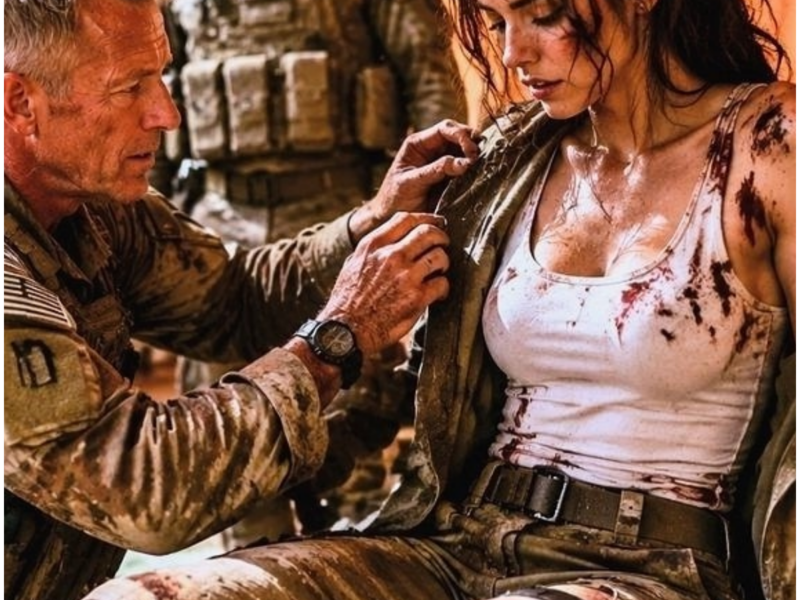
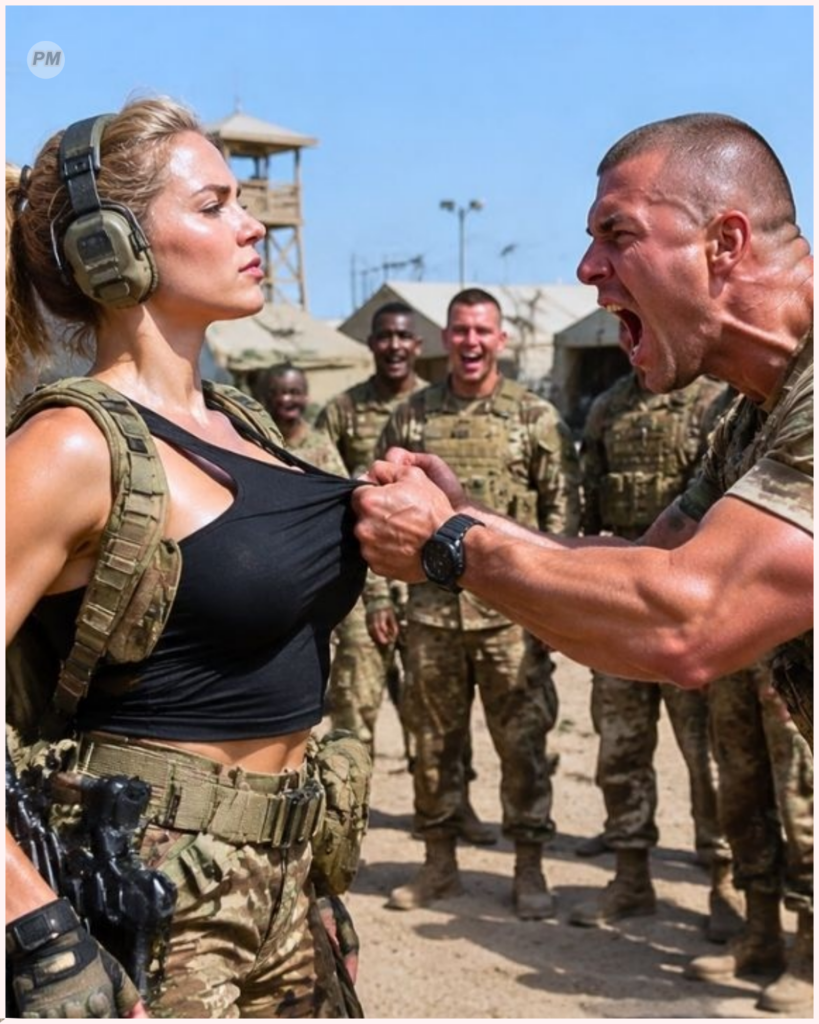
Major Ryan Mitchell tore the black and silver patch off Captain Amelia Brook’s chest, threw it on the floor, and crushed it under his boot in front of 40 laughing soldiers.
He ground his heel into the concrete like he was putting out a cigarette. There, he sneered, leaning into her face.
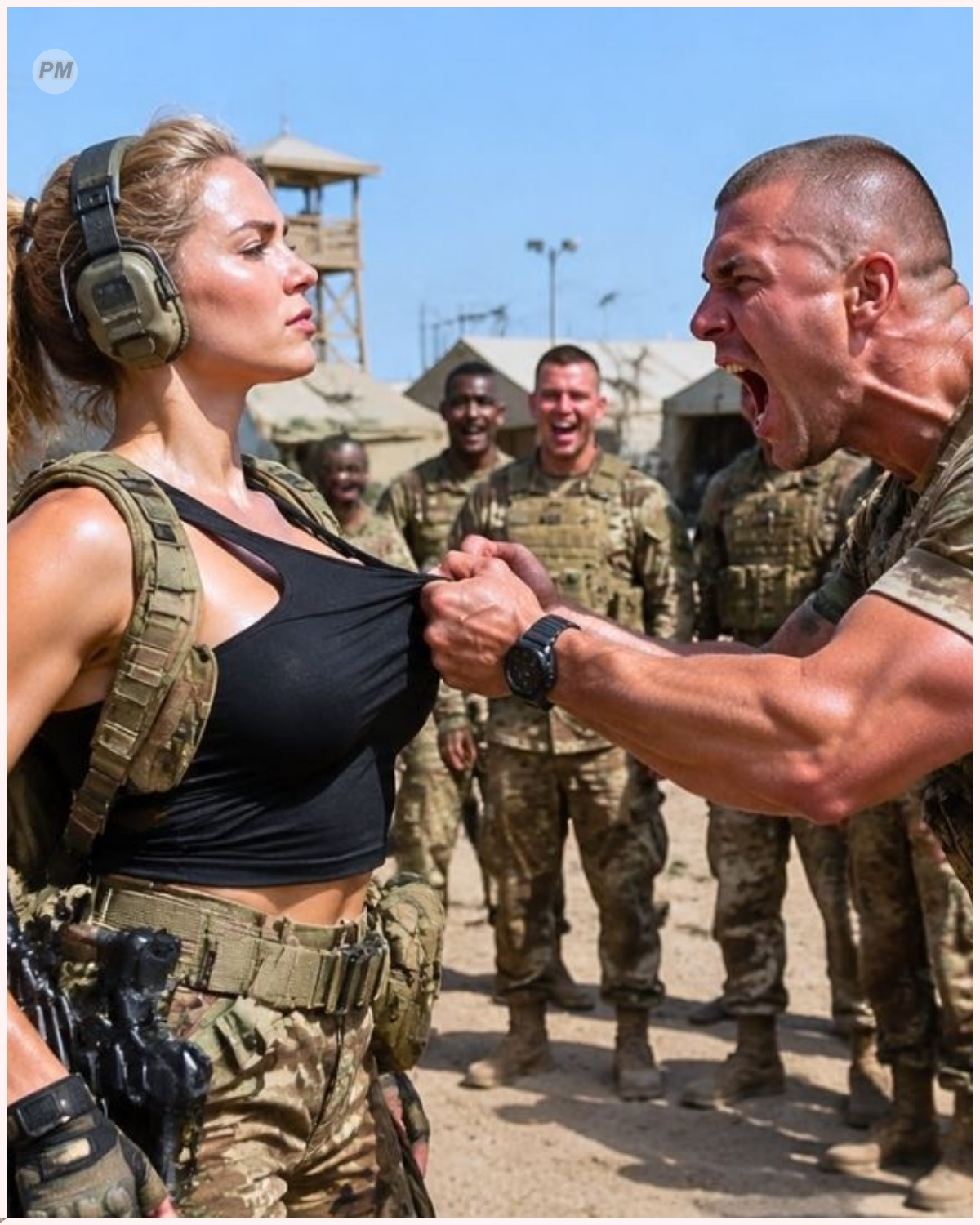
That’s what your little badge is worth to me. Nothing. You want it back. Get down on your knees and pick it up.
That’s the only rank you’ll ever hold on my base. The room roared with laughter and Captain Amelia Brooks didn’t move a muscle.
Before we go on, if you believe that the loudest person in the room is rarely the strongest, do me a favor and hit that subscribe button right now and stay with me all the way to the end of this story because the ending is going to hit you harder than you expect.
And while you’re at it, leave a comment and tell me what city you’re watching from tonight so I can see just how far this story has traveled.
Now, let’s begin. The laughter didn’t stop right away. That was the thing Amelia Brooks noticed first.
It rolled through the room in waves, one man setting off the next, and Major Ryan Mitchell stood in the middle of it like a preacher who had just delivered the funniest sermon of his life.
He had his thumbs hooked into his belt. He had his chin lifted, and he kept looking around at the faces of the younger soldiers to make sure they were laughing with him because that was how men like Mitchell measured their own worth.
Not by what they did, by how many people laughed when he told them to.
Amelia let it happen. She stood there in the doorway of the briefing room at Fort Liberty Advanced Warfare Center.
34 years old, 5’7, with her duffel bag still on her shoulder and her orders still folded in her breast pocket.
And she let the whole room laugh at her. She didn’t flinch. She didn’t blush.
She didn’t do the thing they all expected her to do, which was to start explaining herself, to start listing accomplishments, to start begging for the respect that her past should have earned her the moment she walked through the door.
She just waited. I mean it, Mitchell said, wiping an imaginary tear from the corner of his eye.
Look at her. She doesn’t even weigh a buck 50 soaking wet. Combat master. He shook his head slowly.
You know how many combat masters there are in the entire United States military right now?
You want to guess? Nobody answered. He wasn’t really asking them. Fewer than you can count on two hands, he said.
That’s the whole point of it. That’s what makes it mean something. It’s not a participation ribbon.
It’s not something they hand out because somebody in an office decided we needed better numbers on a diversity report.
He let that last word sit in the air, and a few of the men chuckled again.
Lower this time. The kind of chuckle that men do when they know they probably shouldn’t be laughing, but they’re going to anyway.
It’s earned in blood, in fire, in situations that would make grown men wet themselves.
So, forgive me, Captain, if I have a little trouble picturing you in one of those situations.
Amelia finally moved. She stepped fully into the room, walked past Mitchell without so much as slowing down, found an empty chair in the second row, set her duffel on the floor beside it, and sat.
She pulled out a tablet, she turned it on, and she began to read as though the man standing 8 ft away from her, mocking her in front of 40 people, simply did not exist.
That more than anything, unsettled Major Ryan Mitchell. Because Mitchell had spent 20 years learning how to read people.
That was his gift, the one he was proudest of, prouder even than the ribbons on his own chest.
He could look at a soldier in the first 30 seconds and tell you whether that soldier was going to make it or break.
He’d built a whole career on it. He’d trained hundreds of special operators and he liked to say that he’d never once been wrong about a man.
Give him 30 seconds and he’d tell you the future. And now here was this woman, this quiet, unremarkable woman.
And every instinct he had was screaming at him that she was a fraud, that she was soft, that she was one of those people who had figured out how to move up through the ranks without ever getting her hands dirty.
Every instinct and yet and yet she hadn’t reacted. Not once. Not when he tapped her patch.
Not when he’d called her honey. Not when the whole room had laughed in her face.
In Mitchell’s experience, frauds always reacted. Frauds got loud. Frauds got defensive. Frauds pulled out their resume and started reading it to you because deep down they knew that the paper was all they had.
This woman had pulled out a tablet and started reading terrain data. Mitchell told himself it didn’t matter.
He told himself she was just embarrassed or in shock or too stupid to know she’d been insulted.
He told himself a lot of things in those few seconds because the alternative, the possibility that his 32nd red had failed him for the first time in 20 years, was not something Major Ryan Mitchell was prepared to consider.
“You got something to say?” He asked her. Amelia looked up from her tablet. Her eyes were calm, not angry, not hurt, just calm in a way that most people are never calm.
In a way that comes from having stood in places so much darker than a briefing room that a briefing room could never touch you again.
No, major, she said. I’m just reading. Reading what? The evaluation packet for tomorrow. Operation Iron Shadow.
She said it plainly the way you might mention the weather. I like to be prepared.
Something flickered across Mitchell’s face. It was so quick that only one person in the room caught it, and that person was not one of the laughing soldiers.
That person was sitting in the back corner near the door in a chair he’d pulled slightly away from the others and he had not laughed once.
His name was Colonel Daniel Hayes and he was the commanding officer of the entire base.
Hayes had been watching the whole thing unfold in silence, his hands folded in his lap, his face unreadable.
He was a big man gray at the temples with the kind of stillness that only comes to people who have been in command so long that they no longer feel the need to prove they’re in command.
He didn’t laugh at Amelia. He didn’t defend her either. He just watched and he listened.
And something in his eyes said that he was watching a play he had already read the ending of.
Because Colonel Daniel Hayes knew exactly why Ameilia Brooks was at his base. He knew what was in her file.
He knew the parts of it that were unclassified. And he knew the parts of it that were so classified that even he, a full colonel with a security clearance, most senators would envy, had only been allowed to read them under supervision in a locked room with a man from a three-letter agency, standing over his shoulder the entire time.
And Colonel Hayes had made himself a promise sitting in the back of that room.
He had promised himself that he would not say a word because some truths are worth more when a person discovers them for themselves.
And some men need to fall on their own face before they’ll ever learn to look where they’re walking.
So Haye said nothing and he waited just like Amelia waited. Iron Shadow, Mitchell repeated.
And now his voice had shifted from mockery to something more like a challenge. You’ve read the packet on Iron Shadow.
That’s cute. You know what that packet doesn’t tell you? It doesn’t tell you what it’s like to actually run it.
It doesn’t tell you what happens to your heart rate when the whole thing goes sideways and you’ve got 40 seconds to make a decision that’s going to get people killed either way.
You can read all the terrain data you want. Reading isn’t fighting. No, Amelia agreed.
It isn’t. So maybe Mitchell said, and he took a step closer to her. You ought to sit there quietly and watch how the professionals do it.
And maybe you’ll learn something. That’s what you’re here for, right? To learn from the best.
There was a long pause. Amelia set down her tablet. Not aggressively. She just set it on her knee and she looked up at Major Ryan Mitchell.
And for the first time since she’d walked into the room, she smiled. It was a small smile.
It was not unkind. But there was something in it that made two or three of the younger soldiers in the front row stop laughing entirely because it was the smile of a person who knows something you don’t and who is going to be very patient about it.
“Yes, major,” she said. “I’m here to learn.” And she picked her tablet back up.
Mitchell held her gaze for a second longer, then snorted, turned on his heel, and walked back to the front of the room.
He’d won, or so he’d decided. He’d put the new girl in her place. He’d reminded everybody who ran this training division.
And now he had a briefing to give. All right, he barked, and the room snapped to attention.
All the laughter gone, now replaced by the sharp focus of men who did not want to be on the wrong end of Major Mitchell’s mood.
Tomorrow we run Iron Shadow. For those of you who haven’t been through it, and God help you, this is not your daddy’s obstacle course.
This is the most advanced combat simulation the United States military has ever built. It is drawn from real operations.
Real terrain, real enemy behavior, and it does not care about your feelings. He tapped a control and a map appeared on the wall behind him.
>> [clears throat] >> a sprawling urban environment, streets and alleys and buildings with a central objective marked in red and a scatter of blue and green markers spread throughout.
The scenario is a hostage extraction in a hostile urban zone, Mitchell said. Enemy force of unknown size, civilian population present throughout.
Your job is to reach the objective, secure the asset, and get out with zero civilian casualties and zero friendly losses.
He paused. In the four years this simulation has existed that has been accomplished dlyically zero times.
Zero. The best team we ever put through it got the asset out but lost 11 civilians doing it.
The record 11 dead. And they gave those men medals for it. He let that sink in.
So when I tell you this is hard, he said I want you to understand that I am not being dramatic.
I am telling you that the best soldiers this country has ever produced have walked into this thing and walked out humbled every single time.
Amelia was looking at the map, not at Mitchell, at the map. Her eyes were moving across it in a particular way, tracing lines following streets.
And if anyone had been watching her closely, they might have noticed that her lips were moving very slightly, as though she were counting something or remembering something.
But nobody was watching her closely except Colonel Hayes. My team runs first, Mitchell continued.
I’ll be leading personally along with my top six. We’ll set the benchmark. And then throughout the week, the rest of you will attempt to match it, he smiled.
Or fail to, which statistically is far more likely. A few nervous laughs. Any questions?
For a moment, nobody spoke and then Amelia Brooks raised her hand. The room went still.
Mitchell looked at her and the good humor drained out of his face. Yes, Captain.
Your plan, Amelia said. Would you walk us through it the route you intend to take?
Mitchell narrowed his eyes. Why do you want to know my route? Because I’d like to learn, she said.
And there was not one drop of sarcasm in her voice, which somehow made it worse.
You said, “I’m here to learn from the best, so I’d like to hear how you intend to solve it.”
Mitchell studied her for a long moment. He was trying to figure out the trap.
He was a man who assumed every question was a trap because he was a man who spent most of his own life setting them.
But he couldn’t find the trap in her face because there wasn’t one. There was only that same maddening calm.
“Fine,” he said at last. “Since you want a lesson,” he turned to the map and picked up a laser pointer.
We insert here on the western edge fast. We move hard and heavy up the eastern quarter here straight toward the objective.
We don’t dance around. We don’t creep through alleys like scared rabbits. We hit the enemy before the enemy knows we’re there.
Speed is security. Aggression is survival. You pour so much pressure on the enemy that he never gets a chance to organize a response.
By the time he figures out what’s happening, we’ve got the asset and we’re gone.
He clicked off the pointer. That’s how professionals do it, Captain. You overwhelm. You dominate.
You don’t give the enemy time to think. He looked at her, waiting for the admiration.
Amelia was quiet for a moment. She looked at the map. She looked at the eastern corridor he traced.
And then she said in a voice that was almost gentle, “Major, your eastern row will fail.”
You could have heard a pin drop. Somewhere in the front row, a young soldier actually inhaled sharply the way you do when you watch someone step off a ledge.
Every head in the room turned not toward Amelia, toward Mitchell. Because everyone knew what was coming.
Everyone knew that you did not tell Major Ryan Mitchell that his plan was going to fail.
Not in front of his men. Not on his first day, not when you were a nobody with a patch.
He’d already decided you didn’t deserve. Mitchell’s jaw tightened when he spoke. His voice was very quiet, and quiet was more dangerous than loud from a man like him.
“Say that again.” “Your eastern route,” Amelia repeated, and she did not raise her voice, and she did not lower her eyes.
“It will fail. You’ll lose the asset, and you’ll lose civilians.” “You’ve never run this operation.”
“No,” she said. “I haven’t. You’ve been at this base for,” he checked his watch, less than 2 hours.
“That’s correct. But you’re going to stand there,” Mitchell said. And his voice was climbing now, the quiet burning away.
And tell me, a man who has been fighting real wars since before you graduated high school, that you know better than I do, how to solve a scenario you have never once attempted.
And Amelia said the thing that would echo through that base for weeks afterward. She said it simply without drama, without heat.
She just said it and then she stopped. I’m not telling you I know better than you, Major.
I’m telling you the data does. The data, it’s already there. She said it’s in the packet.
Everything you need to know about how that eastern quarter behaves is in the terrain data and the enemy behavior model and it’s been there the whole time.
You don’t have to trust me. You don’t even have to like me. You just have to look.
She paused. But you didn’t look. You decided. And there’s a difference. For a moment, Mitchell couldn’t speak.
Not because he had nothing to say, but because he had too much. And all of it was tangled up in a rage that had no clean way out.
Here was this woman, this nobody telling him in front of his own men that he hadn’t done his homework, that he’d been lazy, that his 20 years of experience were worth less than an afternoon of her reading a tablet.
He wanted to destroy her. But he was smart enough, even in his fury, to know that you don’t destroy someone by yelling.
You destroy them by letting them be wrong in public. And so Major Ryan Mitchell did the thing that would in less than 48 hours become the biggest mistake of his career.
He smiled. You know what he said? I think this is wonderful. I really do because we’ve got a room full of young soldiers here and they’re about to learn one of the most important lessons of their careers.
They’re going to learn what happens when arrogance meets experience. He spread his hands. You think the Eastern Route fails?
Fine. Tomorrow I’m going to run the eastern road and I’m going to succeed. And then we’re all gonna sit right back here in this room and I’m going to ask you in front of everybody to explain how a combat master could be so completely and totally wrong about a scenario she’s never even seen.
He leaned toward her and you’re going to apologize. Not to me, to them. He gestured at the room for wasting their time.
The room was electric now. This was better than the laughter from before. This was a duel.
And soldiers, young ones especially, love a duel. Love the drama of watching two people put their pride on the table.
Because at that age, you still believe that the person who talks the boldest is the person who’s right.
Most of them were sure Amelia was about to be humiliated. Almost all of them.
Amelia held Mitchell’s gaze, and then she nodded slowly as though he’d offered her something reasonable.
“All right,” she said. “But I’d like to make it a fair test.” Meaning meaning you run your plan tomorrow exactly as you described it.
And if you’re right, I’ll apologize to every person in this room and I’ll mean it.
She let that sit. But if I’m right, if it fails exactly the way I say it’s going to fail, then you let me run it, too.
Alone, no team, and you all watch. A murmur went through the room. Mitchell laughed, but there was something a little forced in it now.
Alone? You want to run Iron Shadow alone? Captain, the whole point of the scenario is that it’s built for a team of seven.
You can’t run it alone. It’s not possible. You said a lot of things aren’t possible, Amelia said quietly.
You said a combat master patch on someone like me wasn’t possible. Let’s find out together.
For the first time, Mitchell hesitated. It was only for a fraction of a second, and he covered it well, but it was there, and Colonel Hayes saw it from the back of the room, and something like the ghost of a smile touched the old colonel’s mouth.
Because Mitchell had just realized something. [snorts] He’d realized that this woman was not behaving like a fraud.
Frauds do not volunteer to be tested. Frauds do not raise the stakes. Frauds do not offer to walk alone and without a net into the exact situation where their fraud will be exposed.
Frauds run from the test. This woman was running toward it. And a small cold voice in the back of Ryan Mitchell’s mind whispered a question he did not want to here.
What if she’s not a fraud? He shoved the voice down. He buried it because he had already committed in front of his men and there was no way back.
Now fine, he snapped. Deal. My plan tomorrow. Then if by some miracle you’re right, you run it alone and you fall on your face and we all learn the same lesson from the other direction.
He turned back to the map, dismissing her. But you’re not going to be right.
Nobody’s ever solved this thing. Certainly not Solo. What you’re describing isn’t confidence, Captain. It’s fantasy.
We’ll see,” Amelia said, and she picked her tablet back up and she went back to reading.
The briefing continued for another hour. Mitchell walked his team through timing, through communication protocols, through fallback positions.
And the whole time Amelia read, she didn’t take notes on his plan. She didn’t watch him.
She just kept scrolling through the terrain data page after page after page, her eyes moving with a focus that most people in that room would never understand.
Because most people in that room had never had to read a battlefield the way you read a letter from someone you love slowly and completely and more than once.
When the briefing ended that soldiers filed out talking in low excited voices about the showdown that was coming.
Amelia gathered her things without hurry. She was almost to the door when a voice stopped her.
Captain Brooks, it was Colonel Hayes. He was still sitting in his chair in the back corner and the room had emptied out around him and now it was just the two of them.
Amelia turned to face him. And when she saw who it was, something changed in her posture.
Just slightly, a little more upright, a little more still. The way you stand in front of someone you respect.
Sir, she said. Hayes studied her for a long moment. You had that packet for how long before the briefing.
About 90 minutes, sir. I read it on the flight. And in 90 minutes you figured out something about that eastern corridor that took my analyst 3 years to fully model.
He said it as a statement, not a question. Amelia didn’t answer right away. Then she said carefully, “I’ve seen that kind of terrain before, sir, in a place I’m not allowed to talk about.
The enemy behaved a certain way there. When I read the packet, I recognized the pattern.”
She paused. It wasn’t clever. It was just familiar. Hayes nodded slowly. He knew exactly which place she meant.
He’d read the file. He’d read the parts they’d let him read. And he’d sat in that locked room with the man from the agency standing over his shoulder.
And he’d turn the pages. And by the end of it, his hands had been unsteady because he was a soldier who had seen a great deal in his life.
And even he had not been prepared for what was written there. “You know what Mitchell’s going to do to you?”
Hayes said, “If you’re wrong.” I’m not wrong, sir. I know you’re not. Hayes said quietly.
That’s not the question. The question is whether you understand what you’re setting in motion.
That man has run this division for 6 years. His entire identity is wrapped up in being the best.
When you take that from him in front of his people, you’re going to take it from him.
He is not going to say thank you. He’s going to come after you. It’s who he is.
Amelia considered that. And then she said something that made Colonel Hayes lean back in his chair and look at her with new eyes.
Sir, with respect, I didn’t come here to take anything from Major Mitchell. She glanced toward the door where the soldiers had gone.
I came here because someone in this building asked me to help build the next version of that simulation.
To make it better, to make it teach the right lessons. She looked back at Hayes.
The right lesson isn’t that Mitchell’s a bad soldier. He’s not. He’s brave and he’s experienced and he’d walk into fire for any one of those kids.
The right lesson is that the day you decide you already know everything, you stop being able to protect the people who depend on you.
That’s what gets people killed. Not lack of courage, certainty. Hayes was quiet for a long time.
“You really did help design it, didn’t you?” He said. Iron Shadow, it wasn’t just a rumor in your file.
Amelia’s expression didn’t change, but she didn’t deny it. Some of it, sir, was all she said.
Some of the enemy behavior. It’s based on things I saw, things I live through.
I gave them to the developers so that the men who train on this thing would be ready for the real version.
Because the real version doesn’t give you a second try. Colonel Hayes exhaled slowly. He stood up from his chair and he walked over to her and he did something that would have shocked every soldier who had laughed at her an hour before.
He extended his hand. Amelia took it. “Get some rest, Captain Hayes said. Tomorrow’s going to be a long day, and it’s not going to go the way any of them think it’s going to go.”
“No, sir,” Amelia said. “I don’t imagine it will.” She left. And Colonel Hayes stood alone in the empty briefing room for a long while looking at the map on the wall at the eastern quarter Mitchell had traced and read.
And he thought about the file in the safe in his office and about the things written in it and about how in less than a day a room full of men who thought they knew what strength looked like were going to find out that they had never really known at all.
That evening in the barracks, Amelia Brooks was already the topic of every conversation. Some of the men defended her.
A young corporal named Ellis, barely 23, said quietly to the others that he’d looked up the combat master qualification after the briefing and that it wasn’t something you could get through paperwork no matter what anybody said.
It’s a real thing. He said, “You don’t get it handed to you. You bleed for it.”
Then how’d she get it? Someone shot back. Look at her. Mitchell’s right. She doesn’t have the presence.
Real operators, you can feel it when they walk in a room. Maybe Ellis said, “Or maybe the ones who really did the worst of it are the ones who don’t need you to feel anything.”
Nobody had an answer for that. But most of them still sided with Mitchell because Mitchell was the one with the loud voice and the 20 years and the ribbons.
And it is very hard when you are young to bet against the loud voice.
Amelia heard some of it. Her bunk wasn’t far, but she didn’t join the conversation, and she didn’t try to defend herself, and she didn’t lie awake stewing over what any of them thought of her.
She lay on her back with her hands folded on her chest and she closed her eyes and she went to a place in her mind that none of them could have followed her to.
She was thinking about a night years ago on the other side of the world in a place with no name that she was allowed to say out loud.
She was thinking about 72 hours in the dark and the sound of wounded men breathing and a decision she’d had to make with 11 lives in her hands and no good options, only bad ones and worse ones.
She was thinking about the reason there was a black and silver patch on her uniform.
And it was not a reason that made her proud. Exactly. It was a reason that made her quiet because you don’t earn a patch like that by winning.
You earn it by surviving something that should have killed you and by carrying for the rest of your life the weight of the ones who didn’t survive it with you.
Mitchell thought the patch was a trophy. He had no idea it was a grave marker.
And tomorrow, though he didn’t know it yet, Major Ryan Mitchell was going to walk into a simulation that Amelia Brooks had helped to build out of the worst night of her life.
And he was going to make every mistake she had learned the hard way not to make.
And she was going to watch him do it. And she was not going to say, “I told you so.”
Because people who have really seen the cost of being wrong never say, “I told you so.”
They just get very, very quiet. Across the base in his own quarters, Major Ryan Mitchell couldn’t sleep either.
He told himself it was excitement about the run. He told himself he was just going over the plan in his head, checking it, sharpening it.
But that wasn’t the truth. And somewhere underneath his pride, he knew it. The truth was that woman’s voice kept coming back to him.
Not the words exactly, the calm, that impossible, infuriating calm. He’d spent his whole life around dangerous people and he knew the difference between the calm of a fool who doesn’t understand the danger and the calm of a professional who understands it better than you do.
And he was very much afraid that Amelia Brooks had the second kind. He got up, he turned on the light, he pulled out the iron shadow packet, the same one she’d been reading on the flight, and he opened it to the terrain data on the eastern quarter, the section he’d skimmed a hundred times and never really read.
And he started to read it slowly the way she had and the further he read the colder he got because it was there just like she’d said.
Buried in the enemy behavior model in a paragraph most instructors skipped because it was dense and technical and easy to ignore.
The enemy and Iron Shadow was not scripted. It adapted. It watched how you moved and it learned.
And if you came up the eastern quarter fast and hard exactly the way aggression and speed told you to, then the model would recognize the pattern of an overwhelming frontal assault.
And it would do the one thing that beat an overwhelming frontal assault every single time.
It would fall back and channel you and let you push deeper and deeper into a corridor that got narrower and narrower until you were committed, until you had nowhere to go but forward.
And then it would close behind you and turn your own speed into a trap.
She was right. Mitchell sat there in the pool of lamplight with the packet open on his knee.
And for the first time in a very long time, Major Ryan Mitchell felt afraid, not of the enemy, of being wrong, of standing up in front of his men and running the plan he’d already promised them would work, and watching it fail exactly the way a woman he’d mocked had said it would.
For one long moment, he thought about changing the plan. He could do it. He could quietly rework the route tonight come the eastern quarter a different way avoid the trap.
Nobody would know. He could still succeed and then he could turn to her and say, “See, I was right.”
And she’d have no way to prove otherwise. His hand actually reached for the pen.
And then his pride stopped it. Because if he changed the plan, then she’d have been right.
In his own mind, where it mattered most, she’d have won. She’d have made him afraid enough to run from a nobody’s warning.
And Major Ryan Mitchell had built his entire life brick by brick on the promise that he was never afraid that he was never wrong.
That his 30 secondond read was gospel and his experience was law. He couldn’t change the plan.
Not because it was right, because he’d rather be wrong on his own terms than right on hers.
He closed the packet. He turned off the light. He lay back down in the dark.
And a long way across the base in a quiet bunk, Amelia Brooks was already asleep, breathing slow and even.
The way a person breathes when they have made peace with what tomorrow is going to bring, because they have already lived through so much worse than anything tomorrow could hold.
Morning came gray and cold over Fort Liberty. By the time the sun was fully up, the observation deck of the Advanced Warfare Center was packed.
Word had spread overnight, the way word always spreads, on a base faster than any official channel could carry it.
The new captain with the combat master patch had told Major Mitchell his plan would fail.
And Mitchell had bet his reputation that it wouldn’t. And this morning they were going to find out.
Soldiers who had no business being there found reasons to be there. Instructors, analysts, support staff, all of them crowded onto the deck above the simulation floor, murmuring, waiting.
Colonel Hayes stood at the rail with his arms folded, saying nothing. Amelia stood a little apart from the crowd near the back, her tablet in her hand, her face unreadable.
And down on the floor in his gear, with his six best operators arrayed behind him, Major Ryan Mitchell checked his weapon and told himself one more time that he was not afraid.
“You good sir?” His second in command asked him. “Never better,” Mitchell said. He looked up at the observation deck.
He found Amelia in the crowd. Their eyes met across the distance, and he expected to see doubt in her face, or fear, or the smug anticipation of someone waiting to be proven right.
He saw none of those things. What he saw on the face of the woman he had humiliated in front of 40 people was something he had not expected at all.
And it shook him more than any threat could have. He saw pity, not cruelty, not triumph, pity.
The soft sad pity of a person who knows exactly what is about to happen to you and who takes no joy in it and who would stop it if she could but knows that you have to see it for yourself.
And in that moment standing on the simulation floor with his team behind him and his reputation on the line, Major Ryan Mitchell understood with a certainty that turned his stomach to ice that Captain Amelia Brooks was not going to be humiliated today.
He was. Iron Shadow is live. A voice announced over the speakers. Major Mitchell’s team, you are cleared to insert.
The clock starts now. Mitchell tore his eyes away from the woman on the deck.
He looked at his team. He looked at the entrance to the corridor, the eastern corridor, the one the data had warned him about, the one his pride would not let him abandon.
“On me,” he said, “fast and hard, just like we planned.” And Major Ryan Mitchell led his six best men straight into the trap that Amelia Brooks had tried to save him from.
Up on the deck, the crowd leaned forward as one. Down on the floor, the simulation came to life around Mitchell’s team, and the first shots rang out, and for a few beautiful minutes, it looked like he’d been right after all.
It looked like speed and aggression were going to carry the day. It looked like the new captain was about to be made a fool of in front of the whole base.
And Amelia Brooks watched with pity in her eyes and waited for the corridor to close.
For the first 90 seconds, Major Ryan Mitchell felt like a god. His team moved through the eastern quarter exactly the way he drilled them, fast and tight weapons, up covering angles, and the enemy in the simulation fell back before them like leaves before a wind.
Two hostiles uh down in the first alley. Three more scattered at the first intersection.
His men flowed forward and Mitchell keyed his radio and said in a voice loud enough to carry up to the observation deck through the open channel.
See that? That’s what pressure does. That’s what happens when you don’t give the enemy time to think.
Up on the deck, a few of the younger soldiers actually cheered. Amelia Brooks didn’t cheer.
She didn’t move. She stood at the back rail with her tablet held loosely in one hand, and she watched the enemy fall back.
And to anyone standing near her, she would have looked calm. But Colonel Hayes was standing near her, and Hayes had learned to read her a little in the last day, and he saw the thing that nobody else saw.
He saw that her eyes weren’t following Mitchell’s men. Her eyes were on the walls of the corridor.
On the way, it narrowed on the pattern of how the enemy was giving ground.
“He’s winning,” Hayes said quietly only to her. “No, sir,” Amelia said just as quietly.
He’s being invited. Down on the floor, Mitchell hit the second intersection and made the call that sealed it.
The quarter split. One branch stayed wide and opened into a plaza. The other narrowed and bent toward the objective.
Every instinct of speed and aggression screamed to take the narrow branch because it was the fastest line to the asset, the most direct, the boldest.
And Mitchell, riding high on 90 seconds of easy victory, didn’t hesitate for even a heartbeat.
Narrow branch, he barked. On me. Push. On the deck, Amelia closed her eyes for just a second, like a person hearing bad news they’d already known was coming.
There, she murmured. That’s the mistake. And it began. The moment Mitchell’s team committed to the narrow branch, the enemy stopped falling back.
All at once, the retreat that had felt like a route revealed itself for what it had always been, a channel, a funnel, a handcuffping around them from behind.
Gunfire erupted from firing positions that hadn’t existed a moment before from windows and rooftops.
The team had already passed positions. The enemy had deliberately left empty until the team was deep enough that there was no way back.
Contact rear. Someone screamed over the channel. Contact rear. They’re behind us. Mitchell spun. And for the first time, the god feeling drained out of him all at once, replaced by something colder.
Fall back to the intersection, he ordered. But there was no falling back. That was the whole trap.
The intersection they’d come through was now a kill zone, raked from three sides by fire that had waited patiently until they were committed.
His men pressed themselves against the walls. His second in command took a simulated round to the shoulder and went down, and the injury registration on the system flashed him yellow, then red.
We’re pinned, the man shouted. Sir, we’re pinned. There’s no exit. On the observation deck, the cheering had stopped.
The silence up there now was a different kind of silence. It was a silence of 40 people watching something happen exactly the way one woman had said it would and slowly, terribly beginning to understand what that meant.
Corporal Ellis, the young man who had defended Amelia in the barracks, turned and looked at her.
He didn’t say anything. He just looked. And Amelia felt his eyes and she didn’t look back because she took no pleasure in this.
None at all. Down on the floor, Mitchell was fighting for his men. Now, not for his pride.
Whatever else he was, whatever his flaws in that moment, he was a leader with people in danger.
And something in him rose to it. He grabbed his radio. Push to the objective, he ordered.
Forward is the only way out. If we can reach the asset, we can hold there.
Move, move, move. It was the right call given how wrong everything already was. And for a moment, it looked like it might work.
His team surged forward past the wounded, past the fire toward the red marker of the objective.
Mitchell led from the front because that was who he was. And if you had asked any man on that team in that moment whether they’d follow him into fire, every one of them would have said yes without thinking.
But the simulation had learned him. That was the part Mitchell didn’t understand. The part that was written in the packet he’d finally read at 2 in the morning.
The part that had made his blood run cold. The enemy in Iron Shadow didn’t just react.
It anticipated. It had watched him choose speed at the first split and speed at the second, and now it knew what he was.
It knew he would push forward because a man who chose speed twice would choose it a third time.
And so the objective itself was the final trap. The assets location was rigged. The moment his team reached it, the enemy sprang the last position, the one held in reserve for exactly this for the aggressive commander who fought his way to the goal and thought reaching the goal meant safety.
The asset room lit up with fire from every angle. Man down, someone screamed. Two down.
Sir, we’ve got civilians in here. The asset room is full of civilians. And that was the horror of it.
That was the thing Amelia had tried to tell him in the briefing. The thing about civilians exposed the thing he’d waved off.
The enemy had herded the simulated civilians into the objective on purpose so that when Mitchell’s aggressive team finally arrived and opened up on the sudden ambush, they’d be firing in a room packed with non-combatants.
Mitchell froze for one full second. He froze because there was no good option. Only the options Amelia had described the bad ones and the worst ones.
Fire back and hit civilians. Hold fire and lose his men. He [clears throat] had built his whole life on speed on never hesitating and now hesitation had him by the throat because both choices were monstrous.
“Sir,” his second in command shouted, “Sir, what’s the order?” And Major Ryan Mitchell, 20 years a soldier, hundreds of operators trained, decorated a dozen times over, did not have an answer.
The simulation made the decision for him. The clock ran out. The enemy overran the position.
And the screen on the observation deck flashed the words that Mitchell would see in his sleep for a long time afterward.
Mission failed. Then below it in numbers that seemed to grow larger the longer you looked at them.
Friendly casualties six. Civilian casualties 47. The observation deck was so quiet you could hear the ventilation system hum.
47. Not 11 that the old record that men had gotten medals for. 47. The single worst result the simulation had ever produced.
Mitchell hadn’t just failed. He’d failed harder than anyone in the history of the program because he’d brought speed and aggression to a scenario that punished speed and aggression above all things.
And he’d been warned in front of everyone by a woman he’d humiliated and he’d done it anyway.
Down on the floor, the lights came up and the simulation dissolved. And Major Ryan Mitchell stood in the middle of the empty room with his weapon hanging in his hands and his six best men climbing to their feet around him alive all of them because it was only a simulation and somehow that made it worse because in the real thing they wouldn’t have gotten up.
Nobody said anything to him. His men wouldn’t meet his eyes. His second in command, the one who’d taken the first simulated round, put a hand on his shoulder for a second, then let it drop because there was nothing to say.
What do you say to a man who has just been broken in front of the entire base?
Slowly, Mitchell raised his head. He looked up at the observation deck and he found her.
Hi. Ameilia Brooks was still standing at the back rail exactly where she’d been the whole time.
And she was not smiling. She was not gloating. She was looking down at him with that same terrible pity from before.
And it was the pity that finished him. Because a man can survive being beaten by an enemy he respects.
What he cannot survive is being pied by the person he tried to destroy. Major Mitchell.
Colonel Haye’s voice came over the floor speakers, calm and even. Report to the observation deck now.
The walk up those stairs was the longest walk of Ryan Mitchell’s life. Every step he passed soldiers who looked away.
Every step he heard the silence, and the silence said everything the soldiers were too disciplined to say.
When he reached the top and stepped onto the deck, the crowd parted for him and not out of respect.
Out of the instinct people have to get away from a man who’s just lost something enormous as though it might be catching.
He stopped in front of of Colonel Hayes. 47 Ryan Hayes said quietly. He didn’t raise his voice.
He didn’t need to. 47 civilians, six of your best men, the worst run in the history of this program.
He let that land. And you were warned. Mitchell’s jaw worked. He wanted to say something.
He wanted to explain that the simulation had cheated, that no one could have known that it wasn’t a fair test.
But the words wouldn’t come because he knew they were lies. And he’d read the packet at 2:00 in the morning.
And he knew that someone had known. She’d known. And she’d told him, and he’d laughed at her and called it fantasy.
Sir, Mitchell managed. The scenario is designed to be unwinable. Nobody’s ever solved it. You said so yourself.
11 casualties was the record and they gave medals for it. That’s true, Hayes said.
And then he did something that turned the knife. He turned slowly and he looked at Amelia.
Captain Brooks, you made a wager yesterday in front of these men. Major Mitchell would run his plan and if it failed, you’d run it, too.
Alone, he paused. It failed. The whole deck turned to look at her. Do you still want to run it, Captain?
And here it was, the moment every person on that deck had been waiting for since the briefing the day before.
Because a part of them, even now, even after watching Mitchell get destroyed, still couldn’t believe that this quiet woman could do what six elite operators and a 20-year veteran had just failed to do.
They’d watched the impossible be proven impossible. And now she was going to walk down there alone and prove it a second time from the other direction, and Mitchell’s humiliation would be balanced by hers, and the world would make sense again.
That was what most of them expected. Amelia set her tablet down on the rail.
She looked at Hayes and then for a moment she looked at Mitchell and what she said next was not to the colonel.
It was to the broken man standing in front of her. Major, she said quietly.
I don’t want to do this to embarrass you. I want you to understand that.
What happened down there? It wasn’t stupidity. You’re not stupid. You’re one of the most experienced soldiers I’ve ever met.
She paused. You just decided before you looked. That’s the only thing you did wrong.
And it’s a thing everybody does. I’ve done it. It cost me more than it cost you today.
Her voice was very steady. So, I’m not going down there to beat you. I’m going down there to show you what you already know how to do.
You just have to be willing to see it. Mitchell didn’t answer. He couldn’t. But something moved behind his eyes, some small crack in the wall of his pride, and Amelia saw it, and it was enough.
She turned and walked toward the stairs. Captain Hayes said. She stopped. The rules. You understand?
You are running this solo. No team, no backup. The simulation is not being scaled down for one operator.
It will run exactly as it ran for Major Mitchell’s team of seven. Same enemy strength, same civilian count, same everything.
He looked at her steadily. By every measure we have, what you’re about to attempt at impossible.
You know that. Yes, sir. Amelia said, “I know. Then why do it?” And Amelia gave an answer that made the whole deck go still because it was not the answer of someone confident of victory.
It was the answer of someone who had made peace with something a long time ago.
Because someone has to show them, sir, that it can be done. That the scenario that’s beaten every team for 4 years isn’t unbeatable.
It just requires you to stop fighting it and start understanding it. She glanced back at the room full of young soldiers.
These kids are going to go to real places someday, real corridors, real traps. And when they do, I want them to remember that there was a day they watched somebody walk into the unwinable thing and come out the other side.
Because that memory is going to be the thing that keeps them alive when everyone’s telling them to give up.
Nobody spoke. Then Amelia Brooks walked down the stairs alone onto the simulation floor. The gear text fitted her out in silence.
She checked her weapon with an economy of motion that a few of the observers noticed and didn’t know how to interpret.
Hands moving through the checks without a single wasted gesture. The way a person moves when they’ve done a thing 10,000 times in the dark under fire with their life depending on it.
She didn’t look up at the deck. She didn’t look at Mitchell. She stood in the center of the floor alone and [clears throat] she waited.
Iron Shadow is live. The voice announced. Captain Brookke solo run. You are cleared to insert.
The clock starts now. And then Amelia Brooks did the first thing that made every person on that observation deck lean forward and frown.
She didn’t move. The clock was running. The enemy was out there. The asset was waiting.
And Captain Amelia Brooks stood at the insertion point and did absolutely nothing. 5 seconds.
10 15. What is she doing? Someone whispered on the deck. She’s frozen. Someone else said, “She’s choking.”
But Colonel Hayes, watching from the rail, shook his head slowly because he could see what she was doing.
And it was the exact opposite of choking. She was reading. She was standing at the mouth of the same corridor that had swallowed Mitchell’s team, and she was reading it.
The walls, the angles, the shadows, the way a person reads a page slowly and completely before they ever take a step.
Mitchell had charged in on 90 seconds of confidence. Amelia was spending 30 seconds learning the ground before she committed to a single meter of it.
At the 30se secondond mark, she moved. And she moved nothing like Mitchell. She didn’t go fast.
She went slow and low. And she didn’t take the corridor at all. She peeled off to the side into a service alley that Mitchell’s team had passed without a glance, a narrow, ugly little gap between the buildings that led nowhere useful, and offered no line to the objective.
On the deck, a couple of the veteran instructors actually laugh softly. The disbelieving laugh of people watching someone do something that looks like a mistake.
“She’s going the wrong way,” one of them said. “But she wasn’t because the alley did one thing the corridor didn’t.
It gave her eyes on the corridor from the outside. And from that angle, she could see the firing positions before she walked into them.
She could see the enemy setting up the exact same funnel they’d used on Mitchell, moving into the exact same windows and rooftops, preparing the exact same trap.
She watched them do it. She let them do it. She spent almost a full minute in that ugly little alley watching the enemy build a trap for a team that wasn’t coming.
And then she smiled to herself and she moved again. “She’s watching them,” Hayes murmured.
“She’s letting them commit first.” Down on the floor, Amelia reached the first civilian marker.
In Mitchell’s run, the civilians had been obstacles, hazards, complications to be maneuvered around. Amelia treated them differently.
She approached the civilian marker in the simulation registered an interaction. And on the deck, the observers watched something they’d never seen anyone do in 4 years of Iron Shadow.
She stopped. She engaged with the civilian. In the logic of the simulation, she gathered intelligence, asked questions, learned the enemy’s positions from the people who had been living under them, the people who saw everything and were invisible to everyone.
“That’s not in the scenario,” an instructor said bewildered. “You can’t do that. The civilians are just they’re just obstacles.
They don’t you can’t talk to them.” “You can,” said a quiet voice. It was Corporal Ellis, the young one.
He was staring at the screen. “You can. It’s in the packet. Deep in the packet, there’s a whole interaction layer with the civilian population that nobody ever uses because nobody ever reads that far.
I found it last night. I didn’t think it did anything. He swallowed. She read it, too.
On the floor, Amelia moved on from the civilian and now she moved differently again because now she knew things.
She knew where the enemy was concentrated. She knew where the trap was set. She knew which routes were watched and which were forgotten.
And she began to do the thing that had earned her the black and silver patch, the thing Mitchell had never understood, the thing that separates a great soldier from a legendary one.
She stopped fighting the battlefield and she started controlling it. She didn’t rush the objective.
She worked the edges. She took out an enemy position here quietly and repositioned. She used the enemy’s own trap against them, letting them hold their funnel, while she came from an angle they’d left undefended because their whole plan assumed an aggressive frontal push.
Every move she made was patient. Every move set up the next. She wasn’t trying to reach the asset.
She was trying to make it safe to reach the asset first before she ever went near it.
On the deck, the mood had changed completely. Nobody was laughing now. Nobody was whispering that she’d choked or gone the wrong way or made a mistake.
The instructors, the veterans, the men who had run this scenario and been humbled by it were leaning against the rail with an expression that most of them would have been embarrassed to have photographed the expression of professionals watching someone do their own job at a level they’d never imagined was possible.
“Look at her spacing,” one of them said under his breath. “Look how she’s she’s never exposed.
She’s never in the open for more than a second. How is she doing that?
She knows where they are. Another said, “She knew before she moved. She read the whole thing before she took a step.”
Mitchell said nothing. Mitchell stood a little apart from the others, and he watched, and the thing happening on his face was the hardest thing of all to watch harder, even than the failure.
Because Ryan Mitchell was a real soldier under all the pride, under all the noise.
And a real soldier cannot watch mastery like that and not recognize it. And recognizing it meant admitting what he’d done.
It meant admitting that the woman he’d stripped of her patch and called a liar in front of 40 men was operating at a level he had spent 20 years chasing and never reached.
He watched her clear a rooftop position without firing a shot, drawing the enemy out of it by making them think the threat was somewhere else.
And something broke loose in his chest, and to his own horror, his eyes stung.
“My god,” he whispered. “She really is one.” Colonel Hayes heard him, and Hayes, without turning his head, said quietly, “You have no idea, Ryan.
What you’re watching right now, this careful, patient, bloodless version, this is her holding back.
This is her being gentle with the scenario because she helped build it and she knows exactly how much worse she could make it go.
He paused. You want to know what she really is? Wait for what’s in that file.
Mitchell turned. What file? But Hayes didn’t answer because down on the floor Amelia Brooks had reached the final stage, the objective, the asset room.
The place where Mitchell’s run had ended in 47 dead. The room the enemy had packed with civilians precisely so that any aggressive assault would become a massacre.
It was the trap inside the trap, the thing that made Iron Shadow unwininnable because there was no version of storming that room that didn’t get innocent people killed.
Amelia didn’t storm it. She stopped outside it and for the second time in the run, she went still reading and the whole deck held its breath because they’d all seen the numbers.
They’d all seen 47 and they knew what waited on the other side of that door.
“She can’t take that room,” an instructor whispered. “Nobody can take that room. It’s a slaughter house no matter what you do.”
But Amelia had spent the entire run setting up this moment, and nobody had realized it.
Every position she’d cleared, every angle she’d worked, every patient move, it had all been for this.
She hadn’t been trying to reach the objective. She’d been trying to reach it, having already removed every enemy who could pin her in that room, so that when she finally entered it, she wasn’t storming a defended position full of civilians.
She was walking into a room where the threats were already gone because she’d hunted them down one by one on the way quietly from the outside while the enemy waited for a frontal assault that never came.
She opened the door and on the observation deck, 40 people watched a room full of simulated civilians.
The same room that had produced 47 deaths less than an hour before sit completely perfectly safe.
She moved through it with a precision that didn’t even look human anymore. The last enemy positions the reserve force, the simulation had held back for the aggressive commander activated as she entered exactly as they had for Mitchell.
But Mitchell had walked into them exhausted, pinned out of options in a room he didn’t understand.
Amelia had walked into them having already mapped every firing line and she took them down in an order that put her body between the enemy and the civilians every single time so that not one round the simulation fired had a clean line to a non-combatant.
The last hostile marker went dark. The room was silent and the screen on the observation deck lit up.
Operation complete. Below it, friendly casualty zero, civilian casualty zero, and then below that in letters that no one on that deck had ever seen the simulation produced in four years of operation because no one had ever come close enough to trigger them.
Perfect score. For a moment, nobody moved. Nobody spoke. 40 people stood on that observation deck and stared at the screen and their minds refused for a few seconds to accept what their eyes were telling them because it contradicted everything they thought they knew about what was possible.
And then the deck erupted. It wasn’t cheering exactly. It was louder and messier than cheering.
It was the sound of disbelief breaking open into something else. Men shouting. Men grabbing each other’s arms.
Men saying, “Did you see that? Did you see that?” Over and over, Corporal Ellis was pounding the rail with his open hand and grinning like a fool.
And the veteran instructor, who’d laughed at her going the wrong way an hour before was standing there shaking his head slowly with his hand over his mouth.
Zero and zero. Perfect score. The unwinable scenario solved. Alone. Down on the floor, the lights came up and Amelia Brooks lowered her weapon.
She didn’t celebrate. She didn’t look up at the deck for applause. She stood in the middle of that room alone, exactly the way Mitchell had stood in it an hour earlier.
And for a moment, her shoulders dropped just slightly. And the observers, who were watching closely, and by now, everyone was watching closely, saw something they hadn’t expected.
They saw that this had cost her something. They saw that running that scenario, the one she’d built out of the worst night of her life, had pulled her back into a place she didn’t like to go.
She stood there for a second with her eyes closed, breathing, and then she straightened and she was herself again, calm and quiet and unreadable.
She racked her weapon and walked toward the stairs. The applause on the deck died down as she climbed, replaced by something more powerful than applause, which was respect the real kind.
The kind that comes from people who understand exactly how hard the thing you just did was.
As she reached the top of the stairs, the crowd parted for her the same way it had parted for Mitchell.
Except that this time, it wasn’t the instinct to flee from a broken man. It was the instinct people have to make room for someone who has just shown them what they’re capable of aspiring to.
The first person she came face to face with was Major Ryan Mitchell. The whole deck went quiet again because everyone remembered.
Everyone remembered the patch on the floor and the boot grinding it into the concrete and the words, “Get down on your knees and pick it up.
That’s the only rank you’ll ever hold on my base.” And now here they were face to face.
And the man who’d said those words had just watched her do the impossible. And nobody knew what was going to happen.
Mitchell’s face was a wreck of things. Shame and awe and grief and something that might have been the beginning of respect.
All fighting for control of his features. He opened his mouth and nothing came out.
Amelia looked at him and she didn’t gloat and she didn’t twist the knife and she didn’t say any of the 10,000 things she’d have been entitled to say.
She just waited patiently the way she waited for everything and gave him the room to be a man about it or not.
Captain, Mitchell finally said in his voice was rough. I uh he stopped started again the patch yesterday.
I. And then in front of all 40 of them, Major Ryan Mitchell did something that none of them would ever forget.
He reached into his pocket and he brought out the black and silver patch the combat master patch the one he’d torn off her chest and crushed under his boot on the concrete floor.
He’d picked it up. Sometime after the briefing, when no one was watching, the man who’d ground it into the floor had gone back and picked it up off the ground himself, and he’d been carrying it in his pocket ever since, and no one had known.
He held it out to her on his open palm. I picked it up, he said quietly.
His hand was not quite steady. Because I knew even yesterday, some part of me knew I was wrong and I couldn’t stand it.
So, I did the worst thing I could think of because if I could make it worthless, then I wouldn’t have to admit what it meant.
He swallowed hard. I don’t know how you earned this. I don’t know what you did, but I know now that you earned it, and I’m asking you to take it back from me in front of them because they watched me disrespect it, and they need to watch me give it back.
The deck was so silent, you could hear the ventilation hum. Amelia looked at the patch on his palm for a long moment, and then she looked up at his face, and what she did next surprised everyone because she did not simply take it.
She closed his fingers over it. Keep it for now, Major,” she said quietly, so quietly that only the people closest could hear.
“Hold on to it a little longer because there’s something you don’t know yet. And when you find out, you’re going to want to give it back to me in a very different way than this.”
She held his gaze. “There’s a reason I knew that eastern corridor would fail. There’s a reason I knew how the enemy would behave in that funnel.
It’s not just that I read the packet.” She paused. It’s that I’ve been in that corridor before.
Or major, the real one. And the reason I know how it ends is that I’m the only person who ever walked out of it.”
Mitchell went very still. “What are you talking about?” He said. But Amelia had already turned away because Colonel Hayes had stepped forward, and Hayes’s face was grave in a way that made the whole deck fall silent again.
And in his hands was a folder thickedged in red, stamped with markings that several of the veterans recognized, and that made them stand up straighter without even meaning to.
Captain Brooks, Hayes said, I’ve been given authorization just now, 10 minutes ago, while you were on that floor.
He held up the folder. They cleared it. Given what these people just witnessed, and given what you’re going to be teaching here, command decided the men who train under you have a right to know who’s training them.
He looked around at the assembled soldiers at Mitchell at all of them. Most of it’s what’s in this file will stay classified until the day I die.
But there’s a portion I’ve been authorized to read aloud right now to this room.
He looked at Amelia. Do I have your permission, Captain? It’s your record. Your choice.
If you say no, I close this folder and no one ever hears it. And now, for the first time since she’d walked onto that base, something crossed Amelia Brooks’s face that looked like fear.
Not fear of the enemy, not fear of failure, but the specific private fear of a person who has spent years keeping something buried because looking at it directly is almost more than they can bear.
Her jaw tightened, her eyes moved just for a second to some middle distance that none of them could see.
She was thinking about 72 hours in the dark. She was thinking about the sound of wounded men breathing.
She was thinking about the ones who’d walked into that real corridor with her and the ones who hadn’t walked out.
The whole deck waited. Mitchell waited, the patch still clutched in his closed hand. Colonel Hayes waited the folder open in his hands, ready to read or ready to close it, whichever she chose.
Amelia Brooks took a breath and she said, “Read it.” Colonel Hayes looked down at the folder in his hands.
And for a moment, the man who commanded the entire base who had faced down more danger in his life than most of these young soldiers could imagine hesitated because he’d read this file before in a locked room with a man from a three-letter agency standing over his shoulder.
And he knew that the words on these pages were going to change the way every person on this deck understood the woman standing in front of them.
He cleared his throat. This is an excerpt he began from the afteraction report of an operation that took place four years ago.
The location remains classified. The full operation remains classified. What I’m about to read has been declassified specifically for this moment by direct authorization because command believes you have a right to know who Captain Amelia Brooks is.
He looked up. I’d ask that whatever you hear in this room stays in this room.
Nobody moved. Nobody breathed. The operation was a hostage rescue. Hayes read. Deep behind hostile lines, a 12person element inserted to recover eight American citizens being held by an irregular armed force.
Captain Brooks, then a lieutenant, was the assistant team leader. He paused. The insertion went as planned.
The recovery of the hostages was successful. All eight were secured. And then during exfiltration, the extraction aircraft was lost.
A murmur went through the deck. Every soldier there knew what those words meant. Lost the extraction meant lost the way home.
It meant you were suddenly a small group of people deep in enemy territory with no ride out in an enemy that now knew exactly where you were.
The team leader was killed in the same incident that destroyed the aircraft. Hayes read and his voice was very steady the way a voice gets steady when a man is working hard to keep it that way.
Along with three other members of the element. That left eight operators, four of them wounded, two of them critically in charge of eight rescued civilians, 140 mi inside hostile territory with no extraction, no [clears throat] reinforcements, and an enemy force estimated at over 200 fighters closing in on their position.
Somewhere in the crowd, someone whispered, “My god.” Command’s assessment at the time, Hayes continued, was that the element would not survive.
That assessment was not shared with the element, but it was made. The distances were too great.
The wounded could not move fast enough. The enemy was too numerous. By every model command, had the mathematically correct expectation was total loss.
16 Americans dead or captured within 48 hours. He turned a page. Lieutenant Brooks assumed command.
He let that sentence sit there alone for a moment. With the team leader dead and the senior surviving officer among the critically wounded Lieutenant Brooks, the assistant team leader took command of the element.
And over the next 72 hours, she did something that the afteraction review board described, and I’m quoting the report directly now, as quote, without precedent in the recorded history of the unit, end quote.
On the deck, Major Ryan Mitchell was standing perfectly still, the crushed patch still clutched in his closed fist, and he was staring at Amelia Brooks with an expression that had gone past shame into something closer to reverence, and he didn’t even know his hand had come up to cover his mouth.
Amelia herself was not looking at any of them. She was looking at a spot on the floor.
Her face was very controlled, but the people closest to her could see that her jaw was tight and that her breathing had changed and that whatever composure she was holding on to, she was holding on to it the way you hold onto a rope over a drop.
For 72 hours, Hayes read, “Lieutenant Brooks moved the element through hostile territory toward a secondary extraction point 140 mi distant.
She could not move fast because of the wounded and the civilians, so she did not try to.
Instead, she used the terrain, the enemy’s own movements in the civilian population of the region to remain undetected.
The report notes, quote, “The subject repeatedly made contact with local non-combatants gathered intelligence on enemy patrol patterns and use that intelligence to route the element through gaps in the enemy’s search net.”
And quote, “Corporal Ellis inhaled sharply because he just watched her do exactly that on the simulation floor an hour ago.
Talk to the civilians, read the enemy’s patterns, route through the GS. He’d thought it was a brilliant piece of gaming, an obscure feature nobody used.
Now he understood. She hadn’t learned it from the packet. The packet had learned it from her.
She had two critically wounded operators who could not walk.” Hayes read. For the first 30 hours, the element carried them.
When the terrain made carrying impossible and the enemy pressure made speed essential, the wounded men told Lieutenant Brooks to leave them behind, to save the others, to save the civilians.
He paused. The report records her response. Hayes looked up from the page, and for the first time, his professional composure cracked just slightly, and he looked at Amelia before he read the next line, as if to ask her permission one more time silently.
She didn’t stop him, so he read it. Her response, as recorded by a surviving witness, was quote, “Nobody gets left.
We all go home or we all stay. That’s the whole deal. That’s the only deal I know how to make.”
End quote. The deck was utterly silent. She did not leave them, Hayes said quietly.
She constructed field expedient means to move the wounded. She rationed the elements water and what little food they had, giving the larger share to the civilians and the wounded and taking almost none for herself.
The report notes that by the final day, Lieutenant Brooks had gone approximately 60 hours without sleep and had not eaten in over 2 days because she had given her rations to a 9-year-old girl among the rescued civilians.
Somewhere in the crowd, a soldier made a sound, a small involuntary sound, and turned it into a cough.
On the third day, Hayes read, “The element was located by an enemy patrol approximately 8 miles from the secondary extraction point.
A firefight ensued. Lieutenant Brooks positioned herself between the enemy and the civilians and the wounded and held that position alone while the rest of the element moved the non-combatants toward the extraction point.”
He turned the page and his hand was not entirely steady now. She held it for 40 minutes against an enemy force that outnumbered her by the report’s estimate more than 30 to1.
“30 to1,” someone whispered. “She was wounded twice during that engagement,” Hayes read. She did not withdraw.
The report states, quote, “The subject’s actions in delaying the enemy advance were the sole reason the remainder of the element and all eight civilians reached the extraction point.”
Alive. End quote. He paused. When the extraction aircraft finally arrived, Lieutenant Brooks was the last person to board.
She had refused to move to the extraction point until every other living member of the element and every civilian was aboard.
She boarded that aircraft carrying the body of one of the men who had died in the final firefight because, and I’m quoting her again, quote, “Nobody gets left.”
End quote. Hayes closed the folder. For a moment, he didn’t say anything. Nobody did.
The silence on that deck was the deepest silence any of them had ever stood.
In the silence of 40 people who had walked into this building believing they understood what courage was and who had just been shown that they’d never really understood it at all.
Then Haye spoke again and this time he wasn’t reading. He was just talking quietly to the room.
16 Americans went behind those lines. He said eight operators, eight civilians. Command expected to lose all 16.
He looked at Amelia. 15 came home alive. The only ones who didn’t were the ones who died in the first minutes before she took command in the incident that destroyed the aircraft.
From the moment Lieutenant Amelia Brooks took command of that element until the moment she carried the last of her people aboard that aircraft, she did not lose a single living soul.
Not one operator, not one civilian, not one. He let that land. That is why she wears the combat master patch.
It is not a qualification you test for. In her case, it was awarded by name by direct order for what the citation calls quote the preservation of human life under conditions where preservation was deemed impossible.
End quote. [clears throat] He turned to Major Ryan Mitchell. You asked her yesterday, Ryan Hayes said in his voice was not cruel, but it was firm who she had to know to get that patch.
You suggested she got it through paperwork, through politics, through luck. He paused. She got it by holding a line alone wounded against 30 to1 so that a 9-year-old girl she’d given her own food to could make it home to her mother.
That’s who she had to know. Mitchell’s face had gone white. He looked down at the crushed patch in his open hand, the one he ground into the concrete, the one he’d been carrying in his pocket, and something happened in his chest that a man his age and his rank was not supposed to let happen in front of 40 subordinates.
His eyes filled. He looked up at Amelia and when he spoke his voice broke on the first word.
I he said I stepped on it. His hand closed around the patch. I took that that thing that means all of that and I threw it on the floor and I stepped on it and I told you to crawl for it.
He shook his head slowly in front of these men. I made a joke out of it.
I made a joke out of you. Amelia looked at him. And here was the moment.
Here was the moment when she was entitled to everything. Every ounce of vindication, [clears throat] every hard word she had swallowed.
She could have destroyed him where he stood, and not one person on that deck would have blamed her and Mitchell himself would have taken it because he’d have known he deserved it.
But that was not who Amelia Brooks was. “Major,” she said quietly. “Look at me.”
He forced himself to meet her eyes. “You want to know the part that isn’t in the file?”
She said. The part Colonel Hayes didn’t read because it’s not in any report because I never told anybody.
Her voice was very steady, but there was something underneath it now, something raw. That 9-year-old girl, the one I gave my food to, she had a name.
Her name was Amara. She paused. And on the second night when I was carrying one of the wounded and I hadn’t slept in 40 hours and I honestly didn’t think any of us were going to make it, that little girl looked up at me and she wasn’t crying and she wasn’t scared and she said in the little bit of English she knew she said you look tired and I said I was fine and she reached up and she held my hand.
Amelia’s jaw tightened and she said, “Don’t worry, you’re strong. You’ll get us home.” The deck was silent.
A nine-year-old girl I’d known for two days, Amelia said, who had every reason on earth to be terrified, decided that I was going to get her home?
And so I did. She looked at Mitchell. You want to know why I didn’t defend myself yesterday when you were laughing at me?
Why I didn’t react when you took my patch? Because I have been in a place, major, where a child put her whole life in my hands and told me I was strong enough to carry it.
And after you’ve stood in a place like that, a man laughing at you in a briefing room just doesn’t reach you anymore.
There’s nothing you could have said. There’s nothing any of them could have said. She glanced around the deck at all of them.
That’s the thing about the ones who really did the worst of it. We’re not quiet because we’re weak.
We’re quiet because we already know exactly how strong we are, and we don’t need you to tell us.
Mitchell couldn’t speak. There were tears on his face now openly, and he wasn’t trying to hide them anymore.
And the strange thing, the thing none of the young soldiers would forget was that no one thought less of him for it.
Because a man who can weep at the sight of real courage is a man who still has something decent left in him.
He held out the patch again, but this time his hand was different. This time it wasn’t a gesture of restitution.
It was something closer to an offering. I can’t give this back to you the way I should,” he said thickly.
“There’s no way to give it back. That undoes what I did. But I’m asking you to take it, Captain.
Please. And I’m asking you in front of every one of these men who watch me disgrace it to let me be the one who says it out loud.”
He straightened. He came to attention this decorated major in front of a captain, and the gesture rippled through the deck like a shock.
Captain Amelia Brooks, it is the honor of my career to serve on the same base as you, and I am sorry for all of it.”
Amelia looked at him for a long moment, and then she took the patch. She took it from his palm, and she held it in her hand, this small black and silver thing that meant 72 hours in the dark.
And a child’s hand in hers, and a line held at 30 to1. And for just a second, everyone watching saw the weight of it move across her face.
Then she closed her fingers over it and she nodded once. Apology accepted, major, she said quietly.
And for what it’s worth, she paused. You’re not a bad soldier. I meant that yesterday and I mean it now.
What happened down there on that floor, that wasn’t a bad soldier. That was a good soldier who’ stopped being able to hear anybody but himself.
It happens to the best ones. It’s the best ones it happens to because they’ve been right so many times they forget they can be wrong.
She looked at him steadily. The day you can hear a warning from a person you don’t respect and actually check whether they’re right instead of deciding they’re wrong, that’s the day you become the kind of leader those kids deserve.
You’ve got that in you. I saw it today when your team was pinned and you stopped fighting for your pride and started fighting for your men.
That was the real you. Hold on to that one. Let the other one go.
And something moved through Ryan Mitchell. Then some enormous wrenching thing. The feeling of a man being forgiven for something he hadn’t believed could be forgiven.
And he swallowed hard and nodded, unable to speak. Colonel Hayes let the moment breathe.
Then he stepped forward. There’s one more thing, Hayes said that the men in this room need to understand.
He turned to the assembled soldiers. Captain Brooks was not transferred to this base to be evaluated.
She wasn’t sent here to prove herself to Major Mitchell or to any of you.
He paused. She was sent here to take over the advanced warfare training program. Starting Monday, she is the senior instructor of this division.
Every one of you, including you, Major, will be training under her. A ripple went through the crowd, not of resentment, of something closer to awe.
The simulation you just watched her solve, Hayes continued. The one that’s beaten every team for four years, she helped design it.
The enemy behaviors in it, the funnel in the eastern corridor, the civilians herded into the objective, all of it.
Those aren’t the inventions of some programmer in an office. Those are the tactics of the real enemy she faced behind those lines four years ago.
She fed them into that simulation so that when you men go to real places someday and face a real enemy that fights that way, you’ll have seen it before.
He looked around at them. She’s been trying to save your lives since before any of you knew her name.
Since before you laughed at her. The shame that moved through that crowd was a physical thing.
Corporal Ellis, the young one who defended her in the barracks, was standing very straight now, and his eyes were bright.
And when Amelia’s gaze passed over him, he did the only thing he could think to do.
He came to attention and held it. One by one, the others did the same.
It started with Ellis and it spread the way things spread through a group of soldiers until 40 men and women were standing at attention on that observation deck facing a quiet woman holding a small black and silver patch.
The same woman most of them had laughed at less than 2 days before. It was not ordered.
No one commanded it. It simply happened because there are moments when the only appropriate response the human heart can find is to stand up straight in the presence of something larger than yourself.
Amelia looked at them and for the first time since she’d arrived at Fort Liberty, something in her composure gave way just slightly, just for a second, and they saw that this reached her in a way that all the mockery never had, because she’d stood alone in a lot of rooms in her life, and she was not used to a room standing up for her.
“At ease,” she said softly. “All of you at ease.” They relaxed, but something had changed in the room permanently, and everyone in it could feel it.
Hayes clapped a hand on Mitchell’s shoulder. “Ryan,” he said quietly. “Walk with me a minute.”
And as the crowd began slowly to break up, the soldiers moving off in twos and threes, talking in low voices about what they just witnessed.
Colonel Hayes drew Major Mitchell aside toward the far end of the deck, out of earshot of the others, and what he said to him there only Mitchell heard.
“You want to know why I let it happen?” And Hayes said the briefing yesterday when she told you the eastern wrote would fail.
I could have stopped you. I could have pulled you aside and told you who she was.
I knew I’d read the file. He looked at Mitchell steadily. But I let you run it anyway.
I let you fail in front of everybody. And you’ve probably been wondering this whole time what kind of commanding officer does that to one of his own men.
Mitchell said nothing. But it was true. He had been wondering. Because you needed it, Ryan, Hayes said quietly.
Not the failure, the lesson underneath the failure. You’ve been the best in this division for 6 years, and it made you deaf.
I’ve watched it happen. I’ve watched you stop listening to the young ones. Stop checking your own assumptions.
Stop being able to imagine you might be wrong. And a man like that in a training role, shaping the soldiers who are going to fight our next war, that man gets people killed.
Not on purpose, just by teaching them to be as deaf as he is. He paused.
I could have told you all this a hundred times and it wouldn’t have landed.
Some lessons you can’t be told. You have to be shown. She showed you. In one day, she taught you something I couldn’t teach you in 6 years.
He squeezed Mitchell’s shoulder. The question now is whether you’re big enough to keep it.
I think you are. Don’t make me wrong. Mitchell looked down at his hands. Then slowly he looked back across the deck to where Amelia Brooks was standing talking quietly with Corporal Ellis, the young soldier nodding rapidly at something she was telling him.
She gave her food to a little girl, Mitchell said almost to himself. For 2 days she hadn’t eaten in 2 days and she held a line at 30 to 1.
He shook his head slowly and I told her to crawl. You did, Hayes said.
And then she forgave you for it in front of everyone and gave you a road back.
Which is a bigger thing than the line she held if you ask me. Anybody can be brave when the shooting starts.
Being gracious to the man who humiliated you when you’ve earned the right to bury him.
That’s rarer. He turned to go. Think about what kind of man you want to be from here, Ryan.
You’ve got a second chance most people never get. And you got it from the last person on earth who owed you one.
Hayes walked away and Mitchell stood alone at the rail for a long moment, turning the truth of the last two days over and over in his mind.
And then he did something he hadn’t planned, something that surprised even him. He walked across the deck toward Amelia, toward the woman he’d disgraced.
She saw him coming and turned to face him, and Ellis, sensing something, quietly stepped away to give them room.
Captain Mitchell said, “I know you’re taking over the division Monday. I know I’ll be training under you.”
He hesitated. And I want you to know that I’m not going to make it awkward.
I’m not going to be the bitter old major who resents the new boss. I’m going to be the first one in the room and the last one to leave.
And I’m going to learn everything you’re willing to teach me, and I’m going to do it in front of these men so they see that it’s all right to be wrong and get better.
He swallowed. Because that’s the lesson, isn’t it? That’s the thing you were trying to show me the whole time.
That being wrong isn’t the end. Deciding you can’t be wrong, that’s the end. Amelia looked at him and slowly, for the first time, she smiled at him.
A real smile. Not the small knowing one from the briefing room. A warm one.
Major, she said, “You just passed the test.” “What test? The one that actually matters,” she said.
“Not the simulation. Anybody can learn a simulation. The test of whether you can take the worst day of your professional life and turn it into the day you got better instead of the day you got bitter.
She held out her hand. Most people fail that one. You didn’t. I’d be proud to have you in my division.
Mitchell took her hand and they shook the two of them on the observation deck where he’d humiliated her two days before and it was a different kind of handshake than the one Hayes had given her that first evening.
That one had been recognition. This one was something harder one. This one was reconciliation.
And it might have ended there. It should have ended there. A clean and decent ending.
A hard man humbled and made better a quiet hero given her due at last.
But it didn’t end there. Because as they broke the handshake, a young soldier came hurrying up the stairs to the observation deck out of breath and made straight for Colonel Hayes, who was almost to the door.
And the soldier said something to Hayes, low and urgent. And the whole deck watched the color drain out of the colonel’s face.
Hayes turned and he looked not at the soldier but across the room straight at Amelia Brooks.
“Captain,” he said, and something in his voice made the entire deck go still all over again.
“I need you to come with me right now.” Amelia’s smile faded. “Sir, what is it?”
Hayes crossed the deck toward her, and he lowered his voice, but in the silence, everyone heard it anyway.
“There’s a call coming through on a secure line,” he said. From your old unit, the one that ran that operation four years ago.”
He paused and his jaw was tight. “Captain, they’re saying one of the men you carried out, one of the operators from that element.”
He stopped. “They’re saying he’s alive, Amelia, and he’s here. He just walked through the front gate of this base 10 minutes ago, and he’s asking for you by name.”
The patch was still in Amelia’s hand, and her fingers closed around it hard until the edges bit into her palm because there was something about that sentence that didn’t make sense.
Something that couldn’t be true. And every person watching saw it hit her, saw the blood leave her face, saw her steady, unshakable calm crack straight down the middle for the first time since she’d arrived.
“That’s not possible,” Amelia whispered. “Sir, that’s not possible. I carried them all out myself.
I accounted for every one of them. There’s no one from that element who could be walking through the gate.
Her voice dropped to almost nothing. Unless, and she didn’t finish the sentence, because the only way it made sense was a way that turned everything she thought she knew about the worst night of her life completely upside down.
Unless what? Hayes said. Captain, unless what? But Amelia didn’t answer. She was already moving.
She pushed past the colonel, past Mitchell, past the crowd of soldiers toward the stairs, and she moved with a speed and an urgency that none of them had seen from her.
Not on the simulation floor, not anywhere. The woman who did everything slow and careful and controlled, was suddenly moving like the building was on fire.
Captain Hayes called after her, Brooks. She stopped at the top of the stairs and when she turned back her face was a thing that made the whole deck go quiet because it was the face of a person who had been living for 4 years with a certainty one hard terrible certainty and had just been told that certainty might be a lie.
Sir, she said and her voice was not steady anymore. The night we ran that operation during the final firefight, the one where I held the line, she swallowed.
There was a man, Corporal Dylan Reyes, 22 years old. He was on the extraction side moving the civilians.
And when the enemy patrol hit us, he broke off to help me hold the position.
Her jaw worked. He was hit bad. I saw him go down. I got to him and I She stopped.
There was so much happening. The line was collapsing. I had the civilians almost to the extraction point and I made a call.
I had 30 seconds to either pull Rya’s back and lose the white knight, which would have meant losing everybody, or hold the line and get to him.
After her hands were shaking now, I held the line and when I got to him, 30 seconds later, he wasn’t moving.
No pulse that I could find, and the enemy was right on top of us, and I had eight civilians and five other people depending on me.
And one of them was a 9-year-old girl, and I had to make a choice.
Amelia, Hayes said quietly. I carried him out anyway. She said, “That’s what I told you.
That’s what’s in the report.” I said, “Nobody gets left.” And I meant it. And I carried a body onto that aircraft because I would not leave one of my men behind, not even dead.
Her voice cracked. But what if he wasn’t dead, sir? What if I checked for a pulse in the dark under fire with my own hands shaking and my own body bleeding from two wounds?
And I got it wrong. What [snorts] if I carried a man onto that aircraft that I’d already decided was gone and I never checked again because I couldn’t bear to?
Because if he was alive, it meant those 30 seconds I spent holding the line instead of getting to him were the 30 seconds that she couldn’t finish it because the whole deck understood now.
They understood the certainty she’d been living with. And they understood the far worse thing that had just replaced it.
For four years, Amelia Brooks had believed Dylan Reyes died in that firefight and that she’d done everything humanly possible and that his death was a tragedy but not a failure.
And now she was being told he was alive, which meant that on the worst night of her life, she’d made a choice 30 seconds of holding a line instead of reaching a wounded man.
And if that man had been alive the whole time, then those 30 seconds were a decision she’d have to live with in an entirely new way.
I have to see him, she whispered. Sir, I have to see him right now.
Hayes didn’t argue. He simply nodded and he said, “Then let’s go.” And the two of them went down the stairs together fast.
And Major Mitchell, after a half second of hesitation, went right after them because whatever was about to happen, he was not going to let her walk into it alone.
The walk to the front gate of the base felt to Amelia like it took a year and no time at all.
Her mind was going 1,000 m an hour, running through every second of that firefight, every detail she’d buried for 4 years, because remembering it too closely was more than she could stand.
The way Reyes had looked when he went down. The way she’d pressed two fingers to his throat and felt nothing.
The way she’d made herself keep moving, keep leading, keep getting the others out because that was the brew.
And the Quran doesn’t stop for grief. And [snorts] underneath all of it, the question that was tearing her apart.
Did I check hard enough? Did I let him go too soon? They reached the receiving area near the gate.
And there, standing in the middle of it, in civilian clothes, leaning on a cane, was a man.
He was maybe 26 now, lean weathered with a scar that ran from his left ear down under the collar of his shirt in a way of standing that favored his right leg like the left one didn’t fully work anymore.
And when he saw Amelia come through the door, his whole face changed and he took a step toward her, the cane catching his weight.
And he said one word, “Lieutenant, not captain. Lieutenant, the rank she’d held four years ago.
The rank she’d held on the worst night of her life.” Amelia stopped dead. She stared at him and for a long long moment she couldn’t speak cuz her mind was insisting that this was impossible that she’d felt for a pulse and found none that she’d carried this man’s body onto an aircraft with her own two arms.
Reyes, she finally managed. Dylan, you you were She couldn’t say it. Dead, he said quietly.
Yeah, I know. That’s what everybody thought. That’s what the report says. He shifted his weight on the cane.
That’s what you thought. I checked your pulse. Amelia said, and her voice was barely working.
I checked in the dark under fire. I put my fingers on your throat and there was nothing.
There almost was nothing. Rehea said, “That’s the thing. I found out later from the docs that when I got hit, my body did this thing, this shutdown thing where the heart rate drops so low and the blood pressure gets so faint that even a trained medic checking by hand in the dark in a firefight with their own hands shaking can miss it.”
He looked at her steadily. You didn’t get it wrong, Lieutenant. There was almost nothing to get right.
99 out of a hundred people, a thousand out of a thousand would have called it the same way you did.
Amelia was shaking her head slowly, and there were tears standing in her eyes now.
The composure she’d carried onto this base for 2 days gone completely. “But I carried you out,” she said.
“I carried you onto the aircraft.” And then she stopped. And then what? What happened?
Because the report says one of the men who died in that final firefight was recovered and and and here Reyes’s face did something complicated.
“Here’s the part nobody knows,” he said. “Here’s the part I came here to tell you myself because you deserve to hear it from me and not from a file.”
He took a breath. “When you carried me onto that aircraft, you thought you were carrying a body and for the whole flight out.”
That’s what everybody thought. But somewhere over the border, one of the medics doing the count for the transfer, he was doing the paperwork on the on the deceased.
And he put his hand on my chest to move me, and he felt something.
The faintest thing, a heartbeat, once every few seconds, almost nothing. Reyes’s voice was rough now, too.
They worked on me the rest of that flight. They restarted my heart twice, and when we landed, they rushed me into surgery, and I flatlined again on the table, and they brought me back again.
He paused. I was in a coma for 2 months, Lieutenant. When I woke up, the war was a different war.
My unit had rotated. The paperwork had already gone through listing me as killed in action and then quietly corrected, and it got buried in the chaos.
And by the time anybody thought to make sure the members of that element knew I’d survived, he shrugged, and the shrug cost him something.
You’d already been reassigned. Classified unit, no forwarding address. The people who knew I was alive didn’t have the clearance to reach you.
And the people who had the clearance to reach you didn’t know I was alive.
I fell through a crack, Lieutenant. For 4 years, I fell through a crack. And you spent 4 years thinking you carried a dead man out of that place.
Amelia’s hand had come up to cover her mouth. The tears were falling now freely, and she wasn’t trying to stop them.
You spent 30 seconds holding that line, Rehea said, and his voice broke on it.
30 seconds. And I know because you told me later in the after shun before you got reassigned, I know you’ve been carrying those 30 seconds around, thinking maybe they cost me my life.
Thinking maybe if you’d come to me first instead of holding the line, I’d have made it.
He shook his head hard. Lieutenant, listen to me. Listen, if [clears throat] you’d come to me first, if you’d broken off that line to pull me back in those 30 seconds, the enemy would have poured through and killed all of us.
Every single person, the civilians, the little girl, all of us. Those 30 seconds you held the line, they’re the reason 14 other people are alive, including me.
Because if that [clears throat] line had broken, I’d have died right there on the ground with everybody else.
Coma or no coma, heartbeat or no heartbeat. He took a step closer, Kane and all.
You didn’t spend those 30 seconds letting me die. You spent them saving everybody. And it turned out that included me.
You just didn’t know it for 4 years. And that was the thing that broke her.
For two days, Ameilia Brooks had stood in front of people who mocked her and never cracked.
She’d had her patch torn off her chest and ground into the floor and hadn’t flinched.
She’d relived the worst night of her life for a room full of strangers and kept her composure.
But this this she could not withstand. And she didn’t try to. She took two steps forward and she put her arm her arms around Dilly Sherea’s cane and scar and ruined leg and all.
And she held on to him the way you hold on to something you thought you’d lost forever.
And the sound that came out of her was not a sound most of these soldiers had ever imagined they’d hear from a woman like her.
Reyes held her back and over her shoulder to the soldier standing frozen in the receiving area, he said in a voice thick with his own tears, “You should know who you’ve got here.
You should know exactly who this is. He tightened his grip on her. This woman gave her own food to a starving kid for two days and then held a line at 30 to1 on an empty stomach.
This woman refused to leave a body behind and it turned out the body was breathing.
This woman is the only reason I got to grow up, get married, and have a daughter.
His voice cracked completely. I named her Amelia, my little girl. I named her after you.
And I’ve been trying to find you for two years to tell you that and to say thank you and to tell you that you didn’t fail me on that night.
You saved me on that night. You’ve just been grieving a man who’s been alive and grateful this whole time.
Amelia pulled back just enough to look at his face. You have a daughter, she said.
I have a daughter, Rehea said, smiling through the tears. She’s two and she’s got a picture of you on her wall.
The only one I could find from the unit. I told her, “That’s the lady you’re named after.
That’s the lady who carried daddy home.” [clears throat] He laughed wet and broken and joyful.
She thinks you’re a superhero. I never had the heart to tell her she’s exactly right.
Behind them, the receiving area had filled up. Word had spread through the base the way word always spread faster than any official channel.
And now there were soldiers crowding at the edges of the room watching. And Colonel Hayes was standing off to one side with his hand pressed hard over his mouth.
And Major Ryan Mitchell, the man who two days ago had told this woman to crawl on the floor for her patch, was standing near the door with tears running openly down his face and no shame about it at all.
And that little black and silver patch was still clutched in Amelia’s hand. She’d been holding it this whole time through all of it, the news and the walk and the reunion gripping it like an anchor.
She looked down at it now. And then she did something that nobody expected. She reached out and she took Dylan Reyes’s hand and she pressed the patch into his palm and she closed his fingers over it exactly the way she’d closed Mitchell’s fingers over it an hour before.
Lieutenant Rehea said confused. What are you? I want you to hold it, she said quietly.
Just for a minute because I’ve been carrying this thing for 4 years thinking it stood for the worst night of my life.
Thinking it was a grave marker. Thinking every time I looked at it, I had to remember the men I couldn’t save and the choices I had to make and the 30 seconds I spent wondering if I’d let you die.”
Her voice steadied. “And I just found out that it doesn’t stand for that at all.
It stands for you being alive. It stands for a little girl named after me who thinks I’m a superhero.
It stands for the fact that nobody got left.” And it turns out that was even more true than I knew.
She looked up at him. So hold it for a second and give it back to me clean.
Give it back to me as the thing it actually is instead of the thing I’ve been afraid it was.
Reyes looked down at the patch in his hand [clears throat] and then he looked back up at her and he nodded unable to speak and he held it for a long moment and then he pressed it back into her hand and closed her fingers over it gently.
There he said clean. It’s yours and it never meant what you were afraid it meant.
Not for one single day. Colonel Hayes stepped forward, then wiping his eyes with the back of his hand, not caring who saw.
Corporal Reyes, he said, and then he corrected himself, glancing at the cane at the scar.
Or, forgive me. What’s your just Dylan now, sir? Reyes said. I mustered out 3 years ago.
The leg doesn’t let me do the job anymore. I do a little training work with wounded vets these days, helping guys figure out how to live in the bodies they came home in.
He glanced at Amelia. It’s good work. It’s how I keep her lesson going. Nobody gets left.
Even the ones who come home, especially the ones who come home. That’s Hayes started and then had to stop and clear his throat.
That’s damn fine work, son. And then Major Mitchell crossed the room. He walked up to Dylan Reyes, this stranger.
This man he’d never met, and he stood in front of him, and there was something he needed to say, and everyone could see him working up to it.
“You don’t know me,” Mitchell said. “My name’s Ryan Mitchell. I run the training division here.
Or I did. He glanced at Amelia. Captain Brooks is taking it over Monday. He swallowed hard.
And I need to tell you something, and I need to tell it to you in front of everybody because I said the worst of it in front of everybody, and I owe the correction in front of everybody, too.
He straightened. Two days ago, when Captain Brooks got here, I looked at that patch on her chest, the one she just handed you, and I called her a liar.
I said she couldn’t have earned it. I tore it off her uniform and I threw it on the floor and I stepped on it and I told her to crawl to pick it up.
His voice was shaking. I did that to the woman who carried you home. To the woman who saved your life and 13 others.
I looked at the proof of the bravest thing I have ever heard of and I ground it under my boot because I couldn’t stand the idea that somebody quieter than me could be braver than me.
Reyes looked at him for a long hard moment and the whole room held its breath because nobody knew what this man this man who owed his life to Amelia Brooks was going to say to the man who disgraced her.
“You know what she’d tell you?” Reyes finally said, “If you were beating yourself up about it, you know what she’d say?”
He glanced at Amelia and then back at Mitchell. She’d say, “Nobody gets left. Not even the ones who mess up bad.
Not even the ones who did the wrong thing.” She’d say the whole point is that you get to come back from it.
He held out his hand. So come back from it, major. That’s the only thing she’d ask.
Don’t spend four years grieving a mistake the way she spent four years grieving me.
Learn it and let it go and be better. That’s the deal. That’s the only deal she knows how to make.
Mitchell took his hand and the two men shook and something passed between them. Some understanding that only exists between people who have both been on the receiving end of Amelia Brooks’s particular kind of grace.
Hayes stepped in again gently. “Dylan,” he said, “you’ve come a long way, and I suspect you and Captain Brooks have got a great deal to talk about that shouldn’t happen in a room full of gawkers.”
He turned to the crowd of soldiers. “All right, show’s over. Everybody’s got somewhere to be.
Move.” The soldiers began reluctantly to disperse. But before they did, something happened. Something that started once again with young Corporal Ellis.
He came to attention facing Amelia and Reyes both. And he held it. And once again, one by one, the others followed until the receiving area was full of soldiers standing at attention, honoring not just the woman who’d solved the unwinable simulation, but the living, breathing proof of what that patch on her uniform actually meant.
Amelia looked at them and then she looked at Reyes and she said quietly so only he could hear.
You see this? Two days ago they were laughing at me. Yeah, Rehea said smiling.
Well, 2 days ago they didn’t know what I know. He looked at the room full of soldiers standing at attention.
Now they do. Later, much later after the crowd had gone and the base had settled into its evening rhythm, Ameilia and Dylan sat alone in the empty briefing room, the same room where Mitchell had mocked her 2 days before, and they talked.
They talked for hours about the operation, about the men who hadn’t made it, the ones who really hadn’t made it, the ones Amelia had grieved rightly, about Reyes’s coma and his recovery and his marriage and his daughter.
About the four years they’d spent, each of them carrying a version of that night that turned out to be wrong.
His version where he’d never gotten to thank the woman who saved him. Her version where she’d carried a dead man out and spent 30 seconds wondering if she’d killed him.
And at one point late in the evening, Reyes reached into his jacket and pulled out a photograph worn soft at the edges from being carried and he slowed it across the table to her.
It was a little girl 2 years old with dark curls and a gap to grin sitting on a kitchen floor laughing at something off camera.
“That’s her,” Rehea said. “That’s Amelia.” Amelia Brooks picked up the photograph and she looked at it for a long, long time.
And the woman who had held a line at 30 to1, who had not cracked when they laughed at her, who had solved the unwinable scenario without a flicker of doubt, sat in an empty briefing room, and cried over a photograph of a 2-year-old girl she’d never met who bore her name, who existed because of 30 seconds she’d spent believing she was failing when she was actually saving everyone.
“She’s beautiful,” Amelia whispered. “She’d like to meet you,” Rehea said. “If you ever,” he stopped.
I mean, if you’re not too busy running this place, whenever you he trailed off.
Amelia set the photograph down, and she looked at Dylan Rey as the man she’d carried home, the man she’d grieved, the man who was alive.
“Dylan,” she said, “I’ve spent four years thinking the worst night of my life was the night I lost people I couldn’t save.
And I did lose people. That part’s real, and I’ll carry it forever the way you’re supposed to.”
She paused. But I think maybe I got the meaning of that night wrong. I [clears throat] think maybe it wasn’t the night I failed.
I think maybe it was the night I found out exactly what I’m made of.
And I think you coming here today, you and this little girl who’s got my name.
Her voice caught. I think you just gave me back my own life. The real version of it.
The one I’ve been too afraid to look at straight. Reyes reached across the table and took her hand.
Then we’re even, he said quietly. Because that’s exactly what you gave me four years ago in the dark when you wouldn’t leave me behind.
They sat there, the two of them, hands clasped across the table in the empty room where it had all started 2 days before with mockery and a crushed patch and a woman who wouldn’t defend herself.
And neither of them said anything else for a long while. Because some things don’t need to be said.
Some things you just sit with in the quiet, holding on to the hand of a person you thought you’d lost, letting four years of the wrong story finally, finally give way to the right one.
But the quiet didn’t last because Dylan Reyes had come a very long way. And there was more than one reason he’d come.
Lieutenant, he said, and then he caught himself and shook his head. Sorry, Captain. It’s going to take me a while.
In my head, you’re always going to be the lieutenant who carried me home. He turned the photograph of his daughter face up on the table between them as though he needed her there for what he was about to say.
There’s something else. Something I didn’t put in the message I sent ahead. Something I wanted to say to your face because it matters too much to say any other way.
Amelia looked at him. [clears throat] Dylan, you already gave me back four years of my life.
Whatever else it is, you don’t have to be careful about it. Just say it.
It’s about the others. Rehea said quietly. The men who didn’t make it. The ones you grieved, right?
Like you said, he drew a slow breath. I’ve spent two years tracking down the families.
The team leader who died in the crash, the three who went with him, I found their people, for some parents, a couple of kids older now.
He looked at her steadily and every single one of them when I told them what happened out there.
When I told them the real version, the version where you refused to leave a single body behind, where you held a line.
And so their husband or their son could come home to be buried instead of left in the dirt in a place with no name.
Every single one of them asked me the same question. Amelia’s throat had gone tight.
What question? They asked me where you were. Rehea said they asked me for your name.
They said we were told there was a lieutenant who wouldn’t leave anybody. We were told she carried our boy out on her own back.
Nobody would tell us who she was. It was classified. And we’ve spent all these years wanting to find her, wanting to thank her, and we never could.”
His voice thickened. “Amelia, there are five families out there who have been trying to find you for 4 years.
Not to blame you, to thank you because you brought their people home because they got to bury their sons and their husbands with honor instead of never knowing.
And you didn’t even know they were looking because you’ve been so busy believing that night was a failure that it never once occurred to you that there are people out there who think you’re the reason they got to say goodbye.
Amelia put her hand over her mouth for a moment. She couldn’t speak at all.
I thought she finally managed. I thought the families would hate me if they ever knew.
I thought she was in command. She made the calls. Four of them died on her watch.
Her voice broke. I never once imagined they’d want to thank me. Why would they want to thank the person who was in charge when their sons died?
Because you were also the person who made sure their sons came home. Reyes said, “You don’t get it, do you?
Even now, you’ve spent four years so focused on the ones you lost that you never let yourself see the ones you saved.”
14 people, Amelia, 14 people are alive because of what you did. Eight civilians, a little girl named Amara, me, three other operators, and four families got their sons back to bury with dignity instead of a folded flag over an empty box.
He leaned forward. That’s not a failure. That’s the single most successful thing I’ve ever heard of a human being doing under those conditions.
And you’ve been treating it like the worst day of your life. It was the worst day of my life, Amelia said quietly.
I know, Rehea said. It was mine, too. But it was also the day you became the person these kids on this base are going to spend the rest of their careers trying to be.
Both things are true. That’s the part you’ve never let yourself hold. That the worst day and the best day can be the same day.
He tapped the photograph. My daughter exists because of the worst day of your life.
You see what I’m saying? The worst day and the miracle are the same day.
You don’t get one without the other. You’ve been carrying the worst part and setting down the miracle.
And I came all this way to make you pick the miracle back up. Amelia looked down at the photograph of the little girl and something shifted in her face.
Something that had been locked for 4 years and slowly slowly it began to give.
You said the families want to meet me. She said they do desperately. All five of them.
Reyes reached into his jacket again and pulled out a folded piece of paper worn like the photograph and slid it across the table.
I wrote down all their names, their towns. I told each of them that if I ever found you, I’d ask.
That’s all. Just ask. No pressure. You’ve got no obligation to a single one of them.
But they’ve been waiting 4 years, and now I found you. And I promise them I’d at least put it in your hands.
Amelia unfolded the paper. She read the names. Five names, five towns, five families scattered across the country.
Each of them holding a grief and a gratitude they’d never been able to give to the person it belonged to.
Her hand trembled as she read. The Hendersons, she read softly. Sergeant Henderson. He was the team leader.
He died in the crash. She looked up. His wife Karen Reyes said she’s got two boys.
They’re teenagers now. They were little when it happened. She [snorts] told me she tells them every year on the anniversary your dad didn’t get left behind.
A lieutenant made sure he came home. She’s been telling them that story for 4 years without a name to put to it.
He paused. You could give her the name Amelia. You could go stand in her living room and let those two boys meet the person who brought their father home.
Do you have any idea what that would mean to them? Amelia set the paper down and she was quiet for a long moment.
And then she said in a voice that had steadied into something like resolve, “I’ll meet all of them.
Everyone, however long it takes.” She looked at Reyes. “You spent 2 years finding them.
The least I can do is spend a few weekends going to see them.” Rya smiled, and the relief on his face was enormous, like he’d been carrying this errand for 2 years and could finally set it down.
“They’re going to lose their minds,” he said in the best way. There was a knock at the briefing room door, then soft, and Colonel Hayes leaned his head in.
“Sorry to interrupt,” he said. “I know you two have a lot of ground to cover, but Dylan, I wanted to catch you before it got too late.
There’s a guest quarters made up for you on base for as long as you wanted, and he hesitated and something almost shy crossed the old colonel’s face.
And I was hoping if you’re up to it that you might do something for me, for all of us.
Name it, sir.” Rehea said, “The soldiers on this base.” Hay said. The young ones.
They watched Captain Brooks do something extraordinary today and then they heard her file read out loud.
But hearing a file is one thing. You’re the living proof of it. You’re the man she carried home.
He paused. Would you be willing to talk to them tomorrow? Not a formal thing.
Just stand up in front of them and tell them what it was like, what she was like out there when it was real.
Because these kids are going to go to real places someday. And I want them to carry the picture of you in their heads when they do.
I want them to know that the quiet ones, the ones who don’t announce themselves, are sometimes the ones who will carry you home on their own back.
Reyes glanced at Amelia and she gave him a small nod. I’d be honored, sir, Rehea said.
I’ve been wanting to tell this story to somebody who’d understand it for 4 years.
Can’t think of a better audience than a room full of people who might need to be the lieutenant someday themselves.
Hayes smiled and there was moisture in his eyes again and he didn’t bother to hide it this time.
Thank you, son. Get some rest, both of you. And he withdrew, closing the door softly behind him.
And so the two of them sat a while longer, and the conversation turned the way conversations do late at night between people who share the worst and best day of their lives from the heavy things to the lighter ones.
Reyes told her about his wife Sarah, a nurse he’d met during his recovery, the one who’d sat by his hospital bed through the second surgery, and the third, and never once looked at his ruined leg like it made him less.
He told her about learning to walk again, about the [clears throat] cane, about the day his daughter took her own first steps, and how he’d sat on the floor and wept, because he’d been told once he might never walk, and there was his little girl doing it like it was nothing.
He told her about the work he did now with wounded vets, the guys who came home broken and couldn’t see a way forward, and how he told each of them the same thing, the thing he’d learned from a lieutenant in the dark.
Nobody gets left, not even the ones who came home, especially the ones who came home.
And Ameilia [clears throat] listened. And for the first time in 4 years, the story of that night stopped being only a wound.
It started slowly to become something else. A seed. A thing that had grown into a marriage and a daughter and a man who spent his days pulling other men back from the edge.
All of it growing out of 30 seconds she’d spent believing she was failing. “Can I ask you something?”
Amelia said when there was a lull. The little girl, Amara, the one from the civilians, the one I gave my food to.
She hesitated. Do you know what happened to her? After I never found out. I got reassigned so fast and it was all classified and I never she stopped.
I’ve thought about her every day for four years. Whether she made it, whether she’s okay, whether she even remembers.
And here Dylan Reyes went very still, and a slow smile spread across his face.
A smile that was almost mischievous. The smile of a man who has been saving the best thing for last.
“Funny, you should ask,” he said quietly. Amelia’s heart lurched. Dylan, what what does that mean?
It means Rehea said that I wasn’t the only person trying to find you these last four years.
He reached into his jacket one more time. And this time, what he pulled out was not a photograph and not a list of names.
It was an envelope, cream colored, slightly bent, with something written on the front in careful, painstaking handwriting.
The handwriting of someone still learning the language. He set it on the table and slid it across to her.
Amar’s family resettled, Rehea said, two years after the operation refugee program. They’re here now in this country a few states over.
His voice was thick again. And that little girl, Amara, she’s 13 now, and she has never once stopped talking about the American soldier who gave her food and held her hand and told her she’d get home.
Her mother told me when I finally tracked them down. Amara talks about you all the time.
She’s been writing you letters for 4 years. Amelia letter she had no way to send because she didn’t know your name and it was all classified so she just kept them in a box dozens of them.
He nodded at the envelope. When I told her mother I might have found you.
Amara sat down and wrote one more. And she made me promise. She made me swear I would put it in your hands and not just mail it because she said if you find her, I want her to hold it.
I want her to hold the paper I held. Amelia looked at the envelope on the table.
Her hands were shaking so badly she wasn’t sure she could pick it up. “She’s alive,” Amelia whispered.
“Amara’s alive. She’s 13. She’s here. She’s alive.” Reyes confirmed gently. “She’s alive and she’s healthy and she’s top of her class and she wants to be a doctor and she has spent 4 years believing that an American soldier she knew for 2 days is the whole reason she got to have a life at all.”
He pushed the envelope an inch closer. “Open it, Amelia. She wanted you to read it.
That’s the whole reason she wrote it. And Amelia Brooks, captain combat master, the woman who had held a line at 30 to1 and solved the unwininnable scenario and never once cracked when they laughed at her, reached out with trembling hands and picked up the envelope and opened it and unfolded the letter inside and began to read the careful, painstaking words of a 13-year-old girl who had been 9 years old in the dark, who had reached up and held her [clears throat] hand and told her she was strong, who had been carried home along with everyone else because nobody, not one, one single soul was ever going to get left behind.
And whatever was written on that page, none of them would ever fully know because Amelia read it alone, her lips moving silently, tears falling onto the paper.
One hand pressed flat against her chest as though to hold her own heart in place.
When she finished, she folded it back up very carefully along the same creases the girl had made, and she held it against her chest, and she looked up at Dylan Reyes with an expression that no one who had mocked her 2 days ago would have recognized because it was not the face of a soldier or an instructor or a legend.
It was just the face of a woman who had finally, after four long years, been given permission to believe that the worst night of her life had been all along the night she saved everyone.
I have to meet her, Amelia said, her voice barely working. Dylan, I have to meet Amara as soon as I possibly can.
I know, Rehea said softly. Her mother’s already said yes. She’s already said anytime, anywhere.
You just tell us when. He smiled. That girl’s going to fly into your arms so hard she’ll knock you down.
Combat master and all. And Amelia laughed. Then a wet, broken, joyful laugh. The first fully unguarded laugh anyone on that base had heard from her.
And she pressed the letter tighter against her chest and she said, “Then I’ll let her I’ll let her knock me flat on the ground.
It’s the least I can do for the girl who told me I was strong when I didn’t have anything left.”
They talked until nearly 2:00 in the morning. The two of them in the empty briefing room.
And when they finally said good night, Amelia [clears throat] walked Dylan to the guest quarters, matching her pace to his cane without a word about it the way you do for someone you’d carry on your back if you had to.
And had once in the dark. At the door, Reyes turned to her. For four years, he said, “I’ve been carrying around a thank you I didn’t know how to deliver, and now I’ve delivered it, and I don’t feel lighter.
You know what I feel?” He shook his head wonderingly. “I feel like I finally got to give back a fraction of what you gave me.
And it’s not even close to even. It’s not even in the same universe as even, but it’s something.
And it’s the something I’ve wanted to do for 4 years. He put his hand on her shoulder.
You saved my life and then you saved it again just now in a different way because you let me be the one to hand you back the four years you’ve been throwing away on grief.
Thank you, Lieutenant, for all of it, for everything. Amelia looked at him for a long moment and then she pulled him into one more embrace.
Careful of the cane, careful of the leg, and she held him and she said into his shoulder quietly, “Nobody gets left, Dylan.
Not even the ones who come home. You taught me that part tonight. The part I didn’t know that the ones who come home still need somebody to make sure they don’t get left behind by the story.”
She pulled back. “You didn’t get left. Not 4 years ago and not now. And Dylan Reyes nodded, unable to speak, and went inside.
And Amelia Brooks stood alone in the quarter for a long moment. The letter from a 13-year-old girl pressed to her chest.
The photograph of a 2-year-old namesake folded in her pocket. The list of five families in her hand and the black and silver patch clean, now given back to her by the living proof of what it meant, pinned once more over her heart.
And she understood, standing there in the quiet that she had walked onto this base two days ago, carrying the heaviest version of her own story.
The version where she’d failed. The version where the patch was a grave marker. The version where she stayed silent because she was too broken to fight back.
And she was going to walk out of this base carrying a different story entirely.
The true one. The one where she’d saved everyone. The one where nobody got left.
The one where a quiet woman with an empty stomach held a line in the dark so that a little girl could grow up to want to be a doctor and a young corporal could grow up to have a daughter and four grieving families could bury their sons with honor.
She’d come here to teach these soldiers how to fight. But she understood now that she was going to teach them something else, too.
Something harder and more important. She was going to teach them how to carry the true version of their own stories.
How to hold the worst day and the [clears throat] best day when they turn out to be the same day.
How to let the ones who love them hand back the years they’ve been throwing away on grief.
How to make sure that nobody, not the living and not the dead, and not even themselves, ever, ever, gets left behind.
She looked down at the patch over her heart one last time. Then, Captain Amelia Brooks turned and walked down the quiet corridor toward her quarters, lighter than she had been in four years, ready for whatever Monday would bring.
Monday came and with it the first day of Captain Amelia Brooks’s command of the Advanced Warfare Training Division.
She [clears throat] walked into the same briefing room where it had all begun. The room where a major had torn the patch off her chest 4 days before and this time nobody laughed.
This time when she came through the door, 40 soldiers came to their feet and stood at attention without being told and held it.
And the silence in that room was the exact opposite of the silence on her first day.
That silence had been the silence of people waiting to see her humiliated. This one was the silence of people who would have followed her into fire.
At ease, she said, “Take your seats.” They sat. And in the front row, in the seat that had once been the seat of the loudest man in the room, sat Major Ryan Mitchell, notebook open, pen ready, the first one in the room, and as he promised, planning to be the last one to leave.
He looked up at her and there was nothing in his face now but respect the hard one kind, the kind you can’t fake and can’t buy and can only earn by being broken and choosing to rebuild.
Good morning, Amelia said. Some of you know by now who I am. Most of you heard my file read out loud on Friday.
And I want to start by saying something about that because I think it’s the most important thing I’m going to teach you more important than any tactic or any simulation.
She paused and she looked around the room, meeting eyes. That file made me sound like a hero and I need you to understand that I don’t feel like one.
On the worst night of my life, I made a series of impossible choices and some people lived and some people died.
And for 4 years, I carried that night as a failure. I only found out on Friday, the same day you did, that it wasn’t.
The room was silent. There was a man I thought I lost, she continued. Corporal Dylan Reyes.
I carried what I believed was his body at out of that place because I refuse to leave anyone behind.
And it turned out he was alive. He’s here on this base right now. He’s going to speak to you this afternoon.
A murmur went through the room. I spent 4 years believing I I’d let him die.
And I was wrong. And here’s the lesson. The real one. The one I want you to write down.
She waited until pens were moving. You are going to be wrong about things that feel absolutely certain.
The most certain feeling in the world, the feeling that you know exactly what happened and exactly what it means that feeling can be completely wrong.
For 4 years running, I was as sure that Dylan Reyes was dead as I’ve ever been sure of anything.
I felt for his pulse with my own hands, and I was wrong. She leaned forward.
So when you’re out there someday and you’re absolutely certain of something, I want you to remember that a woman who was certain a man was dead carried him 140 mi and he was breathing the whole time.
Certainty is not truth. Check. Always check. It’s the difference between the leaders who get people home and the leaders who leave them behind.
In the front row, Major Mitchell was writing fast and there was something in the set of his shoulders that said he understood this lesson better than anyone else in the room because he’d learned his own version of it on a simulation floor 4 days ago in front of everyone at the cost of everything he’d thought he was.
That afternoon, Dylan Reyes stood up in front of the assembled soldiers leaning on his cane and told them the story from the inside.
He told them what it was like to be the man on the ground hit going down watching a lieutenant make a choice.
He told them about the 30 seconds. He told them what he’d told Amelia, that those 30 seconds she’d spent holding the line were the reason 14 people were alive and that if she’d broken off to reach him, everyone would have died.
And then he told them the part that made grown soldiers look at the floor and blink hard.
She carried a body out of there, Rehea said, because she wouldn’t leave anyone behind.
And that body turned out to be me. So, I’m standing here today because Captain Brooks had a rule, and the rule was nobody gets left.
And she followed that rule even when it meant carrying what she thought was a corpse 140 m through enemy territory on no food and no sleep and two bullet wounds of her own.
He looked around the room. You want to know what makes a great soldier? It’s not how fast you move or how hard you hit.
It’s whether you’ve got a rule you won’t break even when breaking it would be easier.
She had one. It saved my life. Find yours. When he finished, the room stood for him, and he [clears throat] stood there on his cane and let them.
And in the back of the room, Amelia Brooks watched, and her eyes were bright.
The weeks that followed changed Fort Liberty in ways that outlasted everyone who was there to see them.
Under Amelia’s command, the training division became something it had never been. She rebuilt Iron Shadow, not to make it harder, but to make it teach the right things.
She added the civilian interaction layer that Corporal Ellis had discovered and made it central so that every soldier who ran the scenario had to learn what she learned in the dark.
That the people you’re there to protect are also your best source of survival. That you don’t move through a battlefield by fighting it, but by understanding it.
Team after team ran the new simulation and slowly, painfully, they got better. Nobody matched her perfect score.
But that wasn’t the point. The point was that they stopped charging up the eastern corridor.
They started reading the ground before they took a step. And Major Ryan Mitchell became her greatest student and eventually her closest colleague.
He was true to his word. He was the first one in the room every morning and the last one to leave every night.
He trained under her without a flicker of resentment. And when the younger soldiers watched a decorated 20-year veteran take correction from the woman he had once mocked and take it gladly and get better because of it, they learned a lesson about humility that no lecture could ever have taught them.
Mitchell became in his own way the living proof of the second half of Amelia’s philosophy.
Reyes was proof that nobody gets left behind. Mitchell was proof that nobody gets left behind by their own mistakes either.
That a man can grind a thing into the dirt with his boot and still find his way back to being someone worth following.
One evening a few weeks and Mitchell found her alone in the briefing room after the others had gone.
“Captain,” he said, “Can I ask you something off the record?” “Always, Ryan, that first day,” he said, “when I took your patch, when I told you to crawl for it, when I said all of that in front of everyone,” he shook his head.
“You never fought back. Not once. You just sat down and read your tablet. And I’ve been trying to understand it because I’ve met a lot of tough people in my life.
And every one of them, you push them. Like I pushed you, they push back.
It’s instinct. But you didn’t. He looked at her. How How does a person just sit there and take that?
Amelia was quiet for a moment. Then she said, “Because you weren’t the worst thing that ever happened to me, Ryan.
Not even close. You were a man in a room being an unkind. I’ve stood in places where a child’s life was in my hands and I hadn’t slept in 40 hours and I didn’t know if any of us were going to see the sun again.
She paused. After you’ve been somewhere like that, a briefing room can’t touch you. There was nothing you could have said that would have reached me.
Not because I’m strong, because I already knew exactly how strong I was and I didn’t need it from you or anybody else.
She smiled slightly. That’s the thing I want you to understand about the quiet ones, Ryan.
When somebody doesn’t need to prove themselves to you, it’s usually not because they’ve got nothing to prove.
It’s because they already proved it somewhere you’ll never see at a cost you can’t imagine.
Mitchell nodded slowly and then he said something that had clearly been sitting on him for weeks.
I’ve been thinking about becoming that person, he said. The one who checks, the one who listens to the young ones, the one who assumes he might be wrong.
He looked down at his hands. For 20 years, I was so sure of myself that I stopped hearing anybody.
And it took getting destroyed in front of my whole division to wake me up.
And I keep thinking, how many soldiers did I train badly in those 20 years?
How many kids did I teach to be as deaf as I was? How many of them are out there right now running up their own eastern corridors because I taught them that certainty was strength?
His voice caught. I can’t fix that. I can’t go back. No, Amelia said gently.
You can’t. But you can do what I did. You can stop treating your worst day as only a failure and start treating it as the day you got better.
You woke up, Ryan. Most people never do. They stay deaf their whole lives and they take the deafness to the grave and they call it confidence right up to the end.
She put a hand on his shoulder. You’ve got years left to train soldiers the right way.
Every kid you teach to check to listen to assume they might be wrong. That’s one more leader who’s going to get their people home someday.
You don’t fix the past by grieving it. You fix it by being different going forward.
That’s the only way anybody fixes anything. And Ryan Mitchell, who had once told this woman to crawl on the floor for her patch, looked at her with something close to what a son looks at a parent with and said quietly, “Thank you, Captain, for not leaving me behind either.”
Amelia smiled. “Nobody gets left, Ryan. I keep telling people that nobody, not even the ones who did the wrong thing, especially not them.”
[clears throat] The day finally came when Amelia met Amara. Dylan Reyes had arranged that driving her family of the three states to Fort Liberty on a Saturday.
And Amelia stood into the visitors area of the base with her hands clasped in front of her, more nervous than she’d been for any simulation, any mission, anything because she’d held a line at 30 to 1 without her hands shaking.
But she stood there waiting for a 13-year-old girl, and she couldn’t keep them still.
And then the door opened and a girl came through it tall for 13 with serious dark eyes and a face that Amelia recognized instantly.
Even four years and a lifetime later. And the girl stopped and looked at her and her lip trembled and she said in English that was now fluent and clear, “You held my hand.”
“I held your hand,” Amelia said, and her voice broke on it. “And then Amara ran across that room and threw her arms around Captain Amelia Brookke so hard that she nearly did in fact knock her clean off her feet exactly as Reyes had promised.
And Amelia caught her and held on. And the two [clears throat] of them stood there, the soldier and the girl she’d saved.
Four years and half a world away from the dark where they’d first held hands.
And neither of them let go for a very long time. I wrote you letters, Amara said into her shoulder.
So many letters. I didn’t know where to send them. I kept them all. I know, Amelia said.
I read the one you sent. Dylan gave it to me. I’ve read it a hundred times.
I’m going to be a doctor, Amara said, pulling back to look at her fierce and certain.
Did they tell you I’m going to be a doctor because you saved me and I want to save people, too.
I want to be like you. And Amelia Brooks, who had spent four years believing the worst night of her life was a failure, looked at a 13-year-old girl who was alive and healthy and fierce and full of a future, a girl who wanted to spend her life saving people because a soldier had once given her food and held her hand and told her she’d get home.
And Amelia understood all the way down in a place that no file and no citation and no patch could ever reach exactly what that night had been for.
It had not been a failure. It had been a seed and everything good that had grown from it.
The girl who would be a doctor. The man who pulled other veterans back from the edge.
His daughter who bore her name. Four families who got to bury their sons with honor.
40 soldiers on a base learning to check their certainty. A broken major learning to listen.
All of it had grown from 30 seconds she’d spent in the dark believing she was losing everyone.
She’d been saving them the whole time. That evening, after a Mars family had gone, promising to come back, promising to stay in touch, promising a hundred things that this time she believed would actually happen, Amelia stood alone on the observation deck above the simulation floor.
The same deck where she’d watched Mitchell fail. The same deck where her file had been read out loud.
The same deck where 40 soldiers had stood for her for the first time. Colonel Hayes found her there.
Big day, he said, coming to stand beside her at the rail. Big day, she agreed.
They stood in silence for a moment, looking down at the empty floor where so much had happened.
You know, Hay said, that first day when I watched Mitchell tear that patch off your chest and grind it into the floor, I almost stopped him.
I had it in me to end his career right there. He glanced at her.
I’m glad I didn’t because if I’d stopped him, none of this happens. He doesn’t get his lesson.
Those kids don’t watch you solve the unwininnable. Rehea shows up to a base that never learned who you were.
Sometimes you have to let the wrong thing play out all the way because the right thing is hiding on the other side of it.
That’s a hard way to command, Amelia said. It’s a hard way to live, Hayes said.
But you’d know that better than I would. He turned to her. Can I ask you something, Captain?
You came here believing that patch was a grave marker. You told Mitchell that yourself.
I heard about it. And now Amelia looked down at the patch over her heart.
The black and silver patch that had been torn off and crushed and picked up and given back held by a broken major and by a living man she thought was dead pinned back over her heart clean.
Now, she said slowly, “I think I finally understand what it actually means.” She touched it.
For four years, I thought it sudden and I did lose people and I’ll carry them forever the way you’re supposed to.
But that’s not what the patch is. She looked up out over the empty simulation floor, out past it towards something none of them could see.
It stands for the ones I didn’t lose. It stands for a rule I made in the dark and never broke.
Nobody gets left. It stands for a girl who’s going to be a doctor and a man who came home breathing in a namesake I never met until she was 2 years old.
Her voice was steady now, steadier than it had been in 4 years. It doesn’t mark a grave, Colonel.
It marks the exact opposite. It marks the day I found out there was nothing life could throw at me that I couldn’t carry home.
Hayes nodded slowly. That’s a hell of a thing to have it on your chest.
It is, Dilia said. It took me four years and a dead man walking through the front gate to understand it, but it is.
And down below them, the simulation floor sat empty and quiet in the fading light, waiting for Monday when a new group of soldiers would walk onto it and learn from a quiet woman who’d once been laughed at the only lessons that had ever really mattered.
That certainty is not truth, and you have to check. That the loudest person in the room is rarely the strongest.
That the people you’re there to protect are also the ones who will save you if you’ll only stop fighting the world long enough to understand it.
And that the strongest rule a soldier can carry, the one worth breaking your body for the one worth carrying 140 m through the dark on no sleep and no food and two wounds of your own is the simplest one of all.
Nobody gets left. Captain Amelia Brooks had walked into Fort Liberty 4 days. A stranger laughed at mocked her patch torn from her chest and crushed under a boot.
And she would walk out of it alleged, not because she’d proven anyone wrong, but because she’d shown an entire base what real strength looks like.
And it looks quiet and it looks patient. And it looks like a person who has already survived the battles everyone else is afraid to even imagine.
And who carries that survival not as a weapon, but as a promise to everyone who will ever depend on her.
They had mocked her combat master claim. And her record had not just stunned the entire base.
It had changed it forever. And every soldier who trained there afterward would carry a piece of her into whatever dark places their own lives would take them.
Because the greatest warriors are never the ones who shout the loudest. They are the ones who stand quietly in the doorway, letting the room laugh.
Holding a truth so heavy and so hard one that no laughter on earth could ever touch it.
Waiting patient as stone for the moment. The world finally understands exactly who was standing in front of them all along.
And when that moment comes, it does not just silence the room, it changes everyone in