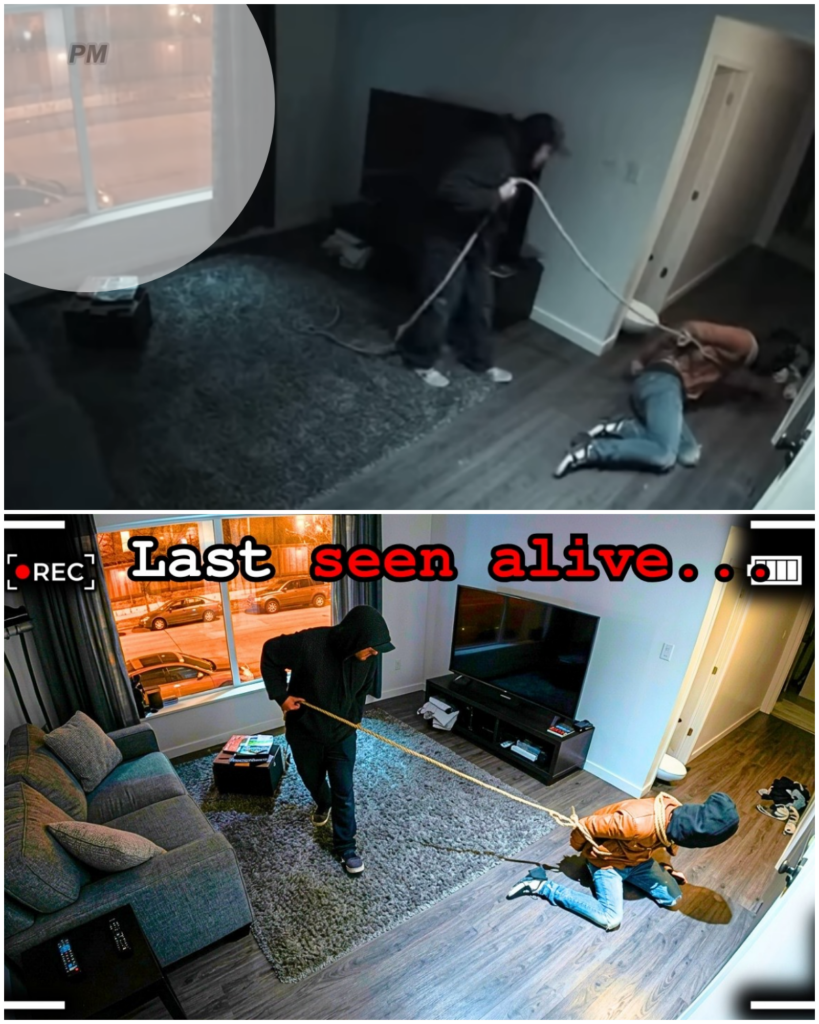
Look at this security camera footage. A living room, Sagena, Michigan. 2:47 in the morning.
A man walks into frame holding a rope. At the end of that rope, another man, hood pulled over his head, hands bound, legs that can barely hold him up.
They cross the room. They disappear. The woman who installed that camera wasn’t a detective, wasn’t suspicious of her husband, wasn’t looking for anything criminal.
She installed it because she thought her house was haunted. She was two states away when it recorded.
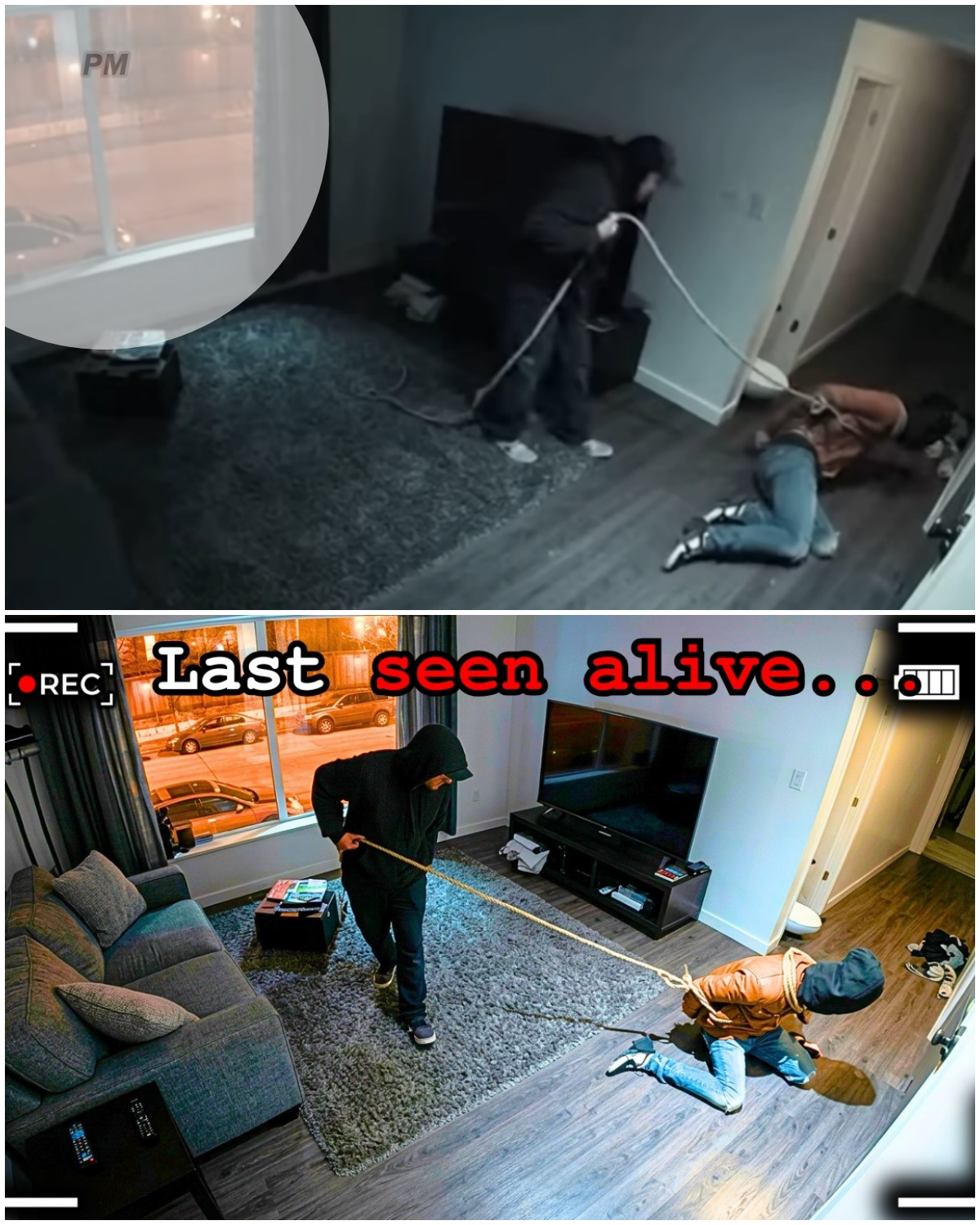
She came home 2 weeks later, sat down at the kitchen table, opened her laptop, and found that file.
November 9th, 2:47 a.m. She watched it once, then again, then again. The man holding that rope was her husband of 12 years.
And the man at the end of it had been living in their basement the entire time she had known him, 5 years, 20 ft beneath where she slept every night.
She had no idea he was there. What she did next set in motion the final hours of a secret that had lasted 5 years.
Selene Ravenwood was 40 years old and had spent the last 12 years building a life that from any reasonable distance looked completely functional.
Pharmaceutical sales representative, a territory covering Indiana and Ohio. Hospitals, clinics, doctor’s offices spread across two states.
Two to three weeks on the road every single month. Hotels, rental cars, conference rooms, dinners with physicians whose names she memorized because that was her job and she was good at it.
She was organized, reliable, the kind of professional who followed up, showed up prepared, and never missed a detail.
She came home to Sagenaw, Michigan to a house on the east side of the city that had been in her husband’s family for three generations.
Silas Rook was also 40, software consultant. He worked from home from an upstairs office he rarely left.
He had no close friends that Seline had ever met. He didn’t socialize. He didn’t go out much.
When he did leave the house, he was vague about where he’d been. And Selene had long since stopped asking follow-up questions because the answers were always the same.
Erands, nothing interesting. You wouldn’t want to know. They had been married for 12 years.
The house belonged to Silus’s family. His grandfather had built it in the 1950s, a methodical man with thick walls, deep foundations, and a certain conviction that structures should be built to outlast the people who lived in them.
The basement had been designed as a Cold War bunker. Concrete walls poured thick, no windows, a single reinforced door, soundproofed, not by modern design, but by sheer mass.
Walls built to contain the sound of the world ending, which meant they contained everything else just as completely.
It had sat empty for decades. Sagen is not the kind of city people choose.
It’s the kind of city people stay in because leaving requires a momentum that gets harder to generate with every passing year.
The east side especially dead factories, brutal winters, streets that carry the specific exhaustion of a place that peaked 40 years ago and has been declining quietly ever since.
You stop noticing the weight of it after a while. That’s the most dangerous thing about it.
On the surface, Selene and Silas were a functioning couple. She traveled. He stayed home.
They shared a mortgage, a routine, a life that generated no particular concern in the people around them.
But Seline had noticed things. The way Silas never invited anyone over. The way he deflected questions about his day, the coldness between them that had settled in years ago and never lifted.
She had suspected an affair at various points. It was the only architecture her mind could build from the available pieces.
Another woman, something hidden. She was right that he was hiding something. She was completely wrong about what it was.
There were also parts of the house she had never accessed. Silas had explanations ready for all of it.
The door at the end of the downstairs hallway, storage, he told her, old furniture, boxes from his parents, junk he kept meaning to sort through, structural issues.
She shouldn’t worry about it. The basement especially. She had never once been down there in 12 years of marriage.
Silas made it sound like a liability. Rotting wood, unstable flooring, a project perpetually deferred.
She had no reason not to believe him. This is the first thing this case teaches us about how predators operate inside relationships.
Silus Rook didn’t keep Seline out of that basement by force. He kept her out with words, with vague explanations that were just plausible enough to close the conversation, with the accumulated trust of a marriage, which is the most effective security system ever built, because it works from the inside out.
Selene didn’t avoid the basement because she was afraid of what she’d find. She avoided it because her husband had told her there was nothing to find, and she believed him.
That’s not naivity. That’s what trust looks like from the inside. She trusted him for 12 years.
October 2023. Selene had been on the road for most of the month. Indiana, then Ohio, then back to Sagena for a few days before heading out again.
But something had changed when she came home. She started hearing sounds. It began with scratching.
Not the random settling of an old house. Not wood contracting in the cold or pipes shifting in the walls.
This was rhythmic, deliberate, the kind of sound that has a pattern to it, that repeats at intervals, that stops and starts with a consistency that random noise doesn’t have.
Like fingernails dragged slowly across wood, like something knocking against a surface in a particular sequence, then thumping below the floor.
Not loud, not alarming on its own, but present. A low structural vibration that moved through the house the way sound moves through solid material when it has nowhere else to go.
Here’s the thing about the basement’s soundproofing. It was designed to block airborne sound, voices, cries, anything that travels through air.
And it did that completely. But structural sound is different. Structural sound travels through the building itself, through pipes, through support beams, through the bones of the house.
And those sounds don’t obey the same rules. What Seline was hearing was not someone screaming.
It was someone who had been down there long enough to understand that screaming accomplished nothing.
What she was hearing was Trevor in the fifth year of his captivity in a state of profound physical deterioration using the only method of communication still available to him.
He had found the old water pipes that ran vertically through the basement walls and connected to the plumbing above.
He had found a support beam that transmitted vibration upward. And in the moments when he had enough strength to do it, he knocked against them rhythmically, deliberately, not knowing if anyone could hear, doing it anyway.
Selene mentioned the sounds to Silas. His response was immediate and dismissive. Rats, he said.
Maybe raccoons getting into the foundation. Old house, old problems. He’d look into it. She wanted to believe that she almost did.
But the sounds kept coming and Seline, whose entire professional life was built on paying attention to details that other people missed, started paying attention to this one.
She noticed the pattern. The sounds happened when she was home and Silas was elsewhere in the house, in his office, or briefly out running an errand.
They stopped when he came back. That consistency bothered her in a way she couldn’t articulate.
Her mind went somewhere she hadn’t expected. Silas’s father had died in this house. His grandfather, too.
Both had lived here, grown old here, passed here. She had grown up in a family that discussed the supernatural the way other families discussed the weather, as a real and present part of the world.
She began to wonder if the house was holding something, if the people who had lived and died inside these walls were trying in whatever way they could to reach her.
She wasn’t entirely wrong about that. She ordered a small wireless security camera, motion activated.
She mounted it on a bookshelf in the living room, angled toward the center of the space.
She said nothing to Silus. She told herself it was because she didn’t want him to think she’d lost her mind, that she’d explain when she had something concrete.
But underneath that justification was something simpler and more instinctive. She didn’t want him to know it was there.
She left for a two-week work trip at the end of October. Indiana hospitals first, then Ohio.
The camera stayed behind. It recorded everything. November 14th, 2023. Seline came home. The house was the same, cold, quiet, carrying the specific emptiness that had characterized it for years.
Silas was upstairs in his office. He acknowledged her return with a nod, barely looking up.
A word or two, the greeting of two people who have been performing the motions of a marriage for so long that neither of them notices the performance anymore.
She remembered the camera. She retrieved it from the bookshelf. Silas hadn’t touched it, hadn’t moved it, hadn’t noticed it at all.
She carried it to the kitchen table, transferred the footage to her laptop, and sat down.
Two weeks of recordings, hundreds of files. She fast forwarded through most of it. Silas walking through frame.
The cat crossing the room. Afternoon light moving across the floor. The slow arc of it marking days she hadn’t been there to see.
Hours of nothing. And then a file. November 9th 2:47 a.m. She clicked on it.
The living room. Dark. Then motion. Silus enters from the left side of the frame.
He is holding a rope. At the end of that rope is a man. Hood pulled over his head.
Hands bound. Legs struggling to hold him upright. Silas moves forward. The man stumbles. Barely catches himself.
Keeps moving. They cross the room. They disappear from frame. Seline watched it once. She sat very still.
Then she watched it again and again and again. Her hands were shaking. Questions were arriving faster than she could process them.
Who was that man? Why was there a hood over his head? Why was he bound?
Why was he in their house? Why was he so weak he could barely walk?
How long How long had he been? How long had he been here? Here is what I need you to understand about that moment.
Seline had installed that camera to find evidence of something paranormal. What she found instead was evidence that the man she had shared her life with for 12 years was a complete stranger.
That while she had been sleeping in that house, traveling her territory, coming home exhausted and going to bed, something had been happening beneath her feet that she had no concept of.
This is what psychologists call a reality collapse. It isn’t just betrayal. It is the complete restructuring of everything you thought you knew.
Every memory gets re-examined. Every closed door takes on new meaning. Every absence is suddenly a question.
But the question that mattered more than any of that was this. The man in that footage, how long had he been there?
And where was he now? To understand what was in that basement, you need to go back 5 years.
November 3rd, 2018. Silas Rook is driving alone on a two-lane highway south of Bay City, Michigan, 15 miles north of Sagena.
Late, no street lights, no other cars. He had been at a bar, not drunk.
Toxicology would later confirm this, but he’d been drinking. More than that, he’d been thinking.
The kind of thinking that accumulates at a certain point in a man’s life when the distance between who he is and who he has been pretending to be becomes something he can no longer manage.
Silas had known since adolescence that he was not attracted to women. He had never told anyone.
Not a friend, not a therapist, not Seline. He had built his entire adult life as a sustained performance of a person he wasn’t.
And by 2018, that performance had become something closer to suffocation. The marriage was cold because it had always been cold.
The distance between him and Seline was not a problem to be solved. It was structural.
It was what the marriage was made of. He wasn’t paying attention to the road.
He didn’t see the man walking along the shoulder until the impact had already happened.
The collision was not catastrophic. Silas wasn’t speeding, but it was enough. The man went down on the shoulder of the road.
Silas stopped. He got out. The man was conscious. He was bleeding from a head wound.
One leg was broken. He couldn’t stand. He looked up at Silas from the ground and said the words that should have had exactly one possible response.
Help me. Please call an ambulance. Silas stood there. What happened in the next several seconds is something that forensic psychologists would later spend considerable time analyzing because it is the hinge point of everything that followed.
Silas wasn’t panicking. The evidence doesn’t support panic. Panic produces flight or frantic calling for help or the kind of erratic behavior that leaves traces.
What Silas did was deliberate. He assessed the situation. An injured man, an empty road, no other cars, no witnesses, a person who was hurt, alone, and completely unable to help himself.
And he made a calculation. He picked Trevor up. He put him in the back seat.
Trevor, in pain, disoriented, relieved, believed he was being driven to a hospital. Silas drove him to Sagenaw to the house to the basement.
He carried Trevor down the stairs. He locked the door. He walked back upstairs. Trevor Lang was 32 years old.
He had been walking home from a friend’s house. He lived alone. He had no family in Michigan.
He was originally from Oregon. And while his family there would eventually file a missing person’s report, the trail went cold almost immediately.
There were no leads, no evidence, no trail to follow. Nobody in Sagena was looking for him.
Nobody knew he was there. Think about what that moment on the highway actually was.
Silas had choices. He could have called 911. He could have driven Trevor to a hospital, reported the accident, and faced whatever came from that.
By most legal assessments, a sober driver who stops and renders aid after an unintentional collision faces very different consequences than one who doesn’t.
Instead, he looked at a vulnerable human being on an empty road and made a different calculation entirely.
Behavioral researchers describe this as the predatory window. The moment when someone with deeply suppressed antisocial tendencies encounters a situation that appears to offer consequence-free control over another person.
It doesn’t emerge from a single bad moment. It emerges from years of internal pressure building behind a facade of normaly until something cracks.
And what comes through isn’t an impulse. It’s a decision. Most people faced with a genuine moral test at that level of extremity choose the right path.
Not because they’re saints, because the capacity to reduce another human being to an object.
To look at someone in pain asking for help and see only an opportunity requires a specific kind of internal architecture that most of us simply do not have.
Silas had it, and he had been carrying it hidden for a very long time.
The basement of the rook house was built to contain concrete walls poured thick the way Silas’s grandfather had done everything with permanence as the only acceptable standard.
No windows, a single door. The soundproofing was not a modern retrofit. It was structural, a byproduct of cold war construction designed to withstand pressures far beyond what any human voice could generate.
Airborne sound, speech, cries, anything that travels through air was absorbed completely by the mass of those walls.
Nothing reached the floor above. Trevor’s injuries from the accident were never properly treated. No hospital, no surgeon, no imaging, no cast.
Silas improvised. He splinted the broken leg with materials from the house and in the weeks that followed sourced antibiotics through channels that would later form part of the prosecution’s evidence.
Working from home with unrestricted access to certain online markets, he obtained what he needed to prevent sepsis to keep infection from progressing to the point where Trevor would die from it before Silas was ready for that to happen.
The leg healed. It healed badly. The bone set crooked, leaving Trevor with a permanent limp that worsened as the years of muscle atrophy progressed.
But it healed because Silas needed it to. That methodology, the minimum necessary to preserve what he considered his, extended to everything about how Trevor was kept.
Chemical toilet, the kind used in camping trailers, installed in a corner of the basement, replaced and cleaned obsessively on the days Seline was traveling, which accounted for the majority of the month.
Industrial-grade odor neutralizers. Ventilation managed through a small duct that Silas had retrofitted himself. On the days Seline was home, Silas avoided the basement entirely, and the systems ran passively.
When she was gone, he maintained everything with a precision that bordered on compulsion. To anyone who noticed the cleaning products in the house, the industrial supplies, Silas had a ready explanation.
Old pipes, chemical treatments, the ongoing maintenance demands of a house built in the 1950s.
Seline had heard this explanation many times. It had never occurred to her to question it.
What Silas had constructed in that basement was the one space in his life where the performance was suspended.
Upstairs, he was a husband, a consultant, a man with a normal life and normal routines.
In the basement, none of that existed. Trevor was not a person to him in any functional sense.
He was possession, control in its most absolute form. The one area of Silas’s life where nothing had to be hidden because everything was already hidden.
That’s not intimacy. That’s captivity dressed in the language of need. Trevor resisted for the first year, consistently and desperately, searching for weaknesses in the door, in the structure, in Silas’s patterns.
He found none that he could exploit. The room was designed to contain. By the third year, the physical resistance had stopped, not because Trevor had accepted his situation, but because the combination of deteriorating health, complete isolation, and the total absence of any evidence that resistance would ever produce results had reduced him to something closer to endurance than fight.
He existed. He waited. He knocked on pipes when he had the strength to do it.
By 2023, Trevor Lang was 37 years old. He had spent a third of his adult life in that basement.
He was malnourished. His muscles had atrophied severely from years without meaningful movement. His leg healed wrong made walking painful.
He rarely spoke. He had adapted in the way that humans adapt to environments that should not be survivable, to the only world available to him.
Silas believed it could continue indefinitely. He had no plan, no exit strategy, no contingency.
He had simply built a life in which the basement was a permanent feature, managed, maintained, invisible.
He had been doing it for 5 years. He saw no reason it would ever change.
He was wrong about all of it. November 8th, 2023. A water pipe in the basement fails.
Sagena winters arrive fast and hit infrastructure hard. The Rook House, three generations old, never fully modernized, had pipes that had been deferring this particular failure for years.
On the night of the 8th, one of them finally gave way. Water began pooling on the concrete floor.
Silas discovered it when he went downstairs. The flooding wasn’t catastrophic, but it was rising, and Trevor, in his severely weakened condition, could not remain in a basement with water pooling around him.
Silas needed to move him temporarily. Here is where the layout of the house matters.
The door at the end of the downstairs hallway, the one Selene had always been told led to storage, the one she had never opened in 12 years of marriage, did not lead to a storage closet.
It led to a staircase. The staircase that went down to the basement. The door was the only access point and it had always been locked.
Selene had accepted the explanation and never tried it. That door was one of the foundational deceptions of the last 12 years, hiding in plain sight at the end of a hallway she walked past every day.
The actual storage room, a small space on the main floor at the back of the house, legitimately filled with boxes and old furniture, was where Silas decided to move Trevor while the basement drained.
No windows visible from the street. No reason for Seline to go in there. And Seline was still traveling.
She wasn’t due home for days. At 2:47 in the morning on November 9th, Silas went downstairs.
He pulled a hood over Trevor’s head. He didn’t want Trevor to see the layout of the house to develop any knowledge of what surrounded him.
He bound his hands. He attached a rope. He led him up the stairs, through the kitchen, through the living room.
30 seconds in a room with a motion activated camera on the bookshelf that Silas did not know existed.
Trevor could barely walk. 5 years of muscle atrophy, of malnutrition, of a body pushed far past its tolerances.
He stumbled as Silas moved forward with the rope. He barely kept his feet. They crossed the room and disappeared from frame.
Silas kept Trevor in the back storage room for 2 days until the water in the basement had receded enough that it was manageable.
Then he moved him back down. He fixed the pipe. He cleaned the floor. He restored everything to its default state.
By the time Seline came home 5 days later, there was no visible evidence that anything had changed, except that there was a file on a camera she hadn’t checked yet.
Seline has watched the footage four times. Her hands have steadied. Something colder has taken their place.
She finds Silas upstairs. She does not go into his office and close the door behind her.
Every instinct she has is telling her not to put herself in an enclosed space.
She stands in the hallway near the top of the stairs, close to the front of the house, close to the door.
She has her phone in her hand. The number 911 is already dialed. Her thumb is on the call button.
She is shaking, but it is the shaking of shock, not calculation. There is nothing strategic about what she’s doing.
She is a woman in the grip of something she doesn’t have language for yet.
Doing the only thing that feels possible, asking the question directly and watching what happens.
She tells him she installed a camera in the living room. She tells him she was hearing sounds and thought the house was haunted.
She tells him she found the recording from November 9th. She tells him she saw him with a man.
Who is he? She says, “Where is he?” Silas looks at her. He says nothing.
She tells him the police are on their way. She hasn’t called them yet. She says it to see his face.
And what she sees in his face in the seconds after she says it is not what she expects.
It is not panic. It is not collapse. It is something more controlled than that and more frightening.
He stands up. He walks past her without speaking. She follows him down the stairs, asking where he’s going, getting no answer.
He walks to the door at the end of the hallway. The door she has passed 10,000 times, the storage door.
He takes out a key. He unlocks it. He opens it. Behind it, not storage.
A staircase leading down. He walks down without looking back. Seline stands at the top of those stairs and does not follow.
She doesn’t know what’s down there. She doesn’t know what he’s about to do. And then she hears it.
A voice rising from below. Weak. Barely there. Hoor in the way a voice gets when it hasn’t been used in years.
Please. No. Please. Her thumb hits the call button. When you spend your life hiding who you are, hiding eventually becomes the only skill you have.
Silas Rook didn’t keep Trevor in that basement out of love. He kept him there because that basement was the one place in his life where the performance stopped, where he didn’t have to be the husband, the consultant, the man with the normal life, where control was total and unaccountable and no one could take it from him.
That’s not connection. That’s imprisonment. Wrapped in the logic of need. When Seline threatened to end it, Silas didn’t confess.
He didn’t break. He walked downstairs because in whatever remained of his reasoning, if the secret was going to end, it was going to end the way he decided, not on Trevor’s terms, not on Selen’s.
His police arrived at 11:34 a.m. On November 14th, 2023. Seline was at the front door.
She was still shaking. She told them everything. The camera, the footage, the confrontation, the voice she had heard from the bottom of those stairs.
Officers went down. The basement was still partially flooded from the burst pipe. Shallow water stood in pools across the concrete floor.
In the center of the room, they found a body. Trevor Lang, 37 years old, strangled, dead less than an hour.
Silas was sitting on the floor beside him, silent, staring at nothing. He did not resist when they handcuffed him.
He did not speak. He did not ask for a lawyer. He simply allowed himself to be taken with the particular stillness of someone for whom something has finally irrevocably ended.
The investigation that followed documented everything. Restraints, locks, a mattress on the floor, the chemical toilet in the corner, industrial cleaning supplies, medical materials consistent with long-term captivity management, antibiotics, basic wound care, the infrastructure of keeping a person alive by the minimum necessary margin.
Forensic analysis confirmed severe malnutrition, the healed but malformed leg fracture, and the physical deterioration associated with years of confinement without movement, sunlight, or adequate nutrition.
Trevor Lang had been reported missing in November 2018. His family in Oregon had filed the report.
Investigators had found nothing. The case had gone cold. He had been alive for 5 years in a basement in Sageno, Michigan, 20 ft beneath a woman who had no idea he existed.
His family was notified. The charges were kidnapping, unlawful imprisonment, and first-degree murder. Trial began in March 2024 in Sageno County.
The prosecution built its case on four elements. The camera footage from November 9th played for the jury in its entirety.
Selen’s testimony delivered without evasion, the forensic evidence from the basement, and the documented timeline connecting Trevor’s disappearance in 2018 to the night of the accident on that two-lane highway south of Bay City.
The defense argued diminished capacity, that the accident had triggered a cascade of decisions that spiraled beyond Silus’s rational control, that what followed was psychological collapse, not premeditation.
The jury deliberated for 6 hours. On April 2nd, 2024, they returned guilty verdicts on all counts.
Silas Rook was sentenced to life in prison without the possibility of parole. He showed no emotion, no apology, no explanation.
He stared straight ahead as the sentence was read with the same stillness he had shown sitting on that basement floor beside Trevor’s body.
Trevor’s mother had traveled from Oregon. She had not seen her son since before he disappeared.
She had spent 5 years in the particular grief of not knowing, which is its own category of loss, one without the finality that allows mourning to begin.
She said her son had been taken from her twice. Once on a November night in 2018, and again every single day for 5 years while he was alive and suffering.
And she didn’t know it. Trevor was buried in Oregon. His family visits his grave on his birthday, on the anniversary of his disappearance, and on the days when they simply need to be somewhere that belongs to him.
Seline filed for divorce within weeks. She put the house on the market. Nobody wanted it.
She eventually moved to Grand Rapids, shifted to a remote work arrangement, and stopped traveling entirely.
She started therapy. Six months after the trial, she gave one interview to a local journalist.
She said she thought about Trevor constantly, about the fact that the sound she had started hearing in October 2023, the scratching, the rhythmic thumping below the floor had almost certainly been him, a man in the fifth year of his captivity, with almost nothing left, knocking on the pipes of a house because he didn’t know what else to do.
Because the alternative was silence, she said. I thought I was looking for ghosts. The real horror was right in front of me.
I just didn’t see it. I’ll live with that forever. The house was demolished in 2025.
No buyer was willing to live in it. Whatever was built on that lot was constructed without a basement, without the architecture of what had happened there, without history.
Here is what that camera actually was in the full context of everything you now know.
It didn’t capture 5 years. It captured one moment from one night. A practical problem Silas was solving.
Moving a man from one location to another because a pipe had burst. A logistical decision in the maintenance of a secret that had run undetected for half a decade.
Without that camera, Trevor Lang dies in that basement and is buried somewhere no one ever finds him.
Silus continues. The house continues. The marriage continues or ends for ordinary reasons. And the story simply doesn’t exist.
No arrest, no trial, no mother standing in a courtroom in Sagena to say that her son was taken twice.
No answers of any kind. A motion activated camera installed by a woman who thought she was documenting a haunting running while she worked her territory across Indiana and Ohio recorded the footage that ended everything.
Here is the final thing I want you to sit with. When shame becomes consuming enough, when the gap between who you are and who you’ve been performing becomes a thing you can no longer manage, some people build entire architectures to contain it.
They construct systems of control, of concealment. They maintain them with a precision that looks from the outside like the ordinary diligence of a person with a busy life.
Silas Rook destroyed an innocent man. He destroyed his wife’s understanding of her own life.
He destroyed himself. And none of it addressed the thing that started it. Because that thing was never Trevor.
It was never the basement. It was the unbearable weight of a self that had never been allowed to exist.
The predatory window on that highway opened because Silas had spent decades developing the capacity to see other people as variables.
And when you’ve spent that long learning to do that, it becomes the only lens you have.
Seline installed a camera to catch a ghost. What it caught was proof that the thing she was afraid of was real and that it had been living in her house the entire time.
How many houses have rooms that nobody talks about? How many lives have basements that the people living above them have never seen?
How many secrets are maintained not by force but by the simplest possible mechanism, a locked door, a plausible explanation, and the trust of someone who had no reason not to believe you.
Selene got her answer on November 14th, 2023. Trevor Lang never got his. If this stays with you, it should.
And if you’ve ever dismissed something that felt wrong, as paranoia, as imagination, as nothing, trust it.
Because sometimes the camera catches what the eye refuses to see.
