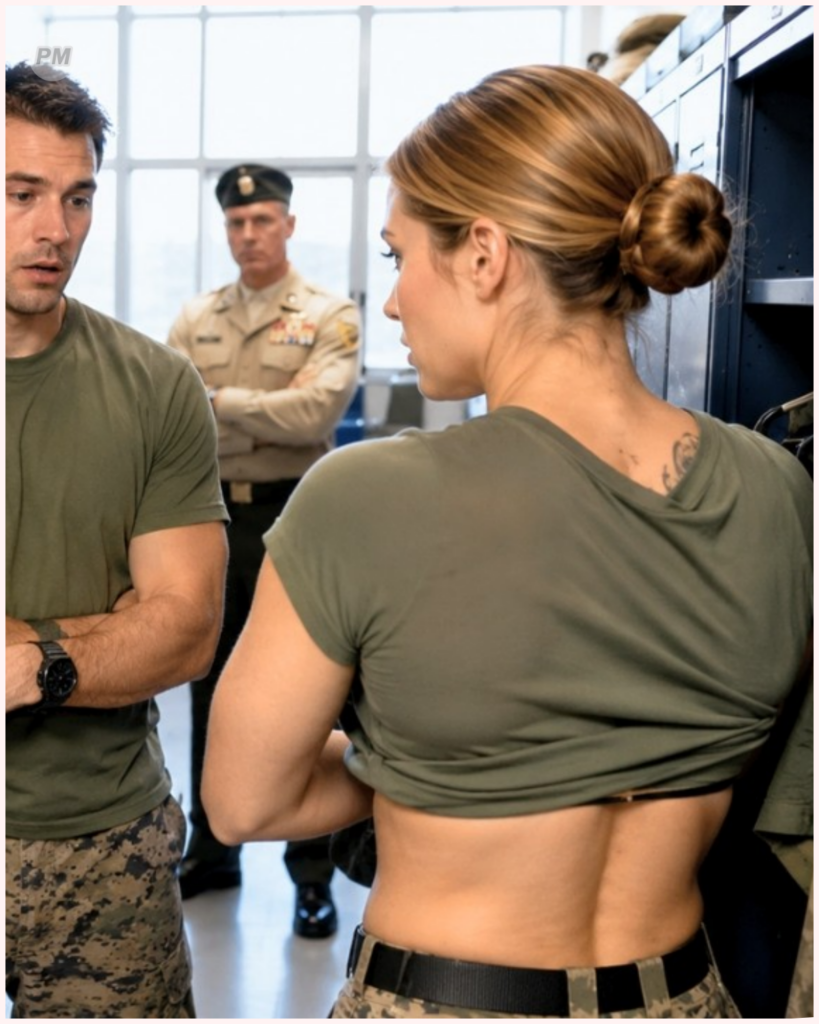
The door of the women’s locker room exploded inward at 0530, and Commander Cole Harrison, seventy years old and forty-five years a SEAL, stopped breathing.
The young woman standing at the lockers had her back to him, and across that back, from shoulder blade to shoulder blade, was a tattoo no living person had any right to wear.
It was a SEAL trident, but not the standard design. The eagle’s wings spread wider.
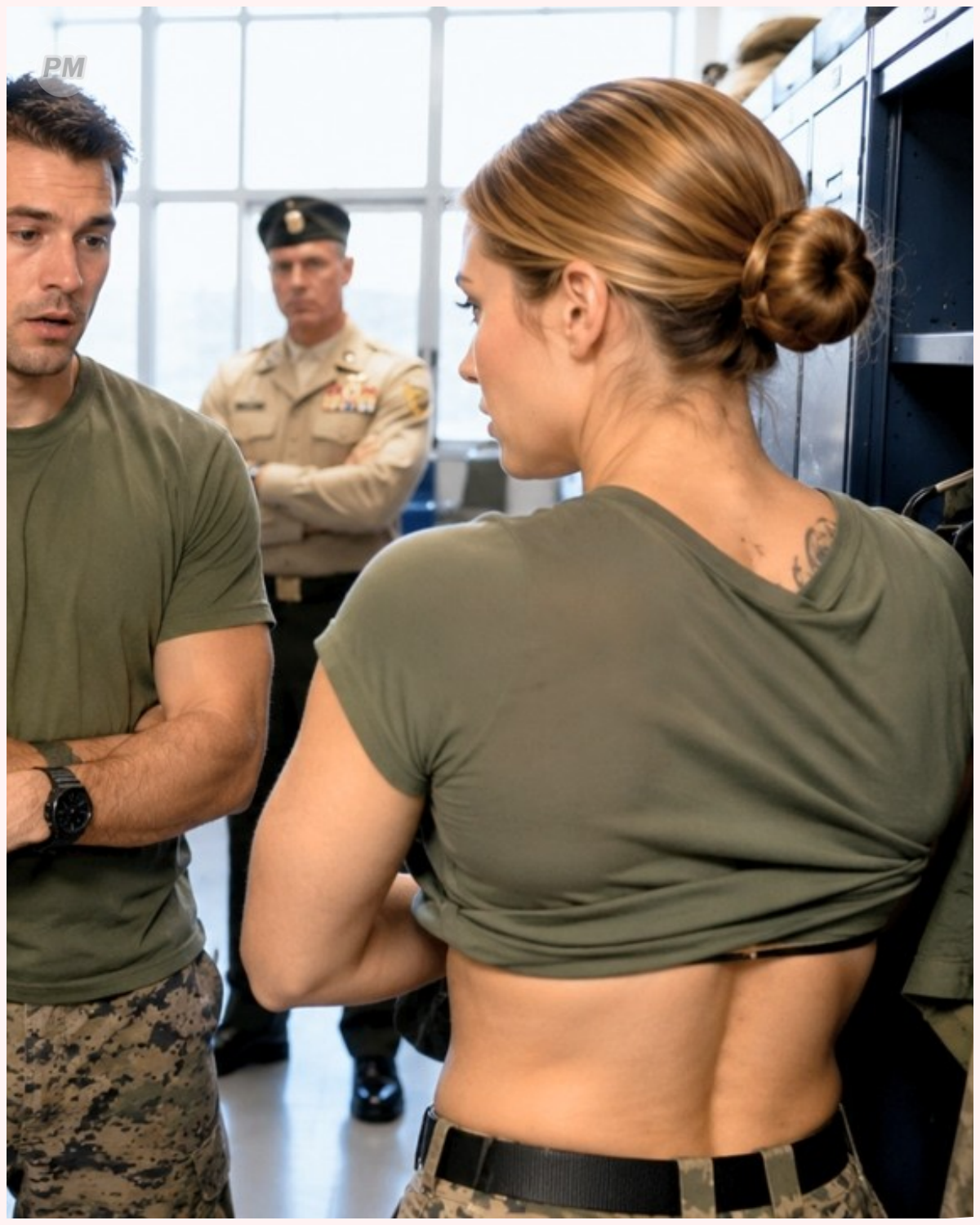
The anchor’s flukes were sharper. It was the exact variant carried by the original members of SEAL Team Six when the unit formed in 1980, a design only eleven men were ever authorized to bear.
Eight of those men were dead. Two were crippled. And one had vanished in 1984.
Beneath the trident, in precise military stencil, were the words Phantom’s Heir, 1983, and two initials that turned Harrison’s blood to ice.
NC. She did not startle. She did not scramble for her shirt. She simply turned, looked the commander up and down with gray eyes cold as winter steel, and asked him whether he intended to stand there all morning, or whether he was going to explain what he was doing in the women’s locker room.
When Harrison finally found his voice and demanded to know where she got that tattoo, her answer was quiet, flat, and impossible.
From the only person who had the right to give it to me, sir. Her name was Riley Kane, and she claimed to be the granddaughter of Nathan Cross, Harrison’s mentor, the man who had carried him off a bullet-swept runway in Grenada in 1983, the man who had supposedly died in a training accident in the Philippines a year later.
Except Nathan Cross had not died in 1984. He had faked his death and lived twenty-five years in hiding, hunting the traitor who had sold out the team in Panama in 1989, on an operation where nine SEALs walked into an ambush and never came home.
Nathan got too close to the truth, and in 2009 someone ran him off a Montana road and finished the job.
Before he died, he trained his granddaughter the way he had once been trained, and he left her three things.
A bullet engraved for the Angel of Death. A journal full of coded suspicions. And a list of five names, the five men who could be the traitor called Archangel.
One of those names was Cole Harrison himself. In a windowless room built to keep secrets, she proved the first part of it with a photograph, an eleven-year-old girl standing beside an old man with a scar through his left eyebrow, holding a rifle Master Chief Wyatt Brennan recognized on sight.
Then she set a single brass round on the steel table, a .338 Lapua Magnum her grandfather had pressed into her hand before he died, engraved with words only the men of that lost Panama operation would understand.
The CIA was already listening. An arms dealer named Dimitry Volkov was hosting a buyer in the Idaho mountains, and Washington believed that buyer was Archangel.
Harrison was ordered to take the girl, and he gave her one chance to prove she belonged anywhere near his team.
On the thousand-yard range, behind a Barrett M107 she had never fired, Riley Kane walked a slow circle around the shooting position before she ever touched the rifle.
She studied the wind flags, watched the heat shimmer twist off the sand, and dropped to one knee to lay her palm flat on the ground, reading the earth the way Nathan had taught her.
Harrison had seen that ritual exactly once before in his life, on the man who saved him.
Then she settled behind the rifle, became perfectly still, and put five rounds through the heads of five targets in forty-seven seconds.
When it was over, Harrison stepped forward, extended his hand, and gave her the only name that fit.
Wraith. Ghosts haunt, she told him. Wraiths hunt. Days later she jumped out of a C-17 at thirty thousand feet over the Sawtooth Mountains of Idaho, hunting an arms dealer named Dimitry Volkov and the buyer the CIA believed was Archangel himself.
Somewhere below her in the dark were four men she had been ordered to trust, and one of them had already sold the mission.
She found the trap waiting at the compound, climbed a cliff the defenders believed no one could climb, and walked alone into a basement room where Admiral Victor Graves, a man officially dead since 1990, was waiting for her with a smile.
The traitor stood beside him, and it was a face she knew, a man who had checked her gear before the jump and prayed beside her on the plane.
What happened in that basement, and in the bunker beyond it, decided whether three good men lived or died on a ridge half a kilometer away, and whether a seventy-year-old commander would take a bullet meant for a twenty-three-year-old girl.
Nathan Cross spent twenty-five years hunting one name. His granddaughter would spend twelve years hunting two hundred and seventeen of them, and the last page of his journal was waiting for her at the end of it, with the one order he never gave her while he lived.
Do you think Riley was right to walk into that basement alone, knowing one of the men behind her was the traitor?