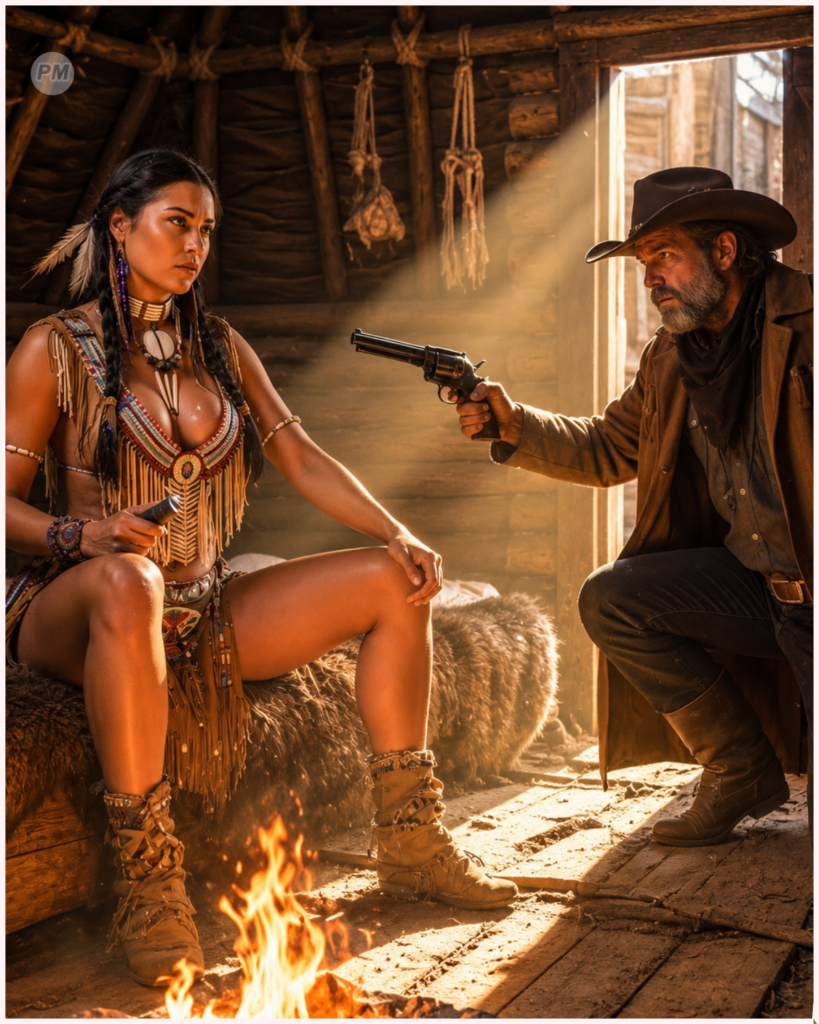
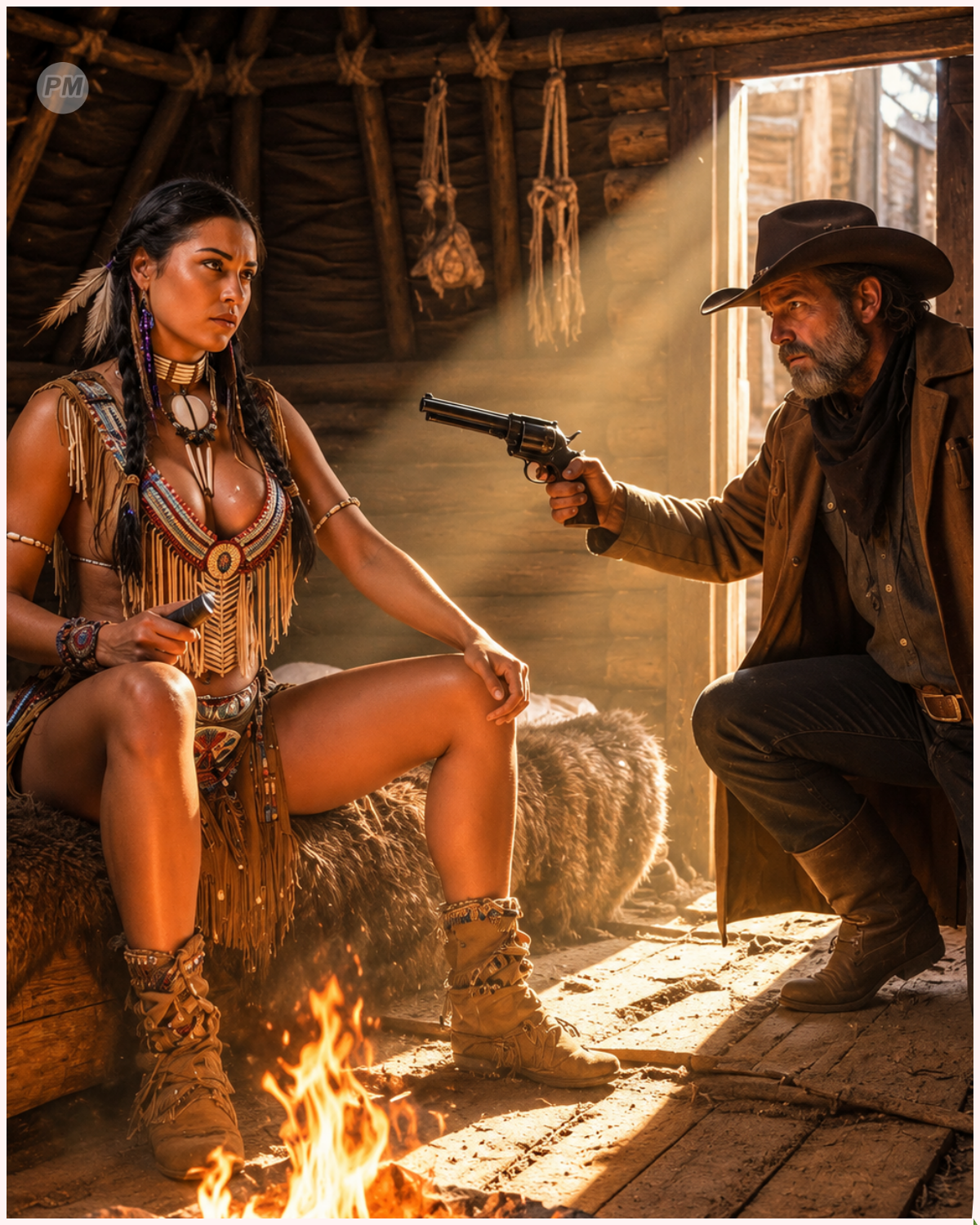
Will you be running others into this place? >> No, I rode alone. >> He entered an Apache shelter seeking shelter from the storm but found the chief’s daughter waiting in the quiet.
The storm and the stranger. The storm came sideways out of the hills, cold rain driven by a north wind that bit through coat and bone.
Thomas Hale leaned over the withers of his bay and felt the animal shudder beneath him.
The trail had turned to black glue, hooves sucking and slipping, the mesquite bending like men under orders.
He kept his hat pulled low and his thoughts lower, the way he had learned in other winters when the air itself seemed to hold a grudge.
He had not meant to ride this far toward the Sangre de Cristo range. Work had ended early in Silver Creek post set.
Wire pulled tight. A day’s honest labor and the foreman’s pay sat like a thin coin in his pocket.
It was enough for coffee and beans in town, enough for a bunk. He had told himself he wanted the quiet instead.
The quiet never argued with a man’s past. Lightning sketched the ridgeline. In the brief white flare he saw a shape on a low shelf of rock, hide staked against wind, a lean cone of poles, no smoke, no lantern.
A shelter. His first thought was trespass. His second was weather. The second won. He slid off the bay, felt the ground give, and led the horse under the lip of rock.
The shelter’s flap hung open, rain knitting a curtain beyond it. He told himself he would leave an apology or a coin or both.
He told himself he would only stay until the worst of the wind had passed.
He told himself many things men tell when they mean to cross a line. Inside was the smell of wet leather and cedar smoke that had died hours ago.
His eyes found a low hearth of stones, cold ash, then a stillness that was not empty.
The sense a body has of another presence when the air changes by a fraction.
He turned, slow as a man in a church. She sat near the back, knees drawn up, a blanket over her shoulders, hair braided and dark as wet hawk feathers.
The light was poor, but her gaze did not need light. It reached him without sound, no cry, no scramble for a knife, only watching.
The kind of watching that had weight. He lifted both hands, palms out. “Storm,” he said, voice low.
“That’s all.” Her face did not alter. She tipped her chin toward the opening and the scouring rain beyond it, as if to say that much was obvious.
He felt his throat working around words that would not decide who they belonged to.
He settled the bay’s reins on a peg and stayed standing the way a man waits to be told whether he has done wrong.
Wind shook the poles. The shelter answered with a creak like old bone. Somewhere out past the rock lip, water ran in a small new voice, a rill cut by violence.
He could feel the cold moving through the hole in his shoulder where the bullet had gone years ago and never fully left.
He flexed his hand once. The ache reminded him he was a man of weather and choices.
The woman turned her head and regarded the dead hearth. After a moment, she extended an arm from the blanket and nudged a small bundle toward him with the toe of her moccasin.
Twigs. A braid of something resinous. He understood the permission in that small economy and knelt, set flint to steel, coaxed a flame from the stubbornness of damp.
When it took, the smoke rose sweet and reluctant. Light found her face in lifts and fades.
The planes of her cheeks, the line of her jaw, a scar like a fine white thread above the brow.
He did not ask a name. Names had a way of turning into property in the mouths of men like him.
He sat near, but not close, holding his hands out to the weak heat. He considered speaking of thanks, of debt.
The words felt like coins too bright to be honest. “Will you be running others into this place?”
She asked suddenly, English shaped by another language beneath it, steady but deliberate. The question was not small talk.
It was a line thrown across a gorge to see if it would hold. “No,” he said, “I rode alone.”
“Then do not speak,” she said, “let the wind say the rest.” He closed his mouth.
Outside, the water’s new voice found its course, and the wind went to work on what could be moved and what could not.
He sat with a stranger in a shelter that was not his, warming to a fire he had built from her small offering, and felt a piece of himself he did not trust begin to loosen.
It felt like mercy and fear braided tight, the shelter of distrust. Morning did not come in a clean line, but seeped through wool clouds.
The rain had settled into a patient fall, finer and colder. The horse had found a dry stand under the rock and stood with head low, one hind foot cocked, eyes half-lidded in the way of creatures who learn to wait.
Thomas felt his shoulder sing in the dull key of weather. When he rolled it, the pain cut like wire turned inside flesh.
The woman was awake, eyes on the opening. She moved differently than the people he had known in towns and camps.
Motion seemed to start in her attention and only then arrive at her hands. He had seen Mescalero Apache before, from a distance, through rifle smoke or the false clarity of rumor.
He had seen the aftermath of cavalry rides, cooking fires stamped out, women wailing in a language men called noise when they wanted not to hear grief.
He rinsed the tin cup, scooped rain from a bowl he had placed outside, and set the water near the hearth to warm.
She unrolled a small pouch and pressed dried leaves into his palm. Bearberry and willow, she said, for what your face hides.
He filled two cups and steeped the leaves, the steam clearing a sweetness in the air that gathered around them both.
He drank and felt the clean bitterness move through him like scent. I can ride out when the band eases, she said finally.
I’ll leave coin for the wood. Her lips pressed, not a smile. You will leave when the wind tells you, not before.
He did not argue. He knew enough of being wrong about weather. He drained the cup and set it down careful, the way men set down things that have been given instead of taken.
They worked without instruction. He offered to mend a tear in the shelter flap. She set out sinew and bone needle as if she had already decided he would be able to learn.
He sewed slow and poor at first, then better, fingers remembering a different rhythm than reins and trigger.
While he worked, she gathered and ground, the mortar’s small rattle carrying the sound of a household into a space that had been only a line against wind.
When she spoke again, it was not for his comfort. Men burned our camp, she said, eyes not leaving the pestle.
The night before the snow melted and the river ran strong, they came when we were sleepy and thinking of food.
They shot my father as he stood with a piece of meat in his hands.
He had told a joke. He was smiling. It is a good way to leave, maybe, laughing.
But the noise of his body on the ground was not a joke. It was wood split.
The pestle stopped. She let silence finish the picture. Thomas watched the stitches he had made, crooked and improving, a line of clumsy intention.
He wanted to say a thing men say when they feel accused, even by truth, that he had not been there, not that day.
He remembered another day, a different river, smoke rising in dry columns that tilted when the heat made its own wind.
He had watched a woman hit the ground with her baby still in her arms and had done nothing but load.
“My name is Thomas,” he said. It felt like a confession and a dull knife.
“Thomas Hale.” She nodded once, then looked up. “Nadali.” The way she shaped the syllables made it sound like a piece of landscape.
“It means she moves,” quote. He wrapped the last stitch and tied the sinew off.
The flap lay flatter now. The rain struck it and sheeted away. The small difference between wet and shelter.
He exhaled and felt the world come half a degree closer to bearable. The day held.
They shared boiled pinole and thin strips of jerky from his saddlebag. She ate with a calm that was not hunger’s enemy but its manager.
He noticed her wrist scabbed where rope had left a ring. He stacked the images in his chest where they would not rattle and spill out.
At dusk, coyotes sent their lean music through the wash. The bay tossed his head but did not call back.
The hearth burned low, the red a pulse more than a flame. “You will sleep,” Nadali said, the command softened by fatigue.
“I will listen,” he tried to protest. She held out a small bundle of herbs and a roll of hide for his head.
The authority in her stillness silenced him. He lay on the sanded ground, the smell of smoke and damp hide turning the place into something like a room.
His shoulder throbbed itself into the bottom of his mind. In the seam between waking and sleep, he remembered the laugh of a man dying with meat in his hands.
He had never been taught a prayer for that. He made one out of quiet, the quiet between them.
The storm had spent itself in the night. Morning counted its small victories, new cuts in the arroyo walls, rocks turned.
A thin skin of water on everything that made the world shine without being kinder.
The wind had shifted, carrying the smell of piñon and horsehair and the cold iron of a distant river.
Nadali stepped out first, scanning in a slow circle that started at her feet. She moved with her center lower than most, knees ready, shoulders free, as if she expected the ground to lie for its own amusement.
Thomas saddled the bay without hurry, tore two strips of rawhide to re-lash a worn cinch ring.
The job both habit and something else now that his hands were steadier. At the edge of the shelf, the land fell away to a scatter of juniper and stone.
He saw a sign he would not have recognized a year ago, a broken twig turned on purpose to mark direction, smoke stain on rock worn to a delicate ghost, a place where many feet had rested and the earth had remembered.
She saw more. She knelt at a patch of sand and sifted with two fingers, then wiped her hand on the leg of her leggings as if tasting a thought.
“Soldiers?” He asked. She shook her head. “Hunters. Men who sell men.” He wanted to call that word wrong.
He wanted to say it belonged somewhere else, nearer oceans and ships, where he had never been.
He had seen enough in New Mexico to know the land did not care for men’s tidy maps of cruelty.
He remembered a boy sold his mother’s brooch for a bottle, the man who bought it and then said he had stolen nothing.
They spent the day in tasks that would have looked like husbandry to eyes that were not listening.
He fixed a split pole. She cut new lashings. He taught the babe to accept the smell of juniper smoke by standing with him near the hearth.
She taught Thomas to breathe through his nose when the wind carried a new scent, to let the smell tell him its shape before he named it.
Late afternoon brought a thin sun and a warmth that was more idea than fact.
Nadali sat with her back to the rock, face turned to the light. Her features eased, not soft, but a peace looser, like a knot that had been tugged in the right direction.
Thomas sat a few paces away and cleaned his Colt with the care of a man washing a child.
When he finished, he wrapped it in oiled cloth and laid it on the far side of the hearth.
“You do not sleep with it in your hand,” she observed. “I did,” he said, “a long time.”
“What changed?” He thought of the first winter after the war, the way he had woken with his fingers around iron and the sound of his own voice calling for men who were already ground.
He thought of a woman with a soft mouth who had asked him to put the gun under the bed and how he had promised and how death had come anyway.
A fever that made a fire of lung. He thought of promises that had held nothing but air.
“Nothing changed,” he said, “but I am tired of waking the wrong way.” She did not nod.
She let the words fall into the little quiet they had built and stay there.
In the slow weight of that silence, he felt a kind of agreement that did not need her to show him she agreed.
He felt responsible to it. When the sun slid behind the ridge, he stood >> Well, you’ve been very quiet.
>> to the shelf’s edge. The land turned the color of a bruise, >> alone.
>> blue under purple, the far mesas carrying a memory of blood in their name.
He put his hand on the rock and felt it give back the day’s warmth.
Without thinking, he pressed his scar into sand, palm grinding, grit biting. It was not penance.
It was an experiment to see if the ground could take a thing and hold it without judgment.
Behind him, the hearth crackled. He turned. Nadali had not moved, yet her gaze had changed.
It bent toward him for the first time as if curious in a human way, not merely a practical one.
Her chin dipped, the smallest acknowledgement that a man pressing his hand into soil might be saying a true thing without words.
Night broadened. Stars cut holes in it. He slept, not easy, but without the hard edge that keeps a man near the door.
In his sleep, he saw a river. It ran black and kind beneath cottonwoods. Voices on the bank were voices he did not know and wanted to.
He woke with the taste of ash and something sweet he could not name. The tracks in the mud.
Hoofbeats came around noon. A rattle on thin rock that reached before any dust. Thomas and Nadali were above the wash refitting a lash.
She froze and laid her hand flat, open. A signal he understood. The sound came from the west.
It carried the impatience of men who believed distance owed them deference. Three, she whispered.
He listened harder. Heard the fourth, slower, lame. Four. One dragging. Orden. She regarded him a heartbeat.
Then nodded toward the low slot cut into the rock behind the shelter. “There,” she said.
“Stay on your heels. No marks.” The slot was a ribbon with edges sharp as a knife.
Inside, the air cooled and smelled like old rain. Thomas eased the bay down and backed him into shadow.
Nadali moved like a thought through brush, pulling the shelter flap closed with two fingers.
She pressed her palm to the hearth as if to request silence from Ash. When she joined him in the slot, her shoulder touched his for a moment.
A point of heat that felt like being counted. Voices arrived before faces. Tracks here, a man said.
Light. Woman or boy. The other sets heavier. Rounded hoofs. Not shod. That means Indian stock.
I told you we were close, another voice, higher and trying too hard. He gets talky when he smells money.
Shut it, the first said, but without malice. Men who work together long enough grow used to one another’s worst notes.
Thomas watched a thin line of day in front of the slot’s mouth and saw a boot heel cross it.
The man’s spurs were plain iron. Government issue changed hands and uses more easily than decent people like to think.
The boot paused. Dust lifted. Settled. Smoke, a third voice said, off to the right.
Old though, the first voice again, impatient now. Check it. If it’s theirs, we burn what’s left, get them to ground.
We bring a girl in. It keeps the buyer’s purse soft. Someday I’ll teach you bastards to think like merchants.
The word girl cracked through Thomas’s ribs like a dry branch under a boot. He felt his heart throw itself in his chest, hard and useless.
He made his breath smaller. He could smell the men horse, stale tobacco, the sour of wool that had been rained on and dried on a body.
He felt Nadali beside him settle lower, weight forward over her feet. Her gaze did not move, but he sensed where it had gone.
To the colt wrapped in cloth on the far side of the hearth. Don’t, he whispered, barely sound.
We let them leave. Leave to bring fire back, she whispered back. He tried to calculate distance, time, the arc of a shot in air shifted by wind.
He tried to build a fight that ended with no one he cared about dead and found he could not do it on numbers alone.
Footsteps approached the shelter. One of the men ducked inside. The dim in the slot deepened as if the day itself had been pushed away.
Old fire, the man called, and look here, a peg set at horse height. Someone stayed.
Could be hours. Could be last night. Could be now. Metal slid. The little drows of ash on the hearth would suffer a boot heel poorly.
Thomas closed his eyes, not prayer, but the steadying of a mind at a ledge.
When he opened them, he felt the strange calm that had sometimes found him just before the worst charge.
It was not bravery. It was math after the numbers run out. He moved. He flowed out of the slot low, a line of shadow under brighter shadow, crossed the few yards to the hearth in three quiet strides and had the colt unwrapped and leveled before the first man pivoted.
The man was young, the beard still learning his jaw. Surprise will show a boy where time lives.
Nobody takes fire from here, Thomas said, voice calm in a way that had frightened him once and now steadied him.
You’ll step back and mount and tell yourselves there is other game to run today.
The second man swore from outside. The leader stepped into view at the shelter mouth.
He had a face like oiled walnut, handsome until the eyes. He appraised Thomas as if Thomas were a mule in need of teeth checking.
He smiled small. That’s a clean piece, he observed, glancing at the colt. Mind telling me where you got it?
Same place you picked up your manners, Thomas said, from a man better than they deserved.
Behind the leader, the lame horse shifted, hoof sliding. The fourth man murmured to it without tenderness.
The young one in the shelter looked at the gun’s mouth as if it were a hole a man could fall into.
The leader’s gaze flickered past Thomas toward the shadow where Nadali waited. If he saw more than rock, he did not show it.
“You talk like a man who’s been alone too long.” The leader said. “That kind grows opinions he can’t back and then the world takes him down to half his height.”
He nodded toward the hearth. “What’s her name?” Thomas’s finger tightened by a hair. The leader raised both hands, palms up, mock placating.
“None of my business.” He said. “But my business is catching what runs. And something ran through here.
You look like you want to stop us and like you can’t. We’ll take the help you can’t give.
Then we’ll be on our way.” “Quote, you’ll be on your way now.” Thomas said.
“Empty-handed.” The leader’s smile died by degrees. The kind of man who sells human beings without a theory about why will still dislike being told no.
He took a step forward. Thomas stepped one to match and felt the wind behind him pick up out of the east.
It came cool and clean through the shelter and carried a smell he had learned only yesterday, wet stone and crushed juniper, the little sharp of iron where lightning has put its mouth to ground.
He could shoot the leader and maybe the young one. The fourth man would spook at the shot.
The lame horse would lunge and fall screaming and men shoot worse with screams in their throats.
Nadali would move then and what she would be forced to do would take something from her she could not replace.
He lowered the gun the smallest measure that still meant business. “You’re riding a lame horse.”
He said to the fourth man. “It won’t carry you far at speed. That’s a bad thing to have under you when you’re making enemies.”
The man startled as if the truth of it had been waiting to hear itself.
He looked down then up, a flick of shame crossing his face, the leader cut Thomas with a glance.
“We’re done here,” he said, too loud, pretending command. He backed a step, then another.
The young one followed, eyes still on the colt as if the gun’s sight held him on a string.
They mounted. The lame horse balked. The fourth man gave it its head, gratitude ugly in his mouth.
They left in a clatter that sounded brighter than it should have. Their dust rose, hung, and then chose to belong to the air again.
Thomas waited three breaths after the sound had faded to smaller than a bird’s wing before he turned and set the colt down on the floor.
Nadali stepped out of the slot. She looked at his hands. They were shaking now that the arithmetic was over.
“You did not kill them,” she said. “No.” “Go.” “Why?” “I spent a long time watching men die who did not need to,” he said.
“I am not very good at being a good man, but I can be tired in the right direction.”
Her face turned, considering the way people look at a distant ridge and see a path a map has not drawn.
The choice and the fire. They moved before dark. The shelter came down quick and quiet.
Poles bundled, hide folded, ash scattered the way her people scattered it, a thanks and a forgetting.
Nadali distributed the weight without saying where it should go, and Thomas took what she handed him without protest.
They walked the bay because the ground had gone to slick clay in places, and because making less sound was a choice they could still afford.
Past the wash, the land lifted. They found the seam where a dry channel had cut a thin hallway and followed it, walls rising on both sides until the sky was a blue ribbon laid against stone.
The slot curved and narrowed. Twice they had to turn the bay sideways and press in through.
The horse would have balked for another man. For Thomas, after two days of new language, he made himself small.
They reached an opening, a bowl in the rock with a lip of cedar and a scatter of flat stones like old tables.
Above, the wind ran a higher register, but here it softened, the way sound does inside a hand.
Nadali pointed to a dark mouth at the back of the bowl. “There,” she said, “water in spring, air now.”
Quote. They laid the gear just inside the cave, set no fire, and ate without light.
The food was small, a survival rather than a meal. Hunger made it taste like better years.
After, Thomas felt the band in his shoulder tighten until it was an iron hoop.
He breathed through the boil of pain and refused the groan he could feel wanting his throat.
He had made choices with pain riding him before. He would not let it be a deputy now.
He leaned back against the cave wall. Stone greedily drank the heat from his spine.
Nadali slid to sit beside him, not touching. She unrolled the small pouch again, wet the herbs with a little water, and pressed the paste to the scar where the bullet had once explained the world to him.
Her hands were competent without apology. He felt the cold of the medicine creep into the ache and tease it apart.
He closed his eyes because there were things in a man’s face he did not like strangers to see, and he had no name for the way she had ceased to be a stranger.
“Why help me?” He asked, voice a scrape. “Because you did not shout,” she said, “because you did not wake the fire like a child and call it yours, because when death came and asked for company, you did not introduce me.”
He breathed out. Something that had nested high in him for years shifted lower, nearer his hands where he could feel its weight and decide what to do with it.
Night unrolled heavy. Far off, the world made war with itself again. The men had not given up the notion of trade.
Thomas could feel it the way an old hound feels weather. He stood and moved to the bull’s lip and looked down.
On the flat beyond the wash, three fires had bloomed. They were not cooking fires.
They were the kind men build to comfort themselves with damage. He counted shadows and came up wrong twice before he decided there were five.
Sleep. Nadali said behind him. I have. He said. Enough to owe back. She joined him at the lip.
The fires popped orange. Sparks rose and died. He watched the small floats of light and thought of the word belong.
It had bitten him for years like a burr under a saddle skirt. He had not known it might one night mean he would stand on rock with a woman and decide to be brave at a pace that matched hers.
When the first of the men began to climb, they did not shout. They had learned something from earlier.
Shadows moved where there should have only been night. Thomas moved too. Not loud, not bright.
He laid the bay flat with a hand on the withers and a breath at the ear.
He found the bigger of the flat stones and set it at an angle. A small ramp that would turn a foot wrong.
He chose the ground the way a carpenter chooses a nail. The first man took the ramp with his weight too far forward.
He went to a knee without noise, cursed once, and grabbed for something that would not hold.
By the time his hand came up with a pistol, Thomas had stepped close enough to put a boot on the wrist.
He said no in a tone he would have used for a colt that did not mean harm but needed telling.
The second man came quicker. The lame horseman from earlier. Face Wolf bright with the relief of doing something instead of thinking.
Nadali turned him with a short whip of cedar branch that startled him honest. He swung.
She moved her head by an inch. He swung again and found nothing but air and the sick certainty of overcommitment.
Thomas reached and took him under the belt and the collar and introduced him to the ground with a gentleness born of disgust.
The man curled around the loss of wind and did not get up. Then the third came with a knife and the fourth with a burning brand.
The brand carried its own argument. Thomas had to decide fast which piece of the world to grab.
He chose fire. He took the burning end in his left hand before his body could explain why that was foolish and used the clean part to strike the knife hand.
The brand broke on rock and scattered a ring of sparks that landed like red bees.
The man cursed. Nadali closed and put a knee where a knee does arithmetic on another knee.
The knife fell. She kicked it over the lip. It made no sound men could use.
The fifth man hung back. [snorts] He had the leader’s voice. “You could have let us do our business,” he called.
“There’s money in the world for the taking. Don’t you like to eat?” Thomas heard the question as if from another time.
He answered like a man to himself. “I have eaten things that took too much from me,” he said.
A shot cracked the night. Stone chips stung his cheek. The leader had not missed by accident.
He had wanted to scare or pin. Thomas felt the carefulness in his bones change its temperature.
He got low and moved to the right where the cave mouth cut a shadow cleaner than most.
The leader fired again, higher, too eager. Thomas saw the flash and knew where the man was by it.
He lifted the Colt and did not shoot to kill. He took the man’s hat off his head from 30 yards and felt no triumph, only relief a second later when the man crouched hands [clears throat] over nothing, a boy reflex.
“You won’t make me that kind of story,” Thomas said loud enough for it to carry as a shape of meaning.
“Leave. Take your men. Let the night forget you.” Quote, whether it was the missing hat or the way his name in his own head had sounded less like an accusation and more like instruction, the leader listened.
He backed, calling to the others, a collection more than a company. The lame man wheezed.
The one whose wrist had learned about boots did not say anything. They went. They left a smell of pride douced late.
Thomas stood for a long time with the cold down at his side. He could feel his burned palm and his shoulder and a lightness in his knees that might have been fear finally deciding it had work to do.
Nadali’s hand came to his wrist. The touch was not comfort and not claim. It was an inventory.
She led him back into the cave. She wrapped his left hand with damp and cloth that smelled of spruce.
She tended to the shoulder again, the paste a cold hand that knew its business.
When she finished, she sat back on her heels and looked at him the way people look at a field they have sown just before first light.
“You were a soldier.” She said. “Yes.” “You are not now.” “No.” “You did not become something worse.”
“I am trying.” He said. “That is what the wind asked for.” She said. And that was all.
Duatnem. Dawn over Ruidoso. They slept in a staggered way, two bodies keeping time with a night that had been asked to be too much.
The cave breathed like a tired chest, stone exhaling the day’s heat into the thin hours before morning.
Outside, wind combed through the juniper and the whisper of sand sounded like slow applause for anyone who had made it through the dark.
Toward dawn, the air cooled. It slipped over rock and skin with that strange ancient sound that makes men think of ghosts remembering how to sing.
Thomas woke to it and thought first of the sound and then of the silence, the absence of another rhythm beside his own.
He sat up. The place beside him was empty. Only the impression of her body remained on the blanket and the faint trace of smoke on the air.
Near the fire pit lay a small pouch of herbs, the bone needle, and a folded piece of tanned hide.
He reached for it, opening it like a man who already knew he was holding a farewell.
On the hide, stitched with red thread, was a circle deliberate, patient, and whole save for a single opening on the east side.
Inside that gap, a small shape bloomed, a flame turning into a flower, refusing to decide which one it truly was.
He did not need anyone to explain it. He’d seen the way she worked, the stillness required for hands to make such a thing, the breath held so long the chest forgot its purpose.
He traced the circle with one finger. The thread scratched slightly against his skin, a tiny heartbeat left behind.
Outside, light began to gather not sunrise yet, just the promise of it. The land below was still shadow, but the ridge beyond caught a pale line of fire.
Between that and him lay the whole country of what had been done and what still waited.
The sky bled from black to bruised blue, then softened toward mercy. He rose, slower than he liked, feeling the ache in every motion.
The night had taken something from him, but he couldn’t name what. He walked to the mouth of the cave.
From there, the valley opened brush, rock, a shallow wash glinting with the first edge of light.
On its far side were tracks, small, clean, deliberate. Her tracks. They curved uphill toward the maces where the wind kept its own council.
At one point, she had paused. He could see the deeper mark where her heels pressed in, the small indentation that said she had turned back once.
Looked, perhaps, hesitated, then kept going. He let the sight settle in him. Not his sorrow, not his relief, just truth.
A person who has been spared must move. A person who has spared must learn how to stay.
He breathed in the cold and felt it burn sweetly in his throat. The world below shimmered faintly as the first rim of sun cleared the ridge.
The light was thin at first, then gold, then something wider than forgiveness. He watched it reach the stones, the grass, the horse tied nearby.
Dust rose in small halos around its hooves. Thomas turned back into the cave. The fire was only ash.
He gathered what was his, a canteen, his coat, and what was not, but had been shared, the little pouch, the folded hide.
He packed them together without hurry. The horse stirred as if ready to move again.
He saddled up, tying the hide to the rear strings, the thread glinting once in the morning light before disappearing against the bay’s flank.
The bone needle he placed carefully in his pocket as if it were a nail to be driven later somewhere in the building of a new kind of life.
Before he left, he rebuilt the hearth. Three stones, a handful of twigs. He struck spark, blew gently until a coal caught and grew into a tongue of flame.
He held his hands over it not for warmth, but for the small ceremony of saying yes to the day, to breath, to being alive where another had been.
He watched it until it held steady, a small, stubborn fire declaring itself against the cold.
Then he stood, let the smoke climb, and whispered something wordless into it. It wasn’t a prayer, more like an agreement between two beings who had survived enough to stop arguing.
When he turned from the cave, the ridge was ablaze with white gold. In that light, everything became honest without turning pretty.
The kind of light a man can live inside. He mounted. The horse shifted, then found its rhythm.
Together they rode down the slope, hooves striking small echoes out of the dry earth.
At the wash, he paused. The water there was shallow, glass-like, and in it the blurred reflection of his face seemed to belong to another time.
He crossed. On the far side, her footprints were already fading, edges softened by wind.
He watched them go, her trail becoming part of the land’s long memory, like all trails do.
He didn’t call out. Names had work elsewhere now, words, too. The silence between them would hold better than any promise.
He turned east, into the light. The wind caught his coat and carried the smell of smoke past him toward whatever awaited beyond the horizon.
He felt a sentence rise in him, simple, steady, not meant to be said aloud.
A man can be made as much by what he refuses to do as by what he does.
He let that truth sit in his chest like a second heart. The trail wound through a scatter of pines, sunlight filtered between them in thin gold knives.
Each one cut a little deeper into the shadow still clinging to him until he could almost believe the past was not following.
He thought of her circle open on the east. That small break meant something, continuance, maybe.
The road in, the place where light enters. By midday, the world had turned warm again.
He stopped where the ridge flattened and let the horse drink from a trickle of water running through the rocks.
He filled his canteen, then sat, the saddle creaking like an old friend complaining softly.
He pulled the folded hide from his pack, looked at it once more. In the sunlight, the red thread glowed like embers.
He turned it over. On the back, faint but deliberate, she had burned a small mark, a handprint made with ash.
Her hand, perhaps, or the idea of one. The sight steadied him more than any blessing ever could.
He tucked it back carefully and looked east again. The sky there was a clean, impossible blue, the kind that made a man forget to doubt for a minute.
He felt the ache in his ribs from where he’d taken a blow days ago, felt the scar on his palm reopen slightly where the rope had burned it.
Both hurt less now. Pain had become something instructional, not punitive. When he finally rose, the sun was high and merciless, but he no longer minded.
The land, stripped bare, spoke in a language he could understand again, stone, dust, endurance.
He mounted once more and began the descent toward Ruidoso. From up here, the valley shimmered faintly, dotted with piñon and scrub oak, a few columns of smoke from distant homesteads.
Civilization, or what pretended to be. Somewhere down there were fences that needed mending, cattle that would break loose, men who would drink too much and pray too little.
He was one of them, or would be soon enough. Only this time, he might be less ghost and more man.
The wind shifted, carrying the faintest echo of song. Not a real one, just the imagination of it, the way memory sometimes hums when it wants to stay quiet.
He thought of her walking through the high country, shawl pulled tight, the dawn at her back.
The circle, the fire, the flower that refused to stop burning. He smiled once, small, honest.
Then he clicked his heels and moved on. The trail narrowed again before widening into open ground, and there he saw it, a half-broken fence line running along the ridge.
The posts leaned, wire loose, and singing faintly in the wind. He stopped, dismounted, and walked over.
He tested one strand. It moaned like an old instrument out of tune. He reached for his pliers, pulled the wire taut, set the staple.
The work was slow, deliberate, and strangely right. For the first time in months, he wasn’t running from anything.
He was repairing something, even if it wasn’t his. When he finished, he wiped his hands on his coat and looked at the line stretching away.
The fence held. The world, at least in this one small part, was mended. He mounted again and rode on until the land fell away into the long slope, down where the road began its hard argument with the desert.
Ahead, the wind kicked up dust that looked like distant smoke. He watched it twist upward and thought of the cave, the flame he’d left behind.
Fire becomes light, given enough patience. He rode east until the sun stood high above him, and everything else was shadowless.
Then he let the horse choose its pace. By the time he reached the first rise above the town, the roofs of Ruidoso caught the late glow, tin flashing like mirrors too far to touch.
He didn’t hurry. He just watched the light shift and thought of how the land never forgets who walks it, only waits to see if they’ll return different.
He whispered once to no one. One fence at a time. Then he kept riding, the wind carrying the last smoke of night east toward the place where names no longer mattered, and morning had finally decided to stay.