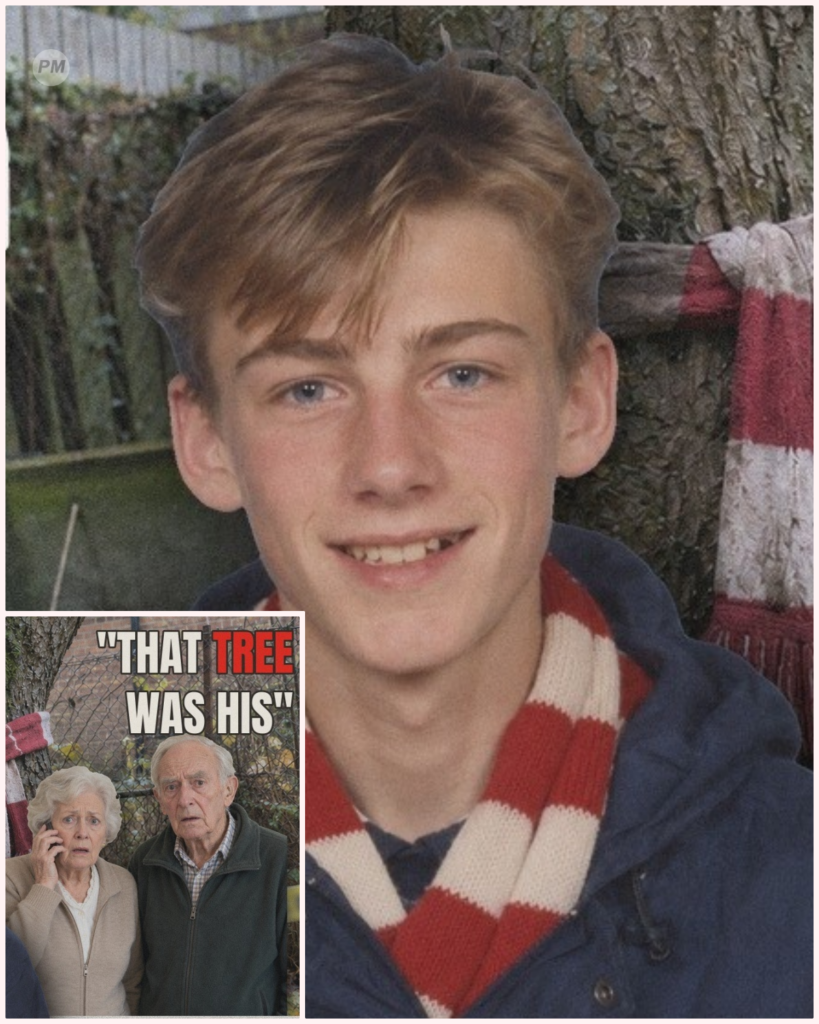
Just after 9 on the morning of Wednesday the 6th of November 2024, a tree surgeon in Larch Avenue, Well took the first limb off a horse chestnut tree and a 78-year-old man jumped out of a taxi at the gate as if the engine had been on fire.
His name was Dennis Thakray. He had a lung condition. A folder from the hospital clinic under his arm and a look on his face that his wife Brenda had seen only once before on the night in 1996 when their 15-year-old son went missing.
For 28 years, Dennis had never let anyone cut that tree. Not the neighbors, not the insurers, not a man with a ladder and a friendly smile.
Brenda had always put it down to grief. But that morning she watched her husband of 51 years lay himself down on the wet grass in front of a running chainsaw.
And for the first time she asked herself the question she had somehow never asked.
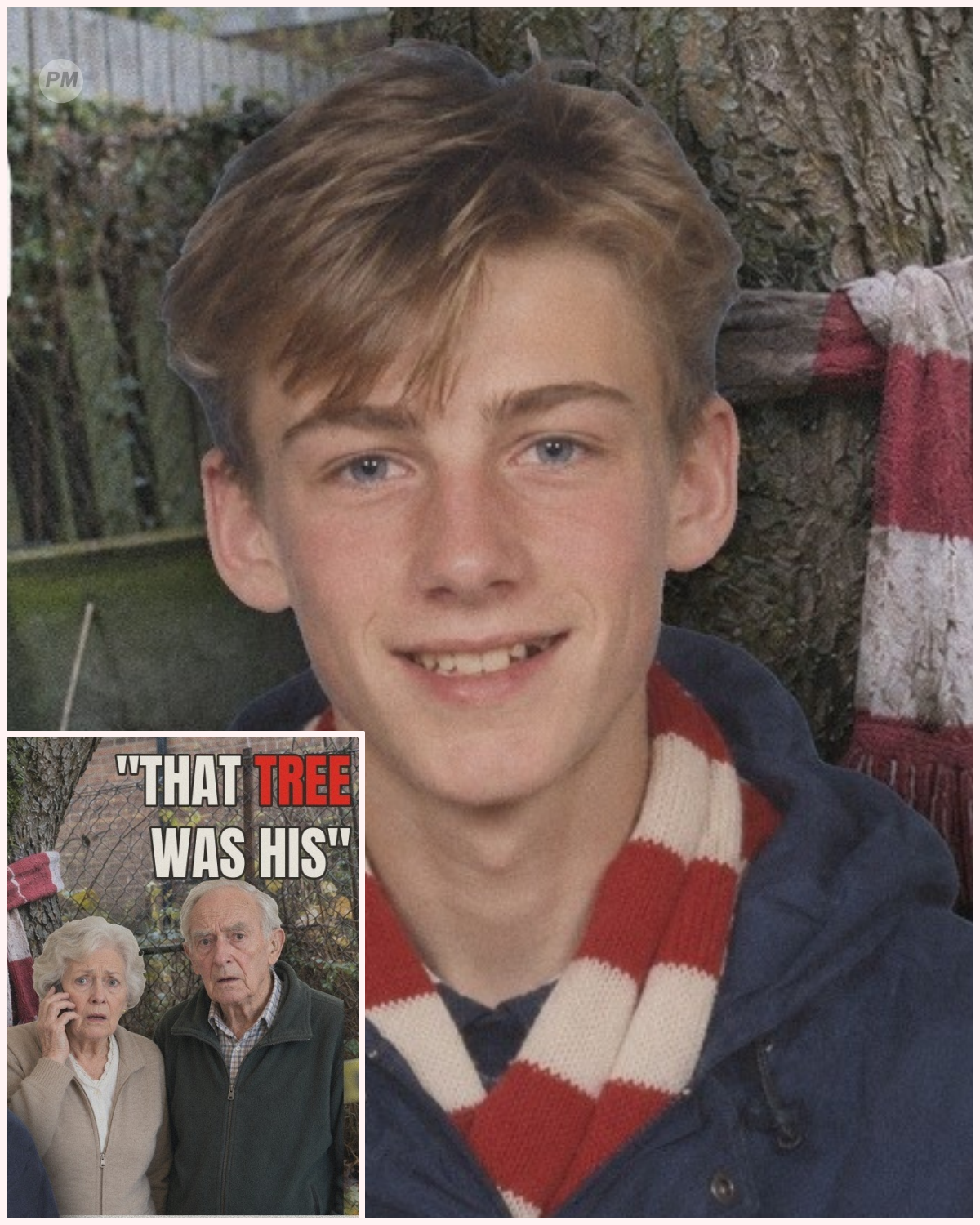
What exactly was he protecting? Danny vanished in 1996. His mom waited 28 years to notice the one thing that had been sitting at the bottom of her own garden the whole time.
And what that tree was standing on would take her nine more days to find out.
Before we go back to the beginning, if you’re new here, subscribe and hit the bell because this one has more turns in it than the road out of Barnsley.
And tell me in the comments where you’re watching from and what time it is there.
One quick note, this is a dramatized story. The names and some of the details are fictional.
Now, let me tell you how it all began. Wombwell is a town of red brick and old spoil heaps a few miles outside Barnsley in South Yorkshire.
In 1996, you could still smell the coal on a wet day, though the pits had been shutting one after another, and with them had gone a certain kind of man’s idea of himself.
Dennis Theray was one of those men. Born in 1946, down the pit at 16, the first on his shift, steady as a wall.
He had stood on the picket line at Orgrieve on a hot Monday in June 1984, and watched what the police did there.
And he had never trusted a South Yorkshire policeman since. When the pit closed, he took odd jobs, mended other people’s fences, and kept a cough that he blamed on nothing at all.
His wife Brenda was a dinner lady at Ings Road Primary. They had married in September 1973, and bought the house at 14 Larch Avenue, a red brick semi from the 1930s with a long back garden, 90 ft of it, running down to a wire fence.
At the bottom stood a green shed, a brick coal house, and Dennis’s winter cabbages.
Brenda was a woman who ironed tea towels. She laughed with her whole chest, and she worried with the same lungs.
They had two children, Joanne, who everybody called Joe, was 13 that autumn, sharp tonged, forever scribbling in a diary she kept under her mattress.
And then there was Dany. Dany was 15, born on the 14th of March 1981, thin as a rake, dark blonde hair with a cowick at the crown that no amount of water would flatten, a center midfielder for the school team, and a Barnsley supporter since the age of six when Dennis first lifted him over the turnstyle at Oakwell.
His dream was simple. One day, he would walk out at Oakwell in the red shirt and the whole town would sing his name.
There were three things that everyone in Wwell knew about Danny Thakray, and you will need them because they come back.
First, his front tooth. The upper left one was chipped, a little corner missing from the day he walked into the swing ball pole at the age of 10.
He hated it. Everybody else thought it made his grin. Second, his whistle. Dany whistled the match of the day theme through the chip in that tooth all the time on the stairs in the bath on his paper round until his sister swore she would murder him in his sleep.
Third a conquer. Every October the school held a conquer championship and that year Dany owned a champion which he called old faithful a 14er which means it had beaten 14 others.
He had baked it, drilled it, and threaded it onto a length of bright blue nylon string, and it never left his coat pocket.
A chipped tooth, a whistle, a conquer on a blue string. Hold on to those.
Dany also had a rule, and Brenda built her peace of mind on it. If he was going to be late, he rang.
There was a phone box on the corner of Larch Avenue and he would ring from it even if all he had to say was, “Ma’am, I’m at Gareth’s back by 10.”
That autumn he carried 40 pence in his coat for exactly that purpose. Gareth Pickering was his best mate, and Gareth’s older brother, Lee, had a reputation for driving other people’s cars.
Brenda used to say, “You could set the clock by that lad’s phone calls. Brendan knew how quickly a house could go quiet.
Her own father, Harry Dyson, had dropped dead in the yard at 38 when she was 11 years old, and she had never quite stopped listening for the next bad news.
She would soon be asked to describe him to a policeman on a form with a box marked distinguishing features.
Without even thinking, she wrote the first thing that came into her head. Chipped upper left front tooth.
But that was still to come. On the 5th of November 1996, a Tuesday, the whole of Wombwell was burning something.
In Yorkshire, they called it plot night, and the night before it was mischief when kids knocked on doors and ran.
By Tuesday afternoon, the whole of Larch Avenue smelled of wood smoke and parkin, and every back garden had a pile of pallets, old fence panels, and broken chairs, waiting for a match.
Dennis had built theirs down at the far end, well clear of the shed. There was a guy on top in one of his old pit jackets with a face drawn on a paper bag.
There was a tray of trickle toffee going hard on the windowsill. There was a box of fireworks from the corner shop and a bag of potatoes for the embers.
Dany came in from school at 10 4, dropped his bag in the hall, whistled his way through a plate of beans on toast, and went back out to help his dad stack the wood.
Brenda had never missed a Tuesday at the miner’s welfare. It was bingo night, and she went with her sister Sheila, and not even bonfire night was going to change that.
So at 25 6 with her coat on and her purse in her hand, she stood in the hall and shouted up the stairs that there was a pie in the oven and that they were to be good for their dad.
Dany came out of the back room with his scarf around his neck, the red and white Barnsley one, and his hands in his coat pockets.
“Terra, ma’am,” he said, and as she went out of the front door, she heard him start to whistle the match of the day theme through that chipped tooth.
It was the last time Brenda Thray ever heard her son whistle. For the next four hours, she sat in a smoky room with a bingo card and a pen, shouting house at the wrong moment and laughing at Sheila.
Out of every window of the welfare, the sky kept going off like a battlefield, green, red, white, and each bang made the glasses ring.
Nobody in that room had the slightest idea what kind of night it was turning into.
Sheila’s husband, Sheila’s husband, Terry, dropped Brenda at the gate at 20 to 11. The first thing Brenda noticed was the quiet.
The fireworks had mostly finished. Down at the far end, the bonfire had collapsed into a long, low bed of gray ash, and somebody had rad it out flat with a spade.
On the wall beside it, in the glow of the last embers, sat six small parcels of tin foil, scorched black, the potatoes.
They hadn’t been touched, not one. She went in through the kitchen. Dennis was sitting at the table in his socks with a mug of tea he hadn’t drunk.
His hands were scrubbed red raw. His boots were by the back door. “Where is Danny?”
She said, gone off. “Oh,” said Dennis, in a mood. Him and me had words about his school report and about 8 he said he was going down to Gareth’s for the bonfire at the wreck.
He’d have rung. I said Dennis he would. Upstairs Joe’s bedroom door was shut. Brenda knocked and a muffled voice said go away.
She looked at the clock. It was 10 to 11. She stood at the foot of the stairs and waited because Danny Thray in 15 years had never once been late without ringing.
At 11, she phoned the Pickerings. Gareth’s mother said that Gareth was in bed and that no, Dany hadn’t been round.
Gareth had rung the thack rays himself at 8, she said to ask where Dany had got to, and Dennis had told him that Dany had left at 8 and must have gone straight to the wreck.
At 25 to 12, Brenda rang the police. They were kind and they were bored.
A lad of 15 out on bonfire night, a row at home. He’ll turn up, love, they said.
He’ll be asleep in a shed. But a patrol car came at half midnight anyway, and a young sergeant wrote it all down in a notebook while Dennis stood in the doorway with his arms folded.
The next morning, Wednesday the 6th of November, two officers came back to do it properly.
One of them was a constable called Pritchard, 22, only a year out of training.
They went through Danyy’s bedroom. They looked in the shed in the coal house. They poked a stick into the compost heap.
They walked the length of the garden, past the black patch of the bonfire, with Dennis at their shoulder the whole way, telling them about the row and the way the lad had stormed off.
They had no reason to dig anything. They spoke to Joe in the front room on her own with her mother holding her hand and Joe with her eyes on the carpet said that Dany had gone out through the front gate at 8 and that she hadn’t seen where he went.
A neighbor, Mrs. Greenwood, told them that she’d been walking home from the display at the wreck along the backl at about 20 to 8 and had heard a young voice shout, “I wish you were dead.”
From one of the gardens. She couldn’t say whose or even whether it was a boy’s or a girl’s.
The police wrote it down. It fitted. A boy and his father, a quarrel, a door slammed, a runaway, and Dany had form.
In July, he’d taken a bus to Skaggnes after a row over a school report and sat for two days on a beach.
In September, he’d gone to a cousins in Sheffield. This, the police said, was the third time.
The ringing, they said, was a different matter, but they put that down to him punishing his parents.
What they did next was find someone to blame. In September, someone had driven Danny to Sheffield in a borrowed car, and that someone was Lee Pickering, 19, Gareth’s big brother, with a caution for taking a car without the owner’s consent.
Lee was brought in on the Thursday and interviewed again and again over the next three weeks.
He lost his job at a garage. By Christmas, half of Wombwell was crossing the road to avoid him.
People would stop him in the street and say, “What did you do to Danny Thakray?”
Lee told them the same thing every time. Nothing. It made no difference. On Sunday the 10th of November, Dennis went down the garden with a tel and a carrier bag of Danyy’s conquers from the hall.
Brenda watched him from the kitchen window. He turned the earth in the corner by the shed where the old pit of the wartime Anderson shelter used to be and pressed a single conquer into it.
Then he tied Danyy’s scarf around the stake beside it. He’d found it, he told her, on the shed door, so Dany must have gone without it.
He’ll see it when he comes home, Dennis. A tree for when he comes home.
Brenda cried at the window. She thought it was the kindest thing she had ever seen a man do.
In January, the police wrote no further lines of inquiry on the file. In April, on a Saturday, Barnesley beat Bradford City 2-nil at Oakwell and were promoted to the Premier League for the first time in their history, and Dennis stood on the terrace alone and didn’t sing.
Dany, as the whole street said, would have been in heaven. Brenda went over the last week of him a thousand times.
The school report, the row, the weather, the day in October when he’d gone dizzy for a moment at the edge of the school field and blamed too much coke.
Her brother Ronnie had dropped dead at 33 in the middle of a Sunday morning football match, and Brenda had never liked a quiet moment on a pitch since, but Dany had eaten a sandwich and been fine.
She laid a place for him at the table for 3 years. Joe left home at 18 and moved to Sheffield and came back for Christmases with her eyes on the floor.
Dennis put up posters in every town as far as Doncaster and went to every vigil and was thanked for it.
And the dog Sandy Danny’s yellow Labrador took to sleeping at the bottom of the garden, curled around the stake of the little tree every single night in all weathers, and no chain or kind word could ever make her come in.
Brenda thought she was waiting for him. Every 5th of November, Dennis went out after tea and tied the red and white scarf around the trunk and stood beside it until the last firework had gone off.
Brenda, who couldn’t bear bonfire night, sat on the kitchen step with the light on.
Both of them knew better than to say a word. But there was one question she never stopped asking.
Not who or why. Just this. Where was the phone call? Because whatever had happened to Dany that night, he hadn’t been able to reach a phone.
The letter arrived on Monday the 16th of September, 2024 in a cream envelope with a solicitor’s Frank on it addressed to Mr.
D. Thakray and Brenda opened it because Dennis was out at the welfare. It was from the insurers of the man next door.
Ahmed Desai, a physiootherapist in his 30s, had moved into number 16 with his wife three years earlier.
In the gales of the previous winter, a heavy limb had come off the old horse chestnut at the bottom of the Thack’s garden and landed on his greenhouse and half his conservatory roof.
The letter was polite, and it was very clear. The tree was in the thacks care.
If another limb fell, the thacres would be liable. A month later, an arborist came round with a clipboard and a ladder.
His report took him an afternoon and said one thing in three pages. The tree had bleeding canker.
It was dying from the inside. It should come down. Brenda read it three times.
Then she did what any sensible woman of 74 would do. She rang a firm called Writings Tree Care, paid a deposit on the kitchen table, and booked them for the first Wednesday they had free.
That was the 6th of November. She didn’t tell Dennis the day. She knew exactly what he would say.
What she had not stopped to think about when she picked the date was that the 6th was the day after the anniversary.
On Tuesday the 5th of November 2024, it was exactly 28 years. Dennis went out after tea in his good coat, as he had done every year, tied the faded red and white scarf around the trunk of the tree, and stood beside it in the dark until the last firework in Wombwell had gone off.
Brenda sat on the kitchen step with the light on. Neither of them said a word.
In the morning, Dennis had an appointment at the lung clinic. He took the 745 bus on his own, as always with his folder, and Brenda watched him from the front window until he turned the corner.
At 20 to 9, the writings van pulled up. There were two men and a chipper.
By 5 9, the foreman, a big lad called Kev Oldroid, had put his saw to the first limb.
What Brenda didn’t know was that Amit Desai had been at the bus stop. Glad it’s finally getting sorted, Mr.
Thakray,” he had said, smiling. And Dennis had got as far as the hospital car park before he understood what he’d been told.
The taxi came down Larch Avenue at 20 9. Dennis got out of it faster than a man of 78, with half a lung, should be able to move.
He went through the side gate and down the long garden with the folder still under his arm and he saw the limb on the grass and he made a sound.
Brenda would hear that sound for the rest of her life. It wasn’t shouting. It was something lower and worse than that.
Get off it, he said. Get off my tree. Kevlddroid took his ear defenders off.
Mr. Your wife’s booked us. We’ve got the paperwork, mate. It’s got canker. Moy, I don’t care what it’s got.
It’s coming down on your neighbor’s roof next time. You’ll be liable. Then you’ll have to cut me first, John,” said Dennis.
And he walked up to the trunk and laid down on the wet grass in front of it on his back with his arms round the base of the tree and his cheek against the bark in front of two tree surgeons, a running chainsaw and half the back windows in Larch Avenue.
Brenda stood on the patio with her hands over her mouth. She had known this man for 53 years.
She had seen him cry at his mother’s funeral and at the pit closing. She had never seen him look like this.
Except once, she thought, and her stomach turned over once, the night in 1996 when she came home from bingo.
She just hadn’t known then what she was looking at. Somebody rang the police. Two officers came.
A polite young constable and a woman sergeant, and they stood at the back door and listened to the foreman and to the neighbor and to the old man on the grass.
“Nobody had committed an offense,” they said. “It was a civil matter between neighbors.” The foreman rolled up his cable.
“Not worth it, love,” he told Brenda, and he took the chipper away. Dennis sat down at the foot of the tree with a flask and a blanket, and he refused to come in.
It rained. He was still there at midnight. At midnight, Brenda went upstairs to the back bedroom, opened the wardrobe, and took down the old Quality Street tin where Dennis kept what he called his papers.
She had never opened it. It had never occurred to her. Dennis dealt with the post, the bills, the outside, the man at the door.
It was how it had always been. Inside were letters and receipts and a few cheap invoices, and she took them down to the kitchen and laid them out on the table in the order of their dates.
In 2004, Mrs. Greenwood had written to ask if she might trim the overhanging branches.
Dennis had written back no. In 2013, a letter from the water company said the roots had got into the main drain and the pipe would have to be dug up.
Dennis had refused and paid a firm 3D’s $800 in cash to line the pipe from the inside without digging.
In the hot summer of 2018, the cracks had come in the back wall. The insurers had sent an engineer and the engineer had wanted to dig a trial pit beside the tree.
Dennis had refused and had his claim thrown out and paid twos $900 for resin to be injected under the footings, again without a spade.
In June 2021, a tree surgeon hired by the neighbors had been sent away by Dennis, then 75, carrying a shovel.
The police had been called. There was a reference number. Brenda remembered every one of those years.
The men with their plans, the engineer in the garden, the police on the doorstep.
Dennis had always said it was grief, and she had let him. What she had never seen was a single letter or a single pound note leaving the house.
She added it up with the pencil from the telephone table. 6700. Her husband had spent 6700 out of a pit pension to make sure no man ever put a spade within 30 ft of that tree.
And it hadn’t been about the tree. He’d let them do almost anything else. He’d let them mend the wall and line the drain.
The only thing he had never allowed was for anyone to dig. She sat there with the rain on the window, and she thought about Dany upstairs in a photograph on the landing with his cow lick and his chipped front tooth, about the whistle she could still hear if she let herself, and the conquer on its blue string that had never been found.
And one sentence arrived in her head so calmly that it frightened her. He was never protecting a tree.
He was protecting the ground. What had Dennis been guarding for 28 years? Was Brenda a grieving old woman seeing ghosts in a dead tree or the first person to see clearly in a quarter of a century?
And why had it taken her until now? If you want to know what she found, hit the like button and stay with me because what comes next?
Nobody in Larch Avenue saw coming. Dennis collapsed in the kitchen at 6:00 the next morning, gray lipped with a chest like a wet sack.
By 8, he was in an ambulance. By noon, he was in a bed at Barnesley Hospital with a drip in his arm and a doctor saying the word infection and Brenda sat beside him and held a hand that wouldn’t hold hers back.
Don’t let them near it, Bren. He whispered when the nurse had gone. Promise me.
She didn’t promise. Her daughter came at 1:00. Joe was 41 by then. A school receptionist married to a solicitor called Craig with two children.
Poppy, who was 12, and Ben, who was nine. She looked as though she hadn’t slept for a month.
They went down to the cafe, and Brenda told her about the letters. Joe listened with her cup in both hands, her eyes on the table.
Then she said very quietly, “Ma’am hits a tree.” Joe, your dad spent £6,700. He’s grieving.
He’s always been like that about it. It’s the only thing he’s got of Danny’s.
Ma’am, he’s in a hospital bed. Not now. I think our Danny’s under that tree.
Joe’s cup hit the saucer so hard that it cracked. Don’t you dare say that, she said in a voice Brenda had never heard from her.
Don’t you dare say that in front of my children. Then she picked up her bag and left and didn’t look back.
Joe had always been fussy about mud. In all the Sunday dinners at Larch Avenue, she had never let her children go down to the end of the garden, not even for a ball.
Brenda drove home alone through Wombwell in the gray afternoon. She did not trust the police.
She had married a man who didn’t. But she put the Quality Street tin into her handbag.
With that sentence still going round and round her head, and the next morning she went down to the station in Barnsley, the duty sergeant at Barnesley Police Station was a man in his early 50s with reading glasses on a cord and a face that had heard everything before.
His name badge said Pritchard. He came to the counter when she asked, and there were five people behind her in the queue.
She told him the whole thing in under 3 minutes, standing at the counter with the tin open in front of her, the letters, the scarf, the drain, the spade.
A boy missing since 1996. And a tree. Sergeant Pritchard listened to all of it politely and tapped something into his computer.
“Mrs. Thatray,” he said. “Danny, I remember the name. He was a runaway love. They all were.”
That year we looked very hard at Lee Pickering and he was the best we had and he got nowhere.
A lot of them turn up in London in a bedsit and don’t ring home.
He never missed a call in his life. I’m sure that’s how it seems. He turned his screen slightly.
I’ve got a record here from June 2021. Your husband threatened a tree surgeon with a shovel.
Advice was given. I’m not going to ask a magistrate to dig up a pensioner’s garden because he’s fond of his tree.
Somebody behind her coughed. Brenda stood very still. Then she took a thin sheet out of the tin and laid it on the counter.
It was the carbon of the missing person form from the 6th of November 1996 gone yellow at the folds.
At the bottom in blue bro it said reporting officer PC 2214 Pritchard. The constable left me this copy some said Brenda.
I kept it in case anyone ever asked. She picked up her tin and she went out into the rain.
On Saturday the 9th Craig came to the house. Her son-in-law was 46, a conveyancing solicitor at a firm in Barnsley with a good coat and a calm voice.
And he stood in the kitchen with his car keys in his hand and did not sit down.
Joe told me, he said, “Brenda, I’m going to say this once, and I’m saying it as family.”
“You’ve been to the police about Dennis. You’ve got a man of 78 with a chest infection lying in a hospital bed.
If this goes any further, it’s harassment. I’ll have to speak to Dr. Ahmed about your state of mind and Joe and I will decide whether it’s right for Poppy and Ben to be around you.
Around me? Poppy blacked out at hockey in September. And there are tests coming up.
Joe’s at the end of her rope. You’ll not see the children, Brenda. Not until you’ve seen since.
Brenda thought of Ben’s small hand and hers on the walk to school, of Poppy asleep on her shoulder in the car.
It was the worst thing anyone had said to her in 28 years, and he said it so gently that for a minute she thought she’d misheard.
That night, in a terrace house in Cudworth, an off-duty sergeant sat at his own kitchen table and could not sleep.
Pritchard had kept a copy of his own. He didn’t know why. He looked at his signature, 28 years old and neat, at the bottom of that form, and he remembered the afternoon he’d walked down that garden in 1996, beside a gray-faced father who never took his eyes off him.
A black bed of ash, a shed, a cabbage patch. He remembered that the father’s boots were still by the back door, caked in clay to the laces in a garden that was mostly lawn.
He’d noticed it, and he had let it go. At 10, he picked up the telephone and rang a woman he’d trained with, a detective sergeant in the cold case review team, and he said, “Michelle, I’ve got something I should have taken more seriously.”
On Sunday evening, Brenda’s phone rang. “Mrs. Thakray, it’s Detective Sergeant Michelle Ogden. I’ve read your file twice.
Can I come around tomorrow?” Das Ogden turned out to be 46, a minor’s daughter from Goldthorp with a greywolf coat and a voice that didn’t hurry.
On Monday the 11th, she sat at the kitchen table where the letters were still laid out in their rows and read everyone.
She went down the garden and stood in front of the tree for a long time, looking at the scarf.
When she came back in, she said what Brenda had been waiting 28 years to hear anyone say.
I don’t know what’s under that tree, Mrs. Thray, but I don’t like the shape of what’s around it.
Then she explained the rest. Brenda was a joint owner of the house. If she signed a consent form, the police could search the garden with her permission.
It would get them through the gate. It would not get them past a husband standing in the way, and for that she’d need a magistrate.
But Dennis was on a hospital drip for the time being. You’d be doing it against him, said Ogden.
I want you to understand that whatever we find or don’t. Brenda looked at the form at the line where her name went.
She had been Mrs. Dennis that for 51 years she signed it. On Tuesday morning, a white van pulled up in Large Avenue and four people in blue overalls carried a machine like a lawn mower on a long handle into the garden.
It was ground penetrating radar. The forensic archaeologist, Dr. Priya Raman, a small, brisk woman in muddy boots, walked it up and down the lawn in neat lines all morning while the whole street found reasons to stand at their windows.
Amad Desai came out and offered everyone tea. Nobody said what they were thinking. At 2:00, Dr.
Ramen came in with a print out. There’s one clear thing, she said. Down by the fence to the right of the shed.
A disturbance about a meter down, roughly a meter long, and I can’t read anything under the tree itself.
The roots are too dense. It scramles the signal. A meter long, said Brenda. About the right size for a large dog, said Dr.
Ramen. Or a small person. The next day was Wednesday the 13th, and the dig began at 8.
Two officers in white suits knelt in a trench beside the fence, scraping the clay away with trowels.
And in the garden next door, three children had come up on a wall to watch.
Brenda stood at the kitchen window with a mug that went cold in her hand.
At 10, they hit something. At half, Dr. Ramen stood up, her face unreadable, and held up one hand to stop everybody.
In the whole of Larch Avenue, you could have heard a leaf fall. Then she knelt again and brushed gently with a paintbrush and said, “It’s an animal.”
Brenda didn’t understand. “A dog,” said Dr. Ramen. “An adult Labrador, I think.” There’s a collar.
He held up a rusted metal tag. The letters on it were worn but clear.
Sandy, Danny’s dog. Brenda had been telling herself for two days, “Please not him.” And under it, in a voice she hated, “Please let it be him.
Let it be over.” It was neither. She went into the downstairs toilet and was sick.
On Thursday morning, the detective chief inspector came himself. DCI Hail was a tall man in a navy overcoat who talked to Brenda on her own front step.
They had found what the radar had found. He said, “A family pet. The only other disturbance was under the tree itself, and Dr.
Ramen couldn’t read it. To investigate that properly. He said they would need a specialist team and a contractor to lift the whole root plate in a month and a budget he didn’t have on the strength of radar noise.
I’m sorry, Mrs. Thray. We’ll backfill today. Dr. Ramen caught Brenda at the gate with her kit bag over her shoulder.
If you fell it yourself, he said quietly, you’ll wreck whatever is under there. Please don’t.
By 4:00 the trench was filled and the vans had gone. The same afternoon Dennis was discharged and a taxi brought him home.
He walked down the garden with his stick. He saw the fresh turned earth and the big white sack of spoil and he stopped and then he walked on and sat down at the foot of the tree beside the scarf.
Brenda watched him from the window. She saw him lay his hand flat against the trunk.
He looked, she thought, like a man who had just been told that he wasn’t going to be hanged.
Behind her in the kitchen, Craig and Joe were standing side by side. “Satisfied,” said Craig quietly.
Brenda didn’t answer. She was looking at the long, wet scar in the lawn where Sandy had lain 6 ft from the fence.
And she was remembering the one and only time in 51 years that Dennis had ever shouted at her about that tree.
It was a Saturday in April 2003, the 12th, Sandy had been failing for weeks, and that morning she died in her basket in the kitchen with her head on Brenda’s slipper quietly the way old dogs do.
Brenda had known exactly where she wanted her. For six years that dog had slept every night at the foot of Danyy’s tree, curled around the stake in all weathers.
It seemed the only decent thing in the world to lay her there. So she went out to the garden where Dennis was standing with a spade and she told him.
“Not there,” said Dennis. “Dennis, it’s where she wanted to be.” “Not there. Not there, Brenn.”
He roared it. In 30 years of marriage, Brenda had never heard him raise his voice to her.
And now the whole terrace could have heard. His face was gray and his hands were shaking on the handle of the spade.
Then he turned his back on her and dug for 6 hours in the rain in the far corner by the shed 15 ft from the tree until he was in mud to the thighs.
She had stood at the window thinking that her husband had never loved anything as much as that dog.
Now she stood in the same window with a cold mug and she saw it differently.
Every refusal, every letter, the money, the scarf, the six years that Sandy had spent curled around a little steak in the rain.
A dog doesn’t wait 6 years for a boy who isn’t there. Sandy hadn’t been waiting for Dany to come home.
She had been lying beside him. Brenda put the mug down very carefully on the draining board.
She didn’t tell Joe or Craig. She sat up all night. At half 7 the next morning, Friday the 15th of November, she rang Writings Tree Care and spoke to Kevlddroid and said that she’d pay double.
She also said that this time they were to cut it at the base and leave the roots where they were.
Detective Sergeant Ogden was at the gate at 20 to 10 with her gray coat buttoned to the neck.
She’d rung Dr. Rammon at home, she said on her rest day. The DCI had refused the budget.
He hadn’t said anything about her standing in a friend’s garden. If Kev cuts at the base and doesn’t touch the roots, said Ogden, Priya says the cut won’t be damaged, and if there’s something there, it becomes a scene whether the DCI likes it or not.
Dennis had been home for a day. He came down the stairs slowly in his dressing gown while the van was reversing into the avenue and he saw Kev’s men with their saws through the kitchen window and Brenda in the doorway in front of him.
She had expected him to run. She had expected him to throw himself on the grass again.
He stopped on the bottom step and he looked at her for a long time.
Dennis, she said, I’m cutting it down. You can lie in front of the saw again and I’ll lie down beside you.
But I’m asking you one thing first. What’s under it? His mouth moved. Nothing came out of it.
Please, she said. Dennis Thakray closed his eyes. Tell them to cut it at the bottom, he said, and tell them to dig by hand on the fence post side 4 ft down and mind him.
Behind her. DS Ogden took a step forward and put a hand on the doorframe.
At 25 10, for the first time in 28 years, the saw bit into the trunk of that tree.
It took four minutes. The big horse chestnut leaned and groaned and came down across the lawn with a long tearing crash that shook the washing line.
And the scarf, the faded red and white scarf, lay in the wet leaves, with one end still knotted round a branch.
And there, where the trunk had been, was nothing but a pale round stump, a mat of roots, and a smell of damp earth.
Dr. Ramen and two officers in white suits went in with trowels and brushes. Kev and his lad stood against the shed with their hats in their hands.
Next door, Ahmed Desai had come out to the fence and put his hand over his mouth.
It took them an hour and a half. At 10 to 12, a few inches below where the roots thinned out.
Dr. Raymond’s triel struck something that wasn’t clay, a fold of green plastic sheeting. She stopped.
She called Ogden over without lifting her head, and the two women crouched in the trench together, and nobody in the garden moved.
They had found the cut of the old wartime shelter pit, she said quietly. The backfill was loose rubble and ash, and 4t down below a mat of roots as thick as a man’s wrist, a tarpollen had been folded over something.
She lifted a corner with the tip of the trowel. “Detective Sergeant,” said Dr. Ramen, we have human remains.
Brenda was standing on the patio. She could not hear what was said next. She heard only the silence, and then from the trench, a different sound.
The scrape of a brush. A soft, steady scraping like someone sweeping a step. By 2:00, a forensic anthropologist had arrived, a tall man called Dr.
Nuosu, who spoke gently and never hurried. He worked for an hour with a torch.
Then he said one thing to Ogden very quietly, and she took the folded yellow sheet out of her coat pocket.
The carbon of the form from 1996. She read it in the garden in the hush in her flat Yorkshire voice.
Distinguishing features, said DS Ogden. Chipped upper left front tooth. Habits whistles the match of the day theme.
The tooth is chipped, said Dr. Nou. Upper left. Brenda made a noise that she did not recognize.
Mrs. Thakray, said Ogden, there’s a loop of nylon string by the right hand, a blue one with something on it.
Black. It looks like a conquer. She stopped and in the pocket of the coat, four coins, 10 p each, 40.
40. For the phone box on the corner. Danny Thakray had never once been late without ringing, and he had gone into the ground with the money still in his pocket.
“I’m so sorry, Brenda,” said Ogden. “It’s Dany. We’ll need the DNA to be certain, but it’s him.”
For 9 days, Brenda had been walking towards this moment, and for 28 years before that, without knowing it, she felt her legs fold.
Somebody caught her. A chair arrived. When she looked up again, Dennis was sitting on the backst step in his dressing gown with his stick across his knees, and he was looking at nothing, and the wind was moving the white hair on his head.
She crossed the lawn and stood in front of him. Neither of them said anything for a long time.
“Was it you?” Said Brenda. “I didn’t kill him, Bren,” said Dennis, his voice cracked and went on.
“I buried him.” “Then who?” A car door slammed at the front of the house.
Footsteps ran down the side passage fast and stopped. Joe was standing at the side gate in her work coat with her car keys in her hand, and her face was the color of paper.
“Ma’am,” said Joe. “Ma’am, it was me.” Das Ogden cautioned Dennis on the back step in the same flat voice she had used to read the form.
“He said that he understood. He said that he wanted to say it once to his wife and after that as many times as the police liked.
They sat in the kitchen, Brenda, Dennis in his dressing gown, Joe with her coat still on, and the detective at the end of the table with her notebook shut.
Outside the window, two officers in white suits were lifting something very gently into a tent.
“I lit the fire at half six after you’d gone,” said Dennis. He set it to the tablecloth.
I put the potatoes in at 10 7. Danny and our Joe were mcking about by the coal house.
Next thing I know, Danny’s come out the back door with a notebook and he’s reading it out in a dafted voice.
Something about a lad called Mark Ellison. Joe made a sound. It was her diary, said Dennis.
He’d found it under her mattress. I told him to give it back, and I turned around to see to the fire.
Then I heard her. I’ve never heard a last scream like it. He stopped. Brenda didn’t move.
I ran round the coal house. Danny was lying on his back in the grass.
He’d gone down with the back of his head on the corner of that brick, and there was blood in his hair, a lot of it, and his eyes were half open.
And Joe was standing over him. She said, “I pushed him, Dad. I pushed him, and I told him I wished he was dead.”
Joe had her hands over her face. Now, “I was 13,” she said from behind them.
“I just wanted him to stop reading it. He took two steps back. That’s all.
Two steps.” “I was a first aer for 20 years,” said Dennis. “I did what they teach you, mouth to mouth and the chest.”
“I did it for 6 minutes by my watch. I couldn’t find a pulse, Bren.
I looked and I looked. I’d have sworn on my mother’s life he was gone.
The kitchen was very quiet, and then I heard Mrs. Greenwood’s gate in the ginnel.
She’d heard Joe shout, and she’d have heard her say it, and that was when I understood what was going to happen.
It was November 1996. It was 3 years since those two lads in Liverpool. I’d seen what it did to them, their faces on every front page in England, and they were 10.
And I’d stood at Orgrieve Bren. I’d seen what South Yorkshire police did when they decided who’d done what.
And I looked at my daughter covered in her brother’s blood, saying she’d killed him.
And I thought, “They’ll take her. They’ll take her before the ambulance has got to the end of the road.”
“So you didn’t ring,” said Brenda. It came out as a whisper. I told her to go in the house and get in the bath.
I said, “You’ve done. You never say a word about this. Not to your mother, not to God.”
He told the rest in a flat, tired voice, how every street in Wumble had a bonfire and a lad with a torch, and there was no way to carry a boy of 15 past the front of the house.
How the old Anderson pit at the bottom of the garden had been filled with rubble, which was loose and quick to dig, and how his own father, a minor, had taught him that a shallow grave was a gift to the first fox.
How he dug for nearly three hours with fireworks going off over his head, wrapped Dany in the green tarpollen from the shed, laid him in, and raked the bonfire ash over the top.
He had left his boots by the back door, caked in clay to the laces, and had never given them a thought.
“I took the scarf off his neck,” said Dennis. I couldn’t put it in the ground with him.
It was the last thing of his I could take out again. “And the potatoes,” said Brenda.
She hadn’t known she was going to say it. I’d put them in at 10 7.
They were still in the ash. I took them out and put them on the wall, and I couldn’t eat them, and I couldn’t chuck them.
They were the last thing I’d done for him. He looked at her for the first time.
I told you he’d gone to Gareth’s because you’d have told the police, he said.
“You’d never have lied for her. You were too honest, Bren. It’s why I never told you.
Not that night. Not any night. You let me wait, said Brenda. I You let me lay his place at the table.
I I did 28 years. I put a conqueror on top of him while said Dennis because I had to put summit on him.
And I told myself it was for when he came home. After that it came out in pieces.
He chained Sandy the first week because she kept digging at the earth. He’d tied the scarf around the tree every 5th of November and told Dany what they’d had for tea.
He’d paid for the pipe and the resin and sent the tree surgeon packing because he was a collier and not a gardener and he knew only one thing about trees.
A man who comes to cut a tree comes to diger. He said that’s all I knew.
Did you ever think of telling me? In 1998, said Dennis, they changed the law, and a lawyer on the telly said it was different for children.
I sat in the welfare car park for two hours with the words ready. I couldn’t.
It had been 2 years by then, and when Joe turned 18, I told her we could go to the police together.
She begged me. She begged me. Bren, I was frightened. Joe said. She had taken her coat off at last, and she was holding it in her lap like a child.
I’ve pushed him every night for 28 years, ma’am. Every night. I closed my eyes, and I’d do it again.
I couldn’t tell, Craig. I couldn’t tell you. I stopped you the other day because if they dug, it would be real.
I never let the kids go to the bottom of that garden. I couldn’t even look at it.
Brenda looked from one of them to the other. Her husband, her daughter, the two people who had loved her best for 28 years and had never let her know where her son was.
And Lee Pickering, she said. Dennis’s face collapsed. God forgive me, he said. I let that lad be spat at in the street.
I wrote to him every Christmas, whispered Joe. I never posted any of them. There was a knock at the back door, and Dr.
Nosu came in wiping his hands on a paper towel. He asked quietly if he might have a word with the detective sergeant.
Ogden stood up and went out onto the step, and Brenda, without knowing why, followed her.
He kept his voice low. I thought you’d want to know before it goes in a report.
I’ve examined the skull. And said Ogden, there’s no fracture. None at all. The back of the skull is completely intact.
Not a crack, not a depression. Whatever happened at that wall, it didn’t break his head.
Brenda put her hand on the door frame. Then what killed him? She said, and Dr.
Nosu looked at her with such gentleness that she knew before he spoke that he couldn’t tell her.
The DNA came back on Wednesday, the 27th of November. It was Dany. Brenda had known it for 12 days, and still she sat in the kitchen with DS Ogden’s folder in front of her and said his name out loud to nobody over and over as if it were a thing that could be mended by saying it.
They buried him on Saturday the 14th of December in the churchyard at the top of the hill with 150 people packed into the church and more standing in the rain outside.
In the coffin beside him were the faded red and white scarf from the tree and four 10 pence coins for the phone box.
At the end of the service, a heavy man in a dark suit stood up from the third pew.
Gareth Pickering, 43 years old, who had been 15 once and had been Danyy’s best friend.
He put two fingers to his lips and he whistled the theme from match of the day all the way through in a thin, steady line.
By the second bar, the whole church was humming. Brenda put her hand over her mouth.
At the back of the church, by the door, stood Lee Pickering, 47, in a borrowed black tie.
He had come in last and meant to leave first. Brenda walked the length of the aisle in front of everyone and stopped in front of him.
“I’m sorry, Lee,” she said. “I’m so sorry.” He didn’t say it was all right.
He nodded once, like a man who had waited 28 years for someone to speak to him, and he let her hold his hand.
The law took longer than the grief. On the 6th of January, Dennis Thakray was charged with perverting the course of justice and preventing the lawful and decent burial of a dead body, two ancient offenses that carry a possible life sentence.
He pleaded guilty on the 3rd of February. On the 20th of February, the Crown Prosecution Service announced that Joanne Whitaker would not be charged.
There was no evidence that what she had done as a girl had caused her brother’s death.
In 1996, the law had presumed a child of 13 couldn’t be convicted unless the prosecution proved she knew it was seriously wrong.
And DS Ogden, who had sat with Joe through every interview, said what the lawyers wouldn’t.
A frightened girl who had obeyed her father at 13 and couldn’t undo it at 18 was not a criminal.
She was a witness to the worst night of her own life. On Friday the 13th of June 2025 at Sheffield Crown Court, the judge looked down at a frail man of 79 in a gray suit and told him that he had allowed an innocent young man to carry the suspicion of a whole town for 28 years and had let his wife grieve in the dark.
She sentenced him to 3 years and 6 months. Dennis didn’t look at the public gallery.
When they took him down, Brenda was holding Joe’s hand and Joe was holding hers.
There was one thing left, and it came from the clinic in January. Because of Dany and because of her father and her brother, a heart specialist in Sheffield had asked Brenda and her grandchildren to come in for tests.
The results took weeks. When they came, they were the same for three of them.
A tiny fault in one gene passed down the Dyson line that can stop a healthy heart without warning.
Brenda had it. Poppy, the girl who’ blacked out at hockey, had it. Ben, thank God did not.
And the laboratory, working from a tooth, had found it in Danny. Poppy now has medicine every morning and a checkup every 6 months.
And a rule that she never swims alone. She is alive and she is 12 because her grandfather’s tree came down.
On Wednesday the 12th of March, the coroner recorded an open conclusion. The cause of Danyy’s death could not be proven, but the specialist had said it plainly to the family, and Brenda carried it with her afterwards.
That boy, with no mark on his skull in a family like this one, had almost certainly died of his heart, not of the push.
And he’d said the other thing as well because he was an honest man. If an ambulance had reached him within minutes, he might have lived.
She told Dennis on a visit in a prison visiting room that smelled of floor polish.
He put his head down on his folded arms and didn’t lift it for a long time.
“I’m not going to tell you that it’s all right,” said Brenda. “It isn’t. It never will be.”
And she took hold of his hand and she did not take it away. On Wednesday the 5th of November, 2025, a year after that bonfire night, the garden at 14 Larch Avenue was quiet.
The tree was gone. There was only a low, pale stump with new green shoots at its foot.
Brenda stood beside it in her good coat, and beside her stood Poppy and Ben, who had never been allowed to walk down to the end of that garden with a flower pot between them full of earth.
Poppy had found a conquer in the leaves under the old tree in October. Ben pressed it into the soil with his thumb.
Behind them, Joe watched from the patio, and for once she didn’t look away. Above the rooftops of Wwell, the first rocket went up and burst green.
Brenda sat on the wall and for the first time since 1996, she watched the sky.
Three things, a silence that begins as protection can become a prison. The people who love you can hide the worst things from you out of love.
And the question you’ve been too afraid to ask is very often the only one that matters.
If this story stayed with you, subscribe and hit the bell. And tell me in the comments, would you have believed Brenda?
Do you think Dennis did the wrong thing or the only thing a frightened father could?
I read everyone. See you in the next
