PART 1: The Post at the Edge of the Camp
The arrow struck the sand three feet in front of his horse, and Jesse Harlan knew, in the space of a single heartbeat, that his life now belonged to someone else.
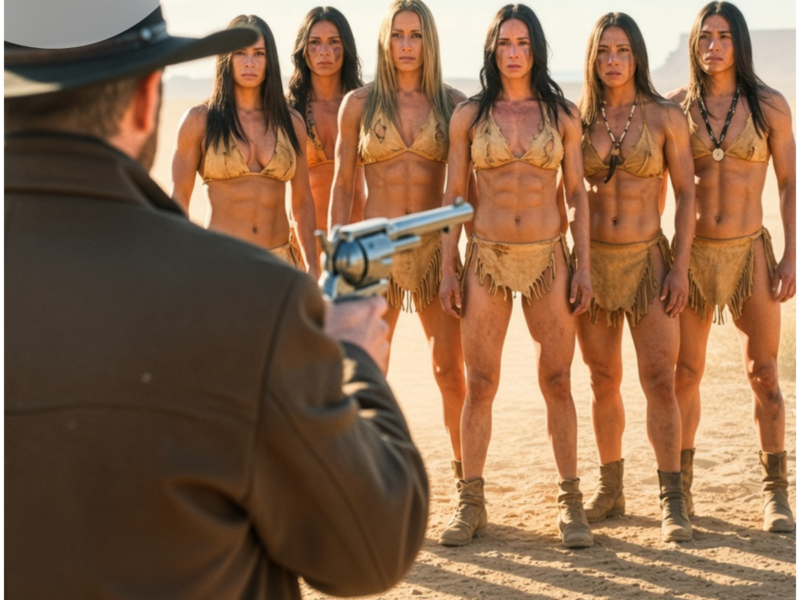
The sorrel reared, screaming. Jesse fought her down with one hand and raised the other high, palm open, as figures rose from the rocks on every side of the narrow wash. Seven. Ten. Fourteen. Apache warriors with bows drawn to the cheek, rifles leveled, faces painted with streaks of white clay. Not one of them made a sound.
“Easy,” Jesse said, to the horse and to the men. “Easy now. I’m alone. I’m not looking for trouble.”
No one answered.
He was thirty-six years old, and he had lived long enough in the Arizona Territory to know what silence like that meant. It meant they had already decided what he was.
Two hours earlier, it had been an ordinary morning. He had left his small ranch on Cienega Creek at first light, leading two green-broke geldings to sell to the Miller outfit near the Whetstones. A simple job. He’d planned to be home by supper, back to the quiet house where no one waited for him and the only voices were the horses’.
Then he’d found the tracks.
Dozens of hoofprints, crossing the trail at a hard run. Shod horses chasing unshod ones. A torn saddle cinch. A rifle cartridge, still bright. And a little farther on, a dark stain soaking into the sand that no amount of wind had yet erased.
Every instinct had told him to turn around. Instead, he had remembered the Apache camp he knew lay somewhere to the west along the San Pedro, and the families in it, and the men who had made those tracks. If someone was raiding, someone needed warning.
So he had followed the trail.
And now he sat in the middle of a dry wash with fourteen weapons aimed at his heart, and the trail he had followed led straight to the spot where he was standing.
A warrior stepped forward. He was young, perhaps twenty-five, lean and hard-eyed, with a fresh, half-healed cut across his cheekbone. He ripped Jesse’s Winchester from its scabbard and hurled it into the sand. Then he dragged Jesse from the saddle and threw him face-down beside it.
Jesse didn’t fight. He felt rawhide bite into his wrists as they bound his hands behind his back. He felt the young warrior’s knee grind into his spine, felt hot breath against his ear, and heard a single word hissed in Apache that needed no translation.
Murderer.
They walked him for six hours.
He stumbled behind a horse with a rope around his neck, his boots filling with sand, his throat burning. The sun climbed and hammered down. Twice he fell. Twice they dragged him up without a word. His two geldings and his sorrel mare were led behind, and every so often he heard one of them whinny for him, confused and frightened.
Late in the afternoon, they came over a rise, and the camp lay below him.
Brush shelters spread along a bend in the river beneath a stand of cottonwoods. Smoke curled from cookfires. Children were playing near the water. But as the warriors rode in with their prisoner, the children stopped playing. Women stepped out of their shelters. Old men rose to their feet. And as Jesse was dragged through the center of the camp, a terrible silence followed him, spreading outward like a ripple through water.
Then a woman began to wail.
It was a sound Jesse had never heard before and would never forget: a high, keening cry of grief that rose and broke and rose again. Another voice joined it. Then another. Jesse turned his head and saw, near the river, three fresh mounds of earth beneath the cottonwoods.
His stomach dropped.
They led him to a great fire at the center of camp, where an old man sat on a buffalo robe. His hair was white and long, his face carved deep by seventy years of sun and sorrow. He didn’t rise. He simply looked at Jesse, and in that look was the weight of every loss his people had ever suffered.
The young warrior with the cut cheek spoke rapidly, pointing at Jesse, at the horses, at the graves by the river. His voice shook with rage. The old chief listened without moving.
When the warrior finished, a stooped, gray-haired man shuffled forward and spoke to Jesse in slow, broken English.
“I am Tobah. I speak for Nantan Haske.” He nodded toward the chief. “Four nights ago, men came for our horses. White men. They took forty. Three of our people fought them.” He gestured toward the graves. “Three of our people are there now.”
Jesse closed his eyes.
“This one,” Tobah continued, nodding at the young warrior, “is Nakai. His brother is in one of those graves. Nakai says he found you on the trail the thieves used. With horses that are not yours.”
“They are mine,” Jesse said hoarsely. “I raised them. I was taking them to sell to—”
“He says that is what a thief would say.”
“I followed those tracks because I thought someone was in danger.” Jesse’s voice cracked with thirst. “I was coming to warn you.”
Tobah translated. Nakai laughed, harsh and bitter, and spat into the dirt at Jesse’s feet. Several warriors muttered. One drew a knife and ran his thumb along the blade, staring at Jesse with naked hatred.
The chief raised one hand. Instantly, the camp fell still.
He spoke a few quiet words. Tobah translated them, and they fell like stones.
“The council will decide at dawn.”
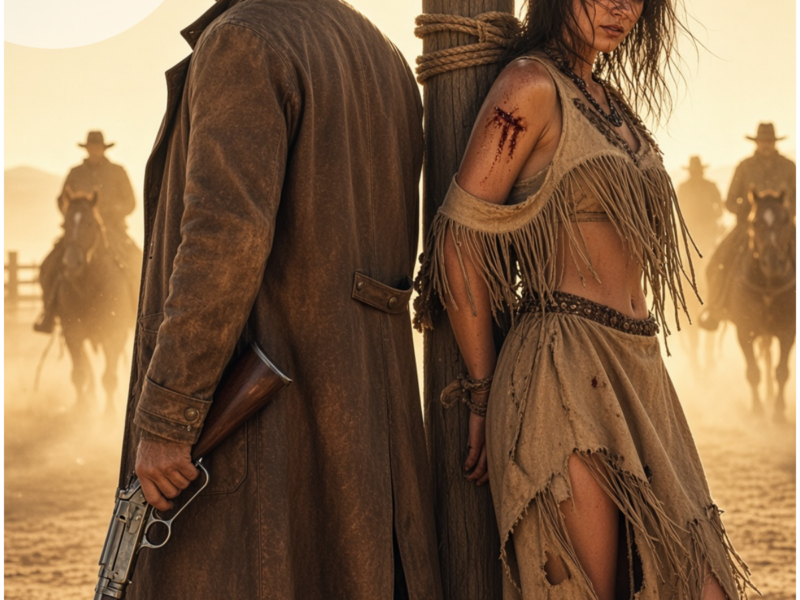
They tied him to a post at the edge of the camp, a thick cottonwood trunk sunk deep in the earth, scarred and stained by things Jesse didn’t want to imagine. His wrists were bound behind it. His ankles were bound in front. He could sit, barely, with his back against the rough wood, and that was all.
Night came down cold and fast. The fires burned low. Families ate in silence, and every so often, a face would turn toward him in the darkness and then turn away.
Jesse leaned his head back against the post and looked up at the stars.
Strange, he thought, how bright they were. He had always meant to learn their names. His little brother Danny had known them all. Danny had known everything: the stars, the birds, the names of every plant along Cienega Creek. Danny had been fourteen when his horse stepped in a badger hole and threw him against the rocks. Jesse had been holding the reins of his own horse, watching, twenty feet away.
He’d buried Danny beside their parents, who had died of fever two winters before. And then he had been alone. Seventeen years alone.
Maybe this was how it ended. Not with a fall or a fever, but here, at a post, for something he hadn’t done. No one would even know. The Millers would wonder why he never came. Someone would find his ranch empty in a few weeks and turn his horses loose.
A shuffle of footsteps. Jesse opened his eyes.
An old woman stood before him with a small boy at her side. She set a wooden bowl on the ground: a few strips of dried venison and a gourd of water. She didn’t speak. She didn’t meet his eyes. She simply set it down and walked away.
“Thank you,” Jesse whispered after her.
He leaned forward as far as the ropes allowed, which was barely enough to reach the bowl with his teeth. He was about to take the first strip of meat when he noticed her.
A little girl, perhaps six years old, stood a few yards away in the shadows. Her dress was thin and patched. Her hair was tangled. And she was staring at the bowl with the hollow, desperate stillness of a child who had not eaten in a long time and was trying very hard not to show it.
Jesse looked at the meat. He hadn’t eaten since dawn. He didn’t know if they’d feed him again before they killed him.
He nudged the bowl toward her with his boot.
“Go on,” he said softly. “You take it.”
The girl stared at him. She looked toward the fires, uncertain, as though afraid of being punished.
Jesse smiled. “It’s all right. I’m not hungry.”
His stomach chose that moment to growl loudly. The girl’s eyes widened. Then, for the first time, the ghost of a smile crossed her small face. She darted forward, snatched up the meat, and ran back into the darkness.
Jesse leaned back against the post and laughed quietly at himself.
He didn’t see the woman by the fire who had watched the whole thing.
Her name was Teya, and she had not laughed in a year.
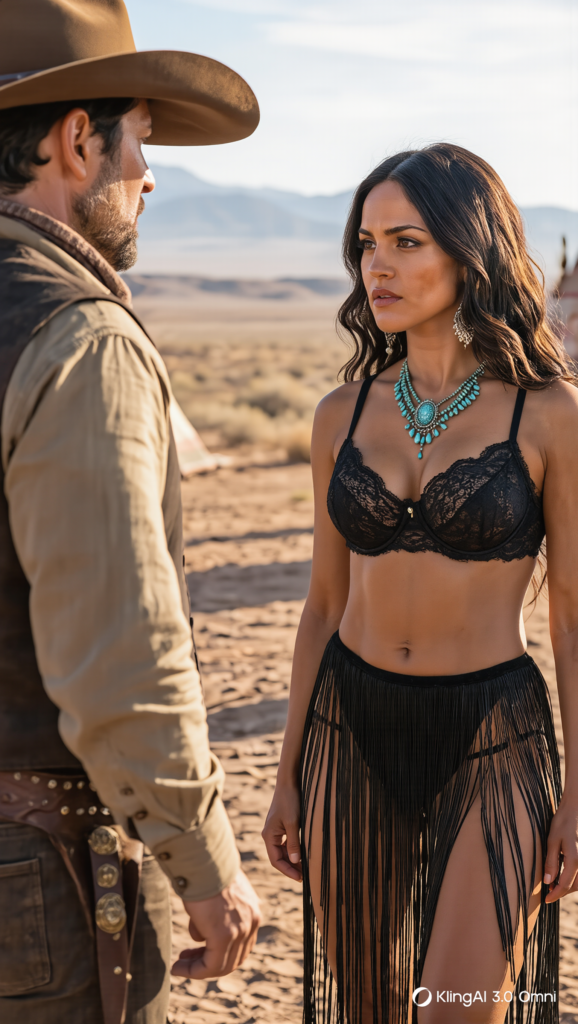
She stood alone beside the dying embers, her arms wrapped around herself against the cold. She was perhaps thirty, tall and straight-backed, with a face that might once have been quick to smile. Now it was a still, closed thing, like a door bolted against the wind.
A year ago, white horse thieves had raided her family’s camp in the Dragoons. Her husband, Ashkii, had ridden out to stop them. He had come back across his own saddle. She had cut her hair to mourn him and had not let it grow since.
She had every reason in the world to hate the man tied to the post. Every reason to stand beside Nakai at dawn and watch the blade fall.
And yet.
A thief does not give his last meal to a hungry child. A thief does not sit so still, staring at the stars, as though remembering someone he loved. A thief begs, or threatens, or curses. This man had done none of those things.
She watched him for a long time. Then, almost before she knew she had decided, she picked up a folded blanket from her shelter and walked toward the post.
He heard her coming and looked up. In the firelight his face was gaunt and dust-streaked, his lips cracked. His eyes were the color of a winter sky, and very tired.
She knelt and laid the blanket across his shoulders.
“You are cold,” she said in careful English. Her husband had taught her the words, years ago, from a trader’s book.
He looked at her, surprised. “I’ve been colder.”
“Your hands. They bleed.”
“They’ll heal.” He paused. “Or they won’t. I suppose it doesn’t much matter after tomorrow.”
She studied his face. “You gave your food to Hashke’s daughter.”
“She looked hungrier than me.”
“Her father is dead. One of those graves.” Teya nodded toward the river. “Killed by horse thieves.”
Jesse closed his eyes. “I’m sorry.”
“Are you?”
“Yes, ma’am.” He opened his eyes and looked straight at her. “I didn’t take your horses. I didn’t kill anyone. I can’t prove it. But that’s the truth.”
For a long time, Teya said nothing. The fire popped. Somewhere in the camp, a baby cried and was hushed.
“I am Teya,” she said finally.
“Jesse.”
“You have family, Jesse? Someone who will wait for you?”
He looked up at the stars. “Not anymore.”
And then, without quite meaning to, he told her. About the fever that took his parents. About Danny and the badger hole and the twenty feet of empty ground he had never been able to cross in time. About seventeen years of silent mornings and empty supper tables.
She listened without moving.
When he finished, she sat back on her heels and was quiet a long moment.
“My husband was Ashkii,” she said. “He died one year ago. Men like the ones who took our horses killed him.” She looked at her own hands. “Since then, I have hated every white face I see. Every one.”
“I don’t blame you.”
“I know.” She looked at him strangely. “That is the problem. You do not blame me. You do not blame anyone. You sit here waiting to die, and you give away your food, and you are sorry for our grief.” Her voice dropped to a whisper. “A man who stole our horses does not behave like you.”
“Then why am I still tied to this post?”
“Because grief is loud,” Teya said. “And truth is quiet. Sometimes grief speaks so loudly that no one can hear the truth at all.”
She rose and turned to go. Then she stopped, her back to him.
“Tomorrow,” she said, “when the council meets, I will speak.”
Jesse stared at her. “You’d do that? For a stranger?”
She looked back over her shoulder. For the first time, something moved in her face. Not quite a smile. But close.
“Not for a stranger,” she said. “For the truth.”
And she walked away into the dark.
Dawn came gray and cold.
The whole camp gathered around the council fire. Warriors stood in a wide ring. The old men sat beside Nantan Haske. Women and children pressed close behind them. They untied Jesse from the post and dragged him into the center of the circle, his legs numb, his hands still bound.
Nakai stood across the fire with his arms folded. He had painted his face black from the eyes down: the paint of mourning, and of vengeance.
The chief spoke. Tobah translated.
“The stranger was found on the thieves’ trail. The stranger has horses. Our people are dead. Who speaks?”
Nakai stepped forward and spoke with fury. Others joined him. One by one, the warriors raised their voices, and Jesse didn’t need Tobah to tell him what they were saying. The sound of it was clear enough. It was the sound of grief looking for someone to blame.
The chief listened. Then he looked at Jesse for a long, long time.
He spoke a single word.
Tobah’s voice was barely a whisper. “Death.”
Nakai stepped forward, drawing a long knife from his belt. Two warriors seized Jesse’s arms and forced him to his knees. The camp was utterly silent. Jesse looked up at the pale sky, and he thought of Danny, and he thought, Well, little brother. Maybe I’ll finally see those stars up close.
The blade rose.
“No.”
The word cracked across the camp like a rifle shot.
Every head turned.
Teya walked into the circle. She walked straight past the warriors, past the fire, past the elders, until she stood between Nakai’s blade and Jesse’s throat. Her chin was high. Her hands were steady.
Nakai stared at her in disbelief. He spoke, sharp and angry. Sister. Move.
Teya didn’t move. She turned to face the chief, and when she spoke, her voice rang through every corner of the camp.
Jesse didn’t understand the words. But he saw the faces around him change. He saw the old women gasp and cover their mouths. He saw warriors take a step back. He saw Nakai’s knife hand drop slowly to his side, his face draining of color.
He saw old Tobah’s jaw hang open.
“What—” Jesse whispered. “What did she say?”
Tobah turned to him, and his voice was shaking.
“She has claimed the widow’s right,” he breathed. “The oldest law of our people. She has placed her life beside yours. If you are guilty, she will die with you.”
Teya turned and looked down at Jesse, kneeling in the dirt.
And then she drew her own knife, and laid its blade flat against her own throat.
PART 2: The Widow’s Vow
No one breathed.
Teya stood perfectly still, the knife pressed to her throat, her eyes locked on the chief’s. A thin bead of blood welled where the steel touched her skin.
Jesse struggled to his feet against the warriors holding him. “Teya, no. Put it down. Don’t do this for me.”
She didn’t look at him. She spoke again to the chief, steady and clear, and Tobah translated in a trembling whisper.
“She says: ‘I am the widow of Ashkii, who died fighting horse thieves. No one in this camp has more right to hate this man than I. And I say he is innocent. If my people kill him, they will kill the truth. Let him prove what he is. If he lies, take both our lives.’”
Nakai shouted at her. His voice broke. Jesse understood now: Ashkii had been Nakai’s brother too. Teya was his brother’s widow. And she was standing between him and his vengeance.
Nantan Haske rose slowly from his buffalo robe for the first time. He walked to Teya and stood before her for a long moment. Then he spoke, softly.
Tobah translated. “The chief asks: ‘Do you understand what you have done?’”
Teya answered without hesitation.
“She says: ‘Yes.’”
The old chief looked from Teya to Jesse. He studied the stranger’s face for a long time, as though reading something written there that only he could see.
Then the thunder of hooves broke the silence.
Three riders came pounding into camp, their horses lathered and blowing. Scouts. The lead rider leaped down before his horse had stopped and ran to the chief, speaking rapidly, pointing west.
Tobah listened. His eyes widened.
“They have found the thieves’ camp,” he said. “In the badlands, two days west. Many stolen horses. Many from white ranches too.”
The second scout stepped forward, holding out a scorched strip of canvas. Burned into it was a brand: an M inside a horseshoe.
Jesse’s breath caught. “That’s the Miller brand. I sold Tom Miller six horses last month. That’s who I was riding to see.”
Tobah translated. The chief’s eyes narrowed.
The third scout dropped a leather satchel on the ground and spilled out its contents: silver coins, a gold pocket watch, a running iron used to alter brands, and a sheaf of papers. Tobah picked up one of the papers and squinted at it.
“A reward bill,” he said slowly. “From the territory. For Apache horse thieves.” He looked up. “Someone wrote names on it. White names. Men they mean to blame.”
He held it out. Jesse took it in his bound hands and read the list.
His own name was third.
Jesse Harlan. Cienega Creek. Lives alone. No one will ask.
A cold fury rose in Jesse’s chest. He looked up. “These men aren’t just stealing horses. They’re stealing from both sides and blaming whoever’s convenient. They knew I’d ride that trail. They meant for you to find me.”
Tobah translated. The camp erupted in voices.
And then a fourth rider came in slowly, slumped in the saddle, an old white man with a bandaged arm and a bloodied face. The scouts had found him tied to a wagon wheel at the thieves’ camp, left for dead.
He looked up, saw Jesse, and his face crumpled with relief.
“Harlan,” he croaked. “God almighty. They said they’d fix it so the Apaches killed you.”
“Gus?” Jesse stared. “Gus Pruitt?”
The old wrangler worked for the Millers. Through Tobah, he told the council everything. A gang led by a man named Ward Kessler had been raiding ranches and Apache camps alike for a month. They hit one side, then planted evidence pointing at the other. They wanted a war. A war meant the Army, and the Army meant land cleared of Apache and ranchers driven off, ready for Kessler’s backers to buy up cheap.
“Harlan rode through our spread a week back,” Gus wheezed. “Warned us there’d been raids. Kessler heard. Decided Harlan’d make a good dead man.”
Silence fell across the camp.
Slowly, Teya lowered her knife.
Nakai stared at the ground, his black-painted face unreadable. The chief looked at Jesse for a long time, then spoke.
“The chief says: you could have run when our warriors surrounded you. You had a rifle and a fast horse. Why did you not?”
Jesse thought about it. “Running would’ve made me look guilty. And I wasn’t.”
The chief nodded slowly. Then he spoke again.
“He says: these men are still free. They will come again. Will you ride with us to find them?”
A murmur rippled through the crowd. Nakai’s head snapped up.
Jesse looked at Teya. She met his eyes.
“Yes,” he said.
“You may die.”
“I was about to die anyway,” Jesse said. “Might as well die doing something useful.”
For the first time, something like a smile touched the old chief’s lips. He spoke a short command, and a warrior stepped forward and cut the rawhide from Jesse’s wrists.
Jesse rubbed his torn skin and looked at Teya. “Why?” he asked quietly. “Why’d you do it?”
She touched the small cut on her throat.
“Because one year ago, I could not save my husband,” she said. “I could only watch. I would not watch again.”
Seven rode out at midday: Jesse, Nakai, four warriors, and Teya.
The elders had argued against her coming. But Teya knew the badlands better than any of them; she had grown up there. And she had staked her life on the stranger’s word. She meant to see it through.
Nakai rode beside Jesse and never once looked at him.
They followed the scouts’ directions west through broken country, across dry washes and red-rock mesas. The heat was brutal. By the second morning, Jesse found where the trail split.
He dismounted and crouched over the tracks. “They divided,” he said. “Most went north with the herd. A few went into that canyon.” He pointed. “Shod horses, carrying weight. Fresh.”
Nakai crouched beside him and studied the prints for a long moment. Then, grudgingly, he grunted and nodded.
They rode into the canyon.
Halfway up, a rifle cracked from the rimrock.
Then a second sound, worse than gunfire: the deep, grinding groan of rock coming loose. Jesse looked up and saw a boulder the size of a wagon breaking free from the cliff above, tumbling end over end toward the narrow trail.
Toward Nakai.
Nakai’s horse screamed and stumbled on the loose shale. Nakai went down, his leg pinned beneath the thrashing animal.
Jesse didn’t think. He vaulted from his saddle, scrambled across the stones, grabbed Nakai by the collar, and heaved with all his strength. Nakai’s leg came free. They rolled together against the canyon wall as the boulder crashed onto the trail where Nakai had lain, exploding into fragments, the dust boiling up around them.
When it cleared, they lay side by side against the rock, coughing.
Nakai turned his head and stared at Jesse. The black paint on his face was streaked with dust and sweat. For a long moment, he said nothing.
Then he spoke, in rough, halting English Jesse hadn’t known he had.
“Why?”
Jesse coughed and spat grit. “Because your brother’s widow put a knife to her own throat for me,” he said. “Figured the least I could do was keep her brother-in-law alive.”
Nakai looked at him for a long, long moment.
Then he held out his hand.
Jesse took it.
They found Kessler’s camp at sunset.
It sat in a box canyon below them: four wagons, a rope corral jammed with stolen horses, a dozen men drinking around a fire. Ward Kessler was easy to spot, a broad, red-faced man in a fine black hat, laughing loudly at something one of his men had said.
Jesse studied the camp from the rimrock. “Fewer guards than I expected.”
Nakai pointed to a narrow cut leading behind the corral. “There. We take the horses first.”
Jesse nodded. “Then they can’t run.”
They planned it in whispers. Nakai and three warriors would loop around to the corral. Jesse and the fourth warrior would cover the fire. Teya would stay on the rim with the horses and Jesse’s rifle.
“If it goes wrong,” Jesse told her, “you ride. You don’t wait for us.”
She looked at him and said nothing.
They went down in the darkness.
It almost worked. Jesse was creeping along the canyon wall, fifty yards from the fire, when he heard Nakai’s whistle from the corral, soft as a night bird. The horses were free. In a few moments they would stampede through the camp, and in the chaos—
A scream split the night.
Not a man’s scream. A woman’s.
Jesse spun around. Up on the rimrock, silhouetted against the stars, two figures struggled. A third man, one of Kessler’s lookouts posted on the rim, had found her.
Teya.
Then the lookout’s voice boomed down into the canyon, loud and gleeful.
“Kessler! Got us a little Apache wildcat up here! Says she’s with the cowboy!”
Down at the fire, Ward Kessler rose slowly to his feet and smiled.
“Well, well,” he called out into the dark. “Harlan. I know you’re out there. Thought the Apaches would’ve done my work for me by now.”
Jesse pressed himself against the rock, his heart hammering.
“Here’s how this goes,” Kessler shouted. “You walk into this firelight, hands up, in the count of ten. Or my man up there opens her throat and throws her off the cliff.”
He drew his pistol and cocked it.
“One.”
Jesse looked toward the corral. Nakai was there in the darkness. He couldn’t see him.
“Two.”
He looked up at the rimrock. Teya had stopped struggling. The lookout had a knife at her throat, exactly where her own blade had rested two days before.
“Three.”
Jesse stepped out of the shadows and into the firelight, his hands raised high.
PART 3: The Dawn She Gave Him
“Well, now,” Ward Kessler said, grinning. “Ain’t you the noble one.”
Jesse stood in the firelight with a dozen guns pointed at him. “Let her go, Kessler. You’ve got me. You don’t need her.”
“Oh, I need her plenty.” Kessler strolled closer, pistol leveled. “Here’s my problem, Harlan. Those Apaches were supposed to kill you. Then I tell the Army they murdered an innocent rancher, the Army comes, and everybody’s happy. Except you’re still breathing, and now you’ve brought Apaches with you.” He shook his head. “So now I’ve got to kill you myself, and her too, and make it look like the Apaches did it. Messy. But it’ll work.”
He raised the pistol toward Jesse’s chest.
On the rimrock above, Teya stood still with the lookout’s blade at her throat.
And then she did something no one expected.
She began to sing.
Her voice rose clear and high into the night, a long, wavering note that echoed off the canyon walls. Kessler’s men looked up, confused. The lookout laughed.
But down at the corral, every horse in the canyon lifted its head.
The Apache horses had heard that song before. Their mothers had heard it. It was the song the women of the camp sang at dusk to call the herds home.
The herd burst from the corral like a flood.
Forty Apache horses and a dozen stolen ranch horses thundered through the camp in a tidal wave of hooves and dust, straight toward Teya’s voice. Kessler’s men scattered, screaming. The fire exploded into sparks. Wagons overturned.
On the rim, the lookout stumbled back in shock, and in that half-second, an arrow hissed out of the darkness and struck him in the shoulder. He spun and fell. Teya wrenched free.
Down in the canyon, Nakai rose from the shadows, already nocking another arrow.
Kessler whirled toward Jesse, pistol raised. Jesse lunged.
They went down together in the dirt as the herd thundered past them. Kessler was heavier, and he got a forearm across Jesse’s throat, pressing down, the pistol clawing toward Jesse’s temple. Jesse’s vision went dark at the edges. He heard Danny’s voice in his head, absurdly, telling him the name of a star.
Then a shadow fell across them, and the flat of a war club cracked against Kessler’s skull.
Kessler slumped sideways and lay still.
Nakai stood over them, breathing hard. He looked down at Jesse, then reached out his hand and hauled him to his feet.
“Now,” Nakai said, “we are even.”
By sunrise it was over.
Kessler and seven of his men sat bound beside their overturned wagons. The rest had fled into the badlands on foot, and the scouts would run them down within days. The stolen horses, Apache and settler alike, grazed peacefully along the canyon floor.
Jesse found Teya sitting on the rimrock, watching the sun rise.
He sat down beside her. Neither spoke for a long time.
“You sang to them,” he said finally.
“My mother taught me. Her mother taught her.” Teya looked at the horses below. “I did not know if they would hear.”
“They heard.”
She turned to look at him. There was a thin red line across her throat now, from two knives on two different days. Jesse reached out and, very gently, touched it.
“You keep putting yourself between me and a blade,” he said.
“You keep giving me reasons.”
He laughed, and then she did too. It was a soft, rusty sound, like a gate that had not been opened in a long time. Then she stopped, surprised at herself, and looked away.
“That is the first time,” she said quietly, “since Ashkii.”
Jesse said nothing. He just sat beside her as the sun climbed over the badlands, and for once, the silence didn’t feel lonely at all.
The whole camp was waiting when they returned.
Nantan Haske stood at the council fire, and around him gathered every man, woman, and child of the band. When they saw the stolen horses coming over the rise, a great cry went up. Women wept. Children ran. Hashke’s little daughter, the girl who had taken Jesse’s meal, flew across the camp and threw her arms around his leg.
The chief raised his hand, and the camp grew quiet.
Tobah stood beside him, beaming.
“Two days ago,” the chief said through Tobah, “this man stood in this circle bound for death. Our grief was so loud that we could not hear the truth. Only one of us listened.”
He turned to Teya.
“Teya, widow of Ashkii, you placed your life beside a stranger’s. Our law says that the widow who saves a life by her vow may ask one thing of the people, and it will be granted. What do you ask?”
Teya was silent for a long moment. She looked at Jesse.
“I ask,” she said, “that he never again be called a stranger here.”
The chief smiled. He took from his own neck a strand of turquoise and silver beads and placed it over Jesse’s head.
“Then he is not,” Nantan Haske said. “From this day, Jesse Harlan is of our people. His enemies are our enemies. His home is our home.”
Nakai stepped forward. He had washed the black paint from his face. He looked at Jesse for a long moment, and then he spoke, in English, so everyone could hear.
“My brother is dead,” he said. “But today, I have another.”
Ward Kessler and his men were handed over to the territorial marshal at Tucson, along with the reward bill bearing Jesse’s name and a dozen others. Gus Pruitt testified. So did Tom Miller. The trial made the newspapers as far as Santa Fe. Kessler hanged that winter, and the men who had financed him quietly sold their land claims and left the territory.
Jesse went back to Cienega Creek.
But the ranch was not quiet anymore.
Nakai came by often, at first to trade horses, then just to sit on the porch and argue about whose colts were faster. Hashke’s daughter came with her grandmother, and Jesse taught her to ride the gentlest of his mares. Tobah came to tell long, rambling stories that Jesse never entirely followed but always enjoyed.
And Teya came.
She came first with the others. Then she began to come alone, riding in at dusk on the gray horse her husband had given her. She would sit beside Jesse on the porch, and he would tell her about his brother, and she would tell him about Ashkii, and neither of them would feel the need to fill the silences between.
In the spring, she let her hair begin to grow again.
Years later, when Jesse Harlan was an old man with a white beard and a ranch full of horses, children from the ranches and the camps along the San Pedro would sometimes ask him to tell the story of the post at the edge of the camp.
He always told it the same way.
“I was dead,” he would say. “Tied up, knife raised, all of it. And the bravest thing I ever saw in my life was a grieving woman walking into the middle of that circle, with every reason in the world to hate me, and saying no.”
The children would always ask the same question. “Why did she do it?”
And Jesse would look out across the porch, to where Teya sat beside him, her long hair now silver, her hand resting over his.
“Because she listened,” he would say, “when everyone else was shouting.”
And Teya would smile, and squeeze his hand, and say nothing at all.
Because some truths are quiet.
And the quiet ones are the ones that last.