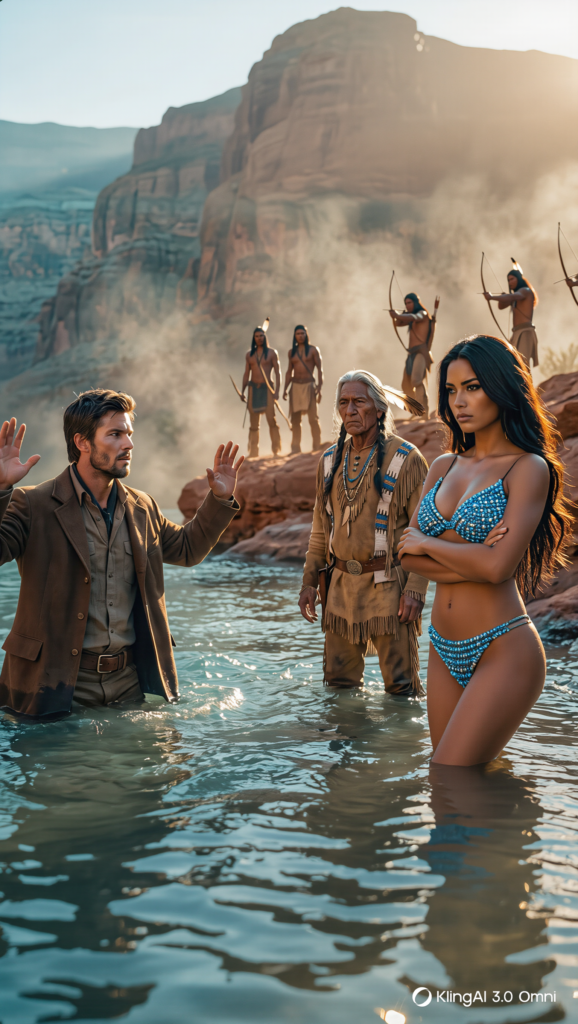
PART ONE: The Meal
Wade Tillman was not a thief. He would tell himself that later, many times, but on the fourth evening after the robbery, staggering up a pine-dark ridge in the Mogollon Mountains with his boots split and his belly folded in on itself like an empty sack, he would have stolen anything at all that a man could put in his mouth.
It was October of 1877, and Arizona Territory was already turning cold at night. Four days earlier, three men had come into his camp on the Black River at dawn, friendly, asking for coffee. Wade had poured it for them. He was forty-one years old and had been a cattleman most of his life, and he still believed, against a great deal of evidence, that men who asked politely for coffee generally meant no harm. The tallest of them had shot his horse out from under the picket line while the other two took his rifle, his saddle, his eighty dollars of trail wages, and his boots’ worth of dignity. They left him alive. Wade spent the next four days wondering whether that had been mercy or simple laziness.
He’d been walking north since, following the river and then losing it, eating nothing but a handful of piñon nuts and one unlucky lizard. By the fourth evening his thoughts had gone thin and strange, and when the smell of roasting meat came drifting down through the pines, he was half certain he had died and been sent somewhere better than he deserved.
He followed it to a small clearing on a shoulder of the mountain. A low cairn of stones stood at its center, freshly built, with a juniper staff planted upright among the rocks and a strip of red cloth tied to the top of the staff, fluttering in the wind. Before the cairn, a small fire had burned down to a bed of coals, and laid across those coals on a flat stone was a haunch of venison, crackling and brown. Beside it sat a clay bowl of roasted corn and a gourd of water.
Nobody was there. Wade stood at the edge of the clearing for a long moment, swaying, and some faint, decent part of his mind told him that this was not his, that food left before a grave was meant for someone, and that he ought to go on.
The rest of his mind was louder. He sat down by the coals and ate until his hands shook.
He was drinking the last of the water when he felt the knife at his throat.
It was a woman who held it. He understood that much before he understood anything else, from the smallness of the hand gripping his collar and the steadiness of the blade, which did not tremble at all. Then a man stepped out of the pines in front of him with a rifle leveled at his chest. The man was young, perhaps twenty-five, lean and furious, with his hair cut short in the Apache way of mourning.
The woman spoke over his shoulder in her own language, low and shaking with something far worse than anger. The young man answered her. Then she came around in front of Wade, still holding the knife, and he saw her face for the first time.
She was perhaps thirty, tall, with a strong, square face and eyes red-rimmed from weeping. Her hair, too, had been cropped short. She wore a plain buckskin dress, unadorned, the clothing of a woman in deep grief. She looked down at the bones of the venison and the empty gourd, and then at Wade, and when she spoke English, it came out precise and cold as creek water.
“Do you know what you have done?”
“I was starving, ma’am,” Wade said. His voice cracked. “I’m sorry. I’ll pay for it. I don’t have anything right now, but I’ll—”
“Pay.” She said the word as if she had never heard anything so stupid. “That food was for my husband. He was killed nine days ago. We buried him here. We made his last fire so his spirit would have strength for the journey. And a stranger walked out of the trees and ate it.”
The young man spat out something in Apache and raised the rifle to his shoulder. The woman put out one hand without looking, and he lowered it again, though it cost him visibly.
“My brother-in-law wants to kill you,” she said. “That would be simple. But it would not be right. Get up. You will come to our camp, and the old ones will decide what you are.”
Their camp lay in a hidden valley two hours higher in the mountains: a scattering of brush wickiups along a creek, smoke rising, horses grazing in an aspen meadow gone yellow with fall. The band was small, perhaps fifty people, and it called itself the Cibecue Springs people. Every one of them stopped what they were doing to stare as Wade was marched in at rifle point with his hands bound before him.
The council met in the last light around a central fire: four elders, two men and two women, with the oldest woman at their center. Her face was so lined it seemed carved from walnut. The widow, whose name was Itzela, told the story standing. Wade didn’t understand a word of it, but he understood every tone, and when she finished, a long murmur of shock went around the firelight.
Then the old woman spoke for a long time. When she was done, nobody said anything at all. Itzela’s face had gone the color of ashes.
The young man, whose name was Tazhe, turned away from the fire with a sound like he’d been struck.
“What did she say?” Wade asked.
Itzela didn’t look at him. She looked at the fire.
“Among our people,” she said slowly, “the last meal is for the dead man alone. It carries his strength, and also what he leaves undone. If a living man takes it, he takes those things too. That is the old law. Grandmother Nadí says the law must be followed, or my husband will wander, unable to rest.” Her voice dropped. “She says that what my husband carried, you carry now. His debts. His duties. His family. Until they are finished.”
“His family,” Wade repeated.
“Me,” Itzela said, flat. “And my son Ahiga. He is eight years old.” Then she lifted her eyes to his, and in them was a grief so deep and so furious that Wade had to fight not to step back. “And my husband’s blood debt. The men who killed him. You carry that too, white man. That is the meal you ate.”
Her husband’s name had been Nakai. He had been, Wade learned that night, the best tracker and horse trader in the band. Ten days earlier he had ridden down to the Salt River to trade horses with a party of white men who claimed they were buying for the army. They hadn’t been buying for anyone. They had shot him from ambush, taken the eleven horses he was driving, and left him by the river. Tazhe found him the next morning. The killers had carved a mark into a cottonwood beside the body as if signing their work: a crude circle with a line through it.
“They are scalp hunters,” Tazhe said. His English was rough but clear, and he spoke to Wade for the first time across the fire, with naked hatred. “The governor of Chihuahua still pays for Apache scalps. Men, women, children, it doesn’t matter to them. One hundred pesos each. They took my brother’s horses, and they would have taken his hair if I had not come.”
Wade looked down at his bound hands. He felt sick.
“I’m sorry,” he said, and found that he meant it more than he had meant almost anything in years. “I didn’t know. I’ll do what I can. But I’m one man with nothing, not a gun or a horse to my name.”
“You have my husband’s name now,” Itzela said. “That must be enough.”
She cut his bonds herself and left him a robe by the fire and walked away into the dark without another word. Wade sat alone, and after a while a small figure crept out of the shadows and crouched on the far side of the coals, watching him with enormous solemn eyes.
It was a boy, thin and quick, with his father’s mourning haircut and a stone-tipped knife on a thong around his neck. He studied Wade the way a fox studies a trap.
“You ate my father’s food,” the boy said in careful, schoolroom English.
“I did,” Wade said. “I’m sorry for it.”
The boy considered this. “Grandmother says now you are my father’s shadow. Until his work is done.” He tipped his head. “Are you a good tracker?”
“Not as good as your father was, I expect.”
“No,” Ahiga agreed gravely. “Nobody is.” He got up and walked away, then turned back. “But you can learn. My father taught me. I will teach you.”
For three days, Wade tried to be what the law said he now was. He chopped wood for Itzela’s wickiup, though she never once thanked him for it. He hauled water. He went out with Tazhe to check the horse herd and was told, with contempt, everything he did wrong. Ahiga followed him everywhere and taught him to read sign: here, a deer bedded down; here, the scuff of a horse’s hoof on stone, a day old.
And on the third night, Itzela came and sat on the far side of his fire.
“Why did you not run?” she asked. “Nobody has guarded you since the first night. You could have walked out of this valley any time.”
Wade had asked himself the same question. “Because I ate the food,” he said finally. “I didn’t know what it meant, but I ate it all the same. Where I come from, a man stands by what he’s done.”
She looked at him for a long time across the coals. Something in her face shifted, very slightly.
“Nakai would have said that,” she said quietly. She rose to leave. Then she stopped and spoke without turning around. “Tomorrow Tazhe rides to the Salt to look for the men who killed my husband. I want you to go with him.”
It was the first thing she had ever asked him.
They never got the chance to go.
The raid came an hour before dawn. Wade woke to dogs screaming, horses stampeding, and a burst of gunfire so close that splinters of brush rained down on him in the dark. He rolled out of his robe and came up running toward Itzela’s wickiup with nothing in his hands but a stick of firewood.
It was over in minutes. Six riders swept through the lower end of the camp, firing high and wide to scatter the people, cut the horse herd loose, and pulled back into the dark as fast as they had come. When the shooting stopped and the women’s wailing began, Wade found Itzela on her knees in the ashes of her own fire, both hands clutching the doorway of an empty wickiup.
Ahiga was gone.
Tazhe came running out of the dark, his rifle in his hand and blood on his arm. He was holding something, a scrap of paper nailed to a cottonwood stake that had been driven into the ground beside the creek. Below the paper, carved fresh into the stake, was the circle with a line through it.
“They want rifles,” Tazhe said, his voice ragged. “Twenty rifles, and the rest of our horses, at the old stage road crossing on the Salt in three days. Or they take the boy to Chihuahua.” He couldn’t finish.
Itzela took the paper from him. Her hands were steady, but Wade saw what it cost her. She read it, and then, slowly, she turned and held it out to Wade.
“There is a name at the bottom,” she said. “It is not an Apache name. Perhaps you can tell us what it means.”
Wade took the paper. He tilted it toward the firelight. The handwriting was a cramped, backward-leaning scrawl that he had seen before, many years before, on a Kansas schoolhouse slate and on letters that stopped coming after the war.
He read the name at the bottom three times. It didn’t change.
Cole Tillman.
His little brother.
PART TWO: The Name
Wade did not lie to them. Later, he thought that was the only thing he did right that whole terrible morning.
He stood in the gray light with the paper in his hand and told Itzela, Tazhe, and Grandmother Nadí everything. He told them he’d had a brother eight years younger than himself, raised on the same Kansas farm. After their mother died, Wade had raised the boy more than their father had. Cole was clever and quick and charming, and so wild that no fence on earth could hold him. When the war came, Cole had run off at fifteen to ride with Quantrill’s guerrillas in Missouri, and Wade had gone after him and failed to bring him home. After the war, Cole had drifted from one bad outfit to the next, cattle rustling, then stagecoach robbery. The last letter Wade ever received from him had come from Texas ten years ago, asking for money. Wade had sent it. He never heard from his brother again.
“I didn’t know,” Wade said. “I swear to God I didn’t know he’d come to this.”
Tazhe had his rifle up before Wade finished speaking. “His brother,” he said. “We took his brother into our camp. He’s a spy. He ate the meal so that we’d trust him.”
“I was robbed and left on foot,” Wade said steadily. He didn’t raise his hands. “I don’t know if my brother was one of the men who did it. Maybe so. Maybe he knew I’d come stumbling into this country and maybe he didn’t. But I didn’t come here to betray you, and if you want to shoot me for being his blood, then go ahead. I’d ask only that you let me bring your nephew home first.”
Tazhe’s finger was white on the trigger.
It was Itzela who put her hand on the barrel and pushed it gently down.
“He could have run,” she said to her brother-in-law in English, so Wade would hear it. “Three nights he could have run. He stayed.” She turned to Wade, and her eyes were dry now and very hard. “Will your brother kill my son?”
Wade thought about it honestly, the way he would have wanted someone to think about it for him.
“The Cole I knew wouldn’t have,” he said. “But I don’t know the man who wrote this. He signed his name to it. That means he wanted somebody to know it was him.” He folded the paper and put it in his shirt. “Give me two days’ head start. I’ll go to him alone. If any part of my brother is left in there, I’ll find it. If there isn’t, I’ll get your boy out some other way.”
“No,” said Itzela. “I will go with you.”
“Itzela—”
“He is my son.” Her voice cracked once, and then held. “You carry my husband’s debt. Fine. But I am still his mother. I go.”
They left within the hour, on two of the band’s remaining horses: Itzela on a tough little paint mare, and Wade on a big, rawboned dun that had belonged to Nakai. Tazhe would gather the warriors from two neighboring bands and follow two days behind. Grandmother Nadí gave Wade Nakai’s rifle with her own hands. She said nothing at all, but she held his eyes as she did it, and he understood that a debt was being handed over from one generation to another.
They rode south off the mountain into broken desert country, mesquite and greasewood and red rock, toward the Salt River canyon. They rode fast and hardly spoke the first day. On the second night they camped without a fire in a dry wash, and Itzela sat with her knees drawn up, staring at the stars.
“Tell me about him,” she said. “Your brother. As a boy.”
Wade hadn’t spoken of Cole to anyone in ten years. He found that once he started, it came easily.
He told her about the summer Cole was six, when he’d hidden a wounded hawk in the barn loft and nursed it back to health and refused to let anyone see it until it could fly. About the time Cole had stood up to the schoolmaster for whipping a slow boy, and taken the whipping himself instead. About the night before Cole ran off to the war, when he’d sat on the porch steps beside Wade and asked whether a man could ever really become somebody different from the person he’d been born.
“I told him no,” Wade said quietly. “I told him he’d always be my baby brother, and he’d always be a farm boy from Kansas no matter how far he ran. I thought I was comforting him.” He stared into the dark. “He left the next morning. I think I made him feel like he had to prove me wrong.”
Itzela was quiet for a long time.
“Nakai was like that,” she said finally. “When we were young. Wild. Always trying to prove something. To his father. To me.” She smiled faintly in the dark, the first smile Wade had ever seen on her face. “He stole eighteen horses from the Mexicans at Fronteras to pay my bride price. My father said that was too many and made him return half.”
Wade laughed, surprising himself.
“He settled when Ahiga was born,” Itzela said. Her smile faded. “He used to say that a man doesn’t really know who he is until someone small depends on him for it.”
They sat with that between them a while.
“I’m sorry,” Wade said. “For eating his fire. I didn’t understand then. I think I do now.”
Itzela turned her head and looked at him in the starlight.
“Grandmother Nadí does not think it was an accident,” she said. “She thinks Nakai’s spirit led you there. That he could not rest until he found someone to finish his work.” She paused. “I told her that was foolishness. That a starving white man stumbling onto a grave was just bad luck.” She looked back up at the stars. “I am less sure now.”
The scalp hunters’ camp lay in a side canyon of the Salt, under an overhang of red cliff where an old Mexican stage station had crumbled into ruin. Wade and Itzela lay on the rim above it at dawn on the third day and counted: nine men, twenty-odd horses in a rope corral, including Nakai’s eleven. A smoky fire burned in the station’s broken doorway.
And there, sitting against the wall with his ankle chained to an iron ring, was a small thin boy with a cropped head and a stone knife still on a thong around his neck.
Itzela made no sound at all. But Wade felt her whole body go rigid beside him, like a drawn bow.
Then a man came out of the ruin into the morning light, stretching, and Wade forgot to breathe.
Ten years had changed Cole Tillman. He was gaunt, with a long scar down his jaw and hair gone prematurely gray at the temples. He wore a Mexican serape and two pistols tied low. But he walked exactly as he had at fifteen, loose and restless, as if the ground beneath him couldn’t be trusted. He crouched down beside Ahiga and held out a tin cup of water. The boy turned his face away. Cole set the cup down beside him and stayed there crouching, very still, looking at the boy for a long time.
“He gave him water,” Itzela whispered.
“I saw.”
“Then perhaps your brother is still in there.”
Wade watched Cole walk back to the fire. A big, bearded man with a Sharps rifle across his knees said something, and the other men laughed, and Cole didn’t.
“Maybe,” Wade said. “Stay up here with the rifle. If I don’t come back out, or if they lay a hand on that boy, you shoot whoever’s closest to him.”
“And you?”
Wade stood up on the rim in plain sight with the sun behind him. Below, a man shouted, and nine rifles came up to point at him.
“I’m going to go have coffee with my brother,” he said.
They let him walk in, because he came with his hands empty and raised and because Cole, at the first sight of him, had shouted at the others to hold their fire. He had shouted it in a voice Wade hadn’t heard in ten years, a voice that cracked high in the middle like a boy’s.
They stood across the fire from each other. Neither one spoke for a long time.
“I heard,” Cole said at last. His voice was rough. “Ezra came back saying they’d robbed a cowhand on the Black River, and he described the man, and I knew. I sent two men back to find you. They couldn’t track you.” He wet his lips. “I thought you were dead out there.”
“Nearly,” said Wade.
“How in God’s name did you end up with the Apaches?”
“I ate a dead man’s supper,” Wade said. “Turned out he was the man your crew murdered on this river ten days ago. Turns out the boy over there is his son. Turns out, little brother, that by the law of the people who took me in, everything that dead man owed and everything he was owed is mine now.”
The bearded man with the Sharps laughed out loud. “Cole, your brother’s gone injun.”
Cole didn’t laugh. He was staring at Wade with a strange, stricken look on his face.
“That’s Bodie Kessler,” Cole said, without looking at the bearded man. “This is his outfit. Not mine. I signed the note because he wanted the Apaches to know a white man’s name, in case the army came asking. I wasn’t the one who killed that horse trader.”
“You were there,” said Wade.
Cole flinched as if he’d been struck. And Wade saw it then, clearly, in his brother’s face: the scared fifteen-year-old who had run off to the war to prove he could be somebody else, and had spent ten years since proving it in the worst possible way.
“Let the boy go,” Wade said quietly. “Walk away from this. Come with me.”
Bodie Kessler stood up from the fire with his Sharps. “Nobody’s walking away from anything,” he said. “Your little brother there’s been getting soft since we picked up that brat. I figure it’s time he proved which side he’s on.” He swung the Sharps around to point at Wade’s belly. “Tie this man up, Cole, or I’ll shoot him myself and take your share of the scalp money besides.”
Every man around that fire was watching Cole now.
Cole looked at his brother. Then he looked at the boy chained to the wall, who was watching him with enormous, solemn eyes and the cup of water still untouched beside him.
Very slowly, Cole Tillman drew his pistol. Then he turned it on Bodie Kessler.
PART THREE: The Debt Paid
The canyon exploded.
Kessler’s Sharps went off with a roar, and Wade felt something hot tear through the flesh of his left side. He was already diving for the boy, and in the same instant Cole fired twice, and Kessler went backward over the fire in a burst of sparks. From the rim above came the flat, sharp crack of Nakai’s rifle, once, twice, three times. Itzela shot steadily and coldly, and every bullet put another man on the ground before he could swing his gun toward the wall where Wade had thrown his body over Ahiga’s.
The remaining outlaws broke and ran for the horses. They got there just as Tazhe and thirty Apache warriors came pouring around the bend of the canyon, a full day earlier than anyone had planned. Itzela had sent the paint mare back up the trail at a gallop with a message the night before, telling no one, not even Wade. It was over in less than a minute.
When the smoke cleared, Wade was sitting against the old station wall with his hand pressed hard against his bleeding side and Ahiga in his lap. The boy clung to his neck so tightly he could hardly breathe. Itzela came down the canyon wall half running and half falling, and dropped to her knees, and gathered her son out of Wade’s arms. For a long time she couldn’t do anything but hold him and shake.
Ten feet away, Cole Tillman lay on his back in the dirt. One of Kessler’s men had fired as he ran, and there was blood spreading across the front of Cole’s serape.
Wade crawled to him on his hands and knees.
“Cole.”
His brother’s eyes found him. They were clear and very young.
“Didn’t kill that horse trader,” Cole whispered. “Swear to God. But I didn’t stop it either.” His bloody hand found Wade’s sleeve. “Tell the boy’s mother I’m sorry.”
“Tell her yourself,” Wade said. His voice was breaking. “You hang on. You hear me? You’re going to tell her yourself.”
Cole smiled, the same lopsided smile he’d had at six years old, nursing a hawk in the barn loft.
“You were wrong, you know,” he whispered. “What you said that night on the porch. A man can become somebody different.” His grip tightened. “It just takes him a long time. And somebody small watching.”
He died a few minutes later, with the October sun coming down gold into the canyon. Wade held his brother’s head in his lap the whole time.
They buried Cole Tillman on a rise above the Salt River, under a cairn of stones. Tazhe argued against it, but Grandmother Nadí, who had come down with the warriors, overruled him. She said a man who died freeing a child of the People deserved to rest decently, whatever else he had been.
That night, by the fire in the canyon, Itzela did something nobody expected. She built a small fire beside the new grave and laid a strip of venison on a flat stone above the coals, and a bowl of corn beside it, and a gourd of water.
Wade watched her from his robe, where Grandmother Nadí had packed the wound in his side with herbs and bound it in clean buckskin. Tazhe watched too, with a frown.
“Sister,” Tazhe said in English, so Wade would understand. “That is the last meal. The meal for the dead. He was not one of us.”
“No,” said Itzela. “But I think he has unfinished things too.” She looked across the fire at Wade. “And I think his brother would like to see them carried.”
They brought Nakai’s eleven horses home and Ahiga with them. Wade’s wound kept him on his back through the first snows of November, and Itzela nursed him herself, though she would not discuss it with anyone and would not let Tazhe tease her about it.
When he was well enough to walk, Wade went to Grandmother Nadí, sitting by her fire with her hands folded, and asked her through Ahiga, who had become his interpreter and shadow, whether Nakai’s debt was paid now.
The old woman considered for a long time. Then she spoke, and Ahiga translated slowly, his brow furrowed with concentration.
“She says the killers are dead or gone. The horses are home. I am home.” The boy paused. “She says you are free. My father’s spirit has what it needed, and it can rest now. She says you can go anywhere you want.”
Wade stood outside the old woman’s wickiup in the cold, with the aspens bare and the first snow lying light across the meadow. He thought about Texas, Kansas, and every other place he had drifted through in twenty-five years of working cattle for other men. He thought about his brother on a porch step at fifteen, asking whether a man could ever become somebody different.
He walked to Itzela’s wickiup. She was sitting outside it in the cold, weaving a basket of willow and devil’s claw, and she didn’t look up when his shadow fell across her work.
“Grandmother says you are free,” she said. “Ahiga already told me. He’s been running around the whole camp telling everyone.”
“She did.”
“Then you will go.” Her hands kept weaving, steady as ever. “I understand. You did more than the law asked. More than Nakai could have asked. You owe us nothing more.”
Wade sat down across from her in the snow.
“I came into this valley owing your husband everything,” he said. “Now, according to the old woman, I don’t owe anybody anything at all. That’s the first time in my life I’ve ever been free to choose a thing for no reason except that I want it.”
Itzela’s hands went still.
“Then what do you want, Wade Tillman?”
He looked at her face, which he had first seen red-eyed and furious over a knife held at his throat. He thought of her on the canyon rim, shooting steady and cold to save her son. He thought of her on her knees beside his brother’s grave, laying out a meal for a man who had been her enemy, so that his unfinished work might be carried.
“I want to stay,” he said. “Not because I ate a dead man’s supper. Because I want to.”
Itzela looked at him for a long time across the half-woven basket. Then something in her face that had been held tight since the night beside her husband’s grave let go, very slowly.
“Nakai used to say that a man doesn’t really know who he is until someone small depends on him,” she said softly. “You know who you are now, I think.”
“I believe I’m starting to.”
From behind the wickiup, a small voice spoke up, scandalized. “He’s staying? I told everybody he was staying!”
Itzela laughed then, for the first time since Wade had known her, a real laugh, startled out of her. She reached across the basket and took his scarred hand in both of hers.
They were married in the spring, when the snow went off the mountains and the creek ran loud with melt. Ahiga stood beside Wade the whole ceremony with his chin up, as proud as if he had arranged the entire thing himself, which, in a sense, he had.
Wade Tillman lived out his life in the Cibecue Springs valley. He learned to track nearly as well as Nakai, which Ahiga said with great kindness. He learned to speak the language well enough to be teased in it. He raised horses alongside Tazhe, who never stopped grumbling about him and never stopped standing beside him either. Every October, on the day Nakai had died, he and Itzela and Ahiga, and later their own two daughters, rode up to the cairn on the shoulder of the mountain. They built a small fire there, and laid out a meal, and left it for the dead.
They rode down to the Salt River too, every year, to a smaller cairn on a rise above the water.
On those nights, sitting by the fire, Wade would sometimes tell his daughters about a boy who once nursed a wounded hawk in a Kansas barn loft and asked his older brother whether a man could ever become somebody different. He’d tell them the brother had been wrong. A man can. It only takes him a long time, and somebody small watching.
Then he would look across the fire at Itzela, and at the tall young man Ahiga had become, and think about a starving stranger stumbling out of the pines toward the smell of roasting meat. He had believed he was stealing a dead man’s supper.
He had been accepting an invitation.


