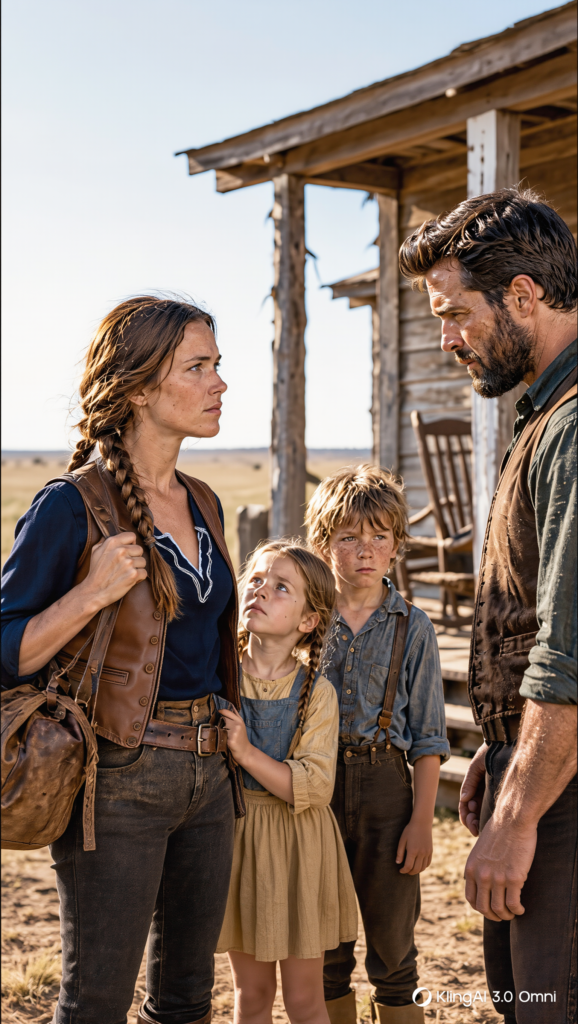
PART 1: The Woman in Her Sister’s Coat
The train pulled into Cheyenne at a quarter past four on a September afternoon, and Nora Ellery sat in her seat until every other passenger had gone, staring at her own gloved hands and trying to remember how to breathe.
The gloves were Lydia’s. So was the grey wool traveling coat, let out at the shoulders the night before she left Philadelphia because Nora had always been the broader of the two sisters, the stronger one, the one their mother used to call her sturdy girl in a voice that was never quite a compliment. In the coat’s inside pocket, wrapped in a handkerchief, was a bundle of letters tied with blue ribbon. Twenty-three of them, written in a bold, slanting hand by a man named Jonah Reed, who owned a cattle ranch on Lodgepole Creek, forty miles north of the railroad.
Every one of them began the same way.
My dear Lydia.
Nora had read them all twice on the train. She had not meant to. She had meant to burn them in the stove at the boarding house the night of the funeral, with the rest of the things that belonged to a life that was over. But she had been holding the first one in her hand, ready to drop it into the flames, when her eye caught a single line:
I have built a porch facing west, so that whoever sits on it will have the whole sunset to herself. I hope someday that will be you.
She had not burned it. She had sat on the floor of a cold rented room on Locust Street with her sister’s coffin not yet two days in the ground, and she had read every word, and she had cried harder over a stranger’s porch than she had cried at the graveside.
Then, three days later, the landlord had come for the rent.
Lydia had been sick for most of the year, and the doctor’s bills had eaten everything. The piano lessons Nora gave to merchants’ daughters paid for bread and not much else. Mr. Aldous Pike, who owned the building and three others on the street, had stood in her doorway with his thumbs in his waistcoat and explained, in a reasonable voice, that a young woman alone in the city with no family and no prospects had very few ways to settle a debt of sixty-one dollars, and he was prepared to be generous about which one she chose.
She had shut the door in his face. And then she had sat down and looked at the railroad ticket Jonah Reed had sent in his last letter, the ticket meant for Lydia, valid for one passage, Philadelphia to Cheyenne, Wyoming Territory.
It had not felt like a decision. It had felt like falling.
He was waiting on the platform. She knew him at once from Lydia’s descriptions of his descriptions of himself: tall, a little stooped at the shoulders as if he spent his days ducking under a sky too low for him, with a weathered, square-jawed face and hair the color of dry prairie grass. He was holding his hat in both hands, turning it slowly by the brim, and searching the windows of every car with a hope so naked that Nora almost stayed in her seat until the train pulled out again.
She made herself stand. She made herself walk down the steps.
He saw her. His hands went still on the hat.
“Miss Ellery?” His voice was deeper than she’d imagined. “Lydia?”
There it was. The moment. Nora had rehearsed it for two thousand miles. No. I’m her sister. She died in August. I’m so sorry. I came to tell you in person because you deserved that much. That was the speech. It was a good speech. She’d worked hard on it.
But he was looking at her with such relief. Such plain, bewildered gladness, as if he could hardly believe she was real. And behind her, the train whistle blew, and the cars began to roll, carrying away the only way back to a city where a man like Aldous Pike was waiting with his thumbs in his waistcoat.
“Yes,” Nora heard herself say. “Yes. I’m Lydia.”
Jonah Reed smiled. It transformed his whole face, like sunrise coming over a hard ridge.
“You’re taller than I pictured,” he said, and then went red to the ears. “I don’t mean— that came out wrong. I only meant you said you were small. In your letters.”
Lydia was small, Nora thought, and felt something tear inside her. Lydia was small and fair and laughed at everything and she should be standing here instead of me.
“I suppose I didn’t want to frighten you off,” she managed.
He laughed, a short, surprised sound, as though laughing were a thing he did not do often. “Ma’am,” he said, “I’ve been waiting eleven months. You’d have had to be a sight more frightening than tall.”
They were married the next morning in the parlor of a Methodist minister on Ferguson Street, because Jonah had written months ago that he did not think it proper for her to travel forty miles alone with a man she was not yet married to, and Lydia had written back that she thought him very old-fashioned and liked him the better for it. Nora had read that exchange on the train and wanted to weep.
She said the vows in a voice that did not shake. When the minister asked her name for the register, she said Lydia Ellery and watched her own hand write it in her sister’s looping style, the style she had practiced for hours by lamplight on the train with the letters spread out across her lap.
Jonah’s hand covered hers for a moment when she set down the pen. It was warm and rough and very steady.
“I know this isn’t how a woman dreams of being married,” he said quietly, as they walked out into the thin, bright September sunshine. “No flowers. No family. I’m sorry for it.”
“I didn’t come for flowers,” Nora said, which was true.
“No,” he agreed, looking at her sidelong. “You came for the porch.”
She had to look away, because her eyes had filled, and she could not tell him why.
The ranch on Lodgepole Creek was nothing like Philadelphia and nothing like she had imagined. The house was of squared logs, with a stone chimney and real glass windows, and yes, a porch facing west across an ocean of grass that ran gold and unbroken all the way to the blue line of the Laramie Mountains. Below the house, the creek wound through a stand of cottonwoods just beginning to turn. Cattle grazed on the far slopes, more than she could count.
And on the porch, waiting with his arms crossed and a scowl on his face, was a boy of about twelve, thin and sharp-featured, with dark hair falling over a pair of wire-rimmed spectacles thick as the bottoms of bottles.
“This is my brother Davy,” Jonah said. “Davy, this is— this is your sister-in-law.”
Davy did not uncross his arms. He tilted his head, studying her through those thick lenses, and Nora had the uncomfortable feeling of being read like a page.
“You don’t look like your letters,” he said.
“Davy,” Jonah said sharply.
“Well, she doesn’t. You read them to me. She said she was little and had yellow hair like corn silk.” The boy squinted. “Her hair’s brown.”
Nora’s heart stopped. Jonah turned and looked at her, and for one terrible second she saw a flicker of puzzlement cross his face.
“It was a figure of speech,” she said. “I was being silly. Girls are silly in letters.”
Jonah’s face cleared. He laughed, embarrassed, and clapped his brother on the shoulder. “There. You see? Now go wash for supper.”
Davy went. But at the door, he looked back at her one more time, and Nora knew with certainty that she had not fooled him at all.
The first weeks were the hardest of her life, and the best.
She learned to cook on a woodstove that seemed to have a malicious mind of its own. She learned to churn butter and wring a chicken’s neck and tell a heifer from a steer. She learned that Jonah rose before dawn and came in at dark smelling of horses and sage, and that he never once complained about burned biscuits, though she burned a great many of them. She learned that he had been raising Davy alone since their parents died of cholera on the trail from Missouri eight years before. She learned that the fever which had taken most of the boy’s eyesight two winters ago had nearly taken his life too, and that Jonah had sat by his bed for nineteen days.
She learned that Jonah Reed kept his promises. He had written to Lydia that he would give her a room of her own until she was ready to be more than a stranger to him, and he did. He slept in the small back room off the kitchen and never once pressed her. In the evenings he sat across the table and asked her about Philadelphia, about music, about the books she’d read, and listened to the answers as though they were the most interesting things he had ever heard.
And every evening she had to be careful. Because every evening, sooner or later, he mentioned something from the letters.
“You wrote that your father used to take you to see the ships come up the Delaware,” he said one night. “What kind of ships?”
Their father had taken Lydia. Nora had been home with their mother, who was ill. “Oh, all kinds,” she said lightly. “I was too young to tell one from another.”
Another night: “You never did tell me the name of that song you said you’d play for me. The one your mother loved.”
Nora knew that one. She knew it, because she had been the one who taught it to Lydia. “Long, Long Ago,” she said. “I’m afraid there’s no piano for me to play it on.”
He looked at her for a long moment across the lamplight. “No,” he said. “Not yet.”
Two weeks later, he drove forty miles to Cheyenne and forty miles back in a single day, and came home after midnight with a battered upright piano roped into the bed of the wagon, its varnish cracked, half its keys yellowed. He had bought it off a saloon keeper who was going out of business. It took him and two of his riders an hour to wrestle it into the house.
Nora stood in the parlor in her nightdress with a shawl around her shoulders and stared at it.
“It’s out of tune,” Jonah said apologetically. “Badly. I don’t know how to fix that part.”
“I do,” she whispered.
She tuned it herself, over three days, with a borrowed wrench and patience she did not know she had. On the fourth evening she sat down and played Long, Long Ago, and when she finished, she looked up and found him standing in the doorway with his hat in his hands and an expression on his face that she would remember on her deathbed.
Davy, sitting on the floor with his back against the wall and his eyes closed, said quietly, “Play it again.”
She did.
It was Davy who found her out first. Or rather, Davy who let her know that he had.
He came upon her in the barn one October morning, sitting in the hay with the bundle of letters in her lap, reading them over as she did every morning, memorizing them like scripture so she would not stumble at supper.
“You read them every day,” he said from the doorway. “Like you’re studying for a test.”
Nora jerked and nearly scattered them.
Davy came closer, squinting. He sat down on an overturned bucket a few feet away. For a long moment he didn’t say anything at all.
“I can’t see much,” he said finally. “Faces are mostly blurs. But I can hear real good. Better than before.” He was quiet a moment. “Your voice is different from how her letters sound in my head. When Jonah read them to me, I always heard somebody sort of fluttery. Like a bird. You don’t sound like that. You sound like somebody holding a rope that’s trying to get away from her.”
Nora said nothing. Her throat had closed.
“I’m not going to tell him,” Davy said. “If that’s what you’re scared of.”
“Why not?”
He shrugged his thin shoulders. “Because he laughs now. He didn’t use to laugh. And because you tuned the piano.” He picked at a splinter on the bucket. “And because when I got lost in the cottonwoods last week and couldn’t see my way back, you came and found me and didn’t tell him I’d been crying.” He looked up at her through those thick spectacles. “But you ought to tell him. He’d want the truth. He always wants the truth, even when it hurts.”
“I know,” Nora whispered. “I know he does. I’m going to.”
“When?”
She didn’t have an answer.
She almost told him the night of the first snow.
It came early that year, the last week of October, soft and silent out of a yellow sky. Jonah came in from the range with flakes melting in his hair and stood at the window looking out at it with an odd, worried expression.
“Too early,” he said. “And the grass was short this year. Summer was dry.” He shook his head slowly. “Old Swede Larsen up the creek says the muskrats built their houses twice as thick as usual. Says the geese went south a month early.” He turned from the window. “Says it’s going to be a hard winter.”
“How hard?”
He tried to smile. “Swede says hard enough to remember.”
They sat by the fire afterward, Davy asleep in his room, the house silent except for the hiss of the logs. Nora watched the flames and gathered her courage the way she had gathered it every night for six weeks.
“Jonah,” she said. “There’s something I have to tell you.”
He looked up. And in that instant, there was a pounding at the door.
It was Ned Tolliver, one of Jonah’s riders, back from Cheyenne with the mail and the supplies, snow caked on his shoulders. He stamped his boots, accepted a cup of coffee, apologized for the hour, and handed Jonah a small stack of envelopes.
Jonah sorted through them absently. A bill from the feed store. A letter from the stock growers’ association. And then his hands stopped.
He held up a square white envelope with a heavy black border around its edges.
Nora knew what a black-bordered envelope meant. Everybody knew. It was the way people sent news of a death.
“It’s from Philadelphia,” Jonah said slowly, puzzled. “From a Reverend Thomas Hale. Addressed to me.” He looked up at her. “Do you know a Reverend Hale, Lydia?”
Nora knew him. He was the minister of the church on Locust Street. He had buried her sister. And she remembered now, with a sickening lurch, the last thing she’d said to him at the graveside when he asked whether Lydia had any other family to be notified: There’s a man in Wyoming. She was going to marry him. His name is Jonah Reed. I suppose someone should tell him.
She had meant to be the one. She had told the Reverend she would write. And then she had gotten on the train instead, and never written anything at all.
The Reverend, a thorough and kindly man, had evidently decided not to wait.
Jonah broke the seal with his thumb. Ned Tolliver, sensing something, set down his coffee cup very quietly.
Nora could not move. She could not speak. She watched Jonah unfold the single sheet of paper. She watched his eyes move across the first line, and the second. She watched them stop.
The fire popped. Snow whispered against the window glass.
Jonah Reed read the letter all the way to the end. Then he read it again. Then he set it down on the table, very carefully, smoothing it flat with his rough hand as though it were something fragile.
He raised his eyes to her face, and they were the eyes of a stranger.
“It says,” he said, very quietly, “that Miss Lydia Ellery died of consumption on the eleventh of August. That she was buried in the churchyard of St. Mark’s on Locust Street. That the Reverend is sorry for my loss.” He drew a breath that seemed to cost him something. “It says she is survived by one sister. Miss Nora Ellery.”
He stood up slowly. The chair scraped back across the floorboards.
“Who,” Jonah Reed said, “are you?”
PART 2: The Winter Hard Enough to Remember
Ned Tolliver left without finishing his coffee. Neither of them noticed him go.
Nora told him everything. She told it standing in the middle of the kitchen with her hands knotted together so hard her fingers went white, because she was afraid if she sat down she would never get up again. She told him about Lydia’s illness and the doctor’s bills and the room on Locust Street. She told him about Aldous Pike. She told him about the ticket, and the train, and the moment on the platform when she’d meant to say no and said yes instead.
He listened to every word without interrupting. He stood by the window with his back to her, watching the snow, and his shoulders never moved.
When she finished, the silence went on so long she thought he would never speak again.
“Eleven months,” he said finally, to the window glass. “I wrote her every week for eleven months. I told her things I’ve never told anyone living. About my mother. About the cholera. About sitting with Davy all those nights not knowing if he’d see morning.” His voice was very low. “And she’s been dead since August. And I didn’t know. I didn’t even get to grieve her.” He turned around at last. His face was grey. “You took that from me too.”
“I know,” Nora whispered.
“You stood up in front of a minister and said her name.”
“I know.”
“Was any of it true? Any of it at all? The piano, the—” He stopped, unable to finish.
“All of it,” she said. “Everything since I got off the train. Everything except the name.”
He laughed then, a terrible short sound with nothing in it. “Everything except the name. Well. That’s a fine distinction, ma’am. I’ll have to think on it.”
He took his coat from the peg and walked out into the snow, and he did not come back that night.
He slept in the bunkhouse with the riders after that. He came to the house for meals, because Davy was there, and because Jonah Reed was not a man to punish a boy for his own grief. But he sat at the far end of the table and spoke to Nora only when he had to, in a voice so carefully polite it was worse than shouting.
She waited for him to send her away. Every morning she woke expecting it. She packed her trunk on the second day and left it standing by the door, so he would know she understood.
He walked past it every morning and said nothing.
“He doesn’t know what to do,” Davy told her, sitting on the kitchen floor while she peeled potatoes with shaking hands. “I’ve never seen him not know what to do.”
“He should send me back.”
“Back where? To that landlord?” Davy pushed his spectacles up his nose. “He’s mad, Nora. He’s not stupid.”
It was the first time the boy had used her real name. She had to set the knife down for a moment.
The winter came in earnest the second week of November, and it did not let go.
It came in on a howling wind out of the north that blew for three days without stopping, packing the snow into drifts higher than the cabin windows, then froze it hard as iron. Then it snowed again. Then the wind came back. The thermometer on the porch post dropped to twenty below and stayed there, then thirty below, then a number Jonah stopped reading aloud.
The cattle could not get at the grass. It lay buried under a crust of ice so thick the animals cut their legs to the bone pawing at it. They drifted south before the wind, bawling, and piled up against fence lines and in coulees and died there standing, frozen upright in the snow like terrible statues.
Jonah and his three riders worked from before dawn until long after dark, breaking ice on the creek with axes so the stock could drink, cutting cottonwood branches so they could chew the bark, pushing hay they could not spare into the mouths of animals already too weak to stand. They came back each night half frozen, with faces burned black by the wind and eyes gone hollow with exhaustion and despair.
Nora kept the stove going around the clock. She kept coffee hot and stew on and dry socks warming on the oven door. She rubbed snow into Ned Tolliver’s frostbitten fingers when he came in with them white and dead, and sat with him while he wept from the pain of them coming back. She did not wait for anyone to ask. She did not wait for Jonah to speak to her. She simply did what needed doing, the way she had done it at Lydia’s bedside for a year.
And at night, when the house was silent and the wind screamed under the eaves, she sat at the out-of-tune piano and played softly, very softly, so as not to wake Davy. Long, Long Ago. Hymns. The old Scottish airs her mother had sung. She did not know whether Jonah could hear it across the yard in the bunkhouse.
She did not know that some nights, when the wind dropped, he stood outside the kitchen door in the snow and listened until he could no longer feel his feet.
The day before Christmas, the stock growers’ association sent a rider through with news that Jonah’s neighbors had lost half their herds. Swede Larsen had lost everything. Jonah came in that evening and sat down at the table without taking off his coat and put his face in his hands.
“Four hundred head,” he said into his palms. “Maybe more. I won’t know until spring. I’ll lose the ranch, Davy. The note comes due in June. I can’t pay it with dead cattle.”
Davy, sitting across from him, said nothing. He looked at Nora.
Nora set a cup of coffee in front of Jonah. She sat down in the chair beside him, the first time she had sat that close to him in six weeks. He did not move away.
“My father lost everything once,” she said quietly. “When I was nine. A bank failed. He’d put every cent into it. We went from a house on Spruce Street to two rooms above a cobbler’s shop in a week.” She folded her hands on the table. “He never got over it. He used to say a man is what he owns, and when he lost what he owned, he didn’t know who he was anymore. It killed him, in the end. Not right away. But it killed him.”
Jonah lifted his head.
“I don’t believe him,” Nora said. “I never did. Lydia and my mother and I lived in those two rooms for eleven years, and we were still exactly who we’d always been. We laughed in those rooms. We sang in them.” Her voice wavered and steadied. “You’re not four hundred dead cattle, Jonah Reed. You’re the man who drove eighty miles in one day to buy a piano for a woman he’d only known two weeks. That man doesn’t lose anything that matters in a blizzard.”
He looked at her for a long time. Then, slowly, he reached out and laid his rough, cracked hand over hers on the table. He didn’t say anything. He didn’t have to.
It was the first time he had touched her since the letter.
The worst storm of that whole terrible winter came on the ninth of January.
The morning broke strangely warm, almost mild, with a soft wet wind from the south and a grey haze over the sun. Jonah and his riders took advantage of it to push what was left of the herd down into the shelter of the creek bottom. Davy, who had been trapped indoors for six weeks and was half mad with restlessness, begged to go along and help.
“Stay close to Ned,” Jonah told him. “You hear me? You don’t let him out of your sight. Such as it is.”
Davy grinned and saluted. Nora watched them ride off across the white slopes and felt something cold settle in her stomach, though she could not have said why.
At two o’clock in the afternoon, the sky in the northwest turned black.
Not grey. Black, like the edge of the world rolling toward them. The temperature fell forty degrees in an hour. The wind arrived with a sound like a train coming through the walls, and the snow came with it, not falling but driving, horizontal, so thick that from the kitchen window Nora could not see the barn forty feet away.
At half past three, Ned Tolliver came staggering in through the door, white from head to foot, his eyebrows crusted with ice, dragging Jonah’s riders in behind him.
He looked around the kitchen wildly.
“Is the boy here?” he gasped. “Tell me the boy’s here.”
Nora’s heart stopped.
“We got separated in the whiteout,” Ned said. “I had him, I swear to God I had him right beside me, and then the wind came, and I turned around and he was gone. Jonah went back for him. I tried to stop him. He went back in there alone.”
Nora did not remember putting on her coat. She did not remember Ned grabbing at her arm or shouting that she would die out there, that a man couldn’t see his own hand in front of his face. She remembered only one thing, standing on the porch with the wind tearing at her skirts and the snow blinding her: Davy, sitting on an overturned bucket in the barn in October, saying I can’t see much. But I can hear real good.
She ran back inside. She threw open the piano’s lid. And then she ran to the kitchen and pulled down the great iron triangle that hung beside the stove, the dinner bell Jonah’s mother had brought all the way from Missouri, and she ran out onto the porch with it and began to ring.
She rang it until her arms burned. She rang it until her hands went numb inside her gloves and the skin on her palms split and bled into the wool. Ned Tolliver came out and took over when she faltered, and she went back inside, frozen to the bone, and sat down at the piano and played as loudly as she could, every window in the parlor flung wide open to the howling dark so the music would carry. Long, Long Ago. Again. Again. The song Davy always asked her to play twice.
An hour passed. Two. Ned rang the bell until he collapsed and another rider took his place. Nora played until her fingers were nothing but pain, until she could not feel the keys at all, until the snow drifting in through the open window piled up on the floorboards around her chair and froze the hem of her dress to the floor.
At ten minutes past six, out of the screaming dark, a voice answered.
It was thin and broken by the wind, and she almost thought she imagined it. Then she heard it again, closer: a boy’s voice, singing. Singing the melody of Long, Long Ago, off-key and shaking with cold, the way a lost child sings a song to follow it home.
Then the shape of a horse loomed out of the white, and on it, slumped together in a single saddle, were two figures caked in ice. Jonah Reed, frozen half to death, with his arms locked around his little brother so tightly it took two riders to pry them loose.
They carried them into the kitchen. Davy was conscious and shivering violently, his spectacles gone, his lips blue. Jonah was barely conscious at all. His hands were white and waxen to the wrists. His face was grey.
Nora did not cry. There would be time for crying later. She stripped off their frozen clothes. She wrapped them in every quilt in the house. She packed snow against Jonah’s hands to bring them back slowly, the way the old Swede had taught her, and she held them in her own bleeding hands for three hours while he moaned with the pain of the blood coming back into them.
Somewhere past midnight, Jonah opened his eyes and looked up at her.
“Davy,” he whispered.
“He’s asleep by the stove. He’s going to be fine.”
Jonah closed his eyes. “I couldn’t find him. Couldn’t see a thing. I was riding in circles. I knew I was going to die out there. And then I heard the bell.” His cracked lips moved. “And then the piano. And Davy heard it too. He heard it before I did. He was singing. I followed his voice.” His eyes opened again. “You played the whole time?”
“The whole time.”
He turned his head on the pillow and looked down at her hands, wrapped in strips of bandage, still holding his.
“Nora,” he said.
It was the first time he had ever said her name. Her real name. She had not known until that moment how badly she had needed to hear him say it.
PART 3: The Letters in the Trunk
The winter of 1886 did not truly end until April. When the snow finally melted off the slopes along Lodgepole Creek, it revealed what everyone had feared: the bodies of cattle by the hundreds, piled in coulees and against fences, the worst disaster the cattle country of the West had ever known. Ranchers who had been rich men in October were penniless by spring. Some simply walked away from their land and never came back. People would call it the Great Die-Up for the rest of their lives.
Jonah Reed lost three hundred and sixty head of cattle. He kept his brother, his house, his riders, and every one of his fingers.
He also, in April, found the letters in Nora’s trunk.
He had not been looking for them. Davy’s new spectacles had come on the train from Cheyenne, and the boy had wanted to read something, anything, with his own eyes for the first time in two years. He had gone rummaging in the trunk that still stood unopened by the door, looking for one of Nora’s books, and come out instead with a thick bundle of paper, much folded and much crossed out, covered in a slanting hand.
He brought it to his brother, frowning. “Jonah. These are your letters. Your words. But it’s not your writing.”
Jonah took them. He looked at them for a long time, standing in the middle of the parlor in the soft spring light.
Then he went out to find his wife.
She was on the porch, sitting in the chair facing west, watching the sun go down over the Laramie Mountains. She looked up as he came out, saw what he held in his hand, and went very still.
“These are drafts,” he said quietly. “Of Lydia’s letters to me. In your hand.” He turned the pages. “Here. This is the one about the stars over the Philadelphia rooftops. The one I read until it fell apart. There’s three versions of it. All crossed out but the last.”
Nora looked down at her hands. The scars on her palms from the iron bell had faded to thin pink lines.
“She was so sick,” she said at last, very low. “Almost from the beginning. She’d lie there and tell me what she wanted to say, and I’d write it out for her, and she’d copy it in her own hand so you wouldn’t know. After a while she was too tired to tell me what to say. So I’d just write. And read it to her. And she’d laugh and say, Yes, that’s it, Nora, that’s exactly how I feel.” She swallowed. “Maybe the last eight letters. Maybe more. I lost count.”
Jonah sat down slowly in the chair beside her.
“The porch,” he said. “When I wrote about the porch facing west. And Lydia wrote back that she’d sit on it every evening and never tire of the view.”
“Lydia never saw that letter,” Nora said. “She was asleep when it came. I wrote the answer by myself. I was going to show it to her in the morning.” Her voice cracked. “She didn’t wake up for three days. When she did, she didn’t remember. I sent it anyway.”
The sun touched the mountains. The whole prairie turned gold.
“I thought I was in love with a dead woman,” Jonah said finally. “All winter. I’d lie awake in that bunkhouse thinking I’d been made a fool of, that I’d loved somebody who never existed, and the woman I’d married was a stranger who’d stolen her name.” He turned the bundle of drafts over in his hands. “But it was you. The stars and the music and the porch. Half of it, anyway. It was you all along.”
“I didn’t know how to tell you,” Nora whispered. “It would sound like an excuse. Like I was trying to steal that too.”
Jonah set the letters down on the porch boards. He reached into his coat and took out a long folded paper and held it out to her. A railroad ticket. Cheyenne to Philadelphia. One passage.
Nora stared at it, and something inside her went dark.
“I bought it in Cheyenne when I picked up Davy’s spectacles,” he said. “I paid off your landlord too. Sixty-one dollars. Wired it to a lawyer in Philadelphia. That man won’t trouble you again.” He held the ticket steady between them. “I wanted you to have a choice. A real one. Nobody’s debt standing behind you and no train pulling away. You came to me with nothing else to choose. That’s not a fair way for anybody to start a life.”
She took the ticket with shaking fingers. She looked at it a long time.
Then she stood up, walked into the kitchen, and fed it into the stove.
She came back out and sat down beside him, and folded her scarred hands in her lap, and looked out at the sunset.
“Lydia always said I was the sturdy one,” she said. “I think she meant I was stubborn.”
Jonah began to laugh. It started low in his chest and went on until he had to wipe his eyes, and somewhere in the middle of it Nora started laughing too, and from inside the house Davy shouted to know what was so funny, and neither of them could tell him.
They were married again in June, in the little log church at Horse Creek, with the whole surviving county in attendance. There was very little money in Wyoming that spring, and nobody had any cattle to spare, but they brought what they had: pies and quilts and jars of chokecherry jelly, and Swede Larsen played the fiddle. Ned Tolliver stood up as best man with all ten of his fingers. Davy wore his new spectacles and held the ring.
When the minister asked the bride to state her name for the register, she said, clearly, so the whole church could hear, “Nora Ellery.” And she signed it in her own hand, the strong upright hand that had written half the love letters in the territory without ever once signing them.
Below it, Jonah wrote his name. Then, after a moment’s thought, he dipped the pen again and added a line beneath, in his bold, slanting script. Nora read it upside down and had to press her knuckles against her mouth.
In memory of Lydia, who brought us together.
That autumn, Jonah built a second chair for the porch, so there would always be two. Nora kept the piano by the parlor window, and every evening at sunset she played, with the window open, so that the music carried out across the grass toward the cottonwoods and the creek. And when the riders came in from the range at dusk, they said that they could hear it a mile away, and steered their horses by it, the way sailors steer by a lighthouse.
Years later, when Nora and Jonah’s own children asked how their parents had met, he would tell them that he fell in love with their mother through a stack of letters, and that it took the worst winter in the history of the West for him to figure out who had actually written them. She would roll her eyes and tell him he was being sentimental.
And then she would go to the piano, and play Long, Long Ago, and he would stand in the doorway with his hat in his hands, exactly as he had the night she first tuned it, looking at her as though he could hardly believe she was real.


