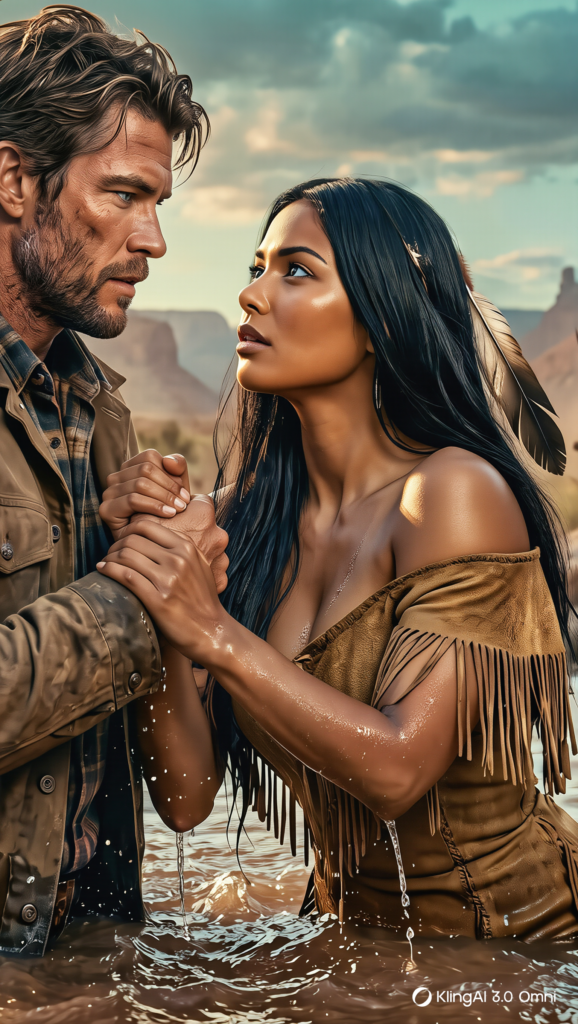
PART 1: The Stranger in the Barn
The wind came down off the Sacramento Mountains that January like something with a grudge, and Clara Whitfield had learned long ago not to argue with it.
She barred the shutters at four in the afternoon, banked the stove, and set her son Sam to mending harness by the lamp while she counted what was left in the flour barrel for the third time that week. Fourteen months had passed since a fall from a green-broke horse had snapped her husband’s neck in the south pasture, and in those fourteen months she had discovered exactly how much of a ranch a single woman could hold together with two hands, a stubborn spine, and a shotgun she had never once fired at anything bigger than a coyote.
The answer, most days, was almost enough.
The neighbors had stopped coming by after the first winter. Not out of cruelty, exactly. People on the frontier had their own fences falling down. But Clara had noticed how the visits thinned once it became clear she wasn’t going to sell out and move back east to her sister in Ohio, as though a widow who refused to give up were somehow more unsettling than one who did. The banker in Lincoln had made her an offer for the land in November. So had a cattleman named Augustus Vane, whose spread ran along the river to the north, and whose men had a habit of letting their herd drift onto other people’s grass and calling it an accident.
She had turned them both down. Sam had asked her why, and she had told him the truth: because his father had built this house with his own hands, and because she would not let anyone else tell her when she was finished.
That night, sometime past ten, the mule began to scream.
Clara was out of bed with the shotgun before she was fully awake. Sam stood in his nightshirt in the doorway, wide-eyed.
“Stay inside,” she said. “Bar the door behind me. Don’t open it for anybody but me.”
“Mama—”
“Sam. Do as I say.”
The cold hit her like a slap. Snow was blowing sideways through the yard in thin, needling sheets, and the barn door, which she knew she had latched at dusk, stood half open and banging in the wind. The mule was kicking its stall. The two horses were pressed against the far wall, eyes rolling white.
She raised the lantern and stepped inside.
There was blood on the straw. A long smear of it, dark and glistening, leading back to the empty stall at the end where her husband had once kept his saddle. And in the corner of that stall, half sitting and half fallen against the boards, was a man.
He was young, perhaps thirty, with long black hair loose around a face gone grey with cold and blood loss. He wore a cavalry coat too big for him, the brass buttons torn away, and beneath it his shirt was soaked crimson from the left side all the way to his belt. His hand was pressed hard against the wound. In his other hand, held loosely across his knees, was a knife.
He was Apache. Clara knew that the instant the lantern light reached his face, and she felt the old fear the whole territory had taught her rise in her throat like bile.
His eyes opened. They were very dark and very steady, and they looked at the shotgun, and then at her face, and then, with a kind of tired, terrible calm, he set the knife down in the straw and pushed it away from himself with two fingers.
He did not say anything. He simply waited, the way a man waits who has already decided that whatever comes next is out of his hands.
“Who are you?” Clara said. Her voice came out higher than she wanted.
Nothing.
“Who did this to you?”
He closed his eyes.
From somewhere far off, carried and broken on the wind, came a sound Clara knew all too well: horses, more than a few, and a man’s voice raised in a shout.
The stranger’s eyes snapped open. For the first time something moved across his face, not fear for himself, she would think later, but something closer to grief. He tried to push himself up, failed, tried again, and got one knee under him before his wound tore and he went down hard into the straw with a sound that was not quite a groan.
“Mama?”
Sam was standing in the barn doorway in his nightshirt and his father’s too-big boots, snow in his hair.
“I told you to stay inside!”
But the boy wasn’t looking at her. He was looking at the man in the straw. And then he said something that Clara would carry with her for the rest of her life.
“Mama,” Sam whispered. “He’s not the bad one.”
“You don’t know that.”
“I do.” Sam’s chin came up, exactly like his father’s used to. “Look at his hands. He put the knife down. Bad men don’t put the knife down.”
The horses outside were closer now. She could hear individual voices.
Clara Whitfield had perhaps five seconds to decide what kind of woman she was going to be. She thought about the banker, and about Augustus Vane, and about every neighbor who had stopped coming by. She thought about her husband, who had once given a whole side of beef to a family of Mexican sheepherders stranded in a blizzard and shrugged off every complaint in town about it. She thought about the stranger setting down his knife.
“Sam,” she said. “Get the lantern. Help me lift him.”
The root cellar was beneath the kitchen floor, a cramped hole dug into the hard caliche, lined with shelves of preserved peaches and sacks of potatoes. They got him down the ladder somehow, Clara bearing most of his weight while Sam guided his feet, and laid him on a pile of empty flour sacks. He was shaking violently now. Clara tore a bedsheet into strips and pressed them against the wound, and he didn’t make a sound, though his jaw clenched so hard she heard his teeth grind.
“Don’t move,” she told him. “Don’t make a sound, whatever you hear.”
He looked at her. And for the first time he spoke, in English, rough and low and careful.
“Why?”
She didn’t have an answer. She dropped the trapdoor, dragged the braided rug over it, and set the kitchen table squarely on top. Then she sent Sam to bed, smoothed her hair, and was standing at the stove pouring coffee into a cup she had no intention of drinking when the fist hit her door.
There were five of them on the porch, and more in the yard. Clara recognized the man in front: Jory Pike, Augustus Vane’s foreman, a lean, sour-faced man with a scar through one eyebrow and a habit of looking at women like they were livestock at auction.
“Evening, Mrs. Whitfield,” he said, not taking off his hat. “We’re hunting a man.”
“At this hour?”
“An Apache buck. Stole six head of horses off the Abbott place two days back and killed the whole family doing it. Father, mother, the hired man. Burned the house over them.” He let that settle. “We winged him this afternoon down by the river. Blood trail leads this way. You seen anything?”
Clara felt the cold settle in her stomach. A whole family. Burned.
She thought about the stranger setting down the knife.
“I heard my mule fussing an hour ago,” she said evenly. “Went out to check. There was nothing in the barn but a coyote, and it ran off. You’re welcome to look.”
They looked. She stood in the doorway in her shawl and watched them kick through her barn and her woodshed and her chicken coop, watched one of them lift a lantern and study the smear of blood on the straw, watched Pike crouch beside it and touch it and rub it between his fingers.
“Coyote,” he said, rising, “bleeds a lot.”
“It had a rabbit,” Clara said. “Or the rabbit had it. I didn’t stay to ask.”
Pike came back across the yard slowly. He stopped at the foot of her porch steps, close enough that she could smell the whiskey on him.
“Mr. Vane’s riding over himself at first light, with the rest of the men. We’ll pick up the trail when the snow quits.” He smiled with half his mouth. “Be a shame, ma’am, if we found out that trail ended somewhere close. Folks in this county don’t take kindly to anybody harboring a murdering savage. That’s the kind of thing makes a widow’s life real hard. Harder than it already is.”
He touched his hat brim at last, an insult disguised as manners, and they rode off into the snow.
Clara stood in the doorway until the sound of hooves faded completely. Then she closed the door, leaned against it, and found that her hands were shaking so badly she couldn’t work the bar.
He was awake when she climbed down with the lamp.
“They said you killed a family,” she said. “The Abbotts. They said you burned them in their house.”
For a long moment he said nothing at all. The lamplight carved deep shadows under his eyes.
“You let them believe I am not here,” he said finally. “Why, if you believe them?”
“I don’t know what I believe. I’m asking you.”
He looked at the ceiling. Above them, faintly, they could hear Sam’s footsteps creaking across the floor. The boy had not gone to bed.
“My name is Kele,” he said. “I am Mescalero. My people are camped in the high country, at the place your maps call Dog Canyon. I scout for the army at Fort Stanton sometimes, when they pay. Two days ago I was riding home from the fort along the river.” He stopped. His jaw worked. “I saw smoke. I rode toward it.”
“The Abbott place.”
“The house was burning. The men who set it were still there. Six of them, white men, taking the horses from the corral.” His voice dropped. “One of them was the man who stood on your porch tonight. The one with the cut through his eyebrow.”
Clara’s breath stopped.
“I was seen,” Kele said simply. “They shot at me. I rode. They have hunted me two days. Now they tell the whole territory I am the killer, so that when they find me, nobody will ask questions about the rope.” He turned his head and looked at her straight. “That is the truth. I have no way to prove it. My word against theirs. You know whose word this county will believe.”
“Then why didn’t you say something to the army?”
“I was riding to tell them,” he said, “when the bullet found me.”
Clara sat back on her heels. In the dark of the root cellar, with the wind howling above and peaches glinting in jars around her, she felt the world shift beneath her into a shape she did not like.
Augustus Vane had wanted the Abbott land. Everyone knew it. The Abbotts had refused to sell, the same as she had.
“There’s something else,” Kele said quietly. “Something they don’t know. I need you to listen.”
But before he could finish, there came a sound from upstairs. Not a knock. The splintering crack of wood, and then Sam’s voice, high and terrified, shouting a single word.
“MAMA!”
Clara was up the ladder before she knew she had moved. She burst into the kitchen and froze.
It was not first light. Pike had lied. Augustus Vane had not waited for dawn.
The front door hung off one hinge where it had been kicked through. The room was full of cold air and men with rifles. And standing in the center of her kitchen, in a long grey coat with snow melting on his shoulders, was Augustus Vane himself: tall and silver-haired and courteous, with the calm, pleasant face of a deacon. One gloved hand rested on Sam’s shoulder. The other held a revolver, its barrel resting almost gently against the side of her son’s head.
“Good evening, Mrs. Whitfield,” Vane said softly. “I find I couldn’t sleep. Jory tells me you’ve got a coyote problem.” He smiled. “I’d like to see this coyote. I’ll count to ten.”
Sam’s face was white. His eyes found his mother’s, wide and pleading, and then, without meaning to, they flicked once toward the kitchen table. Toward the braided rug beneath it.
Vane saw it. Clara watched him see it.
“One,” Vane said.
PART 2: The Rope and the Ridge
“Two.”
Clara’s mind had gone completely white. She heard the wind. She heard the clock on the shelf, her mother’s clock, ticking out the seconds of her son’s life. She heard the click of a rifle hammer somewhere behind her.
“Three.”
“There’s nobody down there,” she said, and her voice did not sound like her own.
“Four.” Vane didn’t even look at her. He was watching the rug.
And then, from beneath the floor, came three slow, deliberate knocks.
The trapdoor rose against the weight of the table. It lifted an inch, then two, then the whole table tipped with a crash and slid aside, and Kele pulled himself up out of the root cellar on arms that shook with every inch. His shirt was black with blood. His face was the color of ash. He got to his feet and stood swaying in the middle of Clara Whitfield’s kitchen with his empty hands held out from his sides, and he looked at Augustus Vane and said, very clearly:
“Let the boy go.”
Vane’s smile widened, slow and satisfied.
“Well,” he said. “There’s our coyote.”
He took the revolver from Sam’s head. He pushed the boy toward his mother, and Sam stumbled across the floor and into her arms, sobbing, and Clara held him so tightly she felt his heart hammering against her ribs.
Pike and two others seized Kele by the arms and hauled him toward the door. He did not resist. As he passed Clara, he turned his head, and their eyes met for one brief moment, and she saw in his face no anger at all. Only a strange, quiet steadiness, as if he had known since the moment he set down his knife in her barn exactly how this night would end, and had made his peace with it.
“Thank you,” he said, so softly only she could hear. “For the peaches.”
Then they dragged him out into the snow.
They meant to hang him from her cottonwood.
Clara understood it as she stood on the porch with Sam clinging to her skirts, watching Pike throw a coil of rope over the low, thick branch where her husband had once hung a swing. They meant to do it here, in her yard, in front of her son, so that every person in the county would hear about it and understand what happened to people who crossed Augustus Vane.
“He didn’t kill the Abbotts,” she said.
Vane, who was pulling his gloves tighter in the cold, glanced at her with mild interest.
“No?”
“He saw who did. He told me. He saw your foreman there. Taking the horses.”
The yard went quiet. A few of the riders shifted in their saddles. Clara saw one young man near the back, hardly more than a boy himself, look sharply at Pike and then down at his own hands.
Vane studied her for a long moment. Then he walked up the porch steps until he stood close enough for her to see the fine grey stubble on his jaw.
“Mrs. Whitfield,” he said gently, “you are a widow alone with a small child, forty miles from the nearest lawman, on land I have offered you a very fair price for. You have just been caught hiding a wanted murderer under your kitchen floor. If I were you, I would think very carefully about what I said next, and who might hear it.” He leaned closer. “Accidents happen out here. Your husband’s horse, for instance. Such a terrible thing.”
Clara went very cold. Not the cold of fear. Something else. Something that had been sleeping in her for fourteen months and was now, slowly, opening its eyes.
Her husband had been the finest horseman in the county. She had never understood how that horse had thrown him.
Vane straightened and turned away. “Get it done, Jory.”
They put Kele on a horse beneath the branch. They bound his wrists behind him. Pike settled the noose around his neck and drew it snug, and Kele sat very straight in the saddle with his chin lifted and his eyes on the eastern sky, where the first grey thread of dawn was just beginning to show over the ridge.
“Any last words, Injun?” Pike said.
Kele said nothing. He was watching the ridge.
So was Sam.
“Mama,” the boy whispered, tugging at her sleeve. “Mama, look.”
Clara looked.
Along the top of the eastern ridge, black against the slowly paling sky, riders were appearing. One, then five, then twenty. They came up over the crest without a sound and stopped in a long, silent line, and in the growing light Clara could see the shapes of rifles across their saddles. There were forty of them at least. Perhaps more.
In the yard, someone swore. A horse squealed and backed. Pike’s hand went still on the rope.
One rider broke from the line and came down the slope at a slow, deliberate walk. As she drew closer, Clara saw it was a woman, young and fierce-faced, her hair bound back with a strip of red cloth, a Winchester resting across her knees. She stopped thirty yards from the cottonwood and looked at Kele sitting beneath the branch with the rope around his neck, and something passed across her face that Clara recognized instantly, because she had felt it herself not ten minutes before with a gun pressed to Sam’s head.
“That is my brother,” the woman said in clear, careful English. Her voice carried across the whole silent yard. “My name is Nalin. Take the rope off him, or none of you will ride home.”
Augustus Vane did not move for a long moment. Clara watched him count: forty rifles on the ridge, twelve in the yard. She watched him do the arithmetic and arrive at an answer he did not like.
And then she watched him smile.
“Take it off,” he said.
Pike stared at him. “Mr. Vane—”
“I said take it off, Jory.” Vane’s voice never rose. “We’re law-abiding men. We’ll take the prisoner to Fort Stanton and let the army hang him properly, with a judge and a rope that was paid for. These people can follow along and watch if they please.” He looked up at Nalin pleasantly. “Unless you’d like to start a war over one horse thief, miss, and bring the cavalry down on every lodge in Dog Canyon. Your choice.”
Nalin’s knuckles went white on her rifle. Clara could see her weighing it: her brother’s life against the lives of everyone on that ridge.
It was Kele who answered.
“Nalin,” he said quietly, in English, so everyone could hear. “Let them take me to the fort. It is better.”
His sister looked at him in disbelief.
“There,” Vane said cheerfully. “The prisoner agrees.”
They lifted the rope from Kele’s neck. They tied him across the saddle instead, and Vane’s riders formed up around him, and the whole company turned north toward Fort Stanton at a slow walk. The line of riders on the ridge turned and paced them along the high ground, silent and watchful.
Clara stood on her porch and watched them go, and something about it was wrong. Vane had given in too easily. A man like that did not surrender a prisoner he wanted dead. He waited for a better place to finish the job.
Fort Stanton was two days’ ride. The road went through Ruidoso Canyon.
Nalin came down to the house an hour later, alone. She found Clara saddling her husband’s old bay in the barn, her shotgun in the scabbard and Sam bundled in his coat on the mule beside her.
“Where are you going?” Nalin asked.
“Wherever they’re taking him.”
Nalin studied her a long moment: the widow’s black dress, the shotgun, the set of her jaw. “Why? He is nothing to you.”
“He came up out of my root cellar to save my son,” Clara said. “He knew they’d kill him for it, and he did it anyway.” She cinched the girth tight. “And that man Vane just told me, standing on my own porch, that he killed my husband. I want to see him answer for it. I don’t care who I have to ride beside to do it.”
Nalin was silent for a moment. Then she did something Clara did not expect. She smiled, a quick fierce flash of teeth.
“My brother told me once he would know the right white woman when he met her,” she said. “I told him he was a fool.”
Clara looked up sharply. “What does that mean?”
But Nalin was already turning away. “Ride, then. But listen first. There is something Kele did not have time to tell you.”
What Kele had not had time to tell her was that the Abbott family had not died together.
Ruth Abbott, nine years old, had been in the springhouse when Vane’s men came. She had hidden in the cold dark beneath the water trough while her family died, and when the riders were gone and the house was a ruin of embers, Kele had found her there, half frozen and silent with shock. He had carried her on his own horse forty miles up into the mountains to his people’s camp at Dog Canyon, and left her in his sister’s care, and ridden back down toward the fort alone to report what he had seen.
“She has not spoken since,” Nalin said as they rode. “Not one word. She only sits by the fire and looks at nothing. But she saw their faces, Clara Whitfield. She saw the one with the cut eyebrow.”
“Then she’s the proof,” Clara breathed. “She’s the only witness besides Kele.”
“Yes. And if Vane learns she is alive, she is the next one he kills.” Nalin glanced toward the north. “My brother let them take him so that no one would ride up into the mountains looking for anything else. He is buying her time with his neck.”
Clara thought of the young man sitting beneath the cottonwood with the rope snug around his throat and his eyes fixed on the ridge, waiting. Not for rescue. For his sister to see, and understand, and stay away.
She thought about her husband, and the horse that should never have thrown him.
“Then we go get the girl,” Clara said. “And we bring her to the fort. Before Vane gets Kele there.”
“Vane will never let him reach the fort,” Nalin said flatly. “You know this.”
“I know it,” Clara said. “So we’d better ride fast.”
They rode up into the mountains through the long cold afternoon, Sam tucked in the saddle in front of his mother, Nalin and six of her warriors around them. They reached the camp at Dog Canyon at dusk. It was a scattering of brush lodges and cookfires beneath towering cliffs of white limestone. And Clara Whitfield, who had grown up on newspaper stories about savages and massacres, found herself welcomed with blankets and hot stew by grandmothers who fussed over Sam’s cold red ears exactly as her own mother would have.
Ruth Abbott sat beside the largest fire, wrapped in a woven blanket, staring at the flames with eyes that seemed to look at nothing.
Clara knelt down in front of her. She did not ask questions. She did not mention her family. She only said, quietly, “My name is Clara. I’m a friend of Kele’s. He’s in trouble, honey. The men who hurt your family have him.”
Nothing. The girl didn’t blink.
It was Sam who sat down beside her. He didn’t say anything either. He just took a battered tin soldier out of his coat pocket, the one his father had carved for him, the one he slept with every night, and held it out to her.
Ruth looked at it for a long time.
Then, very slowly, her small cold hand closed around it.
“The man with the eyebrow,” she whispered, so faintly that Clara almost missed it. “He laughed. When the roof fell. He laughed.”
It was the first thing she had said in three days.
Clara gathered her into her arms and held her while she began, at last, to cry.
They left before dawn. Nalin had sent scouts down to shadow Vane’s company through the night, and the word they brought back made her face go hard.
Vane had not taken the main road. He had turned east into Ruidoso Canyon, a narrow, twisting gorge with walls of red rock rising two hundred feet on either side. There was no reason to go that way unless a man wanted to do something where no one could see.
“He will tell the army Kele tried to escape,” Nalin said grimly. “Shot while running. They will not even ask.”
“How far?”
“If we ride hard, we reach the canyon mouth by noon.”
They rode hard. Clara had never ridden like that in her life, the bay’s breath coming in great white clouds, Ruth clinging to Nalin’s back and Sam clinging to hers, the world reduced to wind and pounding hooves and the bitter knowledge that every minute might be the one that mattered.
They heard the gunshot a mile before they reached the canyon.
It echoed off the red walls, flat and final, rolling down the gorge toward them like thunder. Then another. Then silence.
Nalin made a sound Clara would never forget, a sound like something tearing.
They came around the last bend of the canyon at a full gallop. And there, in a narrow clearing among the rocks, they saw Vane’s riders scattered across the trail. Two men were down in the dirt. Horses were plunging riderless. And in the center of it all, on his knees beside the creek with his hands still bound behind him and his face streaked with blood, was Kele.
Alive.
Standing over him with a smoking rifle was the young rider Clara had seen in her yard at dawn, the boy who had looked at Pike and then down at his hands. His face was dead white. And at his feet, clutching a shattered arm and cursing, lay Jory Pike.
“He was going to shoot him in the back,” the young rider said hoarsely, to no one at all. “Told us to look away. I couldn’t. I saw that Abbott house. I couldn’t do it again.”
Of Augustus Vane, there was no sign.
Only a single set of hoofprints, galloping hard to the north. Toward the fort.
PART 3: The Witness
Vane reached Fort Stanton three hours ahead of them. By the time Clara rode through the gates with Nalin’s warriors at her back and Kele slumped in the saddle behind her, the commanding officer, Major Edwin Prescott, had already heard a full account of how a band of renegade Apaches had ambushed a lawful posse in Ruidoso Canyon, shot two good men, and freed a murderer.
Vane was standing on the headquarters porch beside the major when they arrived. He watched Clara dismount with the faint, patient smile of a man who had already won.
“Major,” he said. “There’s your proof. The widow’s thrown in with them. I warned you.”
Major Prescott was a grey, weathered man with tired eyes. He looked at Clara, and at the forty silent warriors waiting outside his gates, and at the bleeding scout he had once paid to track for his own troopers.
“Mrs. Whitfield,” he said heavily. “I’d like to hear your side of this.”
“It isn’t my side you need to hear, Major.”
Clara turned. Nalin lifted Ruth Abbott down from her horse.
The color drained from Augustus Vane’s face so fast it was like watching a lamp go out.
The little girl walked across the parade ground slowly, Sam’s tin soldier clutched in her fist, Sam himself walking at her side. Troopers stopped to stare. She climbed the headquarters steps one at a time and stood in front of the major. And then, in a small, clear voice that carried across the whole silent fort, Ruth Abbott told him what she had seen from beneath the water trough in the springhouse.
She told him about the men taking the horses. She told him about the fire. She told him about the man with the cut through his eyebrow, who had laughed when the roof fell in. And she told him about the tall silver-haired man in the long grey coat who had sat his horse at the edge of the yard and watched it all, and said, when it was over, Good. Now the creek’s mine.
Then she lifted her hand and pointed straight at Augustus Vane.
The young rider from the canyon, his name was Will Garrity, stepped forward and confirmed every word. So, once his arm was splinted and the army surgeon made it clear exactly how long a man with a shattered elbow might wait for laudanum, did Jory Pike.
Augustus Vane was arrested on the porch of Fort Stanton headquarters before the sun went down. He did not shout or struggle. He only looked at Clara Whitfield as the troopers led him away, with an expression of genuine puzzlement, as though he could not understand how a widow alone with a child had ever been a threat worth noticing.
Clara looked back at him without blinking. “My husband’s horse,” she said quietly. “I’ll be telling them about that too.”
Vane hanged in Mesilla that spring, after a trial that the territorial newspapers covered for weeks. Pike, who testified against him, went to prison for twenty years. In Vane’s own papers they found a list of the ranches he had meant to take along the river. The Abbotts’ name was crossed out. The Whitfield name was next.
Kele’s wound took a long time to heal. Clara insisted he do his healing at her ranch, since, as she pointed out sharply to Nalin, nobody in Dog Canyon had a root cellar full of peaches. Nalin laughed and called her bossy, and left her brother there anyway.
Ruth Abbott stayed too. She had no other family left in the territory, and when the army asked where she wished to go, she simply walked across the room and took Clara’s hand, and that was the end of the discussion.
Through the long spring, the ranch filled with something it had not held for fourteen months. Noise. Sam and Ruth chased the barn cats through the yard. Nalin rode down from the mountains every week to check on her brother and stayed to argue with Clara about cooking. Kele taught both children to track rabbits through the brush, and to sit so still that the quail walked right past their boots, and to understand that patience was a kind of strength.
He did not speak much. But Clara found, more and more often, that she did not need him to.
One evening in May, she found him on the porch watching the sun go down over the Sacramentos. She sat beside him without a word. After a while he said, still looking at the mountains, “Nalin says I told her once I would know the right woman when I met her.”
“She told me that too.”
“She also said I was a fool.”
“She told me that as well.”
He was quiet a moment. “When you came down into the cellar with the lamp, you asked me if I killed that family. You did not ask so you would know whether to turn me in. You asked because you wanted me to say no.” He turned and looked at her. “No one had ever wanted that from me before.”
Clara found she could not speak.
Out in the yard, Sam and Ruth were trying to teach the mule to shake hands. The cottonwood stood dark against the sky. Its low, thick branch was empty now. Early in April, Kele had cut down the old frayed swing rope and hung a new one, and the children had been fighting over it ever since.
Clara Whitfield had spent fourteen months believing that a woman alone held a ranch together with two hands and a stubborn spine. She knew better now. She had learned it on the coldest night of the year, when a dying stranger set down his knife, and her son looked at him and saw what she had been too frightened to see.
He’s not the bad one, Mama.
She reached over and took Kele’s hand. He held on.
They sat there together on the porch until the stars came out, and neither of them felt any need to let go.


