PART 1: The Woman Who Asked for Nothing
The wind came down off the Pinaleño ridges that evening with a bite in its teeth, the first true cold of the year. It rattled the shutters of the Weller ranch house and moaned through the gaps in the barn boards. Out beyond the corrals, the cottonwoods along Sabino Creek had already gone gold, and their leaves fell in slow spirals onto water that would soon be ice.
Hollis Weller was scraping the last of the beans into a pot when he heard the knock.
It was not a loud knock. Three soft raps, spaced apart, the way a person knocks when they half hope no one will answer.
He set down the spoon. No one came to his door. Not since his father died eleven years ago, and not since his own wife followed four years after that, taken by a fever that burned through the valley like a grass fire. The people of Dry Wash called him the Silent Rancher, and they meant it only partly as an insult. Hollis spoke when he had something worth saying, and lately he rarely had anything at all.
He opened the door.
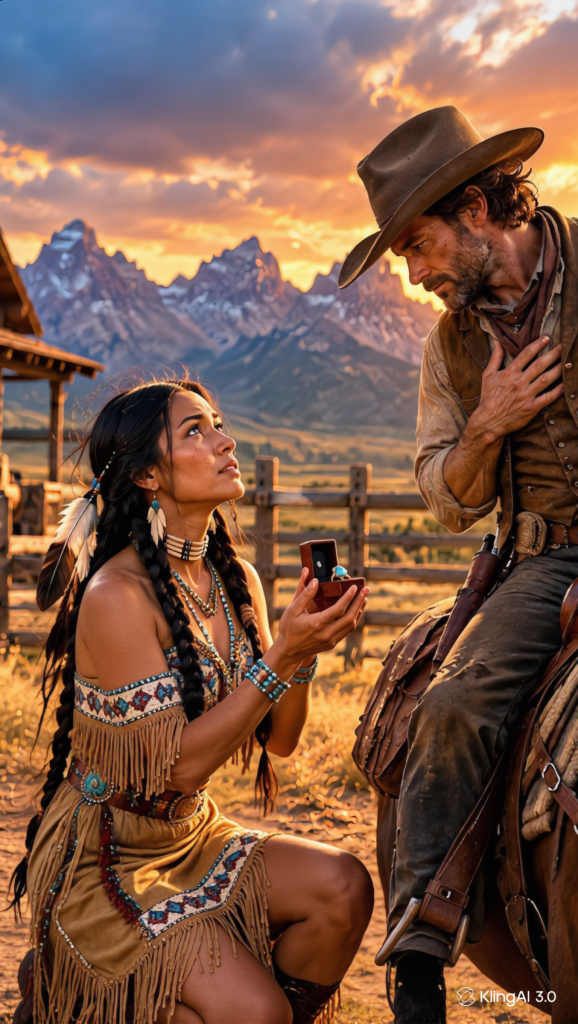
A woman stood on his porch in the last violet light of dusk.
She was Apache. He knew it at once from the cut of her buckskin dress beneath a wool trade blanket, from the high-topped moccasins worn nearly through at the toes, from the beaded cord that bound her black braid. Dust caked her to the knees. Her lips were cracked. In her hands she held a water gourd, and when she lifted it a little, as if in apology, he heard that it was empty.
She did not look away from him. Her eyes were dark and steady and very, very tired.
“One night,” she said. Her English was careful and clear. “That is all I ask. I will be gone before sunrise.”
Hollis looked at her for a long moment. He looked at the dust on her moccasins. At the scar across her knuckle. At the way she held herself perfectly straight, as if standing upright were the last possession she had left and she would not give it up.
He said nothing.
He simply stepped aside and held the door.
She hesitated only a heartbeat. Then she walked past him, so close he caught the scent of cedar smoke in her hair, and into the warm, low-ceilinged kitchen.
Hollis did not watch her go. He went back to the stove, lifted the lid from the blackened pot, and spooned beans onto a tin plate. Beside them he set a heel of bread, still soft from the morning’s bake. He crossed the room and put the plate on the table in front of her.
Then he nodded. Once.
Welcome.
That was all.
He did not ask where she had come from. He did not ask why a woman would walk alone through country where a woman alone, and an Apache woman especially, was in danger every mile. He pulled out the chair across from her, sat down, folded his arms, and turned his gaze to the window, to the wall, to the lamp. Anywhere but her.
She stared at the food. Then at him.
In her life, kindness had always arrived with a price tag still dangling from it. A trader fed you so he could cheat you at dawn. A soldier gave you a blanket so he could ask for your name and write it in a book. A man smiled at you and wanted something before the smile had even finished.
But this one was not even looking at her. As if he understood that being watched while you were starving was its own kind of shame.
She ate slowly at first. Then not slowly at all.
When the plate was clean, she set down the spoon and wiped her mouth with the back of her wrist.
“You are not going to ask me anything,” she said.
Hollis considered that. “Figure a body talks when they’re ready.”
He rose, poured water from the pitcher into a tin cup, set it in front of her, and sat down again.
Outside, the wind pushed against the shutters. The lamp threw his long shadow across the floorboards. The woman wrapped her fingers around the cup, and Hollis, though he still did not look at her, heard her let out a breath so long and slow it seemed to have been held for a hundred miles.
“Nelda,” she said at last. “My name is Nelda.”
“Hollis.”
“I know,” she said.
He looked at her then. Really looked. But her face gave him nothing, and she said no more that night.
She did not leave before sunrise.
When Hollis went out to the barn in the gray cold before dawn, he found her already there, standing in the doorway with the first pale light behind her and her chin lifted. Her blanket was folded neatly over her arm.
“I said I would go,” she told him. “But I would rather earn my place than beg for it twice.”
He waited.
“Your east fence is down in three places. I saw it when I came in. Your water trough is cracked. Your gray mare favors her left hind, and no one has looked at that hoof in a week.” She drew a breath. “I can ride line and fix wire. I can doctor horses. I can muck stalls and split wood. Give me the loft to sleep in, and I will work as hard as any man you could hire. Harder.”
Hollis studied her. In the cold light, he could see now how thin she was beneath the blanket. How the bones of her wrists stood out.
“You’ll be cold up there,” he said.
“I have been colder.”
He reached into his vest pocket, took out a horseshoe nail, turned it once between his fingers, and set it on the workbench. An old habit. His father’s habit, when he was making up his mind.
“Blankets in the tack room. Take two,” he said. “East fence needs the most care. Start there.”
Some of the stiffness went out of her shoulders.
“You are not going to ask where I come from?”
“Not today.”
“Not ever?”
He shook his head. “A body’s past is their own. The work’s what I see.”
She nodded slowly, like someone handed a gift so unfamiliar she did not yet know how to hold it.
Hollis fetched the blankets himself and laid them over the ladder rail. Then he turned back to the horses, and Nelda climbed to the loft, and neither of them said another word.
But the barn felt warmer than it had in years.
She worked like a woman possessed.
By the end of the first week, the east fence stood straight and tight. By the end of the second, the gray mare walked sound, her hoof packed with a poultice Nelda made from creosote leaves and clay. She rose before Hollis did. She rode the line until dark. She ate what he put in front of her, said thank you every single time, and climbed back to her loft every night without complaint.
Hollis’s widowed sister, Josephine, who lived in the little cabin by the creek and came up each morning to help with the cooking, watched the two of them with narrowed, thoughtful eyes.
“She doesn’t talk much,” Josephine observed one morning, kneading dough.
“Neither do I.”
“That’s what worries me.” Josephine smiled faintly. “Two silent people on one ranch. The coyotes’ll start thinking the place is abandoned.”
Hollis did not answer. But that evening, for the first time, he set a second plate on the table and called up to the loft, and Nelda came down and ate with them.
Word travels fast in a town like Dry Wash.
It reached the mercantile before Hollis did.
When he walked in that Saturday with dust on his boots and a short list in his hand, the room went quiet. Every head turned. Then the talk started up again, low and sharp, like wasps behind a wall.
“Flour,” Hollis told the clerk. “And coffee. And a tin of salve, if you’ve got it.”
Behind him, a voice drawled, “Buying medicine for your squaw, Weller?”
Hollis did not turn around.
The voice belonged to Cole Brandt. Everyone in Dry Wash knew it. Brandt owned the biggest spread in the valley, and over the last five years he had been swallowing the small ranches around him one by one, the way a drought swallows creeks. Drought had helped him, too. The springs had failed on half the land north of town. Brandt’s cattle drank from wells and stock tanks and whatever water he could buy.
And for three years running, he had tried to buy Hollis Weller’s south pasture, where Sabino Creek ran clear and cold year-round and never once went dry.
“Folks are talking, Hollis,” said a woman by the pickle barrel, Mrs. Tate, the banker’s wife. Her voice was almost kind, which somehow made it worse. “You remember the trouble in seventy-eight. That raid on the Hardesty place. It always lands on the man who opened his door.”
Hollis set his coins on the counter one by one, slow and steady.
“She has a name,” he said.
“That’s not the point,” said Mrs. Tate.
“It’s the only point I care about.”
Somebody at the back laughed, uneasy, and stopped.
Brandt stepped closer. He was a big man, broad as a door, with a silver watch chain across his vest and pale eyes that never quite blinked enough.
“Let me give you some neighborly advice,” he said quietly. “There’s soldiers out of Fort Grant hunting stragglers from the San Carlos breakout. Women included. They’re paying for information, Hollis. Good money. Now, I’d hate for anybody to think you were harboring a fugitive. A man could lose his land that way. Lose everything.”
The clerk, a young woman named Ruth, wrapped the flour in brown paper with fingers that trembled.
Hollis finally turned. He looked at Brandt for a long moment, and something in his face made the bigger man shift his weight.
“You want my south pasture, Cole,” Hollis said. “You’ve wanted it three years. You’ll want it till you die. And you won’t get it. Not by money, and not by scaring a woman who never did you any harm.”
He took the parcel from Ruth. Their eyes met.
“She’s lucky,” Ruth whispered, so only he could hear.
Hollis shook his head once. “No, ma’am. I reckon I’m the lucky one.”
He walked out into the sun. The bell over the door rang behind him.
And through the window, Ruth watched Cole Brandt’s pale eyes follow him all the way down the street.
Hollis came home that evening with his jaw set like iron and his right hand wrapped in a dirty rag. A rope had run through it while he was snubbing a green colt two days earlier, and he had not bothered to tend it.
Nelda saw it before Josephine did. She crossed the kitchen without a word, took his wrist in both hands, and turned the palm up. The rope burn ran red and raw across it, blistered and angry.
“Sit,” she said.
He sat. The way he did everything: slowly, as if sitting cost him something.
She took down a clay jar from the shelf. A salve she’d made weeks ago from prickly pear and beeswax. She worked it into his palm with her thumbs, patient and unhurried, like she was mending a fence post.
He watched her hands the whole time.
“Where’d you learn that?” he asked.
“My grandmother. She said a burned hand remembers. So give it something good to remember.”
A pause. Then Hollis said, gravely, “Mine remembers mostly rope and cussing.”
And Nelda laughed.
It burst out of her sudden and startled, like a quail flushed from a bush. Josephine, at the sink, nearly dropped the plate she was drying. In two weeks, she had never heard Nelda laugh. She had not heard anyone laugh in this kitchen in seven years.
Hollis blinked. And then, slowly, a smile broke across his weathered face, the first real one Josephine had seen there since the fever took his wife.
“Good,” Nelda said, still smiling, her hands warm around his. “Laughter heals the hand too. Same medicine.”
He did not pull away.
The fire started a little after midnight.
Hollis woke to the horses screaming.
He was on his feet before he was awake, stumbling to the window. Orange light leaped and twisted beyond the glass. The haystack beside the barn was a pillar of flame, and the wind, that cold, hungry October wind, was driving sparks straight onto the barn roof.
The loft.
He was out the door barefoot, shouting her name.
The barn doors were already open. Smoke poured from them in black, rolling waves. And out of that smoke, coughing, eyes streaming, came Nelda, leading the gray mare by its halter, with two more horses crowding at her heels. She slapped them toward the corral and turned straight back into the smoke.
“Nelda!”
She did not stop. Hollis plunged in after her.
Inside, the heat was a living thing. Burning straw drifted down from the loft like falling stars. He found her at the last stall, fighting the latch, the old sorrel gelding inside rearing and shrieking. Together they wrenched the door open. Hollis threw his shirt over the horse’s eyes, and they ran.
They stumbled into the yard just as a section of the loft collapsed behind them in a roar of sparks.
Josephine was already at the pump, filling buckets. For two hours, the three of them fought the fire with water and wet blankets and shovels of earth. By the time the stars began to pale, the haystack was a smoking black ruin and one corner of the barn was gone. But the barn still stood. And every horse was alive.
Hollis sank down against the corral fence, his face streaked black, his lungs burning.
Nelda knelt beside him. Her hands were blistered. Her dress was scorched. In her arms she clutched something small and square, wrapped in her singed blanket. She had carried it out of the loft through the fire.
“Was the stack lightning?” Josephine asked hoarsely. “There wasn’t any storm.”
Hollis looked at the ground near the ruined haystack. In the gray light, he could see them clearly: hoofprints. Shod hooves. Two riders, maybe three. Leading away north.
Toward the Brandt range.
He said nothing. But his jaw went tight as wire.
Nelda had seen the tracks too. She looked at them for a long time. Then she looked at Hollis, and something in her face changed. The careful stillness she had worn like armor since the night she arrived cracked open, and what lay beneath it was grief, and guilt, and a terrible decision being made.
“This happened because of me,” she said quietly.
“It happened because Cole Brandt is a snake.”
“It happened because I am here.” She drew a long, shaking breath. “And because I have not told you the truth.”
She unwrapped the blanket. Inside lay a small cedar box, its wood worn smooth and dark with age, scorched now along one edge.
“I told you I would earn my place,” she said. “But I did not come to your door by chance, Hollis Weller. Out of every ranch in this territory, I walked a hundred miles to yours. I have been watching you since the day I arrived. Testing you.”
Hollis stared at her.
“Testing me for what?”
She set her hand on the lid of the cedar box. Her fingers were trembling.
“Thirty years ago,” she said, “your father made a promise to my grandmother. A promise sealed in blood and water on the bank of that creek.” She lifted her eyes to his, and in the dawn light they burned. “And at sunrise, seven riders of my people will come over that ridge to see whether his son will keep it.”
PART 2: What the Cedar Box Held
For a long moment, the only sound was the hiss of steam rising from the wet ashes.
Josephine set down her bucket very slowly.
Hollis did not move. He sat against the corral fence, his chest rising and falling, staring at the woman kneeling before him as if she had turned into a stranger.
“My father,” he said at last. His voice came out rough, scorched by smoke. “You knew my father.”
“No. My grandmother did.” Nelda looked toward the eastern sky. A thin line of rose was creeping along the ridge. “There isn’t much time. Let me show you.”
She opened the cedar box.
The smell rose up first: smoke, old rain, and something sweet and faint, like dried sage. Inside lay a folded strip of soft buckskin. Nelda lifted it out with both hands, the way a priest lifts a holy thing, and unfolded it across her knees.
On the buckskin was a drawing in charcoal, faded but still clear. A creek bending in a long, lazy curve. A stand of cottonwoods on its southern bank. A flat rock jutting into the water, shaped like the prow of a boat. And beyond it, on a low rise, a single tall saguaro with three arms, one pointing up and two pointing down.
Josephine, who had come to stand behind them, drew in a sharp breath.
Hollis’s jaw went perfectly still.
“That’s my south pasture,” he said quietly. “That’s Boat Rock. And the old Three-Arm saguaro. Pa used to say it was older than the territory.”
“Yes,” Nelda said. Her eyes were shining.
“How —”
“Listen.” She laid her blistered hand flat on the buckskin. “Thirty-one years ago, my grandmother was sixteen years old. Her band was running. The soldiers had burned their camp in the Dragoons, and they fled north with nothing. Old people. Children. My grandmother’s baby brother. It was the summer of the great drought. Every spring they knew had gone dry. Every waterhole. They walked for six days without water. The old ones began to die.”
Her voice stayed steady, but her fingers tightened on the leather.
“On the seventh day, they came over that ridge,” she nodded toward the east, where the light was growing, “and they saw the cottonwoods. They knew what green trees meant. But they also saw a white man’s cabin, and white men meant soldiers, and soldiers meant death. So they hid in the rocks, and they watched the water they could not reach, and they waited to die within sight of it.”
Hollis was listening now with his whole body.
“A man came out of that cabin,” Nelda said. “A young man, with red hair and a crooked nose.”
“Pa broke it twice,” Hollis murmured. “Once on a bronc and once on a man who kicked a dog.”
A faint smile touched Nelda’s lips. “He saw them in the rocks. My grandmother said he stood there a long time. Then he walked back into the cabin. They were sure he had gone for his rifle. But when he came out again, he was carrying two buckets. He filled them at the creek, and he walked up into the rocks alone, unarmed, and set them down in front of the people who had every reason to kill him. Then he went back and filled them again. And again. All afternoon.”
Josephine pressed a hand to her mouth.
“He let them camp on that creek for eleven days,” Nelda said. “He butchered one of his own steers to feed them. When a cavalry patrol rode through, he told them he had seen no Apache, and he sent them south. He lied to soldiers for people he did not know. If they had found out, they would have hanged him.”
Hollis’s eyes had gone bright and wet. He did not try to hide it.
“He never told us,” he said hoarsely. “Not one word. Not in thirty years.”
“No,” Nelda said gently. “He promised he wouldn’t. That was part of it.”
“Part of what?”
Nelda turned the buckskin over.
On the other side, in a different hand, a careful, laborious white man’s hand written in faded iron-gall ink, were words. Hollis leaned forward. He knew that handwriting. He had seen it on every ledger and bill of sale in his father’s desk for twenty years.
On this day, July 9th, 1855, I, Thomas Weller, swear before God and the people of Grandmother Itsa that the water of this creek shall never be denied to them or to their children. So long as a Weller holds this land, any of their blood who comes in need shall find water, food, and safe harbor here, no questions asked. And should the day come when any of them has nowhere else to go, this land shall be their refuge, as it was mine.
— T. W.
Beneath the words was a smear of something rust-brown, old and dark.
“Blood,” Nelda said quietly. “His and hers. Mixed with water from that creek. The way my people seal a promise that cannot be broken.”
Hollis read it twice. Three times. Then he set his blackened, salve-smeared hand flat against the buckskin and bowed his head over it, and his broad shoulders began to shake.
Josephine knelt beside him and put her arm around him. She was weeping openly.
“He used to sit on Boat Rock every summer,” she whispered. “Every July. Just sit there all day, watching the ridge. We thought he was crazy. Mama used to say he was waiting for someone.”
“He was,” Nelda said.
Hollis lifted his head. His face was a ruin of soot and tears.
“Why didn’t they ever come back?”
“They did, at first. A few times. Then the reservations came. San Carlos. The fences. The soldiers counting heads every morning. My people could not leave without being hunted.” Nelda’s voice softened. “My grandmother kept this buckskin for thirty years. She said that somewhere in the world there was a place where kindness lived, and she drew it so I would know it if I ever saw it. Before she died last winter, she pressed this into my hands. She said, ‘Nelda, if the world turns hard, go there. Go to the man who keeps it.’”
“But Pa’s gone,” Hollis said. “Eleven years.”
“I know. I learned that when I reached Dry Wash.” She looked down at the buckskin. “I almost turned back. A promise made by a dead man is only words. I did not know if his son was the same kind of man. Or the kind of man who would sell me to the soldiers for twenty dollars.”
“So you came to my door and asked for one night,” Hollis said slowly. “And you watched.”
“I watched,” she admitted. “I watched you feed a stranger without asking her name. I watched you give me the loft and two blankets. I heard from the young woman at the store what you said to Brandt.” Her voice caught. “And last night, I watched you run barefoot into a burning barn after a woman you have known for two weeks.”
She folded the buckskin with great care.
“My grandmother told me that the promise lives only as long as there is someone to keep it. She said I must see it with my own eyes before I let my people trust it again.”
“Your people,” Hollis said. “The seven riders.”
Nelda’s face grew grave.
“There was a breakout at San Carlos two months ago. Forty people fled into the mountains. Some were caught. Some were killed. My father and his riders have been hiding in the Galiuros with the women and children who survived. The soldiers are closing in. They are running out of food. And there is no water left in those mountains. The drought has taken it all.” She lifted her eyes. “When I left, my father said: ‘Go find this place your grandmother dreamed of. If the promise still lives, send us a sign. If it doesn’t, we will die where we are.’”
“What sign?”
Nelda pointed toward the barn. On the ridgepole, still standing above the smoke-blackened gable, someone had tied a strip of red cloth. It snapped and fluttered in the dawn wind.
“I tied that yesterday morning,” she said. “Before the fire. I had already decided.”
Hollis stared at the red cloth. He understood now. Every cold dawn she had risen before him, every fence she had mended, every horse she had doctored, she had been weighing him. Measuring whether his heart was big enough to hold forty starving people the whole territory wanted dead.
And she had decided it was.
“When they come,” Nelda said, “you must understand what you are choosing. If you shelter them, Brandt will bring the soldiers. You could lose this ranch. You could lose your life. No one will think less of you if you say no. Not even me.” Her voice cracked for the first time. “The promise was your father’s. Not yours.”
Hollis rose to his feet slowly. Josephine rose with him.
He looked down at Nelda for a long moment. Then he held out his blistered, salve-slick hand.
“Pa used to say a promise doesn’t die with the man who made it,” he said. “It just waits for somebody to pick it up.”
Nelda took his hand. He pulled her to her feet.
And at that moment, Josephine cried out and pointed.
On the eastern ridge, black against the burning gold of sunrise, seven riders had appeared. They sat their horses motionless, as if they had grown out of the rock itself. Their silence was worse than any war cry.
But they were not the only ones coming.
Down the north road, a column of dust was rising. Hollis shaded his eyes. A dozen horsemen, riding hard. At their head, broad as a door, rode Cole Brandt. And beside him, sunlight flashing on brass buttons and a saber hilt, rode a lieutenant of the United States Cavalry, followed by six blue-coated troopers with carbines across their saddles.
Josephine’s hand closed on Hollis’s arm.
“Hollis,” she breathed. “Dear God.”
Nelda went very still. On the ridge, the eldest of the seven riders slowly raised one hand.
Between them lay the ranch, the burned barn, the creek, and one silent man who had just picked up his father’s promise.
Hollis let go of Nelda’s hand. He did not reach for the rifle leaning beside the door.
Instead, he walked out to the gate and stood there, alone, with his empty hands at his sides.
PART 3: Where Kindness Lives
The troopers reached the gate first.
Brandt reined up hard, dust boiling around his horse’s legs. His pale eyes went to the burned barn, then to Nelda, then to the riders on the ridge, and a slow, satisfied smile spread across his face.
“Well, now,” he said. “Would you look at that, Lieutenant. Just like I told you. He’s got a whole nest of ’em.”
The lieutenant was young, perhaps twenty-five, with a sunburned nose and tired eyes. He looked at Hollis, then up at the ridge, and his hand moved toward his holster.
“Mr. Weller,” he said. “I have orders to detain any fugitives from San Carlos. Mr. Brandt informs me you are harboring them.”
“Mr. Brandt burned my haystack last night,” Hollis said quietly. “His riders’ tracks are still in the ash, if you care to look.”
Brandt’s smile flickered. “That’s a lie.”
“Then you won’t mind the lieutenant comparing those tracks to your horses’ shoes.”
The lieutenant glanced at Brandt. Something shifted in his tired eyes.
“Step aside, Mr. Weller,” he said, more carefully now.
Hollis did not move.
“Lieutenant,” he said, “my father settled this land in eighteen and fifty-three. Two years later, he gave his word to a band of starving people that this creek would never be denied them. He sealed it in blood. He kept that promise until the day he died, and he never told a living soul, not even his own children, because keeping it quiet was part of keeping it.” He drew a breath. “Those folks on that ridge are the grandchildren of the people he swore to. They are hungry. They’ve got children. They have not raided anyone. They are dying of thirst in the Galiuros, and they came here because a dead man told them they could.”
The lieutenant’s jaw worked. “The law —”
“The law says I can water whoever I please on my own land. And it says a man can’t be hanged for feeding children.” Hollis’s voice did not rise. It never did. But every man at that gate heard every word. “You want to take them, son, you’ll have to go through me. And I’m not armed. So you’ll have to decide what kind of soldier you are.”
The wind snapped the red cloth on the barn’s ridgepole.
For a long, terrible moment, no one moved.
Then Nelda walked forward and stood at Hollis’s side. Josephine followed, wiping her hands on her apron, and stood at his other side.
And on the ridge, the old man with the raised hand slowly lowered it, swung down from his horse, and began to walk down the hillside, alone and unarmed, the way Thomas Weller had once walked up into the rocks carrying two buckets of water.
The lieutenant watched him come. Watched a white-haired man in a ragged blanket walk straight toward a dozen guns with nothing in his hands at all.
He took his hand off his holster.
“Sergeant,” he said, without turning his head. “Mr. Weller says there were shod tracks by that haystack. Go examine them. Then examine Mr. Brandt’s horses.”
Brandt went red to the roots of his hair. “Now see here —”
“And I’ll be noting in my report,” the lieutenant continued, “that a band of peaceable Apache came to a private ranch for water under the protection of the landowner, and that I saw no evidence of hostile intent.” He looked at Hollis for a long moment. “I’ll also be noting that the reservation agent at San Carlos has been withholding rations for three months. It’ll go up the chain. It may do some good. It may not.”
“Thank you, Lieutenant,” Hollis said quietly.
The young man touched his hat brim. “My grandfather crossed the plains in forty-nine, Mr. Weller. Would’ve died at the Humboldt Sink if a Paiute hadn’t shown him where the water was.” He turned his horse. “Some debts get passed down.”
The sergeant found the tracks. They matched the shoes on Brandt’s foreman’s horse, down to a cracked heel calk. Brandt rode away that morning under escort, cursing, and within a year he had sold out and gone back to Texas. The south pasture was never mentioned again.
The old man reached the gate as the soldiers rode off.
He was Nelda’s father. His name was Dasgoya, and his eyes were like flint, and his face was carved by seventy winters. He looked at Hollis for a long time without speaking. Then he spoke low and quick to Nelda in their own tongue.
“He asks,” Nelda said softly, “if you have your father’s face.”
“They say I’ve got his nose,” Hollis said. “But I never broke it.”
Nelda translated. And the old man laughed, a short, rusty bark, and reached out and gripped Hollis’s forearm the way warriors grip one another.
That afternoon, thirty-eight people came down out of the Galiuros and camped along Sabino Creek under the gold cottonwoods, just as their grandmothers had thirty-one years before. Hollis butchered two steers. Josephine baked bread until the flour ran out, then rode to town and came back with more, paid for with her own savings. Ruth from the mercantile drove out a wagon of blankets and would not take a cent.
They stayed eleven days. Exactly eleven. Nelda said it was not an accident.
On the twelfth morning, the lieutenant’s report had done its work: an army escort arrived, not to drag them back in chains, but to bring them to a new agency in the White Mountains, where there was water and land and rations promised under a new agent’s signature. Whether those promises would hold, no one knew. But it was more than they had had.
Dasgoya stood at the gate before he mounted. He spoke to Nelda for a long time, his gnarled hand on her shoulder.
Hollis waited by the barn, his heart hammering so loudly he half believed the whole valley could hear it. He had told himself a hundred times he had no claim on her. She had come with nothing. She could leave the same way.
Then Nelda turned.
She did not walk toward the horses.
She walked toward him.
That night, with the creek bank empty and the last cookfires burned down to red seeds, they stood together in the yard under the cold, enormous stars. The air smelled of cedar and frost.
“He wanted me to come with them,” Nelda said. “He said a woman should be with her people.”
“I know,” Hollis said. “I’d never make you stay.”
“I told him I was raised free, and a free woman chooses her own people.” Her thumb moved slowly across his scarred knuckles, as if reading something written there. “I told him my grandmother sent me to find the place where kindness lives. And I found it. It isn’t the creek, Hollis. It isn’t the land.” She looked up at him. “It’s you.”
Something in his face loosened, the way a gate swings open when the latch finally gives.
“There’s a table inside,” he said. “Two chairs. Been two chairs a long while. Only ever one of ’em used.”
“Then we fix that tonight,” Nelda said.
They were married in the spring, under the Three-Arm saguaro on the low rise above Boat Rock. Josephine wept through the whole thing. Ruth from the mercantile brought a cake. Even the preacher came, though he looked nervous about it.
Every July after that, on the ninth day of the month, Hollis and Nelda walked down to the creek and sat on Boat Rock together, watching the ridge. Sometimes no one came. Sometimes a rider or two appeared, thin and dusty, and walked down to the water, and found it waiting for them, with food and safe harbor, and no questions asked.
Years later, when their own children asked what the faded buckskin in the cedar box meant, Hollis would take it down from the mantel and unfold it gently on the kitchen table, between the two chairs that were never empty anymore.
“It’s a map,” he would tell them. “Your great-grandmother drew it so somebody would know the way.”
“The way to where, Pa?”
And Nelda, smiling across the table at the silent man who had held a door open for a stranger one cold October dusk, would answer for him.
“To the place where kindness lives,” she’d say. “And now it’s your turn to keep it.”
Sometimes a single act of mercy outlives the person who gave it. Thomas Weller carried two buckets of water up a hill thirty years before his son ever met Nelda, and that quiet kindness crossed a generation to find its way home. We never know who is watching, or what our small decencies will become. Keep the gate open. Keep the water flowing. Someone may be walking a hundred miles to find you.