PART ONE: The Woman at the Edge of the Pasture
The silence was wrong.
Jesse Holloway had lived on this land for thirty-eight years, and he had learned its sounds the way a man learns the breathing of someone he loves. He knew the lazy complaint of cattle settling for evening, the creak of the windmill turning into the wind, the particular snort his gelding gave when a rattlesnake was near. He could tell, from the kitchen with his eyes closed, whether the herd was grazing or spooked.
That evening, with the sun bleeding out behind the western hills, there was no sound at all.
He reined in Rook at the weathered fence line and listened. The horse shifted beneath him, uneasy, head high, nostrils flaring toward the north pasture.
“What is it, boy?” Jesse murmured. “What do you see?”
Then he saw it too.
A section of the old fence had collapsed, three rotten posts and forty feet of wire lying flat in the dust. Beyond it, a ragged line of cattle was drifting toward the western ridge, where the old cottonwoods leaned out over the arroyo. Eleven weeks without rain had dried that ground to powder. Jesse had been meaning to ride out and look at it for a month. He had not found the time. He had not found the time for a great many things since his father died.
He put his heels to Rook and went after them at a hard lope.
“Hup! Easy, now! Come on, you fools, come on back!”
The cattle ignored him with the serene stupidity of their kind. He swung down, waving his hat, cutting the leaders off, pushing them back toward the break in the fence. Six turned. Eight. But the last dozen kept wandering toward the ridge, lured by a scrap of green clinging to the base of the cottonwoods, and Jesse was one man on foot with the light failing fast.
He was running to head them off when a whistle split the dusk behind him: sharp, piercing, two notes.
He spun around.
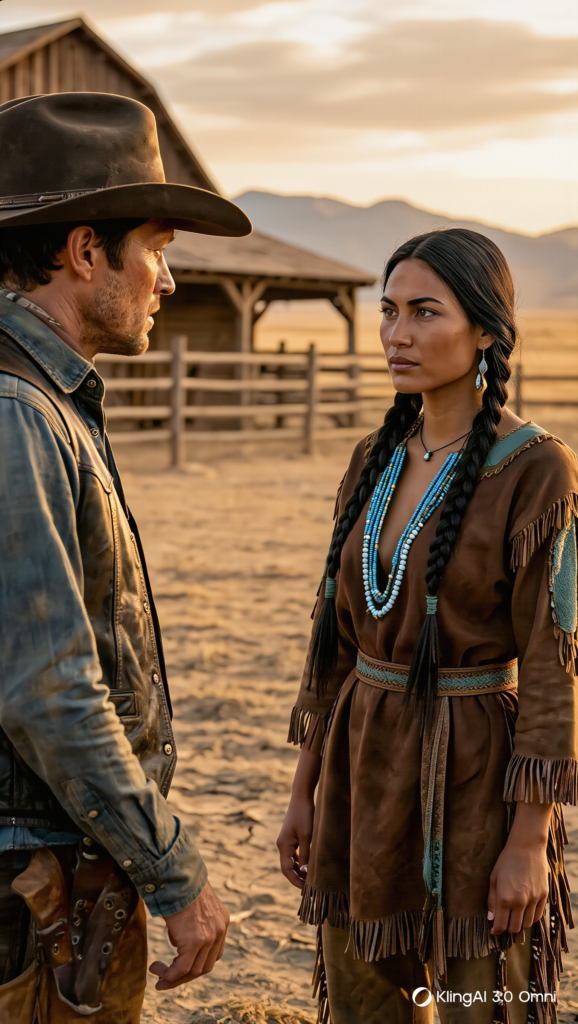
A young woman stood at the edge of the pasture, not fifty yards away, where a moment before there had been nothing but sage. She was Apache, perhaps twenty-five, her black hair bound back with a strip of red cloth, a woven pouch across her shoulder. She wore a faded calico skirt over leggings, and dust to the knee. What struck Jesse most, in that frantic moment, was her stillness. In the middle of all that bawling chaos she stood as calm as a fence post.
She raised one arm and pointed at the ridge.
“Not that way!” she called. “The ground is giving out under the cottonwoods!”
Jesse stared at the ridge. From where he stood it looked like any other slope: dry, gray, ordinary.
“How do you know?”
“Look at the trees.” Her voice was steady. “Look how they lean.”
He looked. And the hair rose on the back of his neck. The two big cottonwoods weren’t leaning out over the arroyo the way they always had. They were leaning further. Much further. At their base, a pale crack ran through the earth like a seam in old leather, and he could see dust trickling from its lip in thin, silent streams.
The whole bank was coming down.
“There’s a safer path along the creek bed,” she said, already moving to the far side of the herd. “Move them slow. They will follow the water smell. Don’t push.”
He didn’t stop to argue. He did exactly what she said.
Together they eased the herd away from the ridge, Jesse on one flank and the stranger on the other, never shouting, never rushing, just walking, walking, a slow tide of brown and white bodies drifting toward the dry creek and down its gentle bed toward the main pasture. Once a young steer broke and bolted back toward the cottonwoods. The woman was in front of him before Jesse saw her move, arms wide, voice low, and the steer turned as if she had simply asked it to.
They were three hundred yards clear when the ridge fell.
It went with a sound like a giant clearing its throat, a deep, rolling whumpf that Jesse felt through his boot soles. The two cottonwoods tilted, hung for a moment against the red sky, and then slid out of sight in a boiling cloud of dust. Tons of earth poured into the arroyo. When the dust finally drifted away on the evening wind, there was simply nothing there: a raw, fresh cliff where the slope had been, and a forty-foot drop to the rocks below.
Every one of those twelve cattle would have gone with it. And Jesse, chasing them on foot, would very likely have gone too.
He stood for a long moment, breathing hard. Then he turned to look at the woman.
She was watching the place where the trees had been. And on her face was not relief, not triumph, but something he did not expect at all.
Grief.
“You knew that ground was going,” Jesse said, when the cattle were safely penned and the light was nearly gone.
“I have walked these hills many times.”
“Not on my land, you haven’t. I’d have seen you.”
The corner of her mouth moved. “You would think so.”
He let that pass. “What’s your name?”
She hesitated, as though weighing whether to give it. “Tsaya.”
“Jesse Holloway.”
“I know.”
That stopped him cold. “You know me?”
“I know your ranch.” She looked past him toward the house: the long, low adobe his father had built with his own hands in 1851, the barn with its sagging roofline, the windmill turning slow against the first stars. “I know this place.”
He studied her in the twilight. No fear in her face. No calculation. Just that sadness, resting behind her eyes like water behind a dam.
“You should look at the north fence before dark,” she said. “There’s another weak section past the second gate. Higher up. The posts are split at the ground.”
“Wait.” He took a step after her as she turned. “You just saved me a hundred head and maybe my neck besides. Why?”
Tsaya looked toward the house for a long moment.
“Because it is your home,” she said.
It was such a simple answer that he did not know what to do with it. Few people understood what this place meant to him. His father, Ward Holloway, had come out from Tennessee with nothing but a wagon and a stubbornness that bordered on religion. He had dug the well, laid every adobe brick, planted the cottonwoods by the house that were now as thick as a man’s waist. He had died last winter in the chair by the window, looking out at the land, and his last words to Jesse had been strange ones: Don’t let them have the water, son. It was never ours to sell.
Jesse had thought it was the fever talking.
When he looked up, Tsaya was already walking away toward the trees along the creek.
“Where are you going?”
She paused but did not turn. “Wherever the road goes.”
And then the darkness took her, as cleanly as if she had never been there at all.
He checked the north fence by lantern light. Past the second gate, exactly where she’d said, four posts were split clean through at the base. One good push from a steer and the whole section would have gone.
Jesse sat on the tailgate of the wagon for a long time afterward, looking at the dark hills.
How did she know?
He found the pouch two days later, lying beside the creek trail where it bent toward the old cottonwood grove: a small bag of woven yucca, frayed at the strap. He recognized it at once. Inside, wrapped in a scrap of red cloth, was a pendant of carved juniper wood, worn smooth by years of handling, shaped like a spiral with a single line running through its center.
He followed the creek upstream until he found her.
She had made a camp in a hollow among the cottonwoods, a lean-to of branches and old canvas so cleverly built into the bank that he nearly rode past it. She was on her knees patching the roof when she heard Rook’s hooves, and she came up fast, one hand going to the knife at her belt.
Then she saw who it was, and the hand dropped.
“You came back,” she said.
He held out the pouch.
Something broke open in her face. She took it from him carefully, with both hands, and pressed it against her chest, and for a moment she closed her eyes.
“My mother gave me this,” she said quietly. “Before she died.”
“Figured it mattered.”
“It does.”
He might have asked a dozen questions. He wanted to. But he had been raised by a man who believed you did not pry a door open that someone was still holding shut. Instead he nodded at the cold fire ring.
“You eaten today?”
She looked surprised. “Not yet.”
He untied a bundle from his saddle: cold biscuits, a slab of salt pork, two apples from the tree his father had planted. “Then you should.”
They sat beneath the cottonwoods with the creek murmuring beside them, and for the first time they talked without anything chasing them. He told her about his father: how Ward Holloway used to say that a man didn’t own land so much as borrow it from his grandchildren; how he’d walk the fence line every Sunday instead of going to church, saying the hills were the only sermon he trusted. Tsaya listened without interrupting, and once, she smiled.
“My grandmother said something like that,” she said. “People live because they help each other. The land lives because people remember it.”
“Your family’s from around here?”
Her face closed like a hand. “Some of them were.”
He let it go. But a few minutes later she asked about the ranch, and he found himself telling her the truth: that it had been a hard two years. That feed cost more every season and the cattle market was falling. That a man named Augustus Thorne had come out from Prescott four times in the last year with an offer for the whole place, each time higher than the last, higher than any honest man would pay for dry grazing land in a drought.
“And you refused,” Tsaya said. It was not a question.
“It’s my father’s house.”
She was quiet for a long time. Then: “That is why he will not stop.”
Jesse looked at her. “What do you mean?”
She turned toward the north, toward the hills that rose above his boundary like the backs of sleeping animals.
“I saw men at your north line,” she said. “Before I came to your pasture. Three of them. They were digging.”
“Digging?” Jesse’s voice went hard. “When?”
“Six days ago. Maybe seven.”
“Why didn’t you tell me?”
“I did not know what they wanted.” She stood, brushing off her skirt, and looked down at him with those grieving eyes. “Now I think I do. You should be careful, Jesse Holloway. Very careful.”
And before he could ask what she meant, she walked into the trees.
Augustus Thorne came on the fourth morning.
He arrived in a black buggy with red wheels, driven by a hired man, with two outriders on gray horses trailing behind. Thorne himself was a soft, pale, beautifully dressed man of fifty, with a silver-headed cane and a smile he took on and off like a pair of spectacles.
“Holloway,” he said warmly, climbing down. “Fine morning.”
“My answer’s still no, Mr. Thorne.”
“I haven’t asked anything yet.” The smile widened. “But since you raise it, I’m prepared to go to six thousand. Six thousand dollars, Holloway. For a drought ranch with a falling herd and a barn that looks like a strong wind would finish it. You could go to California. Start over. Live like a gentleman.”
“I’m not a gentleman. I’m a cattleman.”
Thorne’s eyes drifted north, toward the hills. “Land changes, Holloway. Sometimes the ground just gives way beneath a man’s feet. I hear you nearly lost a few head the other evening.”
Jesse went very still.
“I didn’t tell anyone about that,” he said.
“Small country. People talk.” Thorne climbed back into his buggy and settled the cane across his knees. “Think it over. I’d hate for you to wait until the offer is a good deal smaller than six thousand. Or until there’s nothing left to make an offer on.”
He tipped his hat, and the red wheels rolled away down the lane.
That night, Jesse rode to the cottonwood grove and told Tsaya everything.
When he said the name Augustus Thorne, she flinched as though he had struck her.
“You know him.”
“I know what he is.” She stared into the small fire. “Your land is worth much more than you know, Jesse. Not the grass. Not the cattle. What is under it.”
“Gold?” He almost laughed.
“Water.”
She told him then, in pieces. Generations ago, before the soldiers, before the first wagons, her people had known of a great hidden water beneath the valley: a deep spring that fed underground channels running beneath the dry hills, rising to the surface in a dozen small seeps and wells across fifty miles of country. In the worst droughts, when every creek ran dry, those wells still held. Every ranch in the lower valley drank from them. So did the town. So did the Apache families still living quietly in the canyons above.
“Whoever owns the land above the spring,” Tsaya said, “can try to own the water. And whoever owns the water owns this whole valley.”
Jesse sat back slowly.
The offers that were too high. The strange riders. Men digging at his north line. The ridge that had collapsed after eleven dry weeks, right where those men had been working.
Sometimes the ground just gives way beneath a man’s feet.
“My father,” he said slowly. “Before he died. He told me not to let them have the water. He said it was never ours to sell.”
Tsaya looked up sharply.
“There is a stone,” she said. “Near the western ridge. My grandmother spoke of it. It marks the old water road.”
They found it the next morning, after three hours of searching: a line of half-buried stones in a shallow draw below the ridge, and on the largest, almost erased by wind and time, a carved spiral with a single line running through its center.
The same shape as the pendant around Tsaya’s neck.
And Jesse had seen it once before. In his father’s handwriting.
They tore the house apart looking for it. At last, beneath a false bottom in his father’s old pine trunk, Jesse found a bundle of yellowed papers tied with string. On the top sheet, in his father’s careful hand, was that same spiral. Beneath it, a document: An Agreement Concerning the Waters of the Verde Valley, dated 1852, between the first settlers of the valley and the families who already lived there. Its terms were plain. The water beneath the valley could never be owned or closed by any single landholder. It must remain open forever to all who depended on it.
At the bottom were signatures. Ward Holloway. Two other settlers. And beside them, a mark: the carved spiral, drawn in ink, and a name written beneath it in a clerk’s hand.
Dah-Ana, for her people.
Tsaya made a small sound, as though the breath had been knocked out of her.
But Jesse was looking at the trunk. At the papers. At the string.
The knot was wrong. He had watched his father tie that bundle a hundred times, and Ward Holloway had always tied a double square knot. This was a granny knot, loose and clumsy.
He counted the pages. The agreement referred to three schedules attached hereto. There were only two.
Someone had been in the house. Someone had known exactly where to look. And someone had taken the one page that mattered most.
Tsaya turned slowly toward the dark window.
“They know we found it,” she said.
That night Jesse sat on the porch with the rifle across his knees and the lamp out, listening to the dark.
Near midnight he saw it: a shape at the end of the lane, a man on a horse, motionless, watching the house. Jesse stood. The shape turned and melted into the night.
Then he smelled smoke.
He was off the porch and running before he understood it. Orange light was blooming behind the barn, licking up the old dry siding, and somewhere a horse was screaming. He threw open the stall doors and drove Rook and the mares out into the yard; he dragged the water barrel; he beat at the flames with a wet saddle blanket until his arms were dead and his lungs were full of ash. Tsaya was beside him. He never saw her arrive. She was simply there, hauling buckets from the trough with her skirt hitched up and her face black with soot. Together they fought it for an hour. Together they saved the barn by a hair.
When it was over, he sank down against the corral rails, coughing, and Tsaya sat beside him in the gray ash.
On the barn door, someone had nailed a sheet of paper.
Jesse pulled it down with shaking hands and read it by the light of the dying embers. It was a bill of sale. The Holloway Ranch and all water rights appurtenant thereto, sold to Augustus Thorne for the sum of four hundred dollars, dated 1859, signed Ward Holloway.
It was a perfect forgery of his father’s signature. And at the bottom, in fresh ink: Vacate within seven days. — A.T.
“He can’t,” Jesse whispered. “My father never sold anything. This land has been ours since 1851.”
Beside him, Tsaya was silent for so long that he turned to look at her.
She was crying. Silently, without moving, tears cutting clean lines through the soot on her cheeks.
“Tsaya?”
“It was never his to sell,” she said. “And it was never his to buy.”
“What are you saying?”
She looked at him in the light of the dying fire, and he saw at last what had been behind her eyes from the very first evening: not sadness, but something older and heavier, a thing she had carried across a very long road.
“Your father did not buy this land, Jesse,” she said. “My grandmother gave it to him.”
PART TWO: The Missing Page
For a long moment, the only sound was the soft hiss of the embers.
“That’s not possible,” Jesse said finally.
“Is it not?” Tsaya wiped her face with the back of her wrist. “Then tell me. Where is your father’s deed? Where is the paper that says who sold him this ground?”
He opened his mouth. And closed it.
Because he didn’t know. In thirty-eight years he had never seen one. He had simply assumed, the way a son assumes the sun will rise, that it was somewhere. In a bank in Prescott. In a drawer he’d never opened.
“Tell me,” he said quietly. “All of it.”
She told him on the porch, with the sky beginning to pale in the east and the smell of smoke still thick in the air.
In the summer of 1851, a young man from Tennessee had come into the valley with a broken wagon, a dying ox, and a wife sick with mountain fever. Ward Holloway was twenty-two. He did not know where the water was. He did not know anything. Within a week, the ox was dead and the wife was close behind it.
Dah-Ana found them.
She was Tsaya’s grandmother, a young widow then, a healer of her band. She brought the sick woman willow bark and the deep water from the spring. She showed Ward where to dig his well. When his wife recovered, Dah-Ana’s people taught them both which plants could be eaten, which hills flooded, which ground was rotten beneath the cottonwoods.
“And then,” Tsaya said, “the others came. More wagons. More settlers. And men like Thorne, who wanted to fence the springs and sell water by the barrel. My grandmother understood that her people could not hold the land against the soldiers. So she chose a man she trusted, and she gave him the land above the great spring. On one condition.”
“That the water stay open,” Jesse said slowly. “To everyone.”
“Forever.” Tsaya touched the spiral at her throat. “That is the mark of the spring. The line through it is the water road. Your father signed his name beside hers. He promised.”
Jesse sat very still.
He thought of his father walking the fence every Sunday instead of going to church. Of the windmill he’d built, not at the house, but out at the north pasture, where the creek-bottom families could reach it. Of the way Ward Holloway had never once turned away a thirsty traveler, white or Apache or Mexican, in forty years. Of the stranger he had sometimes found leaving the well at dawn, and how his father had only nodded and said, Let them be, son. They’ve got more right to it than we do.
Don’t let them have the water. It was never ours to sell.
“He kept it,” Jesse whispered. “All his life. He kept the promise.”
“Yes.”
“And Thorne knows.”
“Thorne knows. That is why he needs the third page.” Tsaya looked at him. “The third schedule names the spring and the water road and the families who hold rights to it. Without it, the agreement is only words. With it, no court in the territory could give Thorne the water, no matter how many signatures he forges.”
“So he stole it.”
“Or someone did, for him.”
Jesse stood up. The sky was pink now over the eastern hills, and in that cold dawn light the charred side of his barn looked like an open wound.
“Seven days,” he said.
They went to Prescott that same morning, Jesse on Rook and Tsaya on his father’s old bay mare, the surviving pages of the agreement wrapped in oilcloth inside Jesse’s coat.
The land office was a narrow brick building on Gurley Street. The clerk, a thin man named Pettibone with ink-stained cuffs and evasive eyes, examined the agreement for a long time without speaking.
“Most irregular,” he said at last. “There’s no record here of any water rights attaching to the Holloway parcel.”
“There’s a schedule missing,” Jesse said. “The third one. It would’ve been registered with the rest in 1852.”
Pettibone’s eyes flickered, very briefly, toward a back room.
“I’m afraid the territorial records from that period are incomplete,” he said. “Fire, you understand. In fifty-seven.” He slid the papers back across the counter. “And I must tell you, Mr. Holloway, that a Mr. Augustus Thorne filed a bill of sale on your property yesterday afternoon. It appears to be entirely in order.”
Jesse’s hand closed into a fist on the counter.
Tsaya laid her fingers lightly on his wrist. Just that. And the fist opened.
Outside on the boardwalk, he leaned against a post and stared at the street. Wagons. Dust. A dog sleeping in the sun. The ordinary world going on, unaware that it was ending.
“He’s bought the clerk,” Jesse said.
“Yes.”
“And the territorial records burned.”
Tsaya was looking past him, up the hill, toward the courthouse.
“Paper burns,” she said. “But my grandmother did not trust paper.”
He turned. “What do you mean?”
“She made two copies of the agreement. One for the white men’s office. One for her people.” Tsaya’s hand rose to the spiral pendant. “My mother told me where she put it. But I have never seen it. I did not know if it was still there.”
“Where?”
Tsaya looked north, toward the hills above the Holloway ranch.
“With the water,” she said.
The cave was a narrow crack in the rock above the north pasture, half hidden by a fall of boulders and a tangle of catclaw, barely a hundred yards from where Thorne’s men had been digging. Jesse would have ridden past it a thousand times. He had ridden past it a thousand times.
They left the horses below and climbed on foot as the afternoon light faded. At the mouth of the cave, Tsaya stopped.
“My mother brought me here once,” she said quietly, “when I was very small. Before the soldiers took us to San Carlos. She said, Remember this place, Tsaya. One day the water will need you.”
She lit a candle stub and went in. Jesse followed, bent nearly double.
The passage ran back into the hill, cold and damp, and then, quite suddenly, opened into a chamber the size of a church. Jesse heard it before he saw it: a deep, soft, endless murmur, like a voice talking in its sleep. The candlelight caught a black pool spread across the floor of the cave, perfectly still on its surface, but moving beneath. He could feel the cold breathing off it. He could feel the weight of it, the sheer endless depth of water locked inside the dry hills, enough to carry a valley through a hundred droughts.
On the wall above the pool, painted in red ochre, was the spiral. Taller than a man.
“There,” Tsaya whispered.
Beneath the painting, in a niche in the stone, sealed with pine pitch, was a clay jar.
Her hands shook as she broke the seal. Inside, rolled in oiled deerskin and dry as the day it was made, was a sheet of heavy paper. At the top: Schedule the Third, being a description of the Great Spring and its waters, with the names of those families holding perpetual rights thereto. At the bottom, the same signatures. Ward Holloway. Dah-Ana. And a seal, the seal of the Territorial Land Office, pressed into red wax.
It was a duplicate original. Legal. Witnessed. Sealed.
Jesse let out a breath he felt he’d been holding for a week.
And then, from the mouth of the cave, a voice said: “I’ll take that, if you please.”
Augustus Thorne stood silhouetted against the last of the daylight, the silver head of his cane gleaming. Behind him, two of his men crowded into the narrow passage. One of them held a lantern. The other held a shotgun.
And the third, Jesse saw with a cold shock, held a bundle of dynamite sticks bound with twine, a coil of fuse dangling from his fist.
“I must say, I’m obliged,” Thorne said pleasantly. “We’ve been digging at the wrong end of this hill for two months. It never occurred to me to simply follow the squaw.”
“Don’t call her that,” Jesse said.
“I’ll call her whatever I like. It’s my land.” Thorne extended a gloved hand. “The paper, Holloway.”
“It isn’t your land. And this is a sealed territorial copy. Burn it and there’ll be questions.”
“Who said anything about burning it?” Thorne smiled. “It will simply be lost. Along with whatever unfortunate accident befalls two trespassers exploring a dangerous cave. Mr. Burke here is going to close this spring, you see. A little blasting. Water finds its way, but it may take a few years to find its way somewhere else. Somewhere I’ve already bought.” He shrugged. “In the meantime, I’ll own the only wells in the valley. Every rancher, every farmer, every one of her people up in the canyons will pay me for every bucket. That’s the way of the world, Holloway. Your father was a sentimental fool.”
The man with the shotgun took a step forward.
Jesse moved without thinking. He stepped in front of Tsaya.
“My father,” he said, very quietly, “kept his word for forty years. That’s more than you’ll do in your whole life.”
“Possibly.” Thorne nodded to the man with the shotgun. “But I’ll have a longer one.”
That was when Tsaya blew out the candle.
Darkness slammed down like a hammer.
The lantern swung wildly. Someone shouted. The shotgun roared, deafening in that stone throat, and buckshot sang off the rock somewhere above Jesse’s head. He grabbed Tsaya’s wrist and dropped, flat against the cold stone at the edge of the pool, and felt her press the rolled deerskin against his chest.
“The water road,” she breathed in his ear. “There is another way out. Trust me.”
“Find them!” Thorne was screaming. “Light it, Burke! Light the damn thing and get out!”
A match flared. In its brief glow Jesse saw the man named Burke kneeling at the mouth of the passage, cramming the dynamite into a crack in the stone, touching the match to the fuse. The fuse caught and began to spit sparks.
Thorne and his men scrambled backward out into the daylight.
The cave went dark again except for that tiny hissing star of fire, eating its way along the fuse toward the rock.
And Tsaya pulled Jesse down into the black water.
PART THREE: The Water Road
The cold was total. It stopped his heart, stopped his breath, stopped every thought except one: hold on to her hand.
She swam down. Down and sideways, through utter blackness, her grip like iron, the rolled agreement crushed between his chest and his shirt. His lungs burned. Then they screamed. A current took hold of them, strong and smooth, pulling them along a channel of stone so narrow he felt it scrape his shoulders.
Somewhere behind and above them, the world exploded.
He felt it rather than heard it: a single enormous blow through the water, as if the hill itself had flinched. The current lurched. Rock groaned. And then the channel turned upward and there was light, green and wavering, and Tsaya kicked hard, and they broke the surface together in a gasping, coughing tangle.
They were in the spring-fed pool below the north pasture, the one his father had fenced with cottonwood rails, where the creek-bottom families had drawn water every summer of Jesse’s life.
The water road.
Above them, a plume of dust was rising from the hillside where the cave had been. Thorne and his men stood at the edge of the slope, staring at it.
Then Thorne turned, and saw them, and his face went the color of ash.
What happened next was told in Prescott for twenty years, and grew better with every telling.
Thorne’s men did not shoot. They didn’t get the chance. Because standing in a line along the ridge behind them, where none of them had thought to look, were forty riders. Apache men and women from the canyon families, and ranchers from the lower valley, and the creek-bottom farmers whose wells Thorne had been planning to sell back to them by the bucket. At their head sat old Sheriff Abel Dodd on a dun horse, a deputy’s badge borrowed for the occasion pinned on Tsaya’s cousin, Nantan, beside him.
Tsaya had sent word the night of the fire. She had never told Jesse. A gift you speak of, she said later, is half a gift.
The water was still flowing into the pool. Burke had set his charge in the passage, not the spring. The great black water deep in the hill had not even noticed.
The territorial hearing lasted two days. Pettibone the clerk confessed on the first afternoon, in a sweating, babbling torrent, to forging the bill of sale and to pulling the third schedule from the records and handing it to Thorne for three hundred dollars. On the second day, Tsaya stood before the judge in a borrowed dress, held up her grandmother’s sealed copy of the agreement, and told the whole story in a clear, quiet voice that carried to the back of the room.
When she finished, nobody spoke for a long time.
The judge declared the Holloway title valid, the water rights perpetual and open, and Augustus Thorne under arrest for fraud, arson, and attempted murder. Thorne was led out in irons, his silver-headed cane left behind on the courtroom floor.
People who had once called Jesse Holloway a fool for refusing six thousand dollars came up to shake his hand. Some of them could not quite meet his eyes.
That evening, they walked down to the spring pool together, where the water came up clean and cold out of the hill as it had for a thousand years.
“You saved my ranch,” Jesse said.
Tsaya shook her head. “You saved it. You refused him when you did not even know why.”
“No. You showed me what I was protecting.” He looked at the pool. “I always thought my father left me a ranch. He didn’t. He left me a promise.”
“Promises are heavier than land,” she said softly. “But they last longer.”
They were quiet a while. The cottonwoods whispered overhead. Then Tsaya said, carefully, as though setting down something fragile, “I will be leaving soon. My cousins are going back up to the canyons.”
He had known it was coming. It hurt anyway.
“Why?”
“This was never my home.”
Jesse looked at her for a long moment: this woman who had walked out of the dusk and saved everything he had, who had carried her grandmother’s promise across a hundred miles and twenty years, who had pulled him down into black water and out into the light.
“It was your grandmother’s,” he said. “Before it was my father’s. Before it was mine. Seems to me it was always more yours than anybody’s.”
She didn’t answer.
“I’m not asking you to stay because you saved me,” he said. “Or because I owe you. I’ve got no right to ask anything.” He took a breath. “I’m asking because I’d like to know you. Not the woman at the edge of the pasture. You.”
Tsaya was silent so long that he thought she would simply walk away into the trees, the way she had that very first evening.
Then she smiled. Slowly. The first time he had ever seen the sadness leave her eyes entirely.
“For the first time,” she said, “I think I would like that too.”
The weeks became months. The barn was rebuilt with new siding and a straight roof. The fences were mended, all of them. The cattle came back to the north pasture, and in November the rain finally came, soft and steady for three days, and the creek ran clear.
Tsaya stayed. At first she slept in the little stone room off the kitchen that had once been his mother’s sewing room. She worked the horses better than Jesse ever had. She planted a garden behind the house with seeds her mother had saved, and squash and beans climbed the old cottonwood fence. In the evenings they sat on the porch and talked about the people they had lost, and slowly, the way water finds its way through stone, they stopped being strangers.
On the first anniversary of the evening the ridge fell, they walked to the place where the cottonwoods had stood. The raw cliff had softened. Grass was growing on it.
“I said that first night I owed you more than gold,” Jesse said.
Tsaya shook her head. “You never owed me anything.”
“My father owed your grandmother everything.”
“And he paid it.” She looked out over the valley, at the windmill turning in the dusk, at the far-off smoke of the canyon fires, at the spring pool shining like a coin below the hill. “Every day. For forty years. And now so do you.”
Then she turned to him, and in her hand was the carved juniper pendant, the spiral with the single line through it.
“My mother told me to give this to the person who would keep the water,” she said. “I think that is you.”
He shook his head and closed her fingers gently back over it.
“Then keep it here,” he said. “With me. Both of us.”
And as the first stars came out over the valley, Jesse Holloway understood at last what his father had known all along: that a home is not land and walls. It is a promise kept, by the people who choose to keep it, together.
Some debts can’t be paid in gold. Some promises outlive the people who make them. And sometimes the stranger who saves your home is the one who was meant to share it.
This story is a work of fiction created for entertainment. Any resemblance to real persons or historical events is purely coincidental.