PART 1: The Wrong Side of the Booth
What do you do when the man who canceled your wedding because you couldn’t zip a size-six dress walks into the same steakhouse as you, holding hands with a woman who looks like she survives on lemon water and spite?
If you’re sensible, you ask for the check, slip out through the kitchen, and cry into a pint of ice cream in the privacy of your own car.
If you’re me, on your twenty-eighth birthday, with two glasses of Pinot Noir in your blood and a folder of confidential maritime audit records in your handbag, you lean across a velvet partition and whisper a proposition to the most dangerous man on the Eastern Seaboard.
Five minutes before that catastrophic lapse in survival instinct, my evening had been peaceful.
Aurelio’s Vault was not a place people went to be seen. Tucked beneath the cobblestones of Boston’s harbor district, it smelled of dry-aged ribeye, charred rosemary, and old money that preferred to stay off federal registries. The light was low and amber, pooling over dark oak booths and brickwork that had survived two centuries of Atlantic storms.
I had booked a corner table for one. Turning twenty-eight alone three months after a broken engagement was supposed to feel tragic. But I’d spent six hours cross-referencing shipping manifests from Pier 4, and frankly, a medium-rare strip steak felt more reliable than romance.
I smoothed my deep burgundy silk dress over my hips. It was a size eighteen, tailored by an elderly Italian seamstress in the North End who understood that a woman with a soft stomach, heavy thighs, and a full chest does not want to be wrapped in beige polyester like a grieving mattress.
For four years, Julian Brooks had looked at my body the way an ambitious homeowner looks at a fixer-upper he can never quite afford to renovate. It started small: gym memberships for Christmas, ordering salads for me before the waiter could ask, gentle hints that corporate wives at Sterling Maritime Logistics needed a “sleeker silhouette” for the yacht club photos. Then, ninety days before our wedding, I failed to zip the size-six gown his mother insisted I wear. He sat me down at my own kitchen table and said my weight embarrassed him. He said he felt suffocated. He said we’d grown apart.
Two weeks later, I learned that “growing apart” was twenty-four years old, weighed a hundred and ten pounds soaking wet, and was named Chloe Sterling: the only daughter of the man who signed Julian’s paychecks.
When Julian left, he took my espresso machine, my favorite cashmere throw, and the credit for the automated freight-auditing software I’d spent eleven months coding for his company.
What Julian didn’t realize, because he was the kind of man who spent forty minutes blow-drying his hair and zero minutes reading source code, was that I still held the master administrative keys to the port’s back-end database. And over the last forty-eight hours, those keys had shown me more than fourteen million dollars in phantom freight charges being drained from accounts at the Boston docks.
A burst of high, brittle laughter shattered the dining room’s hush.
My spine stiffened before I even looked up. I knew that laugh. I’d heard it echo down the hall of Julian’s new penthouse when I dropped off the last box of his winter coats.
Near the brass doors, the maître d’ was bowing to a couple shaking October rain from their coats. Julian looked exactly as he always did: blond, pressed into a navy pinstripe suit, wearing the toothy smile of a man who had never once been punched in the mouth. Draped on his arm was Chloe Sterling in an ivory slip dress so thin it looked like expensive tissue paper.
Of all the upscale restaurants in Boston, they had to walk into this one. And the maître d’ was leading them straight down the aisle toward the private alcove just past my booth.
I reached for my tote, meaning to hide my spreadsheets and stare intently at my phone. My fingers had just touched the clasp when Chloe’s gaze swept the room and locked onto my burgundy sleeve.
“Julian, honey, wait,” she said, loud enough to carry over the clink of silverware. “Isn’t that your ex-fiancée?”
Julian stopped dead. His eyes moved over my table: the single wine glass, the basket of warm sourdough, the lone steak knife, and all of me filling out the crimson booth. For a split second, panic flickered across his handsome face, the instinctive guilt of a thief spotting the person he robbed.
Then he noticed the empty seat across from me, and his shoulders relaxed into familiar smugness.
“Clara.” He stepped up to the brass rail beside my booth. “What a surprise. I didn’t know you came to places like this.” His eyes dropped pointedly to the butter dish. “Isn’t it a little heavy for you?”
Chloe rested her bony chin on his shoulder and sighed theatrically. “Don’t be mean, Jules. Everyone deserves a cheat day. Or a cheat autumn, I suppose. Are you here all by yourself, Clara? That’s so brave. I could never sit in a romantic restaurant alone on a Friday night and just eat bread.”
Heat crept up the back of my neck. It wasn’t the dig about my weight. I’d lived in this body for twenty-eight years and knew exactly how much space I took up in the world. It was the unearned superiority in Julian’s eyes. The man was committing federal wire fraud with code I’d written in my pajamas, and he was mocking my dinner roll.
“Actually,” I heard myself say, cool and dry, “I’m waiting for someone. Unlike some people, my companion doesn’t need forty-five minutes in front of a ring light before leaving the house.”
Julian’s jaw tightened. “Right. A companion. Who’s that, Clara? Your tax attorney? Another spreadsheet?” He leaned in and lowered his voice. “Do yourself a favor. Ask for a doggy bag before our friends arrive. Watching you squeeze into that dress and pretend you have a date is genuinely depressing.”
Chloe giggled, a sharp little sound like breaking glass. “Maybe he saw her through the window and kept driving.”
Something cold and reckless snapped inside my ribs.
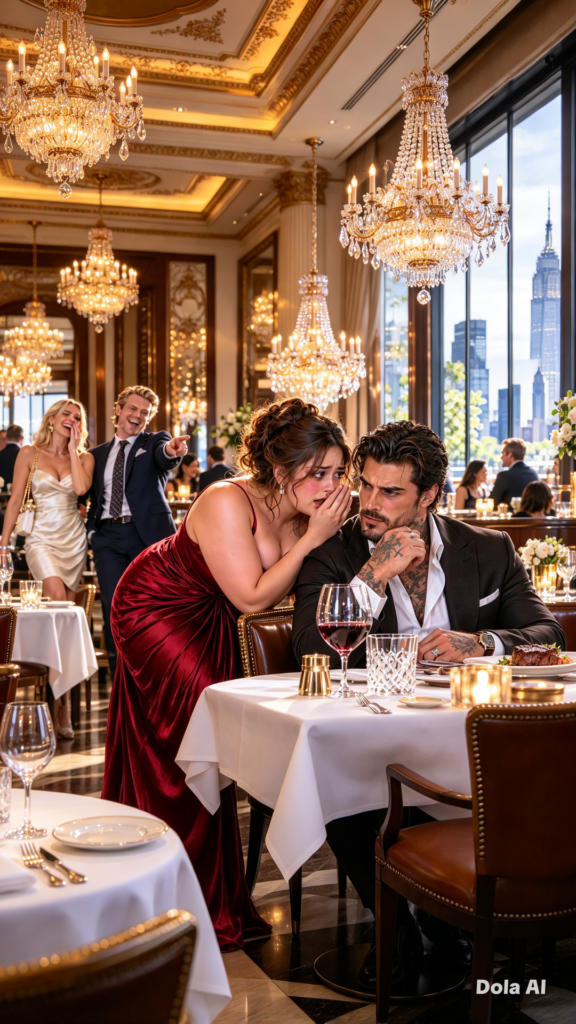
Directly behind me, separated only by a low partition of dark oak and etched glass, was Booth Four, the most secluded corner in the house. Ten minutes earlier I’d noticed two men there. One stood by the pillar like a stone gargoyle, his jacket straining over a shoulder holster. The other sat alone in the shadows with a neat whiskey. I’d only glimpsed his broad shoulders in charcoal wool, a line of black tattoo ink above his white collar, and a heavy platinum watch on a scarred hand. I’d assumed he was a union boss or a private security contractor.
More importantly, he was six feet away, he looked like he could snap Julian in half like a breadstick, and he wasn’t looking at Chloe Sterling.
Without giving my brain half a second to calculate my odds of survival, I turned, rose onto my knees on the cushioned bench, and leaned over the partition into the shadowed booth behind me.
The scent hit me first: cedarwood, rain-cooled leather, and smoky single malt. Up close, the man in the charcoal suit was no union boss. He was thirty-six years of carved granite and quiet violence. His black hair was brushed back from a sharp, aristocratic brow, and his dark slate-grey eyes fixed on mine with the unblinking focus of a predator watching a rabbit leap straight into its jaws.
By his right hand, half hidden beneath a folded black napkin, lay the matte barrel of a suppressed pistol.
My breath caught. Every rational cell in my body screamed at me to sit down, apologize for breathing his air, and walk straight into Boston Harbor.
Behind me, Chloe’s voice drifted over: “See, Jules? She’s looking at the door. Nobody’s coming.”
I was already dead if I backed out now. I might as well die with my dignity intact.
I leaned three inches closer and whispered, my trembling fingers brushing the scarred skin of his wrist.
“Please pretend you’re my boyfriend. I’ll pay for your whiskey. I’ll leave in ten minutes. And I promise not to talk about my feelings.”
In the corner, the bodyguard’s hand darted inside his jacket.
The man in the booth didn’t blink. He raised two fingers an inch off the tablecloth, and the guard froze. Then he let his gaze move slowly down from my eyes, over the curve of my throat, across the trembling swell of my chest in burgundy silk, to my soft hand resting on his tattooed wrist.
For three agonizing seconds, the only sound between us was the distant sizzle of the kitchen grill.
Then the corner of his mouth tilted up. It wasn’t quite a smile. It was more like the slow drawing of a blade.
“Darling,” he murmured, in a low, gravelly baritone that vibrated through the soles of my shoes. He reached across the divider and slid one large, calloused hand around the curve of my waist. “If I’m your boyfriend, why are you sitting on the wrong side of the booth?”
Before I could process that, he stood. He was easily six-foot-three, broad-chested, and he moved with the unhurried grace of a man who had never once had to run for a train. Without letting go of my hip, he stepped out of his alcove, rounded the partition, and slid into my booth.
He didn’t sit across from me. He sat beside me.
The leather dipped under his weight. Heat poured off him, smelling of wool and dark spice. His left arm draped along the back of the seat behind my shoulders, and his right hand settled firmly and unapologetically on the curve of my hip, his thumb tracing slow, possessive circles over the silk.
Julian’s mouth fell open.
Chloe’s smirk vanished as if she’d swallowed a wasp. Her eyes jumped from his three-piece suit to the watch on his wrist that cost more than a car, then to the black tail of a tattooed serpent curling beneath his jaw.
“Sorry to keep you waiting, sweetheart,” the stranger said, loud enough to command the whole section. He didn’t spare Julian a glance. He was looking only at me, his grey eyes warm with dark amusement. “The harbormaster had a problem with a crane at Pier 7. Have you ordered, or were you waiting for me to ruin your appetite?”
My heart was slamming so hard I was sure he could feel it through his palm. But the moment I saw the blood drain from Julian’s arrogant face, forty-eight months of swallowed humiliation turned into pure theatrical instinct.
“I was waiting for you, of course,” I said, leaning my shoulder against his solid chest and laying my hand over his lapel. “Though my ex-fiancé here was just informing me I couldn’t possibly have a date. Apparently women my size are only allowed out after dark if they’re carrying spreadsheets.”
Slowly, so slowly the air seemed to drop ten degrees, the man turned his head toward Julian.
Until that moment, I’d only seen him look at me. When those grey eyes shifted to Julian, the amusement vanished, replaced by a flat, arctic emptiness that raised every hair on my arms. He didn’t shout or puff out his chest the way finance bros did after three gin and tonics. He simply looked Julian over from his blow-dried hair to his Italian loafers, as if calculating the depth of the hole he’d need.
“Is that so?”
Julian swallowed. Even he sensed he was standing in front of an apex predator. He just hadn’t worked out which jungle he’d wandered into.
“We were just saying hello,” he stammered, attempting a man-to-man chuckle that died in his throat. “Julian Brooks, VP of Operations at Sterling Maritime. This is Chloe Sterling.” He stuck out his hand across the rail.
The stranger didn’t move his hand from my hip. His fingers tightened, gathering silk and the warm flesh beneath it, and drew me an inch closer.
“I know what a Sterling is,” he said, sounding bored and lethal. “And I didn’t ask for your résumé. I asked why you’re standing at our table commenting on my woman’s dinner.”
Chloe, insulated by her upbringing from ever recognizing real danger, bristled. “We were walking to the VIP room. And let’s be honest, whoever you are. She probably paid you fifty dollars in the rain to sit here for five minutes. Look at her. Men who wear watches like yours don’t date women built like a bakery clerk.”
The silence was absolute. The bodyguard took one step forward. Two waiters froze mid-stride.
The man beside me didn’t flinch. He lifted his left hand from behind my shoulders and touched my cheek, his rough thumb tilting my face toward his.
“Look at me, Clara,” he murmured, saying my name as if he’d been whispering it in the dark for years.
Mesmerized and terrified, I looked up.
“When I look at you, I don’t see a number on a dress label,” he said. His quiet voice carried to every surrounding table, but his eyes never left my lips. “I see a woman who’s been taught to doubt herself by people too small to appreciate her. I see abundance. I see warmth. I see a woman soft enough to drown in and strong enough to survive a winter at sea.” His thumb traced my lower lip. “Do you understand how rare you are?”
My throat went dry. I knew it was an act. I had bribed him with a whiskey ninety seconds ago. But the raw intensity in his eyes felt like a brand pressed to my skin.
Without looking away from me, he snapped his fingers once.
Within three seconds, the restaurant’s silver-haired French manager came practically sprinting across the carpet, pale with dread. “Yes, Don Moretti? Is something wrong, sir?”
Don Moretti.
The name hit me like a physical blow. Dante Moretti. I’d spent three years auditing every shipping lane between Portland and Providence. There wasn’t a dock worker, customs inspector, or federal prosecutor in New England who didn’t know that name. The Moretti syndicate controlled the longshoremen’s unions, the salvage tugs, and half the cold-storage warehouses on the waterfront. When a Montreal cartel tried to hijack a fleet of Moretti freighters off Cape Ann two years ago, three of their ships went to the bottom of the Atlantic in a single night, and nobody ever found a witness willing to testify.
I hadn’t asked a bodyguard to pretend to be my boyfriend. I had crawled over a restaurant partition and grabbed the wrist of the most ruthless crime boss in Boston.
Julian had gone the color of skim milk.
“Henri,” Dante said smoothly. “There’s a draft coming from the aisle. This man and his toothpick are standing over my table insulting the woman I brought here tonight. They say they have a VIP reservation.”
“A clerical error, Don Moretti,” Henri said instantly, turning a venomous glare on Julian and Chloe. “The VIP room is closed tonight. Mr. Brooks and Ms. Sterling are no longer on our guest list.”
“My father is Arthur Sterling!” Chloe shrilled, flushing scarlet while half the room watched. “He spends twenty thousand dollars a month here! You can’t throw us out over her!”
Dante glanced at the crystal decanter breathing beside our table. “Henri, how much is that wine?”
“Forty-two hundred dollars, Don Moretti. A 1982 Bordeaux.”
“Put it on my bill.” Dante lifted the heavy decanter by its neck and held it over the brass rail, directly above Julian’s pale suede loafers. “Since Mr. Brooks enjoys commenting on things that are too heavy for this restaurant, let’s give him something to clean up.”
He tipped his wrist.
A thick crimson stream of forty-year-old Bordeaux splashed onto Julian’s shoes and pooled across the polished floor. Julian yelped and leapt back, nearly knocking Chloe into a waiter’s station.
“Are you insane?” he choked. Then he caught sight of the massive bodyguard stepping away from the pillar and clamped his mouth shut.
“You have thirty seconds to walk out that door,” Dante said, setting the empty decanter down with a soft, lethal clink, “before I call your boss’s underwriters and tell them Sterling Maritime ships are no longer welcome in my harbor. Take your toothpick and go.”
Julian didn’t argue. With wine squelching in his shoes and every eye in the Vault on his back, he grabbed Chloe’s wrist and dragged her, sputtering, to the door.
The brass doors swung shut. Busboys mopped the floor. Slowly the room’s murmur resumed, though no one within fifty feet dared look toward our corner again.
I sat frozen as the adrenaline drained out of me so fast my fingertips went numb. Dante Moretti’s heavy hand was still on my waist.
“Okay,” I breathed, fumbling in my bag for my wallet. “That was extremely thorough. Thank you. Truly. I think you permanently damaged his suede, which makes this my best birthday since I turned twelve.” I laid two crisp fifty-dollar bills beside his water glass, nearly all the cash I had. “As promised. For the scotch and the theater. And I really won’t talk about my feelings, because I’m leaving right now.”
I made it about four inches toward the edge of the booth before the hand on my waist flexed and stopped me as easily as if I weighed nothing.
His other hand caught my chin. It wasn’t rough, just an unbreakable cradle of warm, calloused fingers that turned my face back to his.
“Leaving?” he murmured. His eyes dropped to the bills on the tablecloth, then rose to mine with a dark, hypnotic glint. “You haven’t touched your steak, little bird. And you just used the Moretti name to humiliate the future son-in-law of my biggest shipping rival in front of thirty witnesses.”
“I didn’t know who you were when I leaned over,” I whispered. “I swear. I thought you were private security.”
“I am private security,” he said softly, his thumb stroking my jaw and sending a traitorous shiver down my spine. “I secure whatever belongs to me.”
Then his gaze dropped to the open mouth of my tote, where the corner of a manila folder was sticking out. It was stamped in bold red ink with the confidential port registry code of MORETTI FREIGHT & TERMINAL.
His fingers tightened on my chin. His voice sank to a velvet whisper meant only for the dark.
“So sit still, eat your birthday dinner, and tell me why a woman who smells like vanilla and rainwater is carrying stolen audits of my syndicate’s shipping lanes in her purse.”
PART 2: Numbers Never Lie
If there is one rule every forensic auditor learns in her first month, it’s this: men with guns do not appreciate creative accounting, especially when the numbers belong to them.
My steak arrived on a sizzling platter, set down by a waiter whose hands shook so badly he nearly dropped the herb butter in my lap.
“Eat first,” Dante said, placing the steak knife in my palm. “You told that blonde idiot you were dining with your man. If you faint from low blood sugar before we reach my car, I’ll look like a poor provider.”
“My blood sugar is entirely stable, Mr. Moretti,” I said, though my voice lacked its usual bite. “But my grandmother didn’t raise a woman who wastes a sixty-eight-dollar New York strip.” I cut a piece and realized, with mild annoyance, that it was the best steak I’d ever tasted. “And technically, those files aren’t stolen. They’re port authority clearing records cross-referenced with private fuel manifests.”
“Public records don’t carry the red internal routing stamp of Pier 4,” he said, watching my mouth. “The last federal agent who photocopied one of those sheets is currently helping anchor a lobster trap off Nantucket.”
I set down my fork. “If I were a federal agent, I wouldn’t have bribed you with two wrinkled fifties to make my ex jealous. And I certainly wouldn’t be sitting here in a dry-clean-only silk dress waiting for you to invite me into a black SUV.”
A faint, dangerous humor flickered in his eyes. “Who said anything about an invitation?”
Twenty minutes later, I was in the back of an armored Maybach gliding north along the rain-slick coast. Dante sat across from me with his jacket open, a leather shoulder holster visible over his vest. His bodyguard Enzo, whose nose had been broken at least three times, drove behind a soundproof glass partition.
I kept my hands folded over my tote and refused to cower against the door. I’d survived four years of boardrooms full of men who believed shouting made them right. If Dante Moretti wanted to intimidate me, he’d need more than expensive leather and moody silence.
His estate perched on black cliffs above the Atlantic near Marblehead: grey slate, weathered cedar, and floodlights slicing through sea fog. It looked less like a house than a nineteenth-century fortress. When the cold salt wind whipped my skirt around my knees, Dante stepped behind me and draped his heavy overcoat over my shoulders. It was warm from his body and long enough to swallow me to the calves.
“Inside,” he murmured, his hand settling back onto its claimed territory at my waist. “My men are waiting.”
The study was lined with walnut bookshelves, with tall arched windows overlooking the white-capped sea and a fire roaring in a river-stone hearth. A lean young man in a navy suit stood by a long slate table: slicked-back hair, restless brown eyes.
“Dante, we heard there was an incident at the Vault.” His smile died when he saw me wrapped in the boss’s coat. “Who is this?”
“Clara Vance,” Dante said, pulling out a leather armchair by the fire for me. He didn’t bother introducing the man in return. “Marco, put the third-quarter port ledgers on the table and leave us.”
Marco looked me up and down: my full figure beneath the coat, my damp curls, my worn tote. It was the same dismissive, calculating look Julian’s friends used to give me at cocktail parties.
“With respect, Don,” he said smoothly, stepping between me and the table, “Enzo says she has Pier 4 routing codes in her bag. If she’s an independent auditor sniffing around our lanes, I should take her downstairs and find out who’s paying her.”
I didn’t wait for Dante. I laid his coat over the chair arm, put on my tortoiseshell reading glasses, and looked Marco dead in the eye.
“If you took me downstairs, Marco, who would stay up here and explain to your boss why someone’s been skimming twelve percent off every refrigerated container passing through Cold Storage Bay Six since April?”
A log snapped in the fire.
Marco’s face went rigid. “She doesn’t know what she’s talking about. Bay Six was audited two weeks ago. It balanced.”
Dante hadn’t moved from the hearth. “Let her talk.”
I spread three color-coded spreadsheets across the slate. “May I have some hot Earl Grey? If I’m going to save you fourteen million dollars at eleven at night on my birthday, I refuse to do it with a dry throat.”
Something fiercely approving flashed across Dante’s austere face. “Bring her tea,” he told Enzo. “And the lemon cake from the kitchen.”
This was my element. Men in three-piece suits lied constantly. Numbers never did.
“Your accountants balanced the ledger because they were looking at gross tonnage and customs receipts,” I said, tapping a highlighted column with my silver pen. “Whoever’s stealing from you is smart. No hijacked trucks, no cracked safes. They’re using micro-structured transfers hidden inside automatic demurrage refunds. Every time one of your ships docks at Pier 4 after midnight, the harbor software logs a three-hour customs delay. That triggers an automatic penalty refund of forty-eight hundred dollars per container, just under the five-thousand threshold that would trigger manual review by your treasury.”
Dante stepped up beside me, so close his arm brushed mine. “Show me.”
“I cross-referenced the tugboat GPS logs with the crane diesel receipts,” I said. “Those ships weren’t delayed three hours. The cranes unloaded them in forty minutes. The delay only exists inside the billing software. Software I personally wrote two years ago, before my ex-fiancé stole it and installed it at Sterling Maritime.”
Dante’s head turned slowly. “You wrote the harbor clearing code?”
“Every line. Including a hidden diagnostic backdoor that stamps the network address of whatever company collects those phantom refunds.” I slid the last page across to his scarred knuckles. “Nearly three thousand micro-transfers in six months. Fourteen million, two hundred eighty thousand dollars out of Moretti Freight, into a Cayman shell called Azure Horizon Holdings.” I smiled coldly. “Which is a wholly owned subsidiary of Sterling Maritime Logistics, owned by the father of the woman who called me a bakery clerk tonight and managed by the man whose loafers you just ruined.”
Marco looked as if someone had hit him with a crowbar. “That’s impossible. Arthur Sterling wouldn’t dare rob the Moretti family directly.”
“He wouldn’t,” Dante agreed, his voice falling to that arctic register that thinned the air. “Not unless someone inside my organization gave him the clearing codes for Bay Six.” His grey eyes lifted and pinned Marco to the wall. “Get out.”
“Dante, let me put a crew together. We’ll hit Sterling’s offices before dawn…”
“I said get out. Touch nothing at the port. Speak to no one.”
Marco shot one last venomous glance at the back of my head and left.
Now that the puzzle was laid bare, exhaustion settled into my bones. Dante poured my tea himself and pushed the cup toward me.
“Why didn’t you take this to the feds?” he asked. “You’ve got enough here to put your ex and Sterling away for twenty years.”
I stared into the fire. “Because Sterling’s lawyers would bury it in discovery for three years. And because Julian ran the whole transfer loop through my original developer credentials. If the feds look at the surface code without understanding the backdoor, Julian will point at me and say I’m the bitter, jilted ex who embezzled millions for revenge.” I laughed bitterly. “Efficient, isn’t he? Four years of me cooking his dinners, writing his software, and apologizing for not fitting into the sample-size dresses his mother bought me. And the whole time, I was his insurance policy.”
Dante didn’t offer empty comfort. He braced his hands on the armrests on either side of my hips, caging me in, and leaned down until his face was level with mine.
“Listen carefully, Clara. Julian Brooks is not going to frame you. And you’re not going back to your apartment tonight. The moment Marco walked out that door, the clock started. Whoever my traitor is will warn Sterling that an auditor is sitting in my house. If you go home unguarded, you won’t live to see Monday.”
A chill ran down my arms. “So you’re locking me in a basement?”
“I don’t keep treasures in basements.” His hand cupped the side of my neck, his thumb on my racing pulse. “I’m offering you a thirty-day contract. Stay here as my chief financial consultant. Help me trace every penny and flush out the rat in my family. Sunday night there’s a maritime charity gala at the Harbor Grand. The Sterlings, your ex, and your whole social circle will be there. You’ll walk in on my arm. Give me your brain to ruin my enemies, and I’ll give you my empire to crush yours.”
I looked into those dark, merciless eyes and understood two things at once. Dante Moretti was the most dangerous man I would ever meet. And for the first time in four years, someone was offering me a weapon instead of an apology.
“Fine,” I breathed. “Thirty days. On one condition. Nobody touches my spreadsheets, and I get an unlimited supply of whoever baked that lemon cake.”
His mouth curved into that lethal, breathtaking half smile. “Done.”
The next morning, two quiet Italian women wheeled brass racks into my guest suite. There wasn’t a single beige tent among them: sapphire silk wrap dresses, cream wool trousers, and gowns of plum and midnight velvet, every one cut to celebrate a size-eighteen hourglass instead of hiding it.
That afternoon I tried on a floor-length sapphire velvet gown with an off-the-shoulder neckline that hugged my waist and lifted my breasts until I blushed at my own reflection. The moment I saw the bare softness of my upper arms and the curve of my stomach under the velvet, Julian’s voice came back like an old scar aching in the rain. Are you really wearing something that tight, Clara? People will stare.
Without thinking, I grabbed a heavy pashmina and wrapped it around myself like armor.
The door clicked open. In the mirror, Dante stepped in wearing a black tuxedo, his bow tie hanging loose. He stopped three feet behind me. Then he came close, peeled the shawl from my shoulders, and let it fall to the floor.
“Hey…” I crossed my arms over my stomach.
He caught both wrists gently and lowered them to my sides. “Why are you hiding?”
“I’m not. It’s October. I was cold.”
“The room is seventy-four degrees, little bird. Don’t lie to me.” His palms slid to rest on the curve of my stomach, then spanned the flare of my hips. “Tell me who taught you to fold yourself in half every time someone looks at you.”
My throat tightened. “When you spend four years with a man who apologizes to his coworkers before introducing you,” I whispered, “you learn that taking up less space keeps the peace.”
His fingers flexed, anchoring me. “Weak men ask women to shrink because it makes them feel tall,” he murmured against my shoulder. “I’m not a weak man, Clara. I don’t want a woman who disappears when the lights go out. I want every soft, magnificent inch of you: hips to hold onto when the world is burning, and a mind sharp enough to burn it down beside me. If anyone ever looks at this body with less than worship, I’ll take their eyes.”
No man had ever touched me like that. It wasn’t tolerance, and it wasn’t despite my size. It was a raw reverence that made me feel carved from gold.
My phone buzzed on the marble vanity.
Incoming call: Mom. Then a text from an unknown number:
We’re at your apartment with your mother. Bring the master server passwords for Sterling Maritime home by midnight, or Arthur’s lawyers file federal embezzlement charges against you at 8 a.m. —Julian
Another text from my mother followed: Stop being dramatic and come home. Julian and Chloe brought pastries. You’ve embarrassed this family enough.
“He brought pastries,” I said flatly. “He’s threatening me with twenty years in federal prison for his crime, and my mother is impressed because he stopped at a bakery.”
“Give me your address,” Dante said quietly. It was the voice of a surgeon asking for a scalpel. “Enzo will clear the room in fifteen minutes.”
I turned inside his arms. “If you send armed men in now, Julian will know we only have the digital logs, not the physical customs ledgers. He’ll wipe Sterling’s backup servers before we can tie the Cayman transfers to his signature.” My mind was racing. “The carbon-copy manifests are at Pier 9, Cold Storage Vault B. The old dock superintendents still keep paper. And my late father’s backup drive is hidden in my apartment. If we get the carbons first, then walk into that apartment together, Julian won’t just be neutralized. He’ll sign his own confession.”
Dante studied me for five long seconds. Then his thumb brushed my lower lip.
“Change into wool and flat boots,” he said. “The harbor’s forty degrees tonight. If we’re walking into your mother’s ambush, I want you warm enough to enjoy it.”
Pier 9 at ten o’clock on a Saturday night looked like the edge of the world: rusted container walls dripping in the fog, and air that stank of diesel and frozen cod. Only four people besides me knew we were coming here: Dante, Enzo, the night watchman, and Marco, who’d called ten minutes earlier claiming he was “securing the east dock.”
The padlock on Vault B lay sheared in two on the wet concrete.
Rifles flashed from a crane catwalk. Enzo drew fire toward the forklift bay, and one shooter fell from the rigging. Then the vault door burst open and three masked men charged out with submachine guns. Dante shoved me behind a stack of cargo pallets and stepped into the choke point, firing four times. Two men dropped. The third ducked behind a steel fish-scaling table and sprayed blind, shattering the lights overhead.
Outside, a fourth gunman came around the Maybach and shot Enzo in the thigh. All two hundred forty pounds of him crashed to the asphalt. His pistol skittered toward the edge of the pier, and the gunman raised his rifle to finish him.
Dante was pinned in the doorway. He couldn’t reach Enzo without stepping into crossfire.
I didn’t have a gun. I had never fired one in my life. What I had was a hundred and ninety pounds of solid New England center of gravity, four years of hauling forty-pound archive boxes up courthouse stairs, and a lifetime of men assuming that because I was soft, I was slow.
Beside me, on caster wheels at the edge of the loading ramp, stood a seven-foot iron rack heaped with galvanized anchor chain. I planted my boots, dropped my hips, braced my shoulders against the cold upright, and drove forward with a guttural roar.
The rusted caster locks snapped. Three hundred pounds of iron and chain toppled off the dock and came down on the gunman like a guillotine, pinning him and his rifle to the asphalt.
I didn’t stop to breathe. I scrambled down into the fog, hooked my arms under Enzo’s armpits, and dug in my heels.
“Clara, get back! You’re in the open!” he roared.
“Shut up and push with your right boot, you giant idiot!” I gasped, and dragged him up the ramp into the steel alcove of the vault.
Inside, two sharp shots echoed as Dante flanked the last gunman and dropped him.
By the time Dante strode into the alcove, gunsmoke curling from his barrel and someone else’s blood flecked across his collar, I had torn the silk lining out of my tote, twisted it around my silver pen as a windlass, and cinched a tourniquet above the wound in Enzo’s thigh.
“Hold that pen flat,” I told Enzo, wiping a curl off my sweaty forehead. “If it unwinds before your doctor arrives, I’m charging you a consulting fee.”
Enzo stared up at me as if I’d grown wings.
I turned to pick up the metal lockbox of carbon manifests from the shelf and found Dante standing there. He wasn’t looking at the dead men or the toppled rack. He was looking at me: my flushed cheeks, my heaving chest, Enzo’s blood on my soft hands. His expression was so fierce, so reverent, that it stole the breath from my lungs.
In three strides he crossed the concrete, holstered his gun, took my face in both scarred hands, and kissed me.
It wasn’t polite. It was raw and scorching, and it tasted of smoke and salt wind. When he finally pulled back, his forehead rested hard against mine.
“You flipped a three-hundred-pound iron rack onto a contract killer,” he rasped. “And dragged my lieutenant out of a kill zone.”
“Well,” I breathed, “it turns out not starving yourself on lemon water is remarkably useful in a firefight.”
A low sound rumbled in his chest, half laugh and half groan. “That thirty-day contract? Void. Thirty days is an insult. You’re never leaving my side.”
At 11:40 p.m., I walked into my own third-floor walk-up alone. The door was half open behind me.
My mother sat on my floral sofa in her Sunday cardigan with a box of macarons. My sister Jenna sat beside her in a cashmere sweater she had “borrowed” from my closet six months ago. Julian stood by my mantel in fresh shoes, flanked by Chloe and a hawk-faced corporate lawyer.
“Black makes you look so wide across the shoulders, Clara,” my mother said by way of greeting.
“Sign this,” Julian said, wearing a mask of wounded sympathy and holding out an affidavit. “Admit you altered the Pier 4 software out of emotional distress over our breakup, hand over your passwords, and Arthur will ask for probation instead of prison.”
“I notice your little Don Moretti isn’t here tonight,” Chloe sneered. “Run out of fifties?”
“Actually, Chloe,” said a deep voice behind me, “she paid me a hundred. I’m still working off the debt.”
The temperature in my living room dropped twenty degrees.
Dante stepped across my threshold with gunpowder still on his cuffs and four six-foot-four enforcers filling the doorway behind him. My mother dropped her macaron. Julian backed into the drywall.
Dante walked straight to me, rested his hand on my hip, and kissed my temple in front of my mother’s horrified eyes.
“Go get your father’s drive, sweetheart. I’ll entertain your guests.”
He tossed a folder of my mother’s overdue mortgage statements onto the coffee table. “Mrs. Vance, you’re four months behind, mostly because of the forty thousand you wired to your younger daughter’s credit cards after Clara stopped paying your bills. Say one more word about Clara’s body, her worth, or her life, and my lawyers will make sure she has every legal protection from you she needs. Do we understand each other?”
My mother couldn’t speak. She just nodded.
When I came back down the hall with my father’s silver drive in one hand and the Pier 9 lockbox in the other, Julian was sweating through his collar.
“Leave the affidavit, Julian,” I said coolly. “Tomorrow night at the gala, you and Mr. Sterling are going to need a much better lawyer.”
All five of them fled down the stairs. I picked up Humphrey, my judgmental pothos plant, and handed him to an enforcer, who held the terracotta pot as gently as a live grenade.
“Let’s go home,” I said.
By 1:30 a.m., I was alone in the cliff house’s windowless archive vault with two guards posted outside. I plugged my father’s drive into an air-gapped terminal. My father, Thomas Vance, had been Boston’s deputy harbor inspector for twenty-six years, until a heart attack took him in his sleep five years ago. He had taught me to read a double-entry ledger before I was ten.
The password was the hull number of the little sailboat he used to take me fishing on: Sweet Clara.
At the bottom of the folders, one file was marked in red: SS NORTHERN STAR — STERLING MARITIME — DO NOT ARCHIVE.
Five years ago, three weeks before my father died, Arthur Sterling’s freighter Northern Star sank off Cape Cod. Four crewmen drowned. The thirty-two-million-dollar insurance payout turned Sterling Maritime into a regional powerhouse.
My father’s photographs showed that the hull valves had been deliberately corroded and rigged to scuttle the ship and send a hold full of illegal chemical waste to the bottom. He had drafted a criminal referral to the Coast Guard.
And at the bottom of the file was his office visitor log from the afternoon before he died. Two men had signed in to see him at four o’clock.
Arthur Sterling.
Julian Brooks.
Six months later, a charming young logistics intern had asked me out for coffee in a bookstore near the harbor.
The air turned to lead in my lungs. Julian hadn’t met me by accident. He’d been sent to move into a grieving inspector’s daughter’s apartment and search her father’s boxes for a report that could hang them both.
One hot, furious tear fell onto my hand. I wiped it away so hard my skin stung.
Then I pulled the Pier 9 carbons under the lamp. Digital logs can hide behind proxy servers, but carbon paper can’t. In the corner of every manifest where a phantom refund had been approved, the stamping machine had embossed the authorizing executive’s syndicate ID: 0014-M.
I typed it into Dante’s personnel directory. The face on the screen was Marco Moretti, underboss, port operations.
Below it a gate alert blinked: Vehicle 4 — Marco M. — entered estate perimeter, 1:42 a.m.
I hit print. The pages slid into the tray.
Somewhere deep in the house, something clunked.
The power died. The lamps went out, the monitors went black, and the room plunged into total darkness.
Outside in the corridor, I heard a dull thud, then the heavy slump of a body sliding down the wall. Then another.
Both of my guards were down.
The brass doorknob turned slowly, testing the latch.
“Clara,” Marco said softly through the oak. All the deference was gone from his voice. “I cut the breaker to the north wing. That magnetic lock has about ninety seconds of emergency battery before the fire release pops it open.” Above the frame, a small red LED began to count down. 01:28. 01:27. “Make it easy on yourself.”
I heard the metallic click of a suppressor being screwed onto a barrel.
“You really thought Dante would keep a whale like you once he got his money back?” Marco whispered. “You’re just a calculator with a pulse.”
PART 3: The Queen of the Harbor
01:10.
No windows. No second door. Only steel filing cabinets, the oak workbench, and, high in the far corner near the twelve-foot ceiling, an iron lever beside an old coal-chute vent.
I had spent the afternoon studying this house’s blueprints while tracing server cables. This vault had been an 1890s munitions room. Beneath the modern magnetic lock, the door still had its original counterweighted steel bolt, wired by pulley to that iron lever. A later renovation had connected the same lever to the vault’s dry-chemical fire suppression system.
Working silently in my stockinged feet, I shoved the printed pages and my father’s drive down the front of my turtleneck. I set the empty metal lockbox on the edge of a low cabinet in the far corner and tied my tote’s long strap to its handle. Then I climbed onto the workbench, thighs straining, and closed my hand around the cold iron lever.
00:03. 00:02. 00:01.
The lock died with a clack. The door swung inward. Marco stepped in, a silhouette against the red exit light down the hall, pistol raised.
I yanked the strap.
Across the room, the metal box crashed to the floor with an ear-splitting clang. Marco spun left and fired three muffled shots into the dark corner, taking two full steps inside with his back to me.
I threw all of my weight down on the iron lever.
With a screech of nineteenth-century cable, the counterweight released. The oak door slammed shut behind him, and a solid iron bar drove into the floor casing. In the same instant, four nozzles above Marco’s head blasted white fire-suppression powder straight into his face.
He screamed and choked, blinded. The pistol flew from his hand. Before he could grope for it, I jumped off the three-foot workbench and landed with both knees and every pound I had squarely across his spine. His head bounced off the floorboards, and he went still.
Ten seconds later, a breaching ram hit the door. On the second blow it gave way. The backup generator roared to life, flooding the room with amber light.
Dante charged through the swirling white haze with a combat shotgun, four guards behind him. His face was twisted with a raw, feral terror I had never seen on a human being.
“CLARA!”
“Down here,” I coughed, sitting comfortably on his unconscious underboss’s back, holding Marco’s pistol by two fingers like a dead rat. “Your cousin tried to cancel my contract early. Also, your fire suppression tastes terrible.”
Dante froze. He looked at Marco, then at me, my curls dusted white like powdered sugar. Then he handed off the shotgun, took the gun from my fingers, and lifted me off the floor into his arms.
“Take that filth to the boathouse cellar,” he said without looking back. “Hold him.”
He carried me up two flights of stone stairs to his own suite, ignoring my protests that I was far too heavy. He didn’t even breathe hard. He set me on the sofa before a roaring fire, then knelt and wiped the powder from my face, my throat, and my hands with a warm towel. He peeled off my dusty socks and wrapped his scarred hands around my bare foot, working the ache from my arch with slow, devastating tenderness.
“For ten years I haven’t cared whether I lived until morning,” he said quietly, head bowed. “Tonight, in the thirty seconds it took me to run up those stairs, I died a thousand times.”
“I’m harder to kill than I look,” I whispered, brushing his black hair back from his brow. “And dating a mafia boss is still statistically safer than doing Julian’s taxes.”
He stared at me for a second. Then the hardness in his face cracked, and he laughed. It was deep and real, and it made him breathtakingly human. A guard passing in the hall actually stopped in his tracks, as if he’d never heard the sound before.
I pulled the crumpled pages out of my sweater and laid them on the table, my father’s report on top.
“Read these,” I said, my voice breaking at last. “Julian and Sterling didn’t only steal your fourteen million. I think they killed my father.”
The laughter vanished. Dante read every page in silence. A cold, absolute vow settled into the line of his jaw.
“Tomorrow night,” he said, “I was going to bankrupt them. Now I’m going to erase them.”
The Imperial Ballroom of the Harbor Grand had been built in 1912 to remind Boston’s shipping dynasties that they were the closest thing America had to royalty. Twenty-foot chandeliers threw diamond light over four hundred guests in black tie and couture.
At eight o’clock sharp, the doors at the top of the grand staircase opened.
I didn’t walk in behind Dante Moretti. I walked in beside him.
I wore the sapphire velvet gown with no shawl and no apology. It framed my collarbones and the full curve of my breasts, where uncut Burmese sapphires from the Moretti vault lay warm against my skin, and it swayed around my hips with every step. On my left hand blazed an eight-carat canary diamond. I’d refused it at breakfast because it would “get in the way of my typing.” At seven-thirty, Dante had calmly told me that if it did, he’d buy me a department of stenographers.
The roar of four hundred conversations died like falling dominoes.
My mother, standing near the flowers on a complimentary pass from Arthur Sterling, saw the diamond and the sapphires and visibly swayed.
At the podium in front of a thirty-foot LED screen stood Arthur Sterling, silver-haired and ruddy, with Chloe in silver sequins and Julian in a white dinner jacket. Marco had called them before he cut the breaker. They believed he had destroyed my father’s drive. They thought I had walked in empty-handed.
The press row was full: the Boston Globe’s investigative desk and Bloomberg’s bureau chief.
Sterling tapped the microphone. “Before tonight’s auction, I must address a grave matter of corporate espionage.”
Julian stepped up with tears in his voice and pointed straight at me across the room. “My former fiancée, Clara Vance, suffered a breakdown when I ended our engagement. Driven by jealousy and her own insecurities, she used her developer credentials to steal fourteen million dollars from the harbor trust, then tried to sell our ledgers to underworld figures.”
Behind him, the giant screen lit up with a doctored spreadsheet showing my developer ID on the Cayman wires, beside a grainy security photo of me leaning over the partition to grab Dante’s wrist.
Four hundred heads turned, waiting for the fat, jilted ex to burst into tears and flee.
Dante looked down at me, calm and dark and utterly devoted. “Would you like me to kill him from here, little bird? Or would you rather carve him open yourself?”
I set down my champagne and drew a tiny black drive from my clutch.
“Keep your hands in your pockets, my love. Watching a man die takes three minutes. Watching him spend thirty years in a federal cage takes much longer.”
I lifted my skirt two inches and walked down the center aisle. I didn’t hurry. I didn’t shrink. The crowd parted before me like the Red Sea. Halfway down, without breaking stride, I handed the drive to Dante’s audiovisual specialist, already stationed beside the hotel technicians.
I climbed the stage, walked past Chloe, who actually flinched, and took the microphone from Julian’s sweating hand.
“Good evening. My name is Clara Vance.” My voice rang through the vaulted hall. “Before you believe the slideshow behind me, I have one question for the Vice President of Sterling Maritime.” I turned to Julian. “Did you really forget who wrote the code behind those numbers?”
His lips parted. No sound came out.
“When I built that auditing system,” I told the room, “I noticed Mr. Brooks had a habit of taking credit for work he couldn’t spell, let alone program. So I embedded a tamper-evident, cryptographically signed ledger that records the device, the authentication, and the network address behind every single transaction.”
I raised my left hand, and the canary diamond flashed.
The screen went black. Then, in towering letters: INDEPENDENT FORENSIC AUDIT — CLARA VANCE.
“Cut the power!” Sterling roared. Nobody did.
The fake spreadsheet was replaced by the true banking trail: fourteen million, two hundred eighty thousand dollars flowing from Azure Horizon straight into the personal brokerage accounts of Arthur Sterling and Julian Brooks.
Then audio filled the ballroom, a recorded call Dante had pulled from Marco’s phone in the boathouse that morning.
Julian’s voice: “Relax, Arthur. I ran the whole loop through Clara’s old key before I dumped her. If anyone catches it, the trail stops dead at her apartment.”
And Arthur Sterling, laughing: “Just make sure she never finds her old man’s files, Jules. If Thomas Vance hadn’t been so stubborn about those hull valves on the Northern Star, we wouldn’t have had to switch out his heart pills.”
The sound that tore through the ballroom wasn’t a murmur. It was a roar of collective horror. Reporters vaulted over chairs. Chloe shrieked and dropped her glass, backing away from her father as though he carried plague.
Arthur Sterling lunged at me with his fist raised.
He didn’t get within six feet. Dante vaulted the brass balustrade and was simply there, catching Sterling’s wrist in midair with one hand. A sharp crack echoed, and the old man dropped to his knees, howling. When four of Sterling’s private guards started up the stage stairs, eight of Dante’s men stepped out of the shadows and walked them silently into the service corridor. No shots were fired. No guest even noticed.
Then the ballroom doors burst open again. A dozen agents in navy windbreakers marched down the aisle: FBI Financial Crimes, IRS Criminal Investigation, and the Coast Guard Investigative Service. At dawn, Dante’s attorneys had delivered the complete verified dossier, including my father’s photographs, the visitor log, and the evidence about his death, to the federal task force already investigating Sterling Maritime. Tonight wasn’t the beginning of the investigation. It was the public reveal.
“Arthur Sterling. Julian Brooks. You’re under arrest for wire fraud, insurance sabotage, and conspiracy to commit murder in the death of Deputy Harbor Inspector Thomas Vance.”
Julian didn’t run. In a display of cowardice so pure it almost made me laugh, he crawled across the stage through the spilled champagne and broken glass and clutched the hem of my sapphire skirt while the cameras flashed.
“Clara, please! I didn’t touch your father’s medicine! Arthur made me date you! We were together four years! Tell them I cooperated!”
At the edge of the stage, two IRS agents were unclasping a diamond bracelet from Chloe’s wrist as she tried to slip out through the kitchen.
I looked down at the man who had spent four years making me feel too heavy, too soft, and too ordinary to be loved in public. Dante stood half a step behind me, his hand warm on my hip.
“Four years, Julian,” I said softly into the microphone. “Four years of ordering salads for me and hiding me from your yacht club friends. You told me watching me squeeze into a silk dress and pretend I had a future was depressing.”
I gently pulled my velvet hem from his trembling fingers and stepped back so the agents could cuff him.
“Don’t worry about your diet in prison. And don’t worry about Sterling Maritime, either. As of five o’clock this afternoon, Dante Moretti’s holding company acquired a controlling sixty-two percent stake through an agreement with its principal shareholders and lenders. The new board appointed me CEO.” I smiled serenely. “As my first executive action: you’re fired.”
The applause didn’t start at the society tables. It started in the back, with the waiters, the bartenders, the union delegates, and the old dock superintendents who had known and respected my father for twenty-six years. Within five seconds, half the ballroom was on its feet as Arthur Sterling and Julian Brooks were dragged out in irons.
That night, the storm finally broke over the cliffs. Rain lashed the windows of Dante’s suite, and the only light came from the river-stone fire.
I sat curled on the sofa in my sapphire gown with my heels kicked off and a plate of toasted sourdough and brie in my lap. Humphrey was safely installed in the conservatory. Enzo was resting with twenty stitches and a half-million-dollar bonus.
Dante stood by the hearth with his sleeves rolled over his tattooed forearms, holding two crisp fifty-dollar bills and our thirty-day consulting memo. He dropped the memo into the flames, along with Julian’s unsigned affidavit. He folded the two fifties and tucked them into his shirt pocket, over his heart.
“You’re keeping the hundred?” I asked around a bite of bread. “For a man who just seized a shipping company before dessert, you have very strange saving habits.”
He took the plate from my lap, set it aside, and knelt before me on the rug.
“If I burn that hundred, my debt to you is paid,” he said quietly. “And I have no intention of ever being out of your debt, Clara Vance.”
He placed a heavy cream folio in my hands, sealed with the Commonwealth of Massachusetts. Inside was the master charter of Moretti Maritime and Terminal Holdings, an empire worth nearly half a billion dollars. Beside Dante Matteo Moretti on the signature line, the trust had been amended to read: Irrevocable 50% Co-Owner and Managing Partner: Clara Elizabeth Vance.
My hands trembled. “Dante. We met forty-eight hours ago in a steakhouse.”
“Forty-eight hours ago,” he said, cupping my cheek, “I was sitting in the dark with a gun under my napkin, surrounded by traitors, watching a world full of hollow people pretend to be alive.” He drew me to the edge of the sofa until I was almost in his lap. “Then you leaned over that partition. Soft, brilliant, terrifyingly brave, smelling like rain and vanilla, ordering the most dangerous man in Boston to be your boyfriend for the price of a scotch. You saved my lieutenant with your bare hands. You trapped my traitor with your mind. And you brought down the men who killed your father without spilling a drop of your own blood.”
He pressed his lips to the canary diamond on my finger.
“I don’t want a trophy, Clara. I want a queen who takes up every inch of her throne. Stay. Rule the harbor with me. Let me worship every curve of this body and every thought in that brilliant head until the ocean runs dry.”
For four years I had tried to make myself smaller for a man who wasn’t big enough to hold me. Looking down at the tattooed king kneeling at my feet, I realized I never had to fold myself in half again.
I set the charter on the carpet, slid my hands into his black hair, and pulled his mouth to mine.
“Okay,” I whispered against his lips, smiling as he lifted me into his arms. “On one condition, Mr. Moretti.”
“Name it, little bird.”
“Tomorrow night, we go back to Aurelio’s Vault. And this time, you’re buying the steak.”
THE END