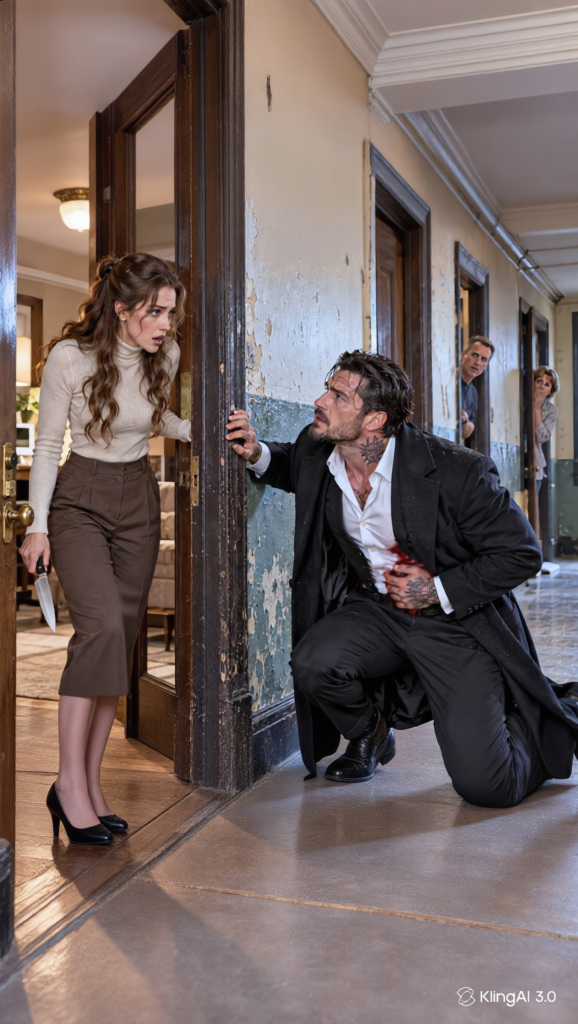
PART 1: THE KNOCK AT 11:58
Christmas Eve is not a holiday when you’re alone. It’s an endurance test. A long, glittering corridor you have to walk through with your head down until the world goes back to normal on the twenty-sixth.
I had a plan for getting through it. A frozen lasagna. A bottle of cheap red wine. The apartment above my veterinary clinic on Passyunk Avenue, with the blinds closed and the phone face-down on the counter.
My name is Clara Novak. I’m thirty-one years old. I spend my days stitching up Labradors who swallow socks and holding the paws of old cats while their owners say goodbye. I’m good at it. Animals don’t lie to you. They don’t pretend to be fine. When they hurt, they show you exactly where.
People are harder.
One year ago tonight, my father died of a heart attack in the waiting room downstairs, while he was hanging paper snowflakes in the window for me. He had built this clinic with his own hands thirty years earlier. Six days after the funeral, my fiancé, Ryan, drained our joint account, the money we’d saved for the wedding and for the clinic’s overdue mortgage, and disappeared with a note on the kitchen table that said only, I’m sorry. I owe the wrong people.
I hadn’t heard his voice since.
So this year there was no tree. No lights. Just a single paper snowflake still taped to the clinic window downstairs, curling at the edges, because I couldn’t bring myself to take down the last thing my father ever touched.
At 11:40, I went down to check the kennels. I had one boarder over the holiday, an elderly beagle named Pickles whose family was in Florida. I gave him his medication, scratched his grey ears, and stood for a while in the dark reception area watching the snow fall past the window. It had been coming down since noon, thick and silent, burying the parked cars and muffling the whole city into something hushed and unreal.
At 11:58, someone pounded on the glass door.
Not knocked. Pounded. A heavy, desperate fist against the glass, hard enough to rattle the frame.
I froze behind the reception desk. Every rule of living alone in this city flashed through my head. You don’t open the door after dark. You don’t open the door to strangers. You especially don’t open the door on Christmas Eve, when nobody has any good reason to be out.
“Please.”
The voice came through the glass, low and rough and strained. A man’s voice.
“I know you’re in there. I saw the light. Please, she’s dying.”
She.
I came around the desk slowly. Through the frosted glass, under the orange glow of the streetlight, I could see a tall figure in a long dark coat, snow caked on his shoulders. He was holding something heavy in his arms. Something wrapped in a coat.
Then I saw the tail. Black and tan, hanging limp.
A dog.
I had the door unlocked before my brain finished arguing with me.
He came in on a gust of freezing air and snow. Up close, he was enormous, well over six feet, broad-shouldered, with dark hair plastered to his forehead and a face that looked like it had been cut from winter stone. His coat was expensive. His shirt beneath it was white, or had been. Now it was streaked with red.
In his arms lay a German shepherd, a big female, maybe five years old. Her eyes were half-closed. Her breathing was fast and shallow. Blood had soaked through the cashmere scarf he’d wrapped around her side.
“She was shot,” he said. His voice was flat and steady, but his hands, I noticed, were shaking. “About twenty minutes ago. Left side, behind the shoulder. Please.”
There is a switch inside every doctor, human or animal, that flips at moments like this. Fear goes somewhere else. Questions go somewhere else. There is only the patient.
“Bring her back,” I said. “Now. Follow me.”
The surgery room was cold and blindingly white under the overhead lamp. He laid her on the steel table, and I was already moving: clippers, gauze, oxygen mask, catheter into the foreleg. Her gums were pale. Her pulse was racing.
“What’s her name?”
“Duchess.”
“Okay, Duchess. Okay, girl. I’ve got you.” I shaved the fur around the wound. A single entry point behind the left shoulder blade, the edges ragged. I pressed my stethoscope to her chest and listened, and relief nearly buckled my knees. Both lungs were moving air. Muffled on the left, but moving.
“The bullet missed her lung,” I said. “I think it’s lodged in the muscle along the ribs. She’s lost a lot of blood. I need to sedate her and get it out and stop the bleeding. It’s going to take an hour, maybe more.”
“Do it.”
“You’ll need to wait outside.”
“No.” He said it quietly, but there was a weight to the word that made the air feel heavier. “I stay with her.”
I looked at him then. Really looked. Grey eyes, cold and pale as frost on glass. A jaw shadowed with stubble. A thin white scar running through his left eyebrow. And something in his face that I recognized, because I’d seen it on a hundred owners in this room: the terror of loving something you cannot protect.
“Then wash your hands,” I said, “and hold her head. Talk to her. She knows your voice.”
He obeyed without another word.
I worked for seventy minutes. I found the bullet wedged against her fifth rib, a dull, misshapen lump of metal that clinked into the steel tray. I flushed the wound, tied off a bleeding vessel, placed a drain, and closed her up layer by layer. The whole time, the stranger stood at the head of the table with one big hand resting on Duchess’s skull, murmuring to her in a low voice. Some of it was English. Some of it sounded like Russian.
When I tied the last suture, it was 1:20 a.m. Christmas Day.
“She’s stable,” I said, peeling off my gloves. My back ached. My hands were trembling now that it was over. “Her vitals are good. She’ll need fluids overnight, antibiotics, pain relief. But I think she’s going to make it.”
He closed his eyes. For a long moment, he didn’t move at all. Then he bent and pressed his forehead gently against the dog’s head, and something about the gesture was so private and unguarded that I had to look away.
“Thank you,” he said hoarsely. “You don’t know what you’ve done.”
“I know exactly what I’ve done. I took a bullet out of a dog.” I crossed my arms. “Which means somebody shot her. Who are you?”
He straightened. The softness vanished from his face like a light switching off.
“Adrian,” he said. “Adrian Kovač.”
I had lived in South Philadelphia my whole life. I knew that name the way you know the name of a storm that tore through your neighborhood years ago. People said it quietly, if they said it at all. Adrian Kovač owned half the shipping warehouses along the Delaware River. The newspapers called him a businessman. Everyone else called him something else.
“She was protecting me,” he said, looking down at Duchess. “Somebody waited for me outside a restaurant on Washington Avenue tonight. Two of them. She saw the gun before I did. She jumped.” His jaw tightened. “She took the bullet meant for my heart.”
My mouth had gone dry. “Why didn’t you go to an emergency vet? There’s a 24-hour hospital in Bryn Mawr.”
“Because it has cameras, and receptionists, and police officers who drink coffee in the parking lot.” He met my eyes. “And because whoever sent those men will check every animal hospital in the city before morning. Your clinic is small. You’re closed. I saw your light.”
I thought about the paper snowflake in the window. The light I’d left on downstairs because I couldn’t stand the dark.
“So you brought a war to my door,” I said quietly.
“I brought my dog to your door,” he said. “I didn’t know where else to go.”
I wanted to be angry. I was angry. But then I noticed something I should have seen an hour ago, if I hadn’t been so focused on Duchess.
He was standing very still. Too still. His right hand was pressed flat against his side, beneath his coat, and his face, in the hard white light of the surgery lamp, had gone the color of old paper.
A dark drop of blood fell from the hem of his coat and landed on my white floor.
Then another.
“Adrian,” I said slowly. “Take off your coat.”
“It’s nothing.”
“Take off your coat.”
He held my gaze for a long, stubborn second. Then he slowly shrugged it off his shoulders, and it fell to the floor with a wet, heavy sound.
The entire right side of his white shirt was soaked crimson from ribs to belt.
“The second man,” Adrian said, almost conversationally, “was a better shot.”
Then his knees buckled.
I caught him before his head hit the steel table, staggering under his weight, and lowered him to the floor. His skin was cold and clammy. His pulse fluttered under my fingers, fast and thin.
“You idiot,” I hissed, tearing his shirt open. “You stood there for an hour holding her head while you were bleeding out?”
“She needed you more,” he muttered.
The wound was low on his right side, just above the hip, a through-and-through tear in the muscle. Bleeding heavily, but not pumping. Not arterial. I grabbed a stack of surgical gauze and pressed down with all my weight. He groaned through clenched teeth, his big hand clamping around my wrist like iron.
“I’m a veterinarian,” I said, my voice shaking. “I’m not licensed to treat people. You need a hospital.”
“No hospital.” His grey eyes, glazed with pain, locked onto mine. “Clara. Please.”
I froze. “How do you know my name?”
“Your name is on the sign outside.” A ghost of a smile touched his mouth. “Novak Animal Clinic. Dr. Clara Novak. Since 1994.” The smile faded. “Your father?”
“Yes.”
“He’d be proud of you tonight.”
My throat closed. I didn’t have time to answer.
Because at that exact moment, out in the dark reception area at the front of the clinic, someone knocked on the glass door.
Not pounding this time. Three slow, deliberate knocks.
Adrian’s hand tightened on my wrist. His eyes went sharp and cold, every trace of pain swept away by instinct.
“Don’t answer it,” he breathed.
Then a voice came through the glass, muffled but unmistakable, a voice I had heard every morning for four years, a voice I had cried myself to sleep over for twelve months.
“Clara? Clara, I know you’re in there. Your light’s on.”
My blood turned to ice.
“Clara, baby, it’s me. It’s Ryan. Please open the door.”
PART 2: THE MAN AT THE GLASS
For a moment, I couldn’t breathe.
A year. A year of silence. A year of unpaid bills, of the bank’s letters stacking up on my kitchen table, of lying awake wondering if he was dead in a ditch somewhere or living it up in Atlantic City on my father’s money. And now, at 1:30 in the morning on Christmas Day, he was standing at my door.
At the same moment a man with a bullet wound lay bleeding on my floor.
I looked down at Adrian. His eyes were narrowed, studying my face.
“You know him,” he said quietly.
“He’s my ex-fiancé. He left a year ago. He stole everything.” My voice came out in a whisper. “He said he owed the wrong people.”
Something shifted in Adrian’s expression. Something dark and quick, like a shark turning beneath the surface of the water.
“Which people?”
“I don’t know. He never told me.”
“Clara!” Ryan’s voice again, louder now, edged with something I recognized. Panic. “Come on, please. I’m freezing out here. I just need to talk to you.”
Adrian pushed himself up onto one elbow, gritting his teeth against the pain. “Clara, listen to me very carefully. Is he alone?”
I crept to the doorway of the surgery room and peered down the dark hallway toward the front of the clinic. Through the frosted glass of the entrance, under the streetlight, I could see Ryan’s familiar silhouette: the slouched shoulders, the hands jammed into the pockets of a thin jacket.
And behind him, standing back near the curb, two larger shadows. Motionless. Waiting.
My stomach dropped through the floor.
I came back and knelt beside Adrian. “There are two men with him.”
Adrian closed his eyes briefly. When he opened them, they were utterly calm.
“Then your ex-fiancé owes his money to a man named Leo Sorrentino,” he said. “Leo has wanted my warehouses for six years. Tonight he decided to stop waiting.” He drew a shallow, painful breath. “And your Ryan is how he plans to find me. Leo’s men know I was hurt. They know I had the dog. They’ve been checking every vet in South Philly. Somebody must have mentioned that the man who owes them money used to be engaged to one.”
I felt sick. “He brought them here. To me.”
“He brought them to your door,” Adrian said quietly, “so that you’d open it.”
My hands were shaking. I pressed them hard against my knees.
“Okay,” I said. “Okay. What do we do?”
He looked at me with something that might have been surprise. “We?”
“You’re bleeding on my floor, and your dog is asleep on my table, and the man who ruined my life is standing outside with two killers. Yes. We.”
For one heartbeat, the hard lines of his face softened. Then he nodded once.
“Can you move her?”
“Duchess? Carefully. There’s a kennel room at the back. It has a steel door that locks from the inside.”
“Take her there. Then help me in. Then you go to the front, and you talk to him, and you do not open that door no matter what he says.” His grip tightened on my hand. “You tell him you’re alone. You tell him you haven’t seen anyone. You act like a woman who hates him, which shouldn’t be difficult.”
“And if they break in?”
Adrian reached beneath his ruined coat and drew out a black pistol. He checked it with a smooth, practiced motion and rested it on his thigh.
“Then they’ll discover I’m not as dead as they hoped.”
It took me four minutes to wheel Duchess on a gurney into the kennel room, settle her on a padded mat beside a bewildered, whimpering Pickles, and half-drag, half-carry Adrian in after her. He sat with his back against the cinderblock wall, his face grey with pain, a fresh wad of gauze taped tightly against his side. The pistol rested in his lap.
“Lock it behind you,” he said. “Whatever happens, don’t open this door unless you hear my voice.”
“You might pass out.”
“Then you’ll hear my snoring.” The faint ghost of a smile again. Then it vanished. “Clara. Thank you.”
I pulled the heavy steel door shut and turned the lock. Then I walked down the dark corridor toward the front of the clinic, my heart slamming against my ribs, and stopped three feet from the glass.
Ryan’s face was pressed close to it. He looked terrible. Thinner. Older. His blond hair was greasy and too long. There were dark circles under his eyes. When he saw me, his whole face lit up with a hope so naked that, for one treacherous second, I felt something old and painful twist inside my chest.
“Clara. Oh, thank God. Open up, it’s freezing.”
“No.”
His smile faltered. “Baby, please. I know I hurt you. I know I don’t deserve it. But I’ve changed. I came back to make things right. It’s Christmas.”
“You came back,” I said, my voice cold and steady, “on the anniversary of my father’s death. With two men standing behind you in the snow.”
His eyes darted toward the curb, then back to me. “They’re just friends. They gave me a ride.”
“At one-thirty in the morning.”
“Clara…”
“What do you want, Ryan?”
He swallowed. When he spoke again, his voice had dropped, and it had the wheedling, coaxing tone I remembered from a hundred lies. “Look. There was a guy. Hurt. He might have come by here with a dog. Big guy, dark coat. He’s dangerous, Clara. Really dangerous. If he’s in there with you, you’re not safe. Just let my friends take a look, and then they’ll go, and you and me, we can talk. Like we used to.”
There it was.
A year ago, he’d stolen my money. Tonight, he’d come to steal the last thing I had left: the person I’d decided to be.
“Nobody’s here,” I said. “Just me and a beagle with a heart murmur. Go home, Ryan.”
Behind him, one of the two shadows moved away from the curb. He was a big man in a dark parka, with a shaved head and a face like a fist. He walked up beside Ryan without hurrying and looked at me through the glass with small, flat eyes.
“Doc,” he said pleasantly. “There’s blood in the snow by your side door.”
My stomach turned to ice. I hadn’t thought of that. Adrian had come in through the front, but the trail of his footprints, the dark drops falling from his coat and from Duchess…
“I’m a veterinarian,” I said, forcing my voice into a bored, flat calm I didn’t feel. “Somebody’s dog got hit by a car on Tasker Street this evening. They brought it in. There’s blood everywhere. Merry Christmas.”
“Funny,” the big man said. “Because we followed it here from Washington Avenue.”
He reached into his parka.
I didn’t wait to see what came out. I spun around and ran.
Behind me, glass exploded. The front door shattered inward in a glittering spray, the alarm shrieking into the night, the cold rushing in with the snow. I heard boots crunch on broken glass, heard Ryan shouting, “Don’t hurt her! You said you wouldn’t hurt her!”
I made it to the surgery room. I slammed the door, but there was no lock. I grabbed the first thing within reach from the counter, a loaded syringe of sedative I’d drawn up for Duchess and never needed, and backed against the far wall.
The door crashed open.
The big man filled the doorway, a gun in his hand. His partner, thinner and younger, with a nervous twitch in his cheek, crowded in behind him. Ryan stumbled after them, white-faced, his hands raised.
The big man’s eyes moved over the room: the bloody steel table, the tray with the misshapen bullet in it, the red-soaked heap of Adrian’s coat lying on the floor.
He smiled slowly.
“Dog hit by a car,” he said. “Sure.”
“Clara,” Ryan whispered. “Just tell them where he is. Please. They said if I found him, my debt goes away. All of it. We could start over. You and me.”
I stared at him. At the man I had once planned to spend my life with. At the coward who had brought killers to the door of my father’s clinic on the night of his death.
“There is no you and me,” I said. “There never was.”
The big man raised the gun and pointed it at my face. “Last chance, Doc. Where is he?”
I held up the syringe. My hand was shaking so badly the needle trembled. “This is enough ketamine to drop a horse,” I said. “Come one step closer and I’ll find out what it does to you.”
He laughed. It was an ugly, genuinely amused sound.
“Lady, you’re holding a needle. I’m holding a gun.”
“And I,” said a low, rough voice from the corridor behind him, “am holding one too.”
Every head turned.
Adrian Kovač stood in the hallway. He was leaning heavily against the wall, one hand pressed to his bloody side, his face grey as ash. But the pistol in his other hand was absolutely steady. It was pointed at the back of the big man’s skull.
I had locked the kennel door from the outside. He must have shot the lock. I hadn’t even heard it over the alarm.
“Put it down, Marco,” Adrian said quietly. “You know who I am. You know I don’t miss.”
For one long, frozen second, nobody moved. The alarm wailed. Snow drifted in through the shattered front door and swirled down the corridor in the cold air. I could hear my own heartbeat, roaring in my ears.
Then the younger man panicked.
He swung his gun toward Adrian. Adrian fired once. The sound was deafening in the small room. The young man screamed and dropped, clutching his shoulder, his gun skittering across the floor.
Marco spun. And as he turned, I lunged forward and drove the needle into the thick muscle of his arm and pushed the plunger all the way down.
He roared and swung at me. His fist caught the side of my head, and I hit the wall and slid down it with stars exploding behind my eyes. I heard another gunshot. I heard Ryan screaming my name.
When my vision cleared, Marco was on his knees, swaying, his gun on the floor, his eyes rolling and unfocused as the sedative flooded his system. Adrian stood over him. Then Marco toppled sideways onto the white tiles and lay still, breathing slow and heavy.
Adrian turned.
Ryan was backed into the corner, his hands up, his face streaked with tears. Adrian walked toward him slowly, the gun hanging at his side.
“Please,” Ryan sobbed. “Please, man, I didn’t have a choice. They were going to kill me. I swear I didn’t want anyone to get hurt.”
Adrian looked at him for a long moment. Then he looked at me, sitting dazed against the wall with blood trickling from my temple.
“He brought them to your door,” Adrian said quietly. “On Christmas. On the night your father died. What do you want me to do with him, Clara?”
The room went silent except for the shrieking alarm.
And I understood, with sick, cold clarity, that whatever I said next, Adrian Kovač would do.
PART 3: CHRISTMAS MORNING
I looked at Ryan for a long time.
I thought about the note on the kitchen table. About the bank letters. About every night I’d lain awake asking what I’d done wrong. And I thought about my father, hanging paper snowflakes in the window, who used to say that the measure of a person was what they did when they had all the power and nobody was watching.
“Let him go,” I said.
Ryan sagged against the wall, sobbing with relief.
Adrian didn’t move. “He’ll talk.”
“He won’t.” I got slowly to my feet, using the counter for balance, and walked over to stand in front of the man I had once loved. “Because you’re going to leave this city tonight, Ryan. You’re going to go somewhere very far away. And if you ever come back, if you ever call me, if you ever even say my name out loud, I won’t ask him to let you go a second time.”
Ryan nodded frantically, unable to speak.
Adrian studied me with an expression I couldn’t read. Then he stepped aside.
“You heard the doctor,” he said. “Run.”
Ryan ran. Out through the shattered glass, into the snow, and out of my life.
Adrian’s people arrived eleven minutes later. Four men in dark cars who moved through my wrecked clinic with silent, terrifying efficiency. They took Marco and his partner away. I didn’t ask where. A grey-haired man with steady hands, who Adrian called Doc, inspected the wound in his side and pronounced my emergency packing “better than half the surgeons I’ve worked with.” The alarm went quiet. Someone taped heavy plastic over the broken front door.
By the time the sky began to lighten, the clinic was silent again. The men had gone. Only Adrian remained, stubbornly refusing to leave until Duchess woke up.
I found him sitting on the floor of the kennel room with his back against the wall, freshly bandaged, the shepherd’s head resting in his lap. Pickles had crawled over in the night and was snoring against his thigh.
I sat down beside him. My head ached. The dawn light through the small window was pale gold, and the snow outside had finally stopped.
“Merry Christmas,” Adrian said quietly.
I laughed, a cracked, exhausted sound. “It’s the worst Christmas of my life.”
“Is it?”
I thought about it. Last year, I had sat alone in this same building and cried until I couldn’t breathe. This year, I had saved two lives, faced down the man who’d broken me, and stood in a room full of guns without running.
“No,” I admitted. “Last year was worse.”
Duchess stirred. Her eyes opened, groggy and confused, and found Adrian’s face. Her tail thumped weakly against the floor, once, twice.
Adrian bowed his head over her. When he looked up again, his grey eyes were wet.
“I owe you more than I can ever repay,” he said. “Your door. Your clinic. Whatever this place needs, it’s done.”
“I don’t want your money, Adrian.”
“I know.” He was quiet for a moment. “That’s exactly why I want to give it to you.”
The bank letters stopped in January.
I called the bank to find out why and was told, politely, that the mortgage on Novak Animal Clinic had been paid in full by an anonymous party. When I tried to argue, the woman on the phone said the transaction was final, wished me a happy new year, and hung up.
New glass went into the front door. The kennels were repainted. A brand-new surgical table appeared one Tuesday morning with no invoice attached.
I tried to be angry. I couldn’t manage it.
Duchess came back every week to have her stitches checked. Adrian always brought her himself. He would sit in the waiting room in his perfect dark suit, among the old ladies with their cats and the children with their hamsters, and they would stare at him, and he would ignore them completely and read the old National Geographic magazines my father had bought in 2009.
After the third visit, he stayed for coffee.
After the fifth, he stayed for dinner.
He told me about the grandmother in Zagreb who had raised him and the shepherd puppy she’d given him when he was nine, the first thing in his life he’d ever been allowed to love. I told him about my father, and the paper snowflakes, and the way the clinic smelled like disinfectant and pine on Christmas morning when I was a little girl. He listened to every word as though it mattered more than anything else in the world.
He never pretended to be a good man. And I never pretended I didn’t know exactly what he was.
But on the night of December 31st, at 11:58 p.m., there was a knock at my door.
Not a pound. Not a desperate fist. Just three gentle knocks.
I opened it.
Adrian stood on the step in the falling snow, Duchess at his side with a red ribbon tied around her collar. He was holding a small box wrapped in silver paper.
“I know it’s not Christmas anymore,” he said. “But I owed you one. A proper one.”
Inside the box was a paper snowflake. Delicate, hand-cut, slightly lopsided, the edges a little rough.
“It took me nine tries,” he admitted. “Your father was clearly a better craftsman.”
I stared at it, and the tears came before I could stop them.
“You made this?”
“I’m told it’s a tradition.” He reached out and gently brushed a snowflake from my cheek with his thumb. “I thought maybe this year, you wouldn’t want to hang it alone.”
Behind me, the clock on the wall ticked toward midnight. Out on Passyunk Avenue, someone set off fireworks early, and the sky over the rooftops burst into gold.
I took his hand and pulled him inside, out of the cold.
“Lock the door behind you,” I said.
He smiled, the real smile, the one that changed his entire face.
“Never again,” Adrian said softly, “will you spend a night behind it alone.”
THE END


