PART ONE: The Thirty-First Morning
The first time Wade Halloran saw the old man, he thought he was looking at a ghost.
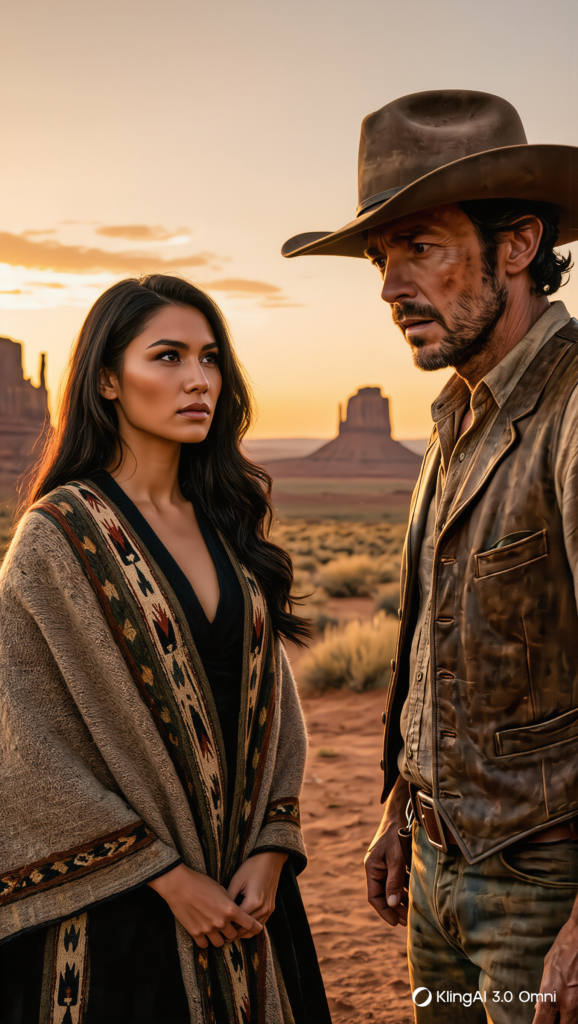
It was late October, the hour when the high desert hangs between night and day and the world is the color of ashes. Wade had stepped onto his porch with a tin cup of coffee, the way he did every morning, and there, beyond the sagging rail fence at the edge of the yard, beneath the lone cottonwood his father had planted forty years before, stood a figure wrapped in a gray blanket.
Motionless. Watching the house.
Wade set down his coffee and reached for the rifle propped beside the door. When he looked again, the figure had not moved. Mist drifted around its legs. A thin wind lifted strands of long white hair from beneath a faded headband.
An Apache. Old. Very old.
Wade waited for him to call out, to raise a hand, to do anything at all. He did not. He simply stood there, gazing at the front door of the ranch house as if he expected it to open by itself, until the first gold edge of the sun broke over the Dragoon Mountains. Then he turned and walked away along the narrow path that wound into the hills, and was gone.
Wade told himself it meant nothing. A traveler. A wanderer. A man lost in his own mind.
The next morning, the old man was back.
And the next.
And the next.
He came in the gray hour before dawn, in wind and in frost, and once through a cold rain that soaked his blanket black. He never crossed the fence. He never approached the house. He never asked for food or water or anything else. He simply stood beneath the cottonwood and watched the door, and when the sun rose, he left.
Wade Halloran was not a man who liked mysteries. He was thirty-four years old and he had buried too much already: his mother when he was nine, his father when he was fourteen, his wife, Clara, two winters ago, along with the son she had died trying to bring into the world. Since then, Wade had made his peace with silence. He worked his three hundred acres of rock and grama grass from dark to dark, spoke to his horses more than to people, and went into the town of San Isidro only when the flour ran out.
He did not want visitors. He especially did not want a silent old man who stared at his door as though it owed him something.
On the twelfth morning, Wade saddled his roan and rode out to confront him. But before he reached the cottonwood, the old man turned and walked into the hills, unhurried, and something in the straightness of that thin back made Wade rein in and let him go.
It did not feel like a threat. It felt like a question.
The trouble was, Wade had no idea what the question was.
By the third week, the old man was not the only thing troubling Wade.
The note from the San Isidro Land & Trust Company arrived on a Tuesday, delivered by a boy who would not meet his eyes. Wade read it on the porch and felt the floor of his life shift beneath him.
His mortgage, the one he had taken out to pay the doctor who had failed to save Clara, had been purchased by a new holder. The new holder was calling the full balance due. Wade had thirty days to pay, or the ranch would be seized.
The new holder’s name was printed at the bottom in tidy black letters.
Judge Corbin Slate.
Every soul in the territory knew Corbin Slate. He had come to San Isidro twenty years ago as a circuit judge and had never left. He owned the bank, the mercantile, half the town lots, and, it was said, most of the men who wore badges within fifty miles. He was soft-spoken, silver-haired, and generous at church. And for reasons Wade had never understood, he had spent two decades trying to buy the Halloran ranch.
Wade’s father had refused him. Wade had refused him. Now, it seemed, the judge had stopped asking.
That same evening, a rider came up the wagon road at a lazy trot: Ike Mercer, Slate’s deputy, a lean man with a broken nose and a habit of smiling when nothing was funny.
“Evening, Halloran.” Ike did not dismount. “Judge sends his regards. Says he’d be glad to forget that little note if you’d just sign the place over. Fair price. More than fair.”
“Tell the judge no.”
Ike’s smile widened. He glanced past Wade toward the cottonwood, now empty in the dusk.
“Heard you got yourself a visitor. Old buck comes round every morning, they say.” He leaned on his saddle horn. “There’s been cattle going missing out by Coyote Wash. Folks figure it’s Apache. Be a shame if a man got hanged for harboring thieves, Halloran. A real shame.”
He touched his hat and rode away, whistling.
Wade stood in the yard long after the sound of hooves had faded. He thought of Clara, who would have known what to say. He thought of his father, Jonah Halloran, a big, quiet man with scarred hands who had died when his horse threw him into Coyote Wash twenty years ago. Jonah had rarely spoken more than a dozen words at a stretch. But there was one thing he had said to Wade over and over, so often that the boy had stopped hearing it:
A man’s word is the only thing he owns that no one can take from him.
Wade had never understood why his father said it so often.
He was about to find out.
The thirtieth morning came in hard and cold, with frost silvering the fence rails and a bruise-colored sky building in the north. Snow weather. The first of the year.
The old man stood beneath the cottonwood as always.
But when the sun broke over the Dragoons, he did not leave.
Wade watched from the porch. A minute passed. Five. The old man stayed, his blanket pulled tight, his breath smoking in the frozen air, his dark eyes fixed on the door.
Something inside Wade finally snapped.
He snatched up the rifle and strode across the yard, frost crunching beneath his boots, his heart pounding with thirty days of bewilderment and a lifetime of grief. He stopped three paces from the old man, close enough to see the deep lines of his face, the cloudiness creeping across one eye, the tremor in his thin hands.
“All right,” Wade said. His voice came out harsher than he intended. “Thirty days. Thirty days you’ve stood at my fence. I’ve got a judge trying to take my land and a deputy calling me a thief-lover, and I’m done guessing. Who are you? Why do you come here every morning?”
The old man regarded him for a long, quiet moment. When he spoke, his English was slow and careful, worn smooth like a river stone.
“My name is Hashké.”
“That’s not an answer.”
Hashké turned his gaze toward the ranch house. Toward the door. Then he looked back at Wade, and in his eyes was a patience so deep it was almost unbearable.
“I am waiting for your father.”
Six words.
Wade felt the cold go straight through him.
“My father,” he said slowly, “has been dead for twenty years. He’s buried on that hill behind the barn. His horse threw him into Coyote Wash.”
Something flickered across Hashké’s face. Something old and painful.
“His horse did not throw him,” the old man said quietly.
The wind stopped. Or perhaps it was only Wade’s heart.
“What did you say?”
“Your father made me a promise. He said that if the day ever came that my people needed it, I should come to this door, and it would open.” Hashké’s voice dropped lower. “Twenty years, I did not come, because we did not need it. Now we do. So I came. Every morning, I waited for the door to open. It did not. I began to think his promise had died with him.”
“What promise?” Wade’s voice was raw. “What are you talking about? What do you mean his horse didn’t throw him?”
Hashké reached beneath his blanket and drew out something on a frayed leather cord: a small disk of carved juniper wood, worn nearly smooth. On it was a symbol, a circle split by a single jagged line, like lightning through the sun.
Wade’s breath left him.
He had seen that symbol before. Carved into the lid of a locked iron box beneath his father’s bed. A box he had been forbidden to touch as a child. A box he had carried to the root cellar after the funeral and never opened, because he could not bear to.
“Where did you get that?” he whispered.
“From the man who gave me his word.” Hashké tucked the disk away. Then he looked north, toward the hills, where the snow clouds were rolling down like a dark tide. “There is no more time to wait, Wade Halloran. My people are in the canyon at Piedra Roja. Old ones. Children. There is sickness among them. The snow is coming. And the men who steal cattle at Coyote Wash wear the judge’s badges. They will blame us. They will come for us.” He paused. “And they will come for you.”
“Why me?”
“Because of what your father left behind.” Hashké held his gaze. “Open the box.”
He turned to go.
“Wait!” Wade caught his arm. It was as thin as a dry branch. “You can’t just…”
The crack of the rifle shot split the morning in two.
Hashké jerked. A dark stain bloomed across his gray blanket, high on his shoulder, and the old man crumpled against Wade’s chest.
Wade spun, dragging the elder down behind the trunk of the cottonwood. On the ridge to the east, silhouetted against the sunrise, sat four riders. Sunlight flashed on a deputy’s star. Ike Mercer lowered his rifle and cupped his hand to his mouth.
“Step away from that cattle thief, Halloran!” he bellowed. “We’ve got a warrant for him! And the judge says if you’re harboring him, we’ve got one for you too!”
The riders spurred their horses down the slope.
Hashké’s fingers dug into Wade’s sleeve. His face was gray with pain, but his eyes burned.
“The box,” he gasped. “Open the box. Before they do.”
The first flakes of snow began to fall.
And Wade Halloran, with a wounded old man in his arms and four armed men charging across his land, realized that the promise his father made twenty years ago was about to cost him everything he had left.
PART TWO: What the Box Remembered
Wade did not decide to run. His body decided for him.
He hauled Hashké up, nearly weightless in his blanket, and half carried, half dragged him across the frozen yard toward the house. A bullet whined off the pump handle. Another punched through a porch post an inch from Wade’s head, spraying splinters. He kicked the door open, pulled the old man inside, and slammed the bar down across it just as hooves thundered into the yard.
“Halloran!” Ike Mercer’s voice. “Don’t be a fool! It’s one old Indian! Hand him over and you can keep your hide!”
Wade laid Hashké on the floor by the stove and tore away the blanket. The bullet had gone clean through the meat of the shoulder. Bleeding badly, but not mortal. Not yet. Wade pressed a dish towel against the wound and guided the old man’s own hand on top of it.
“Hold that. Hard.”
Hashké’s lips were pale. “The box.”
“I heard you.”
Wade crossed the kitchen in three strides, yanked open the trap door to the root cellar, and dropped into the darkness below. The cellar smelled of earth and onions and twenty years of things he had refused to think about. His hands found it by memory: the iron box, cold as a gravestone, tucked behind a barrel of old harness.
He hauled it up into the light. The lightning-sun symbol was etched into the lid exactly as he remembered. The lock was rusted shut.
Outside, a voice called, “Burn ’em out, Ike. Judge said whatever it takes.”
Wade seized the fire iron from the stove and struck the lock once. Twice. On the third blow, it shattered.
He threw back the lid.
Inside, wrapped in oilcloth, lay three things.
A leather journal, its cover cracked with age.
A folded document, heavy paper with a red wax seal stamped with an eagle.
And a letter, addressed in his father’s slow, careful hand: To my son, Wade. If Hashké has come to the door.
Wade’s hands shook as he broke it open.
Wade,
If you are reading this, then I am gone, and my old friend has come asking for what I swore to keep. I am sorry I never told you. I thought I was protecting you. Maybe I was only protecting myself.
Fifteen years ago, in the winter of the great blizzard, Hashké’s people came down out of the mountains starving. I found them in the canyon at Piedra Roja, the place they had wintered for a hundred years. I fed them. I stayed with them through the worst of it. And when the snows broke, an agent from Washington came through and I stood witness while he wrote out a federal grant. The canyon and its spring, set aside forever for Hashké’s people. Signed. Sealed. Recorded.
Only it never reached the county recorder. The man who was supposed to file it was the new circuit judge. Corbin Slate.
Slate burned the record. I know because I saw the ashes in his stove. There is silver in Piedra Roja, Wade. A rich vein. Slate knows it. Without that grant on file, the canyon is open land, and he can claim it the moment Hashké’s people are driven out.
But Slate made one mistake. The agent made two copies. One for the county. One for the witness. I have it. It is in this box. As long as it exists, Slate can never touch that canyon.
He has asked me twice to sell him this ranch. He knows the copy is here somewhere. Last night, he stopped asking. If anything happens to me, it will not be an accident.
I gave Hashké my word that the door of this house would always be open to his people. A man’s word is the only thing he owns that no one can take from him. I am leaving it to you now. It is the only inheritance worth having.
Your father,
Jonah Halloran
Wade read it twice. On the second reading, the letters blurred.
Twenty years. Twenty years he had believed his father died in a stupid, senseless fall. Twenty years Corbin Slate had smiled at him across the church aisle, shaken his hand at the mercantile, sent condolences when Clara died. Twenty years the judge had been hunting for the very paper that now lay in Wade’s lap.
And now Slate had bought his debt. Now he could take the house, tear it apart board by board, find the box, and burn the last proof that the canyon belonged to anyone but him.
Smoke curled under the door.
“They have fired the barn,” Hashké said from the floor. His voice was steady despite the pain. “Next, the house.”
Wade went to the window. Flames were racing up the side of the barn his father had built, roaring orange against the falling snow. His horses were screaming inside.
Rage rose in him like a flood. For a moment, he wanted nothing in the world except to throw open that door and empty his rifle into Ike Mercer’s grinning face.
Then he looked down at the journal, the grant, his father’s letter. And at the old man bleeding on his kitchen floor, who had stood at his fence for thirty mornings because a dead man had once promised him a door would open.
He made his choice.
“Is there a way out the back?” Hashké asked.
“The springhouse. There’s a tunnel to the arroyo. My father dug it.” Wade stopped. “My father dug it,” he said again, slowly, understanding at last why a quiet rancher had spent a whole summer digging a tunnel no one needed.
Jonah Halloran had known this day might come.
Wade stuffed the oilcloth bundle inside his shirt, against his skin. He threw a heavy coat around Hashké and hoisted him onto his back. Then he lit the lamp, set it in the front window so the riders would think he was still inside, and slipped down through the springhouse into the narrow dark.
They emerged in the arroyo a quarter mile from the house. Behind them, the barn was a pillar of fire. Wade had cut the horses loose on his way, and the roan came galloping out of the smoke, wild-eyed, and found him by the sound of his whistle.
From the ridge, Wade looked back once. Through the swirling snow he saw Ike’s men kick in his front door. He saw them drag his table into the yard, his chairs, Clara’s rocking chair, and pile them in the snow.
He did not let himself look again.
The canyon at Piedra Roja lay twelve miles north, a slash of red stone so narrow at its mouth that a man could ride past it a hundred times and never know it was there. They reached it at dusk, the roan stumbling through snow to its knees, Hashké slumped and shivering against Wade’s back.
Inside, the canyon opened like a cupped hand. A spring steamed in the cold air. Along its banks stood perhaps a dozen brush shelters, banked with snow, and among them moved figures: women wrapped in blankets, a few old men, children with hollow cheeks and enormous eyes.
They saw Wade and froze.
Then they saw Hashké, and a cry went up.
A young woman ran toward them through the drifts. She was perhaps twenty, with Hashké’s sharp cheekbones and a fierce, frightened face. She took the old man’s weight from Wade without a word, and only when Hashké was safely lowered by a fire did she turn on Wade, her eyes blazing.
“You did this?”
“No,” Hashké murmured. “Ishtá. No. He carried me home.”
The young woman, Ishtá, studied Wade for a long moment. Then she knelt and began cleaning her grandfather’s wound with snow water and practiced, gentle hands.
Wade sank down by the fire. For the first time, he truly looked at the people around him. A little boy coughing, a terrible wet rattling sound. An old woman rocking a baby too still and too quiet. Children with no shoes, their feet wrapped in rags.
“Fever,” Ishtá said, without looking up. “Half the children. We have no medicine. No food since the deer moved south. The judge’s men have been driving off every head of game near the canyon. They want us to starve or to run.”
“And if you run?”
“Then the soldiers will call it an outbreak and hunt us down.” Her voice was flat. “And the judge will take the canyon.”
Wade reached into his shirt and drew out the oilcloth bundle. He unwrapped the grant and held it in the firelight. The red eagle seal gleamed.
Hashké’s eyes filled.
“Jonah,” the old man whispered. “Old friend. You kept it.”
“He kept it,” Wade said, his voice rough. “And they killed him for it.”
He told them everything: the letter, the burned record, the fall that was no fall. When he finished, the canyon was silent except for the crackle of the fire and the wet coughing of the sick boy.
Then Ishtá spoke.
“There is a federal marshal at Fort Huachuca. Not one of the judge’s men. A man named Tillman. My grandfather knew him in the old days.” She looked at Wade. “If that paper reaches him, the judge cannot touch this canyon. Not ever.”
“Fort Huachuca’s forty miles,” Wade said. “In this snow, two days.”
“Then you should leave tonight.”
Wade looked at the children. At the old woman and the silent baby. At Hashké, gray-faced by the fire.
“And leave you here? Ike Mercer saw me carry your grandfather off. He’ll have trackers on the arroyo by morning. They’ll follow the roan’s prints straight up this canyon.”
Hashké lifted his head. In the firelight, his face seemed carved from the same red stone as the canyon walls.
“Then the paper must ride one way,” he said. “And the trail must ride another.”
It took Wade a moment to understand. When he did, his blood ran cold.
“No,” he said. “You can barely sit up.”
“I have stood at your door for thirty mornings, Wade Halloran.” The old man smiled faintly. “I think I can sit on a horse for one more night.”
But they never had the chance to argue it out.
Because at that moment, from the mouth of the canyon, came the sound of many horses. Torches bloomed in the darkness, one after another, a long chain of fire crawling up the snowy trail.
And a voice rang off the red stone walls, smooth and cultured and terribly familiar.
“Wade, son. It’s Judge Slate. I’ve got twenty men out here and a warrant for every soul in that canyon. Now, I know what you’re carrying. Your daddy had it, and now you do.” A pause. “You bring me that paper, and I let these people walk out of here alive. You don’t, and at first light, we come in shooting. Your choice, son. It always has been.”
Ishtá’s hand found her grandfather’s.
The children stopped crying.
And Wade Halloran stood up in the firelight, holding in his hands the only thing in the world his father had died to protect.
PART THREE: The Door That Opened
It was the longest night of Wade’s life.
He sat by the fire with the grant across his knees and listened to the judge’s men laughing at the canyon mouth, the clink of their bottles, the stamp of their horses in the cold. He thought of every way it could end. All of them ended in blood.
Near midnight, Hashké called him over.
“You are thinking of giving it to him.”
Wade didn’t deny it. “If I do, maybe these children live.”
“If you do, he will kill us anyway. There can be no witnesses. Your father knew that. That is why he never gave it up, even to save himself.” Hashké’s hand closed over Wade’s. “But you are not your father. You must choose your own way.”
Wade looked down at the old man’s thin fingers. At the juniper disk on its frayed cord. And slowly, an idea began to form.
“How well,” he asked, “do your people know this canyon?”
For the first time, Hashké laughed. It was a dry, cracked sound, like a branch breaking in winter.
“There is a goat path over the north rim,” he said. “Only a fool or an Apache would climb it in the snow.”
“Then I suppose I’ll find out which one I am.”
At first light, Wade Halloran rode alone down to the mouth of the canyon.
Twenty rifles followed him. In the center of the line sat Judge Corbin Slate on a tall black horse, wrapped in a buffalo coat, his silver hair bright against the snow.
Wade stopped ten paces away and held up the oilcloth bundle.
“Here it is.”
Slate’s eyes gleamed. “Bring it.”
“First, you send your men back down the trail. Every one. Then you and I talk.”
Slate studied him, then laughed softly. “Your daddy bargained too, son. Right up to the edge of Coyote Wash.”
Something in Wade went perfectly still. “So you admit it.”
“I admit nothing to a dead man.” Slate held out his gloved hand. “Give it here.”
Wade tossed him the bundle.
Slate caught it, tore open the oilcloth, and unfolded the heavy paper inside. His smile froze.
It was blank.
Except for six words, written in charcoal in Wade’s own rough hand:
I came to keep his promise.
Slate’s face went white, then purple. “Where is it?”
“Forty miles from here by now,” Wade said. “Riding to Fort Huachuca on the fastest pony in this canyon, with the bravest girl I ever met. She went over the north rim four hours ago. Your trackers were too drunk to notice.”
“Kill him!” Slate roared. “Kill him and burn that canyon to the…”
He never finished.
Because from the rim above, the canyon walls came alive. Every man, woman and child who could stand rose against the dawn sky, and every one of them held something: a rifle, a bow, an armful of stones, a burning brand. They did not fire. They did not shout. They simply stood, silent, the way Hashké had stood at Wade’s fence for thirty mornings.
Witnesses.
And from the trail behind Slate’s men came a new sound. Hoofbeats. Many of them. And a bugle.
Ishtá had not needed to ride forty miles. Halfway through the night, she had met a cavalry patrol escorting Marshal Ezra Tillman south toward San Isidro, sent by Washington to investigate a twenty-year-old land fraud complaint that a dead rancher named Jonah Halloran had mailed the week before he died, and which had sat lost in a government drawer ever since.
Tillman rode up with the grant in one hand and his revolver in the other.
“Corbin Slate,” he said, “you’re under arrest for fraud, for destruction of federal records, and for the murder of Jonah Halloran.”
Ike Mercer was the first to drop his rifle. The others followed, one by one, until the snow at Slate’s feet was littered with steel.
Corbin Slate never saw the inside of a courtroom. He died of an apoplexy in his cell in Tucson before the trial began, raging at the walls. The federal grant was entered into the county record at last, with Marshal Tillman’s seal beside the old eagle. The canyon at Piedra Roja and its spring belonged, forever, to the people who had wintered there for a hundred years.
The debt on the Halloran ranch, purchased with stolen money, was declared void.
Wade rebuilt the barn that spring. He did not do it alone. Hashké’s grandsons came to raise the walls, and Ishtá brought the children, healthy now, to carry nails and get in everyone’s way. The little boy who had coughed so terribly by the fire turned out to be the loudest of them all.
On a cold morning the following October, almost a year to the day since it had begun, Wade stepped onto his porch with his coffee and saw a figure beneath the cottonwood.
A gray blanket. Long white hair. A juniper disk on a frayed cord.
Wade smiled, set down his cup, and walked across the frosted yard.
“You know,” he said, “most folks just come knock on the door.”
Hashké’s eyes crinkled. “Most doors do not open.”
“This one does now.”
The old man looked past him at the house, at the new barn, at the smoke curling from the chimney and the second chair Wade had built for the porch. When he spoke again, his voice was soft.
“I came every morning for thirty days,” he said. “Do you know why I never knocked?”
Wade shook his head.
“Because a promise cannot be demanded. It must be chosen. Your father chose it. I needed to know if his son would too.”
Wade was quiet for a long moment. Then he reached into his pocket and drew out a second juniper disk, newly carved, the lightning-sun symbol cut clean and sharp into the pale wood. He had made it himself over the long winter evenings.
He placed it in Hashké’s hand.
“My word,” he said. “For your children, and theirs. This door stays open.”
The old man closed his fingers around it. His eyes shone.
Together they walked back to the house. Wade held the door wide, and Hashké stepped through it, into the warmth and the smell of coffee and woodsmoke, the way he had waited twenty years to do.
On the wall beside the stove hung Jonah Halloran’s letter, framed in plain pine. Wade paused beside it, as he did every morning now.
A man’s word is the only thing he owns that no one can take from him.
For most of his life, Wade had thought his father left him three hundred acres of rock and grass, a barn, and a house full of silence.
He knew better now.
His father had left him a promise. And a promise, kept, had given him back everything he thought he’d lost: a purpose, a family, and a door that would never again stay closed.