PART 1: Into the Flood
For three days the storms had hammered the Arizona high country. Thunder rolled through the canyons like artillery, and rain fell in grey sheets that turned dry washes into rivers and rivers into monsters. On the fourth morning the clouds finally broke. Pale gold light spilled across the rocky hills and scattered pines, and the air smelled of wet earth and crushed juniper.
Ethan Carter rode his bay gelding along a narrow trail high above the Salt Fork River, and he did not look down at the water.
He was thirty-eight years old. He had lived most of those years alone on a small ranch eight miles south, mending fences, nursing cattle through hard winters, and asking nothing of anyone. His hands were scarred and callused, and his face was quiet in the way of men who have learned to keep their troubles to themselves.
He preferred mornings like this one, still and clean, with nothing but birdsong and the steady rhythm of hooves on stone. He did not prefer the sound rising from the canyon below: the roar of the flooded Salt Fork, brown and churning, dragging whole trees downstream like kindling.
Ethan had not set foot in a flooded river since he was eight years old.
That was the spring his little sister Lucy slipped from the rocks at Miller’s Ford. He had been holding her hand. The current tore her away, and he stood on the bank screaming, too small and too afraid to go in after her. His father plunged into the water and searched until dark. They found her two days later, a mile downstream.
His father never blamed him. That was almost worse. All he ever said, years later, sitting on the porch with his pipe, was this: “If you ever get the chance to save a life, son, don’t you turn your back. Not ever.”
Ethan had carried those words like a stone in his chest for thirty years.
The storm had scattered broken branches and boulders across the trail, so he slowed the gelding to pick his way through. That was when something below caught his eye. At first it looked like driftwood tumbling in the brown water. Then he saw dark hair fanning out across the surface, and a hand rising for a moment before the current swallowed it again.
His heart stopped. Someone was in the river.
He kicked the gelding down the steep bank, sliding through mud and loose shale. As he got closer, the scene came horribly clear. A young woman was being swept downstream, her arms reaching weakly for the shore before the water pulled her under. She surfaced, gasped, and went down again.
Ethan tied the gelding to a cottonwood and ran to the edge. Then he froze.
The river roared at him. It was louder than he remembered, and much stronger. He could feel its pull from the bank, a cold, hungry thing. He was eight years old again, small and useless, watching Lucy’s yellow dress disappear around the bend.
His legs would not move.
The woman surfaced thirty yards upstream, and her eyes found his. She was terrified, pleading, and almost out of strength.
Don’t you turn your back. Not ever.
Ethan stepped into the river.
The cold hit him like a fist. The current slammed against his legs and tried to sweep them from under him. Every step took everything he had. Hidden rocks rolled beneath his boots, and debris struck his thighs. He waded until the water reached his chest, braced himself against a half-submerged boulder, and stretched out both arms as the woman tumbled toward him.
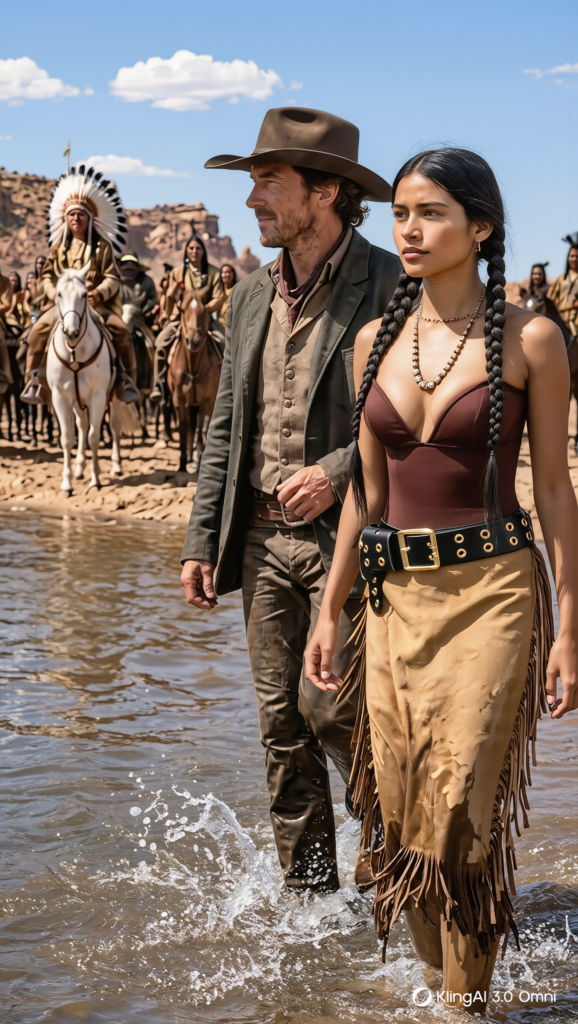
He caught her by the wrist and the collar of her dress. She was barely conscious, a dead weight. He hauled her against his chest, keeping her face above the water, and turned toward the bank.
The return was twice as long. The river wrapped around his boots like hands and pulled. Twice his feet went out from under him and they both went under, choking on muddy water. Twice he fought his way back up. A log the size of a wagon tongue swept past and missed his head by inches.
He would not let go. He would not let go this time.
At last his boots found solid ground. He staggered out of the water and laid the young woman gently on a patch of soft grass beneath a tall cottonwood, then collapsed beside her, gasping.
For a long moment neither of them moved. Then she coughed, a deep wrenching cough that brought up river water, and Ethan nearly wept with relief.
Her eyes opened slowly, full of fear and confusion. She looked around wildly, trying to understand where she was.
“You’re safe,” Ethan said, keeping his voice low and steady. “The river can’t reach you here.”
She tried to sit up and winced. “My horse,” she whispered.
“I didn’t see a horse. Rest a minute.”
As she caught her breath, Ethan noticed the necklace at her throat: polished turquoise stones strung with delicate beads, more finely made than anything he had ever seen. Her clothing, though soaked and torn, was beautifully worked with careful stitching and quillwork. This was no ordinary traveler.
She followed his gaze and laid her hand over the turquoise. “My father gave it to me,” she said softly, with pride beneath the weakness.
He offered his canteen. She drank carefully, then looked at him with dark, searching eyes. “You walked into that river for a stranger.”
Ethan glanced at the roaring water. His hands were still shaking, and not from the cold. “Couldn’t leave you there,” he said simply.
For the first time she smiled. “My name is Ayanna.”
“Ethan Carter.”
Something passed across her face when he said his name. It was quick, almost a flinch. Then it was gone.
“My family will be searching for me,” she said, looking toward the mountains.
“Then let’s help them find you.”
She hesitated. “There is something you should know.” Her voice dropped. “I am the daughter of Chief Nantan of the White Mountain people.”
Ethan absorbed that in silence. He had heard plenty of stories over the years. Some were true, and most were not. But what sat before him now was no legend and no threat. It was a frightened young woman who had nearly died.
Then she said something that turned his blood colder than the river had.
“And Ethan Carter, I did not fall into the river.”
He went still.
“I was riding home from my aunt’s camp at dawn. Men came out of the trees, white men with rifles. They were driving horses, our horses, stolen from our herd. I saw their faces. One of them saw mine.” Her hand trembled on the turquoise. “They shot my mare out from under me at the cliff edge. I fell.”
“Did you see who they were?”
“One of them, yes. I would know his face anywhere.” She swallowed hard. “He wore a star on his coat.”
A lawman. Ethan’s mind raced. Over the last two months cattle had been vanishing from every ranch in the valley. The ranchers blamed the Apache. Deputy Wade Prescott had been riding from ranch to ranch stoking that fear, saying the army was too slow and decent men might have to settle things themselves.
Before Ethan could answer, a sound rolled through the trees. It was hoofbeats, and then more of them, coming from every direction.
Ayanna lifted her head and listened. “They have found us,” she whispered.
Riders appeared along the rocky ridgeline, silhouetted against the morning sky. More slipped silently from behind the pines and boulders, and more came up from the valley floor, until Ethan realized with a sinking heart that they were completely surrounded.
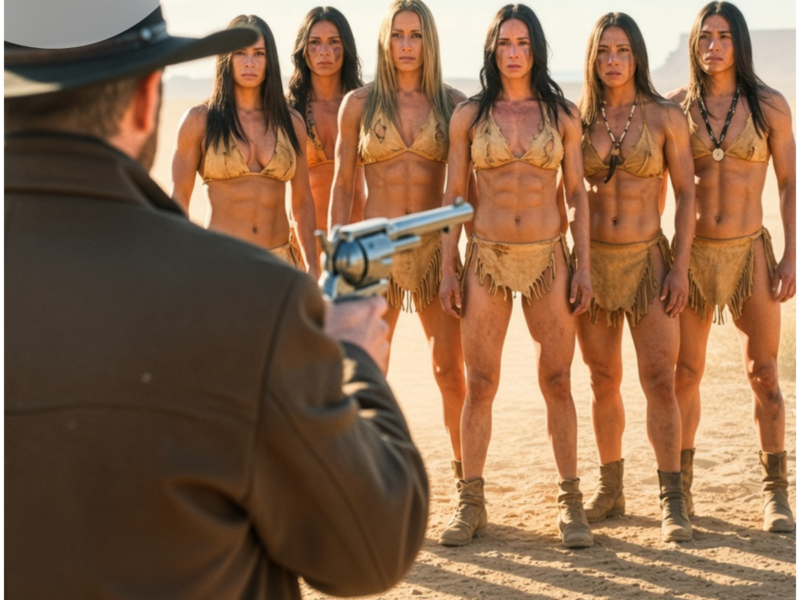
There were hundreds of them. He stopped counting at two hundred. Three hundred Apache warriors sat their horses in a vast, silent ring.
No one spoke. The only sounds were the breathing of horses and the hiss of the river behind him. Then, in one rippling movement that ran all the way around the circle, three hundred bows came up, and three hundred arrows were drawn back to three hundred cheeks.
Every one of them was aimed at Ethan Carter.
He did not reach for his rifle. He kept one hand open at his side and the other ready to steady Ayanna.
From the center of the ring, a young warrior drove his horse forward. He was tall and fierce, with a face like hammered copper, and he was shaking with rage. He reined in ten feet from Ethan and flung something into the mud at his feet.
It was a saddle blanket, scorched and torn. Burned into the leather corner patch was a brand Ethan knew better than his own signature: a C with a bar beneath it. C-Bar. The Carter ranch brand.
The blanket was soaked dark with dried blood.
“This was found three days ago,” the young warrior said in hard, clear English, “beside the body of my brother Hania. He was fourteen years old. He was guarding our horses.” His voice cracked like a whip. “The tracks of the men who killed him led south, toward your ranch, Ethan Carter.”
The bowstrings creaked tighter.
“Kitchi, no!” Ayanna cried. “He saved my life! He…”
She tried to rise, swayed, and crumpled back onto the grass, unconscious.
And as Ethan dropped to his knees to catch her, he heard the young warrior speak a single word in Apache. He did not need a translator to understand it.
Fire.
PART 2: The Trail of Iron
“Enough!”
The voice cracked across the clearing like thunder. Kitchi’s arm froze halfway through its downward stroke. Three hundred arrows held, trembling.
An older man rode forward on a powerful grey horse. His long silver hair was bound back from a face lined by many seasons, and his eyes held the kind of calm that only comes after a great deal of suffering. The warriors parted before him without a word.
Chief Nantan swung down from his horse and went straight to his daughter. He knelt beside her in the mud, laid his hand on her cheek, felt her breath, and closed his eyes. For one moment the great chief was simply a frightened father.
“I thought the river had taken you,” he whispered in Apache.
Ayanna’s eyes fluttered open. “Father.” She gripped his wrist. “He carried me out. He went into the flood for me.”
Nantan raised his eyes to Ethan. They studied each other for a long time.
“My son says you killed his brother,” the chief said at last.
“Your son is wrong,” Ethan said quietly. “But I understand why he believes it.”
“That blanket carries your brand.”
“Yes, sir. It came off a horse that was stolen from my corral in April, along with two others and my best saddle. I reported it to Deputy Prescott in Red Rock.” Ethan held the chief’s gaze. “He said he’d look into it. He never did.”
Kitchi spat on the ground. “Words! Every white man has words!”
Nantan raised one hand. Kitchi fell silent, though his whole body shook.
“Fear has stood between our peoples for many years,” the chief said slowly. “Trust is not given easily. Not after a boy of fourteen is buried.” He looked down at Ayanna, then back at Ethan. “But my daughter breathes because of you, and that I cannot ignore. You will come to our village. You will be our guest.” His eyes hardened. “And you will be watched. If what my son believes is true, you will not leave.”
The White Mountain village lay in a sheltered valley ringed by tall pines and steep red cliffs. Cookfires burned before the family lodges, children ran laughing along the creek, and elders talked quietly in the shade. On the surface it was peaceful, but Ethan felt the tension beneath it like heat beneath a stone.
Everywhere he went, eyes followed him. Some people nodded with quiet respect because word had spread that he had saved Ayanna. Others watched from a distance with flat, cold stares. Near a fresh grave at the edge of the village, a woman sat wrapped in a blanket, rocking slowly. Hania’s mother. When she saw Ethan, she turned her face away.
That night, Ayanna found him sitting alone outside the lodge they had given him, guarded by two silent warriors.
“They do not hate you,” she said softly, sitting beside him. “They are protecting the people they love.”
“I’d do the same if strangers came onto my land,” Ethan said. He stared into the fire. “My sister drowned when I was eight. I was holding her hand when the river took her. I stood on the bank and didn’t go in.” He’d never said it aloud to anyone. “Today was the first time I set foot in a flood since.”
Ayanna was quiet for a long moment. “Then today you saved two people,” she said. “Me, and the boy on the riverbank.”
He couldn’t answer that.
At dawn, Chief Nantan summoned Ethan to a flat stone beneath an old cottonwood overlooking the village. Kitchi stood behind his father with his arms crossed. The chief unrolled a hand-drawn map across the stone.
“For two months, cattle have vanished from the ranches in your valley,” Nantan said. “And for two months, our horses, our food, and our tools have vanished from our hunting camps. Each side believes the other is to blame.”
“My neighbors are saying the same thing,” Ethan admitted. “Prescott’s got them half-convinced your warriors are raiding them. There’s talk of a posse.”
“And my young men,” the chief said, glancing at Kitchi, “speak of riding against your ranches before the ranchers ride against us.”
Ayanna leaned over the map. “Someone wants each side to blame the other.”
“Then the real thieves are laughing at all of us,” Ethan said. “Let me look at where your boy died.”
They rode out with four seasoned scouts: Ethan, Ayanna, and Kitchi, who refused to let the cowboy out of his sight. The place was a high meadow where the White Mountain horse herd had grazed. The rain had washed most of the tracks away, but beneath a rock overhang, where the ground had stayed dry, Ethan knelt and brushed away the pine needles.
There was a horseshoe print, sharp and fresh. He studied it a long time.
“Your people’s horses,” he said to Kitchi, “are they shod?”
“Very few,” Kitchi said grudgingly. “We have no farrier.”
Ethan traced the print with one finger. “Look at the nail holes. Four on one side and three on the other, and there’s a notch in the heel calk.” He looked up. “There’s only one man in this whole territory who shoes a horse like that. Gus Henning, the blacksmith in Red Rock. And he only shoes horses for folks who can pay his prices.” He stood slowly. “Folks like the sheriff’s office.”
The scouts murmured. Kitchi’s jaw tightened, but he said nothing.
“Whoever made this print wasn’t Apache,” Ethan said. “And he wanted you to find my brand next to your brother so you’d ride south looking for me.”
They followed the iron-shod tracks all afternoon and into the night, through forest and valley and over rocky ridges where the trail almost vanished. The moon rose over the cliffs and gave them just enough light. Kitchi rode beside Ethan in silence, but somewhere in those long hours his stare changed from hatred to something more like fierce, wary attention.
Near midnight, crossing a crumbling ledge above a ravine, Kitchi’s horse stumbled. The ground gave way beneath its hooves, and horse and rider pitched toward the drop.
Ethan didn’t think. He lunged from his saddle, caught Kitchi by the arm, and threw his whole weight backward. For a moment they hung on the edge, the young warrior’s legs dangling over sixty feet of darkness. Then the two men tumbled back onto solid rock together. Kitchi’s horse scrambled up beside them, wild-eyed but unhurt.
They lay there breathing hard. Kitchi stared at the cowboy who had just pulled him from his death.
“Why?” he said hoarsely.
Ethan wiped the dirt from his face. “My father used to tell me that if you get the chance to save a life, you don’t turn your back.” He got to his feet and offered his hand. “Doesn’t matter whose.”
Kitchi looked at the hand for a long moment. Then he took it.
An hour before dawn, the lead scout raised his fist. Everyone stopped.
Below them, tucked between enormous boulders in a hidden canyon, lay an old abandoned silver mine. Smoke curled from a single chimney. A rope corral held at least sixty head of cattle, every brand in the valley mixed among them, and two dozen Apache ponies.
Ethan and the scouts crept down through the rocks until they could hear voices through the cracked boards of the mine office.
“One more raid,” a man said, laughing. “Tonight we hit Hollister’s place. We take the herd, burn the barn, and leave a few Apache arrows in the fence posts. By sunrise every rancher in the valley will be riding for that village with a rifle.”
“And while they’re killing each other,” said a second voice, “we drive everything across the border to the Mexican buyers. Forty thousand dollars, boys.”
Then came a third voice, smooth and cold and terribly familiar.
“Let me worry about the ranchers. I’ve been riding ranch to ranch for two months making sure they’re scared enough. Once they’re in the saddle, I’ll lead the posse myself. Nobody’ll question a deputy.”
Ayanna’s fingers dug into Ethan’s arm. Her face had gone white. She mouthed the words without a sound.
That is him. The man with the star.
Ethan pressed his eye to a crack in the boards. In the lamplight sat Deputy Wade Prescott with his boots on the table, a glass of whiskey in his hand and a tin star gleaming on his coat. Beside him, drinking from the same bottle, was a scarred outlaw Ethan recognized from a wanted poster: Cole Dacey.
Then Prescott pulled something from a saddlebag and tossed it on the table. Ethan’s breath caught. It was a hand-tooled saddle, Ethan’s own, stolen from his barn in April.
“Leave this at Hollister’s tonight,” Prescott said. “Next to the Apache arrows. If Carter shows up asking questions, the ranchers’ll think he’s been riding with the savages. Two birds, one stone.”
Kitchi’s hand drifted toward his knife. Ethan caught his wrist and shook his head slowly.
Not here. There are too many of them.
They backed away from the mine one silent step at a time. When they reached the horses, the eastern sky was already turning grey.
“Hollister’s ranch is twenty miles south,” Ethan said grimly. “If they hit it tonight, the posse rides on your village at sunrise tomorrow. Two hundred ranchers, Chief Nantan. And your three hundred warriors will be waiting for them.”
Kitchi looked at Ethan. In his eyes there was no more hatred, only understanding and something close to dread.
“Then we have one day,” he said, “to stop a war.”
PART 3: Side by Side
They rode without stopping. When they reached the village, Chief Nantan was waiting. He listened to every word: the iron horseshoes, the stolen cattle, the deputy with the star, the plan to set two peoples killing each other while thieves walked away rich.
When Ethan finished, the village was utterly silent.
Kitchi stepped forward. “Father,” he said, his voice rough. “I was wrong about him. He pulled me from the edge of a ravine. Hania’s killer wears a white man’s star, and he wanted us to blame this cowboy.” He turned to his warriors. “I will not give that man the war he wants.”
Chief Nantan looked out over his people.
“For many years fear has divided us,” he said. “If we answer fear with more fear, the thieves win.” He raised his voice. “We will protect our families. And today we will protect our neighbors too.”
Within minutes nearly three hundred warriors were mounted. They rode out to prevent a war, not to start one.
Ethan galloped south alone.
By the time he thundered into Red Rock, the town square was a hornet’s nest. Hollister’s barn had burned in the night, his herd was gone, and Apache arrows had been found jammed into his fence posts. Beside them lay Ethan Carter’s saddle.
Nearly two hundred armed ranchers milled around the general store. At their head, on a tall black horse, sat Deputy Wade Prescott.
“There he is!” Prescott roared, pointing. “Carter! The man who’s been riding with the savages!”
Rifles swung toward Ethan. He reined in hard in the middle of the square and raised both empty hands.
“Listen to me! You’ve been played! The Apache aren’t stealing your cattle! The man doing it is sitting on that black horse wearing a badge!”
The square erupted. Prescott laughed coldly. “Grief’s made you crazy, Carter. Boys, the savages are massing in the hills right now. If we don’t hit them first…”
“Look!” someone shouted.
Every head turned.
On the long ridge east of town, riders were appearing. There were dozens, then hundreds, three hundred Apache warriors in a line against the morning sky.
Rifles came up all across the square, and hammers clicked back. Up on the ridge, bows rose. The whole valley held its breath on the edge of a slaughter.
Then one rider came down the hill alone, at a walk: Chief Nantan on his grey horse, with both hands raised and open. Beside him rode Ayanna, wearing her turquoise necklace.
Ethan spurred his horse into the open ground between the two forces and turned to face the ranchers.
“They came to help!” he shouted. “Hold your fire!”
“Fire!” Prescott bellowed. “Shoot, damn you, before they…”
Ayanna rode straight up to him. She looked into Prescott’s face and pointed at the star on his coat.
“You,” she said, loudly enough for every man in the square to hear. “You shot my mare out from under me at the Salt Fork cliffs four mornings ago. You were driving stolen horses. You saw my face, and I saw yours.”
Prescott went white.
At that moment, from the canyon beyond the town, came a sound like thunder: hundreds of hooves. A huge herd of stolen cattle came pouring out of the hills, every brand in the valley mixed together, with Cole Dacey and a dozen outlaws whipping them hard for the border trail. Prescott had told his gang to run the herd south while the posse was busy dying.
Kitchi rose in his stirrups on the ridge and pointed. “There!”
For one heartbeat nobody moved. Then old Tom Hollister, whose barn still smoked, saw his own brand on the lead steer.
“That’s my herd!” he roared.
What happened next became a story the valley would tell for a hundred years. Apache warriors and ranchers charged down the valley side by side for the first time in living memory. They closed from both flanks like two hands, rounding the bend of the canyon road and sealing the outlaws in before they could reach the hills. Dacey’s men looked at three hundred warriors on one side and two hundred ranchers on the other, threw down their guns, and raised their hands.
In the town square, Wade Prescott tried to slip away on his black horse. Kitchi was waiting at the end of the street. The young warrior didn’t draw a weapon. He simply took the black horse’s bridle and held it.
“My brother was fourteen,” he said quietly.
Prescott looked down into his eyes and crumpled in the saddle.
The ranchers bound him with his own rope and tore the star from his coat.
A week later, both peoples gathered on the banks of the Salt Fork, at the very spot where Ethan had pulled Ayanna from the flood. The river ran calm and clear now and caught the sunlight like hammered silver.
Chief Nantan stood before his people and the ranchers who had come to give thanks. He raised his hand, and the crowd fell silent.
“This river nearly took my daughter,” he said. “But it also brought us a man who reminded us that courage begins with compassion.”
He placed a turquoise pendant in Ethan’s hand, carved with the symbol of running water.
“Wherever you go, this says you will always have a place among us.”
Ethan closed his fingers around it. “I didn’t expect any reward,” he said. “Seeing our people standing together is more than enough.”
Kitchi stepped forward and clasped Ethan’s forearm, warrior to warrior. “My brother would have liked you,” he said, and his eyes were wet.
Hania’s mother came last. She did not speak. She simply laid her hand on Ethan’s chest, over his heart, and held it there for a long moment before turning away.
As the sun sank behind the mountains, settlers and Apache shared a simple meal by the water. Children splashed in the shallows, laughing without fear, while elders traded stories of hope instead of grief.
Ayanna sat beside Ethan on the bank, watching the river.
“Are you still afraid of it?” she asked.
He thought of Lucy in her yellow dress and of his father’s words on the porch. Then he thought of a young woman reaching for him from the flood, and of how, this time, he had gone in.
“No,” Ethan said softly. “I think I finally made my peace with it.”
Months later, travelers passing through the valley still heard the tale of the cowboy who carried the chief’s daughter out of a raging river and looked up to find three hundred Apache warriors with their bows drawn. Everyone expected that story to end in blood. It became something far greater: the story of how one act of courage built a bridge between two peoples, and proved that the bravest thing a person can do is reach out a hand to a stranger in the flood.
THE END