PART ONE: The Pine on the Hill
The storm came down out of the Mogollon Rim like something with a grudge.
By midnight it had torn the shingles off the east side of Eli Carter’s barn. By two it had turned Cottonwood Creek, a dry scar of sand for eleven months of the year, into a roaring brown animal that chewed at its own banks. By the time the thunder finally rolled away toward New Mexico, an hour before dawn, Eli had not slept at all. He sat at the kitchen table with a cold cup of coffee and listened to the rain drip from the eaves the way a man listens to a clock in a sickroom.
Across from him sat the empty chair.
It had been Clara’s. Five years now, and he had never moved it. The neighbors who still visited, and there were fewer each year, had learned not to look at it. Eli looked at it every morning and every night. Some days it felt like grief. Most days it simply felt like company.
At forty-two, Eli Carter was a lean, weathered man with gray in his beard and a stillness about him that strangers mistook for coldness. He ran sixty head of cattle, kept four horses, and spoke to perhaps three people a month. He went to Prescott only when the flour ran low. The ranch had been his and Clara’s dream once; now it was the place he hid from a world that had taken her with a fever in nine short days.
When first light broke gray and sullen over the hills, he saddled Daisy, his old brown mare, and rode north to check the fences.
The land looked beaten. Juniper limbs lay strewn across the trail like broken bones. Mud sucked at Daisy’s hooves. The air smelled of wet stone and ozone, and somewhere far off a hawk screamed, thin and furious. Eli found three posts down in the first mile and marked them in his mind. He was following the swollen creek toward the north pasture when he saw it.
A dark shape lay beneath the great ponderosa pine on the rise, the one lightning had split years ago, so that it grew now in two crooked halves like a hand raised in warning.
He thought at first it was a saddle blanket, washed down from somewhere upstream. Then the wind shifted, and the cloth lifted, and he saw a hand.
Eli was out of the saddle before he knew he had moved.
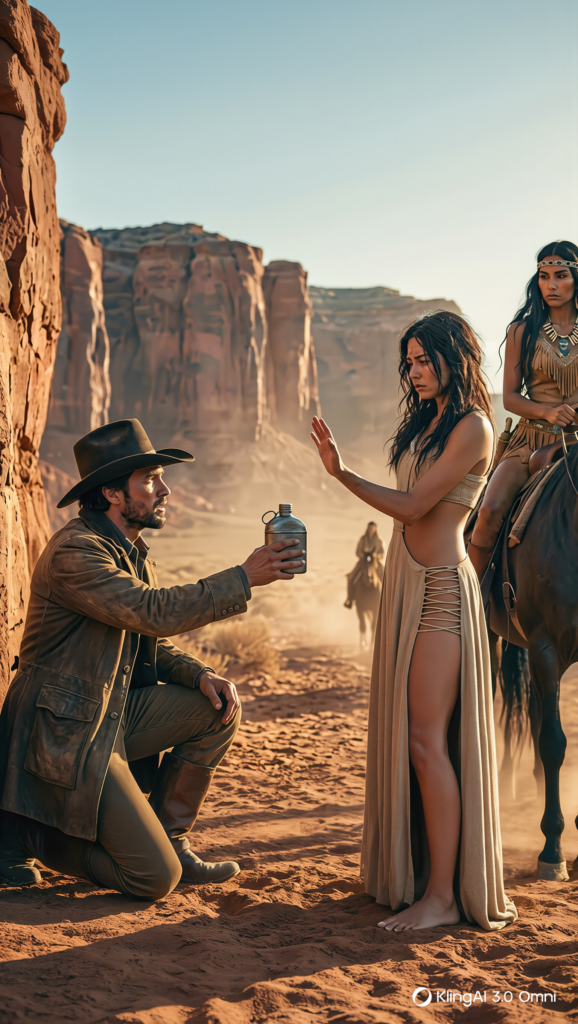
She lay curled against the roots as if she had crawled there seeking the last dry ground on earth. An Apache woman, perhaps twenty-five, her dark hair matted with mud, her buckskin dress soaked black. Her lips were the color of ash. There was a gash along her left forearm, crusted and angry, and her moccasins had been worn nearly through. Eli knelt and pressed two fingers to her throat.
A pulse. Faint as a moth against glass, but there.
He scanned the hillside. No horse. No travois. No tracks the rain had not already swallowed. Only the howl of the creek and the drip of the pines.
“Can you hear me?”
Her eyes opened, black and unfocused, and fixed on him with a terror so naked that Eli felt it in his own chest. Her hand moved weakly toward her belt, where an empty knife sheath hung.
“Easy,” he said, and he held up both his palms. “Easy now. I’m not going to hurt you.”
She tried to speak. Nothing came but breath.
Eli stripped off his coat and wrapped it around her shoulders. She was so cold it frightened him. He had seen men die of that kind of cold, men stronger than her, and he knew there was no time to wonder who she was or how she came to be here.
Lifting her onto Daisy was the hardest thing he had done in years. She was light, too light, but she sagged like water, and twice she nearly slid off the other side. At last he swung up behind her, held her against his chest with one arm, and turned the mare for home.
It was a long ride. Every few minutes he spoke to her, his voice low and steady, the way he would speak to a frightened colt. Almost there. Stay with me. Almost there. He did not know if she understood English. He did not know if she understood anything at all. But once, when Daisy stumbled crossing a wash, the woman’s hand closed on his sleeve and held on.
At the cabin he carried her inside and laid her on a pallet of blankets before the hearth. He built the fire up until it roared. He cleaned the wound on her arm with boiled water and whiskey, and she didn’t flinch, which worried him more than if she had screamed. He dribbled warm broth between her lips a spoonful at a time.
That was when he saw the wound for what it was.
It wasn’t a tear from a branch or a rock. It was a clean, straight cut, the kind a blade makes when someone is fending it off.
Eli sat back on his heels and looked at her for a long while.
She woke that night.
Eli was dozing in the chair by the window, rifle across his knees, when he heard her stir. He opened his eyes and found her watching him from the pallet, the firelight sharpening the angles of her face.
“You’re safe,” he said quietly. “My name is Eli Carter. This is my ranch.”
For a long moment she said nothing. Then, in a voice like dry grass: “Ayita.”
“Ayita.” He nodded. “That’s your name?”
She nodded once.
“Where are your people, Ayita?”
Her gaze drifted to the black window, and her face changed. The fear came back into it, sharper now. “My mother,” she whispered. Then something else, a word in her own language he didn’t know. And then, in English, very clearly: “Men. With guns. They will look for me.”
The fire popped. Somewhere outside, a horse shifted in the barn.
“What men?”
But her eyes had already closed.
Eli did not sleep again that night.
On the second day, they came.
He saw the dust first, just after noon: three riders moving along the creek bottom from the south, slow and deliberate, the way men ride when they are reading the ground. Eli watched them through the window. Then he took down the Winchester, checked the loads, and went out onto the porch.
Behind him, Ayita had pushed herself up on one elbow. Her face had gone gray.
“Stay down,” he said without turning. “Stay away from the window.”
The riders came up the lane and reined in twenty feet from the porch. The man in front was big through the shoulders, with a pale, pockmarked face and a long gray duster that had seen a great deal of weather. A bandolier crossed his chest. The two behind him were younger, hungrier, and they let their eyes wander over the barn, the corral, the cabin door.
“Afternoon,” the big man said. His smile didn’t reach anything above his mouth. “Name’s Silas Crane. We’re tracking a runaway, an Apache woman, young, cut on the arm. Stole two horses from a freight outfit down by Black Canyon. Killed a man doing it.” He let that settle. “There’s a bounty. A good one. You seen her?”
Eli leaned on the porch post. The rifle hung easy in his hand, muzzle toward the boards.
“Storm took down half my fences,” he said. “I’ve seen a lot of mud. Haven’t seen any horses that weren’t mine.”
Crane studied him. “Tracks we followed ended about a mile north of here. Big pine on the hill.”
“Rain washes out a lot of tracks.”
“It does.” Crane’s eyes slid past Eli to the cabin door. “Mind if we water our horses? Maybe take a look around?”
“Trough’s by the barn,” Eli said. “Water’s free. Looking around isn’t.”
One of the younger men laughed. Crane didn’t. For a long, long moment no one moved. The wind came down off the hills and set the windmill creaking. Eli did not raise the rifle. He did not need to. He simply stood there, a still, gray man on a still, gray porch, and let Silas Crane decide what kind of afternoon it was going to be.
Crane touched his hat brim.
“We’ll be around,” he said. “Country like this, a man gets lonely. Might be he gets to thinking a few hundred dollars is better company than a squaw who’ll knife him in his sleep.” He wheeled his horse. “You think on it, Carter.”
Eli had never told him his name.
He watched them until they were specks on the southern ridge. Then he went inside and found Ayita sitting upright against the wall, a kitchen knife in her good hand, her whole body trembling.
“I did not steal,” she said. “I did not kill anyone.”
“I know.”
She stared at him. “How do you know?”
Eli set the rifle against the table, beside the empty chair. “Because a man who’s telling the truth doesn’t need to tell me there’s a bounty before I ask.”
For the first time, she lowered the knife.
That night, she told him in halting pieces. She and her two cousins had been traveling north to rejoin her mother’s band in the high country. Crane’s men had come upon their camp at dusk. They wanted the horses, and they wanted more than horses. Her cousins had fought. She had run. The storm had swallowed her. She did not know if her cousins were alive.
“Crane is a scalp hunter,” she said flatly. “Mexico still pays. He says bounty to white men so they will help him.”
Eli was quiet for a long time.
“He’ll come back,” he said at last.
“Yes.” Ayita looked at him across the firelight, and there was something unbearably old in her young face. “You should give me to him. Then he leaves you alone.”
Eli looked at the empty chair. He thought of Clara, who had once walked four miles through snow to sit with a Mexican family’s dying grandmother because nobody else would. Who had said, on the last clear night of her life, Don’t you close yourself up when I’m gone, Eli. Don’t you dare.
“No,” he said.
On the third morning, the world went silent.
Eli felt it before he understood it. No birdsong. No lowing from the pasture. The horses stood rigid in the corral, ears pricked east, nostrils flaring. Ayita stood in the cabin doorway with a blanket around her shoulders, and she had gone utterly still.
Then it came, from very far away.
A sound like distant thunder, except the sky was clear. It rose up through the soles of Eli’s boots. It shivered the water in the trough. It grew, and grew, and kept on growing until it was not one sound but hundreds: hooves, an ocean of hooves, rolling down out of the eastern hills.
Eli walked to the edge of the yard. He had the Winchester in his hand, and then, slowly, deliberately, he leaned it against the fence post and stepped away from it.
Along the whole length of the eastern ridge, riders appeared against the white dawn sky.
Ten. Fifty. A hundred. More than he could count, men and women on painted ponies, lances and rifles upright, ranged in a silent line that stretched from the creek to the dead cottonwood. The sun broke behind them so that they were nothing but black shapes cut out of fire.
At the center rode an old woman on a black horse.
She came down the slope alone, at a walk. Her hair was silver and bound in a single braid. Her face was carved deep by sun and grief and years, and her eyes, when she drew near enough for Eli to see them, were black flint.
Behind him, he heard Ayita make a sound that was half a sob.
But the old woman did not look at her daughter. Not yet. She reined in her horse ten feet from Eli Carter and looked down at him for a long, long time, as if reading something written across his face in a language only she could see.
Then she lifted her hand and pointed, not at him, but past him, through the open cabin door, at the empty chair beside the table.
And she spoke, in English, slow and clear.
“Where is Clara?”
PART TWO: The Debt
Eli could not breathe.
The name hung in the cold air between them like a struck bell. Five years. Five years he had not heard another living soul say it aloud. The neighbors said your late wife. The preacher in Prescott had said the departed. Even Eli, alone at night, had stopped saying it, as though the name were something that could break.
“How,” he said, and his voice cracked like old leather, “how do you know that name?”
The old woman’s face did not change, but something moved behind her eyes. She looked at him, at the gray in his beard, at the house, at the chair. And then she understood. Eli watched her understand. He watched the knowledge travel down through her like a stone falling into deep water.
“Ah,” she said softly. “Ah.”
She closed her eyes.
Then Ayita was running across the yard, barefoot in the mud, the blanket falling from her shoulders, and the old woman slid from her horse with a speed that belied her years and caught her daughter in her arms. They held each other and did not speak. Ayita wept openly. The old woman did not weep, but she pressed her face into her daughter’s hair and her shoulders shook once, hard, as if something had come loose inside her.
Up on the ridge, the line of riders did not move. But a sound passed among them, low and rising, a kind of keening murmur of relief that Eli felt in his bones.
He turned away and looked at the hills. Whatever this was, it did not belong to him.
Her name was Natsah.
She told him so an hour later, sitting on an upturned crate in the yard while the women of her band tended to Ayita’s arm with poultices and the men watered their ponies at the creek. A dozen of them had come down into the yard. The rest remained on the ridge, watchful, a living wall between the ranch and the southern hills.
“You found my daughter,” Natsah said.
“Under the split pine. North pasture.” Eli sat on the porch steps, his hat in his hands. “She was nearly gone.”
“Tell me everything.”
So he did. The storm. The cold. The wound. The broth, spoon by spoon. Silas Crane on his porch, smiling with only his mouth. Natsah listened without once interrupting, her flint eyes never leaving his face. When he finished, she was silent for a long time.
“Why did you help her?” she asked at last.
Eli frowned. “She was dying.”
“You did not know who she was.”
“No.”
“You did not know where her people were. Whether we would come for her, or come for you.”
“No.”
“There is money on her head. More money than this ranch makes in a year.”
“That’s Crane’s money,” Eli said. “Not mine.”
Natsah studied him. Then, very slowly, she reached into a small leather pouch at her throat and drew out something that caught the morning light.
It was a silver locket. Small, tarnished, oval. Eli knew it before she even opened her hand all the way. He knew the dent in its lower edge where it had once been stepped on in a Missouri dance hall. He knew the tiny engraved initials on the back. He had bought it himself, for nine dollars, the week before he married her.
C.A.M. Clara Ann Mitchell.
The world tilted.
“Where did you get this?” His voice came out a whisper.
“She gave it to me,” Natsah said. “Eleven years ago. In the winter of the great snow.”
She told it simply, the way people tell stories they have told themselves a thousand times.
Eleven winters ago, the cavalry had burned their camp on the Verde. Natsah had fled into the mountains with her infant son and a girl of fourteen, Ayita, and nothing else. The snow had come early that year and stayed late. Her son had taken a fever. By the fifth day, he no longer cried.
“I came down out of the mountains to find a white man’s house,” Natsah said. “I knew they might shoot me. I thought it was better to die by a bullet than to watch my son die in the snow.”
The first ranch had set dogs on her. The second had fired a shotgun over her head.
The third had been a small cabin by a dry creek, with a split pine on the hill above it.
“A woman opened the door,” Natsah said. “Yellow hair. Small. She looked at me. She looked at my son. She did not call for her husband. She did not reach for a gun. She just stepped back and opened the door wider.”
Eli put his hand over his eyes.
He remembered that winter. He had been gone nearly a month, driving cattle to the railhead at Holbrook, snowed in for two weeks at a line camp with five other men and a bad stove. When he came home, Clara had been thin and tired and strangely quiet, and when he asked her what had happened, she had only smiled and said, I had visitors. I’ll tell you about it someday.
She never had. And then there had been no more somedays.
“She kept us eleven days,” Natsah said. “She sat up with my son every night. She gave him medicine from a brown bottle. She cut up her own blankets to make him warm. When the fever broke, she cried more than I did.” The old woman’s voice roughened, just slightly. “When we left, I had nothing to give her. So she gave me this.” She held up the locket. “She said, If you ever need help again, come back. This house will remember you.”
The yard had gone very quiet. Even the women tending Ayita had stopped to listen.
“My son is a man now,” Natsah said. She turned and pointed to a tall young rider standing beside his pony at the creek, broad-shouldered, watchful, a rifle across his back. “His name is Tazhi. He is alive because of Clara.”
Eli could not speak. He looked at the young man, and the young man looked back at him, and something passed between them that had no words.
“When my daughter did not come home,” Natsah went on, “we followed her trail. The storm took most of it. But Tazhi found the split pine. And I knew this place. I knew it.” She folded the locket back into her palm. “I came here thinking, Clara has done it again. I came to thank her.”
Her eyes, those black flint eyes, were wet now.
“I did not know she was gone.”
Eli lowered his hand from his face. When he spoke, his voice belonged to someone younger, someone who had not yet learned how much the world could take.
“Fever,” he said. “Five years ago. Nine days.” He swallowed. “She never told me about you. Not once.”
“No,” Natsah said gently. “She would not. A gift you speak of is half a gift.”
And for the first time in five years, Eli Carter wept. Not quietly, not in the dark, not alone at a table across from an empty chair, but in the open, in the morning light, in front of a hundred strangers. And no one looked away. And no one laughed. Natsah simply sat beside him on the porch step and laid her weathered hand on his back, the way you would steady a horse in a storm.
They stayed that day.
For the first time in five years, the ranch was full of sound: children chasing chickens around the barn, the smoke of a dozen cookfires, women laughing over the corral fence, men trading horse talk in two languages and a great deal of pointing. Tazhi spent the afternoon helping Eli reset the fence posts the storm had felled, saying little but working like two men. Ayita slept for hours in the sun beside the cabin, her mother’s shawl over her, her face finally loose with peace.
At dusk, Natsah found Eli at the woodpile.
“Crane,” she said.
Eli split a round of juniper and set the axe down. “I know.”
“My scouts have seen him. He has more men now. Fourteen, maybe fifteen. Hard men from Sonora. They camp in the canyon south of here.” She watched him carefully. “He thinks you are alone. He does not know we are here. The ridge hides us from the south.”
“He’ll come tonight.”
“Yes. He will come for my daughter. And for you, because you said no to him.” Natsah’s jaw tightened. “We could go. Now. Take Ayita into the high country. He would never find us. But then he finds you alone.”
Eli looked at the cabin. At the light in the window. At the chair.
“Then don’t go,” he said.
Natsah regarded him for a long moment. Then something almost like a smile touched the corner of her mouth.
“Clara said you were stubborn,” she said.
Eli stared at her. “She talked about me?”
“Every night for eleven nights.” The old woman turned toward the fires. “She said, My husband is a quiet man, but there is nothing in this world he would not do for someone who needs him.” She glanced back over her shoulder. “I see she did not lie.”
They came two hours after moonrise.
Eli heard them before he saw them: the chink of a bit, a stone turning under a hoof, a low laugh cut short. He stood alone on the porch, as he had the day before, the lamp lit behind him so that he made a perfect silhouette in the doorway. The Winchester leaned against the post. The yard was empty. The fires had been doused an hour ago, the children and the horses moved behind the barn.
Silas Crane rode into the lamplight with fourteen men fanned out behind him.
“Evening, Carter,” he said. “You do any thinking?”
“Some.”
“And?”
“I think you should turn around,” Eli said. “I think you should ride back to wherever you came from and find some other way to make a living. That’s my thinking.”
Crane laughed, and his men laughed with him. “Old man. You’re one rifle against fifteen. Bring her out, and you can keep your little ranch and your little life. Make it hard, and they’ll find you in the spring when the snow melts.”
Eli didn’t answer.
He simply lifted the lamp off its hook and raised it high above his head.
On the ridge above the ranch, two hundred riders stood up out of the darkness.
They did not shout. They did not fire. They simply rose against the moonlit sky, one after another after another, a black wall of men and horses that ran from the creek to the cottonwood and kept on going, and then, very slowly, they began to walk their horses down the slope. From behind the barn came more. From the creek bed, more still. Tazhi rode out of the shadow of the windmill not twenty feet from Crane’s left side, his rifle level, his face like stone.
Crane’s horse danced sideways. One of his men swore in Spanish. Another simply turned his mount and bolted south into the dark, and after a heartbeat, two more followed.
Natsah rode into the lamplight on her black horse and stopped beside the porch.
“This house,” she said to Silas Crane, in a voice that carried across the whole moonlit valley, “is under the protection of my people. Now, and for as long as one of us lives. If you come here again, you will not leave. If any man comes here because you sent him, you will not live to collect your money.”
Crane looked at her. Looked at the ridge. Looked at the hundred rifles that had not yet been raised, and at Eli Carter on his porch with the lamp still lifted, steady as a lighthouse.
And for the first time, the smile left Silas Crane’s mouth entirely.
PART THREE: The Chair
Crane left that night with what remained of his men and was never seen on the Verde again. Months later, word came up from Tucson that he’d been arrested in Nogales for crimes on both sides of the border, and that the Mexican governor was no longer paying for anything at all.
Eli read the newspaper twice, folded it carefully, and put it in the stove.
Natsah’s band stayed three more days. On the last morning, while the riders saddled their ponies in the gray light, Ayita found Eli at the corral, rubbing down Daisy.
“My mother told you,” she said. “About your wife.”
“She did.”
Ayita leaned on the rail beside him. Her arm was bound in clean deerskin now, and the color had come back into her face. “I remember her,” she said softly. “I was fourteen. She taught me to make biscuits. I burned all of them.” A small smile. “She ate them anyway. She said they were the best she ever had.”
Eli laughed, and it surprised him: a real laugh, rusty but whole. “That sounds like her.”
“When I was lost in the storm,” Ayita said, “I did not know where I was going. My feet just walked. I thought I was going to die. And then I saw the split pine.” She turned to look at him. “I think my feet remembered. Even when I didn’t.”
Eli was quiet a long time.
“You going home now?”
“For a while.” She hesitated, then looked toward the cabin. “But my mother says this house remembers us. I would like to remember it, too. If you will let me come back.”
He looked at her for a long moment, at this stranger who was not, it turned out, a stranger at all. Who had come down out of the storm carrying a thread his wife had tied eleven years ago, without telling him, without telling anyone.
“Door’s open,” he said.
She came back in the spring.
Not alone, at first: Tazhi rode with her, and two of her cousins, both alive, both mended, who had escaped Crane’s men that night in the canyon. They stayed a week and helped Eli with the branding. They came again in summer. By autumn, Ayita came on her own, and stayed a month, and then two.
The ranch changed. It happened so slowly that Eli did not notice until it was done. There were wildflowers in a tin can on the windowsill. There was a second voice in the evening. There were biscuits, still burned on the bottoms, which he ate every morning and swore were the best he’d ever had. Ayita worked the horses better than he did. She talked to them in her own language, and Daisy followed her around the yard like a dog.
They spoke often of the people they had lost. Her cousins who had not survived the cavalry. Her father, whom she barely remembered. Clara. Always Clara. Ayita told him things about his wife he had never known: how she had sung to Tazhi in the night, how she had laughed at Natsah’s dry jokes, how she had once stood on the porch with a broom and chased off a cavalry patrol by pretending she had smallpox.
“She was brave,” Ayita said.
“She was,” Eli said. “Braver than me.”
Ayita shook her head. “No. You were brave the same way. You just did not know it yet.”
One evening in late October, they sat on the porch steps and watched the sun go down behind the Mogollon Rim, turning the whole valley gold and then rose and then violet. Through the window behind them, the lamplight fell across the kitchen table and the chair that stood across from Eli’s.
Ayita looked at it a long while.
“Does it still hurt?” she asked.
Eli knew what she meant. He always did.
“Yes,” he said.
She nodded. “Some things do not go away.”
“No.” He was quiet. Then: “But maybe you learn to carry them. Maybe that’s the whole trick. Not putting them down. Just learning how to carry them and still have a free hand.”
Ayita said nothing. She simply sat beside him, close enough that their shoulders touched, and together they watched the first stars come out over the split pine on the hill.
That winter, Natsah came down from the high country with forty of her people. They brought venison and piñon nuts and blankets woven in red and black. They built fires in the yard, and the children ran shrieking through the snow, and old men told stories Eli could not understand but laughed at anyway.
Late that night, when the fires had burned low, Eli went inside alone. He stood for a long time in front of the empty chair.
Then he picked it up, carried it out into the yard, and set it down in the circle of firelight, among the people Clara had saved without ever telling him.
Natsah looked at the chair. Then she looked at Eli. Then, without a word, she took the silver locket from around her neck and laid it gently on the seat.
No one sat in it. No one needed to.
It was enough, Eli thought, that it was finally among the living.
He looked up at the stars over the split pine and thought of the morning he’d found a dying stranger beneath its branches. He had believed, then, that he was simply helping someone survive a bad night. He had not known that the kindness he gave was only a kindness returned: a thread spun eleven winters before by a small woman with yellow hair, who had opened her door to a stranger in the snow and never asked for anything back.
Ayita came and stood beside him. She did not say anything. She didn’t need to.
And for the first time in five long years, Eli Carter was not alone.
Sometimes the stranger you save is the one who teaches you how to live again. And sometimes, the kindness you give was given to you long before you knew it.