PART 1: The Canyon Called the Devil’s Throat
In the spring of 1879, the Apache horses vanished.
Two hundred of them, gone in a single moonless night from the high meadows beneath the Chiricahua peaks. No gunshots. No bodies. Only a churned trail that ran into the rocks and simply stopped, as though the earth had opened its mouth and swallowed them whole.
The traders at Fort Bowie had their theories. Some said a storm had driven the herd into the mountains. Some said Mexican raiders had taken them south. A few, lowering their voices over whiskey, said the horses had been stolen by Royce Dunmore, and that anyone who went looking for them would be found in an arroyo with his eyes pecked out by crows.
Caleb Whitlock heard all of it and said nothing.
He was thirty-four, lean as fence wire, with a quiet voice and hands that horses trusted the way children trust their mothers. He broke colts for a living on a small spread along the San Simon, and he had a reputation for two things: he never lied, and he never took a job he couldn’t finish. He was not a man who went looking for trouble.
But he knew horses. And he knew that two hundred horses do not disappear.
Forty days after the theft, while hunting a stray mare of his own in the badlands east of Turkey Creek, Caleb found the proof.
It was a water hole, half-dry, ringed with cracked mud. And the mud was printed with tracks. Not the tracks of a wandering herd, scattered and aimless. These were orderly, pressed in long, disciplined lines, the way horses move when men ride flank on either side of them. Among them, deeper and sharper, ran the prints of shod saddle horses.
Caleb crouched and laid two fingers inside one print. The edges were still crisp. A few days old at most.
He looked up. The tracks ran east, toward a jagged black slash in the mountains that every rancher in the valley avoided. The Mexicans called it La Garganta del Diablo. The Devil’s Throat.
“Well,” Caleb murmured to his horse, a steady dun named Patience. “That’s no accident.”
A sensible man would have ridden home. Caleb filled his canteens instead.
The Devil’s Throat earned its name in the first mile.
The walls squeezed in until the sky was a ragged blue ribbon overhead. Loose shale shifted beneath Patience’s hooves. The air grew hot and still, thick with the smell of sunbaked stone. Twice Caleb found the rotten carcasses of mules that had fallen from the narrow ledges. Once he found a rusted Spanish breastplate wedged in a crack, its owner long since turned to dust.
Every sound echoed. The click of a hoof. The creak of leather. His own breathing. He began to feel watched, though when he turned, there was only stone.
By late afternoon, he reached the end of the canyon, where the walls rose sheer and impassable. For a moment he thought he’d been wrong. Then he noticed a fold in the rock, invisible until he stood directly before it, and beyond it a goat trail climbing steeply upward.
He left Patience hobbled in the shade and climbed on foot.
At the top, he dropped to his belly behind a slab of granite and looked down.
His breath stopped in his chest.
Below him lay a hidden valley, perhaps a mile across, green with spring grass and fed by a thin silver creek. And filling that valley, penned inside long corrals of freshly cut pine, were horses.
Hundreds of them.
Bays and sorrels, paints and duns, grays dappled like river stones. Their coats shone in the late sun. Many bore painted symbols on their shoulders and hips: red handprints, white zigzags of lightning, black circles. Apache marks. Caleb had seen them on horses traded at the fort.
He counted once. Then again, slowly, his lips moving.
One hundred and ninety-eight.
The rumors had been true. The horses had never vanished. They’d been hidden.
And they were guarded.
Caleb counted eleven men moving through the camp. Rough men in sweat-stained shirts, rifles slung across their backs. They checked gates, mended rails, hauled water. Near the mouth of the valley stood four freight wagons loaded with grain and supplies, and beside them, a corral of fresh saddle horses.
They were getting ready to move the herd.
Then the door of a log shack opened, and a man stepped out into the light.
Caleb had never seen Royce Dunmore, but he knew him instantly. He was tall and wide-shouldered, with a black beard trimmed close and a long gray coat despite the heat. He moved slowly, like a man who had never once in his life needed to hurry. He walked to the nearest corral, leaned on the rail, and studied the horses the way a banker studies a ledger.
One of his men approached. Their voices carried faintly up the cliff.
“Buyer in Sonora wants ’em by the end of the month, Royce. Army remount officer in Santa Fe’ll take whatever the Mexicans don’t.”
“Then we move in four days,” Dunmore said. “Split the herd at the border. Rebrand the rest. By summer, nobody on God’s earth will ever find them again.”
Caleb’s jaw tightened.
Four days.
He lay on that hot stone until his elbows bled, thinking. One man against eleven. A single trail out, guarded. Two hundred frightened horses who didn’t know him. It was madness, and he knew it.
Then he saw the gray.
She stood apart from the others in the far corral, a young mare the color of smoke and silver, with a long white blaze and a red handprint painted over her heart. While the other horses grazed, she stood perfectly still, her head raised, looking straight up the cliff.
Straight at him.
Caleb went cold. There was no way she could see him. He was hidden, motionless, two hundred yards away. And yet she didn’t look away.
Then she lifted her head and called. A long, ringing whinny that echoed off the canyon walls.
Across the valley, one horse answered. Then ten. Then fifty, until the whole herd was crying out together, a wild chorus that rolled through the hidden valley like thunder.
Down below, Dunmore’s men looked around, uneasy. Dunmore himself turned slowly and stared up at the cliffs.
Caleb pressed himself flat against the granite and didn’t breathe.
After a long minute, Dunmore turned away. “Damn animals,” someone muttered. “Been doing that all week.”
Caleb let out his breath. He looked at the gray mare once more.
“All right,” he whispered. “All right. I hear you.”
For three days, he watched.
He learned the camp the way he learned a horse, patiently, without hurry. He learned that the guards changed at midnight and again before dawn. That the night watchman drank. That the main gate opened once each afternoon, when the herd was moved to fresh grass. That two men slept by the wagons at the valley’s mouth, the only real exit.
And on the second day, he found another way out.
It was a narrow ledge along the eastern cliffs, hidden behind a thick wall of juniper and catclaw. It was steep and treacherous and barely wide enough for a single horse. It climbed to a high saddle between two peaks and then, Caleb guessed, dropped down toward the open grasslands beyond.
It was a terrible route. It was also the only one.
On the third evening, the wind changed.
Black clouds came boiling over the western peaks, their bellies flickering with lightning. The air turned cool and smelled of rain and ozone. Dust devils whirled across the valley floor. In the corrals, the horses grew restless, tossing their heads and stamping.
Caleb looked up at the sky and smiled for the first time in three days.
A storm could hide a great many things.
He checked his revolver, tied his rifle to his back, and went down the cliff in the last gray light, moving from shadow to shadow. The first drops of rain struck the dust like bullets. Then the sky split open with a crack of thunder so loud he felt it in his teeth, and the rain came down in sheets.
He reached the first corral and slid his knife under the rawhide that bound the gate. It parted easily. He left the gate closed, but loose.
The second. The third. The fourth.
Lightning flashed, turning the valley white as bone. For one terrible instant he stood exposed in the open between corrals. Then darkness swallowed him again, and he ran.
He reached the last and largest corral, where the gray mare waited. She stood at the gate as though she had known all along he would come. Rain streamed down her silver face. Her dark eyes held his.
“Easy, girl,” Caleb whispered, reaching for the rawhide. “We’re going home.”
His blade slid under the binding.
And a lantern flared in his face.
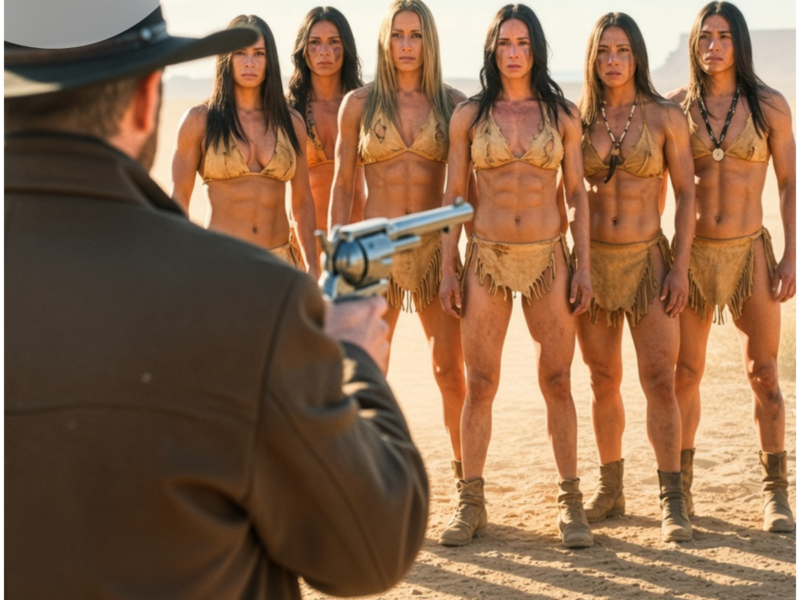
The light was blinding. Caleb threw up an arm, squinting through the glare. Rain hissed and steamed on the hot glass. Behind the lantern, a shape materialized in the storm: a long gray coat, a black beard, and the cold, unwavering muzzle of a Colt revolver aimed directly between his eyes.
“Three days,” Royce Dunmore said softly. “Three days you’ve been lying up on that cliff, cowboy. You think I don’t watch my own ridges?”
Behind Caleb, boots splashed through mud. More lanterns bloomed in the darkness. Four men. Six. Eight. Rifles rose all around him in a tightening ring.
Dunmore thumbed back the hammer. The click was louder than the thunder.
“I’m going to ask you one question,” he said, “and if I don’t like the answer, they’ll find you in the creek tomorrow. Who sent you?”
Caleb said nothing. His knife was still beneath the rawhide. One flick of his wrist.
At his back, he felt the gray mare’s breath on his neck, hot and trembling.
Dunmore’s finger tightened on the trigger.
PART 2: The Night the Herd Ran
“Nobody sent me,” Caleb said.
Dunmore studied him through the rain. “Then you’re a fool.”
“Probably.”
“A dead fool.” Dunmore lifted the Colt a fraction.
Caleb flicked his wrist.
The rawhide parted. The gate swung loose. And in the same instant, a bolt of lightning struck the dead pine at the edge of the corral with a deafening crack, splitting it from crown to root in a blast of white fire.
The gray mare screamed and reared.
Her front hooves came down on the gate, and it flew open with a crash. Behind her, two hundred terrified horses surged forward like a breaking dam.
Dunmore fired. The bullet tore through Caleb’s hat brim. Then the herd hit them.
Caleb threw himself sideways against the corral rail as a river of horseflesh thundered past. Mud exploded in every direction. Lanterns went flying, hissing out in the rain. Men screamed and scattered. Somewhere in the chaos, Caleb heard Dunmore bellowing orders, then a sickening thud and a cry of pain.
Through the darkness, the gray mare wheeled and came back for him.
He didn’t think. He grabbed a fistful of her mane and swung onto her bare back as she passed. She didn’t fight him. She simply ran, and Caleb clung to her with his knees and heels and every ounce of strength he had, steering her with his weight toward the eastern cliffs.
The herd followed her.
He hadn’t planned this. He couldn’t have. But every horse in that valley seemed to know the gray, and wherever she went, they followed. Through the loosened corrals. Past the burning pine. Through the juniper wall and up onto the narrow ledge, single file, pressed against the rock as lightning lit the drop below.
Behind them, rifles cracked. Bullets whined off the stone.
“Keep going,” Caleb gasped into the mare’s ear. “Don’t stop. Don’t you dare stop.”
The ledge narrowed to the width of a man’s shoulders. Rain sheeted down the cliff face. A colt behind them slipped, scrabbling, and Caleb’s heart stopped, but the colt found its footing and lunged on. Higher. Higher. The sounds of pursuit faded beneath the roar of the storm.
They crested the saddle as the clouds began to break. And below them, silvered by sudden moonlight, the endless grasslands rolled away toward the Chiricahua Mountains.
Caleb turned and looked back. One by one, horses emerged from the ledge onto the open ridge. He counted them as they came, his lips moving, his voice shaking.
One hundred and ninety-eight.
Every single one.
He leaned forward, pressed his face against the gray mare’s wet neck, and for the first time in years, Caleb Whitlock wept.
They rode through what was left of the night and all through the following day.
Caleb had circled back at dawn to retrieve Patience from the canyon mouth, praying Dunmore’s men hadn’t found her. They hadn’t. Now he rode the dun and let the gray mare lead the herd, and she led them unerringly west, as though a map were drawn inside her heart.
But Caleb kept looking over his shoulder.
Dunmore wouldn’t quit. A man doesn’t steal two hundred horses and then shrug his shoulders when someone steals them back. Somewhere behind them, Dunmore was regrouping, and when he came, he would come with every gun he could buy.
By the second evening, Caleb saw the dust.
It rose on the southern horizon, a thin brown smudge against the pink sky. Too much dust for a single rider. Too fast for drifting cattle.
He pushed the herd harder.
They reached the San Pedro at moonrise. The river was swollen from the storm, brown and furious, tearing at its banks. Caleb rode Patience to the edge and stared at the churning water. Upstream lay the ford. But the ford would be the first place Dunmore looked.
Behind them, faint but unmistakable, came the sound of hoofbeats.
Caleb looked at the gray mare. She stood at the water’s edge, ears pricked forward, studying the current.
“I know,” he said. “I know it’s madness.”
She stepped into the river.
The herd followed her in. Horses plunged into the current and were swept downstream, heads high, legs churning. Caleb rode Patience in beside them, shouting, whistling, steering the frightened ones toward the far bank. Water closed over his saddle. Patience swam with grim determination. A young filly went under, came up, went under again, and Caleb lunged out of the saddle, caught her halter, and dragged her toward the shallows with the river pounding at his chest.
On the far bank, they staggered out, streaming water.
Caleb dropped to his knees in the mud, gasping. When he looked back across the river, he saw them: a dozen riders reining up on the opposite bank, silhouetted against the moonlit sky.
At their center sat Royce Dunmore, his left arm bound in a bloody sling.
For a long moment, the two men stared at each other across the raging water.
“This isn’t over, Whitlock!” Dunmore’s voice carried across the river. “You hear me? You’ve got nowhere to run! I’ll find you! I’ll find every one of them!”
Caleb stood up slowly.
“Then come on,” he called back. “I’ll be easy to find. I’ll be where those horses belong.”
Dunmore’s men looked at the river. It was rising. Not one of them moved to cross.
Caleb turned his back on them and rode west.
On the fourth morning, he saw the smoke.
Thin columns rose against the blue sky from a broad valley beneath the mountains. As he drew nearer, he saw brush lodges scattered along a creek, and small figures moving among them. Dogs barked. Somewhere a child was laughing.
But the camp felt heavy. Even from a distance, Caleb could sense it, the way you sense grief in a house before anyone speaks. The empty horse meadows. The silence where there should have been herds. A people who had lost something essential and had begun to accept that it would never return.
He reined in at the edge of the valley and waited.
A small boy carrying water from the creek was the first to look up. He stopped. The water jugs slipped from his hands and shattered on the rocks.
Then he screamed. Not in fear. In disbelief.
His cry carried across the valley, and the camp erupted.
People spilled from their lodges, shading their eyes, staring. Elders struggled to their feet. Women dropped baskets. Men ran toward the meadow. And the gray mare lifted her head and gave that same long, ringing call Caleb had first heard in the Devil’s Throat.
Two hundred horses answered her. And from the camp, dozens of human voices answered too.
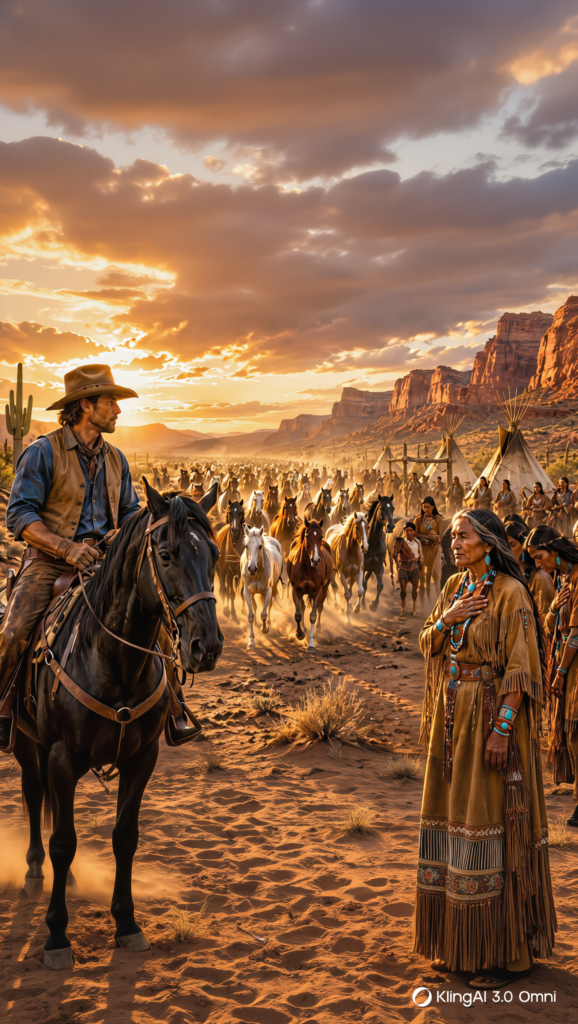
What followed, Caleb would never be able to describe. The herd poured down into the valley, and the people poured up to meet it. Children ran laughing among the horses. Old men buried their faces in manes they had thought they would never touch again. A young woman wrapped her arms around a bay’s neck and sank to her knees, sobbing. An ancient grandmother stood perfectly still, tears streaming down her lined face, while a white-faced paint nuzzled her hands.
Caleb sat on Patience at the edge of the meadow and watched. He didn’t need anything else. This was enough.
Eventually, a man approached him on foot. He was gray-haired and broad-chested, with a calm, weathered face and eyes that missed nothing. He wore no ornament, but every person he passed fell quiet and stepped aside.
“I am Nantan Goyah,” he said in careful English. “These are my people.”
Caleb dismounted and removed his hat. “Caleb Whitlock.”
“Our scouts searched for forty days. They found nothing.” The chief looked toward the herd. “You found everything.”
“I got lucky.”
“No.” Goyah’s dark eyes studied him. “Luck does not swim a flooded river with a filly in its arms. Our boys watched you from the hills yesterday. You were followed by armed men. You could have left the horses and saved yourself.”
Caleb shrugged. “They weren’t mine to leave.”
“What do you want for them?”
“Nothing.”
The chief was silent for a long time.
Then a strange hush fell over the meadow.
The laughter faded. The children stopped running. One by one, people stepped back, opening a path through the crowd.
And down that path walked twenty women.
They ranged in age from young mothers to gray-haired grandmothers. They walked slowly and in silence, side by side, and each carried something in her hands: a finely woven blanket, a beaded bag, a basket so tightly coiled it could hold water, a carved bone comb, a pair of beaded moccasins.
One by one, they knelt and placed their gifts at Caleb’s feet.
Then they rose and stood before him in a line. Every voice in the valley had gone silent. Even the horses seemed to hold still.
The eldest of the women stepped forward. Her face was deeply lined, her hair silver, her eyes as dark and clear as creek water. She looked into Caleb’s face for a long moment.
Then all twenty women bowed their heads at once.
And the eldest spoke, softly, clearly, so that every person in the valley could hear:
“From this day, we are yours.”
Caleb froze.
He looked at the chief. Goyah’s face was unreadable. He looked at the crowd. No one would meet his eyes. The elders gazed at the ground. Even the children had gone silent, watching him with wide, solemn eyes.
“I—” Caleb’s voice failed him. “Ma’am, I don’t understand.”
No one answered.
The old woman only smiled, gently, as though she knew a secret he hadn’t yet learned.
“You will,” she said.
And behind them, on the southern ridge, a lone rider appeared against the sky, watched for a long moment, and turned his horse back the way he had come.
PART 3: What the Gray Mare Carried
That night, the people of the valley held a fire beneath the stars.
Caleb sat near its edge with a bowl of mesquite bread and roasted venison he barely tasted. The women’s words circled in his mind like hawks. From this day, we are yours. He had heard of white men who took wives from the tribes, of trades and bargains he wanted no part of. If that was what this meant, he would refuse it, whatever offense it caused.
Finally, he turned to the chief. “Nantan Goyah, I’m grateful. More than I can say. But I need to understand what those women meant.”
The chief nodded to the old woman, who had been sitting quietly across the fire. She rose and came to sit beside Caleb.
“I am Dahteste,” she said. “Sit, and I will tell you about the gray mare.”
She looked across the firelight to where the silver mare grazed at the edge of the meadow.
“Among our people,” Dahteste said, “the horses belong to the women. We raise them. We care for them. We pass them to our daughters. Each of the twenty women you saw today keeps a herd for her family. Those horses are how our children eat in winter. How our old ones travel when the camp must move. Without them, we do not survive.”
Caleb listened.
“Last autumn, sickness came to our people. Many men died. Our husbands. Our sons.” Her voice did not waver, but something moved in her eyes. “The twenty women you saw are widows. Their herds were all they had left. When the horses were stolen, they lost everything. Some had already decided to go to the reservation at San Carlos, where they would be fed by the soldiers and never be free again.”
She pointed to the gray mare.
“That one is mine. Her mother was the last gift my husband gave me before he died. The red hand on her heart is his. When she was taken, I believed I had lost the last of him.”
Caleb swallowed hard. He could not speak.
“There is an old promise among our people,” Dahteste went on. “Older than my grandmother’s grandmother. If a stranger risks his life to return what keeps a family alive, and asks nothing for it, that family does not pay him. It claims him.” She smiled. “Not as a servant. Not as a husband. As one of our own. When we said, we are yours, we meant that every one of our households now belongs to you, and you to us. You have twenty mothers, twenty sisters, twenty homes. Wherever our people travel, you will have a fire to sit beside. When you are hungry, we will feed you. When you are in danger, our sons will ride for you. When you die, we will mourn you as our own.”
Caleb stared into the fire for a long time.
He had lost his parents to cholera when he was twelve. He had grown up sleeping in barns and bunkhouses, working for men who forgot his name. He had built his small ranch alone. He had been alone so long that he had stopped noticing it.
“I don’t know what to say,” he whispered.
Dahteste laid her weathered hand over his.
“Then say nothing,” she said. “Sons rarely know what to say to their mothers.”
Royce Dunmore came three days later.
He rode to Caleb’s ranch on the San Simon at dawn with fourteen hired guns, his arm still in a sling and murder in his eyes. He had spent every dollar he owned, and he meant to take the horses back or burn the cowboy’s life to the ground.
He found Caleb on the porch, drinking coffee.
“You should’ve stayed across the river,” Caleb said.
Dunmore laughed. “Look around you, Whitlock. You’re alone.”
Caleb set down his cup. “Am I?”
Dunmore’s smile slowly faded.
On the hills around the ranch, riders were appearing. They rose silently over every ridge, from every direction, until the ranch was ringed by them. Apache warriors, more than a hundred, their rifles resting across their saddles. At their center, on a sorrel horse, sat Nantan Goyah.
And beside him, on the gray mare, sat Dahteste.
Then came the others. A column of wagons rolling up the road from the town of San Simon: the sheriff, a dozen ranchers, the blacksmith, the storekeeper, all of them armed. Word had spread across the valley about the cowboy who had brought two hundred horses home. And when ranchers heard that a horse thief planned to murder him, they discovered they had no stomach for horse thieves either.
Dunmore’s hired guns looked around at the circle of rifles. One by one, they lowered their weapons. Then they began backing their horses away.
“Cowards,” Dunmore spat.
“No,” said the sheriff, riding forward with a pair of iron cuffs. “Just men who can count.”
Royce Dunmore was tried in Tucson for horse theft and the murder of two Army remount officers whose bodies had been found that winter. He never saw open country again.
The seasons turned.
Caleb’s ranch on the San Simon grew. The twenty women came often, with their children and grandchildren. They helped mend fences and plant corn. They taught Caleb to braid rawhide the old way. He taught their sons to gentle colts without a whip. Ranchers who once wouldn’t ride within a mile of an Apache camp began trading with them, then sitting at their fires, then calling them friends.
At the place where the ranch met the Apache grasslands, the two communities built a great shared pasture. They called it the Horse Mothers’ Meadow. Children from both peoples groomed the horses together, raced across the spring grass, and grew up never knowing what it was to fear each other.
Caleb never married. When people asked whether he was lonely, he only laughed. He had twenty mothers. He had more family than any man in the territory.
On a golden evening many years later, Dahteste, now very old and frail, sat with him on the porch, watching the herd run across the meadow as the sun sank behind the Chiricahuas.
The gray mare’s granddaughter led them, silver and blazing white, with a red handprint painted over her heart.
“Do you remember what I told you?” Dahteste asked. “That you would understand?”
“I remember.”
“Do you understand now?”
Caleb watched the horses run, thundering across the meadow like a single living thing, children laughing on their backs, their manes streaming gold in the last light.
“I went into that canyon,” he said slowly, “thinking I was bringing horses home.”
Dahteste smiled and closed her eyes.
“And instead,” she whispered, “the horses brought you home.”