PART 1: The Watcher on the Ridge
The morning Ethan Carter left his ranch felt strangely quiet.
The sun had barely cleared the hills of the Sapello Valley in northern New Mexico, laying soft gold across the fields his family had worked for four generations. On any other day, Ethan would have stood on the porch with his coffee and watched the land wake up: the horses drifting across the pasture, the meadowlarks settling on the fence posts, the wind carrying the smell of dry grass and red earth.
This morning, he couldn’t bring himself to look.
Two days earlier, a phone call from Denver had turned his life upside down. His younger sister Grace had been in a car accident. She was alive, but she had two broken legs, a head injury, and an eight-year-old son with nobody else in the world to take care of him. The doctors talked about months of recovery. Maybe a year. Maybe more.
The ranch couldn’t spare him, and it couldn’t afford him either. Eighteen months of drought had withered the hay. The well pump needed replacing. The bank had already sent two polite letters about the mortgage his late father had taken out to survive the last bad decade. Ethan had done everything he knew how to do, and it still wasn’t enough.
He sold off all but twelve head of cattle and six horses and paid the feed store three months ahead. He asked his nearest neighbor to check on the stock when he could. Then he loaded his last duffel bag into his truck and stood a long moment looking at the old white farmhouse his great-grandfather had built.
“I’ll be back,” he said quietly. The words were more for himself than for anyone else.
Then he drove away.
Days turned into weeks, and weeks into months.
At first, neighbors stopped by now and then. The old man down the road threw hay to the horses when he remembered, but he was eighty-one with bad knees, and he remembered less as the winter came on. By December, people had mostly stopped going out there at all.
Among those watching from a distance was Victor Hayes.
Victor owned the Hayes Land & Cattle Company, the biggest operation in three counties. He was a broad, silver-haired man with a politician’s smile, a seat on the county commission, and a habit of getting what he wanted. For fifteen years, he had wanted the Carter place.
It wasn’t the house he cared about, or even the grazing. It was the water. The Carter ranch sat on the senior water rights to Sapello Creek, the last reliable year-round flow in that stretch of the valley. Whoever owned those rights controlled who could irrigate for twenty miles downstream. Old Tom Carter had turned Victor down six times. Ethan had turned him down twice.
Now Ethan was gone.
“He won’t be back,” Victor said cheerfully at the counter of the Sapello General Store, to anyone who’d listen. “Sister’s crippled, and the bank’s circling. Give it a year and that place’ll be a pile of rotten boards and a foreclosure sign.”
Plenty of people agreed with him. Most people in the Sapello Valley agreed with Victor Hayes about most things. It was easier that way.
Six miles away, in the pine-covered foothills above the creek, a woman named Naya lived alone in a small cabin her late husband had built.
Few people in town knew much about her. She was Apache, somewhere in her forties, and she came down to the store once a month for flour, coffee, and ammunition. She said almost nothing and left. People called her strange, unfriendly, standoffish. Some of the older ranchers’ wives said worse things, quietly, behind her back.
Naya paid no attention to any of it. She spent her days working her small garden, hunting, tanning hides, and tending a handful of goats. She had been alone for eleven years, since the winter she lost her husband and their infant son to pneumonia in the same week. Solitude no longer frightened her. It was simply the shape her life had taken.
One evening in late October, she was walking the ridge above Sapello Creek, tracking a wounded mule deer, when she noticed something wrong on the Carter place below.
A stretch of fence along the northern boundary had been cut cleanly. It hadn’t rotted or fallen. Someone had used bolt cutters on it. Fresh truck tracks marked the soft ground beside the gap.
Naya climbed down and followed the tracks a quarter mile in. She found where a trailer had backed up to the old equipment shed. The padlock was smashed. A welder, a generator, and a chainsaw were gone.
She stood very still for a long moment in the fading light, studying the scene.
The ranch was vulnerable. Its owner was gone, and people had already started picking at its bones.
She did not know Ethan Carter well. She had spoken to him perhaps three times in her life. But she had known his father.
And she had made his father a promise.
The next morning, before sunrise, Naya came back with a roll of wire, a come-along, and her husband’s old fencing pliers. She repaired the cut fence herself in two hours. No one saw her, and no one thanked her. When she finished, she went home.
Three weeks later she spotted two men she didn’t recognize with a pickup backed up to the Carters’ hay barn, loading bales. They believed nobody was watching.
They were wrong.
Naya walked out of the tree line and stopped twenty feet away with her rifle cradled loosely in her arms. She wasn’t pointing it at anyone. She was just holding it, the way another woman might hold a basket. She didn’t say a single word. She simply looked at them.
The men looked at her. Then they looked at each other. Then they threw the bales back into the barn, climbed into their truck, and left without a word.
She told no one about that either.
Autumn turned to winter. The ranch went on standing.
When storms tore a gate loose, Naya rehung it. When ice froze over the water tank, she broke it every morning before dawn. When the old neighbor’s visits stopped altogether, she began feeding the horses herself, hauling hay from the Carters’ own barn and, when that ran low in February, from the feed store with her own money. She told the clerk to put it on the Carter account. He was too surprised to argue.
The work was hard and cold and endless. She never once complained.
Each evening, on her walk home, she stopped on the ridge and looked down across the dark ranch with its single porch light. She had rigged a timer on it so the place wouldn’t look empty. The land reminded her of a debt she had never stopped carrying.
Eleven winters ago, when her husband and baby were burning with fever and her truck wouldn’t start, Tom Carter had come up the mountain road in a blizzard. He had seen her chimney smoke stop and come to check. He drove all three of them forty miles to the hospital in Las Vegas through snow most men wouldn’t have driven in daylight. When the doctors couldn’t save her husband and son, he stood beside her at both funerals. He paid every hospital bill himself and never told a soul. Then, for a year, he sent his own ranch hands up the mountain every week to chop her wood and check on her, until she was strong enough to live again.
On the day he left the hospital for the last time himself, eaten up by the cancer that killed him, Tom Carter had gripped her hand and said, “My boy’s got my stubbornness and none of my luck. If he ever needs somebody, Naya, look in on him for me.”
She had promised.
As the first heavy snow fell across the valley that December, Naya made a quiet decision. However long Ethan Carter was gone, she would protect his land. She would keep that promise as long as it took.
The second winter came harder than the first.
People started asking questions. Why were the Carters’ fences still standing? Why were those horses still fat? Why had the place not fallen apart yet? Almost no one guessed the answer. A few had glimpsed Naya near the property, but most dismissed the idea that one silent woman could make much of a difference.
Victor Hayes did not dismiss it.
The longer the ranch survived, the angrier he got. He had expected neglect to do his work for him. Instead, the place seemed to fight off every blow.
“Something strange is going on out there,” he told the regulars outside the general store one afternoon. “That Apache woman keeps showing up on Carter’s land. Day and night. You ask me, she’s fixing to squat on it. Claim it for herself or her people once the bank takes it.” He shook his head sadly. “Somebody ought to tell Ethan.”
The rumor spread through the valley like fire through dry grass. People started crossing the street when Naya came to town. The clerk at the store began counting her change twice. Someone spray-painted a word on her mailbox at the foot of the mountain road. It was a word she had heard before, all her life.
She painted over it and said nothing.
Then, in March, came the night of the flood.
A warm rain fell on three feet of snowpack, and Sapello Creek jumped its banks in the dark. Five of the Carter horses were trapped in the low pasture as the water rose around them, screaming and plunging in the mud. Every sane person in the valley stayed home with their doors locked.
Naya drove down the mountain in the pouring rain with ropes, a lantern, and a bucket of grain. For four hours she worked alone in freezing, waist-deep water. One by one she coaxed the terrified horses up the slope to high ground. By the time the last mare climbed out, the sky was greying with dawn. Naya was so cold she couldn’t feel her hands, and so exhausted she sat down in the mud beside the gate and couldn’t get up for a long time.
The next morning, Sam Turner found the rope burns on the gatepost and the deep tracks in the mud. He was a seventy-year-old mechanic with grease-blackened hands who had lived in the valley his whole life and preferred facts to rumors.
He stood there a long time, putting together what had happened.
Two weeks later, he came across Naya on the Carter place wrestling alone with a broken windmill blade, thirty feet up. Instead of asking what she was doing there, he climbed up beside her with his toolbox.
“Pump shaft’s bent,” he said. “Hold this.”
To his surprise, she held it.
They worked four hours side by side and barely spoke. But Sam Turner went home that night knowing a great deal more about the silent Apache woman than anyone else in the valley. Over the next months, as they kept working the ranch together on Saturdays, he pieced together her story: the husband and baby, the blizzard, old Tom Carter, the promise.
When Sam told people in town, a few began to look at her differently.
Victor Hayes did not.
In late May, after the driest spring anyone could remember, a wildfire broke out in the cheatgrass at the far western end of the valley.
The wind was blowing forty miles an hour straight down the canyon. Within an hour, a wall of smoke a mile high blotted out the afternoon sun. Sirens wailed from every direction. Families loaded children and dogs into trucks and fled toward town.
Naya stood on her ridge watching the orange line crawl toward the Carter ranch. It was coming fast.
She ran for her truck.
She reached the ranch fifteen minutes later, with ash falling like grey snow and the air so thick it burned her throat. The main fire front was still two miles west. If she could cut a firebreak along the eastern edge of the hayfield, she might be able to save the barns.
She grabbed a shovel and a rake from the shed and ran out into the field.
That was when she smelled it, under the smoke. It was sharp and chemical, and it didn’t belong out here.
Gasoline.
She turned. Along the north fence line, the same stretch where she had found the cut wire nearly two years earlier, two new fires were already burning. They weren’t windblown sparks from the main blaze. They were tidy, deliberate lines of flame, set in a row along the dry grass, racing toward the Carter barns from the side, where nobody would be watching.
Beyond them, on the county road, a white pickup was pulling away fast. Its tailgate swung loose, and painted on that tailgate in bold green letters were the words:
HAYES LAND & CATTLE CO.
The truck vanished into the smoke.
Naya stood alone in the burning field with a shovel in her hands, fire coming at her from two directions, and understood with terrible clarity. Victor Hayes had stopped waiting for the ranch to die.
He had decided to kill it.
PART 2: The Evidence
There was no time to be afraid.
Naya ran to the old tractor in the equipment shed, the one Sam had spent three Saturdays rebuilding. It caught on the second try. She dropped the disc plow and drove straight into the smoke, cutting a wide strip of bare earth across the north field between the set fires and the barns. The heat came at her in waves. Twice the smoke was so thick she lost sight of her own hood.
When she came out the far end, Sam Turner’s old Ford was skidding into the yard with three ranch hands in the back. Two of them were young men from the Delgado place who had crossed the street to avoid her only a month before.
Nobody said a word about that now. They grabbed shovels and wet burlap sacks and ran out beside her.
For six hours they fought for the Carter ranch. The heat blistered their skin, and the smoke seared their lungs. Once, when the wind gusted and a tongue of flame leapt the firebreak toward the hay barn, Naya threw herself at it with a wet saddle blanket. She beat it out with her bare hands while the Delgado boys shoveled dirt over the embers.
By sunset, the fire had burned itself out against the break. The north pasture was black stubble, and forty acres of grazing were gone. But the house, the barns, and every animal on the place had survived.
Naya sat on the tailgate of Sam’s truck with burned palms wrapped in wet rags, soot-black from head to toe, too tired to lift her head.
“Two fires on the north line,” she said quietly. It was the longest sentence Sam had ever heard her speak. “Gasoline. A white truck. Hayes.”
Sam went very still. “You sure?”
She nodded once.
“Can you prove it?”
She looked at him. Slowly, she shook her head.
Sam let out a long breath and looked toward the Hayes ranch, where the lights glowed bright and untouched on the far side of the valley.
“Then we don’t say a word,” he said. “Not yet. Victor Hayes sits on the county commission and plays poker with the sheriff every Thursday. You accuse him without proof, and it’s an Apache woman’s word against the most powerful man in the county.” He laid a gnarled hand on her shoulder. “We get proof first. Then we bury him.”
In the weeks after the fire, the talk in the valley began to change.
The Delgado boys told everyone who would listen how the “crazy Apache woman” had saved the Carter barns with her bare hands. Mrs. Delgado showed up at Naya’s cabin with a pan of enchiladas and an apology. The clerk at the store stopped counting her change twice. Someone, nobody ever learned who, scrubbed the paint off her mailbox and planted marigolds around the post.
But Victor Hayes was growing desperate.
Sabotage began at the ranch, carefully disguised as bad luck. One morning Naya found the main stock tank nearly dry, though it had been full the night before. When she traced the water line, she found that someone had loosened three couplings and slit the pipe in two places to drain the reservoir that fed the whole ranch. Fence posts were pulled out of the ground at night. The new well pump Sam had installed burned out after someone poured sand into the intake. Gates were left open so cattle wandered onto the highway.
Naya didn’t confront anyone. She started keeping records.
She bought a cheap phone with a good camera, the first she’d ever owned, and learned to use it from a teenager at the library. Every incident went into a spiral notebook in her small, careful handwriting: dates, times, photographs of the damage, plaster casts of the boot prints and tire tracks she found at every scene. She bought two trail cameras with money she’d been saving for a new roof and hid them in the pines along the north fence line.
Weeks turned into months. The notebook filled.
Then, in October, Sam came up the mountain with a face like thunder.
“Got a cousin who works at the bank in Las Vegas,” he said, sitting down heavily at her table. “Ethan’s mortgage. Tom took it out in the drought of ‘12, and Ethan’s been paying it from Denver, best he can.” Sam’s jaw worked. “Except he’s been late. His sister’s medical bills are eating him alive. Three payments behind.” Sam slapped the table. “And last week the bank sold the note. You know who bought it?”
Naya didn’t need to ask.
“Victor Hayes,” Sam said. “He owns Ethan Carter’s debt now. If Ethan misses one more payment, Victor can call the whole loan. Foreclosure. He’d get the ranch and the water rights for the price of the mortgage, and every bit of it legal.”
Naya sat still for a long time.
Then she stood, went to the old coffee can on the top shelf behind the flour, and took down the money inside: every dollar she had saved in eleven years of selling hides, tanned leather, and beadwork at the tourist markets in Santa Fe. Her husband’s life insurance, which she had never been able to bring herself to spend, was in there too.
She counted it out on the table in front of Sam.
“How much,” she said, “are three payments?”
She paid them in person, at the bank in Las Vegas, in cash. She paid the three missed payments, plus the next six in advance.
She had the teller put a single note on the account: Paid on behalf of Ethan Carter. No questions.
She signed nothing but her initials. Victor Hayes, when he found out three days later that his foreclosure had evaporated, threw a coffee mug through his own office window.
After that, the sabotage turned ugly.
A dead coyote was nailed to the Carter gate. Someone shot out the porch light that had burned on its timer for nearly two years. Twice, driving home on the mountain road at night, Naya saw headlights following her all the way to her turnoff, and then sitting at the bottom of her road with the engine running.
“You’ve done enough, Naya,” Sam said one evening, sitting with her on the Carter porch after they’d replaced the light. The sunset was turning the burned north pasture gold, where new green shoots were coming up through the black. “More than enough. Nobody’d blame you for walking away now.”
Naya looked out across the land for a long time.
“A promise matters,” she said simply.
Sam nodded. He understood. The ranch wasn’t land or buildings to her anymore. It was a promise made to a dying man, and she had never once broken her word.
Her patience finally paid off on a cold night in early November.
One of the trail cameras on the north fence line pinged her phone at 3:12 a.m. She drove down the mountain with her headlights off and crept through the pines on foot. In the moonlight by the north pasture well head, she watched two men with flashlights pouring something from a plastic jug into the open well casing.
She raised her phone and recorded all of it.
When one of them turned, his face came clear in the light: a lean, red-bearded man with a scar through one eyebrow. Naya knew him. Dale Pruitt, Victor Hayes’s ranch foreman. She had seen him a hundred times, driving the white pickup with the green lettering.
Behind them, plain as day in the moonlight, sat that same truck.
She had it. After a year and a half of patience, she finally had it.
She backed silently into the trees, sent the video to Sam Turner, and started the long walk back toward her truck.
She never heard the man come up behind her.
Something hard slammed into the side of her head. The world exploded in white. The phone flew from her hand. She fell face first into the frozen dirt, and through a ringing haze she heard Dale Pruitt’s voice above her.
“Told Victor somebody was watching. Get her phone.”
A boot heel came down on the phone and crushed it. Then the same boot drove into her ribs once, twice, and she felt something crack.
“Leave her,” said the second voice. “Ground’s freezing tonight. She’ll be stiff by morning, and everybody’ll figure the crazy squaw fell off a rock.”
Their footsteps faded. The truck engine started and drove away.
Naya lay in the frozen grass under the stars, unable to move, her breath coming short and ragged through broken ribs. The cold crept into her bones the way it had crept into her husband’s lungs eleven winters ago.
I’m sorry, Tom, she thought. I tried.
Then, far off on the county road, two headlights appeared.
They turned in at the Carter gate and came slowly up the long dirt drive. They belonged to a dusty truck with Colorado plates that hadn’t been seen in the Sapello Valley in nearly two years.
PART 3: The Man Who Came Home
Ethan Carter had driven straight through from Denver.
Grace was walking again, with a cane. His nephew was back in school. After twenty-three months, Ethan was finally coming home to whatever was left of the ranch. All the long drive south he had braced himself for the worst: fallen fences, empty barns, fields gone to weeds, the bank’s sign nailed to the gate.
He topped the last rise at four in the morning and slowed the truck to a crawl.
The fences were standing. The gate was hung straight. The barns stood dark and solid against the stars. And then his headlights swept across the north pasture and caught something lying in the frosted grass by the fence line.
It was a woman, face down, not moving.
Ethan was out of the truck before it stopped rolling.
He knew her the moment he turned her over, though he’d only met her a handful of times in his life: the Apache woman from the mountain, the one his father always waved to. There was blood on her temple, and she was barely breathing, ice-cold to the touch.
Her eyes fluttered open. She looked at his face, and something like recognition crossed hers. Then, impossibly, something like relief.
“You came home,” she whispered. “Tom said… you would.”
Then she passed out in his arms.
He drove her to the hospital in Las Vegas at ninety miles an hour, forty miles through the dark. It was the same road his father had once driven through a blizzard to carry her family to the same hospital. Ethan didn’t know that yet.
She had a concussion, three broken ribs, and moderate hypothermia. The doctors said another hour on that frozen ground, and she would not have woken up.
Sam Turner arrived at the hospital at dawn, red-eyed and furious. He had been awake since 3:15 a.m., watching a video on his phone over and over.
He sat down across from Ethan in the waiting room and told him everything.
He told him about the cut fence the first autumn and the hay thieves. He told him about the flood and the five horses, about the fire and the gasoline, about the drained reservoir and the sand in the pump. He told him about the spiral notebook and the trail cameras. Then he told him about the mortgage, and the coffee can of savings, and nine payments made in cash at this very bank.
Ethan sat with his head in his hands.
“Why?” he finally managed. “I barely know her. Why would she do all that for me?”
Sam looked at him with something close to pity.
“She didn’t do it for you, son,” he said. “Not at first. She did it for your daddy.”
Naya woke that afternoon to find Ethan Carter sitting beside her hospital bed. He was holding a battered spiral notebook in his hands. Sam had brought it down from her cabin. The pages were filled with dates, photographs, and boot-print sketches, twenty-three months of quiet war.
For a long moment neither of them spoke.
“I don’t know how to thank you,” Ethan said at last. His voice wasn’t steady.
Naya turned her face to the window. “You don’t owe me anything.”
“Sam says you spent your life savings on my mortgage. Your husband’s insurance money.”
“It was sitting in a coffee can,” she said quietly. “Your father’s money was not sitting in a coffee can when he paid for my husband’s funeral. Or my son’s.”
Ethan went very still. “What?”
So for the first time in eleven years, Naya told the whole story aloud.
She told him about the blizzard, the stopped chimney smoke, and Tom Carter’s truck coming up the mountain road where no sane man would drive. She told him about the forty miles to the hospital and the two small graves. She told him about the hospital bills that disappeared without her ever seeing a statement, and the ranch hands who came up the mountain every week for a whole year to chop her wood. She told him about a dying man’s hand gripping hers at the end. If my boy ever needs somebody, Naya, look in on him for me.
When she finished, Ethan Carter was crying silently, his face in his hands, the way his father had cried at those two funerals.
“He never told me,” he whispered. “Not one word. He never told anybody.”
“He wasn’t the kind of man who needed telling,” Naya said. “Neither am I.”
The morning Naya left the hospital, Sam Turner and Ethan Carter drove straight to the New Mexico State Police office in Las Vegas. They didn’t go to the county sheriff. They went over his head.
They brought Naya’s notebook, plaster casts of nineteen boot prints, forty-one photographs, and the trail-camera footage: two men pouring something into the Carter well at 3:12 in the morning, with a white Hayes Land & Cattle truck parked behind them in clear moonlight. The crushed phone had died in the dirt that night, but the video had already gone out to Sam.
The state police tested the well. It had been dosed with enough concentrated herbicide to poison the water supply for every animal on the ranch.
Faced with the footage, Dale Pruitt cracked in less than an hour. He told them everything: the cut fences and the stolen equipment, the drained reservoir, the sand in the pump, the gasoline along the north fence line on the day of the wildfire. All of it had been done on Victor Hayes’s orders and paid for in cash. And on the last night, when they found Naya filming them, Pruitt said, it was Victor who had told them over the phone to “make sure she doesn’t come down off that mountain to testify.”
Then others came forward too. They were people who had stayed silent for years because Victor Hayes signed their checks or held their mortgages. Two other ranch hands confirmed Pruitt’s story. A clerk at the feed store remembered Hayes trucks near the Carter place at odd hours. A county roads worker had seen a white pickup leaving the north fence line just minutes before the fire.
Victor Hayes was arrested in front of the county courthouse on a Tuesday morning, in front of half the valley. He was charged with arson, attempted poisoning of a water supply, conspiracy, and aggravated battery. He resigned from the county commission from a jail cell. The Hayes Land & Cattle Company was sold off in pieces over the next two years to pay his lawyers and the civil judgment Ethan won against him.
The mortgage note Victor had bought to steal the ranch went to the court, and the court, in a twist nobody in the valley ever forgot, ordered it transferred as part of the judgment.
The note went to Naya.
A month later, the whole valley gathered in the Sapello Grange Hall for a supper nobody had planned officially. It just happened.
Mrs. Delgado brought enchiladas. Sam Turner brought his fiddle. The Delgado boys hung a hand-painted banner across the stage that said THANK YOU, NAYA in slightly crooked letters. The clerk from the feed store presented her with a framed receipt for every bale of hay she’d ever bought for a ranch that wasn’t hers.
When Ethan Carter stood up to speak, the room went quiet.
“For two years,” he said, “my family’s land was protected by somebody who never asked for one thing. Not credit, not thanks, and not a dime back. She mended my fences in the dark. She pulled my horses out of a flood. She fought a fire set by a man trying to steal my home, and when he tried to steal it with a pen instead, she paid my debts with her own life savings and signed only her initials.”
He looked at Naya, sitting stiffly at the end of the front table with her bandaged ribs and her careful, unreadable face.
“Two weeks ago, the court handed her the mortgage on my ranch,” he said. “She came out to my place that same evening and tried to give it back to me. Torn up, in an envelope.” He smiled. “I told her I’d only take it on one condition.”
He reached into his jacket and laid a folded document on the table in front of her.
It was a deed, a legal partnership in the Carter ranch and its water rights, split evenly between Ethan Carter and Naya. Tom Carter’s name was written in the space where the partnership was named. Underneath it, it read:
Carter & Naya Ranch. Est. by a promise kept.
“Half of everything you saved is yours,” Ethan said quietly. “Dad would’ve wanted it that way. And so do I.”
Naya looked at the paper for a long time. Then she looked up at the room full of faces: people who had once crossed the street to avoid her, and who were now on their feet.
The applause started slowly. Within seconds it was thunderous.
For the first time in eleven years, Naya, the silent Apache woman from the mountain, laughed out loud. Then she put her face in her hands and cried in front of the entire valley. Nobody thought it strange at all.
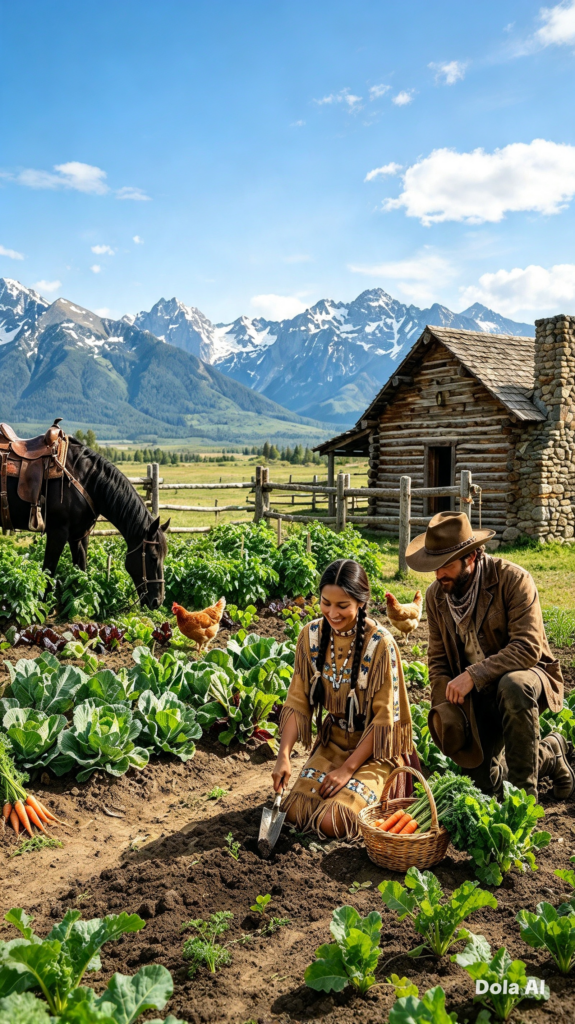
That spring, the burned north pasture came back greener than it had been in twenty years. Naya moved down from the mountain into the little foreman’s house on the ranch. She was still quiet, still careful, and still up before dawn every morning to check the fences, out of habit. But she didn’t walk the land alone anymore.
On the anniversary of Tom Carter’s death, she and Ethan rode up the mountain together to the little cemetery above her old cabin. Two small graves lay there, and a third, larger one stood at the edge of the pines. Ethan had moved his father there so Tom could rest beside the family he had once quietly saved.
Ethan stood with his hat in his hands.
“He’d be proud of you,” he said.
Naya was quiet a long moment, looking out across the valley at the ranch she had guarded through two winters, a flood, and a fire.
“He asked me to look in on you,” she said softly. “He never said for how long.”
Ethan smiled. “Then I guess you’d better stick around.”
A home isn’t saved only by ownership or money. Sometimes it survives because someone chooses to protect it when no one is watching. Naya never asked for recognition. She simply kept a promise to a man who had once kept her alive. And because of that, a whole future changed.
THE END