PART ONE: What the Town Whispered
The sky over Mercy Creek had been bruising since noon.
By four o’clock the clouds hung so low over the Sangre Hills that they seemed to scrape the ridgeline, heavy and swollen and the color of an old wound. The wind came in hard from the west, flattening the bunchgrass and setting the ponderosa pines groaning like ships at sea. Every horse in the valley knew what was coming. So did every man.
Daniel Reese pushed his old bay gelding along the narrow switchback trail, collar turned up, hat pulled low. He was a long, quiet man of thirty-four, with sun-cut lines at the corners of his eyes and hands roughened by twenty years of rope and wire. He had ridden into town that morning for nails, coffee, and salt. He had ridden out with all three, and with something else besides: a sour, uneasy weight that sat in his chest like a stone.
The general store had been crowded with talk.
Harlan Voss’s boy. Gone since yesterday. Seven years old. Wandered off from the north pasture and never came back.
Apache sign out by Dead Horse Wash. Pony tracks. Somebody saw smoke in the canyons.
They took him. Mark my words. They took that child.
Daniel had paid for his nails and said nothing. He had learned long ago that saying something in a crowded room rarely changed a mind, and very often made enemies. But on his way out the door, old Abner Pike, who ran the livery and had never in his life been west of the county line, had caught his sleeve.
“You keep your door barred tonight, Reese. You’re out there all alone. You see one of them, you shoot first. Don’t you go getting soft like your daddy did.”
Daniel had looked at the old man’s hand on his sleeve until Pike let go.
His father, Thomas Reese, had been the kind of man who fed whoever came to his door. Mexican, Apache, Irish drifter, it made no difference. A man in a storm, his father used to say, is just a man in a storm. Leaving him out there tells you more about yourself than about him. The town had never quite forgiven him for it. When fever took both his parents in the same bitter winter four years ago, Daniel had overheard someone at the funeral say, not quite quietly enough, Well, maybe now that ranch’ll stop being a waystation for every savage in the territory.
He had not been back to church since.
The first drops of rain struck his face, cold as needles. Within a minute they had become a steady, slanting downpour, and within five, a roaring gray wall that turned the trail to slick red mud.
“Come on, Jack,” Daniel muttered, patting the bay’s streaming neck. “Few more miles. We’ll both be soaked through before supper, but we’ll get there.”
Lightning split the sky. For one white, frozen instant the whole hillside leapt out of the dark: every rock, every twisted juniper, every bending blade of grass.
And something at the edge of the trail that did not belong there.
He thought at first it was a fallen branch tangled in the brush beneath the big cottonwood at the bend. Then the thunder rolled, and the lightning came again, and he saw it clearly.
It was a person.
She sat slumped against the cottonwood’s trunk with her knees drawn up and her arms wrapped around something bundled against her chest. Rain streamed off her shoulders in sheets. She did not move to shield herself from it. She did not seem able to move at all.
Daniel swung down and approached slowly, hands open.
“Can you hear me?”
Her head came up.
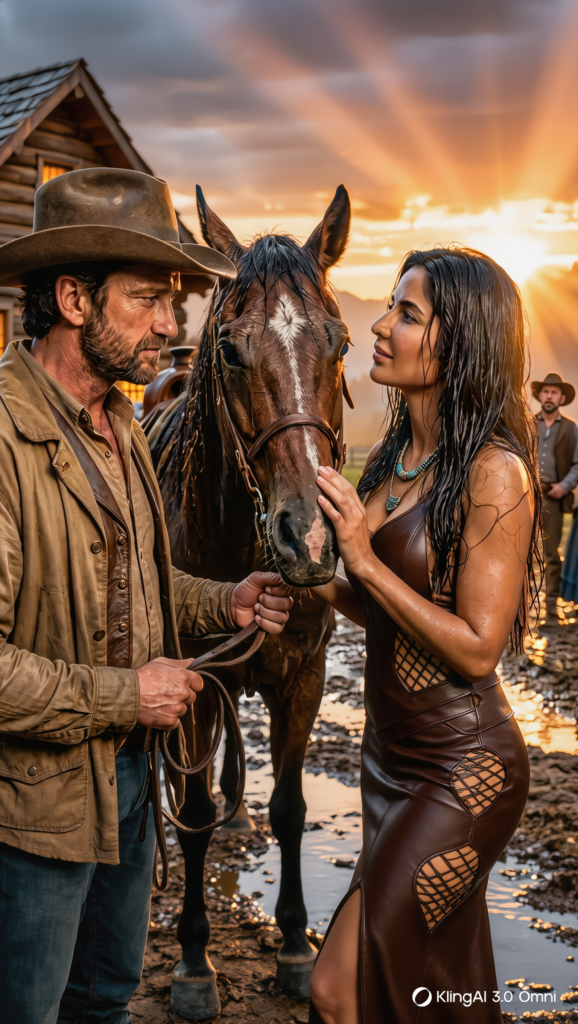
She was young, perhaps twenty-two or twenty-three, her long black hair plastered across her face, her lips gone blue with cold. Her eyes were enormous and dark and so exhausted that for a moment they did not seem to see him. Around her throat hung a necklace of tiny turquoise and white beads, hand-strung, threaded on sinew. Daniel knew the work at once. He had seen his mother trade for necklaces just like it.
Apache.
He stood very still in the hammering rain. Every word he had heard in the general store that morning rose up in his mind at once, like a flock of black birds. They took that child. You see one, you shoot first.
And then he saw what she was holding.
It wasn’t a bundle. It was a blanket, a rough wool trade blanket, wrapped tightly around something she was shielding from the rain with her own body. She had curled herself over it the way a bird curls over a nest. Her own dress was soaked black. The blanket, beneath her arms, was nearly dry.
“Please,” she whispered. Her English was careful, accented. “I’m sorry. I will go. I can walk.”
She tried to stand. Her legs folded beneath her like wet paper, and she caught herself against the tree, still clutching the bundle against her chest.
She could not walk. She could barely breathe.
Daniel looked up at the black, boiling sky. The rain was coming harder. The wind had a cold edge now that he knew too well, the edge that meant hail, or worse. Night was twenty minutes away.
“You’re not staying out here tonight,” he said.
“I don’t want to bring you trouble.”
“You’re not.”
“You don’t know that.” Something almost like a laugh, bitter and broken. “Everyone says I am trouble. Everyone, everywhere.”
“Then everyone can say it to me.” Daniel stripped off his heavy sheepskin coat and draped it over her shoulders, over the bundle, over all of it. She stared at him as though he had done something incomprehensible.
“You need this.”
“I know the way home,” he said. “Right now you need it more.”
He lifted her onto Jack’s back, bundle and all, and climbed up behind her, and turned the horse toward the long valley where his ranch lay hidden behind the hills.
It was nearly an hour’s ride through the storm. Neither of them spoke for a long time. Daniel kept one arm around her to hold her in the saddle, and he could feel her shaking, deep racking shivers that came up from her bones. Through all of it, her arms never once loosened around the blanket.
“I’m Daniel,” he said at last, close to her ear so she could hear him over the rain. “Daniel Reese.”
A long pause.
“Nayeli.”
“Glad to know you, Nayeli.”
“Thank you for stopping.” Her voice was so faint the wind nearly took it. “Many did not.”
“Many?”
She didn’t answer that.
When they reached the ranch, full dark had fallen, and the cabin was nothing but a black shape against blacker hills. Daniel guided Jack straight into the barn, out of the rain, and lifted Nayeli down. She stumbled. He caught her. Together, slowly, they crossed the muddy yard, and he shouldered open the cabin door.
Dry kindling was still stacked beside the stone hearth where he’d left it that morning. Within minutes he had a fire roaring, flooding the small room with gold light and blessed heat. Nayeli sank down on the hearthstones as though her strings had been cut.
Only then, in the firelight, did she finally unwrap the blanket.
Daniel froze where he stood.
Curled inside it, pale and fever-flushed, sound asleep with his thumb in his mouth, was a small boy with tousled sandy hair and a scraped cheek. He wore muddy blue overalls with a patch on one knee. Seven years old, maybe. A white boy.
Daniel had seen those overalls before. He had seen that sandy hair, that cowlick, that patch on the knee, sitting on a fence rail outside the general store two Sundays ago, swinging his legs and eating a peppermint stick while his father loaded flour onto a wagon.
Toby Voss.
“Where,” Daniel heard himself say, very quietly, “did you find him?”
Nayeli looked up at him, and in her eyes he saw fear. Real fear, sudden and sharp.
“In Dead Horse Wash,” she said. “Yesterday, before the storm. He had fallen into the arroyo and hurt his ankle. He could not climb out. He was crying for his father.” She swallowed. “I tried to bring him to the white town. I walked all day. I came to two ranches. At the first, a man pointed a rifle at me before I could speak. At the second, a woman screamed and they set the dogs on us.” Her voice cracked. “I ran. The storm came. I thought, if I can just keep him dry… if I can just keep him warm until morning…”
She looked down at the sleeping child in her lap, and her face crumpled.
“He has a fever,” she whispered. “I couldn’t stop it.”
Daniel worked through the night.
He boiled water and made willow-bark tea the way his mother had taught him. He bound the boy’s swollen ankle with strips of clean linen. Nayeli held Toby upright while Daniel spooned the bitter tea between his lips, and when the boy woke crying for his papa, it was Nayeli who sang to him: a low, wordless, rocking song in her own language, over and over, until he slept again with his small fist wound tight in her beaded necklace.
Around midnight, the fever broke. Toby’s breathing eased. Sweat beaded on his forehead, and he sighed and turned over in Nayeli’s lap and slept like a stone.
Nayeli wept then, silently, her face turned toward the fire.
Daniel sat across from her in his father’s old chair and watched her, and something inside him that had been frozen for four long years cracked open like river ice in March.
“I’ll ride to Voss’s place at first light,” he said. “I’ll tell him the boy’s safe. I’ll tell him what you did.”
Nayeli wiped her face. “He will not believe you.”
“He will when he sees his son.”
She looked at him with an expression he could not read: half pity, half something else.
“You are a kind man, Daniel Reese,” she said softly. “But I have seen what happens when the white town is frightened. They do not stop to see anything.”
Neither of them heard it until it was nearly too late.
Daniel woke in the chair with a start. Gray light was leaking through the shutters, the fire had burned down to embers, and the storm had passed. The silence outside was enormous, the washed, ringing silence that follows a great rain.
Except that it wasn’t silent.
He heard horses. Many horses. The creak of leather, the jingle of bits, the low, rough mutter of many voices trying very hard to be quiet.
He went to the window and looked out through the crack in the shutter.
His yard was full of men.
Thirty of them. Forty. More coming up the lane. Some on horseback, some on foot, rifles and shotguns in their hands, faces hard and gray in the cold dawn light. He saw Abner Pike from the livery. He saw both of the Dutton brothers. He saw the Reverend Amos Kell, a Bible in one hand and a lantern in the other. Torches burned in a dozen fists, though the sun was already rising. And at the front of them all, on a tall roan horse, sat Harlan Voss.
Voss’s face was a ruin. He had not slept in two days. His eyes were red-rimmed and wild, his jaw dark with stubble, and across his saddle horn, coiled and ready, lay a hangman’s rope.
“REESE!” Voss bellowed. “I know you’re in there! Pete Granger saw you on the Ridge Trail last night with a squaw on your horse! A squaw carrying a bundle!”
The crowd muttered, low and ugly.
“Send her out,” Voss roared, his voice cracking down the middle. “Send that thieving savage out here and tell me what she’s done with my boy, or so help me God, we’ll burn this cabin down around both of you!”
Behind Daniel, Nayeli had risen to her feet. Her face was the color of ash.
“Stay here,” Daniel said.
He picked up his father’s rifle, and he opened the door, and he stepped out onto the porch.
Forty guns came up at once.
“Harlan,” Daniel said, very evenly. “Put the rope down.”
“Where is she, Reese?”
“Inside. And she’s done nothing wrong.”
“Nothing wrong!” Voss’s laugh was a terrible thing, high and cracked. “My boy’s been gone two days! There’s Apache sign all over Dead Horse Wash! And you’re harboring one of them in your house, just like your daddy used to, and you’ve got the gall to stand there and tell me she’s done nothing wrong?”
“Harlan, listen to me—”
“Get out of the way, Daniel.” The Reverend Kell stepped forward, lantern raised, his voice ringing out over the yard like a pulpit. “Stand aside. This is the Lord’s justice.”
“There’s no justice in a rope, Reverend.”
“Then you’ll hang beside her!” someone shouted from the back, and the crowd surged forward, a single dark wave of fear and fury. Somebody threw a torch. It struck the porch rail and bounced, sputtering, into the mud. Abner Pike thumbed back the hammer of his shotgun. Harlan Voss shook out the loop of his rope and spurred his roan toward the steps.
Daniel braced his feet, and raised his father’s rifle across his chest, and knew with a terrible calm clarity that he was about to die.
And behind him, in the silence of the cabin, he heard the creak of the door swinging slowly open.
Every man in the yard stopped dead.
Harlan Voss’s face went utterly white. The rope slid from his fingers and fell into the mud.
Because standing in the doorway, barefoot and blinking in the dawn light, his sandy hair sticking up in every direction and one small hand clutching a fold of Nayeli’s skirt, was a little boy in muddy blue overalls.
“Papa?” said Toby Voss.
PART TWO: The Woman Behind the Door
For one long, impossible moment, nobody in Mercy Creek moved.
The torches guttered in the morning breeze. A horse stamped. Somewhere down the lane, a meadowlark began to sing, absurdly bright and cheerful in the frozen silence.
Then Harlan Voss made a sound that Daniel would remember for the rest of his life: a sound that was not a word, that was barely human, a raw, broken cry torn from the bottom of his chest. He threw himself off his horse, fell to his knees in the mud, scrambled up, and stumbled up the porch steps, past Daniel’s rifle, past everything.
He dropped to his knees again in the doorway and pulled his son into his arms.
“Toby. Toby. Oh God. Oh my God.”
“Papa, you’re squishing me,” Toby said into his father’s shoulder. “Papa, my foot hurts. I fell in the wash. Nayeli carried me. She carried me all day, Papa, and there was a big storm, and she sang to me.”
Harlan Voss wept into his little boy’s hair, his huge shoulders heaving, and did not say anything at all.
Slowly, one by one, forty rifles lowered.
Nayeli had not moved from the doorway.
She stood just behind the father and son, very straight, very still, her hands folded in front of her. Her dress was still stained with red mud from the arroyo. Her feet were bare and cut. She looked out over the yard at the faces of the men who had come at dawn with torches and a rope to hang her, and her expression did not change at all. Not anger. Not triumph. Only a terrible, tired patience, as though she had stood in many doorways and looked out at many crowds just like this one.
It was that expression, Daniel thought later, that broke them.
He watched it happen. He watched Abner Pike lower his shotgun and look at the barefoot young woman with the cut feet, and then look down at his own boots. He watched the Dutton brothers glance at each other and quietly extinguish their torches in the mud. He watched the Reverend Amos Kell open his mouth, and close it, and slowly lower his lantern, and his Bible with it.
Nobody said anything. There was nothing anyone could say.
At last Harlan Voss raised his head.
He looked up at Nayeli from where he knelt, his face wet and wrecked, and he tried to speak, and couldn’t. He tried again.
“You,” he said hoarsely. “You found him.”
“In Dead Horse Wash,” Nayeli said quietly. “He had fallen into the arroyo. His ankle is not broken, I think. Only twisted. He had a fever in the night, but it has gone.”
“You carried him.” Voss’s voice shook. “All that way. Through the storm.”
“I tried to bring him to your town.” She said it without bitterness, only as a fact. “Two ranches turned me away. One of them set dogs on us.”
Somewhere in the crowd, a man went very red and turned his face away.
Voss looked at her a long, long time. Then he looked at the hangman’s rope lying in the mud at the foot of the porch steps, the one he had brought for her.
And Harlan Voss, who had never in his life apologized to any man, white or otherwise, bowed his head until his forehead nearly touched the boards.
“Ma’am,” he whispered. “I am so sorry.”
They did not leave right away.
Daniel never quite understood why. Perhaps it was shame. Perhaps it was simply that nobody knew how to turn around and ride home after a thing like that. But the crowd lingered in the yard, uncertain, shuffling, and at last Daniel did the only thing his father would have done.
“There’s coffee,” he said. “Pot’s not big enough for forty, but I’ll make another.”
They stared at him.
“Well?” Daniel said. “Come in, or don’t. Door’s open.”
They came in.
Not all of them. Some of the men from the far end of the valley muttered excuses and rode away. But a good many came, shuffling through the door with their hats in their hands, crowding into the small cabin until there was no room left to stand. Daniel made coffee. Nayeli, without a word, took down the flour tin and began mixing biscuits as if forty frightened, ashamed white men crowded into a kitchen were the most ordinary thing in the world.
The silence was enormous at first.
Then Martha Pruitt broke it.
Martha was the widow of the late Judge Pruitt, a small, sharp-eyed, iron-haired woman of seventy who had ridden out in the back of the Dutton wagon because, she said later, somebody had to keep those fools from doing something they’d answer for on Judgment Day. She had not carried a gun. She had carried a basket of bandages and a bottle of laudanum, just in case.
She lowered herself into the chair by the fire, looked at the boy on his father’s lap with his foot bound in clean white linen, and then looked at Nayeli.
“Who bound that ankle?”
“Daniel did,” Nayeli said. “I held him.”
“Hm.” Martha peered closer. “And the fever? What did you give him?”
“Willow bark. And sang to him.”
“Sang.” Martha Pruitt regarded her for a long moment over her spectacles. “Well. I’ve seen doctors in Santa Fe charge two dollars for worse.” Then, after a moment, almost grudging: “That’s a fine biscuit you’re making, girl.”
“My grandmother taught me,” Nayeli said. “When I was very small.”
Something shifted in the room. Daniel felt it. It was such a little thing, an old woman complimenting a biscuit, and yet it was like a door swinging open somewhere.
Young Samuel Kemp from the blacksmith’s shop, a gangly, freckled nineteen-year-old who had come with a borrowed shotgun and very clearly wished he hadn’t, noticed the blanket folded on the chair by the hearth, the one Daniel had given Nayeli the night before. Sometime in the small hours, while Toby slept, she had repaired its ragged edge with a strip of beadwork so fine and intricate it seemed to shimmer.
“Did you do that?” Samuel asked. “Last night?”
Nayeli nodded.
He picked it up and turned it over in his big, scarred hands, almost reverently. “I never seen stitching like that. Not even in the catalog.”
“It’s nothing.”
“It ain’t nothing.” He looked up. “My ma’s got a quilt from her mother’s mother, back in Ohio. It’s all coming to pieces. Nobody’s been able to fix it right.”
Martha Pruitt sniffed. “I have a wedding quilt in the same condition. Forty years old. The Judge’s mother made it.”
“I could look at them,” Nayeli said quietly. “If you wished.”
Martha regarded her for a long moment. And then, slowly, the old widow smiled, a small, real smile, a smile that took twenty years off her sharp, lined face.
“I believe I would like that very much, my dear,” she said.
Harlan Voss was the last to leave.
He stood on the porch with Toby asleep on his shoulder, and he looked out at the morning: at the sunlight spilling over the rain-washed hills, at the steam rising off the fields, at the hangman’s rope still lying in the mud at the foot of the steps where he’d dropped it.
“I would’ve done it,” he said quietly. “God help me, Reese. I’d have hanged her. I’d have hanged you too, maybe. I was so sure.”
“I know.”
“How’d you know? Last night, out in the storm. Before you saw the boy. How’d you know she wasn’t what they all said?”
Daniel was quiet for a moment.
“I didn’t,” he said. “I just knew she was a person in a storm. My father always said that’s all you need to know.”
Voss looked at him a long time.
“Your father,” he said finally, “was a better man than this whole town deserved.”
He walked down the steps. At the bottom, he stopped, picked up the rope, and stood holding it in his fist for a long moment. Then he walked to the woodpile at the side of the barn, and dropped it on the chopping block, and took up Daniel’s axe, and cut the rope into a dozen pieces.
He didn’t look back as he rode away.
The talk in Mercy Creek did not die down over the following weeks. If anything, it grew. But it was not the talk Daniel had feared.
Martha Pruitt drove out to the ranch in her buggy the following Tuesday with her wedding quilt folded in tissue paper. Nayeli spent four days on it. When Martha came back to collect it, she unfolded it in the middle of the general store on Saturday morning, in front of half the town, and stood there with her chin up, daring anyone to say a word.
Nobody did. They were too busy staring at the stitching.
After that, they came. Shyly, at first. A farmer’s wife with a torn christening gown. Abner Pike himself, red-faced and stammering, with a bridle whose braided leather had come apart. Samuel Kemp rode out every Sunday afternoon to learn beadwork and leather-stitching, and went home with his big hands cramped and his freckled face shining.
Nayeli never asked for money. They paid her anyway: eggs, flour, a bolt of calico, a little pine rocking chair Samuel made for the porch. Martha Pruitt gave her a pair of good walking boots, and Nayeli wore them every day.
Slowly, the way snow gives way in spring, fear gave way to something else.
And through all of it, she stayed.
She hadn’t said she would. Daniel hadn’t asked. It just happened, day by day. She mended the fence beside him, planted a garden behind the cabin, gentled the skittish yearling filly nobody had been able to halter, and in the evenings sat with him on the porch in Samuel’s pine rocker while the sun went down behind the Sangre Hills.
Some nights they talked. She told him about her grandmother, who had taught her medicine and beadwork and the old songs. About her mother and father, gone in the fighting when she was twelve. About the long years since, drifting from camp to camp, mission to mission, looking for honest work and finding mostly doors swinging shut in her face.
“I stopped giving my name,” she said once. “It was easier. When they did not know my name, they did not have to decide to hate it.”
Daniel told her about his own long silence after his parents died: the weeks when he did not speak one word aloud, when the ranch felt less like a home than a tomb.
“Loneliness becomes a habit,” Nayeli said softly. “It feels normal. Until someone reminds you that life was never meant to be lived alone.”
Their eyes met. Neither looked away for a long moment.
And then, one quiet August afternoon, as they worked side by side in the garden, a lone rider appeared on the trail.
He was Apache. An older man, gray-braided, riding a paint pony, with a bundle wrapped in deerskin tied behind his saddle. He drew up at the gate, and looked at Daniel, and nodded gravely.
Then he looked at Nayeli.
“Granddaughter of Huera,” he said in English, so Daniel would understand. “I have been searching for you for three years. The elders have sent me to bring you home.”
PART THREE: Sunrise on the Ridge
The rider’s name was Chato, and he had known Nayeli’s grandmother since they were children together.
From the deerskin bundle he drew out a shawl, deep red wool, embroidered along every border with intricate white and turquoise beadwork in the same spiral patterns that hung around Nayeli’s throat. She made a small sound when she saw it, and took it in both hands, and pressed it against her face.
“It belonged to your grandmother,” Chato said gently. “When she was dying, she asked that it be kept for you. The elders have a place for you, granddaughter. Your people have not forgotten you. You are welcome among us, whenever you are ready.”
Nayeli could not speak. She stood holding the shawl, her eyes shut, her shoulders trembling.
Daniel stepped back to give her room. Every instinct he had was screaming at him to say something: Stay. Don’t go. Please. He held it all behind his teeth.
That evening, on the porch, she asked him.
“You will not ask me to stay?”
He looked at her for a long moment. The sun was going down behind the hills, laying long gold light across the valley, across the garden she had planted, across the mended fence.
“If you stay,” he said quietly, “I want it to be because you chose to. Not because you feel you owe me. Not because you’ve got nowhere else. You’ve got somewhere else now. That matters.” He swallowed. “Nobody should choose your road for you, Nayeli. Not even me.”
She looked at him for a long time. Her eyes were very bright.
“I have spent many years,” she said slowly, “looking for a place where I belonged.”
Daniel watched the light fade over the hills. “I thought this ranch would only ever be a place to work,” he said. “Lately it’s started to feel like a home again.”
Neither of them said anything more that night. Neither of them needed to.
In the morning, she walked out to where Chato was saddling his paint pony.
“Please thank the elders for me,” she said. “Tell them I will come to see them before the snows. Tell them I am well, and that I have found good people here.” She glanced back over her shoulder at the cabin, where Daniel stood in the doorway. “And tell them I have found something here I would like to keep building.”
The old man looked at her, and at Daniel, and something like a smile moved in the deep creases of his weathered face.
“Your grandmother would be glad,” he said. “She always said you would find your home where you least expected it.”
When he had gone, Nayeli wrapped the red shawl around her shoulders and walked back across the yard to where Daniel was setting a new post in the front fence. Without a word, she picked up the spare hammer lying in the grass beside him.
He looked at her. She smiled.
No promises were spoken. But they both understood that something new had begun.
Summer gave way to autumn. The aspens in the high country turned to hammered gold, and the morning air came down off the peaks smelling of pine and woodsmoke and cold.
The Reese ranch was no longer quiet. Neighbors came nearly every week now: Martha Pruitt in her buggy, Samuel with his leather and his questions, the Voss family on Sunday afternoons, with Toby running ahead of them all up the lane, shouting Nayeli’s name. Harlan Voss rebuilt the burned section of Daniel’s porch rail with his own hands, and never once mentioned why it had been burned.
The Reverend Kell, on the third Sunday of September, stood up in his pulpit and preached a sermon on the Good Samaritan. He did not name names. He did not have to.
On a cold, clear October morning, Daniel saddled both horses before dawn.
“There’s a place I want to take you,” he said.
They rode up through the dark to the crest of the long ridge above the valley and sat side by side on a granite ledge, wrapped in blankets, watching the eastern sky go from black to violet to rose. Then the sun broke over the far mountains, and the whole valley below them caught fire: every field, every fence line, the bend of the creek, the cottonwood where he had found her in the storm, the roof of the cabin far below with its thin thread of smoke rising straight and blue into the still air.
Daniel took a long, slow breath.
“When I found you in that storm,” he said, “I thought I was just helping someone who needed a roof for the night.”
Nayeli smiled. “And I thought I was only asking for one safe night.”
“Instead,” he said, “that night gave both of us a new beginning.”
He reached into his coat pocket and drew out a small silver ring, plain and worn thin by years: his mother’s wedding band.
“I can’t promise every day will be easy,” he said. His voice was not quite steady. “This town’s still got a long way to go. Some folks will never come around. There’ll be hard winters and bad years and doors that stay shut. But I can promise to meet every one of those days with honesty, and respect, and gratitude for every single one I get to spend beside you.”
He held out the ring.
“Nayeli. Would you build a future with me?”
For a long moment, she did not answer. The sun rose higher. Far below, a meadowlark began to sing in the frosted grass.
Then she pulled her grandmother’s red shawl from around her own shoulders and wrapped it gently around both of them together.
“Yes,” she whispered. “With my whole heart.”
They were married at the ranch three weeks later.
Half of Mercy Creek came. There were long tables under the cottonwoods, piled with roast beef and squash and fresh bread and Martha Pruitt’s famous peach pies. Samuel Kemp played the fiddle badly and enthusiastically. Chato rode down from the high country with six of Nayeli’s cousins, and for one long, golden October afternoon, Apache and settler sat at the same tables and passed the same bread and laughed at the same terrible jokes.
Martha Pruitt hung her restored wedding quilt over the porch rail for everyone to admire, and told the story of how it was mended to anyone who would listen, and to several who would not.
Harlan Voss gave Daniel a horseshoe he had forged himself, polished bright as silver, to hang over the cabin door for luck.
And Toby Voss, eight years old now, his ankle long healed, marched up to Nayeli in the middle of the dancing and handed her a bouquet of wild asters he had picked himself.
“You saved me,” he announced to the whole crowd. “So I’m gonna marry you when I grow up.”
“I’m afraid,” said Nayeli gravely, “that someone has already asked.”
Toby considered Daniel with deep suspicion. Then he shrugged. “Okay,” he said. “But I get to visit.”
As the sun went down behind the Sangre Hills, Daniel stood at the edge of the yard and looked at all of it: the lanterns in the cottonwoods, the long tables, the dancing, the laughter rolling out across the valley. Not so long ago, this cabin had echoed with silence. He had gone weeks without speaking a single word aloud.
One storm. One choice. One open door.
He thought of his father. A man in a storm is just a man in a storm.
Nayeli came and stood beside him and slipped her hand into his.
“What are you thinking?” she asked.
Daniel looked out at the warm lights, at the faces of neighbors who had once come up this lane with torches and a rope, and now came up it with peach pies.
“That sometimes the greatest blessings arrive without any warning at all,” he said. “They start with an open door. And the courage to see a stranger as a person instead of a threat.”
She leaned her head against his shoulder. And as the last gold light faded from the hills, Daniel Reese knew that the simple choice to help someone in need had given them both the home they had been searching for all along.
One act of kindness in a storm can change more than one life. Sometimes it changes an entire town.
This story is a work of fiction created for entertainment. Any resemblance to real persons or events is purely coincidental.