In 30 BC, Augustus touched Alexander the Great’s body in Alexandria, and a piece of the nose broke off.
At least, that is how the Roman historian Cassius Dio tells it.
But that body, and the tomb that held it, have now been missing for more than 1,500 years.
For more than two centuries, Roman emperors kept coming back to see it.
One took its breastplate.
One locked it shut.
One left his rings on it.
Then the trail goes cold.
And somewhere under the same city may lie the lost tombs of the dynasty that ended with Cleopatra.
To understand how the most famous body in the ancient world could simply disappear, we have to start with a funeral carriage that never reached its destination.
Alexander became king of Macedonia at 20, after his father, Philip II, was assassinated in 336 BC.
Over the next 12 years, he toppled every rival empire in his path, including Persia.
And in Egypt, he declared himself Pharaoh.
In 331 BC, he founded a city on Egypt’s Mediterranean coast, and gave it his name, Alexandria.
That same year, the oracle at the desert temple of Ammon, at Siwa, declared him a son of Zeus.
He died in Babylon in 323 BC, at just 32.
What happened to his body next is one of the strangest funerals in history.
According to the Greek historian Diodorus, Alexander’s men had a coffin made of hammered gold, and filled the space around the body with spices to keep it from decaying.
Then they built a carriage to carry it, with a vault of gold on top, covered in scales set with precious stones.
It was pulled by teams of mules, each one wearing a gilded crown.
Wherever it went, Diodorus says, whole cities came out to see it pass.
The officer in charge of the funeral spent nearly 2 years on the preparations.
And the destination, it seems, was the Temple of Ammon, the god whose oracle had called Alexander a son of Zeus.
It never got there.
Ptolemy, one of Alexander’s generals, had taken control of Egypt.
He marched out with an army and met the procession in Syria.
Diodorus says he did it to honor Alexander.
The geographer Strabo is blunter.
Ptolemy took the body, he writes, “moved by greed and a desire to make that country his own”.
Perdiccas, the regent who claimed control of the body, went to war with Ptolemy.
He lost and was killed by his own soldiers.
Some ancient sources say the body was buried first at Memphis, Egypt’s old capital, and later moved to Alexandria.
They disagree on when and on which Ptolemy ordered the move.
Why go to all this trouble for a corpse? Because whoever held Alexander’s body held a piece of his authority.
Ptolemy used it to strengthen his own claim to rule.
He founded a dynasty that would rule Egypt for nearly three centuries.
Its last ruler was Cleopatra.
If you watched our last video on the search for Cleopatra’s tomb and the sunken port at Taposiris Magna, you know how her story ended.
With a tomb no one has ever found.
Whether it lies in Alexandria or 30 miles away at Taposiris Magna.
This is the story of the tomb her whole dynasty was built around.
Under the Ptolemies, Alexander’s tomb sat at the heart of their capital.
The Greek geographer Strabo says the royal palaces took up a quarter or even a third of the whole city.
Inside that royal quarter was an enclosure called the Sema.
In Strabo’s words, it held the burial places of the kings and that of Alexander.
So, the Ptolemies did not just keep Alexander’s body.
They buried themselves beside it.
The tomb was visited and honored like the temple of a god.
But even here, Alexander did not rest undisturbed.
Strabo says a later Ptolemy nicknamed Coxes plundered the original golden coffin.
By Strabo’s time, Alexander lay in a coffin made of glass.
Now, here is where our two stories meet.
In 30 BC, Octavian, the man who would become the emperor Augustus, took Alexandria.
He had wanted Cleopatra alive to parade her through Rome in his triumph.
But she died before he could.
The Roman biographers Suetonius records what Octavian did next.
He allowed Antony and Cleopatra to be buried together in the same tomb and ordered that the mausoleum they had begun be finished.
Then, Suetonius writes, “About this time, Octavian had the sarcophagus and body of Alexander the Great brought out of its shrine.
He gazed at it, placed a golden crown on it, and scattered flowers over it”.
The historian Cassius Dio adds a detail.
Octavian touched the body, and it is said a piece of the nose broke off.
Then, the people of Alexandria offered to show him something else, the remains of the Ptolemies, Cleopatra’s own ancestors buried in the same royal enclosure.
He refused.
Both Suetonius and Dio record his answer, “I wish to see a king, not corpses”.
Back in Rome, when Octavian celebrated his triumph over Egypt, Cleopatra appeared only as an effigy lying on a couch.
Her children were paraded as trophies.
One of them was a boy named Alexander, also called Helios.
Later, emperors continued to visit, each with his own idea of what the tomb was for.
The emperor Caligula, according to Suetonius, sometimes wore Alexander’s breastplate, which he had taken from the sarcophagus.
Though historians debate whether that story is true.
Around 200 AD, the emperor Septimius Severus >> >> closed it to everyone.
He locked up the tomb, Cassius Dio says, so that no one could view Alexander’s body again.
In 215 AD, the emperor Caracalla came anyway.
According to the historian Herodian, he took off his purple robe, >> >> his jeweled rings, and his belt, and laid them on the tomb.
It is one of the last visits we have on record.
After that, the sources go quiet.
If you want the version of this story that keeps the ancient sources separate from the legends, subscribe.
Because the next part is where the trail goes cold.
Around the end of the 4th century, >> >> the preacher John Chrysostom put a question to his listeners.
Tell me, where is the tomb of Alexander? Show it me, and tell me the day on which he died.
He meant it rhetorically.
But it suggests that >> >> by then, the most famous grave in the ancient world was no longer a place people could easily find.
Historians point to several forces.
Alexandria was becoming a Christian city.
In 391, the great temple of Serapis was destroyed, and monuments to the old gods lost the care and protection they once had.
And then there was the ground itself.
Earlier in that same century, in 365 AD, a tsunami swept into Alexandria.
The Roman historian Ammianus Marcellinus describes the sea pulling back from the shore, then rushing in and drowning many thousands.
It marked the start of a long era of earthquakes and rising seas.
National Geographic reports that the ancient city has been sinking by up to a tenth of an inch a year, as much as 12 feet since Alexander’s time.
If you watched our video on Cleopatra, this will sound familiar.
>> >> Much of the royal quarter, where the Ptolemies built their palaces and their tombs, now lies under water.
Divers led by Franck Goddio have been mapping the drowned harbor since 1992.
And the Cambridge historian Paul Cartledge, speaking about Cleopatra’s tomb, put it bluntly.
That part of the city, he says, is irreversibly submerged.
So thoroughly that not even Jacques Cousteau himself would be able to locate any Hellenic Egyptian royal tombs.
Alexander’s tomb stood in that same royal quarter.
Whether its site is now on land or under the sea, no one can say.
By the time Arab armies took Egypt in the seventh century, no one could confirm where the tomb had been.
And historian Jane Draycott notes that not one of the Ptolemaic royal tombs that ancient sources place in the royal quarter has ever been found.
A lost tomb in a famous city with a famous name attached.
You can probably guess what happened next.
For generations, >> >> people have kept announcing that they found it.
National Geographic counts more than 140 recorded excavations in search of Alexander’s tomb.
Every one of them failed.
Some claims never got far.
In central Alexandria, local legend has long pointed to the Nabi Daniel Mosque.
Digging in the area has turned up Greco-Roman foundations, but nothing that confirms Alexander was ever there.
Some claims even ended up in museums.
In 1805, the traveler Edward Daniel Clarke published a book arguing that a huge stone sarcophagus >> >> taken from Alexandria, then in the British Museum, had held Alexander.
It had been used as a ritual bath in the city’s Attarine Mosque.
Once Egyptian hieroglyphs could be read, >> >> its inscriptions named the real owner, the pharaoh Nectanebo II.
Some made headlines around the world.
In February 1995, >> >> the archaeologist Liana Souvaltzi announced she had found Alexander’s tomb near the oasis of Siwa, home of the same oracle >> >> that had called him a son of Zeus.
She said the tomb was built in the Macedonian style and that inscribed tablets proved it.
Greece sent a team to look, led by George Thomas, the general secretary of its Ministry of Culture.
They said they saw no evidence that the tomb had been found and were not even sure the structure was a tomb.
Its style, they said, was not Macedonian and the tablet fragments did not support her translations.
And some claims turn out to be about people close to Alexander, rather than Alexander himself.
In May 2026, Greece’s Culture Ministry presented the full interior and surrounding enclosure of a huge tomb at Amphipolis in northern Greece.
Headlines tied it to Alexander, but officials connect it to someone in his inner circle, such as his mother, a wife, or a friend, not to the king himself.
This is the pattern.
A big structure, a famous name, a headline, and then the evidence does not follow.
Which is why the most careful search going on right now is not making headlines.
It is happening quietly, 35 ft underground.
In the center of modern Alexandria, there is a public park called Shallalat Gardens.
For more than 20 years, the Greek archaeologist Calliope Limneos-Papakosta has been digging there.
Not all of the ancient royal quarter went under the sea.
Papakosta is following the ancient accounts of where it stood.
And National Geographic reports that her team has reached part of it on land beneath this park.
The tomb, remember, was in the royal quarter.
The work is slow and wet.
To get there, her team has dug down those 35 ft below the modern city.
And had to engineer a system of pumps and hoses just to keep the pit dry.
For 14 years, they found nothing she could point to.
Then, on the last day of a long dig, a piece of white marble showed up in the dirt.
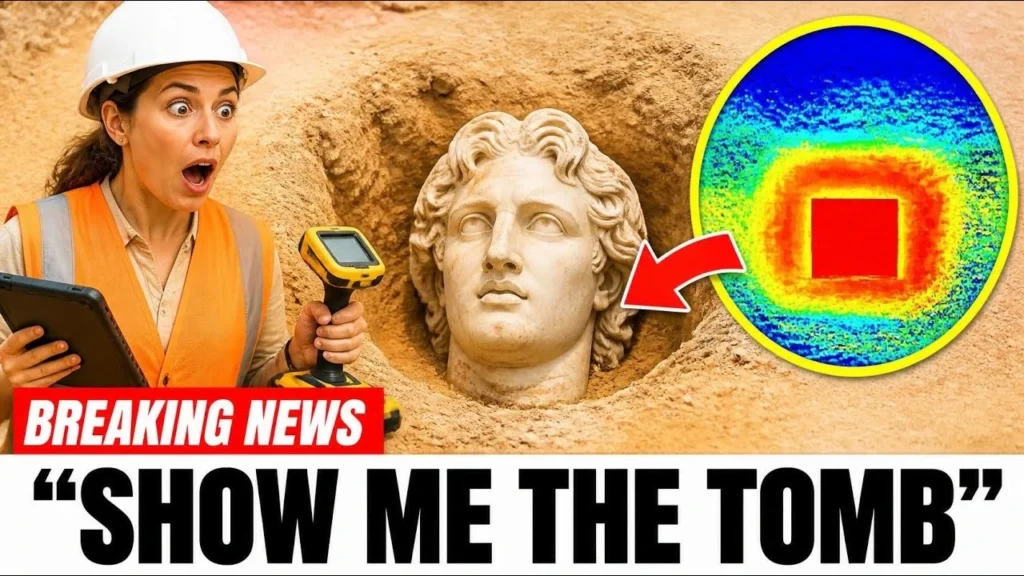
It turned out to be an early Hellenistic statue bearing the features of Alexander the Great.
It now stands in the National Museum of Alexandria.
Since then, her team has used electrical resistivity, one of the same tools used to probe the rock around Tutankhamun’s tomb, >> >> to map 14 anomalies underground.
They have uncovered a Roman road and the remains of a massive public building.
She is careful about what that means.
“For sure, it’s not easy to find it,” she told National Geographic.
“But for sure, I am in the center of Alexandria in the royal quarter.
>> >> And all these possibilities are in my favor”.
The Nottingham Trent archaeologist Jay Silverstein, who has visited her excavation, agrees the statue may depict Alexander.
But, he points out a problem.
It was found discarded in a Roman layer of fill, which means it had already been moved away from wherever it first stood.
And, he holds up her work as a model in contrast to a search you may remember from our last video.
He calls the hunt for Cleopatra’s tomb at Taposiris Magna a cautionary example, where finds were often presented as signs that the tomb was close.
Papacosta, he writes, has kept her claims inside what her evidence can show.
So, let’s score it.
Proven.
Alexander’s body was brought to Egypt and buried in Alexandria.
Strabo, Suetonius, Cassius Dio, and Herodian all describe it there.
And, Roman emperors visited it as late as 215 AD.
Proven.
The tomb stood in the royal quarter in the same enclosure as the tombs of the Ptolemies.
Proven.
Much of that royal quarter has sunk, and part of it now lies underwater.
Plausible.
Whatever survives of the tomb lies somewhere beneath modern Alexandria or its harbor.
Papacosta is digging in what she believes is the right part of the city.
>> >> Unproven.
Every specific site anyone has claimed, from Siwa >> >> and the Nabi Daniel Mosque to Amphipolis, and even Shallalat Gardens for now.
So, what would settle it? The same thing that would settle the search for Cleopatra.
>> >> Not a statue that was moved out of place, but something found where it was left with a name on it.
So, where is Alexander? The honest answer is that no one knows.
His body may have been destroyed in the centuries when the city turned away from its old gods.
It may lie under streets and buildings that were rebuilt again and again.
Or it may be underwater in the same drowned royal quarter where the Ptolemies were laid to rest.
More than 2,000 years ago, Augustus stood over Alexander’s body >> >> and said he had come to see a king, not corpses.
Today, we can see none of them.
Not the king, not the dynasty he left behind, not the queen who ended it.
They may all still be down there waiting for someone to dig in the right place.
If you missed it, our investigation into Cleopatra’s lost tomb is linked right here.
Tell me in the comments, where do you think Alexander is? >> >> And subscribe because if anyone ever finds him, we will be back.


