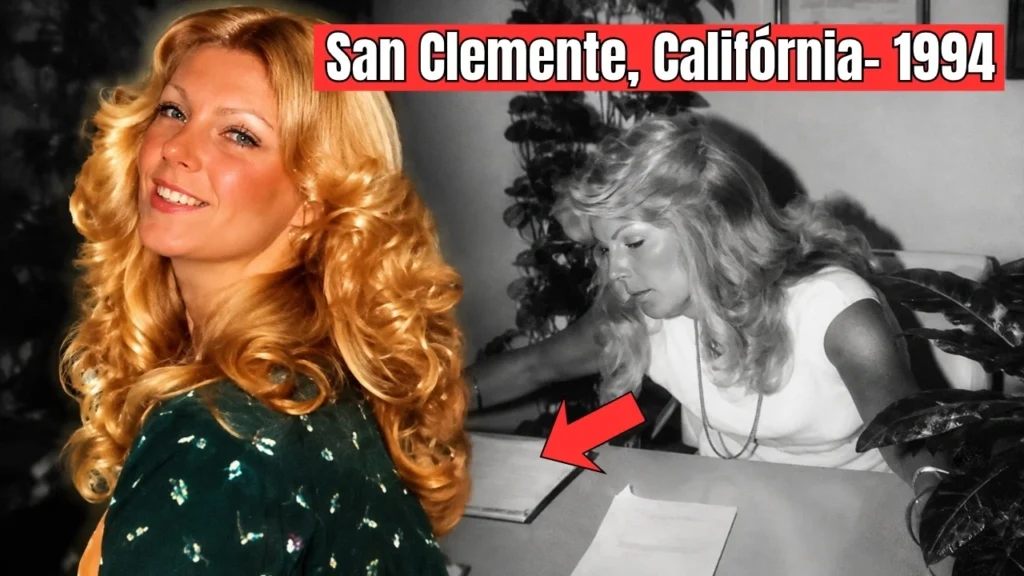
Case archived, reopened, and SOLVED after 16 years. It seemed like the perfect crime

An emergency call at midnight, on June 10, 1994, the house cat had been awakened by a strange noise.
And what we are about to see is a story that took 16 years to solve.
Linda Curry was born as Linda Lecades on February 18, 1944, in Los Angeles.
In her twenties, she started working as a secretary at a Southern California nuclear plant, the San Onofre generating station.
It was an entry-level position; she stayed 27 years at the same company, climbing step by step until she became a training coordinator.
Her job consisted of teaching other employees nuclear safety procedures.
Mary Sebold met her in the 1960s at that same plant and became her best friend.
Mary described Linda as a true lover of fashion.
She would walk through the hallways always impeccable, in elegant suits that matched her shoes, earrings, handbags, and bracelets.
She left no detail to chance.
Her personal life had more ups and downs.
Linda was married twice to men described as handsome and elegant, and both marriages ended in friendly divorces.
She had no children.
Afterward, she had an 8-year on-and-off relationship with Bill Sandreto, a life insurance salesman.
He admired her, but argued with her over her spending, which he considered excessive.
In 1989, Linda ended her relationship with Bill for good and bought a two-story house with a huge garden in San Clemente; her friends called the property the princess house.
That same year, a new employee named Paul Curry arrived at the plant.
He was 32 years old; she was 45.
Paul was short in stature and, in general opinion, did not stand out for his physical attractiveness.
However, he had a mental agility that Linda found irresistible.
Many people considered him a genius.
He claimed to be a member of Mensa, the society for people with a high IQ, and had participated three times in the TV quiz show Jeopardy.
He won on two occasions and took home a total of 24,100.
Linda was fascinated.
Her closest friends did not share that enthusiasm.
To them, Paul was arrogant, self-centered, and often unpleasant.
The warnings were of no use.
The relationship progressed quickly and on September 12, 1992, they both got married in a small ceremony in Las Vegas.
Shortly after the wedding, Mary and Bill noticed something that worried them.
Paul did not seem to contribute the same to the relationship as Linda.
Linda herself confessed to Mary that the couple’s intimate life was practically nonexistent because her husband showed no interest.
For her, however, what mattered was the intellectual challenge of living with such a brilliant man.
She brushed aside the lack of passion.
Shortly after marrying, Paul began pressuring Linda to take out a new million-dollar life insurance policy.
His argument was that he did not need insurance himself, since he was 13 years younger than his wife.
Linda already had several policies totaling nearly a million dollars.
Paul wanted her to change the beneficiary on all of them to his own name.
He also wanted her to include him on the house mortgage.
Bill Sandreto grew concerned and advised Linda not to change anything and to refuse the new insurance.
At the time, the couple’s combined annual income reached $ 10,000 .
Even so, financial problems began to arise, which only increased their friends ‘suspicions.
In June 1993, the house phone rang and Linda answered.
On the other end of the line, a woman she didn’t know demanded immediate payment of back child support.
That was how Linda discovered that Paul had been married twice before and had three children from those relationships.
He had hidden it from her as well as from all his colleagues at the plant.
The discovery also explained the destination of some of the money that was disappearing from the accounts.
Paul was sending considerable amounts to support his secret families.
After a heated argument, Paul bought tickets for a three-day cruise as an official way to apologize.
The trip went wrong.
Linda and Paul got sick and both contracted hantavirus, a rodent-borne disease that causes high fever.
and severe respiratory problems.
After returning, Linda seemed to have overcome the acute phase of the illness .
However, a few days later, her health plummeted suddenly and without explanation.
She began suffering from constant vomiting, extreme dizziness, and weakness so intense that she had to be hospitalized in July 1993.
It was her first emergency admission.
At that time, Linda was about to reach her first wedding anniversary.
She was admitted to the Samaritan Medical Center.
Her condition began with general malaise and evolved rapidly into severe gastrointestinal problems with persistent nausea and vomiting.
The physical change was shocking.
In a few days, the woman who cared about her appearance lost about 24 pounds and took on the frail look of an 80- year-old woman.
Her organs began to fail.
The doctors could not understand why a healthy woman was in such a state and even thought she wouldn’t survive the first night.
During all that time, Paul acted like a devoted husband.
He stayed by the bedside, attentive and solicitous.
Only Mary began to gradually distrust his intentions.
While Linda was receiving intravenous fluids, nurse Sherry Bandy noticed something unusual.
Looking at the IV stand, she noted that the IV solution bag was cloudy and had a strange color, inconsistent with that of a common saline solution.
They removed it immediately and sent it to a laboratory for analysis.
The report was alarming.
The bag contained lidocaine, an anesthetic that should never have been there.
Faced with evidence of possible tampering, the San Clemente police were called to investigate a potential poisoning.
Investigators focused their suspicions on Paul.
He was the only person who stayed alone with Linda in the room while she slept and had free access to the medical equipment.
Still in the hospital, the detectives audio-recorded a statement from Linda.
They asked her if she knew anyone who might want to harm her.
Linda answered sincerely that the only person with financial motives was her husband.
She said that she loved him very much.
After spending 21 days between life and death, Linda recovered and returned home.
The truce lasted 5 months.
In December 1993, the same symptoms returned with the same intensity: vomiting and extreme weakness.
This time, Linda was transferred to another hospital, but the same strange pattern repeated itself.
The IV equipment alarm went off shortly after a nurse saw Paul leaving his wife’s room.
The intravenous line had been deliberately disconnected and Linda had stopped receiving the medication she needed.
The hospital administration acted firmly.
They placed a notice on the door of the room, forbidding Paul from entering or being alone with the patient.
The police returned and conducted a second round of recorded interviews.
Despite the suspicions of her friends, her coworkers, and even the hospital itself, Linda remained loyal to her husband.
She described Paul as a wonderful man who had always taken good care of her.
She refused to file a formal complaint.
Without the victim’s cooperation, the investigation stalled.
During the following months, Linda’s health never returned to normal .
She suffered sporadic episodes of discomfort and pain.
Shortly before the end, Paul began making suspicious moves related to money.
He contacted the insurance company and claimed that Linda’s Rolex watch had been stolen.
The company paid him $ 9,000.
On June 9 , 1994, Paul sent an email to Mary Sebold.
There was something strange about it.
He had never written to her like that before.
In the message, Paul said Linda was worse than ever, that she didn’t even have the strength to walk, and that he seriously feared for her life.
Linda arrived home from work around 6:00 pm, exhausted.
According to Paul, he prepared dinner, but she refused the food.
She just wanted to take a shower and go to bed early.
Near midnight, now June 10th, Paul called 911.
In his statement, he said he had woken up upon hearing the couple’s cat, Scampy, making a strange, terrifying noise next to Linda.
When he looked at his wife, he realized she was cold and unresponsive.
He said he began performing CPR while waiting for the paramedics.
They arrived quickly and took Linda to the hospital, but she had no pulse or heartbeat.
Her death was confirmed around 1:00 am Paul’s behavior after that was described as overly emotional.
He cried for hours on his boss’s shoulder.
However, some friends and nurses were convinced from the very first moment that he had finally succeeded in what he had been trying to do for months.
The death investigation linked the hospital episodes of 1993 with the outcome in June 1994.
Toxicology reports revealed that Linda had catastrophic levels of nicotine in her system.
The dose was between 500 and 1,000 times higher than that of a heavy smoker, and Linda did not smoke.
There was also a large amount of a sedative, the generic version of the sleep aid Ambien.
This indicated she was already incapacitated when the nicotine was administered.
The medical examiner also found a small puncture mark behind her right ear, consistent with a syringe needle entry.
Specialists concluded that death had occurred between 20 and 30 minutes after the injection.
Paul confirmed that he and Linda had been home alone for the 6 hours prior to the emergency call.
According to the evidence, he was the only person who had the opportunity to administer the poison.
As her heir, Paul would receive Linda’s estate, insurance policies, and retirement plans totaling $ 419,000.
The funeral revealed another disturbing sign.
Paul insisted firmly that the casket remain closed throughout the entire ceremony.
He justified it by saying Linda was Jewish and that, according to that religion’s customs, the casket should not be open for attendees to see the body.
Linda’s sister, who had a very close relationship with her, distrusted her brother-in-law’s intentions and insisted on seeing her sister one last time.
After much insistence, Paul allowed the coffin to be opened.
The family was horrified.
Linda, known all her life for being an elegant woman and very careful with her image, was dressed in a way that those present considered unacceptable.
She was wearing a simple gray suit and a shirt that didn’t even match it.
She had no makeup and none of the accessories typical of the fashion-loving woman she had been for decades.
For her friends and family, that appearance was the opposite of everything Linda stood for.
Paul’s image began to crumble shortly after.
He tried to change departments within the power plant where he worked.
A routine security check, followed by a more exhaustive analysis of his documentation, revealed that his career had been built on lies.
Company investigators discovered that Paul had never finished college and therefore did not have the engineering degree required for the position.
They also discovered that he was not a member of Mensa, even though he spent his life bragging about his superior intelligence.
His superior demanded his immediate resignation.
He threatened to fire Paul at 8 o’clock the next morning if he did not receive his resignation letter by fax.
Unemployed, Paul received about $ 19,000 from Linda’s life insurance policies and retirement plans.
He also collected a monthly pension of $ 564 linked to her.
Even so , he stopped paying the mortgage on the San Clemente house and the property went to auction due to foreclosure.
Paul moved to Las Vegas, where he worked as a used car salesman.
Later he moved to Kansas to start a new life.
The case of Linda’s death remained stalled for years.
In 2002, Sergeant Ivon Schul, from the Orange County Sheriff’s Department’s cold case unit, reopened it, dove into the files, and reviewed the interviews recorded in 1993, in which Linda herself described her suspicions about her husband.
The investigation really moved forward when specialists re-analyzed samples of Linda’s blood, including Dr. Neil Benowitz.
The reports confirmed catastrophic levels of nicotine, 500 to 1000 times higher than those of a heavy smoker.
Since Linda did not smoke, the presence of the substance indicated acute poisoning.
A high dose of Zolpidem, the generic form of Ambien, was also detected, which could have been used to sedate her before the injection.
The physical evidence pointed to a quick and violent death.
The medical examiner had identified the puncture mark behind the right ear.
Dr. Benows explained that with the massive dose injected, death must have occurred in just 20 to 30 minutes.
During the investigation, the detective located a witness who recounted an episode that occurred years earlier during a barbecue.
According to their testimony, Paul had boasted that he could take someone’s life without being discovered , using a syringe and toxic substances he handled in his own garage.
With this information, the police developed a hypothesis that Paul had meticulously planned his wife’s death for financial gain.
In 2010, the detective located Paul in Salina, Kansas.
He was working as a building inspector for the city and was married to a woman named Teresa .
To apprehend him, the sergeant prepared a plan.
She wanted Paul to believe he was being questioned by local investigators who just needed to close an old case file.
On November 9, 2010, Paul agreed to give a recorded interview.
He was convinced that his intelligence would be enough to deceive the Kansas police.
During the conversation, the sergeant used the name Marie and acted friendly so he would let his guard down.
The decisive moment came when Paul confirmed on more than one occasion that on the night of Linda’s death, he was the only person inside the house.
He asserted that no one else had entered and that there had been no signs of break-in or theft.
After committing him to that version of events, the detective closed the logical trap.
The nicotine was injected .
Linda died in 20 to 30 minutes and Paul confirmed that they had both remained alone for about 6 hours.
It could only have been him who had administered the lethal dose.
After this implicit confession, the sergeant revealed her true identity and arrested Paul for the murder of Linda Corry.
The next day, from jail, Paul called his wife on the phone and admitted he was in serious trouble.
Due to the evidence presented against him, the call was recorded.
In September 2014, nearly 20 years after Linda’s death, the California court was the scene of the final showdown.
The trial began on September 11, 2014.
Prosecutor Ibrahim Baitier presented Paul not as the genius he claimed to be, but as a cold, calculating, and narcissistic killer who believed he could cheat the system.
The prosecution relied on solid forensic evidence and the testimony of Dr. Neil Benows.
One of the country’s leading experts on nicotine explained to the jury that Linda had been the victim of catastrophic liquid nicotine poisoning, with levels four to five times higher than any he had seen throughout his career.
The substance was injected while she was under the effects of a high dose of a sedative that left her unable to react.
The prosecution also presented the unusual puncture mark behind Linda’s right ear, which examiners identified as consistent with a needle entry.
To demonstrate the defendant’s criminal profile, the court heard testimony from Paul’s second ex-wife.
She recounted that shortly after they married, he began pressuring her to take out a life insurance policy.
When she refused, Paul demanded a divorce immediately and soon replaced her with Linda, who already had assets and several insurance policies.
The testimony revealed a pattern.
Paul viewed his wives as financial assets.
The defense presented a controversial theory that came to be known as the “enema defense.
” It suggested that Linda might have administered a nicotine enema to herself as an unconventional pain remedy, and that this had caused an accidental overdose.
The prosecutor responded vehemently.
He labeled the hypothesis an invention with no backing in the evidence or the victim’s history .
On September 30, 2014, the verdict was read.
Paul Curry was found guilty on all charges, including first-degree murder with the special circumstance of financial gain and insurance fraud.
Linda’s friends and family who were present in the courtroom felt peace and relief.
Mary Sibold, who held one of Linda’s earrings in her hand during the session as a way to keep her friend close, felt that the cycle of injustice had finally closed.
Paul Curry received the maximum sentence: life in prison without the possibility of parole.
He would spend the rest of his life behind bars for the crime he believed he had executed to perfection.


