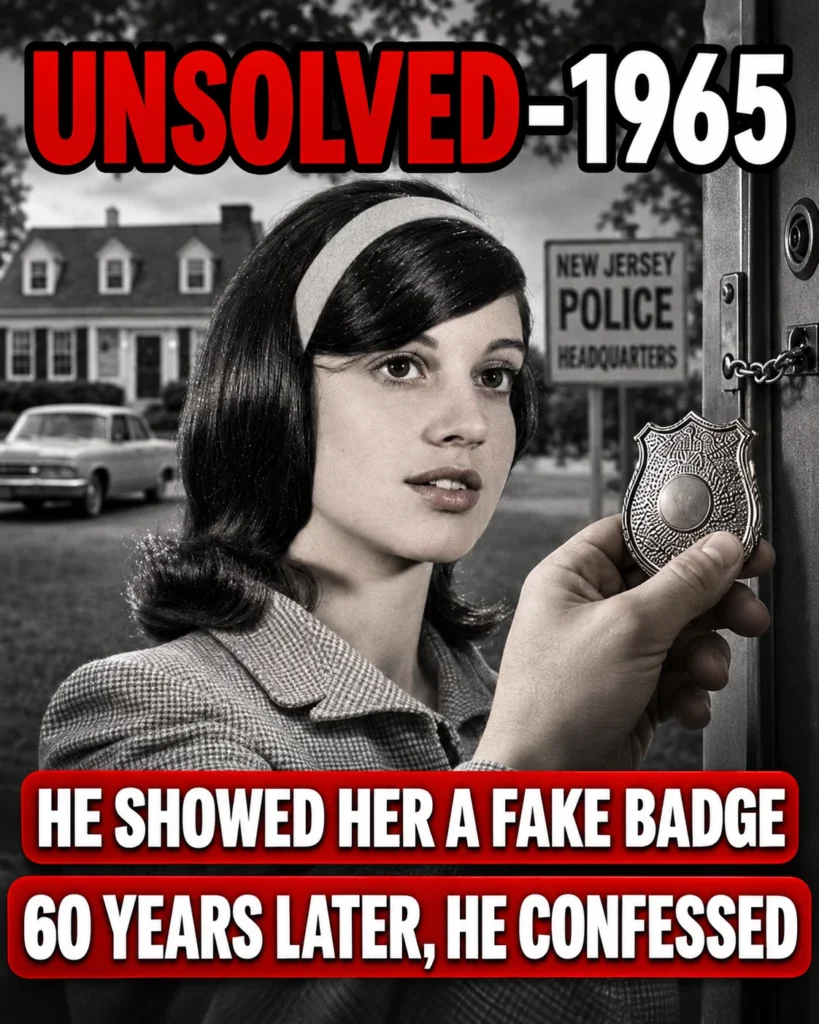
New Jersey 1965 Cold Case Solved After 60 Years: The Torso Killer Flashed a Fake Badge at Her Door
On a Friday afternoon in September 1965, a young man knocked on the door of a Dutch colonial house on Saddle River Road in Fair Lawn, New Jersey.
When 18-year-old Alys Eberhardt opened it, he showed her a police badge and said he needed to leave a phone number for her father.
She had no reason to doubt him.
She turned around to get a pen and a piece of paper.
He stepped inside and locked the door behind him.
Less than three hours later, her father found her body on the living room floor.
The case went cold for 60 years.
The man who knocked on that door went on to kill at least 19 more people across New York and New Jersey.
The newspapers would call him the Torso Killer and the Times Square Killer.
He was already serving multiple life sentences before anyone connected him to Alys.
In the end, it took four years of questioning, more than 50 hours of recorded interviews, and a health scare that nearly killed him to make him talk.
This is the story of the earliest known victim of one of America’s most prolific serial killers, and of the detectives who refused to let her be forgotten.
A Safe Town
If you had asked anyone in Fair Lawn about the Eberhardt family in the fall of 1965, they would have said they were good, solid people.
They went to church on Sundays and kept their yard neat.
They lived in a white Dutch colonial on Saddle River Road, a quiet residential street in Bergen County about 20 miles northwest of Manhattan.
It was the kind of neighborhood where people left their doors unlocked and children rode bikes until dark.
Fair Lawn in the mid-1960s was a textbook New Jersey suburb of about 30,000 people, mostly young families and middle-class professionals who worked in the city and came home to tree-lined streets.
Violent crime was not something people there worried about.
You might lock your car at the train station, but locking your front door in the middle of the afternoon felt unnecessary.
The world Alys grew up in felt safe because, for most of the people in it, it was.
Ross Eberhardt and his wife raised their daughter there.
Her name was spelled A-L-Y-S but pronounced like Alice.
She had auburn hair and a face people remembered.
She had graduated from Fair Lawn High School in June 1965, and by every account she was a student who didn’t just show up but got involved.
She taught Sunday school, was active in her community, and loved skiing and music.
Most of all, she cared about other people.
That was what drew her to nursing.
Everything about her, from the Sunday school teaching to the way she naturally took charge in a group, pointed in the same direction.
She wanted to help people, and nursing was the most direct way to do it.
In the fall of 1965, Alys enrolled at the Hackensack Hospital School of Nursing, about ten minutes from home.
It was a well-regarded program that took its students seriously.
Within weeks, her classmates elected her president of the freshman class.
She was barely a month into nursing school and already leading it.
She was 18, and she had her life mapped out: nursing school, a career in health care, and whatever came after.
She made plans and followed through on them.
She had people who loved her and a future that, by any reasonable measure, looked bright.
Friday, September 24, 1965
At about 2:30 that afternoon, Alys left her nursing dormitory and drove home to Saddle River Road.
Her family was planning to travel to Oswego, in upstate New York, that weekend for her aunt’s funeral, and she needed to pack.
It was supposed to be a quick stop before a family trip.
She never made it to Oswego.
For six decades, what happened inside the house that afternoon was a mystery.
Only when the killer himself described it from a prison interview room in 2025 did the full picture come into focus.
He was 18 years old, the same age as Alys.
He first noticed her in the parking lot of the nursing school.
He watched her get into her car and decided to follow her.
He trailed her from the hospital, stopped briefly at a diner along the way, and then continued behind her all the way to Saddle River Road.
He watched her pull into the driveway.
He waited.
Then he walked up to the front door and knocked.
When Alys opened the door, he was holding a police badge.
It was fake.
He said he needed to speak to her father and asked if he could leave a phone number.
It was a simple, reasonable request from someone who appeared to be law enforcement.
In a town like Fair Lawn in 1965, a police officer at the door was not alarming.
You answered, you helped, and you went on with your day.
She turned to get a pen and paper.
In that moment, he stepped inside and locked the door.
What followed was violent and brief.
Alys fought back hard.
Detectives who later reviewed the case said she defended herself so aggressively that she disrupted whatever the attacker had planned.
The struggle moved through several rooms of the house.
She died of blunt force trauma to the skull.
She also had dozens of stab and cut wounds, though the medical examiner could not say whether they came before or after the head injury.
A large kitchen knife belonging to the Eberhardt family was found at the scene.
Bergen County Prosecutor Guy W.
Calissi said Alys was found partially clothed, but there was no evidence of sexual assault.
A second weapon was also found: a curved souvenir dagger, small and decorative.
No one in the family had ever seen it before.
The killer was still inside when Ross Eberhardt came home shortly before 6 pm As Ross walked in the front door, the man who had murdered his daughter slipped out the back.
Ross found Alys on the living room floor, the kitchen knife from his own home still in her body.
The house showed signs of a violent struggle through several rooms.
He had left for work that morning with a living daughter and came home to a crime scene.
Had he arrived five minutes earlier, he might have caught the killer in the act.
That timing would haunt the case for decades.
The Investigation
The Bergen County Prosecutor’s Office took over immediately.
Prosecutor Calissi assigned his top people, and Fair Lawn detective Robert Van Houten, who would later become the town’s police chief, was named lead investigator.
They worked through the night.
Nine friends and neighbors were brought to police headquarters for questioning.
Alys’s room was searched, and the house was processed for evidence.
Detectives knocked on doors up and down Saddle River Road, asking whether anyone had seen a stranger, an unfamiliar car, or anything out of the ordinary.
In a tight-knit town like Fair Lawn, a murder like this was unthinkable.
A young woman had been killed in her own home in the middle of a weekday afternoon, and nobody could explain how or why.
Parents began locking doors they had never thought to lock.
The local papers covered the story extensively.
At the nursing school, her classmates were devastated.
She had been sitting in class with them just hours earlier.
For a while, it seemed the strange little dagger might give police their answer.
It was about four inches long and clearly not a common household item.
The killer had brought it with him.
Investigators traced it to the Jordanian Pavilion at the 1964–1965 New York World’s Fair in Flushing Meadows, Queens.
Only about 1,000 of these daggers had been made, and they were sold in just three places: at the World’s Fair itself, at a store called the House of Jordan near 38th Street and Third Avenue in Manhattan, and at a shop called the Acropolis near 44th Street and Eighth Avenue.
Police bought an identical dagger for comparison and tracked sales records.
But a thousand daggers, sold for cash to anonymous buyers in one of the busiest cities on Earth, some perhaps given as gifts or resold, was a needle in a haystack.
Police never found the matching curved scabbard, and they never identified the buyer.
Today, a clue like that would be a gold mine.
There would be digital sales records, credit card transactions, and security cameras at the register.
In 1965, none of that existed.
There was no DNA testing, no surveillance cameras on residential streets, no cell phone records, and no forensic databases.
Genetic genealogy and the national DNA database were decades away.
The killer had left two weapons, signs of a struggle across several rooms, and almost nothing else police could use.
Worse, he was an 18-year-old from River Vale, New Jersey, a small town about seven miles from Fair Lawn, with no criminal record.
As Fair Lawn police sergeant Eric Eleshewich would put it six decades later, he was on no one’s radar.
Over the years, Alys’s father was looked at as a possible suspect, which is standard when a family member discovers the body.
It must have been agonizing for a man who had already lost his daughter.
He was never charged.
No one was.
The case went cold.
The file was placed in a cabinet at the Fair Lawn Police Department, where it sat year after year, decade after decade, while the man who killed Alys went home to River Vale and carried on with his life.
The Man Who Knocked
His name was Richard Francis Cottingham.
He was born on November 25, 1946, in the Bronx, and his family moved to River Vale when he was young.
River Vale is a small borough in Bergen County that feels like the country, even though Manhattan is less than an hour away.
When Cottingham was four, he was hit by a car.
Forensic historian Peter Vronsky, who would spend years interviewing him in prison, has pointed to that accident as a possible factor in what he became.
Researchers believe it caused frontal lobe damage.
The frontal lobe governs impulse control, empathy, and decision-making, and an injury there at such a young age can change how a person processes the world.
Whatever the cause, by September 1965 Cottingham had committed his first known murder, and no one knew.
On the surface, his life afterward looked unremarkable.
He finished high school and got a job as a mainframe computer operator at Blue Cross Blue Shield of Greater New York, commuting from New Jersey into Manhattan every weekday.
It was a stable, respectable, slightly boring job, the kind nobody asks follow-up questions about.
He married and had three children.
The family settled in Lodi, another small Bergen County town about 15 minutes from River Vale.
Neighbors saw a family man.
Coworkers saw a reliable employee.
The commuters who rode the bus or train with him saw a familiar face.
He mowed his lawn on weekends.
Nobody saw anything unusual, and that was by design.
He was living a double life.
By day he processed insurance claims.
After hours, and sometimes during lunch breaks or his commute, he was hunting.
He knew the streets of Manhattan and the highways linking Bergen County to New York City and Long Island.
He knew how to move between jurisdictions without drawing attention.
The fake badge he used at the Eberhardt house was not a one-time trick.
It was a tool he had tested and found effective, and it would become a recurring part of his method.
A badge gave him instant authority.
It gave him a reason to ask questions, make demands, and expect compliance.
It worked again and again because people are taught from childhood to cooperate with the police.
That double life kept him invisible for 15 years.
He didn’t fit the profile investigators were looking for.
He wasn’t a drifter, a loner, or someone living on the margins.
He was a commuter with a mortgage and a family.
He looked like everyone else.
Fifteen Years of Killing
After Alys, Cottingham kept killing, and one of the things that made him so hard to catch was that he rarely did it the same way twice.
In October 1967, 29-year-old Nancy Schiava Vogel was found strangled.
For decades, she was considered his first victim.
No one would connect him to Alys for another 58 years.
In 1968, he used a familiar trick.
Diane Cusick, a 23-year-old dance teacher barely five feet tall and about 98 pounds, was walking to her car at the Green Acres Mall on Long Island when a man approached claiming to be mall security.
He accused her of shoplifting.
It was the same basic ruse: a false claim of authority and an order to comply.
Diane was killed.
Her case went unsolved for more than 50 years until a DNA match connected it to Cottingham in 2022.
In the late 1960s, three teenage girls in the Bergen County area were strangled: 13-year-old Jacqueline Harp in 1968, and 18-year-old Irene Blase and 15-year-old Denise Falasca in 1969.
At the time, none of the cases were linked to each other or to any suspect.
Through the 1970s, the killings continued and kept changing.
Cottingham moved constantly between New York and New Jersey: Bergen County, Manhattan, Long Island, then back again.
Each crime landed on a different detective’s desk in a different department with its own files and priorities.
In an era before police databases were linked, a murder in Bergen County and one in Manhattan might as well have happened on different planets.
Nobody compared notes across county or state lines.
Connections that seem obvious now were invisible then.
Whether or not Cottingham planned it, crossing a county line effectively reset the clock.
Peter Vronsky has worked to correct a popular myth about Cottingham’s victims.
After his convictions, the press tended to describe him as a killer who targeted sex workers around Times Square.
According to Vronsky, only about a third of his confirmed victims were sex workers.
Roughly 70 percent were women and girls like Alys: students, working women, housewives, people he reached through manipulation rather than on the street.
In 1974, he murdered two teenage girls in New Jersey, 17-year-old Mary Ann Pryor and 16-year-old Lorraine Kelly.
Their case stayed cold until Cottingham pleaded guilty in 2021.
Then came 1979 and the crimes that gave him his most notorious nickname.
Firefighters responded to a blaze in a room at the Travel Inn hotel near Times Square.
When they put out the fire, they found two women dead.
Their bodies had been set on fire, and their heads and hands had been removed, deliberately, to prevent identification through dental records or fingerprints.
The brutality shocked even hardened NYPD detectives in late-1970s Manhattan.
One victim was eventually identified as Deedeh Goodarzi.
The other has never been identified.
More than four decades later, she remains a Jane Doe, and her family, if they are still alive, may not know she is dead.
The tabloids named him the Torso Killer.
They also called him the Times Square Killer, because several of his New York crimes happened in or near the Times Square district, which in the late 1970s was a grimy strip of adult bookstores, peep shows, and cheap hotels where rooms were rented by the hour and nobody asked questions.
His methods included strangulation, stabbing, drowning, and bludgeoning.
Some victims were tortured before they died.
He moved bodies across jurisdictions and changed his approach from one killing to the next.
With no consistent signature and no system connecting cases across counties and states, police treated each murder as an isolated event.
He later claimed to have killed between 85 and 100 people.
Authorities have not verified that number, but if true, it would mean a killing roughly every seven weeks and would make him one of the most prolific serial killers in American history.
What investigators have confirmed is that he is linked to about 20 killings between 1965 and 1980.
The Arrest
Cottingham’s run ended on the night of May 22, 1980, at a Quality Inn motel in Hasbrouck Heights, New Jersey, not far from where he had killed Alys 15 years earlier.
Motel staff heard screaming from one of the rooms and called the police.
Officers found an 18-year-old woman, Leslie Ann O’Dell, who had been restrained and tortured.
In the room, they recovered a switchblade, slave collars, a leather gag, replica pistols, and prescription drugs.
Cottingham was arrested on the spot.
The double life was over.
The quiet computer operator from Lodi was suddenly in a Bergen County jail cell.
His wife and children had to be told.
His coworkers had to absorb the fact that the man who ran the mainframe was charged with murder.
Searches of his home and belongings made things worse.
He had kept trophies from some of his crimes, along with tools that made clear his violence was planned, rehearsed, and equipped.
The man his neighbors thought they knew had never really existed.
Three murder trials followed between 1981 and 1984, in both New Jersey and New York.
Cottingham was convicted of five killings: Mary Ann Carr and Valerie Ann Street in New Jersey, and Deedeh Goodarzi, the unidentified Travel Inn victim, and Jean Reyner in New York.
He received multiple life sentences and was sent to South Woods State Prison in Bridgeton, in the southern part of New Jersey, far from the streets where he had hunted.
Five convictions.
Case closed.
Except it wasn’t.
Investigators already suspected the list was much longer, and the families of the other victims got nothing from his arrest.
The Eberhardts were among them.
Alys’s file was still in that cabinet in Fair Lawn, and no one had any reason to connect the quiet teenager from River Vale in 1965 to the serial killer caught in 1980.
Pizza and Cards
For 30 years after his conviction, Cottingham said nothing about other murders.
The first crack came in 2010, thanks to a detective with remarkable patience.
Bergen County investigator Robert Anzilotti had been visiting Cottingham in prison for years.
He didn’t interrogate him or pressure him.
He brought pizza.
They played cards and talked about sports, the news, whatever was on TV.
The conversations were casual and carried no demand that Cottingham admit anything.
Imagine driving to a state prison again and again to sit across from a man you know has killed multiple people, eating pizza with him and acting as if everything is normal, for months and then years.
Anzilotti understood that you can’t bully a confession out of someone like Cottingham.
He wasn’t afraid of prison.
He was already there for life.
The only thing that works is making him comfortable enough, for long enough, that talking starts to feel easier than staying silent.
In 2010, after years of this slow rapport-building, Cottingham confessed to the 1967 murder of Nancy Vogel.
It was one confession after decades of silence, but it proved he could be made to talk under the right conditions.
The incentive was simple.
Prosecutors agreed not to file new charges.
Cottingham would never get out, and another conviction would change nothing.
Talk, and we won’t prosecute.
Stay quiet, and those cases stay cold forever.
Between 2014 and 2020, he confessed to the murders of the three teenage girls from the late 1960s: Jacqueline Harp, Irene Blase, and Denise Falasca.
Investigators kept those confessions quiet for years, afraid that a headline might make him feel exposed and shut down.
In 2021, he pleaded guilty in court to the 1974 murders of Mary Ann Pryor and Lorraine Kelly.
In 2022 came a breakthrough no one expected.
Investigators in Nassau County, Long Island, got a DNA match linking Cottingham to the 1968 murder of Diane Cusick.
Nassau County District Attorney Anne Donnelly said it might be the oldest DNA match ever used to bring a prosecution in the United States.
Cottingham pleaded guilty and was sentenced to 25 years to life.
As part of the deal, he confessed to four more Long Island killings from the early 1970s: Mary Beth Heinz, Laverne Moye, Sheila Heiman, and Maria Rosado Nieves.
By the mid-2020s, his confirmed victim count had grown from five to about 20.
Two people played crucial roles as go-betweens.
Peter Vronsky communicated with Cottingham for years and helped police obtain 11 confessions between 2021 and 2025.
Jennifer Weiss, the daughter of victim Deedeh Goodarzi, also built a relationship with him and served as a bridge to detectives.
She died in 2023, before the Eberhardt confession.
Vronsky, who likely understands Cottingham’s psychology better than anyone alive, has been blunt.
Cottingham does not feel remorse in the usual sense.
Vronsky calls it “cognitive remorse”: Cottingham understands intellectually that what he did was horrific, but he does not feel it.
He knows what remorse means the way someone knows the definition of a word in a foreign language.
The meaning is there.
The feeling isn’t.
That matters for understanding his confessions.
He did not confess out of guilt.
He confessed because the conditions were right and the deal was acceptable, and because talking gave him something he wanted, whether attention, a legacy, control over his own story, or simply a break from the monotony of a prison cell.
A Phone Call From an Old Classmate
In the spring of 2021, while Cottingham was in the news for his guilty plea in the Pryor and Kelly case, a phone call came into the Fair Lawn Police Department.
It was from one of Alys Eberhardt’s old nursing school classmates.
After 56 years, someone still remembered the girl who never came back to the dormitory that Friday, and the empty seat in class that Monday morning.
The call went to Detective Brian Rypkema, who brought it to the police chief.
The chief authorized reopening the case, and Rypkema and Sergeant Eric Eleshewich were assigned to it.
They were not outside cold case specialists.
They were Fair Lawn officers, and this was their department’s only unsolved homicide, a file that had sat in their building longer than either of them had been alive.
They started from scratch.
They pulled the original file and went through everything: crime scene photos, the medical examiner’s report, the statements from the nine friends and neighbors questioned in 1965, the records of the World’s Fair dagger investigation, and the notes on Ross Eberhardt as a suspect.
A 1960s case file is thinner than a modern one, the forensic work more limited and the photos grainy, but the details are there if you know what to look for.
As they reviewed it, something clicked.
Cottingham was all over the news, confessing to cold cases.
And the geography fit.
In September 1965 he was 18 and living in River Vale, about seven miles from Fair Lawn.
He would have known Hackensack and how to find Saddle River Road.
It was thin.
There was no DNA and no fingerprints that had survived six decades.
There was only geography, age, and a gut feeling that the timing was too neat to ignore.
The detectives drove to the prison.
When they sat down and told Cottingham they were from Fair Lawn, New Jersey, his expression changed.
He didn’t tense up or shut down.
He perked up.
“Ah, Fair Lawn,” he said.
It wasn’t proof, but it told them they were pulling on the right thread.
Working with the Bergen County Prosecutor’s Office, they decided not to seek new charges.
Cottingham was 75 and already serving three life sentences.
A trial would give him a reason to stop talking.
What they needed was not a conviction but the truth: a confession that matched the evidence, a name for the file, and closure for the family and the town.
The Chess Match
The questioning stretched over four years.
Rypkema and Eleshewich visited Cottingham again and again, sometimes joined by investigators from the New Jersey State Police and the Bergen County Prosecutor’s Office.
They worked through his intermediaries, Vronsky and, before her death, Jennifer Weiss.
Cottingham didn’t simply hand over a confession.
He tested them.
He would raise a detail from his past and watch their faces.
He talked around the edges of the case, referring to Fair Lawn in 1965 without admitting anything.
He dropped hints and pulled back, as if checking whether the detectives had earned the next piece.
He had been playing this game with investigators for over a decade.
He knew the only leverage he had was the information in his head, and he could release it at whatever pace he chose.
Some visits produced nothing but small talk and a long drive home with empty notebooks.
Others yielded fragments the detectives brought back to Fair Lawn and checked against the original file, careful never to reveal what they already knew.
In total they logged more than 50 hours of recorded interviews, spread over dozens of visits across years, each one requiring preparation, travel, and the emotional toll of sitting across from a man who had done what he had done.
The moment of certainty came before the formal confession.
Eleshewich later said there were small ways Cottingham reacted to questions that made it clear he was their man, the kind of involuntary reactions a person can’t fake.
One exchange sealed it.
Eleshewich asked how the killer had gotten into the house.
Cottingham corrected him.
He said the killer had done it a different way, and then he described what actually happened.
He wasn’t guessing.
He was remembering.
The details kept coming.
He described a piece of clothing Alys was wearing that day, something never released to the public.
He described the layout of the house, the rooms and how they connected, things only someone who had been inside would know.
He mentioned that there was no water in the backyard swimming pool.
It was a small, specific, checkable fact, the kind you would only remember if you had been there.
He also gave a rough description of where he had bought the souvenir dagger.
The location matched one of the three sale sites identified by investigators in 1965.
Piece by piece, his story matched the file.
Not perfectly, since 60-year-old memories always carry small discrepancies, but closely and specifically enough that the detectives had no doubt.
The Confession
In November 2025, the timeline sped up.
Cottingham’s health had been failing for months, and he had nearly died in October.
Vronsky contacted the detectives: Cottingham wanted to talk, his time was running short, and if they wanted the full confession, they needed to move now.
The visits became daily.
The conversations grew longer and more focused.
On the night of December 22, 2025, Richard Cottingham gave a full verbal confession to the murder of Alys Jean Eberhardt.
He described following her from the hospital parking lot, the fake badge, knocking on the door of the Dutch colonial on Saddle River Road, what happened inside the house, and slipping out the back door when he heard her father coming home.
He later gave a written confession with the same account.
He was 79 years old.
He had kept this secret for 60 years and three months.
The next morning, December 23, the Eberhardt family was notified.
After six decades of watching their worst day sit untouched in a filing cabinet, they finally had a name.
On January 6, 2026, the Fair Lawn Police Department held a press conference and announced that the murder of Alys Jean Eberhardt, the town’s last unsolved homicide, was officially closed.
Her nephew, Michael Smith, spoke for the family in three words: “We finally know who.
”
What Closure Looks Like
No new charges will be filed.
Cottingham is 79, serving three life sentences at South Woods State Prison, and his health continues to decline.
There is no additional punishment the justice system can impose.
He will die in prison either way.
Every investigator involved understood from the beginning that the non-prosecution agreement was the only path to the truth.
The confession rests on Cottingham’s word, backed by details only the killer could have known.
There is no DNA in the Eberhardt case and no surviving forensic samples that could produce a match after 60 years.
For some, that may feel incomplete: closure without a trial, resting on the word of a convicted serial killer.
In an age of DNA exonerations, skepticism about confessions is healthy.
But consider what he provided.
A piece of clothing never made public.
The layout of a house he had no documented connection to.
An empty swimming pool on a specific afternoon 60 years ago.
A rough location for buying a dagger that only about a thousand people ever owned, matching records from 1965.
These are not details someone invents.
They are memories.
For the Eberhardt family, it was enough.
They were not looking for a courtroom drama.
They wanted the answer to the question that had haunted them since Ross came home that evening: who did this, and what happened in those missing hours? Now they know.
Over the past 15 years, Cottingham’s confessions have given answers to about 20 families.
In some cases, the parents who reported their daughters missing in the 1960s and 1970s died without ever learning the truth, and the answers went to nieces, nephews, and grandchildren instead.
But if his own claim of 85 to 100 victims is even partly true, dozens of families will never get that call.
Their cases were never connected to him.
Their loved ones vanished across New York, New Jersey, and possibly beyond, and their files may still sit in cabinets in departments that don’t know to look his way.
Witnesses have died, evidence has degraded, and Cottingham himself may not remember them all.
The Badge
Alys’s case was the earliest, stretching back to that September afternoon in 1965 when a teenage girl opened her door to a stranger with a fake badge.
That small piece of theater, a hunk of metal official enough to make a young woman pause and do as she was asked, became his signature trick.
Three years later, he used a version of it on Diane Cusick at the Green Acres Mall, posing as security and accusing her of shoplifting.
He used variations throughout his 15 years of killing: a badge, a uniform, a claim of authority, an accusation that put the victim on the defensive.
The details changed, but the logic never did.
People trust authority.
They comply.
They open the door.
Alys did nothing wrong.
A police officer needed to leave a number for her father, so she went to get a pen.
That wasn’t carelessness or naivety.
It was a completely normal, human response to what looked like legitimate authority.
That is what makes his method so unsettling.
He didn’t break into homes or ambush people in alleys.
He knocked, smiled, held up a badge, and people let him in.
Alys Jean Eberhardt was a nursing student, the president of her freshman class, and a Sunday school teacher who loved skiing and music.
She was 18, and she had plans for who she was going to become.
For 60 years, her story ended with a question mark: a cold case, an unsolved file, a name fading from public memory while the man who killed her sat silent in a prison cell.
It took a phone call from a classmate who never forgot her, two detectives who refused to let go, and 50 hours of patience over four years to finally get the answer.
The file is closed.
Fair Lawn’s last unsolved homicide is solved, and Alys’s name is spoken again, not as a case number, but as a person.