
PART 2
Laurel’s hand shook as she slid the key into the first lock. Click. The little door swung open. Inside was a photograph wrapped in faded blue cloth.
A teenage girl sat on the very staircase Laurel had just climbed, dark hair over one shoulder, smiling wide and unguarded. Beside her stood a tall man in work clothes, one hand resting awkwardly on the railing. Laurel knew that face instantly. “Mama,” she whispered.
Miriam couldn’t have been more than fifteen. And she looked happy — not the careful, tired smile from the family albums, but something free. On the back, someone had written: She was safe here. — A.B.
Beneath the photo lay a small wooden bird with one blue-painted wing. Laurel’s throat tightened. Her mother used to keep a bird exactly like it on her bedroom windowsill. After the funeral, it vanished. She turned this one over. Carved underneath: One of two. Someone had made a pair. Miriam had taken one. The other had waited here — for decades.
Laurel looked at the five remaining doors, then at her belly. She couldn’t vanish into a mystery with a baby coming, not without knowing who swept those stairs. At dawn, she walked back to the road, and a passing utility truck carried her into the nearest town: a courthouse, a pharmacy, and a diner with a faded red sign — Hensley’s.
Behind the counter stood an elderly woman with silver hair pinned neatly back. Her name tag said Opal. “Coffee, hon?” Laurel glanced at her stomach. “Maybe tea.” “Tea it is.”
Laurel set her mother’s wooden box on the counter while she called a mechanic. When Opal turned with the kettle, she saw the box — and froze mid-pour. It wasn’t curiosity on her face. It was recognition. “Where did you get that?” “It was my mother’s.” “What was her name?” “Miriam Vance.”
The color drained from Opal’s face. The whole diner seemed to go silent. “Miriam had a daughter,” she whispered. She came around the counter and sat across from Laurel. “I knew a frightened girl who used to come in here with sawdust in her hair and pretend she wasn’t hungry.”
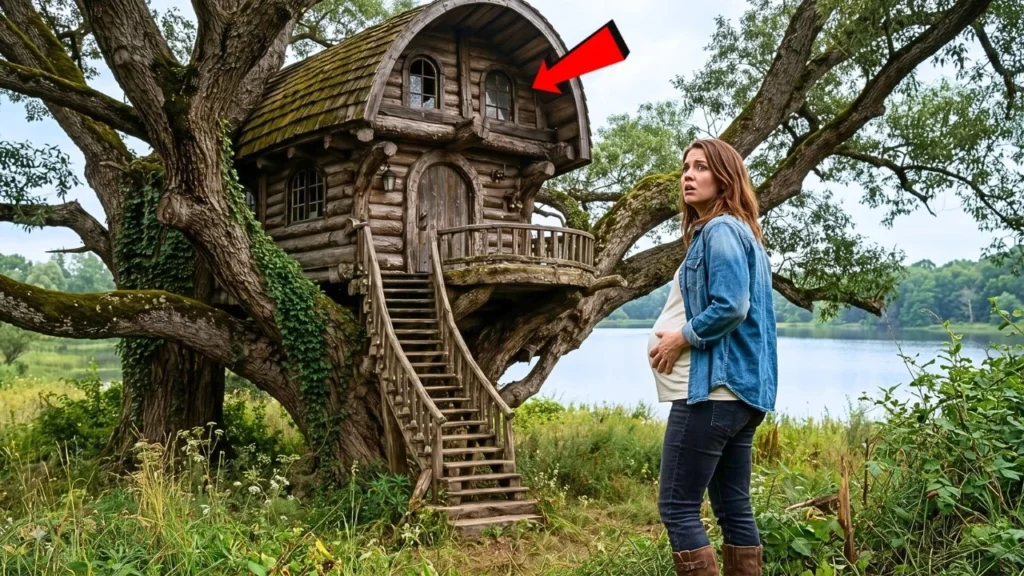
“Who’s the man in the photo?” Laurel asked. “Amos Bellamy. Built furniture, fixed barns, repaired half the porches in this county. Quiet man. Stubborn man.” Opal paused. “And he built a house in a sycamore tree for your mother.” “Why?” Opal looked out at the rain. “Because sometimes Miriam was afraid to go home.”
She didn’t explain further. She didn’t need to. “Was he family?” Laurel asked. “No.” “Then why would he do all that?” Something passed across Opal’s face — grief, maybe regret. “That’s a much longer story.” “Can I talk to him?” “No, honey. Amos died seventeen months ago.”
Another dead person. Another door slammed before Laurel could reach it. Then Opal added quietly, “He spent his last years waiting for someone.” “Who?” Opal’s eyes dropped to Laurel’s belly, then rose to her face. “You.” “That’s impossible. He never knew me.” Opal touched the leaf on the box. “Oh, he knew about you. Your mother made sure of that.”
Opal wouldn’t say more. “Some things aren’t mine to tell.” But she gave Laurel an address: Virgil Boone, a 75-year-old retired lineman living two miles outside town. Laurel found him splitting kindling under a tin roof. When she mentioned the treehouse, he lowered his ax. “So. You finally came.”
“If everyone knew my name,” Laurel snapped, “why didn’t anyone ever find me?” “Amos tried once,” Virgil said. “Found an address. Wrote to your mother. She wrote back — said she was alive, had a daughter, was building a new life. And she asked him one thing: Don’t come looking for us.” The words landed like a slap. “Then why tell him about me at all?” Virgil shrugged softly. “Burying something isn’t the same as forgetting it.”
That afternoon, Virgil drove her back to the lake. He admitted he was the one who kept the stairs clean, cleared branches, checked the roof. “Why?” “Because I promised him.” Inside, he stopped at the doorway. “This part belongs to you.”
Laurel studied the wooden bird again and finally noticed a tiny number under the blue wing: 14. On the bookshelf, the fourteenth book was an old field guide to Appalachian birds. Inside the cover — another key. Compartment two held a narrow leather notebook filled with Amos’s handwriting. Small, careful notes. She ate two bowls of stew today. Fixed the loose hinge herself. Then: Miriam asked if she could sleep here tonight. I didn’t ask why. Then: She says she’s afraid to go home again.
Laurel sat down hard. Her mother — the strong one, who checked every lock twice, who hid emergency cash in the kitchen, who could feel tension in a room before anyone spoke. For the first time, Laurel wondered if those things had been strength… or survival.
Then the ink darkened. I spoke to someone today about taking her in legally. Three weeks later: I haven’t filed anything yet. Then: They asked questions I don’t know how to answer. I’m afraid if I do this wrong, they’ll send her somewhere I can’t reach her. And finally, alone on a page: I waited too long.
“What happened?” Laurel asked. “She left,” Virgil said. “Seventeen, some money saved. Got on a bus before sunrise and never came back. Amos didn’t know until she was gone.” Anger burned up Laurel’s chest. “So he built her a treehouse and thought that was enough?” Virgil met her eyes. “No. That was the problem. He knew it wasn’t.”
A photograph slipped from the notebook and fell to the floor. A little girl with a red backpack and a missing front tooth stood outside a school. Laurel’s heart stopped. It was her, age eight. On the back: R.A.M.’s girl has her mother’s eyes. “Who is R.A.M.?” she asked. For the first time, Virgil’s face completely changed. He sank into the rocking chair.
“Rachel Ann Mercer,” he said. “That was your mother’s name when Amos first knew her.” “My mother was Miriam Vance.” “Later, yes. When she left Kentucky, she didn’t just leave the town. She left the name, too. She wasn’t lying to you, Laurel. She was trying to build a life that didn’t begin with everything she’d survived. Amos never called her Rachel again. He said if someone fights that hard to choose a new life, the least you can do is respect the name she chose.”
On Laurel’s childhood backpack in the photo was a tiny stitched number: 22. Entry twenty-two of the notebook had a note in the margin: Where the bluebird faces morning. Beneath the bird’s painted wing was a hollow — and a third key.
Compartment three was full of letters. Dozens of them, all in Miriam’s handwriting, some over thirty years old. Ohio. Indiana. Cheap apartments. Loneliness. Learning to live normally after a childhood of waiting for something bad to happen. Then the letters changed. They began to talk about Laurel. She loves thunderstorms as long as I’m beside her. She draws trees bigger than houses. She asked me today if people can choose their family.
Laurel covered her mouth and sobbed. Her first library card. Her first bike. The night she refused to sleep because she was sure the moon was following their car. Her mother had been writing it all down for someone. The last letter was mailed only months before Miriam died.
Amos — if anything happens to me, I don’t want Laurel growing up believing she came from nothing. I won’t bring her back to the life I escaped. But I want her to know there was one place where somebody was kind to me when kindness mattered. If she ever has nowhere left to go, she’ll have my box. She’ll know the leaf.
None of it had been coincidence. The leaf. The trail marker. The birdhouse. Her mother had built a path that could wait twenty-two years — a path Laurel might never need. Until now. Taped inside the compartment was a legal envelope marked: NOT YET. Open six first. And compartment four bore a tiny carved house, with five words beneath it: What I should have done.
The key was hidden in the little wooden house on the mantel. Inside compartment four lay a courthouse form more than thirty years old. Petition for Guardianship — Rachel Ann Mercer. Amos had filled out everything: his income, references, a handwritten statement about why the girl needed a safe home. Everything except the signature line. It was blank.
His letter was clipped to it. Laurel, if you’re reading this, you know I cared about your mother. What you need to know is that caring wasn’t enough. The lawyer warned it might get ugly. I got scared. I told myself I was being careful. I told myself the treehouse was keeping her safe. Then she was gone before dawn. I spent the rest of my life wishing I had signed my name.
Laurel lowered the page. All her life she’d learned one lesson: don’t need anyone, because everyone leaves. Nolan left. Her mother died. Every foster home ended. But Amos hadn’t left because he didn’t care. He’d loved Miriam — and fear had convinced him that waiting was safer than acting.
And suddenly Laurel saw herself. She hadn’t called the county about housing because she was ashamed. She hadn’t told her old coworkers how desperate she was. She hadn’t asked anyone for help, because needing people gave them the power to hurt her. Even now, she’d been hoping this treehouse would fix everything. It couldn’t. A roof isn’t a future. A mystery isn’t a plan.
The note at the bottom read: Five is for what she gave me. Compartment five held only photographs. Miriam repairing a railing. Miriam with a fishing pole. Miriam laughing beside a young Opal outside the diner. And one of Amos on the steps, teenage Miriam behind him with both hands over his eyes. On the back: She thought I gave her a safe place. She never understood she gave a lonely old man a family.
That evening, Laurel did something she wouldn’t have done a week before. She asked for help. She called the bakery’s old bookkeeper about work. She let Opal bring her dinner without promising to pay her back. And when Virgil offered to fix the railing, she didn’t say I can handle it. She said, “Thank you.” Small words. Enormous for her.
Days turned into a rhythm. Virgil taught her to replace rotten boards without hurting the old frame. Opal brought soup and stories. Laurel scrubbed windows and aired blankets, and slowly the treehouse stopped feeling like a museum and started feeling like a place someone could live.
One afternoon Virgil handed her an envelope. “Amos left this with me. Said not to give it to you unless you came on your own, and not until you’d opened five doors yourself.” Inside was a small steel key. Compartment six held a deed, a trust document, and a land survey. Before he died, Amos Bellamy had placed the treehouse, the sycamore, and the lakeside land into a trust. Beneficiary: Laurel Miriam Vance.
It wasn’t a fortune. But to a woman who’d been sleeping in a minivan, it was something she’d almost stopped believing in. A home. Days later, a vacation property buyer offered to purchase it — enough for an apartment, hospital bills, and months of breathing room after the baby. Laurel lay awake all night. Nobody had required her to stay. The choice was hers alone. In the morning she called him back. “I’m not selling.”
She stood on the balcony over the lake. For the first time, she wasn’t staying because she had nowhere else to go. She was staying because she chose to. Then she opened the envelope marked NOT YET. A house can keep rain off your head. It cannot decide who you become inside it. The last door isn’t about what I’m leaving you. It’s about what you will leave her. Laurel’s hand found her belly. Eliza.
Compartment seven had no keyhole — only a carved cradle. For three days she left it alone. She was afraid of what came after the last door. So she worked. Fixed boards. Washed curtains. Picked up part-time bookkeeping through one of Opal’s regulars. Then one quiet morning, moving the rocking chair, she noticed a thin seam in the wall.
The panel slid aside. Behind it sat an unfinished wooden cradle. One side was beautifully carved with sycamore leaves; the other rail was rough and incomplete. Beside it lay a set of old tools and a worn chisel engraved A.B. Under the cradle’s frame was a small lever. Laurel pulled it. Across the room — click. The seventh door swung open.
Laurel, I didn’t finish this. Unfinished things shamed me most of my life, and your mother’s papers were the worst of them. When Miriam told me about you, I wanted to find you both. She asked me not to, and this time I listened. But she asked one promise: if you ever came here with nowhere left to go, the door would open. Not because I could save you. One person can’t build another’s life for them. All we can leave is an open door, a second chance, a tool — and trust you to build the rest. Don’t finish my mistakes. Finish the cradle. Build something different for her.
So she did. Virgil taught her Amos’s tools. Her first cuts were crooked. She ruined a whole piece of maple and started again. Opal sat nearby with coffee, telling stories — not about the frightened girl in the notebooks, but the stubborn one who cheated at cards, hated boiled carrots, and once painted Amos’s toolbox bright yellow because he was “too serious.” Laurel laughed. After twenty-two years of memories that only hurt, that surprised her most of all.
One golden autumn evening, she fitted the final rail and turned the cradle over to sign her name beside Amos’s initials. And froze. Words were already carved there, old and worn, made long before his hands grew too weak to finish: For the first child in this family who will never need a hiding place.
Laurel sank to the floor and cried. Not for the eviction. Not for Nolan. Not even for Amos. She cried because she finally understood. Miriam needed this treehouse because home was the place she feared. Laurel came here because she had no home at all. But Eliza would grow up knowing a home isn’t just a roof — it’s where you’re safe enough to be afraid, to fail, to ask for help, and to stay.
Weeks later, Laurel carried newborn Eliza onto the balcony at sunset. Down below, Opal and Virgil were bickering over who was supposed to bring dinner. Laurel smiled. Inside, the seven little doors lined the wall. Six held the past. In the seventh, where Amos’s last letter had been, Laurel placed one of her own: For Eliza — when you’re old enough to ask where we came from.
She closed the little door. She didn’t lock it. Some family stories should never make another generation spend a lifetime searching for the key.
The treehouse had been built as a hiding place. It became an apology. Then a promise. And now, at last, it was a home.
Amos couldn’t go back and sign those papers. Miriam couldn’t erase the childhood that taught her fear. Laurel couldn’t get back twenty-two years of believing she’d been left with nothing. None of them could rewrite the past — but each of them changed what the past became. Sometimes our greatest legacy isn’t land or money. It’s deciding that an old hurt ends with us.
Most of us have a door we wish we’d opened sooner. A call we didn’t make. Words we never said. As long as we’re still here, it isn’t too late.
💬 What door can you still open for someone you love? Tell us in the comments — and share this story with someone who needs a second chance today. ❤️