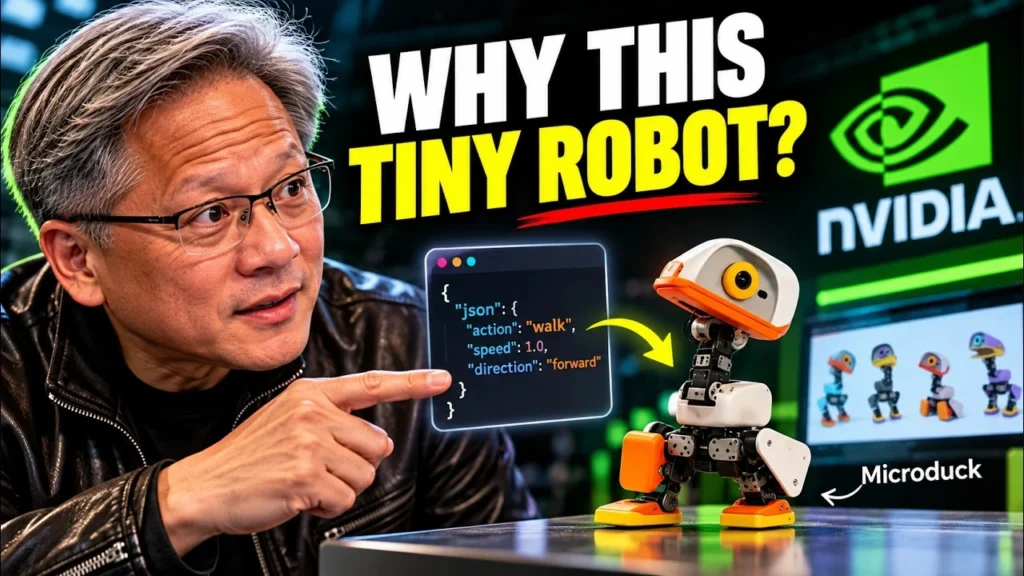
Why Is NVIDIA Paying Attention to a Tiny $400 Robot Duck? The Surprising AI Breakthrough That Could Change Robotics Forever
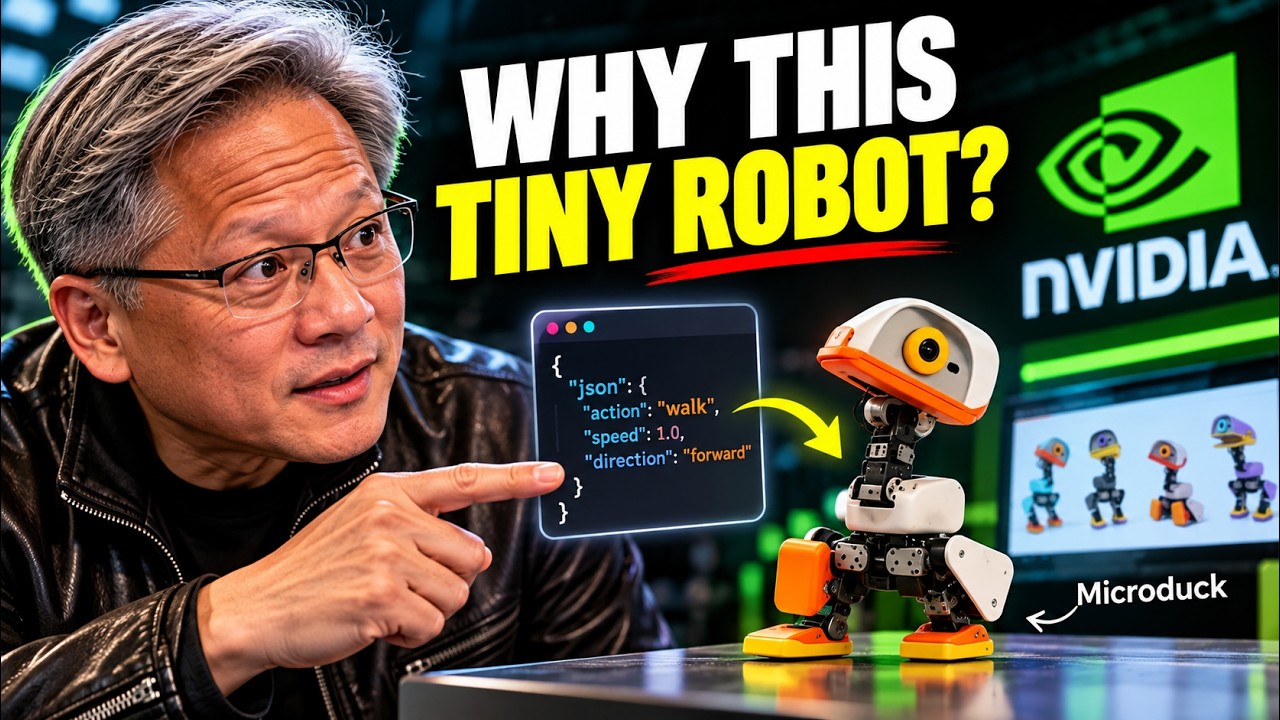
A tiny robotic duck, standing just 25 centimeters tall, may seem like the last thing that would attract attention in the world of advanced artificial intelligence.
Yet this unusual machine illustrates a technological shift that could transform how robots learn, move, and interact with the physical world.
While companies race to develop humanoid robots costing thousands of dollars, a relatively inexpensive walking duck is demonstrating how powerful artificial intelligence can become when training moves from the real world into simulation.
And behind that transformation stands an increasingly important technology provider: NVIDIA.
But there is one crucial distinction.
NVIDIA did not create the robot.
The machine, known as Micro Duck in the source account, comes from the robotics ecosystem associated with Pollen Robotics and Hugging Face.
Its connection to NVIDIA comes primarily through the computing tools used to train its movements.
That relationship reveals something much bigger than an entertaining robotic toy.
It offers a glimpse into the future of physical artificial intelligence.
According to the technical description, Micro Duck stands approximately 25 centimeters tall and weighs around 800 grams.
Its reported price is roughly $400, making it significantly more accessible than many research robots.
The machine is designed around open-source software, allowing developers to study its behavior, modify its capabilities, and experiment with new approaches to robotic control.
Its movements include walking, sitting, standing, kicking, grasping objects with its beak, roller skating, and recovering after falling.
These abilities might appear simple compared with the achievements of advanced humanoid machines.
But teaching a robot to walk reliably is far more complicated than it looks.
Every movement requires continuous coordination between motors, sensors, balance, and the surrounding environment.
A slight shift in weight can cause a robot to stumble.
An unexpected obstacle can disrupt its movement.
And recovering from a fall requires the machine to understand how its body can return to a stable position.
Traditional robotics often relied heavily on engineers manually designing control rules for these situations.
That approach can work, but creating reliable behavior for every possible movement is extremely demanding.
Micro Duck demonstrates a different method.
Instead of manually programming every step, developers use reinforcement learning.
This approach allows an artificial intelligence system to improve its behavior through repeated attempts.
The robot receives feedback about whether its actions are helping it achieve a particular objective.
Successful movements are reinforced.
Unsuccessful attempts provide information that helps improve the control policy.
Over many training cycles, the system gradually discovers more effective ways to move.
The remarkable part is where that learning happens.
Rather than forcing a physical robot to fall thousands of times, engineers create virtual versions inside a physics simulator.
These digital robots can practice simultaneously, dramatically accelerating the learning process.
The source describes one walking policy trained using 4,096 simulated ducks operating in parallel.
Under the reported setup, a usable walking behavior can emerge within approximately one or two hours.
That speed would be difficult to reproduce through conventional physical testing.
Imagine training a single real robot to walk by repeatedly allowing it to fall, resetting its position, and beginning another attempt.
The process would consume time, require supervision, and potentially damage components.
Simulation changes those economics.
Thousands of virtual machines can experience different situations without physical wear or repair costs.
Once the artificial intelligence develops a useful control strategy, engineers transfer it to the actual robot.
This process is known as simulation-to-reality transfer, commonly shortened to sim-to-real.
It is one of the most promising techniques in modern robotics.
However, simulation is not a perfect substitute for the physical world.
Real motors behave differently from mathematical models.
Surfaces have unpredictable friction.
Sensors produce noise, and mechanical components experience wear.
Successful sim-to-real systems must therefore prepare robots for variations that their simulations cannot reproduce exactly.
Researchers often introduce randomized conditions during training to make learned behaviors more robust.
This helps explain how a small robot can recover after losing its balance.
Instead of relying entirely on a fixed sequence of movements, it can use a learned control policy designed to handle changing conditions.
And this is where NVIDIA’s role becomes especially important.
Modern reinforcement learning frequently requires substantial parallel computation.
Graphics processing units, originally developed primarily to accelerate graphics workloads, have become essential tools for artificial intelligence research.
Their architecture allows large numbers of calculations to run simultaneously.
That capability is particularly valuable when thousands of simulated robots are training at once.
The source identifies a simulation system called MuJoCo Warp, which uses NVIDIA’s Warp computing framework.
It also describes MJ Lab, a training environment whose interface resembles NVIDIA’s Isaac Lab.
These tools connect the robot to a broader ecosystem of accelerated simulation and machine learning.
Developers can experiment with physical behaviors, evaluate results, and transfer trained policies to compatible hardware.
The account also mentions tutorials involving NVIDIA Jetson computers, compact computing platforms designed for artificial intelligence applications.
Together, these technologies illustrate how NVIDIA can influence robotics without manufacturing every robot that uses its infrastructure.
A company does not necessarily need to build the final machine to become essential to the development process.
It can instead provide the computing foundation that researchers, startups, and manufacturers depend upon.
That strategy has already proved influential in generative artificial intelligence.
Training and operating advanced AI models frequently requires powerful accelerators, specialized software, and sophisticated development frameworks.
Robotics represents another potential market for those capabilities.
Unlike a chatbot, a physical robot must understand how actions affect objects, surfaces, and its own mechanical body.
It must respond to gravity, momentum, collisions, and uncertainty.
Those requirements make physical AI especially dependent on realistic simulation and efficient training.
A small open-source robot offers developers an accessible way to explore these challenges.
Students can investigate reinforcement learning without purchasing expensive industrial machines.
Researchers can compare different control strategies.
Independent developers can modify behaviors and contribute improvements to shared software.
This accessibility may help expand the number of people working on robotics.
And as more developers enter the field, demand for simulation software and computing resources could increase.
The source also raises a much larger business question.
It mentions reports suggesting that NVIDIA could be approaching an acquisition of Hugging Face valued at approximately $13 billion.
That claim should not be treated as an established transaction.
No completed acquisition or definitive agreement is demonstrated by the supplied material.
Any potential deal would require reliable confirmation before its implications could be assessed.
Nevertheless, the speculation highlights why open-source AI platforms and robotics development tools are attracting attention.
Hugging Face has become an influential platform for sharing artificial intelligence models, datasets, and development resources.
Its robotics initiatives connect machine learning research with affordable physical hardware.
For companies building AI infrastructure, such ecosystems can be strategically valuable because they encourage experimentation and broaden adoption.
But the importance of Micro Duck does not depend on a corporate acquisition.
Its significance comes from the technological model it represents.
Instead of beginning with an expensive, highly specialized machine, developers can start with a relatively simple robot and sophisticated virtual training.
The result is a more approachable entry point into a difficult engineering discipline.
That does not mean a $400 duck can perform the duties of an industrial robot or replace a humanoid assistant.
Its limited size, hardware, and capabilities make it primarily a platform for experimentation.
But breakthroughs often begin with systems that appear modest.
A reliable walking controller developed for a small robot can help researchers understand principles that apply to more complicated machines.
Techniques for balance, recovery, and adaptation may contribute to broader advances in robotic mobility.
And improvements in simulation can benefit projects far beyond a single product.
The deeper story is therefore not that NVIDIA has suddenly become fascinated with a robotic duck.
It is that inexpensive machines can introduce an entirely new generation of developers to GPU-accelerated physical AI.
The duck provides a visible demonstration of a much larger technological transformation.
Its movements may look playful, but the learning process behind them represents serious research.
Thousands of virtual attempts can become one successful physical action.
A robot that falls can learn how to stand again.
And an accessible experimental platform can make advanced robotics feel less distant.
For NVIDIA, the opportunity is not necessarily selling robotic ducks.
It is helping supply the infrastructure behind the machines that future developers will build.
The most important question is no longer whether a tiny robot can learn to walk.
It is what happens when millions of simulated robots begin learning skills that can eventually be transferred into the physical world.
That possibility, rather than the duck itself, may be the real revolution.