
Part 2 📖
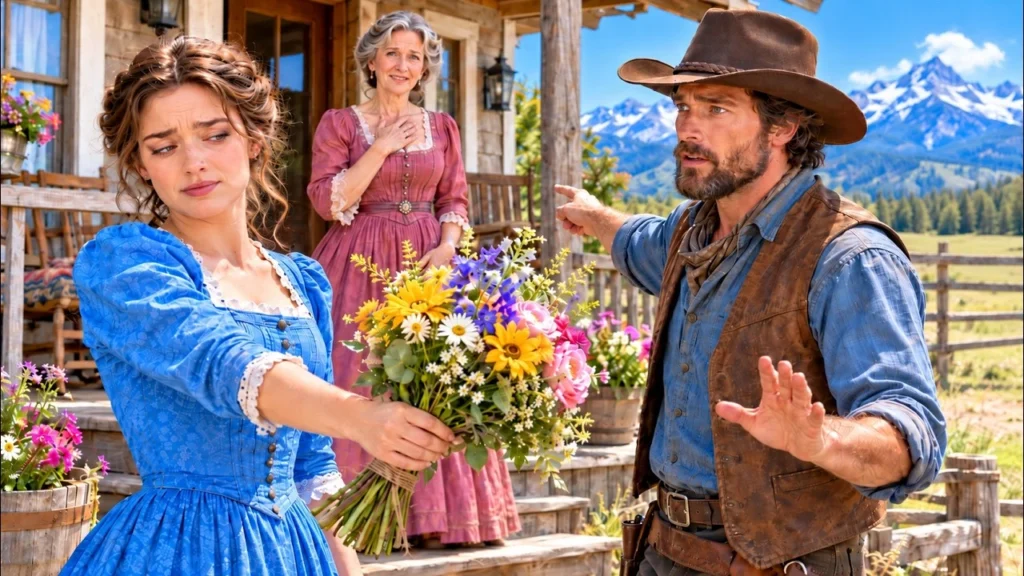
“My mother?” Tess whispered. “My mother is a widow, Mr. Brennan.”
“I know it,” he said quietly. “I stood at the grave with her. I sat up with her that first night while you were asleep. I know to the day how long it’s been.”
Tess’s face burned from her collar to her hair.
She’d walked three miles in the dust to refuse a man who’d never asked her anything.
“You left them in the dark,” she said. “Like a thief.”
“I know how it looks,” Silas said. “I haven’t asked your mother for one single thing. And I won’t. Not unless she gives me room to. I only wanted her to have something that was alive.”
He held the flowers out to her.
“Give them to her. Or put them in the creek. I wouldn’t blame you either way.”
Tess took them and walked out without a word. 😔
At the footbridge, she sat on the creek bank and thought.
Every July, when Silas cut their hay, her mother carried a tin cup of coffee to the fence post at ten. By noon, the cup was back on that post. Empty. Rinsed in the creek.
For six summers, Tess thought it was just manners.
Back home, she put the sweet peas in the blue jar. Then she reached for the big family Bible, just to hold something steady.
It fell open by itself. To Ecclesiastes.
And pressed flat between the pages were sweet peas. Three clusters. One for each Tuesday.
Beside each, in her mother’s neat pencil: June 7. June 14. June 21.
Tucked in the fold was a slip of paper in a heavy, careful hand.
For Mrs. Callaway, if she will have them. — Silas Brennan.
And in the margin, her mother had written one more line.
Lena’s sweet peas. She would have wanted them used.
Above it, lightly underlined, were the old words.
A time to mourn, and a time to dance. 😭
Her mother had known. From the very first Tuesday. She’d kept every single one. And never said a word.
And Tess had just marched them back up the road.
The squeaky wagon wheel sounded in the lane. Her mother was home early.
Ada walked in, tired, sleeves stained. She looked at the sweet peas in the jar. Then at the open Bible.
Her whole face went still.
“You knew,” Tess whispered. “You knew who they were from.”
“From the very first Tuesday.”
Tess told her everything. The walk. The garden. The speech.
“What did you say to him?” Ada asked. “Exactly.”
Tess swallowed. “That he was too old. And that Papa’s chair was still at the head of the table.”
Ada closed her eyes.
“Tess,” she said quietly. “Your father is not in that chair. I’ve looked.”
Then she took her satchel and walked out to the barn without another word.
Two days later, at the general store, Mrs. Penrose couldn’t wait to share the news.
“Silas Brennan’s leased out his whole place for a year. Bought a train ticket to his sister in Cheyenne.”
She leaned in.
“He leaves Tuesday.” 😱
👉 Want Part 3? Comment “SWEET PEAS” below 🌸
Once enough of you comment, I’ll post the ending. Will Ada let him go?
Part 3 🌅
He leaves Tuesday.
Tess walked home with the sack of flour and didn’t feel its weight.
She’d done this. She’d walked into his garden and told a kind man his kindness was an insult.
On Friday morning, she walked up Elk Run Creek again.
Silas was sitting on a bench at the end of the trellis, hat on his knee. He stood up carefully when he saw her. Like he was afraid she’d startle.
“I’m not here to give you anything back,” Tess said. Her heart was pounding. “I came to say I was wrong. I was rude, and proud, and I’ve been ashamed of it ever since.”
“You’ve heard, then?”
“All of Elk Run has heard.” She looked at the sweet peas. “Mr. Brennan. Are you leaving because of me?”
“No,” he said plainly. “Sit down, Miss Callaway. I’ll tell you true.”
She sat at the far end of the bench.
“My sister Hester was widowed two years ago. She has a cattle yard near Cheyenne. She’s asked me to come every spring. Every spring I’ve written back no.”
He turned his hat slowly.
“When you came through that gate Tuesday, I saw how it must look to your mother. A widower leaving flowers in the dark. Her girl walking them back up the road. I’d put her in the middle of something she never asked for.”
He looked at the garden.
“The kindest thing I could think of was to take myself out of the middle. So I wrote yes.”
“Why her?” Tess whispered. “Why my mother?”
Silas was quiet a long time.
“My wife Lena planted this garden the spring we were married,” he said. “She loved sweet peas best. Because they had to be tied up and talked to.”
His voice got rough.
“She died in March of ‘76. Our son was born that same night. He lived about an hour.”
Tess’s breath caught.
“I rode to the nearest house in the rain. Your mother came with her lamp. She held our boy. She washed him herself and wrapped him in one of Lena’s shawls.”
He swallowed hard.
“And when it was light, she washed every dish in my kitchen. Because she couldn’t think what else to do with her hands. She never once asked me for a thing. Not then. Not since.”
Tears ran down Tess’s cheeks.
“I’ve weeded every row of this garden every spring for eleven years,” Silas said. “And I never cut a single stem. I thought if I did, I’d be giving Lena away.”
“But you did,” Tess said softly.
“Last spring I stood out here and thought, Lena would say, Silas, they’re flowers. They want to be used.” He almost smiled. “The first time I cut them, I sat down in the dirt for a quarter of an hour.”
“When did you know?” Tess asked. “That it wasn’t just being a good neighbor?”
The corner of his mouth moved.
“Last August. At the church supper. Your mother was carrying the big soup kettle across the grass. Four men jumped up to take it from her.”
He shook his head.
“I asked her if she’d rather I carried it. Or held the door while she carried it herself.”
“What did she say?”
“She laughed so hard she nearly spilled it.” His eyes shone. “I went home and couldn’t sleep for a week.” 🥹
“I’d never ask her to stop loving Samuel,” he added quietly. “Or ask Lena to move over. Only whether there might be room.”
Tess pulled the folded slip of paper from her pocket.
“She didn’t send them back, Mr. Brennan,” she said. “I did.”
He stared at her.
“She kept them. All three. She pressed them in my father’s Bible. In Ecclesiastes. She wrote the dates. She wrote that they were Lena’s peas, and Lena would have wanted them used.”
She held out the note.
“And she kept this.”
Silas took it. He didn’t read it. He didn’t need to.
He just held it in his big hand. Then he pressed the back of his wrist against his mouth. Turned his face toward the roses.
And for a long time, he didn’t make a single sound. 😭
“Come to the Fourth of July supper,” Tess said gently. “At the church grounds. Please. Don’t leave before the dancing.”
He folded the note and tucked it in his vest.
“I’ll come,” he said. “I gave you my word. I won’t promise more.”
That evening, Tess found her mother sitting on the porch step, watching the road in the golden light.
Tess sat down on the step below her.
“I’m sorry, Mama,” she whispered. “I’ve been wrong from the start.”
“You were mistaken,” Ada said. “That’s not the same thing.”
Tess told her everything. Lena. The dishes. The kettle.
And her mother smiled. A small, private smile that took ten years off her face.
“Four men jumped up,” Ada said softly. “Every one meant to be kind. Not one asked what I wanted. I’ve carried other people’s troubles since the day I married, Tess. And in six years, nobody ever asked me what I’d like carried.”
“Why didn’t you tell me?”
“What would I say?” Her mother’s eyes filled. “I’ve been the strongest woman on Elk Run for six years. And I’ve been so lonely in a full house that some nights, after you were asleep, I’d sit in your father’s chair. Just to hear something creak.”
Tess lifted her head. “You sat in Papa’s chair?”
“It’s only a chair. He isn’t in it.” Ada’s voice shook. “Do you know what he said to me the last night? He opened his eyes and said, Ada, don’t you sit in the dark for me. And I said I wouldn’t. And then I sat in the dark for six years. And called it faithfulness.”
Tess took a shaky breath.
“Mama. I have a secret too. Two letters in my trunk. From the school board at Rose Hill. They want me to teach their school. They need an answer by July fifteenth.”
“I know,” Ada said gently. “I saw the postmarks when I aired the blankets.”
“I couldn’t leave you alone in this house. With his chair and his fiddle and nobody to talk to.” Tess wiped her face. “And when I thought somebody wanted you, I got so angry. Because then I wouldn’t have a reason to stay.”
Ada laughed through her tears.
“Two women tiptoeing around each other in one kitchen for six years,” she said. “Each one guarding the other. Your father would’ve laughed himself sick.”
She took Tess’s hand.
“You’ll write to Rose Hill.”
“I’ll write to Rose Hill,” Tess said. And she meant it.
She looked through the door at the dark kitchen. At the fiddle on its nail.
“Mama. I’m going to play Papa’s fiddle at the supper on Monday. Not for you. Because it’s time it was played.” 🎻
The whole of Elk Run Creek came out on the Fourth of July.
Flags in the cottonwoods. Long tables full of fried chicken and pie. After supper, they laid a plank platform on the grass for dancing.
Silas sat alone at the very last table. Clean white shirt. Plate untouched. He’d come because he gave his word.
Ada wore her good gray dress.
And at her collar, pinned with a little brooch, was a single pressed sweet pea. Faded to the color of old roses.
Mrs. Penrose saw it from two tables away. Her eyebrows nearly hit her bonnet.
Then Tess climbed the steps with her father’s fiddle.
The grounds went silent. Somebody whispered, “Lord, that’s Sam Callaway’s fiddle.”
Her fingers shook. The first note cracked like a dropped plate.
She shut her eyes. She remembered Papa’s hands over hers. The kitchen lamp. The smell of rosin.
The second note came clean. The third came steady.
It was an old, slow waltz. Every soul in that yard had danced to it at some wedding or another.
When Tess finally opened her eyes, Silas had stood up. Hat in hand. Turning to go.
And her mother crossed the grass.
She stopped three feet in front of him. A hundred people held their breath.
“Mr. Brennan,” Ada said quietly. “I understand you leave on Tuesday.”
“Mrs. Callaway,” he could barely say it. “I had thought to.”
“I’d ask you to hold your ticket one week,” Ada said. “You brought me three mornings of sweet peas and never put your name on them. I’ve kept every one.”
She lifted her chin.
“A woman likes to be asked in daylight. In front of people who know her. I don’t promise an answer. I only wish to be asked.”
Silas’s face worked once.
Then he set his hat on the table. And held out his hand.
“Ada,” he said. “May I have this dance?”
“You may,” she said, and put her hand in his. “And on Sunday, you may come to my front door at eight in the morning. With your hat in your hand. And your name on the flowers.” ❤️
Mrs. Penrose set down her fork.
“Well,” she announced loudly to nobody. “I stand corrected.”
Laughter rippled through the yard. Then someone clapped. And the whole town joined in.
Silas led Ada onto the platform. They moved slowly. Stiffly. Then, little by little, with ease.
And Tess kept playing, tears streaming down her face, without missing a single note.
On Tuesday morning, Tess mailed her letter to Rose Hill. Yes.
Five minutes later, Silas Brennan walked into the same store and laid his train ticket on the counter.
“I’ll need this taken back, Mr. Oakes.”
“Figured you might,” Mr. Oakes said calmly. Like he’d been waiting all week.
On Sunday morning at eight o’clock exactly, there was a knock at the Callaway front door.
Ada opened it herself.
Silas stood on the step in his Sunday coat. Hat in one hand. In the other, a great armful of sweet peas. Pink, white, and wine red.
And tied to the twine, in his square, careful hand, was a card.
For Ada Callaway. These are from Lena’s garden. I’d like to bring you more, if you’ll allow it. — Silas Brennan.
Ada held the flowers to her face. When she looked up, she was smiling.
“I’d like to be courted,” she said. “Slowly. I’m forty-two, and I mean to be sure.”
“Slowly’s the only speed I’ve got,” Silas said. His voice shook a little.
“Then come in. You’re letting the morning stand on the step.”
Behind them, Tess was packing her father’s fiddle into its case. In September, she’d carry it on the stage to Rose Hill. To play for her schoolchildren.
The nail above the mantel was finally empty.
The three of them walked to church together in the clean morning light.
At the front pew, Ada paused. One hand on the wood. She looked up at the tall man beside her.
“Where would you like me to sit?” Silas asked softly.
Ada smiled.
“Beside me,” she said. “This pew has been waiting a good long while.” 🌅
✨ Love doesn’t ask us to forget the ones we’ve lost. It only asks if there might be room.
💬 Would you have handed those flowers back, or kept them? Tell me in the comments.
(Note: This story is entirely fictional and created for entertainment purposes only. It does not represent any organization or individual, nor does it encourage inappropriate behavior. Content is created with the support of artificial intelligence.)


