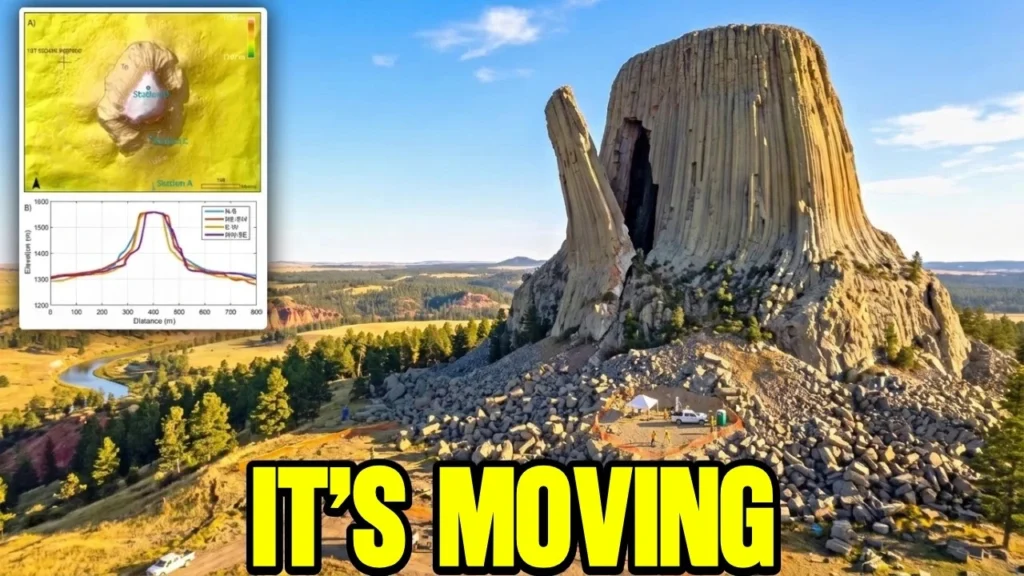

On the open plains of northeastern Wyoming, a column of stone rises 867 ft above the pines.
It looks like the most permanent thing in America.
Half a million people come every year to stand beneath it.
But look down at its feet.
A huge field of broken columns surrounds the base.
Some are the size of a refrigerator.
Some are as long as a school bus.
Pieces of this tower have been falling for a very long time.
And yet, no one in recorded history has ever watched a whole column come down.
Small stones fall often.
The tower itself never seems to move.
Solid.
Silent.
Finished.
Then, in October of 2024, a team of climbers hauled a seismometer to the summit and left it alone up there for 21 hours.
What it recorded was far quieter and far stranger than anyone expected.
The tower stands in the northeast corner of Wyoming, close to where the plains meet the Black Hills.
Below it, the Belle Fourche River winds through red cliffs and ponderosa pines.
From the surrounding land, the tower rises about 265 m.
That is 867 ft.
Taller than the Washington Monument with plenty to spare.
Its sides are almost vertical.
Its top is almost flat.
And from a distance, it looks less like a mountain than something built.
Get closer and you see why.
The whole tower is made of columns.
Hundreds of them.
Long stone pillars packed tightly side by side like a giant bundle of pencils.
Geologists call this columnar jointing.
It happens when a huge mass of molten rock cools very slowly.
>> >> As it cools, it shrinks, and as it shrinks, it it cracks into long, regular shapes.
The same thing happens to mud drying in the sun.
Only here, the cracks run hundreds of feet deep.
In the upper part of the tower, the columns are almost perfect.
For about 190 m, they rise straight and steep.
Low down, each one is 2 or 3 m across.
By the summit, they narrow to about 1 and 1/2.
Most have six sides.
>> >> Some have four.
Some have five.
And here and there, two columns merge into one, >> >> or a single column splits in two.
But the lowest 60 m are different.
There, the columns flare outward like the base of a tree trunk before fading into rough, solid rock.
The rock itself is unusual, too.
It is called phonolite porphyry.
Phonolite is a rare kind of rock made from cooled magma.
The name means sounding stone, because thin slabs of it can ring when struck.
Porphyry means it is studded with large crystals scattered through a fine gray background, like seeds in bread.
Those crystals had time to grow because the rock cooled so slowly.
And all of this happened a very long time ago.
For decades, most books gave its age as about 40 million years.
Then, in 2002, a sharper dating method was applied to crystals from the tower.
It gave a new answer.
49 million years.
For most of that time, the tower was not visible at all.
It sat hidden underground, wrapped in softer layers of sandstone and shale.
Then, over the last 10 million years, rivers and rain began stripping those layers away.
Most of that work happened in just the last 3 million.
The soft rock washed away.
The hard core stayed behind.
And slowly, the tower emerged from the ground.
Long before geologists arrived, people already had a name for it.
The Lakota call it Mato Tipila, Bear Lodge.
More than 20 tribes hold this place sacred.
And the Kiowa tell a story about those columns.
Seven girls were playing far from their camp when a giant bear came after them.
They climbed onto a low rock.
The rock began to rise beneath them, carrying them higher and higher.
The bear clawed at its sides, trying to reach them, and its claws left long grooves running from top to bottom.
In the story, the girls were lifted into the sky and became the seven stars of the Pleiades.
Geologists explain those grooves with cooling and cracking.
The Kiowa explain them with a bear.
Both explanations start from the same marks in the stone.
The name on the map came much later.
Devil’s Tower probably arrived through a mistranslation.
And in 1906, President Theodore Roosevelt made it the first national monument in the United States.
Today, hundreds of thousands of visitors walk the trail around its base every year.
They come because it looks timeless.
Because it looks like the one thing on the plains that will never change.
A monument made by the Earth itself.
Fixed.
Finished.
Climbers have stood on its summit for more than a century.
Scientists have argued about how it formed for even longer.
But almost nobody asked a simpler question.
Is it still changing? The answer was in plain sight the whole time.
Because the ground at its base tells a different story.
Walk the main trail around the tower, and the first thing you meet is not the columns.
It is what fell from them.
A sprawling field of broken rocks spreads out across the slopes below the cliffs.
It covers about 13 acres.
That is roughly 10 football fields of fallen stone.
Some pieces are no bigger than your fist.
Others are whole sections of column lying on their sides like toppled pillars from a ruined temple.
And you can still see their shape.
Five sides, six sides, sharp, straight edges.
Every one of them once stood in the wall above.
The field is not spread evenly.
Most of it lies around the west and south faces of the tower.
Those are the sides that take the worst of the weather.
And the weather here is not gentle.
Summers are hot, winters are bitterly cold, and in spring and fall, the temperature swings back and forth around freezing.
That is what breaks the tower.
Rain and melting snow seep into the cracks between the columns.
At night, the water freezes.
And when water turns to ice, it expands.
It pushes outward on the rock with tremendous force.
In the morning, the ice melts, and the water sinks a little deeper.
Then, it freezes again.
Night after night, year after year.
Each time, the crack opens by a fraction more.
Until one day, a piece of the tower simply lets go.
Geologists call the pile that builds up below a cliff talus.
And the talus at Devil’s Tower holds a clue about time.
Look closely at the boulders, and many are covered in lichen.
Pale green and gray crusts that grow incredibly slowly.
>> >> A rock wearing a thick coat of lichen has been lying still for a very long time.
>> >> In 1980, a geologist named Halverson studied this rubble closely.
The study looked at how much soil had formed on top of it in different places.
Fresh rubble has almost none.
Old rubble has more.
>> >> And the answer was surprising.
The talus was not one single collapse.
There were at least four different ages of it.
Separate episodes of falling rocks spread across a very long stretch of time.
The field is a record.
A slow diary of the tower coming apart.
So, how often does it happen? According to the park service, small pieces fall regularly.
Stones the size of a baseball or a basketball, chunks the size of a microwave oven come down only rarely.
The last large piece of column fell more than a hundred years ago.
>> >> And nobody in recorded history has ever seen a massive column fall.
Think about that.
13 acres of fallen columns, and not a single eyewitness.
The tower breaks on a time scale far longer than a human life.
It changes, but never while anyone is watching.
Except for one group of people.
The people who climb it.
The first ascent came on the 4th of July in 1893.
Two local ranchers named William Rogers and Willard Ripley had a plan.
They drove wooden pegs into a long crack and joined them together into a ladder.
Then, Rogers climbed it while a crowd watched from below.
When he reached the summit, he raised an American flag.
That ladder stayed in use until the 1920s.
In 1937, a climber named Fritz Wiessner led a team up the rock using modern climbing techniques.
A year later, Jack Durrance and Harrison Butterworth found a route of their own.
It is still the easiest and most popular way to the top.
And it is called the Durrance route to this day.
Today, thousands of climbers come every year.
They jam their hands into the same cracks that the ice keeps prying open.
They rest on ledges.
They lean their weight against the columns.
No one alive knows the surface of this tower better than they do.
If anything up there ever started to shift, they would be the first to feel it.
For more than a hundred years, nothing did.
And then, in the summer of 2005, climbers on the most popular route felt something they had never felt before.
The report came from the climbers themselves.
In June of 2005, people on the Durrance route started saying the same strange thing.
One of the columns was moving.
Not the whole tower, a single piece of it.
Climbers call it the leaning column.
It sits on the south face about 60 m above the base.
That is roughly 200 ft up.
It is a detached column about 8 m long, around 26 ft of solid rock.
And it does exactly what its name says.
It leans back against the tower at a slight angle, like a plank propped against a wall.
The route goes right up it.
For generations, climbers had scrambled onto that column and stood on top of it.
As far as anyone knew, it had never budged.
It had been resting in that same position throughout recorded history.
Now, it rocked when someone shifted their weight.
Park Service climbing rangers went up to check.
The reports were true.
So, the monument called in the United States Geological Survey.
In September, two geologists arrived to inspect it.
Their names were Edwin Harp and Charles Lindsay.
One of them had once worked as a climbing ranger at the tower.
They did not study the column from the ground.
They climbed it.
Standing on top, they shifted their weight quickly and watched the column moved back and forth about two times every second.
Each swing was around 5 mm, about a fifth of an inch.
And when they looked closer, they found the column was not one piece at all.
It was three segments stacked on top of each other, moving together as one.
Then, they looked at what was holding it up.
The leaning column rests on the column below it, but not squarely.
It sits off to one side, balanced along a single edge.
At the top, it touches a neighboring column at just one point.
One edge at the bottom, one point at the top, and the whole thing weighs about 37,000 kg, more than 80,000 lb.
Right beneath that edge, the geologist spotted something.
A patch of rock that looked fresh, cleaner and brighter than the weathered stone around it.
It looked as though a flake of the supporting column had recently broken away.
Hairline cracks ran down from the contact, 10 to 20 cm into the rock.
The weight pressing down on that thin edge had probably started to crush it.
And with a piece of its support gone, the column could now rock.
So, could a climber push it over? Harp and Lindsey did the math.
Toppling it by pushing would take far more force than any person could produce.
The real danger was slower and quieter.
Every new flake that broke off would leave the column balanced on even less rock.
That would concentrate the weight even more, which could break off another flake, and another, until the support gave way completely.
And if that happened, they described exactly what would follow.
The column would split into its three pieces, each one about 2 and 1/2 m long.
They would tumble and bounce down the face of the tower and slam into the boulder field below.
Boulders falling like that can travel at up to 120 km an hour, 75 mph.
On impact, they would shatter and spray fragments in every direction.
>> >> Anyone in that boulder field would be in extreme danger.
They pointed to a disaster in Hawaii 6 years earlier.
At Sacred Falls on Oahu, falling rocks had killed seven hikers.
So, what do you do about a column like that? Bolting it to the tower was ruled out.
The monument is protected as an unimpaired landscape.
>> >> So, the solution was wonderfully simple.
Paint was sprayed along the edge where the column meets its support.
If another flake ever breaks off, it will leave a patch of bare unpainted rock, a warning written in stone.
The column might stay there for years or for hundreds of years.
But, that was one column rocking under a climber’s boots.
Nobody had asked whether the whole tower moves all by itself.
Here is something most of us never stop to think about.
Everything that stands up is moving.
Buildings, bridges, towers, even the ground beneath your feet.
All of it is trembling all the time.
The wind pushes on it.
Distant earthquakes send waves through it.
Even the oceans play a part.
Waves pounding coastlines thousands of miles away create a faint hum that travels through the whole planet.
Add traffic and footsteps, and the earth is never still.
Most of the time, these vibrations are far too small to feel.
But, anything that stands on its own responds to them in a special way.
It has a natural rhythm.
Think of a guitar string.
Pluck it, and it always sings the same note.
That note depends on how long the string is, how tight it is, and what it is made of.
Tall structures work the same way.
Nudge them and they sway back and forth at their own particular pace.
Scientists call it resonance and they measure it in cycles per second.
One full sway there and back again every second is called 1 hertz.
Engineers figured this out a long time ago.
In 1900, a Japanese seismologist named Fusakichi Omori measured how a brick building shook during earthquakes.
In 1952, researchers recorded the vibrations of Sather Tower, >> >> the tall clock tower on the campus of the University of California at Berkeley.
Today, skyscrapers are designed with resonance in mind.
Get it wrong and a building can sway enough to make the people inside feel sick.
But for most of the 20th century, almost nobody thought to measure rock this way.
Part of the problem was the method.
To find a structure’s natural rhythm, you once had to shake it yourself at one speed after another and watch how it responded.
You cannot exactly shake a mountain.
Then, the instruments got better.
Modern seismometers are so sensitive they can pick up the tiny background vibrations that are always there.
The wind, the distant quakes, the hum of the oceans.
You no longer need to shake anything.
The earth does the shaking for you.
All you have to do is listen.
One of the people who has done the most listening is Jeffrey Moore, a professor of geology and geophysics at the University of Utah.
He explains it with a piano.
Play a note and the raw sound wave does not look like much, but break it down into its frequencies and it tells you a great deal about what you are hearing.
Rock works the same way.
Moore and his colleagues have spent years placing seismometers on some of the most famous rock formations in the American West.
Delicate sandstone arches in Utah.
In 2019, they measured Castleton Tower near Moab, a sandstone spire about 400 ft tall.
It sways at about 1 Hz, once every second.
Later researchers showed that even the Matterhorn in the Swiss Alps is vibrating.
An entire mountain swaying to the rhythm of the planet.
And some of what they found was worrying.
One study showed that a natural rock bridge in Utah was being stirred into motion by human activity.
Another looked at how much vibration from people and machines adds to the growth of cracks in rock arches.
Because every sway bends the rock just a little.
And rock that bends over and over can slowly weaken.
That is why this kind of work has a name.
More calls it structural health monitoring.
>> >> Put a seismometer on a landform for just a few hours and its rhythm reveals how stiff the rock is, what it is made of, and how it compares with rock anywhere else on Earth.
Most of these studies had looked at sandstone.
Most had looked at formations small enough to reach easily.
Devil’s Tower was something else entirely.
Made of hardened magma instead of sand and shaped almost like a perfect cylinder.
If any rock formation could show what a giant stone tower really does when no one is looking, it was this one.
But there was only one way to find out.
Someone had to carry the instrument to the top.
The climb took place in October of 2024.
>> >> More needed a climber who could haul delicate equipment up a sheer wall of rock.
That job went to Catherine Vollinger.
She is an independent researcher from Leavenworth in Washington and one of the studies authors.
Cameron Reed and Greg Dooley helped.
The National Park Service granted a permit and on the 12th of October, the team started up the tower.
The instrument they carried was a broadband seismometer, a compact sensor that can feel motion in three directions at once.
Alongside it went a data recorder and a battery.
They hauled it all up the columns by rope.
On the summit, Vollinger chose a spot on the northern side.
She set the seismometer directly on bare bedrock.
A small dab of putty went under each of its feet to grip the stone.
It was leveled.
It was pointed north.
And then, it was covered with an upturned bucket to keep the wind from buffeting it.
The battery went under a tarp.
A bucket on top of the first national monument in America.
Two more identical instruments went in down below.
One sat on solid bedrock at the foot of the south wall.
The other sat on a big flat boulder about 200 m away.
If the summit picked up something the ground did not, that something belonged to the tower.
Then, the climbers came down and left the tower alone through the afternoon, through the night.
The seismometer recorded 100 measurements every second.
The next morning, Vollinger climbed the tower again to bring it down.
Two ascents in 2 days.
21 hours of data from the summit.
19 hours were all three instruments were listening at the same time.
Then, the analysis began.
The first thing they saw came from far away.
A slow pulse that rose and fell roughly once every 7 seconds.
It showed up equally on all three instruments.
That was the ocean.
Waves breaking on distant shores were shaking the plains of Wyoming.
Then they found the signal they were looking for.
A strong, clear peak at about 1.
1 hertz.
>> >> Strongest in the side-to-side motion.
The tower was swaying slightly more than once every second.
And it never once stopped.
But there was something odd about it.
When the team broke the recording into 5-minute windows, the strongest beat kept jumping between two values.
>> >> 1.
1, 1.
2.
Back and forth at random, and almost exactly the same number of times each.
The tower was not humming one note.
It was humming two.
To understand why, the team built a detailed computer model of the tower from laser scans of its shape.
The answer was in the geometry.
Devil’s Tower is almost perfectly round.
Almost.
It is a little slimmer from east to west, and a little thicker from north to south.
So it sways at one rhythm in one direction, and a slightly faster rhythm in the other.
A perfect cylinder would sing both at the same note.
The model revealed a third movement, too.
At around 2 hertz, the whole tower twists.
It turns a tiny bit around its own vertical axis and back again.
A faint trace of that twist showed up in the field data.
Sway one way, sway the other.
Twist.
It is the same pattern engineers measure in skyscrapers.
So, how big are these movements? On the windiest stretch, the summit moved about half a micrometer.
That is half of 1/1000th of a millimeter.
In calm periods, it was about 10 times smaller still.
You could film the tower for a century and never see it move.
Skyscrapers sway far more because they are mostly hollow steel frames.
Devil’s Tower is solid stone all the way through.
And yet, even when the wind dropped completely, the movement continued.
Moore says the tower is bending and twisting every second of every day.
The results were published in GSA Today in the spring of 2026.
But the most revealing number in the paper was not how fast it sways.
It was how soft it turned out to be.
Here is how they worked it out.
The way a structure sways depends on two things: its shape and how stiff it is.
Stiffness is simply how hard something is to bend or squeeze.
A steel ruler is stiff.
A rubber eraser is not.
The team already knew the shape of Devil’s Tower down to the meter from those laser scans.
So, they adjusted the stiffness in their computer model, turning it up and down until the virtual tower swayed at exactly the same rhythm as the real one.
The number that matched was 8 gigapascals.
On its own, that means very little.
So, they needed something to compare it with.
They took a fresh boulder of the same rock from the slope at the foot of the tower.
From it, they drilled three small cylinders of stone, each about an inch and a half wide and a little over 3 in long.
Then, in a laboratory, they squeezed each one in a press until it broke.
Small pieces of solid rock with no big cracks in them.
Their stiffness averaged 55 gigapascals.
55 for the rock in the lab, >> >> eight for the tower as a whole.
The tower behaves as if it is about seven times softer than the stone it is made of.
>> >> That is a huge gap.
When Moore’s team measured sandstone arches in Utah, the difference was only two to five times.
So, where does all that softness come from? The answer is the cracks.
Remember that the tower is a bundle of columns.
Between every column there is a joint.
A small sample of rock has none of those joints inside it.
The real tower is full of them and every joint gives a little when the tower bends.
>> >> Add them all together and the whole structure becomes far more flexible than solid stone should be.
But the size of the gap told the team something more.
To explain a difference that large, the joints cannot be tightly closed.
Their results suggest that most of the rock in the tower contains joints that have opened up even deep inside.
They think it may be because the tower stands alone.
Buried rock is squeezed tight by everything around it.
A free-standing tower has nothing pressing on its sides so the cracks between the columns have room to loosen.
Those are the very same cracks we met at the start.
The cracks where rainwater seeps in and freezes.
The cracks that fed 13 acres of boulders.
The cracks beneath the leaning column.
The seismometer had felt them from the summit.
So, is Devil’s Tower breaking apart? Here is the honest answer and it has two parts.
The swaying is not what is tearing it down.
The motion is far too small.
Moore says he knows of no risk from these movements.
Northeast Wyoming lies far from the kind of active faults that could produce an earthquake strong enough to topple it.
And here is the strangest part.
When the team ran their model as one single block of rock, it matched the real tower almost perfectly.
For all those open joints, the tower still moves as one.
In Moore’s words, it is pretty monolithic.
A bundle of cracked columns that sways like a single stone.
What is breaking it apart is slower.
Water, ice, gravity, >> >> working on those loosened joints one winter at a time.
And that is why this recording matters.
Knowing how the tower vibrates helps scientists predict how it would respond to a big earthquake and which rocks might come loose first.
During the 21 hours, the tower’s rhythm never drifted.
In other rock formations, that rhythm can shift with temperature or with water freezing in the rock.
So, this recording is a starting point, a first measurement of the tower’s heartbeat, something future scientists could compare against.
For more, there is another reason it matters.
He wants people to see the tower in a new way, not just as rock that changes over millions of years, but as something alive with motion on a human timescale.
For more than a century, people looked at Devil’s Tower and saw something finished.
They were wrong.
Ranchers drove wooden pegs into its cracks and climbed it.
Geologists painted a broken edge and waited for it to speak.
And a climber left a seismometer under a bucket on the summit for one quiet night.
The answer did not come from a dramatic collapse.
It came from patient listening.
Right now, as you watch this, the tower is swaying a little more than once every second, one way then the other then a gentle twist.
The pulse of distant oceans is passing through its stone.
The tower was never silent.
We just had not learned how to listen.
What do you think? Would you have guessed that a solid stone tower sways like a skyscraper? Let me know down in the comments.
And if you enjoy stories of the places that are quietly changing all around us, consider subscribing.
There is always another story waiting.