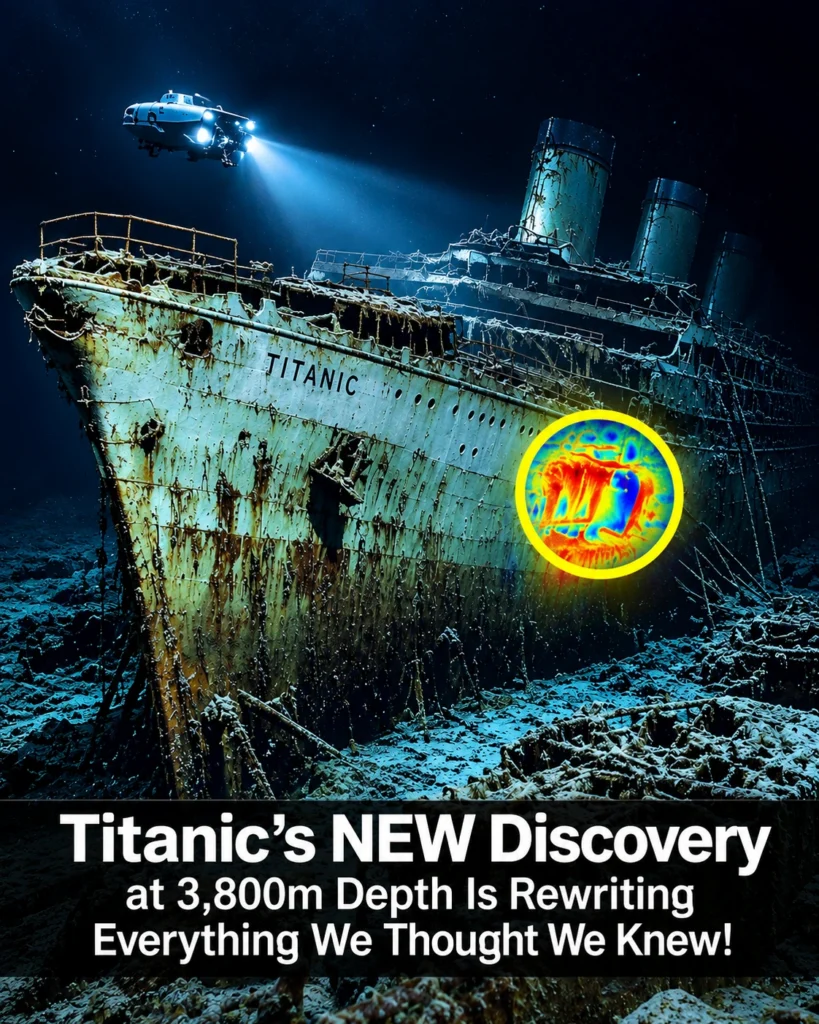
We’ve watched the Titanic sink in documentary after documentary and in more than one Hollywood blockbuster.
But there’s one Titanic nobody had actually seen until now.
At last, there’s a perfect copy of The Real Wreck.
For more than 100 years, her story looked finished.
It was the sad story everyone knew, repeated in films, in museum displays, and in family legends.
But 3,800 meters under the Atlantic in water that never sees daylight, a team of researchers just rewrote it.
From more than 700,000 photographs, they built a complete three-dimensional twin of the wreck, accurate down to single rivets.
What that model shows tears up what we were sure of and gives away secrets that turn the history around.
If you assumed the last Titanic mystery got solved years ago, stick around.
I’m Ambrose Wild and this is the story of what that digital twin is telling us about the night of April 14th, 1912 and about the men below decks whose part in it hardly anyone ever told.
Summer 2022.
Far out in the North Atlantic, two deep sea submersibles named Romeo and Juliet were hovering over the most famous shipwreck in the world.
They belong to Miguelan, a deep sea mapping company working with the British documentary makers at Atlantic Productions.
The plan sounded almost simple.
Fly over every part of the wreck from every angle and photograph all of it, the bow, the stern, and the whole field of wreckage between them.
The expedition ran for about 6 weeks, and the submersible spent more than 200 hours on the bottom.
They came back with over 715,000 still images, 4K video, and millions of laser measurements, roughly 16 terabytes of data in total.
The method has a name, photoggramometry, and the idea behind it is older than the technology.
Take enough overlapping photographs of an object from enough angles and a computer can match the same point across hundreds of different pictures.
Work out exactly where that point sits in space and build up a surface out of millions of them.
Do that with a coffee cup and it takes an afternoon.
Do it with the biggest ship of her day broken in two in total darkness and it takes a lot longer.
Then came the slow part.
Back on land, the team spent months stitching every one of those images together until the pictures stopped being pictures and became one continuous model of the ship as she lies today.
When the first images went public in May 2023, people who had studied the Titanic for most of their lives said they’d never seen her like this.
Park Stevenson, a Titanic analyst who has spent decades on the wreck, put it plainly.
What it’s showing you now, he said, is the true state of the wreck.
That’s not a small thing to say about a ship that has been photographed since 1985.
Every earlier image had been a flashlight in the dark, a few square meters at a time, lit by a submersible lamps, never the whole thing in one view.
And going down to look in person has never stopped being dangerous.
Barely a month after those first images were released on June 18th, 2023, the submersible Titan imploded near the wreck, killing its pilot, Stockton Rush, and the four passengers with him.
A model built from photographs doesn’t replace the real wreck.
But it means researchers can now spend as long as they like inside the Titanic without anyone risking their life to get there.
So, what does the whole thing look like? The bow sits upright on the seabed and from certain angles she still looks like a ship.
When she hit the bottom she was moving fast enough to plow deep into the sediment about 60 ft down right up to the base of her anchors.
The stern is a different world.
It lies around 600 m away and it is a heap of twisted collapsed metal.
Its decks crushed down on top of each other.
Between the two halves runs a debris field covering roughly two square miles of seabed scattered with pieces of the hull, machinery, and the personal belongings of the people on board.
Here’s the part that changes how all of it gets studied.
With the digital twin, researchers can walk around the wreck, zoom in on a single fitting, and see exactly where each piece landed in relation to everything else.
Stephvenson compared it to a crime scene.
You need to see what the evidence is, he said, in the context of where it is.
A loose piece of steel photographed on its own tells you very little.
That same piece sitting at a known spot in a known orientation next to everything else that fell starts telling you the order in which things happened.
And almost straight away, the model started correcting the story.
One port hole near the bow looks as if it was smashed in, most likely by the iceberg itself as the ship scraped past it.
That matches what some survivors said afterwards.
That ice had come into their cabins.
Fragments of the hull showed something else.
When the Titanic went down, she didn’t just break neatly into two pieces.
She was torn apart violently enough that the break ripped straight through firstass cabins.
That’s already a different ship from the one in the films.
But the outside of the wreck was only the start.
In 2025, the scan became the backbone of a 90-minute National Geographic documentary, Titanic, the Digital Resurrection, made with Atlantic Productions by the filmmaker Anthony Geffen.
And the team working on it pointed the model somewhere.
The old retellings almost never went.
Not the Grand Staircase or the Firstass lounges, the boiler rooms.
Pay attention to this next part because it explains why the lights stayed on that night and who paid for it.
Think about how the sinking usually gets told.
It’s almost always told from the decks, the lifeboats swinging out on their dabbits, the band playing, officers trying to keep people calm, and the long line of passengers waiting their turn.
That’s the version survivors could describe because that’s where survivors were standing.
Down below, in the parts of the ship where almost nobody survived, the story mostly went untold because there were so few people left to tell it.
And the Titanic below the waterline was a different kind of place.
She wasn’t just a floating hotel.
She was a floating power station.
Her engines were driven by steam from 29 boilers fed by more than 150 furnaces.
And that steam did a lot more than turn the propellers.
It also drove the ship’s dynamos, the generators that made her electricity.
Every light in every corridor, the pumps, the wireless set, all of it ran on power that started as coal being shoveled into a fire deep inside the hull.
If the steam stopped, the ship went dark.
Keeping those fires going was brutal work in an ordinary hour.
Stokers and firemen fed the furnaces.
trimmers wheeled the coal to them and above them all were the engineers, the officers responsible for the machinery.
The man in charge of every one of them was the chief engineer, Joseph Bell.
At 11:40 on the night of April 14th, the iceberg scraped along the starboard side, and the sea started coming in at the front of the ship.
And from that moment, the men below had a choice to make.
The upper decks and the lifeboats were up there somewhere above them.
The furnaces were right here.
This is where the digital twin comes in.
For the documentary, Stevenson walks through a full-scale reproduction of the ship with two other specialists, the metallurgist Jennifer Hooper and the master mariner Chris Hearn, testing each piece of the evidence against what they knew about how steel and ships behave.
The model shows one of the ship’s huge boiler rooms sitting at the back end of the bow section, right where the Titanic split in two.
and some of the boilers in it are concave.
Their round faces are pushed inward.
To the experts studying the scan, that suggests those boilers were still working when they went under, still full of steam and pressure as the ship sank.
Boilers don’t stay fired up on their own.
Somebody was tending them.
The documentary team’s reading goes further.
Engineers stayed at their stations in Boiler Room 2 for more than 2 hours after the collision.
two hours with the sea already inside the hull and the deck tilting under their feet.
I mean, think about that for a second.
The men down there knew this ship’s machinery better than anyone else on board.
They knew exactly what that water meant.
Then there’s the valve.
Out on the stern section in that tangle of collapsed steel, 600 m from the bow, the scan picked out a valve sitting in the open position.
That small detail matters a lot because it points to steam still flowing into the system that generated the ship’s electricity.
In other words, right to the end, somebody was keeping the power on.
Stevenson’s verdict was simple.
They kept the lights and the power working to the end, he said.
Belle and his team stayed behind, shoveling coal into the furnaces to keep the lights burning.
Because of that, the crew on deck could launch the lifeboats with some light to work by instead of trying to load people into small boats in total darkness on a sloping deck in the middle of the Atlantic at night.
And the survivors had been telling us that for over a century.
One of them was Lawrence Beasley, a science master at Dulich College traveling in second class, who watched from lifeboat number 13 and later wrote one of the first books about the sinking.
He described the ship’s lights, which had shone without a flicker all night.
He even used them to measure what was happening from the boat.
He could see that the rows of lit port holes should have run parallel to the sea, and they didn’t.
The lines met at an angle inside the black hole, which told him the bow was going down first.
That was what people in the boats remembered.
Row after row of lit port holes, holding steady as the bow sank lower and lower until very near the end.
For years, it was easy to treat that as the kind of vivid detail memory adds to trauma.
The open valve says it was simply true.
But this is the detail that everyone missed at the time.
The power wasn’t only for the lights.
In the wireless room, two operators were sending distress calls on that electricity.
Their signals were how the Carpathia, 58 mi away, learned that the Titanic was sinking at all.
Around 1:45 in the morning, one of the last messages anyone could make out came from that room, and it was about the rooms far below them.
Engine room full up to boilers.
The water had reached the men who were keeping the transmitter alive, and the operators kept sending anyway.
Even at full speed, the Carpathia needed about 4 hours to get there.
She reached the scene about an hour and a half after the Titanic went down.
And by 9:15 that morning, she had picked every survivor out of the boats.
If the men below had walked away early, all of that would have stopped.
If they’d left their posts even 15 minutes sooner, the boat deck would have gone completely dark while lifeboats were still being lowered.
The ship carried 20 lifeboats with room for 1,178 people.
Getting those boats away in the dark with frightened passengers and a deck that kept tilting further would have been far harder.
They were saving other people’s lives, and they almost certainly understood they were giving up their own to do it.
Because here’s how it ended for them.
Not one member of the ship’s engineering staff survived.
24 engineers, six electrical engineers, two boiler makers, a plumber and a cler.
And every one of them died with the ship along with Bell himself.
When their colleagues built a memorial to them in Southampton, an estimated 100,000 people came out to watch Sir Archable Denny unveil it on April 22nd, 1914.
The inscription honors the engineer officers who remained at their posts.
Right across from it stands a second memorial to the ship’s musicians, the band who kept playing on deck.
Two groups of men who stayed where they were, one up in the light and the other down in the heat, and only one of them ended up in all the films.
That memorial has been standing since 1914.
The scan is the first time anyone could point at the wreck itself and show you the evidence of what it was for.
concave boilers, an open valve, and a ship that stayed lit long enough for hundreds of people to get away from her.
Somewhere between 1,490 and 1,635 people died that night, and around 710 survivors were picked up from boats that had been launched under lights the men at the bottom of the ship were keeping on.
Put more simply, for every person who got away, about two didn’t, and the ones who got away did it by that light.
Every minute those engineers bought came out of a ship that was already doomed.
And that raises the question the rest of the scan was built to answer.
If those men were fighting this hard and the ship stayed up this long, why did she go down at all? And why so fast? For most of the last century, the answer seemed obvious.
The iceberg tore a huge gash down the side of the ship.
The sea poured in, and that was that.
It’s the version a lot of us pictured as kids, a long black wound running along the hole.
But the version you’ve heard, that’s not the full picture.
Even at the time, there was a man who doubted it.
Edward Wilding, giving evidence at the British inquiry, argued that the damage was probably uneven and broken up, and that the actual openings might be relatively small.
Hardly anyone took that seriously.
People assumed it would take an enormous gash to sink the biggest ship in the world, and that made a better story.
Then, in 1996, an international team assembled for a Discovery Channel investigation, later broadcast as a 2-hour special called Titanic: Anatomy of a Disaster, including the Naval Architect William Garske and David Livingstone from Harland and Wolf, used sound waves to look through the mud that hides the lower bow.
Alongside the sonar, they ran computer simulations and tested the metal of steel fragments recovered from the wreck.
What they found was a series of six thin openings along the starboard side, one in each of six watertight compartments.
Added up, all of that damage came to roughly 12 or 13 square ft.
That’s less than the area of two paving slabs.
The Great Gash had never existed.
Ballard, the man who’d found the wreck, later called the belief in a major breach a byproduct of the mystique of the Titanic.
People wanted a wound big enough to match the size of the tragedy.
And now the new research has gone a step further.
Here’s one thing worth being clear about because it’s easy to get wrong.
The scan itself can’t show the iceberg damage.
That part of the bow is buried in the seabed.
So a team at University College London led by Professor Gom Pike built a computer simulation of the collision instead using the ship’s blueprints along with her speed, direction, and position that night.
They described using advanced numerical algorithms, computer modeling, and supercomputing to rebuild what happened in those first few seconds.
What the simulation shows is a glancing blow that left a line of punctures along a narrow strip of the hull.
And they were small.
Simon Benson, a lecturer in naval architecture at the University of Newcastle, said the difference between the Titanic sinking and not sinking comes down to the fine margins of holes about the size of a piece of paper.
So, the biggest ship in the world was opened up by a row of holes you could cover with a few sheets from a notebook.
Here’s why something so small was fatal.
The Titanic was divided into watertight compartments, and she was designed to stay afloat with as many as four of them flooded.
The punctures were spread out along such a long stretch of hull that six compartments were open to the sea, so the water came in slowly, but it came in everywhere at once.
As the bow got heavier and settled lower, the water rose over the tops of the bulkheads, the walls between the compartments, and spilled into the next one, and then the next.
Her designers had planned for a hard knock in one spot, the kind of collision that floods a couple of compartments.
A long, thin scrape down the side was a different problem.
You can actually follow it in the timeline.
The lookout spotted the iceberg at 11:39, a minute before the impact.
By around 1:30 in the morning though, the bow was tilting down by about 10° and there was no hiding it anymore.
That slow flooding is the reason she lasted as long as she did, about 2 hours and 40 minutes from the collision until she went under at around 220 in the morning.
It’s also why the engineers below had to keep the power going for so long.
A ship that sank in 20 minutes wouldn’t have needed them for 2 hours.
The ending though wasn’t slow at all.
And for decades, the official story of that ending was wrong, too.
Both inquiries in 1912 discounted the survivors who said they’d watched the ship break in half and concluded she’d gone down in one piece.
Some people in the lifeboats insisted they’d seen her come apart.
They were treated as confused or frightened or simply mistaken.
They were right.
On September 1st, 1985, a joint French and American expedition from the French institute if Woods Hole in the United States led by Jean Louie Michelle and Robert Ballard found the wreck and it was lying in two main pieces which proved the ship had split between her second and third funnels.
Beasley himself had described the sound of those last moments from his lifeboat.
Partly a roar, partly a groan, partly a rattle, and partly a smash going on for maybe 15 or 20 seconds.
Whatever he took it for in that moment, what he was very probably hearing was the ship tearing herself apart.
The digital twin lets researchers read that tearing in more detail than ever.
As the bow filled and dragged the front of the ship down, the stern was lifted higher and higher out of the water.
Some estimates put the angle at more than 30° before the hole gave way.
Beasley watched what was left rise until it stood almost straight up and then simply stay there for a moment, perfectly still before it slid under.
The two halves took very different journeys to the bottom.
When the bow reached the seabed, at an estimated 20 knots, it drove itself deep into the mud.
That’s why it’s still in one recognizable shape.
The stern did something else.
A sonar map made in 2010 showed it had rotated as it sank, spinning like a helicopter blade, and when it hit the bottom, its decks collapsed onto each other.
Today, those stacked decks are generally only 12 to 15 ft high in total.
That’s the heap of steel in the scan.
Air trapped inside, the force of the fall, and the impact all did that.
And between them is everything the brake let go of.
There are two debris fields, each somewhere around 600 to 800 meters long, full of coal, fittings, sections of hull, and the things people had packed for a new life.
The scan found empty spaces in that wreckage, too.
Places where whole chunks of the middle of the ship simply aren’t where you’d expect them.
Some experts think those sections broke up into small pieces on the way down.
Others think they’re buried so deep in the seabed that even this model can’t see them.
Nobody knows yet.
There’s one more uncomfortable idea that comes out of all this.
The Titanic’s double bottom and her watertight compartments were real advances for their time.
But instead of letting her sink as a single unit, her structure may have passed the strain along the hull in ways nobody predicted until she broke in a slow, violent tear.
The safety features that made her famous may have helped decide how she died.
And the scan still had one more part of the ship to give back.
That part is the wireless room.
And the two operators who used every bit of the power the engineers were making.
Their names were Jack Phillips and Harold Bride.
They sent distress calls for most of the time the ship was sinking, and they kept sending almost to the end.
Phillips was on the key when that message about the engine room went out.
After it, the signals coming from the Titanic grew jumbled and impossible to read as the electrical system began to fail.
Bride survived.
He was in that small radio cabin with Philillips right to the last minutes, and he even fought off a man who tried to steal Philillips’s life belt while Philillips was still working.
Then he made his way forward and ended up at collapsible lifeboat B.
He later said he saw Captain Smith jump from the bridge.
Phillips didn’t make it.
The chaos of those last minutes reached the boats, too.
Two of the 20 were never properly launched and simply floated off the deck as the water rose.
When people today talk about the wireless calls that brought the Carpathia, they’re talking about two men in a little cabin and a power supply that only existed because of the men far below who refused to leave the boilers.
Put those pieces together and you start to see why this scan changes the story itself.
For more than a century, the Titanic was told as a story about the people at the top of the ship.
The millionaires, the officers, the band, the lifeboats.
The physical evidence on the seabed is a story told from the bottom up.
Concave boilers in the room where the ship broke.
An open valve in the stern.
A line of punctures smaller than a sheet of paper spread across six compartments.
Every piece of it points in the same direction to a ship that took a long time to die.
and to the people below decks who used that time for everybody else.
The model has also put a couple of old rumors to rest.
There’s no sign in the wreckage of sabotage and no sign of any secret cargo.
What’s down there are the marks of a mechanical failure and of the sheer force of the North Atlantic.
And it’s full of small human things.
Boots lying on the seabed.
Pieces of luggage and personal belongings scattered across the debris field still lying where they fell that night.
But this story has a clock on it and the clock had already started.
The wreck is being eaten.
A species of bacteria first identified in 2010 was named Halamonus Titanic after the ship.
And by some estimates, bacteria are consuming around 400 lb of the hull every single day.
The American ocean agency Noah has estimated that the hull itself may collapse within 50 years.
Two researchers, Henrietta Man and Bavine Core, went further and concluded the wreck might not exist at all by around 2037.
It’s already happening.
In 2024, an expedition found that part of the railing at the very front of the bow, the spot every film has recreated, had collapsed and fallen away.
Mellin’s own scans had already caught other parts of the wreck in the act of coming down.
So, this digital twin is more than a new way to look at the Titanic.
It’s a record of her captured as she was in 2022 before more of her disappears.
A few decades from now, it may be the only complete Titanic anyone can visit.
That’s exactly why Stevenson keeps going back to it.
She’s only giving her stories to us a little bit at a time, he said.
And every time she leaves us wanting for more.
Each new pass through the model turns up something that somebody has to rethink.
There’s still plenty the model can’t answer.
Who exactly was in boiler room 2 at the end? And who opened that valve on the stern or left it open? Were the engineers still at the boilers when she broke or had the water finally driven them up into the machinery spaces above? Did that smashed port hole belong to one of the cabins where survivors saw ice come in? Where are the missing pieces of her midsection? And what does the damage under the mud really look like? The punches the simulation says are there, but no camera has ever seen.
Those answers might be sitting in the data already in a corner of the model nobody has studied yet.
Or they might be inside steel that’s rusting away faster than anyone can get to it.
So let’s go back to where this started to those rows of lit port holes the people in the lifeboats watched in the dark.
For a hundred years, that was the most haunting image of the night.
A huge ship sinking with her light still burning, almost too strange to believe.
Now we know what was behind it.
Somewhere in the back of the bow, a group of engineers and firemen kept boilers fired and steam flowing while the sea came up around them, and they kept that ship lit until it couldn’t be lit anymore.
Beasley wrote that at the very end the lights went out suddenly came on again for one single flash and then the ship was dark.
The scan has finally shown us the men who were holding them on.
I’m Ambrose Wild and if you’d like more discoveries like this one about the Rex that are still rewriting their own stories, there are plenty more on the way right


