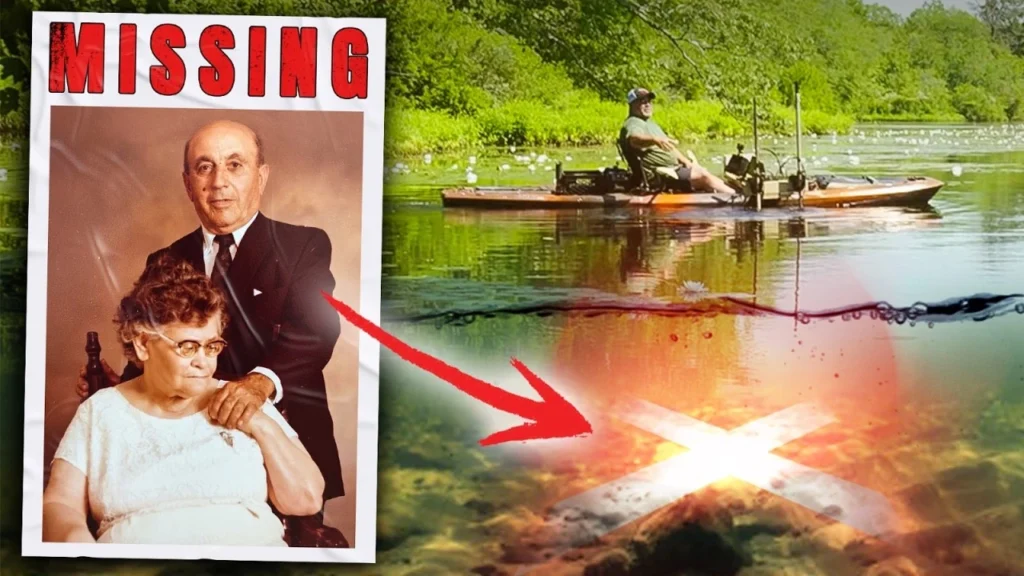
On a bitterly cold December night in 1981, a 79-year-old grandfather named Thomas Privitera got into his car on Long Island, New York, and drove into the dark. He was never seen again.
More than four decades later, his family still does not know what happened to him. Was it a tragic accident on an icy road? Or was it something far worse?
The last time anyone saw Thomas was around 7:30 p.m. on Stewart Avenue in Westhampton. He was driving a 1971 bronze Oldsmobile with New York plate 48710J. He was on his way home to Doris Drive in Mastic Beach.
According to the police report, it was about 20 degrees Fahrenheit that night. The roads were icy, and it was very, very cold.
THE ROAD HOME
Thomas had two ways to get home. He could take the main highway, where there are no lakes or ponds. Or he could take the quiet back roads, where there are six or seven bodies of water along the way.
For a 79-year-old man driving on a freezing night, the back roads may have felt safer. But they also held a hidden danger. At one turn, there is water on the left, water on the right, and water in the middle. One slide on the ice could have sent a heavy car straight into a pond.
Thomas was only about five feet five inches tall, and he was driving a big, heavy car with large tires. In icy weather, a car like that can slide very easily.
THE DIVERS WHO DON’T GIVE UP
Decades later, a team of volunteer divers came to Long Island to search for Thomas. They are civilians who work on cold cases for free, often for families who have almost given up hope.
Their plan was simple: look at the accident possibility first. If a car went into the water that night, it might still be there.
The team searched pond after pond with sonar. At one spot near a guardrail, the screen showed something strange, an object rising almost to the top of the water, about two to three feet high. For a moment, it looked like it could be something with wheels. But after a closer look, the team decided it was most likely just thick weeds.
Again and again, the result was the same. Most of the ponds were only two to six feet deep, far too shallow to hide a car for more than 40 years. One pond they checked had been completely rebuilt in recent years, which means it would have been drained, and any car inside would have been found.
There was also an old sand and gravel pit nearby, a flooded quarry about 55 feet deep. The owners would not let the team search it. But dive schools train in that quarry regularly, and the owner said there is no car in the water. If there were, the divers would have found it long ago.
Wildwood Lake, another possible location, turned out to be shallow near the edges where a car could have entered.
“I have not found a body of water that has the depth,” the lead searcher said. “That’s the issue that we have.”
A PHONE CALL FROM THE FAMILY
Then something unexpected happened. Thomas’s grandson, Bob, saw a video about the search and called the team.
Bob was only 10 years old when his grandfather vanished. And he shared a very different story about that night.
According to Bob, his grandfather was “sharp as a whip.” There were no signs of memory problems. And Thomas hated driving at night. He always wanted to be home before the sun went down.
So why was he out on Stewart Avenue at 7:30 on a freezing December night?
Bob explained that two of his aunts lived on Stewart Avenue. He said they often depended on his grandfather for money and help. Bob believes Thomas may have been called over that night, maybe asked to bring food.
THE HIDDEN MONEY
There was another detail that made the family suspicious.
Thomas was a proud, old-school Italian immigrant. He did not trust banks very much. He kept his money close: in his pockets, in his car, and hidden around his house.
After he disappeared, the family cleaned out his home. They found money everywhere: in the attic, in the drawers, even inside the dishes.
Many in the family came to believe that Thomas was lured out that night for his money. They think something may have gone wrong, and he never made it home. Bob said his father was strongly convinced of this until the end of his life.
These are the family’s beliefs. No one has ever been charged in Thomas’s disappearance, and the case remains unsolved.
Some people had also wondered whether Thomas had ties to organized crime, since it was the late 1970s and early 1980s. But Bob says no. His grandfather played cards with some tough characters, but he was never part of that world. He was a Mason, a family man, and a quiet person.
A SEARCH THAT ISN’T OVER
Bob also remembered something from his childhood. After his grandfather vanished, he went out searching with his father. There was one place his father kept returning to: a single-lane road near the end of the Quogue River. Today, that area is a condo complex.
The divers promised to keep looking. Their next plan was to search more lakes and rivers, including the Peconic River, and then return to the water near Mastic, in case Thomas missed his turn in the dark and drove into the river close to home.
“You can miss a vehicle by two inches,” the searcher said, “and that’s like missing it by a mile.”
The team said they still hope it was an accident, because that would be easier for the family to live with.
For Bob, the answer matters less than one simple wish. Everyone who might have been involved is now gone. Even if it was a crime, no one could be punished.
“It would just be nice,” he said, “to be able to take his remains and bury him with my grandmother.”
After 43 years, Thomas Privitera is still missing. Somewhere between Stewart Avenue and his home in Mastic Beach, a grandfather and a bronze Oldsmobile simply disappeared.
What do you think happened that night?


