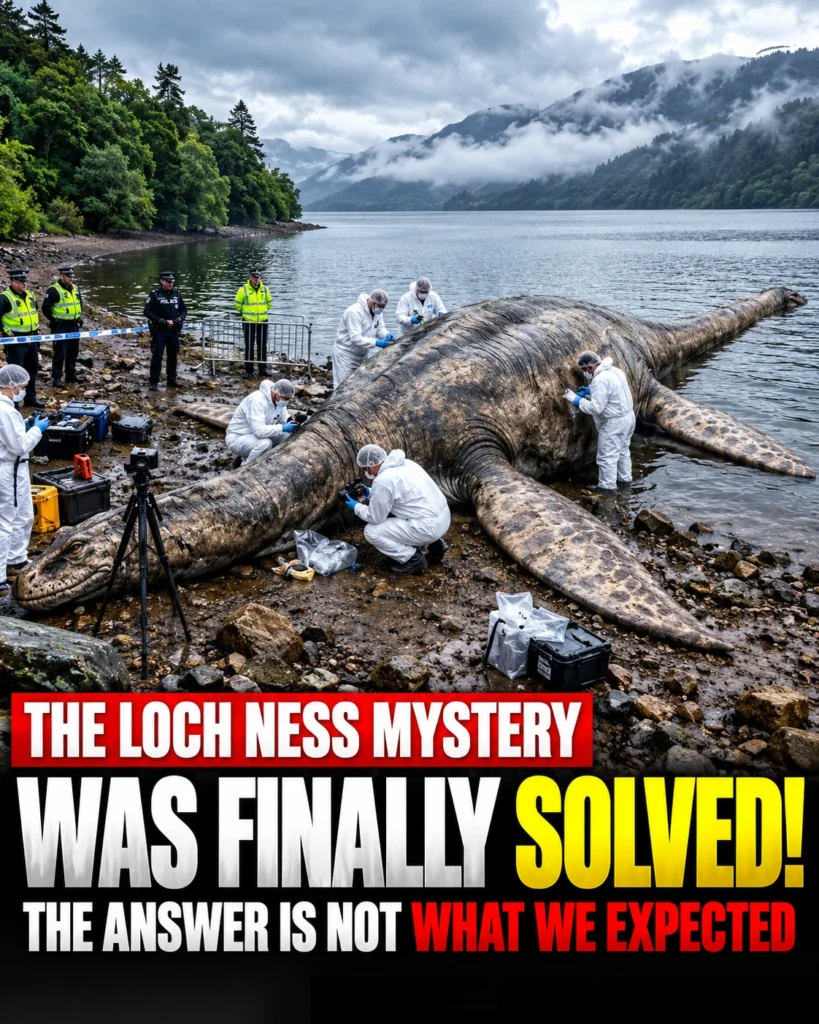
For close to a hundred years, people were sure something prehistoric was living in the black water of a Scottish loch, a creature with a long neck, maybe a dinosaur that never died out, maybe something even older.
Tourists cross the world to see it.
Scientists spent decades looking and came back empty.
Then, a few hundred bottles of lake water finally solved it.
And the answer was not what anyone expected.
I’m Ambrose Wilde, and today we’re following those bottles all the way to the answer.
It was June 2018, and a geneticist from New Zealand was out on Loch Ness with a boat, a long coil of rope, and a stack of empty sample bottles.
His name was Neil Gemmell, a professor at the University of Otago, and he wasn’t there to photograph anything.
He wanted the water.
Every living thing in a lake leaves traces of itself behind as it goes about its day.
Fish shed scales and slime.
Birds and mammals drop skin cells and waste.
All of that material carries DNA, and scientists call it environmental DNA, or eDNA for short.
So, the plan was simple.
Collect the water, pull the DNA out of it, read it, and check every fragment against the world’s genetic databases.
If a big unknown animal was swimming in Loch Ness, it would be shedding into that water like everything else.
Gemmell’s team took 250 water samples.
They worked around the edges of the loch, through the middle, and down into its deepest parts, from the surface to near the bottom.
The DNA was extracted at the University of Hull in England and processed in Grenoble, France.
The boats and the local know-how came from Adrian Shine, a naturalist who has studied Loch Ness since 1973 and led the famous Operation Deep Scan sonar sweep in 1987.
If you wanted one person on board who knew where a monster could hide in that loch, it was him.
On the 5th of September, 2019, Gemmell presented the results at the Loch Ness Centre in Drumnadrochit.
His team had picked up roughly 3,000 species in the samples.
They found DNA from the humans, dogs, sheep, and cattle that live around the loch, from deer, badgers, foxes, rabbits, and voles, and from a long list of birds.
Then he went through the famous theories one by one.
The plesiosaur, a marine reptile that somehow outlived the dinosaurs, had nothing behind it.
There was no reptile DNA in any sample, and Gemmell said his team couldn’t find evidence of a creature even remotely related to one.
Giant sturgeon, a fish that sometimes wanders into rivers from the sea, left no trace.
Sharks, including the Greenland shark that some people had suggested, left no trace either.
And the giant catfish, a theory backed by some of the most dedicated monster hunters around, turned up no catfish DNA at all.
But one animal showed up almost everywhere they looked.
Eels.
European eels, the species scientists call Anguilla anguilla, were in the samples from nearly every location in the loch in amounts that caught the team off guard.
Out of 90 years of theories, one suspect was left standing.
And the reason nobody had pinned it down before has a lot to do with the strange water it lives in, which turns out to matter more than any single animal in it.
Loch Ness doesn’t behave like an ordinary lake, and the reason starts underneath it.
The loch fills a long, straight trench carved by glaciers along the Great Glen Fault, a line that cuts diagonally across the Highlands for about 62 miles.
That fault still moves.
A strong earthquake hit Inverness in 1816, put at magnitude 5.
1.
And in 1901, a magnitude five quake near Dochgarroch opened a crack in the ground about 500 m long beside the canal towpath.
Smaller tremors still register there every year.
Then there’s the size of the thing.
The loch runs about 23 mi from end to end and reaches about 755 ft at its deepest point.
Its average depth is around 433 ft, so almost the whole loch is deep water.
It holds about 7.
5 cubic kilometers of fresh water.
That’s more than all the lakes in England and Wales put together.
Below about 100 m, the water stays near 5° C all year round, whatever the weather is doing up top.
But the detail that matters most is the color.
The hills around the loch are thick with peat and rain soaks through that peat before it drains into the water.
On the way down, it picks up dissolved plant material called humic acids and those stain the loch a deep brown, close to the shade of strong tea.
Visibility underwater is often measured in inches.
Put your hand under the surface on a bright day and your fingertips fade out before your wrist is even wet.
Cameras are close to useless down there and sonar has to read its echoes through all that murk.
So, for most of history, nobody could see into Loch Ness at all.
People could only see whatever came up to the top for a moment.
I mean, think about what that does to a mystery when nothing can be checked once it sinks back down.
And even the surface of this loch has a habit of moving in ways it shouldn’t.
Here’s the detail that most monster documentaries skip because on paper it sounds dull.
In 1971 and again in 1972, the journal Nature published work by the scientist SA Thorpe on something called an internal seiche in Loch Ness.
In the warmer months, the loch splits into layers with a warm layer sitting on top of cold, heavy water underneath.
When a steady wind blows down the length of the glen, it shoves that warm top layer toward one end of the loch and the boundary between warm and cold tilts like a tray.
When the wind drops, the warm water surges back.
It overshoots, swings back again, and keeps rocking for days and even weeks.
None of this shows from the shore.
What does show are the side effects.
Water shifting underneath can set up slow currents at the surface, sometimes running against the breeze.
On a flat, calm day, that can look like a long, dark shape sliding across the loch with no boat wind to explain it.
A witness might watch it for half a minute, maybe a full minute, before it smooths out and is gone.
Shine has argued for years that this effect alone is enough to turn an ordinary afternoon into a monster sighting, especially on glassy water where there’s nothing nearby to judge size against.
That’s also why so many of the best-known sightings turn up when the air is still.
Between 1962 and 1972, volunteers from the Loch Ness Investigation Bureau kept watch over the water, and they even had a name for those conditions.
They called it Nessie weather.
Boats make it worse.
Shine has pointed out that the old 15-ft salmon fishing dinghies on the loch can look very strange at a distance.
He argues the hump in a famous 1960 film by the monster hunter Tim Dinsdale was one of those dinghies slipping into a dark band on the water and showing up again side on.
Seen from behind, a wake looks like a wake.
Seen from the side, it can look like a row of humps.
So, that’s water moving where it shouldn’t.
The ground under the loch moves, too.
Though, and to see why that matters, we have to go back almost 1,500 years.
In the year 565, the Irish missionary Saint Columba was crossing the Highlands when he reached the River Ness, the brief stretch of river that carries the loch’s water out to the Moray Firth.
A life of Columba, written around the year 690 by the Abbot Adomnán of Iona, says the saint found that a water beast had killed a man there.
Columba sent one of his companions to swim across.
The beast rose toward him with its mouth open, and Columba raised his hand in the sign of the cross, and commanded the creature to go.
For centuries, that was read as a miracle story, the kind told to show a saint’s power over beasts and demons.
Then a geologist read it differently.
In 2001, the Italian geologist Luigi Piccardi presented a poster at a scientific meeting in Edinburgh arguing that Loch Ness sightings might come from the fault itself.
In the old Latin text, the beast comes up with a great roar.
Piccardi’s idea was that the roar was the ground, a tremor on the Great Glen Fault, gas escaping through the bed of the loch, and the water heaving at the surface would look and sound like an animal to anyone standing on the bank in the 6th century.
And there’s a small detail that fits strangely well.
The name of the River Ness itself most likely comes from an old Celtic word meaning the roaring one.
Plenty of geologists aren’t convinced.
They point out that the bigger quakes on the fault in 1816, 1888, 1890, and 1901 don’t line up with the famous waves of sightings, but nobody disputes that the fault is real and awake.
When engineers built the Kessock Bridge at Inverness, which opened in 1982, they fitted it with seismic buffers at the north end, close to the line of the fault.
And when the Great Lisbon earthquake struck Portugal in 1755, about 1,300 mi away, it set off waves on Loch Ness.
So, stack it up.
A deep loch nobody can see into, a warm layer that rocks back and forth for weeks, and a live fault underneath that can shake the floor and push up gas.
Add a large population of long, slippery fish that nobody had properly counted until 2019, and the old sightings start to look a lot less mysterious.
Every one of those pieces belongs to the lock itself and that’s worth holding on to for later.
The European eel has one of the strangest life stories of any animal in Europe and it starts in the Sargasso Sea, a stretch of the Atlantic near Bermuda.
For a long time that was only a theory.
In the early 1920s a Danish biologist named Johannes Schmidt found the tiniest eel larvae there and published his results in 1923 but for almost a century nobody managed to follow an adult eel back to it.
That changed in 2022 when a team led by Ros Wright of the UK Environment Agency published tracking data from 21 female eels tagged and released off the Azores.
Six of them reached the Sargasso Sea with their tags still attached, the first direct proof that adult European eels really do go there to spawn.
The longest straight line any of them covered was 2,275 km at an average of about 6.
8 km a day.
From the Sargasso the young larvae drift toward Europe on the ocean currents, a trip of around 300 days.
Near the coast they turn into see-through glass eels then into young elvers that push up rivers and streams.
They can spend years growing in fresh water before they change into silver eels and head back out across the Atlantic to spawn and die.
Some of them stay put.
An eel that never makes the journey keeps feeding and keeps growing and it can live far longer than usual.
In the wild European eels typically live about 15 to 20 years.
In 1859 an 8-year-old Swedish boy named Samuel Nilsson dropped an eel into the family well in the fishing village of Brantevik.
The family called it Ale from the Swedish word for eel.
It was found dead on the 7th of August 2014 which would make it 155 years old.
Some experts doubt that age, and it has never been fully confirmed.
When a Swedish nature program measured Ali in 2009, it was only 53 cm long with unusually large eyes that people put down to a life spent in the dark.
Its head, which everyone thought had been lost, later turned up in a freezer.
And no, I’m not making that up.
Now picture that kind of eel in Loch Ness.
Cold, steady water, plenty of salmon and trout to eat, and nothing big enough to hunt a full-grown eel.
It’s exactly the kind of place where a stay-behind could keep going for a very long time.
Gemmell’s DNA could show the eels were there in numbers.
It couldn’t show how big they were.
He said a 4-m eel would be far outside the normal range, but he couldn’t rule one out.
In 2007, a man named Gordon Holmes filmed a dark, torpedo-shaped object on the surface that was put at about 4 m, but the numbers pushed back hard.
Adult European eels usually measure 45 to 65 cm and rarely pass 1 m.
In 2023, a researcher named Floe Foxon of the Folk Zoology Society published a study in the journal JMIRx Bio using eel catch data from Loch Ness and other European waters, including a sample taken with baited traps in the loch in the 1970s.
The chance of finding a 1-m eel in Loch Ness came out at roughly 1 in 50,000.
For anything near the size people usually give Nessie, Foxon put the chance at virtually zero.
So eels can explain a good share of the smaller sightings, especially the long, wriggling shapes people describe just under the surface, but nothing in the catch data supports an eel several meters long.
And one man on the shore has never accepted the eel answer at all.
In 1991, a 28-year-old from Dorset named Steve Feltham gave up his house, his job, and his relationship and drove about 600 mi north to Loch Ness.
Guinness World Records dates his vigil from June 19th that year.
He lives on Dores Beach in a converted mobile library, scans the water every day, and holds the record for the longest continuous vigil for the Loch Ness Monster.
In all that time, Guinness notes just one unexplained sighting of his own, a white streak moving against the current.
In 2015, after more than two decades of watching, Feltham said publicly what he thought Nessie probably was, a Wels catfish, a huge freshwater fish from mainland Europe that can grow to nearly 9 ft.
Victorian landowners stocked some British waters with them for sport in the late 1800s, and Feltham worked out that fish released then would have been reaching full size around the early 1930s.
That’s right when the modern legend took off.
On the 15th of April, 1933, Aldie Mackay and her husband, John, reported a whale-like creature in the loch while driving along the A82.
On July 22nd that same year, George Spicer and his wife said a strange animal had crossed the road in front of their car.
And on the 21st of April, 1934, the Daily Mail printed the surgeon’s photograph, the long neck rising from the water that became the face of Nessie for decades.
That photo was a fake.
It was a toy submarine from Woolworth with a head made of wood putty.
And in January 1991, a man named Christian Spurling admitted his part in it.
It was partly revenge on the Daily Mail, which had mocked a big game hunter named Marmaduke Wetherell over some fake monster footprints.
And that’s still the picture most people have in their heads when they think of Nessie.
When the DNA results came back in 2019 with no catfish anywhere, Feltham still didn’t let go.
In a 2023 interview with Saga magazine, he still named the catfish as his top suspect and argued that a handful of surviving fish could explain why sightings have become rare while leaving too little DNA behind to detect.
Adrian Shine, after more than 50 years on the same loch, ended up somewhere much quieter.
He believes the great majority of sightings are things anyone could see on a normal day.
Boat wakes, internal seiches, otters, and water birds.
Cormorants and other long-necked diving birds have caused plenty of reports, and a line of low-flying birds can look like one long creature with humps.
Shine likes to say the loch really does have long-necked creatures, and they’re called swans.
As for big sonar contacts, nobody can explain.
He thinks those are most likely seals.
Gray seals and harbor seals do come up the River Ness from the sea chasing salmon.
So, there are two men who gave their lives to the same stretch of water and came away with completely different answers.
And the odd thing is that each of them has a piece of it.
Because when you lay everything out, Nessie turns out to be five different things happening on the same water.
The first is alive.
There really are a lot of eels in Loch Ness, and some may be unusually big, which fits the long, rippling bodies in the better eyewitness sketches.
The second is the water.
Those internal seiches that slide dark humps across a calm surface for weeks after a strong wind.
The third is the ground.
The fault shakes may let gas escape and stirs the surface in ways people have read as a creature since Columbus’ time.
The fourth is what our eyes can handle.
In peat brown water with visibility measured in inches, there’s no way to judge how big or how far away anything is, especially when the surface turns into a dark mirror on a still day.
And the fifth is us.
On the 2nd of May, 1933, the Inverness Courier ran a report by Alex Campbell, the loch’s water bailiff and part-time journalist, and the word monster went into print.
From then on, every log, wake, otter, deer, salmon, and odd ripple had a name waiting for it.
You can watch that fifth force fading.
Gary Campbell started the official Loch Ness Monster Sightings Register after his own sighting in 1996.
And he has since handed it to his daughter, Paige Daily.
It now holds 1,157 recorded sightings.
In 2023, 10 sightings were accepted.
In the first half of 2024, there was exactly one from a Canadian tourist named Perry Malm near Urquhart Castle on April 4.
The likeliest reason is that almost everyone at the loch now carries a decent camera in their pocket.
And when those humps get filmed, they nearly always prove to be waves.
Still, a few loose ends refuse to tie off.
During Operation Deep Scan in October 1987, 24 boats with echo sounders swept the loch side by side, and they picked up three objects in deep water that nobody could identify.
Each somewhere between a shark and a whale in size.
When the boats went back, the contacts were gone.
Science Focus magazine says they were probably debris, temperature effects, or perhaps a seal.
In 2003, the BBC ran a search with 600 sonar beams and found no animal of any real size, even though the system could pick out a small boy.
Roughly 20% of Gemmell’s DNA reads couldn’t be matched to any known species.
They are almost certainly microbes nobody has cataloged yet, but on paper they’re still unidentified.
And during the Quest Expedition of 2024, Alan McKenna of the Loch Ness Exploration Team recorded a rhythmic pulsing on a hydrophone that he said he had never heard before.
It still hasn’t been explained.
So, the mystery hasn’t been erased.
It has been squeezed down to almost nothing.
There’s no plesiosaur in Loch Ness, no reptile left over from the dinosaurs, and no undiscovered giant species lurking on the bottom.
The DNA, the sonar, and the physics have closed those doors one after another.
And there’s a twist almost nobody mentions.
The one real animal at the center of this story is in trouble.
The European eel is listed as critically endangered on the IUCN red list, and the number of young eels reaching Europe is thought to have dropped by about 90% since the 1970s.
So, the best living candidate for Nessie is an animal that is quietly vanishing from the rivers of Europe.
The loch keeps doing what it has always done.
It’s still dark, cold, and stained with peat, sitting on a live fault, rocking with seiches, and full of eels.
Somebody pulls over on the road above Urquhart Castle, looks down at the water on a still afternoon, and sees a long dark shape moving where there’s no boat and no wind.
That’s what Gemmell’s bottles really pointed to.
The monster of Loch Ness was never a single animal waiting to be caught.
It’s what this one deep, dark, restless lake does to the people looking at it, and it will keep doing it for as long as anyone stands on that shore.
I’m Ambrose Wild, and there are more videos like this one on the channel.
Each one chasing a famous mystery until the evidence runs out.


