The story begins with Nineveh, one of the greatest cities of the ancient world.
Located along the Tigris River in what is now northern Iraq, Nineveh became the capital of the Assyrian Empire under King Sennacherib around 700 BC.
At its height, the city contained monumental palaces, fortified walls, temples, and administrative buildings.
It was also the city named in the biblical Book of Jonah.
According to that religious narrative, the prophet was commanded to warn Nineveh of impending destruction.
The inhabitants responded with repentance, and the city was spared.
The biblical account does not identify Jonah’s burial place.
Nevertheless, a hill in Mosul became associated with his memory through centuries of religious tradition.
Known as Nebi Yunus, or the Hill of the Prophet Jonah, the site eventually supported a prominent mosque and shrine.
For generations, worshippers visited the monument without seeing the ancient structures concealed beneath it.
But archaeologists had long suspected that something important lay underground.
During the nineteenth century, British archaeologist Austen Henry Layard investigated the ruins of ancient Nineveh.
He recognized that the hill contained remains associated with the Assyrian royal complex.
However, the site’s religious importance restricted extensive excavation.
Later Iraqi archaeological investigations uncovered additional evidence, including architectural remains and monumental sculptures.
Yet large sections remained inaccessible because excavating beneath the shrine risked damaging the sacred building.
For more than a century, the palace remained only partially explored.
Then, in June 2014, ISIS seized Mosul.
The occupation marked the beginning of a devastating period for the city’s inhabitants and cultural heritage.
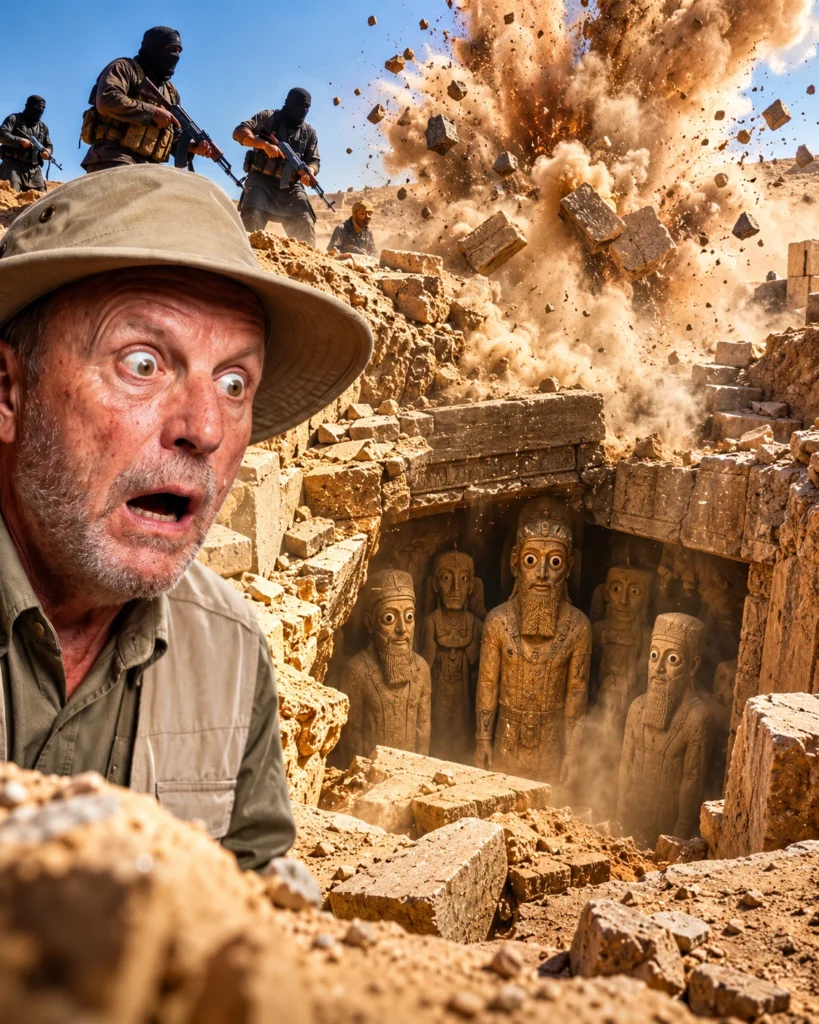
On July 24, 2014, militants demolished the Jonah shrine using explosives.
Footage of the destruction circulated internationally.
The monument, which had stood as a religious landmark for generations, disappeared within seconds.
But the destruction did not end there.
Beneath the ruins, militants began excavating tunnels through the ancient archaeological layers.
Their apparent objective was to locate portable antiquities that could be removed and sold.
Later investigations documented an extensive network of underground passages.
Some were narrow enough that researchers could move through them only by crawling.
The excavations were dangerous.
The tunnels lacked proper structural support, and collapsing earth threatened both investigators and surviving archaeological remains.
Yet those illegal passages also exposed chambers that had remained inaccessible to modern researchers.
After Iraqi forces regained eastern Mosul in early 2017, archaeologists began examining the damaged site.
Among the first was Layla Salih, an Iraqi heritage specialist.
Entering the tunnels required navigating unstable passages beneath the shattered mosque.
What she encountered was remarkable.
Large stone slabs decorated with Assyrian reliefs stood along the underground corridors.
Some displayed female figures holding ceremonial objects.
Others contained inscriptions written in cuneiform, the wedge-shaped script used throughout ancient Mesopotamia.
The carved figures were particularly intriguing because their arrangement and presentation differed from more familiar examples of Assyrian palace decoration.
Researchers also documented monumental guardian sculptures associated with royal entrances.
These included representations of lamassu, protective beings traditionally depicted with human heads, animal bodies, and wings.
Their presence indicated that the excavators had reached important sections of an ancient royal building.
But the most revealing evidence appeared in the inscriptions.
Several stone slabs carried the name Esarhaddon.
He ruled Assyria from 681 to 669 BC and was the son of Sennacherib.
The inscriptions identified the royal authority associated with the building and helped researchers reconstruct its historical development.
The discovery was significant because Esarhaddon also appears in ancient written accounts outside Assyria.
One of those sources is the Bible.
In 2 Kings 19:37, the text describes the assassination of Sennacherib and identifies Esarhaddon as his successor.
A parallel account appears in Isaiah 37:38.
The inscriptions beneath Nebi Yunus therefore connected the physical remains of an Assyrian palace with a ruler independently named in biblical historical narratives.
That correspondence is historically important.
However, it does not prove every event described in those religious texts.
It demonstrates that the texts preserve references to genuine historical rulers whose existence is independently documented.
The assassination itself is also recorded in ancient Mesopotamian sources.
Babylonian chronicles describe Sennacherib being killed during a rebellion in 681 BC.
The records differ in certain details concerning the perpetrators.
Biblical accounts identify two sons, while other ancient sources provide different or less specific descriptions.
Esarhaddon’s own inscriptions discuss the succession crisis and the struggle against his brothers.
Yet they do not provide a complete account of his father’s assassination.
That omission has attracted scholarly attention.
Was it a deliberate political choice?
Was the new king attempting to emphasize his legitimate succession rather than the violence preceding it?
The surviving evidence cannot establish his personal motives with certainty.
But the contrast between the sources reveals the complicated nature of ancient royal history.
Kings frequently commissioned inscriptions intended to celebrate their authority.
Those documents were political statements as well as historical records.
Their omissions can be as revealing as their claims.
The archaeological discoveries beneath Nebi Yunus also provided information about the palace itself.
Later investigations involving Iraqi and German researchers used three-dimensional mapping and architectural analysis to document the surviving structures.
The work revealed monumental spaces, including a vast throne-room complex.
Researchers compared architectural measurements with descriptions preserved in ancient royal inscriptions.
These comparisons helped clarify how the palace had been constructed, expanded, and used.
The building was associated with royal administration and military organization.
Ancient descriptions refer to facilities for horses, chariots, equipment, and valuable goods.
The inscriptions also reflect Assyria’s extensive political relationships with neighboring kingdoms.
Among the rulers named in Esarhaddon’s building records was Manasseh of Judah, another figure known from biblical texts.
This provides an additional historical connection between Assyrian imperial records and the kingdoms described in the Hebrew Bible.
Yet the most troubling aspect of the discovery concerns the objects that may have disappeared.
During the occupation, ISIS operated systems for exploiting antiquities found in territories under its control.
Documents recovered from the organization revealed administrative procedures connected to archaeological looting and the collection of revenue.
At Nebi Yunus, investigators believed that smaller portable objects had been removed from the tunnels.
Pottery, decorative pieces, and other artifacts were among the categories considered vulnerable.
Some estimates suggested that hundreds of objects might have been taken.
However, the precise number and identities of missing artifacts remain uncertain.
Without complete excavation records from before the illegal digging, determining exactly what disappeared is extremely difficult.
That uncertainty creates a serious problem for archaeological research.
An artifact removed from its original location loses much of the contextual information that gives it historical meaning.
Its position, surrounding materials, and relationship to architectural features can be essential for interpreting its purpose.
When those details are destroyed, even a recovered object may tell only part of its story.
The tunnels themselves created another paradox.
Although the illegal excavations severely damaged the site, their paths exposed portions of the palace’s architecture.
Researchers could use the tunnel network, combined with modern mapping techniques, to reconstruct areas of the building previously hidden beneath the shrine.
An act of destruction had unintentionally revealed evidence of extraordinary historical importance.
But the discovery came at an enormous cost.
The archaeological layers had been disturbed.
The monument above had been destroyed.
And potentially valuable artifacts had vanished.
Today, conservation and restoration efforts seek to protect the surviving remains and preserve the site’s religious and historical significance.
The challenge is considerable.
Ancient walls require stabilization, damaged areas must be documented, and underground passages remain vulnerable to collapse.
Yet the importance of Nebi Yunus extends beyond the recovery of one palace.
The site connects several different periods of human history.
It preserves evidence of Assyrian imperial power.
It reflects religious traditions associated with Jonah.
And it bears the scars of modern conflict and deliberate cultural destruction.
Perhaps the most remarkable discovery is the continuity between these different historical layers.
A king whose name appears in ancient biblical accounts also left inscriptions beneath a hill that later became sacred to generations of worshippers.
For nearly three thousand years, the structures remained buried as civilizations rose, disappeared, and transformed the landscape above them.
The surviving evidence does not establish that Jonah himself was buried there.
Nor does it resolve every question surrounding the assassination of Sennacherib.
But it confirms that the ancient city of Nineveh was a real imperial center whose rulers left extensive physical records.
And those records continue to illuminate the historical world in which biblical narratives were written.
The story of Nebi Yunus is therefore not simply about a hidden palace.
It is about the extraordinary survival of history beneath a city repeatedly transformed by conquest, religion, and war.
When Layla Salih entered the tunnels in 2017, she encountered evidence that generations of archaeologists had struggled to reach.
The inscriptions identified a king.
The sculptures revealed the grandeur of his palace.
And the damaged corridors exposed the consequences of modern looting.
But one question remains unanswered.
How much of the ancient palace’s history disappeared before researchers arrived?
Some evidence may survive in undiscovered chambers.
Other objects may remain hidden in private collections.
And some information may have been lost permanently.
Beneath the reconstructed landscape of Mosul, the remains of Nineveh continue to hold fragments of a civilization that once dominated the ancient Near East.
The destruction of Jonah’s shrine revealed a palace.
But the deeper discovery was something more enduring.
Even after thousands of years, the names carved into stone can still speak.
And sometimes, they reveal connections between history, archaeology, and ancient texts that have been waiting centuries to be understood.