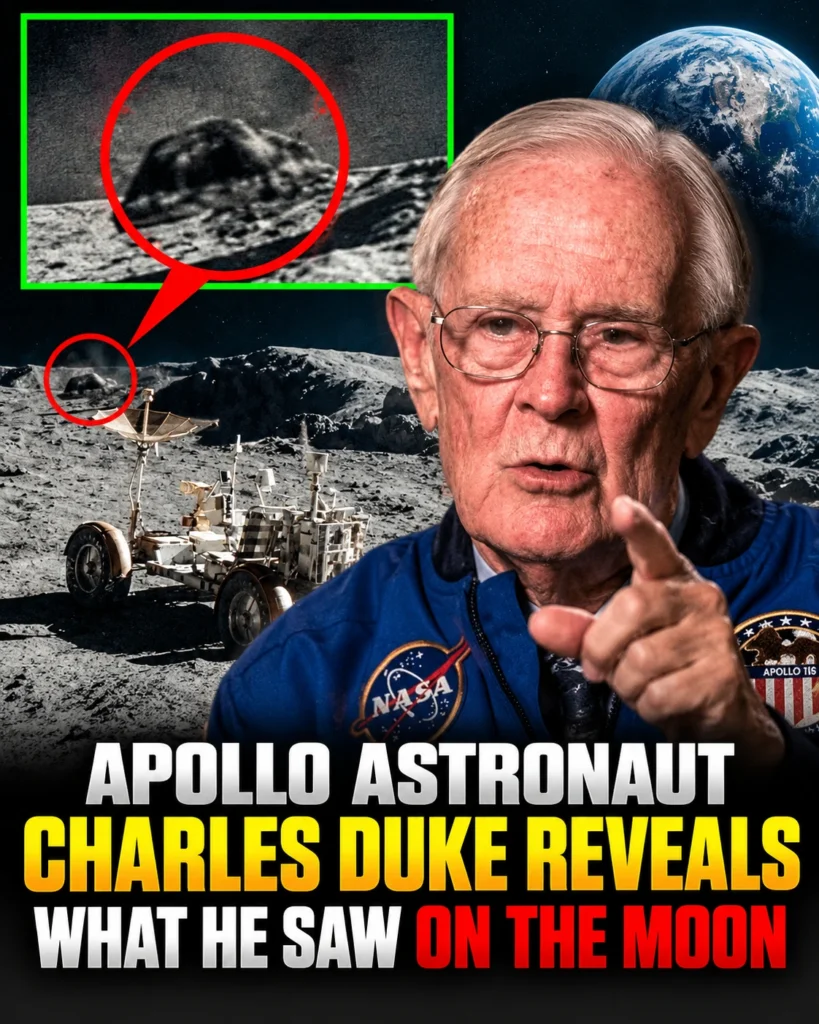
On July 20, 1969, Charles Duke sat inside Mission Control in Houston as the Apollo 11 lunar module descended toward the moon.
He was serving as CAPCOM, the astronaut responsible for communicating directly with the crew.
As Neil Armstrong and Buzz Aldrin approached the lunar surface, fuel reserves became dangerously low.
Controllers watched the instruments while Duke relayed essential information.
Then Armstrong announced that the Eagle had landed.
Duke’s relieved response became part of spaceflight history.
He told the astronauts that Mission Control had nearly turned blue from holding its breath.
Although millions heard his voice, relatively few recognized the man behind it.
Three years later, Duke would experience the moon from an entirely different perspective.
Apollo 16 launched on April 16, 1972, carrying John Young, Ken Mattingly, and Charles Duke toward the lunar highlands.
Their destination was the Descartes region, where scientists hoped to investigate terrain believed to have been shaped by ancient volcanic activity.
But the mission nearly ended before the landing began.
After the lunar module separated from the command module, engineers detected an irregularity involving the command spacecraft’s propulsion control system.
Mission Control delayed the descent while specialists examined the problem.
For several hours, the astronauts waited in lunar orbit without knowing whether they would be permitted to continue.
Eventually, NASA determined that the landing could proceed.
On April 20, Young and Duke touched down on the lunar surface.
At 36, Duke became the youngest person ever to walk on the moon.
That record remains unbroken.
But his first impressions had little to do with records or historical recognition.
What overwhelmed him was the environment itself.
Without an atmosphere to scatter sunlight, the lunar sky appeared completely black.
The surface, meanwhile, reflected intense sunlight.
Rocks cast sharply defined shadows, and distant terrain appeared unusually clear.
The visual contrast was unlike anything Duke had experienced on Earth.
His spacesuit created another challenge.
The helmet restricted his field of vision, making it difficult to look upward or inspect the surrounding landscape without moving his entire body.
Even the simplest movements required planning.
In the moon’s reduced gravity, walking became a sequence of controlled hops.
Yet the same conditions that made movement fascinating also created unexpected dangers.
During the mission, Duke attempted a high jump and lost his balance.
He fell backward toward the portable life-support system attached to his spacesuit.
The equipment was essential for maintaining breathable air, pressure, and temperature.
A serious failure could have been fatal.
Duke later acknowledged that the maneuver had been reckless.
The incident demonstrated how quickly an ordinary human impulse could become dangerous in an environment with almost no margin for error.
But Apollo 16 was primarily a scientific expedition.
Across three lunar excursions, Young and Duke spent more than 20 hours exploring the surface.
They traveled approximately 26.7 kilometers using the lunar rover.
Their work included geological observations, sample collection, photography, and deployment of scientific instruments.
Among those instruments was an extraordinary piece of technology developed by scientist George Carruthers.
The Far Ultraviolet Camera Spectrograph allowed researchers to observe ultraviolet radiation from the lunar surface without interference from Earth’s atmosphere.
It represented an important milestone in astronomical observation beyond Earth.
The astronauts also collected approximately 95.8 kilograms of lunar rocks and soil.
One specimen became particularly famous.
Known as Big Muley, lunar sample 61016 weighed approximately 11.7 kilograms on Earth.
It was the largest individual rock returned during the Apollo program.
Duke collected the specimen near Plum Crater, struggling to handle the awkward object while wearing his restrictive spacesuit.
The rock later provided valuable information about the moon’s ancient geological history.
But Apollo 16’s most important scientific contribution came from an unexpected result.
Before the mission, researchers believed portions of the Descartes Highlands might contain evidence of ancient volcanic formations.
The samples told a different story.
Many were impact breccias, rocks formed when powerful collisions shattered, heated, and recombined older lunar materials.
These findings helped scientists reconsider the processes responsible for shaping the highlands.
The mission demonstrated that meteorite bombardment had played a crucial role in the moon’s geological development.
This was not evidence of a hidden civilization or an undisclosed lunar secret.
It was a scientific discovery made possible by direct observation and carefully collected samples.
And its importance continues today.
Decades after Apollo 16, researchers still examine lunar material returned by Duke and his colleagues.
Modern analytical techniques can reveal details that were impossible to investigate in the 1970s.
Yet the scientific achievements are only one part of Duke’s story.
He has also spent years explaining what the experience felt like to people who know the moon only through photographs and television footage.
The lunar environment was profoundly unfamiliar.
There was no wind.
No breathable atmosphere.
No familiar blue sky.
The astronauts depended entirely on equipment designed and tested thousands of miles away.
Every movement took place against a background of constant risk.
That reality gave the mission an emotional significance beyond its scientific objectives.
Duke also left a deeply personal object on the lunar surface.
He placed a photograph of his family inside a protective covering and photographed it resting on the lunar ground.
The image showed Duke, his wife, and their children.
It was a small human gesture in an otherwise extraordinary technological environment.
The photograph remains on the moon, although decades of exposure have likely altered its condition.
For Duke, the mission also became part of a larger personal journey.
In later years, he spoke openly about his Christian faith and how his spiritual life influenced his understanding of purpose and achievement.
He has described his religious transformation as more personally significant than walking on the moon.
His reflections offer an unusual contrast.
A man who participated in one of humanity’s greatest technological accomplishments ultimately found his deepest personal meaning elsewhere.
Today, Duke also confronts a different challenge.
Despite extensive documentation, some people continue to question whether the Apollo moon landings occurred.
The evidence supporting those missions is substantial.
It includes photographs, telemetry records, independently tracked spacecraft, lunar samples, scientific instruments, and observations from later lunar orbiters.
For Duke, the debate is especially personal.
He witnessed Apollo 11’s landing from Mission Control and later explored the lunar surface himself.
His testimony forms part of an enormous historical record rather than standing alone as its only proof.
As the Apollo generation grows older, preserving that firsthand testimony becomes increasingly important.
Only a small number of the twelve astronauts who walked on the moon remain alive.
Their experiences provide details that technical reports cannot fully communicate.
Duke continues to encourage younger generations to pursue scientific discovery and exploration.
He regards future lunar missions as an extension of the work begun during Apollo.
Programs designed to return humans to the moon could help scientists investigate new regions, test technologies, and prepare for more distant expeditions.
Mars remains a particularly ambitious objective.
Unlike lunar missions, journeys to Mars would involve months of travel, delayed communications, and limited opportunities for emergency return.
The experience gained during Apollo provides important lessons, but future explorers will face challenges on a different scale.
Duke’s legacy therefore extends beyond the footprints he left in lunar dust.
He helped communicate humanity’s first successful moon landing.
He became the youngest person to walk on another world.
He participated in discoveries that changed scientific understanding of lunar geology.
And he experienced firsthand how fragile human life becomes beyond Earth’s protective environment.
More than five decades later, the moon remains both familiar and mysterious.
Scientists understand far more about its history than they did in 1972.
Yet enormous regions remain unexplored by humans.
The photographs, samples, and instruments from Apollo 16 continue to offer clues.
For Charles Duke, the enduring lesson is not that the moon concealed some extraordinary secret from the public.
It is that the real experience was already more astonishing than popular imagination could capture.
The darkness was deeper.
The landscape was stranger.
The dangers were closer.
And the scientific discoveries were more consequential than many people remember.
His footprints remain in the lunar highlands, preserved in a place without wind or rain to erase them.
They are evidence of what one generation accomplished and a reminder that humanity’s exploration of the moon is far from finished.