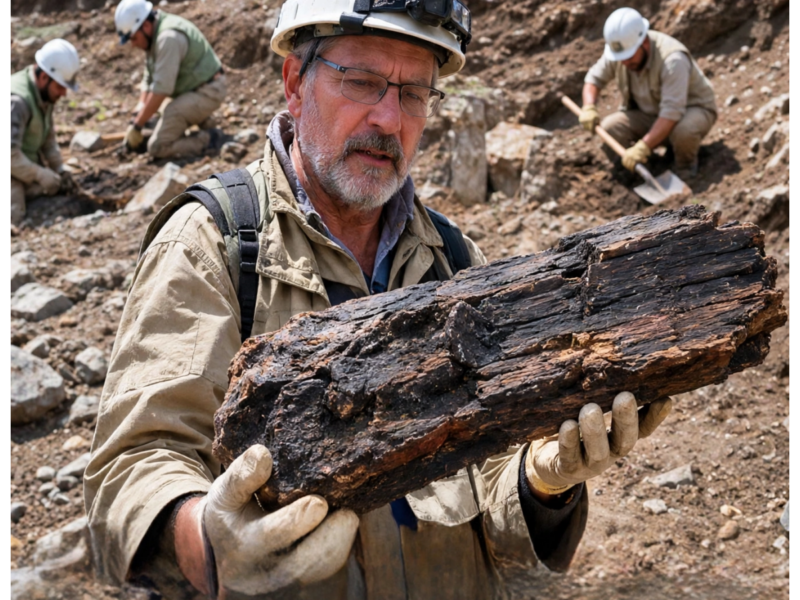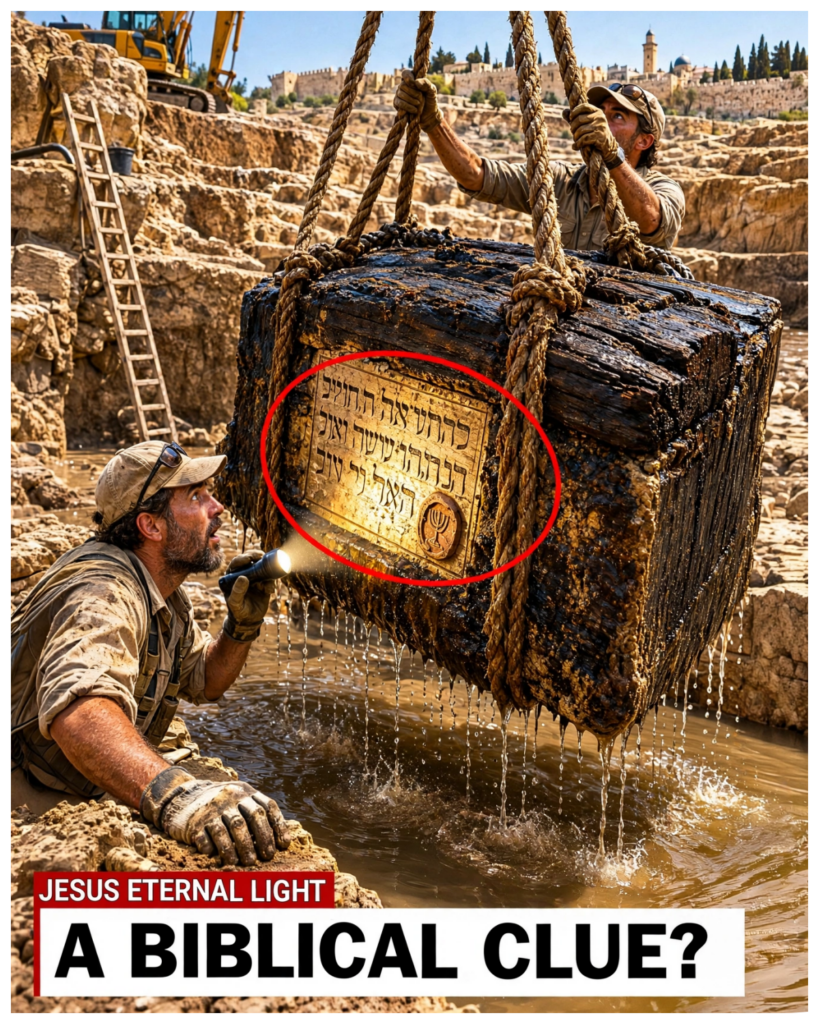
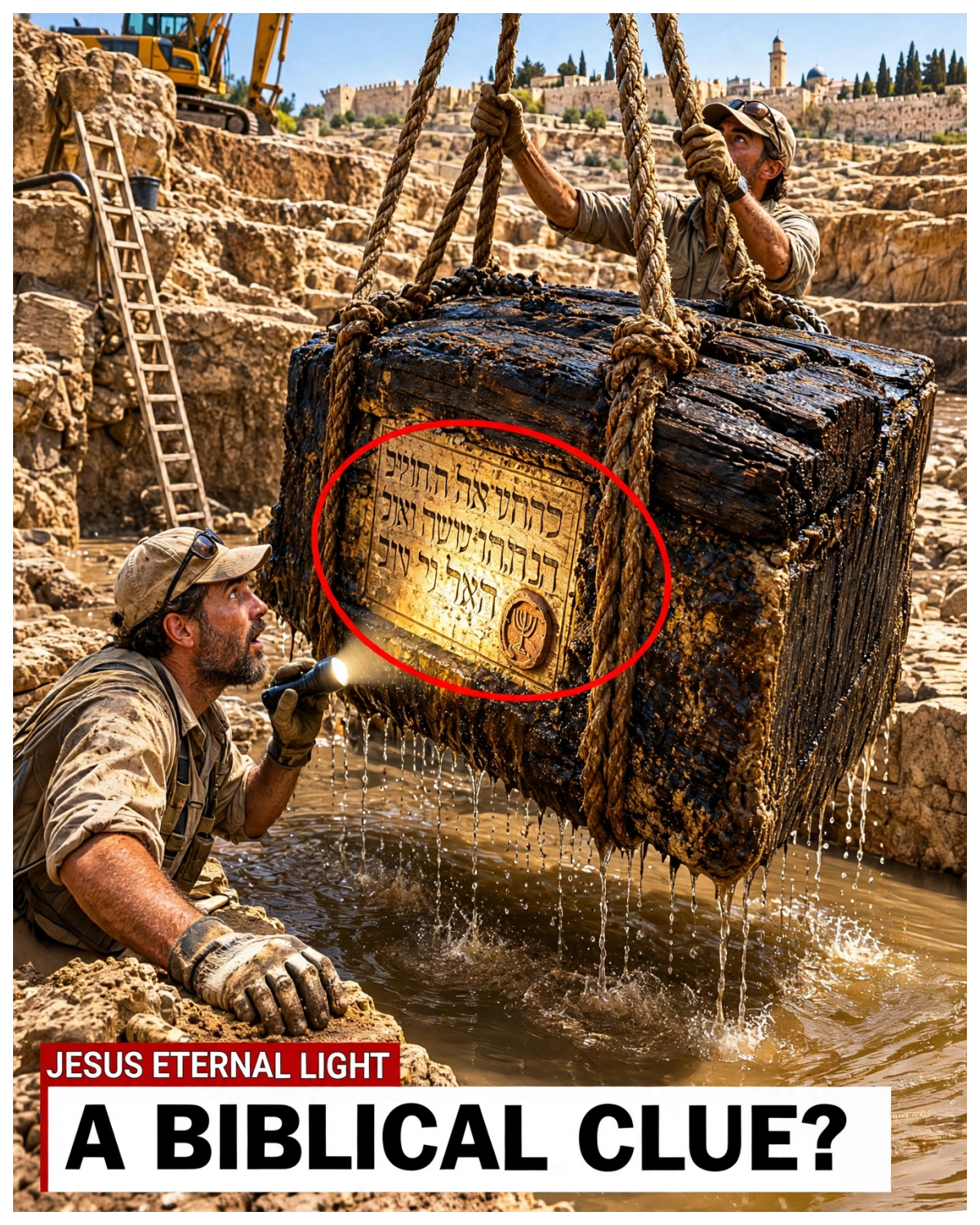
Massive wooden beams from the first temple in Jerusalem have been unearthed.
Now, the temple was uh behind me you can see the destruction layers of 586 BC.
Look at that.
Beneath the ancient streets of Jerusalem, something terrifying has emerged from the ashes of a forgotten catastrophe.
Archaeologists excavating the city of David have uncovered 2,600year-old burned wooden beams buried beneath the ruins of a city once consumed by Babylon’s armies.
But what makes this [music] discovery so disturbing is that the Bible described Jerusalem’s destruction by fire thousands of years ago.
And the evidence does not end there.
Ancient seals, mysterious treasures, and scientific findings are revealing [music] chilling details about the city’s final days.
Could these discoveries be exposing a warning that humanity has forgotten?
And why does the book of Revelation speak of Babylon’s terrifying return?
Stay with us because what lies beneath Jerusalem may change how you understand [music] biblical prophecy.
Before we begin, share your personal prayer to the Lord in the comments below.
For nearly 2,600 years, the evidence of one of Jerusalem’s most devastating nights remained buried beneath the very ground where people walk today.
Deep inside the city of David, archaeologists excavating near the Givati parking lot uncovered the remains of an ancient building that had been consumed by a violent fire.
As layers of rubble were carefully removed, [music] blackened wooden beams emerged from the ruins, still lying where they had collapsed centuries [music] ago.
But what caught the researchers attention was the extraordinary condition of the surrounding material.
The heat had been so intense that plaster from the walls had hardened around the burned timbers, preserving a haunting record of the destruction.
Now consider what this means.
These were not simply the remains of an ordinary household accident.
The ruins belong to a period when Jerusalem faced the overwhelming military power of Babylon.
And the Bible describes a catastrophe [music] remarkably similar to what archaeologists have uncovered in 2 Kings 25-9 scripture records.
[music] and he burnt the house of the Lord and the king’s house and all the houses of Jerusalem and every [snorts] great man’s house burnt he with fire.
The destruction was so complete that even the city’s most important buildings could not escape.
Yet perhaps the most unsettling detail is that Jerusalem had been warned.
In Jeremiah 21:10, God declared concerning the city, “It shall be given into the hand of the king of Babylon, and he shall burn it with fire.”
For believers, these ancient remains invite a sobering reflection on the danger of ignoring God’s warnings.
But the flames were only the final horror.
Before Jerusalem burned, its people endured a terrifying siege that would bring an entire kingdom to [music] its knees.
The fire that left those wooden beams buried beneath Jerusalem was the final act of a nightmare that had begun long before the first flames appeared.
Around 586 BC, Jerusalem was trapped behind its own walls, surrounded by the armies of King Nebuchadnezzar.
For months, Babylonian forces cut off the city’s supplies, turning what [snorts] had once been a thriving capital into a place of desperation.
[music] Food disappeared, families struggled to survive, and the streets that once echoed with worship were filled with suffering.
In 2 Kings 25:3, the Bible reveals the horrifying condition inside the city.
And there was no bread for the people of the land.
When Babylon finally breached Jerusalem’s defenses, King Zedekiah attempted to escape under cover of darkness, but he was captured.
The Babylonian commander Nebu Zaredon [music] later entered the city, setting fire to the temple of the Lord, the royal palace, and Jerusalem’s great houses.
Sacred treasures were carried away.
Defensive walls were demolished and countless lives were shattered as people [music] were forced into exile.
Imagine the anguish of watching the very place where generations had worshiped God disappear beneath the flames.
What makes this tragedy especially painful is that Jeremiah had warned Judah’s leaders of the approaching disaster.
Yet they repeatedly [music] rejected his message.
His story reveals how pride and stubbornness can prevent people from recognizing danger until the consequences become unavoidable.
And beneath Jerusalem, the archaeological evidence brings this ancient suffering into sharper focus.
Beyond the blackened beams, excavations have revealed burned [music] rooms, shattered objects, and arrowheads associated with the city’s violent final years.
These discoveries raise another disturbing question.
How close can we come to reconstructing the final moments before Jerusalem fell?
The ruins [music] beneath Jerusalem are not the only evidence of the violence that once swept across the Holy Land.
Far beyond the ancient city in the barren [music] cliffs overlooking the Dead Sea, archaeologists have uncovered a disturbing secret hidden inside a remote cave for nearly 1,900 years.
The discovery began when researchers noticed an ancient weapon lodged between the rocks.
Further examination revealed four remarkably preserved [music] swords concealed deep within a narrow crevice.
Three still enclosed in their original wooden scabbards.
Their condition was extraordinary, but the circumstances surrounding them raised a darker question.
Why had these weapons been hidden so carefully in a place where their owners might never find them again?
Archaeologists believe the swords may have been seized from Roman soldiers and concealed by Jewish rebels during a period of brutal conflict.
Roman military campaigns had turned parts of the Judeian wilderness into [music] dangerous territory where caves became shelters for those fleeing persecution and [music] warfare.
The weapons suggest a desperate effort to keep valuable arms beyond the enemy’s [music] reach.
Yet their owners never returned, leaving behind a mystery that has survived for centuries.
Were they captured, killed, or forced to abandon their hiding place forever?
The discovery recalls the anguish expressed in Lamentations 5:9.
We gat our bread with the peril of our lives because of the sword of the wilderness.
Although these weapons belong to a later conflict, the verse reveals how warfare can strip ordinary people of safety and peace.
But the Dead Sea wilderness holds another remarkable biblical account.
Long before these swords were concealed, David sought refuge among its caves, where an unexpected encounter with King Saul would test his faith more severely than any battle.
The caves overlooking the Dead Sea have witnessed centuries of bloodshed, desperate escapes, and terrifying struggles for survival.
But long before the four ancient [music] swords were concealed among these rocks, another man was hiding in the same unforgiving wilderness, hunted by a king who wanted him dead.
His name was David.
According to 1 Samuel 24, King Saul had assembled 3,000 chosen soldiers to [music] pursue him through the cliffs of Angeti.
Every passage through the mountains carried the danger of discovery, and capture could mean certain death.
David and his followers had taken refuge deep inside a cave, surrounded by darkness, with an army searching the wilderness outside.
Then, without warning, the very man who had ordered David’s pursuit [music] entered their hiding place.
Saul had no idea that the man he desperately wanted to kill was concealed only a short distance away.
For David’s followers, this seemed like the moment they had been waiting for.
Their enemy was defenseless, and one [music] strike could end the nightmare of being hunted.
But David faced something far more frightening than Saul’s army.
[snorts] The temptation to take a life when no one could stop him.
He secretly cut a piece from Saul’s robe.
Yet his conscience immediately [music] troubled him.
In 1 Samuel 24:6, David declared, “The Lord forbid that I should do this thing unto my master.
The Lord’s anointed.
Rather than surrender to vengeance, he placed his future in God’s hands.
The ancient swords discovered nearby belong to a much later conflict.
Yet, they reveal how these caves continued to conceal the dangers [music] of war.
David’s experience exposes a profound truth.
The darkest moments can reveal whether faith or fear truly governs the human heart.
But back in Jerusalem, another generation would face a far more devastating choice.
As God’s warnings went unheeded and a kingdom moved toward destruction.
The most terrifying thing about Jerusalem’s destruction is that even those who possessed everything were [music] powerless when the flames finally reached their doors.
Deep beneath the city of David, archaeologists uncovered the remains of an extraordinary two-story building known as building 100.
A place where wealth and privilege once flourished behind magnificent walls.
Scattered throughout its ruined chambers were approximately 1,500 fragments [music] of beautifully carved ivory decorated with delicate flowers and trees.
Ancient storage jars even contain traces of wine flavored with rare vanilla, revealing a lifestyle far removed from the hardships endured [music] by ordinary families.
But these treasures were not discovered inside a magnificent palace still standing proudly above Jerusalem.
They were buried among collapsed walls, blackened debris, and the horrifying remains of a building consumed by fire.
Everything its occupants had treasured was swallowed by the same catastrophe that devastated their city.
And that is what makes this discovery so deeply disturbing.
Whoever lived within these walls may have possessed influence, servants, and extraordinary riches.
Yet, none of those privileges could guarantee safety when Babylon’s armies arrived.
The identity of the occupants remains unknown.
But their ruined home exposes a painful truth about the fragility [music] of human power.
In Jeremiah 9:23, God warned, “Let not the wise man glory in his wisdom, neither let the mighty man glory in his might.
Let not the rich man glory in his riches.”
These words carry extraordinary weight beside the [music] shattered luxuries of ancient Jerusalem.
The possessions that once represented security had become silent witnesses to its destruction.
But the most frightening evidence was still concealed within the building itself.
As [music] scientists examined the burned floors and fallen walls, they discovered traces of extreme heat that could reveal how the fire spread through this once magnificent residence, exposing another terrifying detail of Jerusalem’s final destruction.
The burned palaces beneath Jerusalem reveal the horrifying destruction Babylon left behind.
[music] But scripture exposes something far more disturbing about the empire responsible for this catastrophe.
Babylon was not merely a kingdom of powerful armies and ruthless conquerors.
In Jeremiah 25, God revealed that this terrifying empire would become an instrument of judgment against nations that had repeatedly rejected his warnings.
The prophet Habachok described the Babylonians as a fierce and dreadful people whose armies swept across kingdoms with overwhelming force.
In Habachok 1:8, their horsemen are described [music] as those who shall fly as the eagle that hasteth to eat.
Their conquests brought entire nations to their knees, [music] leaving ruined cities, shattered families, and countless captives in their [music] wake.
Yet Babylon’s darkest danger extended beyond the battlefield.
Its rulers demanded submission not only to their political authority, but even to their gods.
In Daniel 3, King Nebuchadnezzar commanded his subjects to worship an enormous golden image, [music] threatening anyone who refused with death inside a blazing furnace.
For believers, this terrifying confrontation reveals the cost of remaining faithful when earthly power demands what belongs to God alone.
But Babylon’s rulers failed to understand one dreadful truth.
The empire permitted to bring judgment upon others would eventually face judgment itself.
[music] Isaiah 13 describes Babylon’s downfall through frightening [music] images of trembling heavens, darkness, and divine wrath.
Centuries later, Revelation 17 and 18 [music] invoke Babylon again, portraying a mysterious power associated with corruption, deception, [music] and rebellion against God.
Christians differ in their interpretations of this prophetic Babylon, but its warning remains deeply unsettling.
No earthly kingdom [music] can claim the authority that belongs to the Lord.
And before Babylon’s power finally collapsed, scripture records an extraordinary [music] night when a mysterious message appeared upon a palace wall announcing that a mighty kingdom’s days were numbered.
Babylon had brought Jerusalem to its knees, burned the temple of the Lord, and carried thousands into captivity.
[music] Its rulers believed their empire was too powerful to fall, protected by mighty walls, enormous wealth, and armies [music] that had crushed entire kingdoms.
Yet, while Babylon stood at the height of its glory, [music] the Bible had already pronounced a terrifying judgment against it.
In Isaiah 13:6, the prophet declared, “Howl ye, for the day of the Lord is at hand.
It shall come as a destruction from the Almighty.”
The prophecy describes a day of overwhelming terror when human courage fails.
The heavens grow dark and the foundations of earthly power are shaken.
The empire that had spread fear across nations would one day face a future its own rulers could not prevent.
Even more disturbing were the warnings recorded in Jeremiah 50.
Babylon’s idols would be disgraced.
Its warriors would lose their courage.
And the kingdom that once seemed invincible would fall before another conquering power.
The city eventually passed into Persian hands in 539 BC, although its decline unfolded over centuries rather than in a single night of total destruction.
Today, the ancient ruins remain in modern Iraq, where broken walls and remnants of [music] royal buildings stand as witnesses to an empire whose greatness could not endure.
For those who suffered under Babylon’s cruelty, these prophecies carried a profound promise.
God had not forgotten their suffering, and earthly power would not escape his justice forever.
Yet, before Babylon lost its throne, the book of Daniel describes an even more frightening [music] warning.
During a royal feast, as sacred vessels taken from Jerusalem were being dishonored, a mysterious hand appeared and began writing upon the palace wall.
The final hours of Babylon’s power were marked by one of the most terrifying supernatural warnings recorded in scripture.
Inside the royal palace, King Belshazzer was hosting a magnificent feast [music] for a thousand of his nobles, surrounded by wealth, music, and the arrogance of a kingdom that believed itself untouchable.
But the celebration took a disturbing turn when the king ordered sacred vessels [music] stolen from Jerusalem’s temple to be brought before his guests.
They drank wine from objects once dedicated to the worship of the Lord, praising their idols of gold, silver, and stone.
Then, without warning, something appeared that brought the entire [music] celebration to a horrifying halt.
According to Daniel 5, the fingers of a human hand suddenly emerged and began writing mysterious words upon the palace wall.
The king’s face turned pale, his body trembled, and his knees struck together in terror.
His wisest advisers [music] could not explain the message.
Only Daniel, the prophet who had remained faithful through years of captivity, could reveal its dreadful meaning.
In Daniel 5:27, he declared, “Teel, thou art weighed in the balances, and art found wanting.
Babylon’s days had been numbered, its kingdom judged, and [music] its power destined to pass into other hands.”
The most chilling detail comes at the end of the chapter.
That very night, Belshazzer was killed and the kingdom passed to new rulers.
His story reveals how spiritual blindness can become most dangerous when pride convinces people they are beyond accountability.
[music] But the sacred vessels, dishonored during that final feast, raise another troubling mystery.
[music] What became of the treasures Babylon had stolen from the house of the Lord?
When Babylon’s soldiers entered Jerusalem’s temple, they did more than destroy one of the holiest places in Israel’s history.
They stripped it of sacred objects that had been used in worship for generations, carrying away treasures whose disappearance would leave questions unanswered for centuries.
According to 2 Kings 25, the invaders dismantled the great bronze pillars, removed the vessels of gold and silver, and took furnishings that had once stood within the house of the Lord.
These objects represented far more than extraordinary wealth.
They belong to a sacred tradition that connected the people of Judah to their covenant with God.
Their removal was a devastating humiliation for a nation already suffering the destruction [music] of its capital.
Yet the story of these treasures did not end in Babylon.
In Ezra 1:7, scripture records also Cyrus the king brought forth the vessels of the house of the Lord, which Nebuchadnezzar had brought forth out of Jerusalem.
After Babylon fell, the Persian king authorized the return of sacred vessels to the Jewish [music] exiles.
Ezra records thousands of gold and silver articles being entrusted to those preparing to return to Jerusalem.
For a people who had lost their temple, their homes, and their independence, this was an extraordinary moment of restoration.
What had been carried away in humiliation was now being returned with the possibility of renewed worship.
But the fate of many individual temple treasures remains uncertain.
[music] Were some lost during Babylon’s decline, destroyed in later conflicts, or buried beneath ancient cities where they remain undiscovered?
Their mystery reminds believers that even after devastating loss, God’s promises of restoration can endure.
And beneath Jerusalem itself, another kind of evidence has survived, [music] revealing something deeply disturbing about the fire that consumed the city.
The destruction of Jerusalem was so violent that its buildings preserved evidence of the flames long after the Babylonian soldiers had disappeared.
Beneath the City of David, researchers examining the remains of building 100 discovered that the ancient floors and collapsed walls held clues to a catastrophe [music] almost 2,600 years old.
Using advanced magnetic analysis, scientists [music] studied hundreds of samples taken from materials exposed to extreme heat.
Some revealed temperatures reaching several hundred° C, suggesting that parts of the building had been engulfed in an extraordinarily intense fire.
But the most disturbing evidence concerned what happened while the structure was still burning.
Certain floor fragments retained magnetic signatures that helped researchers investigate their position during the blaze.
The findings suggested that an upper level may have collapsed while flames [music] were still consuming the building.
This meant the destruction was not simply a fire that damaged a few rooms before fading away.
The building suffered a catastrophic structural failure, leaving its contents buried beneath layers of debris.
In Jeremiah 39:8, scripture records, “And the Calaldanss burned the king’s house and the houses of the people with fire and break down the walls of Jerusalem.”
[music] The archaeological evidence gives physical depth to those ancient words, revealing how fire could transform homes into ruins within [music] a single catastrophe.
For the families who once lived in Jerusalem, the destruction meant losing places where generations had built their lives.
Their suffering gives deeper meaning to the [music] grief preserved in lamentations.
Yet, the scientific investigation uncovered another troubling [music] detail.
The fire had not spread evenly through building 100, raising questions about how the destruction began and whether different areas had burned independently.
One of the most unsettling findings from Jerusalem’s ancient ruins is that the fire did not leave the same evidence everywhere.
Inside building 100, scientists discovered areas that had endured tremendous heat, while nearby sections showed far weaker signs of burning.
This uneven pattern presented a difficult question.
If a single fire had swept through the entire structure, why were some rooms [music] devastated while others appeared to have escaped the worst of the flames?
Researchers turned to magnetic measurements and the physical condition of the surviving materials, [music] searching for clues that could explain the building’s final moments.
The results suggested a complicated sequence [music] of destruction rather than one uniform blaze.
Some sections may have burned intensely while others experienced less heat, possibly because of differences in available fuel, air flow, or the way the building collapsed.
[music] Researchers also considered whether fires could have begun in separate locations.
Although the surviving evidence cannot establish precisely who ignited the flames or how many fires were started, it reveals [music] the destructive force that overwhelmed parts of ancient Jerusalem.
In 2 Kings 25-9 10, scripture describes the burning of the temple, the royal palace, and the great houses, followed by the destruction of the city’s walls.
The biblical account portrays a devastating assault upon Jerusalem’s most important structures.
There is a particularly painful truth within these discoveries.
Behind every ruined wall was a place where people had lived, [music] worked, and expected another ordinary day.
The fire erased much of that world, yet it also preserved traces that researchers [music] can still examine.
And this raises a question that reaches beyond the destruction itself.
Can modern science determine when Jerusalem’s final catastrophe occurred?
Bringing the archaeological evidence even closer to the chronology preserved in scripture.
Jerusalem had fallen.
Its sacred temple was gone.
Its walls lay broken.
And thousands of its people had been carried far from the land their ancestors had called home.
For those who survived Babylon’s conquest, the deepest suffering was not simply the loss of their houses or possessions.
It was the unbearable thought that they might never again see the city where their fathers had worshiped, where their children had been raised, and where generations had called upon the name of the Lord.
The streets of Jerusalem had once been filled with the sounds of celebration and prayer.
Now, the kingdom of Judah had disappeared, and its people were scattered across a foreign empire.
Yet, hidden [music] within this terrible chapter of Israel’s history was a promise so extraordinary that it would change the meaning of everything that had happened.
Long before the exiles returned, God had already spoken of a future beyond Babylon.
The prophet Jeremiah had delivered that promise during one of the darkest periods in Judah’s history.
In Jeremiah 25-11, he warned, [music] “And this whole land shall be a desolation and an astonishment, and these nations shall serve the king of Babylon 70 years.”
Those words announced a long season of suffering [music] and foreign domination.
But the prophecy did not end with desolation.
Jeremiah 29:10 reveals God’s promise.
After 70 years be accomplished [music] at Babylon, I will visit you and perform my good word toward you in causing you to return to this place.”
The same prophet who had warned that Jerusalem would burn also declared that its people [music] would not remain in exile forever.
The 70 years were connected to Babylon’s period of domination and the promised restoration.
Although scholars differ on the precise chronological boundaries, what mattered most to those who heard Jeremiah’s message was that their suffering had not erased God’s covenant faithfulness.
There is something deeply moving about the circumstances in which this promise was delivered.
Jeremiah did not speak to a people celebrating victory.
He wrote to families living in captivity, surrounded by unfamiliar customs, [music] separated from their homeland, and uncertain whether their children would ever return.
Many had lost relatives during the siege.
Others had watched their homes disappear beneath the flames.
[music] Their grief was not something that could be healed by a few comforting words.
They needed a reason to continue living when the future seemed to have been taken from them.
And God’s instructions were remarkable.
Rather than commanding the exiles to spend their days waiting helplessly for Babylon’s downfall, Jeremiah told them to build houses, plant gardens, establish families, and seek the peace of the cities where they had been taken.
In Jeremiah 29:7, he instructed them, “And seek the peace of the city whether I have caused you to be carried away captives, and pray unto the Lord for it.”
Even in a foreign land surrounded by the consequences of war, [music] they were called to preserve life, care for their families, and contribute to the well-being of others.
This is one of the most beautiful and demanding teachings within the entire story.
The people of Judah were not asked to forget Jerusalem or pretend their suffering had never happened.
They were being taught that faithfulness to God could continue even when everything familiar had been lost.
Their responsibility to love, work, pray, and care for one another did not disappear because their circumstances had become unbearable.
For Christian believers today, this speaks to a profound spiritual responsibility.
[music] A family enduring hardship, a community recovering from tragedy, or an elderly person facing loneliness may not know when relief will come.
Yet, even during seasons of uncertainty, there remains an opportunity to offer kindness, preserve dignity, and become a source of peace to someone else.
Jeremiah’s message also contained a promise that has comforted countless [music] generations.
In Jeremiah 29:11, the Lord declared, “For I know the thoughts that I think toward you, saith the Lord, thoughts of peace, and not of evil, to give you an expected end.”
These words were originally addressed to a community facing a long exile, not a promise that every individual hardship would immediately disappear.
Their deeper beauty lies in the assurance that God’s purposes were not exhausted by the catastrophe his people had experienced.
The exiles would have to endure, and many would not live to witness the return themselves.
Nevertheless, they were invited [music] to trust that the story of their people had not reached its final chapter.
Then history began to change.
In 539 BC, Babylon fell to the Persian Empire under Cyrus [music] the Great.
The kingdom that had once destroyed Jerusalem, no longer controlled the destiny of its captives.
According to Ezra 1, Cyrus issued a proclamation permitting Jewish exiles to return and rebuild the house of the Lord in Jerusalem.
[music] Ezra 1:3 records his invitation.
Who is there among you of all his people?
His God [music] be with him and let him go up to Jerusalem, which is in Judah, and build the house of the Lord God of Israel.
For the returning families, this was more than a political change.
It was the beginning of a journey toward a homeland many knew only through the memories and stories of their [music] parents.
The road back to Jerusalem would not erase the graves left behind in Babylon, or restore every life lost during the conquest.
Nor would rebuilding be easy.
The returnees faced the difficult task of restoring worship and community life amid the remains of a devastated kingdom.
Yet the possibility of gathering again in Jerusalem gave new meaning to the promises that had sustained them through captivity.
And perhaps the most powerful part of this history is that [music] restoration did not require the past to be forgotten.
The ruins remained part of Jerusalem’s story, but they no longer defined its entire future.
The people who returned were entrusted with something greater than recovering ancient buildings.
They were [music] called to rebuild a community rooted in worship, responsibility, and renewed faithfulness to God.
What Babylon had torn apart would require patience, cooperation, sacrifice, and the courage to begin again.
For Christians, this history also opens a beautiful path toward the hope revealed in Jesus Christ.
The return from exile was a real historical restoration.
While the gospel speaks of an even deeper reconciliation [music] between humanity and God.
In John 14:27, Jesus tells his disciples, “Peace I leave with you.
My peace I give unto you.
Not as the world giveth, [music] give I unto you.”
His words do not deny the reality of grief, persecution, or suffering.
[music] They offer a peace that can sustain the faithful even when the world around them remains uncertain.
Jerusalem’s return from exile, therefore, carries a message that reaches far beyond its ancient walls.
Destruction may change the course of a life, but it need not extinguish [music] compassion.
Loss may leave wounds that endure for generations, but it does not make love or renewal impossible.
The people of Judah had learned what it meant to lose their kingdom.
Their descendants would now learn what it meant to rebuild.
And within [music] that extraordinary return lies another question worth considering.
How did a scattered people preserve their faith through decades of captivity?
And what gave them the strength to begin again in a city still marked by the scars of Babylon?
More than five centuries after Babylon conquered Jerusalem, [music] a new empire ruled much of the world, and the ancient kingdom of Nebuchadnezzar had become a memory of the distant [music] past.
Yet the name Babylon had not disappeared from the pages of scripture.
It returned in the book of Revelation, surrounded by images so disturbing that Christians have [music] spent centuries seeking to understand their meaning.
This time, Babylon was not introduced as an army marching toward Jerusalem or a king sitting upon a golden throne.
Instead, the Apostle John described a mysterious woman clothed in purple [music] and scarlet, adorned with precious stones, and holding a golden cup.
Everything about her appearance suggested extraordinary wealth and influence, but the beauty concealed something dreadful.
In Revelation 17:4, John describes the cup as full of abominations and filthiness of her fornication.
What appeared magnificent on the outside was spiritually corrupt within.
The vision becomes even more unsettling when John reveals the name written upon the woman’s forehead.
In Revelation 17:5, scripture declares [music] mystery Babylon the great, the mother of harlots and abominations of the earth.
Early for early Christians familiar with the Old Testament, this name carried a terrible history.
Babylon was the empire that had destroyed Jerusalem’s first temple, taken sacred vessels from the house of God, and carried the people of Judah into captivity.
Its name had become associated with arrogance, idolatry, and the [music] abuse of earthly power.
But John’s vision was written long after the Neoabylonian Empire had fallen.
Why would such an ancient name appear again in a prophecy concerning the spiritual struggles of God’s people?
For many biblical scholars, the answer lies in the way scripture uses historical events to communicate truths that reach beyond their original setting.
Some interpretations understand Babylon in Revelation as a reference to Imperial Rome, whose power and persecution shaped the world of the [music] early church.
Others see a broader symbol of corrupt political and economic systems, spiritual unfaithfulness, or a future manifestation of opposition to God.
Christians do not agree on every detail of this prophecy and its imagery should not [music] be treated as a simple identification of any modern nation or community.
Yet these interpretations share a deeply serious concern.
Human institutions can become dangerous when wealth, prestige, and authority are valued above truth, mercy, [music] and the dignity of human life.
Consider the world in which the earliest Christians heard these words.
Many lived under Roman imperial authority in cities where magnificent temples, public monuments, and wealthy marketplaces stood alongside poverty [music] and social inequality.
Some believers faced hostility because their devotion to Christ conflicted with demands for religious conformity.
They knew what it meant to live under powers they could neither control nor easily escape.
For them, Revelation’s description of Babylon was not merely a mysterious prediction about distant centuries.
It offered a way of understanding the spiritual dangers present within the world around them.
And then the vision turns from dazzling luxury to overwhelming grief.
In Revelation 18, [music] an angel announces the downfall of Babylon.
The rulers and merchants who once benefited from her prosperity mourn as the source of their wealth disappears.
[music] In Revelation 18:10, their cry is recorded, “Alas, alas!
That great city Babylon, that mighty [music] city, for in one hour is thy judgment come.
The suddeness of the scene is frightening.
A power that appeared permanent is reduced to [music] ruin, and those who trusted in its riches discover how little protection their possessions can provide.
But one of the most heartbreaking details appears later in the chapter.
Revelation 18:13 includes slaves and souls of men among the goods associated with Babylon’s commerce.
Human beings appear within a catalog of merchandise.
This is where the prophecy becomes more than a warning about luxury or the collapse of an empire.
It confronts a terrible moral failure.
A society can become so consumed by profit that it begins to treat people as objects to be bought, sold, [music] exploited, or forgotten.
That warning deserves careful attention from every Christian community.
Throughout his ministry, Jesus repeatedly challenged the belief that wealth or [music] social position determines a person’s worth.
He approached the sick, welcomed those rejected by society, and [music] treated the poor with a dignity that others often denied them.
In Matthew 25 to 40, Christ declared, “In as much as ye have done it unto one of [music] the least of these, my brethren, ye have done it unto me.”
These words offer a powerful contrast to the world represented by Babylon.
[music] Where corrupt power measures human beings by their usefulness, Christ teaches his followers to recognize the sacred value of every person.
This has profound meaning for the church today.
A Christian community is not measured only by the beauty of its buildings, the size of its congregation, or the influence of its leaders.
Its spiritual character is also revealed in how [music] it treats those who cannot offer anything in return, the elderly who have been forgotten, families struggling to provide for their children, workers treated unjustly, [music] and strangers seeking compassion.
The warning of Babylon challenges believers to examine whether success has ever become more important than conscience, or whether the desire for comfort has made the suffering of others easier to [music] ignore.
Yet, Revelation does not leave God’s people without direction.
In Revelation [music] 18:4, a voice from heaven declares, “Come out of her, my people, that ye be not partakers of her sins.”
This command has often been understood as a call to spiritual separation from corruption, rather than a demand to abandon responsibility [music] for the world.
Christians are called to live among their neighbors, serve their communities, and participate in society without surrendering their conscience to injustice.
It is possible to work within imperfect institutions while refusing to celebrate dishonesty, cruelty, or exploitation.
This distinction is especially important because Revelation’s warning should first encourage moral examination, not suspicion toward everyone outside the church.
The temptation to pride is not confined to emperors or wealthy merchants.
It can enter a family, a congregation, or even the heart of someone who sincerely believes they are doing God’s will.
A person may begin by seeking security and gradually [music] become unwilling to share.
A leader may begin with a desire to serve and slowly become more concerned with preserving [music] authority.
Even religious devotion can lose its tenderness when humility gives way to the desire to control others.
[music] The answer offered by the gospel is not despair.
It is repentance, renewed conscience, and a return to the love Christ commanded.
[music] In Mark 10:43, Jesus told his disciples, “Whosoever will be great among you shall be your minister.”
His understanding of greatness overturns the values that made ancient empires appear so impressive.
True authority is expressed through service.
Genuine spiritual strength is revealed through humility.
[music] And a life of faith is not made beautiful by the power it accumulates, but by the love it gives away.
This is why the mystery of Babylon remains so meaningful.
The ancient empire that burned Jerusalem eventually disappeared.
[music] But the moral dangers associated with its name did not vanish with its walls.
Revelation invites believers [music] to recognize those dangers wherever they arise, including within themselves, while remaining faithful to a kingdom founded upon righteousness [music] and love.
And as the story returns to the ashes beneath Jerusalem, one final truth begins to emerge.
Archaeologists can uncover the remains of a destroyed city and historians can trace the rise and fall of empires.
But scripture asks a question that reaches into [music] every generation when the monuments of human achievement have crumbled.
What will remain of the lives we have lived?
For Christians, [music] the answer begins with the things no empire can purchase or command.
Faithfulness, mercy, truth, and love.
These are the treasures Christ calls his people to preserve, even when the world around them is changing.
Deep beneath the ancient streets of Jerusalem, something extraordinary has survived more than 2,500 years of silence.
Blackened wooden beams, burned stones, and the shattered remains of buildings still bear witness to one of the darkest moments in biblical history.
These fragments may appear insignificant compared with the magnificent treasures once carried away by Babylon.
Yet, they preserve something far more powerful, the memory of a city that suffered, a people who [music] lost their homeland, and a warning that would continue speaking long after the empire responsible for their destruction had disappeared.
The most heartbreaking part of this discovery is not the destruction of Jerusalem’s palaces or the loss of its wealth.
It is the suffering of ordinary families whose lives were forever changed.
Behind those ancient walls were parents raising their children, elderly people remembering happier days and families gathering in homes they believed would shelter future generations.
Then came the siege, the hunger, and the flames.
The city that had once echoed with prayers and celebrations became a place of grief.
Their names may have vanished from history, but the remains of their homes remind us that every ancient catastrophe [music] involved real human beings whose lives mattered.
And there is something deeply haunting about the fire that consumed Jerusalem.
The same flames that destroyed its buildings also helped preserve evidence of their final days.
Wooden beams were charred, floors collapsed, and household objects became buried beneath layers of destruction.
Centuries [music] passed, kingdoms rose and fell, and generations walked above these ruins without knowing what remained below.
Yet, the evidence survived, waiting to reveal a tragedy that time itself could not completely erase.
But the Bible tells us that Jerusalem’s destruction [music] was more than a military catastrophe.
Long before Babylon’s armies entered the city, the prophet Jeremiah had pleaded with his people to turn away from injustice and listen to the Lord.
His warnings were often rejected and his faithfulness brought him suffering.
Yet Jeremiah never treated the coming destruction as something to celebrate.
In Jeremiah 9:1, he cried, “Oh, that my head were waters and mine eyes a fountain of tears, that I might weep day and night for the slain of the daughter of my people.”
These words reveal the heart of a prophet who loved his people [music] even while warning them of judgment.
He did not speak with hatred or delight in their suffering.
He wept because he understood what was at stake.
For Christians today, Jeremiah’s example carries an important lesson.
There are moments when love requires us to speak uncomfortable truths.
A parent may need to correct a child.
A friend may need to confront a harmful decision.
And a community may need to acknowledge wrongdoing, but correction should never become an excuse for humiliation.
True spiritual wisdom combines honesty with compassion, [music] remembering that the purpose of guidance is to help others find a better path.
After Jerusalem fell, its grief was preserved in the book of Lamentations.
The suffering described there is almost unbearable.
Yet within those sorrowful pages appears one of scriptures most beautiful promises.
In Lamentations 3:22:23, [music] we read, “It is of the Lord’s mercies that we are not consumed because his compassions fail not.
They are new every morning.
Great is [music] thy faithfulness.”
Consider how extraordinary those words are.
They emerged from a world marked by destruction, loss, and uncertainty.
The writer did not deny the pain of what had happened.
Instead, he expressed faith that God’s compassion had not disappeared.
This message speaks to anyone who has experienced profound grief.
[music] Perhaps you have lost someone you loved, watched a cherished relationship fall apart, or endured a season when every prayer seemed unanswered.
Scripture does not demand that you pretend everything is fine.
It reminds us that sorrow [music] and faith can exist together.
Sometimes trusting God means finding the courage to face another morning, even while carrying the pain of yesterday.
And Jerusalem’s history reveals that suffering was not the end of its story.
The Babylonian Empire eventually fell to Persia and Jewish exiles [music] were permitted to return to their homeland.
They faced the difficult work of rebuilding their religious life among the ruins of a city their ancestors had once known.
The return did not erase the suffering of previous generations, but it marked the fulfillment of a promise that had sustained their people through [music] captivity.
In Jeremiah 29-14, God declared, “And I will be found of you, saith the Lord, [music] and I will turn away your captivity, and I will gather you from all the nations.”
For the exiles, this was a promise of restoration.
For believers [music] reflecting on their history, it also teaches the importance of remaining faithful to God’s purposes even when their fulfillment lies beyond our own lifetime.
Yet, the warning associated with Babylon did not disappear.
In Revelation 18:4, a voice from heaven declares, “Come out of her, my people, [music] that ye be not partakers of her sins.”
In Revelation’s prophetic imagery, Babylon becomes a symbol of spiritual corruption and the dangers of participating in wrongdoing.
That warning should encourage us to examine our own lives.
Pride is not found only in powerful rulers.
It can appear when we refuse to forgive, when we place possessions above relationships, or when we become indifferent to someone else’s suffering.
The danger begins whenever we allow selfishness to silence the voice of conscience.
Jesus offered his followers a different foundation.
In Matthew 7:24, he taught that whoever hears his words and follows them is like a wise man who built his house upon a rock.
That foundation is not wealth, political power, or human recognition.
It is a life shaped by obedience to [music] God, humility, forgiveness, and love.
And so, our journey ends where it began, beneath the city of David.
Babylon’s armies are gone.
Its rulers have passed into history.
The magnificent buildings that once seemed permanent now survive only in fragments.
But the warnings of the prophets, the prayers of the faithful, and [music] the promises of God’s mercy continue to reach new generations.
The ashes of Jerusalem remind us that earthly greatness is fragile.
Yet, they also invite us to consider what truly deserves to endure, the faith we pass to our children, the compassion we show to strangers, and the love we offer when someone needs it most.
For Christians, the greatest hope is found not in the permanence of earthly kingdoms, but in Jesus Christ, whose promise of eternal life [music] reaches beyond suffering and death.
If this journey through biblical history has strengthened your faith, please like this video, subscribe to our channel, and share it with someone who needs encouragement today.
May the Lord bless you and your family, protect your hearts, and guide your steps.
[music] And may we always remember that while earthly kingdoms rise and fall, the word of God endures forever.
Thank you for watching [music] and may the peace of Jesus Christ be with you