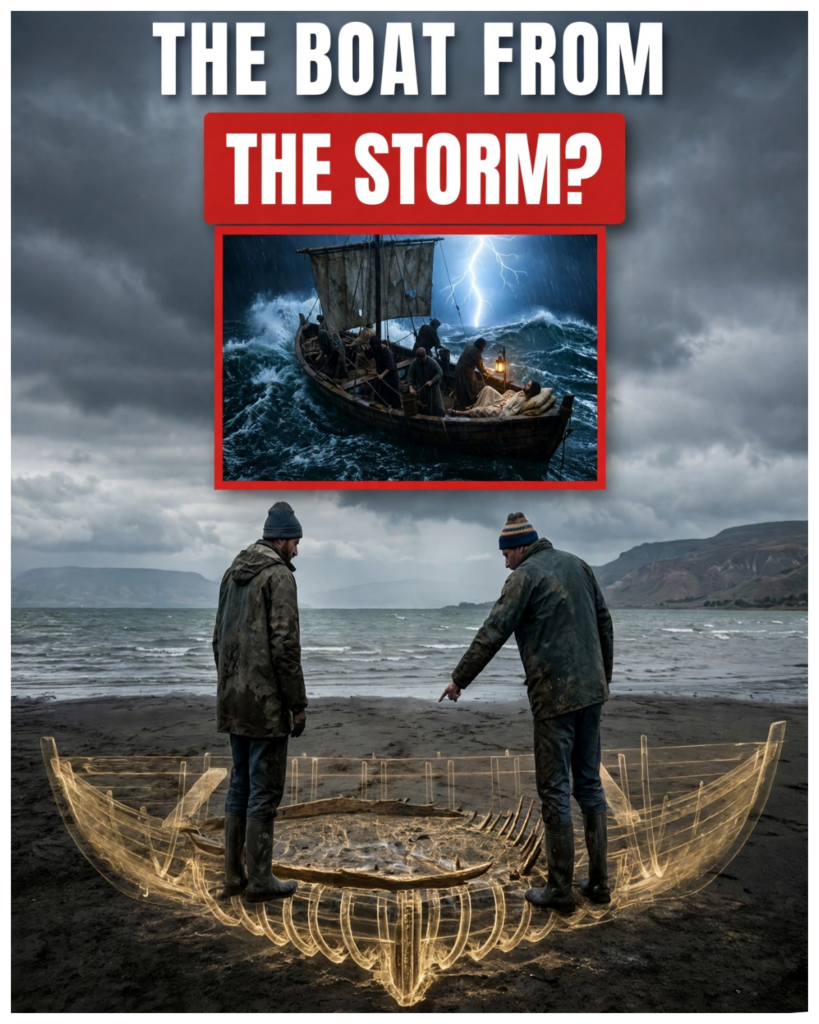
In February of 1986, a government archaeologist named Shelley Waxman drove out to the Sea of Galilee with his diving gear in the back of a jeep.
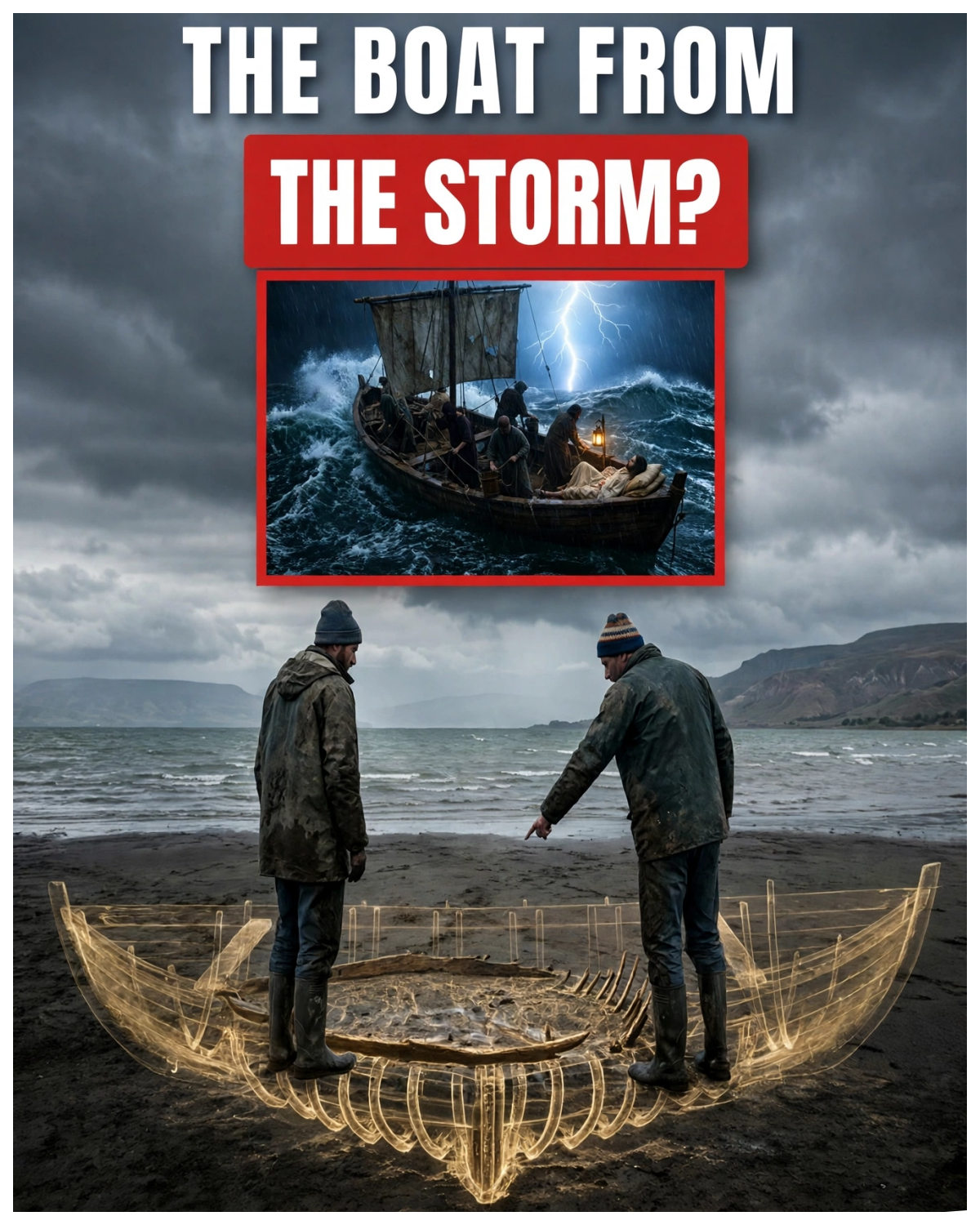
He had come to meet two fishermen, brothers who said they had found something in the mud.
As he pulled out his tank, he [music] asked one of them where the boat was.
The answer was, “You’re standing on it.”
Under his feet lay a fishing boat from the time of Jesus.
Soon the lake would be rising toward it.
A storm wind would come howling off the hills and crowds would be hunting it for gold that was never there.
Saving it would take 11 days and nights.
Right up to the last minute, the man leading the rescue wasn’t sure they would make it.
If you have ever read about Peter letting down his net or Jesus asleep in the back of a boat while the waves broke over the side, this is the kind of boat those [music] stories describe.
It was the first ancient boat ever pulled out of this lake.
[music] And from the very first headline, one question followed it everywhere.
[music] Could this be the very boat Jesus sat in?
The man who led the dig always answered that one with care.
Before we’re done, you’ll hear what the evidence can say and what [music] it can’t.
The story starts with a drought.
In the mid 1980s, the winter rains over Israel barely [music] came.
The Sea of Galilee is the country’s main store of fresh water, so pumps kept drawing it down for the thirsty fields.
The lake is shallow along its edges.
Every drop in the level laid bare another wide strip of mud that is normally well underwater.
[music] Two brothers from Kabutz Genosar on the northwest shore went out onto that mud.
Yuval Lufon was 44 and his younger brother Moshe was 31.
They were fishermen, the second generation of their family to work this lake and keen amateur archaeologists on the side.
[music] Yuval later said he had been looking for an old boat since he was 3 or 4 years old.
That January, the brothers were walking a stretch of shore south of the Kabutz.
A tractor had got stuck in the mud there, [music] and its churning wheels had turned up ancient bronze coins.
So, they kept coming back every day after work.
For 4 days, they found an iron nail, then [music] a few more.
Then they saw something that made them stop.
It was a faint oval line in the mud, [music] the outline of a boat buried in the lake bed.
Uuvall brought their father out to look.
His verdict was short.
She is very, very old.
But old could mean a h 100red years, and the brothers needed somebody who could tell them for sure.
That somebody was Shelley Walksman.
Born in Canada, he had moved to Israel in 1968, [music] and by then he was the country’s inspector of underwater antiquities.
The message reached him on the 4th of February.
That is how he came to be standing on wet mud holding a diving tank [music] he would not need.
All anyone could see was a thin line of dark wood at the surface.
Whatever had once stuck up above the mud had rotted away long ago.
[music] Worse, another archaeologist had already looked at this line of wood and called it a modern boat.
Waxman knew a quick test.
Ancient shipwrites around the Mediterranean built the outer shell of planks first and added the ribs last.
They locked each plank to the next with hidden wooden tongues pinned in place with pegs.
[music] The method is called mortise and tenon.
If you own a piece of fine old furniture held together without nails, [music] you have seen the same idea.
It took enormous labor and by about the sixth century after Christ, it was dying out.
So they opened a small patch along the top plank.
Right away, they could see the slots and the round heads of the pegs.
This boat was ancient.
As they stood there taking it in, a huge rainstorm broke over them, and they ran for the jeep.
5 minutes later, the rain stopped.
When they climbed out, two rainbows stood over the lake.
Walksman said later they looked like they had been ordered by central casting.
Yuvall nudged him in the ribs and said that now they knew who this boat belonged to.
Walksman asked who.
Wasn’t it obvious?
Yuvall said.
It was the long boat from Noah’s ark.
For 2 days, a small team dug a test trench.
[music] They found a cooking pot lying upside down just outside the boat and an oil lamp high up inside the boat.
Both were the kind of pottery used from the middle of the century before [music] Christ until late in the century after.
Waxman was careful to say that pottery found loose in the mud can’t date a boat for certain.
Still, [music] it was a first clue and that window takes in the whole life of Jesus.
Then the team buried the boat again.
Their plan was to keep the find quiet, [music] wait for the rains to bring the water back and dig it properly later underwater.
The secret lasted 2 days.
[music] The test dig ended on a Friday.
On Sunday, an item about an inch long ran on a back page of the Hebrew newspaper Haritz.
It said a boat from Jesus’s time had been found in the lake.
A day later, papers across Israel and overseas had it on the front page.
Only now, it was called the boat [music] of Jesus.
Walksman never liked that name.
As he put it years later, there is no such thing as the [music] boat of Jesus because, as far as we know, he didn’t own one.
He felt the nickname wasn’t fair to Christians since nobody can draw a straight line from this hall to the Lord.
Hold on to that because it matters at the end.
Then a second story [music] got tangled up with the first.
Around the lake there was an old legend of a Turkish boat sunk by the British in the First World War carrying money to pay Turkish troops.
[music] Somehow the two tales merged.
People began wandering the shore looking for the boat of Jesus [music] full of gold coins.
One of the team later said the whole area became a mad house.
You can guess what Waxman feared.
Sooner or later, someone would turn up with a tractor and a shovel and tear the hall apart.
They would be hunting a treasure that didn’t exist and destroying the treasure that did.
The site had to be guarded night and day, and in the end, the diggers were protected by police and guard dogs.
Waiting for the water was no longer an option.
Within a [music] few days, the Department of Antiquities decided the boat had to come out now, and Walksmen would lead the dig.
From that moment, a clock was running.
Nobody could tell them how much time they had.
The rain, the wind, and the crowds would decide that.
You would think a find like this would arrive with a big [music] budget.
It arrived with almost nothing.
The department was so short of money that when Waxman wanted to call in a leading American expert, his boss said they would write the man a letter.
They couldn’t afford a long-distance phone call.
Kurt Ray, [music] a marine archaeologist who worked beside Walksman, remembered how small they started.
Their group [music] was just six people with three buckets and two shovels.
A dig like this, he said, normally comes with a million dollars and a year of preparation.
[music] Nobody in Israel had ever dug up an ancient boat, and certainly not on land.
Walksmen later admitted they were flying by the seat of their pants, so help came from wherever it could.
Members of Kibbut’s Genosar came down to dig and so did volunteers.
[music] Ornoen, a conservator from the Hebrew University, took charge of keeping the wood alive.
They dug [music] day and night.
Rav put the feeling into two short lines.
It seemed like mission impossible.
We needed miracles and [music] the lake was coming back.
The rains that were ending the drought were filling the Sea of Galilee again and the water kept creeping closer to the pit.
Then one morning just before sunrise, the wind swung around to the east.
Locals call it the Sharkia.
It pours down off the Golan Heights, races across the water, and drives big waves straight at the western shore, exactly where they were digging.
Walksman pointed out that the east wind is the one the Bible names as the wind seafarers fear most.
All they had against it were a few sandbags scred from the kibuts.
But the night before, Walksman had made a request he later compared to asking for open season on bald eagles.
He had asked [music] the Kineret authority, which runs the lake, whether it could lower the Sea of Galilee.
By then, government ministers were talking to each other about this boat, [music] and the head of the authority came out himself.
They could not lower the lake, he said, [music] but they could build a dyke.
The next morning, just as the wind picked up, crews arrived with caterpillar tractors and sandbags and threw a dyke around the dig.
It held to the very end.
And that rising water, Walksman said later, would turn out to [music] be providential.
You’ll see why.
With the lake held back, the greatest danger was the boat itself.
The waterlogged wood had lost almost all its strength.
Walksmen compared it to wet florists foam.
You could squeeze a piece of plank [music] to mush in your hand.
Water was the only thing holding the cells of the wood in shape.
If it dried out, those cells would collapse and nothing could ever pump them back up.
Then the February weather turned warm and sunny and every hour of sunshine became a [music] threat.
They laid two iron bridges across the pit and stretched a tarpollen over the hall.
Sprinklers kept the timbers wet and pumps ran around the clock to keep ground water out of the trench.
Once the mud was out of the bottom, a foot would go straight through the hole.
So they hung a platform inside it and diggers lay flat on it for hours, scraping out mud by hand without ever touching the wood.
Then the American expert arrived and he brought a deadline of his own.
Dick Steffy of Texas A&M University had more or less invented the science of rebuilding ancient holes.
Waxman said he could read wood the way you read a newspaper.
One of Stephy’s sons was about to be married [music] and his wife had told him that if he missed the wedding, he neededn’t bother coming home.
Walksman said that was one more reason they were working so fast.
[music] Stephie reached the site after dark.
He pulled on his galosshes, climbed down into the pit by the light of fisherman’s lanterns, and looked around for a long time while everyone waited for the great man’s verdict.
Finally, he climbed out and said, “Yep, it’s an old boat.”
Everyone turned and stared at Wsman as if to [music] say, “This is your expert.”
Stephie was pulling their legs.
So now they were racing a rising lake, a crowd of gold hunters, and [music] a wedding.
And the hardest problem was still ahead of them.
Ask yourself how you would do it.
How do you move a boat about 27 ft long made of something like wet foam without it falling apart?
[music] Usually archaeologists take an ancient wreck apart plank by plank because in the salty Mediterranean the iron nails rust away.
This boat was different.
[music] In the fresh airless mud of the lake, its iron nails had less than a millimeter of rust [music] and they were holding the whole hole together.
It had to travel in one piece.
Orna Cohen came up with an idea that had never been tried.
The team fitted frames of fiberglass and resin inside the hull between the old ribs.
They laid a thin plastic film over the whole inside of the boat.
[music] Then they sprayed in polyurethane, which goes on as two liquids swells into foam [music] and sets hard, something like styrofoam.
It happened at night.
Waxman remembered the foam rising and spreading until it looked like it was eating the boat.
Then came the job nobody enjoyed.
To wrap the bottom, they dug tunnels under the hall, straight across beneath the keel, [music] working in from both sides.
You sat in very cold, wet mud with an ancient boat resting just above your head.
When the two [music] ends of a tunnel met, they slid a fiberglass support through it and filled the tunnel with foam.
Row by row, they built a cocoon around the whole boat without moving it an inch.
[music] Now, how to get it out?
You can’t drive a truck across that kind of mud.
The Israeli Air Force offered a helicopter, but Walksman worried its shaking would travel down the cable and break up the hall.
Then a man from the Kiner Authority pointed out the obvious.
“Polythane [music] floats,” he said.
“And you’ve got a lake right here.”
The water they had spent all those days fighting was about to become their way out.
So they turned the pumps around.
The same pumps that had kept water out of the pit now poured it in, and the foam cocoon lifted off the mud and floated free.
A steam shovel cut an opening through the dyke and a rowboat towed the hole out onto the Sea of Galilee.
It ran ground on a sandbar.
It got loose again, and for the first time in some 20 centuries, that old fishing boat was back on the water.
It traveled about 550 yd by water to the Yiggle Allen Museum at Kbutskinosar, a building that was still going up.
It took about a day to rig a platform to lift it, and then a crane set it down on the beach.
From the first day of digging to the moment it reached land had taken 11 days and nights.
Yuval Lufan called it miracle after miracle.
They hadn’t even built a pool to hold it.
Right up to the last minute.
Walksman admitted they weren’t sure they would succeed and nobody wanted to pay for a pool for a boat they might lose.
The boat was on land, but it was not safe yet.
It took 10 more days to build a concrete pool.
[music] Before the lift, Walksman asked the crane operator to be careful because this was not a pile of bricks.
[music] The man told him not to worry.
He knew exactly what he was doing.
Then the crane shifted and the boat nearly fell into the pool.
A different operator came the next day.
Then the team found their own mistake.
In the rush, nobody had worked out how to get the foam off again.
The boat couldn’t go back underwater while it was wrapped because the floating foam would strain the weak [music] wood.
So they had to dig the boat out a second time out of its own cocoon.
[music] Everyone brought a knife.
Someone wanted to use an electric turkey carver, but heated polyurethane can give off cyanide.
Instead, they cut and peeled the foam away by hand [music] and some of it with their fingernails.
It went so slowly that for a while they truly believed they were losing the boat.
They kept going and they got it back underwater.
Then the long wait began.
The boat lay in a heated bath [music] of polyethylene glycol, a synthetic wax that slowly took the place of the water inside every cell of [music] the wood.
Walksman summed it up himself.
It was 11 days to excavate, but 10 years to conserve.
In June of 1995, the pool was drained [music] and the boat held its shape.
In the year 2000, after months of wiping off extra wax with rags and hair dryers, it went on permanent display at the museum where it still sits [music] today.
Saving the boat was the adventure.
Reading it was the detective [music] story.
The wood would tell them how old the boat was, what kind of man had owned it, and why it was left in the mud.
And this is where it starts to touch your Bible [music] and the stories you have known since Sunday school.
The first question you would ask is the one they asked, “How [music] old is it?”
Most shipwrecks carry cargo you can date.
This one carried almost nothing, [music] as if it had simply been left in the lake.
So the team came at the date from three directions.
Stephie studied how it was built and placed it between 100 years before Christ and 200 after.
Radiocarbon tests on the wood came back at 40 before Christ, give or take 80 years.
But radioarbon only tells you when the tree was cut, not when the boat sank.
[music] And some of this wood had already served in older boats, which may push the real date later.
The pottery belonged between about 50 before Christ and the year 70.
And the boat lay near the ancient town of Mgdal, which you know as Magdala, the town Mary Magdalene came from.
The Romans [music] destroyed Mgdal in the year 67.
Put it all together the way the team [music] did, and Walksman’s report concluded that the boat lived its working life sometime between a century before [music] Christ and the year 70.
A boat like this probably lasted about a [music] decade, perhaps a little longer.
That window covers the whole life of Jesus [music] and the years when Peter, Andrew, James, and John fished this lake.
The wood also told them [music] something the gospels never spell out.
This was an old boat, even in its own day.
Metal staples had been driven across seams where the joints were failing.
Walksman’s team counted 12 different kinds of wood.
The planks were mostly cedar from Lebanon, which doesn’t grow around the lake, [music] and the rest were local trees used wherever they would fit.
Even the keel was made of three pieces, each a different kind of wood.
One timber still had slots cut in it that held nothing at all.
It had come out of another boat.
On his first day, Stephie grumbled that this builder didn’t know what he was doing.
The planking made no sense.
[music] The next day, he came back smiling and said he’d been completely wrong.
This was an expert boat builder.
He just had poor materials.
The kind of scraps that, as a Wman put it, would have gone for kindling on the Mediterranean coast.
Here’s what that means for you as a reader of the Gospels.
[music] A man who owned a boat like this was not at the bottom of village life.
Zebedee, the father of James and John, had hired servants in his boat.
[music] Yet even an owner like that was patching together leftovers.
Waxman saw in it how hard life was in Galilee under Roman taxes in the world Jesus [music] preached to.
He liked to tell church groups it would make a good sermon, an expert, building something useful out of almost nothing.
Some parts were missing, and not because they had rotted.
The post at the stern was gone, and Stephie found the marks of pliers where someone had pulled the nails to free the timbers.
A rib near the bow had been yanked out, too.
So had the block that held the mast, [music] which left behind four nail holes and a dark stain.
The most likely story, Walksman concluded, is that the owner decided his worn out boat wouldn’t make it through another winter.
He traded it in and [music] the useful timber went into a new boat.
What was left was pushed into the shallows with its bow propped on a tree trunk like an old car parked behind a garage for spare parts.
[music] Not long after, silt buried it, sealed it from the air, and kept it until that drought.
So, what would you have seen if you had stood on this shore when it was whole?
Stephie described it to Wsmen [music] on that first day.
A sharp cutwater bow, a stern that curved back up, probably two oresmen on each side, [music] and judging by that stain, a mast.
5 minutes later, two Franciscan archaeologists who were digging next door at Migdall came over.
Not to be outdone, they said they had an ancient boat, too, in a first century mosaic found in a villa there.
Waxman asked them to draw it.
What they drew was almost exactly what Stephie had just described.
Later, Waxman projected a photo of that mosaic onto a sheet of paper on his refrigerator at home and [music] traced it stone by stone.
When he reached the stern, he jumped the ore at the back widened at the bottom like a blade.
It was a quarter rudder for steering.
That meant four rowers and one man at the helm.
Five men matches the written record, and you can check it in your own Bible.
The Jewish historian, Josephus, who led the rebel forces in Galilee during the war with Rome, wrote that he once gathered 230 boats on [music] the lake with no more than four sailors in each.
Add a helmsman and you have five.
In Mark 1, James and John are in the boat with their father, Zebedee, and the hired servants.
Five or more?
In John [music] chapter 21, after the resurrection, Peter goes fishing with six other disciples.
How many people could you fit [music] aboard?
Josephus says he once took 10 leading men of Tiberius aboard a single boat which with its crew makes about 15.
During the dig, people kept asking whether Jesus and the 12 [music] could have fit inside and the team kept saying they didn’t know.
Then one night, Stephie walked into a meeting looking very serious and [music] said he had done the math.
12 could fit, he said, and one would have to walk alongside.
There is a darker chapter in this boat’s world, too.
While the newspapers talked about Jesus, the people in the pit were wondering about the battle of Mgdal in the year 67.
[music] Roman troops stormed the town.
They were led by Titus, the son of Vespasian, and both men would later become emperors of Rome.
Many of the town’s defenders [music] escaped onto the lake in boats like this one, and Vespasian had craft built to hunt them down.
Josephus wrote that the Jewish boats were small and fitted only for piracy.
Afterward, he wrote, “One might see the lake all bloody and full of dead bodies, for not one of them escaped.”
He put the dead, counting those killed in the town at [music] 6,500.
Waxmen had all the mud from in and around the boat saved and numbered.
In it was a pyramid-shaped iron arrow head, just like once found at Gamla, the next town the Romans attacked.
It may well have come from the battle, but Walksman was careful here, too.
An arrow head in the mud does not make this a battle boat.
Everything about the hole says it was an old working boat that had already been retired.
So now the question everyone asked, could this be the very boat Jesus sat in?
Here is the honest answer.
No one can say it was, and nobody can prove it wasn’t.
There is no name on it, no inscription, nothing inside that ties it [music] to any person at all.
Walksman put it plainly.
It does seem, he said, that the boat fits this time range and is of the type that would have been used by [music] Jesus and his disciples.
That is as far as the evidence goes.
Yuvuval Lufan saw it a little differently.
Years later, asked whether Jesus could have used this boat, he smiled and said, “Show me that Jesus didn’t [music] use this boat.”
Both men were being honest, and you can hold both thoughts at once.
But something real did change.
Waxman liked to show audiences three famous paintings of gospel boats by Raphael Rembrandt and Deloqua and ask what the boats had in common.
The answer was nothing at all.
Nobody knew what these boats looked like until that drought.
Now you can see one with your own eyes.
Open your Bible to Luke 5 with this hole [music] in mind.
Peter let down the net at Jesus’s word.
His partners came to help [music] and the catch filled both the ships so that they began to sink.
When Jesus tells the parable of a net cast into the sea that gathers fish of [music] every kind, the word Matthew uses means a sane net, that is a long net with weights along the bottom and floats along the top, paid out from a boat and hauled up onto the shore.
Boats about this size worked that kind of net on the Sea of Galilee into the 1920s.
Then turned to the storm in Mark 4, a passage you may know by heart.
The waves beat into the [music] ship so that it was now full and Jesus was in the hinder part of the ship, asleep on a pillow.
Stephie saw signs that this boat once had a deck at the stern, and under that deck would be the quietest place on board.
And the pillow?
The best explanation walks had heard comes from men who sailed these waters in recent memory.
[music] They carried sandbags for ballast, and the Arabic name for one meant a sand pillow.
People sometimes slept on them.
So when you read that Jesus was asleep on a pillow in the stern, you may be reading about a ballast sack in the one sheltered corner of a boat very much like this one.
If you visit today, you’ll find the boat resting on a metal frame in [music] its own hall at the same museum, now called the Yeagle Allen Center beside the lake at Guinosar.
By its entrance, the museum planted a row of trees, one for every kind of wood in the hall, each labeled with its name.
In 2023, the Vatican museums put a replica of it on display, blessed by Pope Francis, [music] who called it everyone’s boat, and the lake is low again.
In November [music] of 2026, the Sea of Galilee stood at 213.7 m below sea level, among its lowest readings for that date in a decade.
Years later, Walksman said he was convinced there are more boats down there, [music] but he would not recommend digging another one up.
This boat, he said, added 100% new knowledge.
Another of the same type would add maybe five.
So the next time you open your Bible to the calling of the fisherman or the storm or the morning Peter jumped into the sea to reach the shore, you’ll know the kind of boat it was.
Low and open, built of cedar and patched with whatever wood a working man could find.
Two fishermen found it.
Archaeologists, fishermen, and volunteers saved it in 11 days of mud and foam.
[music] and it is still there for you to see.
If the story was worth your time, subscribe.
[music] Every find we cover gets the same treatment.
The real people, the real dates, and nothing claimed that the evidence can’t hold.

