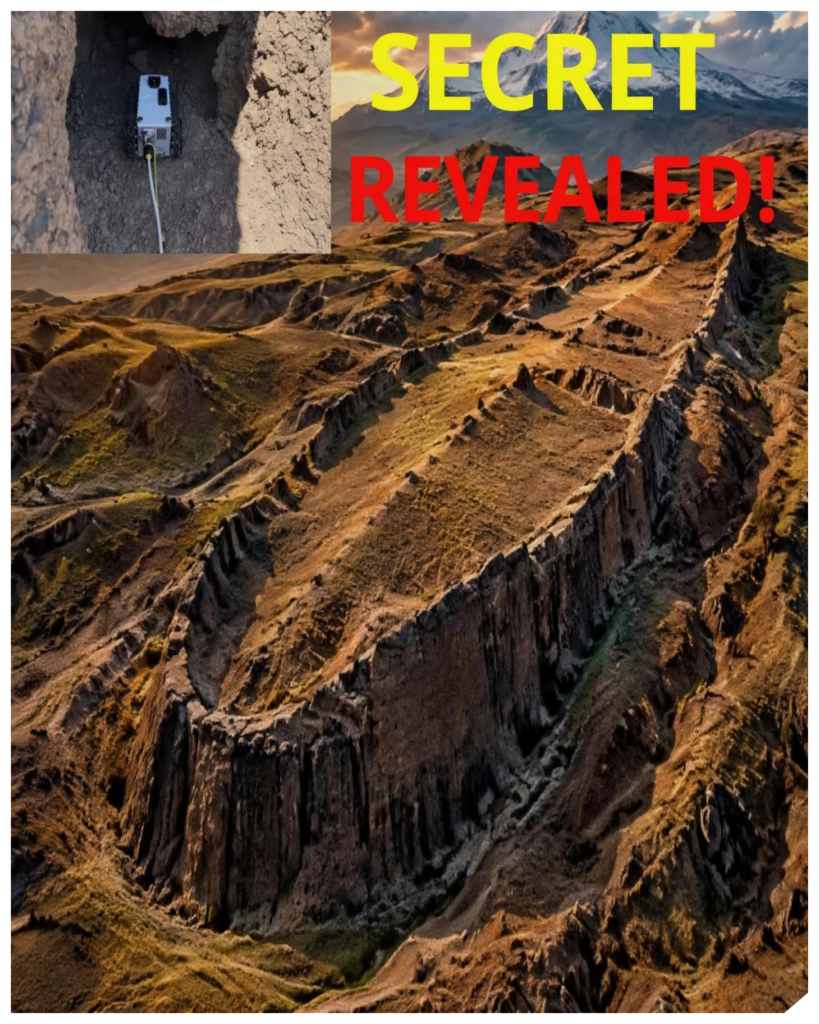
This is what happened when a robot originally built to crawl through wombat burrows was lowered beneath a hill that some people believe holds Noah’s ark.
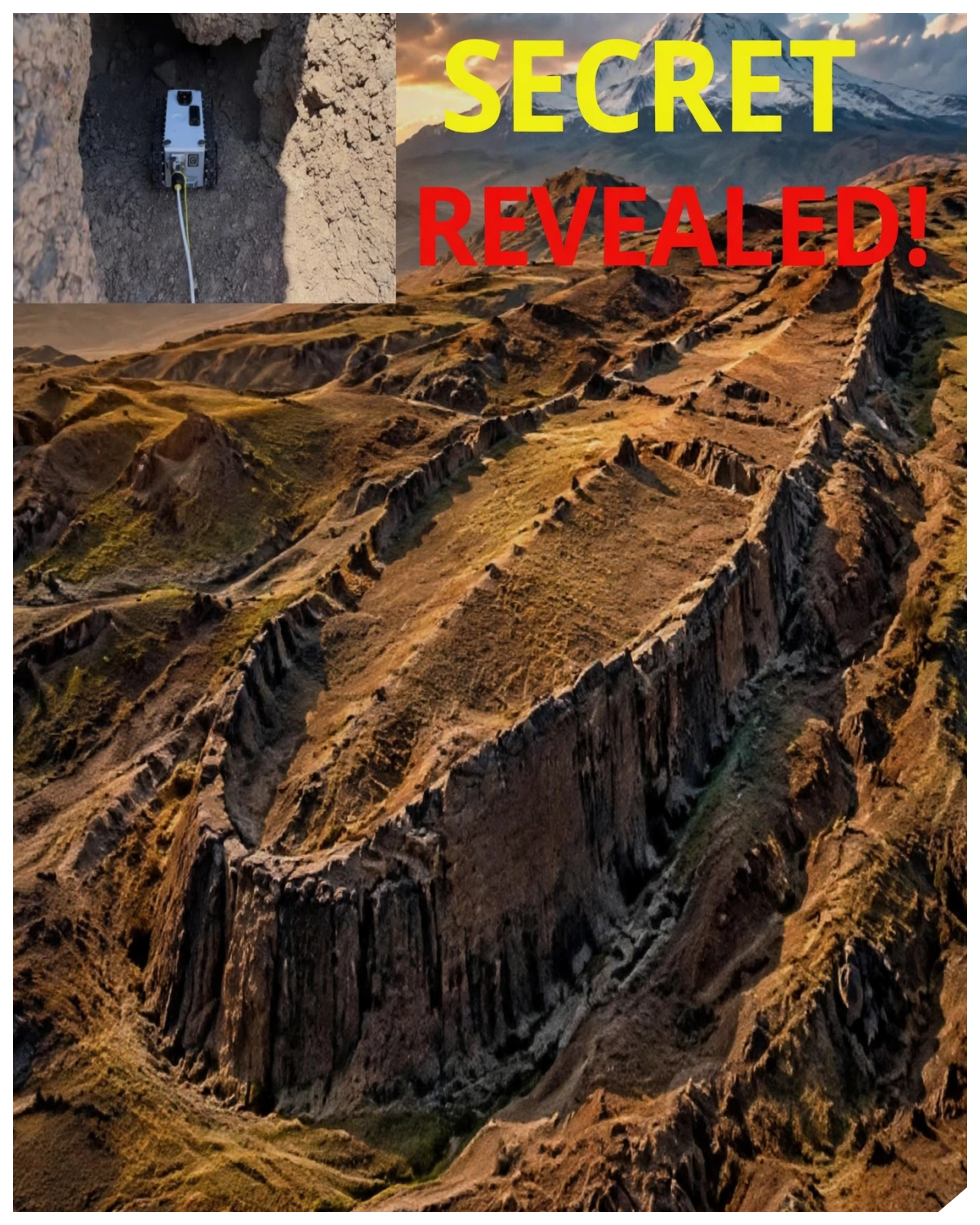
This is also the truth about what its camera found.
September 2026 brought a team of researchers to eastern Turkey where they began drilling into one of the most argued over landforms on the planet with a plan to send a small underground robot named Gopher into the holes and finally see what lies inside.
That footage is out now.
What it shows along with the story wrapped around it turns out to be stranger and messier than the headlines let on.
The site is called the Durapanar Formation and it sits in the Dogubazit district of Agra province near the border between Turkey and Iran roughly 30 km south of the summit of Mount Ararat.
That location carries real weight.
According to the book of Genesis, once the floodwaters pulled back, the ark came to rest on the mountains of Ararat.
Back in 1959, a Turkish army officer named Captain Ilhan Durupanar spotted an odd stretched out shape in aerial survey photographs of the region.
From above, it looked like a ship.
The team behind the new expedition measures it at 157 m or 515 ft.
While other reports push that figure closer to 538 ft, the number shifts depending on who does the measuring and where they decide the ends are.
For more than 60 years, one question has hung over this hill.
Is it simply a natural landform or the buried remains of an enormous wooden vessel?
That question still hasn’t been settled.
The very first expedition reached the site in 1960, dug in a handful of spots, and walked away convinced the feature was natural.
That was the first verdict.
It would not be the last.
Interest faded until the late 1970s and 1980s.
That’s when an American amateur explorer named Ron Wyatt turned the hill into the centerpiece of his claims.
Wyatt insisted he’d recovered petrified timbers, metal rivets, and anchor stones.
The problem came when those samples were examined.
The petrified wood turned out to be ordinary local rock, and the rivets were natural iron oxide mineral growths.
In 1987, geoysicist John Bombgardner and Turkish geologist Sali Baraktutin surveyed the site together and both men eventually concluded it was natural.
A drilling attempt followed in 1988.
Only a few holes were completed and today’s team says those cores were contaminated by the water used to cool the drill.
Then came a turn nobody expected.
David Fold had been one of the site’s most energetic promoters.
Yet in September 1994, he visited alongside Australian geologist Ian Plymer and concluded the formation was not a boat.
Two years later, his name appeared on a peer-reviewed paper in the Journal of Geoscience Education that identified Durupanar as a common geological structure.
The promoter had become the debunker.
Even so, the argument over this hill never really went away.
And decades later, it came back with drills, radar, and a robot in tow.
All of this leads to 2026 when a project called Noah’s Ark Scans, founded by Andrew Jones, partnered with Turkish universities for what it calls the largest permitted scientific expedition in the site’s recorded history.
Archaeologist Professor Chanker Attilla of Civas Jumhury University directs the Turkish program and the entire effort is backed by official authorization from Turkish government agencies.
In August, a scientist named Dr.
Kosro Baktar ran a radar survey at the site.
According to the project, earlier scans turned up straight lines, right angle intersections, and long empty spaces.
The team interprets these as possible corridors and chambers beneath the surface.
On September 23rd, the team announced that core drilling had begun.
Samples came up from as deep as 18 m, nearly 60 ft.
Jones reported layers of rich organic material that he believes could be the decayed top of the ark along with several underground cavities, including one that kept filling with mud and water.
Then four to 5 m down in one of the holes, the drill hit something nobody had planned for.
A layer so hard that the bit broke apart.
Jones put it plainly.
Whatever the core drill struck was harder than limestone and hard enough to break the bit.
Petrified wood is one possibility they want to test in the lab.
And this is where the robot enters the picture.
Gopher takes its name from the gopher wood that Genesis says the ark was built from.
It carries a highresolution camera designed to slip into narrow bore holes without anyone needing to dig large trenches.
It was designed by Dr.
Robert Ross of Latroe University in Australia and its backstory is anything but ordinary.
Ross explained that he repurposed it from machines he’d built for wildlife ecologists.
One was made to explore wombat burrows in Australia.
Another to explore armadillo burrows in French Gana.
So, what did Gopher’s camera actually reveal?
The team posted the footage under the caption, “First look, footage from inside Noah’s Ark.”
The video shows Gopher being lowered into a 12 m hole, and what the camera showed was dirt.
The team’s own post admitted that Gopher needed modifications before it could look around since its wheels kept struggling on the loose sediment.
Even so, the team argued the footage supports its view that there’s no bedrock inside the formation.
Nobody has independently confirmed that claim.
None of that slowed the headlines down.
On September 22nd, the team told the Daily Mail it had 100% confirmed the formation was man-made.
That phrase spread fast across social media and quickly turned into headlines of its own.
Critics spotted the contradictions right away.
The team had posted that no rock or bedrock had been found.
Yet, it also said it wanted to learn where the true bedrock lies.
All while its drill had just broken on something hard enough to destroy the bit.
Archaeologist Dr.
Aaron Judkins, who has visited the site himself, published a detailed rebuttal.
His argument ran like this.
Hard material 4 meters down is exactly what you’d expect in volcanic country full of basalt boulders.
Underground cavities form naturally on a slope that’s unstable and waterlogged.
And the site has never actually been excavated.
His summary landed bluntly.
Good theology does not need bad archaeology.
Andrew Jones himself has acknowledged that the evidence hasn’t definitively identified the formation as the biblical vessel, even while insisting he firmly believes that’s exactly what it is.
Belief and proof in his own telling are still two separate things.
One more detail makes the story stand out.
Researchers who disagree on almost everything.
Creationists like Dr.
John Morris and critics of creationism like geologist Lawrence Collins have landed on the same conclusion about this hill.
It’s natural.
So what is the truth?
Right now no laboratory results have been released.
Testing is scheduled for this winter and will cover organic content, minology, and microscopic analysis.
After that, Professor Attilla says a public scientific statement will follow.
More field seasons are planned for 2027, and a modified gopher is expected to make another attempt.
What the camera revealed was not corridors, not rooms, and not a ship.
It found loose sediment at the bottom of a boar hole and a robot built for wombat burrows struggling to find its footing.
None of that closes the case, but it does mean that for now, the truth about the Durupinar formation is still sitting in a lab, not in a headline.
If new results come in, we’ll cover them.

