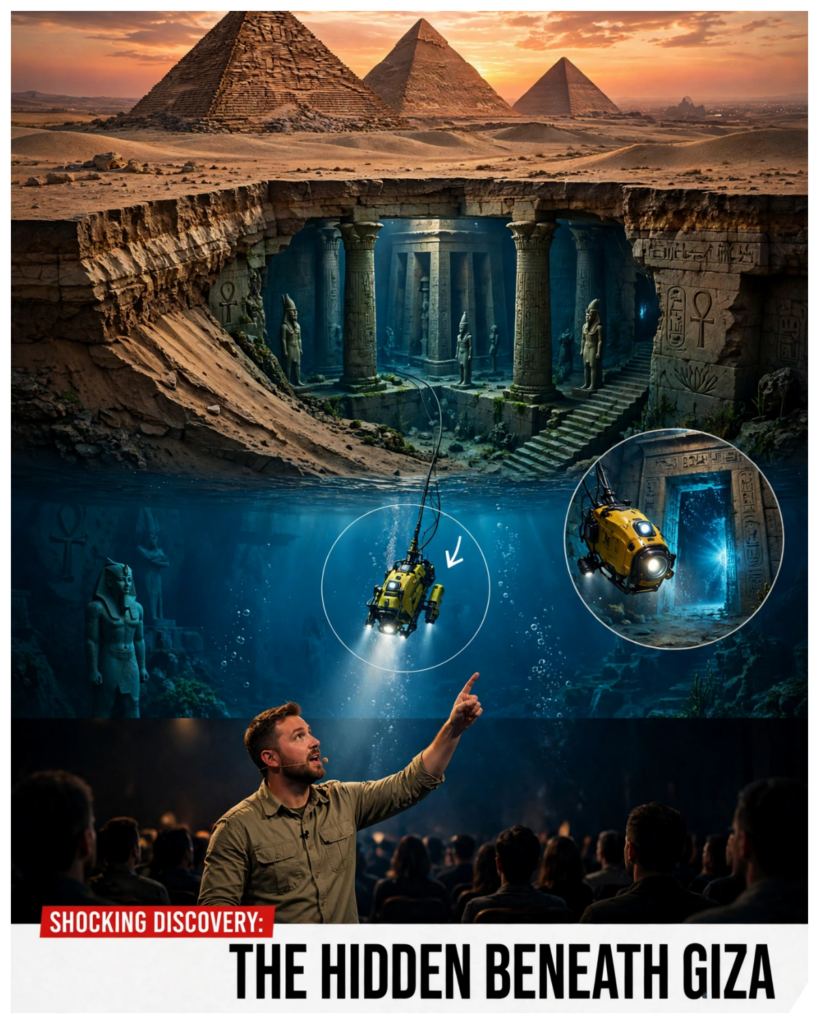
There’s no verified expedition in which scientists sent a camera into a flooded shaft beneath Giza and found something that changes everything.
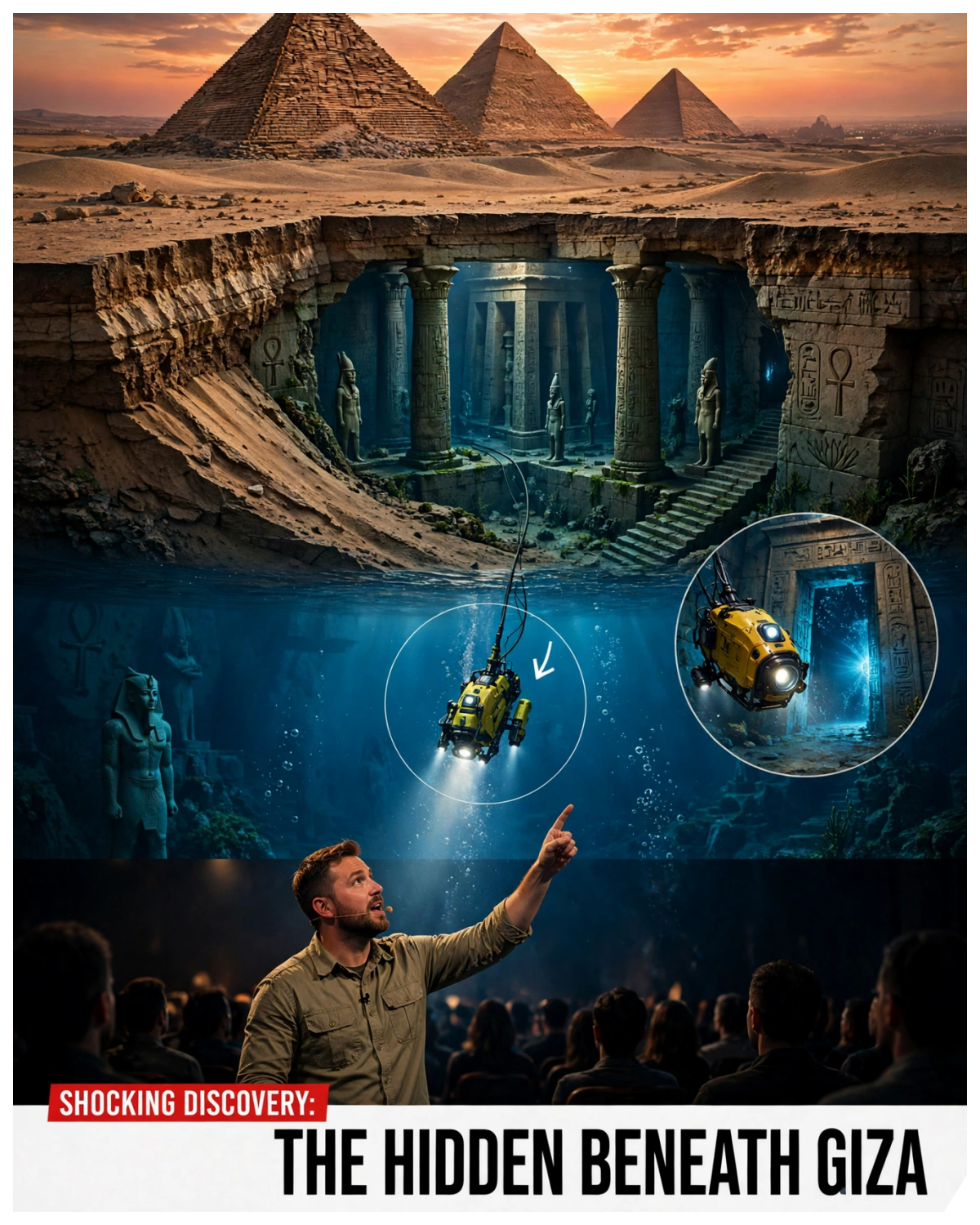
I searched for one and could not find it.
What I did find is a pile of real stories that videos like this one routinely blend together.
A genuine flooded shaft on the Giza Plateau called the Osiris shaft.
Three famous episodes in which robot cameras were pushed into the narrow shafts of the Great Pyramid.
A moon scan that revealed a hidden void inside the pyramid.
And a 2025 claim of a giant underground city beneath the pyramid of Coffrey that experts rejected and that in part has since run into a retraction.
So, this script walks through each of those, tells you what is solid and what is not, explains why the title’s promise does not hold up, and shows you how to check a claim like this before you share it.
Start with the setting.
The Giza plateau on the west bank of the Nile just outside Cairo holds three large pyramids built for the pharaohs Kufu, Kafre, and Marcar during the fourth dynasty roughly 2600 to 2500 BC along with the Great Sphinx, temples, causeways, and a huge number of tombs.
The Great Pyramid of Kufu was originally about 146.6 m or 481 ft tall, and it was the tallest humanmade structure in the world for nearly 4,000 years.
Archaeologists have been working at Giza for two centuries, and they are still finding things, including cemeteries of the people who built the pyramids and the remains of the town where they lived.
The idea that the plateau still holds secrets, is true.
The idea that those secrets are about to rewrite history, is where the trouble starts.
Now, the flooded shaft, which is real.
It is usually called the Osiris shaft, or the tomb of Osiris.
It lies on the Giza plateau in the area between the pyramid of Kufu and the pyramid of Kafra near the causeway.
It is a deep vertical shaft cut into the limestone bedrock descending more than 30 m through three levels and the lowest level is flooded with groundwater.
Accounts differ in the details and I want to be careful about that because the sources I could find are mixed in quality.
A travel site describes an an entry chamber at about 6 m, a room with sarcophagy, and a flooded subterranean chamber that is believed to be a symbolic tomb of Osiris.
A podcast episode describes a shaft descending more than 30 m, passing three chambers before reaching a waterfield vault and says the Egyptologist Zahi Hawas cleared it in the late 1990s and that other Egyptologists have responded skeptically.
A University of Montana graduate thesis from 2021, which draws on Hawai’s work and on investigations by the Giza mapping project states that the role the Osiris shaft played in the religious and daily practices of ancient Egyptians remains unknown.
Hawas himself published an article in 2007 called the discovery of the Osiris shaft at Giza.
So the shaft has a published scholarly record even though many online summaries are loose about it.
Why is it called the Osiris shaft?
Osiris was the Egyptian god of the afterlife, resurrection, and the underworld.
And a flooded burial chamber in which a stone sarcophagus sits on an island of rocks surrounded by water resembles the way Egyptians imagined the primeval mound of creation rising from the waters of chaos and the place where Osiris was buried.
Hawas has argued that the site was a symbolic tomb of Osiris used as a ritual place for worshippers of the god.
Though not everyone agrees about its date or purpose, some of the architecture looks old kingdom while later reuse is clear.
And the late period, especially the 26th dynasty from 664 to 525 BC, saw a revival of interest in the old kingdom monuments with new tombs and reuse of old shafts at Giza.
A news report from 2005 described a different but related discovery by Hawas’s team.
A 26th dynasty shaft tomb between the Sphinx and the pyramid of Kafra with a wooden coffin and a pile of blue green fence figurines that is typical of Giza.
Many shafts hold burials from far later than the pyramids.
The link to a Greek historian explains much of the legend.
In the fifth century BC, Herodotus visited Egypt and wrote about the pyramids.
In his account of the Great Pyramid, he reported that underground chambers had been built beneath it, where Kufu was buried on an island surrounded by water brought in by a canal from the Nile.
Modern scholars treat Herodotus as a valuable but unreliable source on Egypt since he relied on guides and priests who told him stories that were sometimes garbled, and he wrote nearly 2,000 years after the pyramids were built.
The discovery of a flooded shaft at Giza led some to say that Herodotus was right.
Others note that Kufu’s burial chamber is almost certainly the king’s chamber inside the Great Pyramid itself, which contains an empty granite sarcophagus, and that the Waterfield shaft is something else, possibly a ritual or symbolic structure linked to Osiris.
As far as I can tell, there is no evidence that anyone has found the burial of Kufu in the flooded shaft.
So, what about the camera?
Cameras have indeed been sent into narrow shafts at Giza, and some of those episodes were hugely publicized.
They are almost certainly the source of titles like this one, and they are worth telling properly.
The Great Pyramid has two pairs of narrow shafts about 20 cm wide that run upward from the king’s chamber and the queen’s chamber through the masonry.
The shafts from the king’s chamber go to the outer face of the pyramid.
The shafts from the queen’s chamber stop short, and for a long time, nobody knew why.
In 1993, a German engineer Rudolph Gantenbrink sent a small robot named Upwout 2, built with an electric motor and a camera up the southern shaft from the Queen’s Chamber.
It traveled about 65 m and found its way blocked by a small stone slab with two copper handles or fittings.
The image of that little door set off decades of speculation about what was behind it.
In September 2002, a televised event hosted by National Geographic and Zahi Hawas, then in charge of the Giza Plateau, sent a robot called Pyramid Rover up the same shaft.
It drilled a small hole in the stone door and pushed a camera through.
Millions of people watched live.
The camera found another block just beyond the first with a small cavity between them.
It was an antilimax, and the show had arranged a distraction, the opening of a sarcophagus found by How’s team elsewhere at Giza.
The following day, a robot went up the northern shaft, crawling about 213 ft around sharp bends until it hit another limestone slab.
It reported markings in red ochre, painted lines, and symbols about 4,500 years old on the back of the door in the blocks.
Researchers said they did not know yet what the writing said or why it was there, and that it did not look like a rough stone used to keep debris out of the shaft.
The project’s mission manager said it was the farthest anyone had gone in the pyramid.
To date, no one has gotten past the second blocking stone.
The shaft’s purpose is debated.
Many Egyptologists think they were symbolic or ritual, a path for the king’s spirit to ascend to the stars, while others have suggested that they were for ventilation or for construction purposes.
The honest summary is that robots have shown interesting details, but have not found a hidden chamber of treasure.
And as one German Egyptologist said before the 2002 event, nothing sensational was likely to be found.
That is the real history of cameras in the pyramid’s shafts.
They are fascinating.
They got a lot of attention and they did not change everything.
That is the pattern that clickbait titles borrow.
The next real discovery is a more significant one.
In 2015, a team of Egyptian, French, Japanese, and Canadian researchers launched the scan pyramids project, which uses non-invasive techniques to look inside the pyramids.
One of their main tools is muon tomography, also called muon radiography.
Muons are particles created when cosmic rays hit the upper atmosphere and they rain down continuously on the Earth’s surface.
They pass through stone but are absorbed at slightly different rates depending on the density of the material.
By placing detectors inside the pyramid and counting the muons arriving from different directions, researchers can map where there is less material, meaning voids.
In November 2017, the team published a paper in the journal Nature reporting the discovery of a large void above the Grand Gallery in the Great Pyramid at least 30 meters long with a cross-section similar to that of the Grand Gallery.
It was called the Big Void.
It was the first major internal structure found in the Great Pyramid since the 19th century.
Its purpose is unknown.
It might be an architectural feature related to the construction such as a space to relieve weight or a ramp or a gap in the building process.
In 2223, the team reported the discovery of a corridor about 9 m long behind the chevron-shaped limestone blocks above the entrance on the north face, and it used an endoscope, a thin camera inserted through a gap in the stones to see inside.
Those are genuine scientific results published in peer-reviewed journals.
They show that there are still unexplored spaces in the Great Pyramid and that modern technology can find them.
They also show that the results are modest and carefully described.
A void is not a treasure chamber and a corridor is not a lost civilization.
Now to the claim that fed much of the recent excitement.
In March 2025, two Italian researchers, Curado Malanga of the University of Pisa and Filipo Beyond who had been affiliated with the University of Strathclyde in Scotland held a press briefing in Italy announcing that they had used a radar technique to find a vast network of structures beneath the pyramid of Kafra.
According to coverage of their claims, they said they found eight vertical shafts surrounded by spiral pathways descending 648 meters connected to two cube- shaped structures about 80 to 90 m on each side, plus five stacked structures near the pyramid’s base, linked by passageways and tunnels extending 2 km, possibly linking the three major pyramids.
Malanga suggested that the network might be 38,000 years old, predating the pyramids by tens of thousands of years, and the story was widely described online as an underground city with comparisons to the duat, the Egyptian underworld.
The reaction from experts was swift and almost entirely negative.
Azahi Hawas, the former Egyptian Minister of Antiquities, called the claims baseless and fabrications and said the Supreme Council of Antiquities had not granted any permits for work inside the pyramid of Koffrey and that no radar devices had been used inside it.
Other specialists pointed out the physics.
The method the team used was a form of synthetic aperture radar, which analyzes radar signals from satellites.
And in conditions like those at Giza, such radar penetrates only a couple of meters into the ground, not hundreds of meters.
As National Geographic put it, the researchers did not claim to have discovered a new way of detecting structures 2 km below the ground, but a new way of interpreting radar signals, one that had not been independently verified.
A geoysicist who works with ground penetrating radar told a newspaper that current radar technology cannot detect structures at such depths.
The announcement was made at a press conference, not in a peer-reviewed paper, and the work had not been reviewed.
An Egyptian museum director called the claims exaggeration and deception.
More recently, there has been a development that is directly relevant.
Newsweek reported that a scientific journal, Remote Sensing, retracted a 2022 paper by Bayai and Malanga that had claimed satellite radar could reveal hidden structures inside the Great Pyramid, finding serious methodological flaws and statistical errors that undermined its conclusions.
The notice said the findings and conclusions were not reliable.
The retraction applies to the 2022 paper about the pyramid of Kufu and it does not strictly speaking review the later claims about Coffrey which were not published in that article though the same method underlies both.
Beyond and Malanga disagreed with the decision according to the journal’s notice and Beyond has continued to share material about the wider project.
Speculation about an alleged second sphinx beneath the plateau the report noted has also never been confirmed.
So, the underground city story, which was the biggest Giza headline of 2025, is now in worse shape, not better.
Let me put those threads together and show how a title like yours gets built.
Take a true fact, such as a flooded shaft at Giza that was explored by archaeologists.
Add a famous scene, such as a robot camera sent into a narrow shaft, which was real in 1993, 2002, and 2011.
Add a recent controversy, such as the 2025 underground city claim.
Add a promise such as it changes everything.
The result is a title in which none of the sentences is exactly false and yet the whole is misleading.
It implies a recent expedition, a specific camera, a specific discovery, and a world-changing result, and none of those exists.
Why is it so hard to do what the title describes?
Let me explain what real exploration of a flooded shaft involves.
The first problem is the water.
A flooded space is dark and murky, and silt stirs up with any movement.
So cameras need lights in clear water and visibility can fall to near zero.
The second problem is access.
A narrow deep shaft requires special equipment safety planning and in the case of divers specialized training.
The third is the risk to the archaeology itself.
Pumping water out changes the conditions because waterlogged materials such as wood and organic remains can deteriorate when exposed to air and the walls can become unstable.
The fourth is permission.
At Giza, all work is controlled by Egypt’s Supreme Council of Antiquities, part of the Ministry of Tourism and Antiquities, and nothing is done without a permit.
The fifth is documentation.
Real archaeology requires detailed records, including measured drawings, photographs, 3D scans, and written descriptions, and results are published in scholarly books and journals.
If a discovery were made, the first announcement would typically come from the Egyptian ministry or the excavation team, followed by scholarly publication, and other Egyptologists would weigh in.
A viral video on its own does not meet that standard.
And what has real research told us about the pyramids builders?
That is where the actual rewriting of history has happened, and it is more interesting than the legends.
In 2013, the French archaeologist Pierre Tallet and his team found at an ancient port called Wadiel Jarf on the Red Sea coast a cache of papyrie that included the log book of an official named Maror.
It is a diary of a work crew transporting limestone blocks from the Tourories across the Nile to Giza during the reign of Kufu and it is the oldest inscribed papy ever found.
It describes the logistics of building the great pyramid in the words of someone who took part in the 1990s.
Zahi Hawas and Mark Lanner uncovered cemeteries near the pyramids with the tombs of workers.
And Laner’s team excavated a settlement, a town with bakeries, breweries, and barracks, now known as the hate elarab or lost city of the pyramid builders, which has given a vivid picture of how the workforce was fed and organized.
These findings point to a paid or conscripted, organized, and honored workforce buried with dignity near the king’s monument.
Not slaves and certainly not extraterrestrials.
If you want a camera and shaft story that changes what we know, it is in the fine archaeology of a bakery in a log book, not in a flooded vault.
Let me say a word about why people are drawn to the idea of a hidden Giza.
The pyramids are enormous, ancient, and impressive.
And they have attracted theories for centuries, from the 1800s, when some people claim the dimensions of the great pyramid encoded prophecy to the 20th century when authors proposed lost civilizations or visitors from space.
These ideas have a long history and are often rooted in the unconscious assumption that ancient Egyptians could not have built such monuments.
An assumption that is both false and quietly disrespectful.
The evidence of tools, quaries, ramps, workers towns, and papyri shows that they did.
The wonder of Giza is not that someone else built it.
It is that these people did it with copper tools, stone, hammers, wooden sledges, ropes, and organized human labor 4 and a half thousand years ago.
When a title implies that the true story is a secret chamber of something otherworldly, it takes away credit from the people who actually built the pyramids.
If you want to evaluate a claim like this one, here is a checklist.
First, ask who.
A real discovery has named researchers, an institution, and usually an Egyptian official.
Second, ask when and where.
If the video says scientists sent a camera into the flooded shaft, but does not say when, which team, or what they saw, that is a warning sign.
Third, ask for the publication.
Peer-reviewed journals such as Nature, Antiquity, and the Journal of Egyptian Archaeology are where serious results appear, and press conferences are not a substitute.
Fourth, ask whether other experts have commented.
If the quoted experts all say it is baseless, as they did for the Coffer claims, that matters.
Fifth, ask about the physics.
A claim that radar sees 2 km down into limestone from a satellite runs into basic limits, and that should trigger skepticism.
Sixth, ask whether the claim has been checked or retracted.
And seventh, ask what the video wants from you.
If it ends with a subscription push, a product, or claim that the establishment is hiding the truth, remember that the incentives favor drama over accuracy.
What is likely to come next in real Giza research?
Scan pyramids is continuing its work with detectors and endoscopic cameras exploring the Great Pyramids voids and corridors, and its results will be published through scientific channels.
Egyptian archaeologists continue to excavate at Giza and work in the Osiris shaft area and the nearby tombs is part of the ongoing study of the plateau.
Mapping projects such as the Giza mapping project and the work of ancient Egypt research associates continue to refine our picture of the plateau as a whole, including its settlements and cemeteries.
New technologies such as improved ground penetrating radar, electrical resistivity, tomography, microgravity surveys, and drone based imaging are being applied.
Each of them has limits and the best results come from combining several methods and confirming them with careful excavation.
That is a slow process and it rarely fits in a headline.
Let me summarize.
Fact one, I found no verified recent expedition that sent a camera into a flooded shaft beneath Giza and found something that changes everything.
Fact two, a flooded shaft does exist, the Osiris shaft, deep three-level shaft on the Giza plateau with a water-filled lower chamber.
Explored and published by Zahi Hawas, whose purpose and date are still debated with scholars noting that its role in ancient religious practice remains unknown.
Fact three, robot cameras were indeed sent into the narrow shafts of the Great Pyramid in 1993 by Rudolph Gantenbrink, in 2002 by the National Geographic and Hawas Broadcast, and in 2011 by the JD team from Leeds, revealing a small door, a second block, and red markings, but not a hidden treasure room.
Fact four.
The genuinely important recent discoveries inside the Great Pyramid are the Big Void reported in Nature in 2017 and the North Face Corridor reported in 2023.
Both found by scan pyramids using muantomography and endoscopy.
Fact five.
The 2025 claim of an underground city beneath Coffrey based on satellite radar interpretation was rejected by Egyptian authorities and other experts was never published in a peer-reviewed paper and the related 2022 paper on the Great Pyramid was retracted for serious methodological flaws and statistical errors.
Fact six, the best evidence for how the pyramids were built comes from the mayor Papy in the workers town and cemeteries which show an organized honored workforce.
So, go back to the image.
The title paints a camera descending on a cable into a black water- fil shaft.
Its lights picking out stone walls and then something appears.
It is a good image, and it has a real counterpart.
In a small shaft in the Great Pyramid in 2011, a bendy camera slid through a drilled hole and saw red marks on a 4 and a half thousand-y old stone painted by someone who put them there for reasons we still do not know.
That is the real mystery of Giza.
It does not rewrite history.
It adds a question and that more than any claim of a vanished city is what archaeology is made of.
Small patient looks into small dark places and the humility to say we do not know yet.
A note on accuracy.
The central finding is a negative one.
I could not find any credible report of a recent camera expedition into the flooded Osiris shaft that changes everything.
So, the script treats the title as a blend of real stories.
The Osiris shaft details come from fairly thin sources.
A travel site, a podcast description, a 2021 University of Montana thesis, and a reference to Hawas’s 2007 article.
So, the dates and exact layout should be checked against Hawas’s publication and the Giza mapping project before you publish.
The robot camera history, Gentrink 1993, Pyramid Rover 202, Jetty 2011 comes from the news and heritage sources below.
The Kafra underground city claims and the responses come from Jerusalem Post, National Geographic, Kyrosine and Newsweek.
And the retraction of the 2022 remote sensing paper comes from the Newsweek report which I could not read in full.
So verify the details.
The scan pyramid’s results, nature 2017, big void 2023 Northace corridor, Herodotus’ account, the mirror papyri, and the workers town come from my general knowledge and should be fact checked.
I can trim or expand any section to reach exactly 4,000


