For decades, Easter Island has been presented as a chilling warning about human greed, environmental destruction, and the collapse of an entire civilisation.
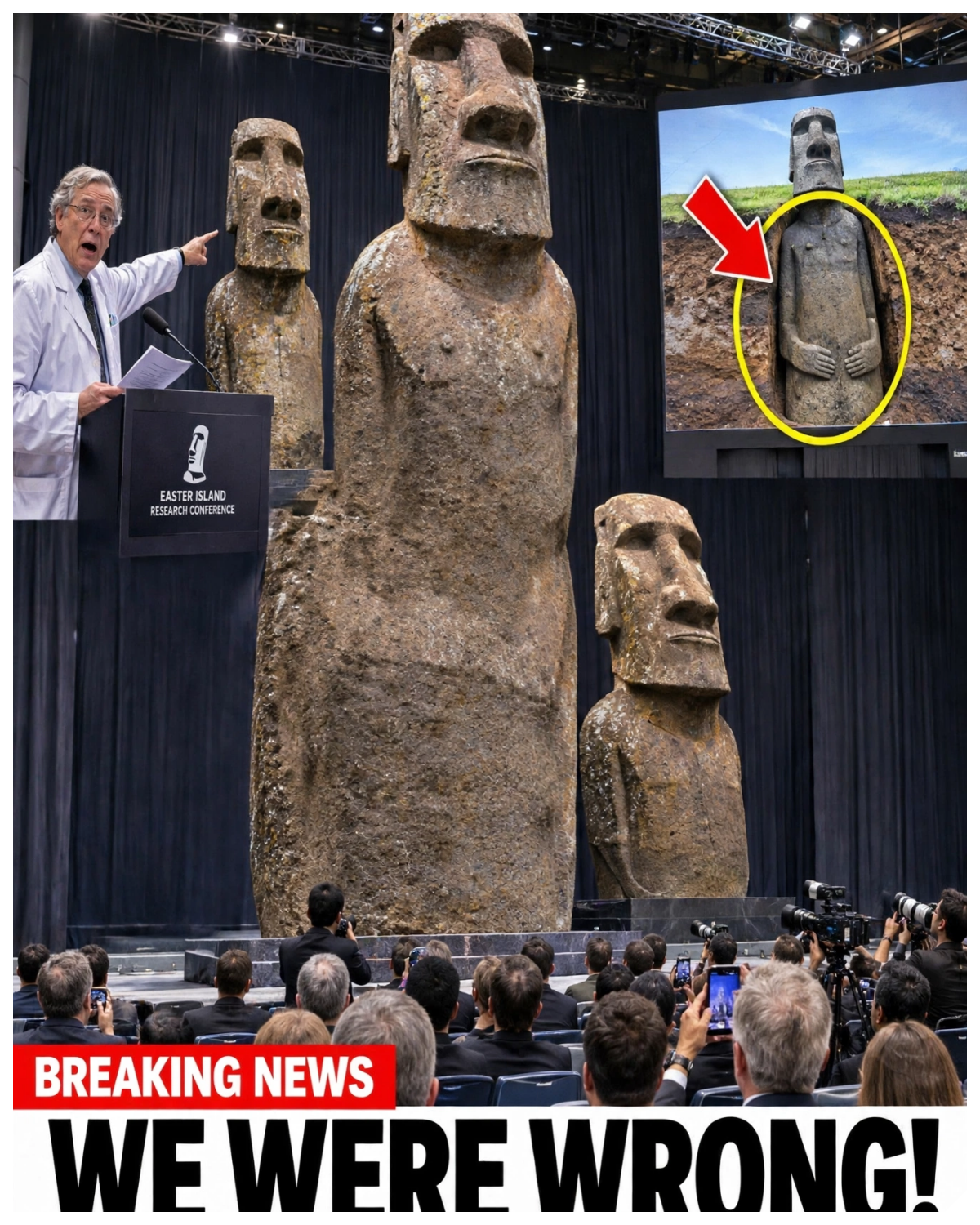
But what if almost everything we thought we knew was wrong?
Now, scientists are uncovering evidence that challenges the accepted story, raising disturbing questions about the island’s mysterious past.
Even more astonishing, their discoveries could completely rewrite how history understands its people.
So, what did researchers finally uncover, and why does it change EVERYTHING we thought we knew?
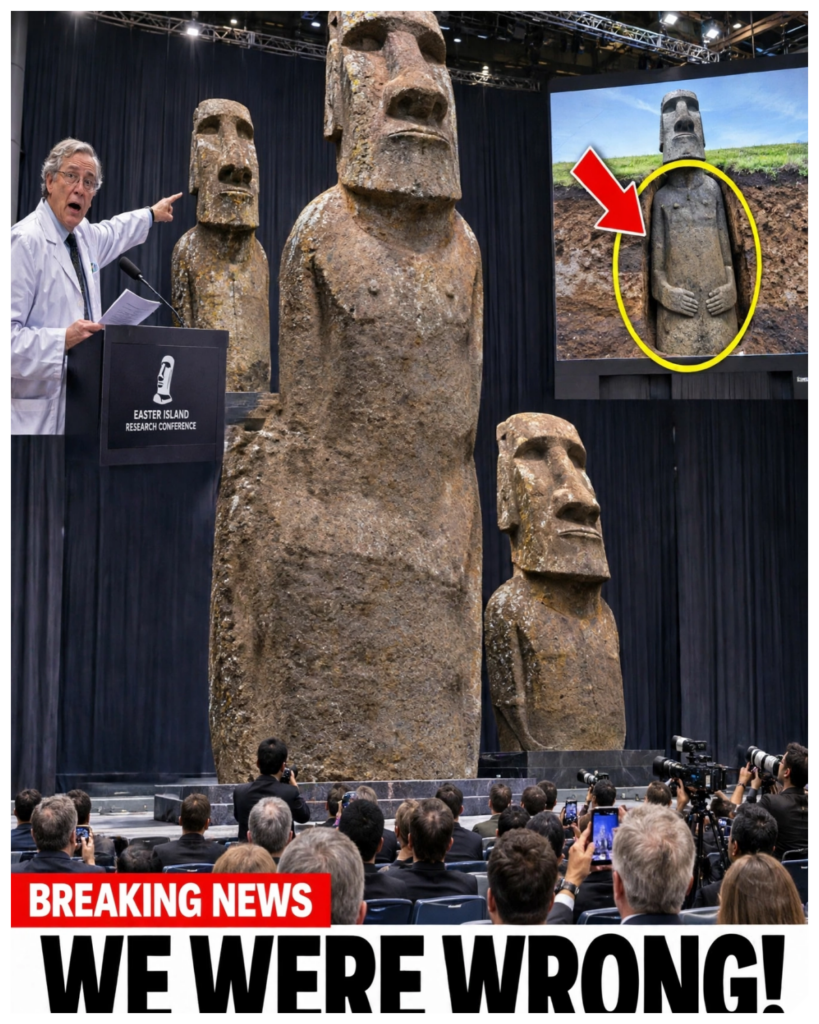
The Moai Beneath the Lake Scientists were not searching for an ancient statue when they made a discovery that could change what researchers know about Easter Island.
Their mission was much simpler: they were trying to restore a damaged marshland inside the crater of an extinct volcano.
The area had once contained a lake, but the water had been slowly disappearing since 2018, exposing parts of the lakebed that had remained hidden for centuries.
What they uncovered beneath the drying ground was something nobody expected.
For at least 200 to 300 years, the lake had been filled with water nearly ten feet deep.
This meant that whatever lay beneath its surface had been protected from human eyes for generations.
As the water disappeared, however, an astonishing sight emerged from the exposed lakebed.
A complete Moai statue was standing there, as though it had been waiting patiently for someone to find it.
The figure stands a little over five feet tall.
Although it is much smaller than the enormous Moai statues that have made Easter Island famous, it is still an impressive piece of ancient craftsmanship.
Its body is complete, and its facial features are clearly visible.
More importantly, this is the first known Moai ever discovered at the bottom of a lake.
Nobody had expected to find one in such an unusual location.
Researchers believe the statue was deliberately moved into the crater by the Rapa Nui people during an earlier period when the lake had dried up.
At some point, water returned, gradually covering the figure and hiding it beneath the lake for centuries.
The Moai statues are generally believed to be more than 500 years old, although scientists hope to establish a more accurate date through radiocarbon testing.
But there is one important detail.
The local Rapa Nui community has asked that the statue remain exactly where it was discovered.
The island’s elders, particularly its oldest community members, want the figure protected in its original position rather than removed for further study.
The discovery raises two fascinating possibilities.
First, Moai statues were not always created or positioned individually.
If one statue lies beneath the old lakebed, there is a real possibility that others could be buried nearby, hidden beneath layers of soil, reeds and vegetation.
Second, the discovery suggests that the ancient islanders may have deliberately placed these figures in locations far away from the familiar coastal platforms.
Now, as the crater continues to dry, researchers are considering using special ground-scanning equipment to investigate what remains beneath the exposed lake floor.
And that is perhaps the most exciting part.
The statue may not be the only secret waiting beneath the ancient crater.
Easter Island could still be hiding an entire chapter of its past, and the land is only beginning to reveal it.
What makes Easter Island so remarkable?
What exactly is special about its landscape?
Let’s find out.
Easter Island’s Hidden Natural Wonders Easter Island, also known as Rapa Nui, is a small and remarkably isolated island in the vast Pacific Ocean, measuring approximately 23 kilometres in length.
While the island is world-famous for its enormous stone statues, known as Moai, there is much more to its landscape than these mysterious figures.
Beneath its quiet and seemingly simple appearance lies a world of dramatic volcanic formations, rugged cliffs, rolling green fields, hidden underground tunnels, beautiful sandy beaches and breathtaking ocean views.
It is a place where nature and human history have combined to create one of the most unusual landscapes on Earth.
One of the island’s most impressive natural wonders is Rano Kau, a gigantic volcanic crater located on its western side.
Formed by ancient volcanic activity, this enormous depression has steep, towering walls that surround a wide interior filled with freshwater, unusual vegetation and thriving plant life.
Its inner landscape almost resembles a world of its own, separated from the surrounding island by the crater’s enormous walls.
On one side, the crater opens towards the endless Pacific Ocean, creating a spectacular view.
Close to this remarkable formation is Orongo, an ancient ceremonial village where the mysterious Birdman competition once took place.
During this dangerous tradition, competitors risked their lives by climbing down steep cliffs, swimming through rough waters and searching for the first egg laid by a particular seabird.
On the eastern side of the island, another extraordinary sight awaits visitors.
Ahu Tongariki, famous for its magnificent collection of fifteen Moai, features a long stone platform carrying fifteen enormous statues.
Standing in a perfectly striking line against the vast Pacific horizon, these figures create one of the most unforgettable scenes on Rapa Nui.
Nearby lies Rano Raraku, the volcanic quarry where ancient islanders carved many of their famous statues from relatively soft volcanic rock.
What makes this location especially fascinating is the number of unfinished Moai scattered across its slopes.
Some remain partly buried in the ground, while others appear to have been abandoned before completion.
Their mysterious positions create the impression that the workers simply stopped carving and disappeared.
Along the western coastline, Ahu Tahai offers yet another remarkable experience.
Its ancient statues become particularly striking during sunset, when their dark outlines stand against the glowing evening sky.
The surrounding area also contains numerous volcanic caves and underground lava tunnels, formed when flowing lava cooled and hardened while molten rock continued moving beneath the surface.
Further north, Anakena provides a completely different picture of the island.
Its beautiful golden sand, clear waters and tall palm trees create an almost tropical paradise, offering a surprising contrast to Rapa Nui’s rough volcanic coastline.
Beyond its mysterious statues, Easter Island is therefore a remarkable meeting point of natural beauty, ancient volcanic forces and human creativity.
Every crater, coastline, cave and archaeological site reveals another fascinating part of its extraordinary story.
But how on earth did the statues find their way to the site?
How were they transported to the site?
Did they really walk?
Keep watching.
The Statues That Walked!
For centuries, researchers struggled to understand how the ancient people of Rapa Nui transported enormous Moai statues across Easter Island without modern machinery.
Weighing several tons, these volcanic stone giants had to cross hills, rocky paths, and uneven landscapes.
Earlier theories suggested that islanders used wooden rollers, heavy sledges, or hundreds of workers pulling ropes.
However, recent research has uncovered a much more fascinating possibility: the ancient builders may have developed a clever technique that allowed the massive statues to move upright, rocking from side to side as though they were actually walking.
By studying nearly a thousand Moai statues, researchers began to notice something unusual about their physical design.
Many had slightly forward-leaning bodies and curved, rounded bases.
Rather than being accidental features, these shapes may have been carefully created to make transportation easier.
Their design shifted the statues’ centre of gravity, allowing them to rock from one side to another without immediately falling over.
When strong ropes were attached around their upper sections, small groups of people could pull them in carefully controlled directions.
One team would pull from one side, while another pulled from the opposite direction, gradually making the statue move forward.
With each alternating movement, the Moai appeared to take another step.
In other words, the statues were not necessarily dragged across the ground.
They were made to walk.
To find out whether this extraordinary explanation could actually work, researchers decided to put the theory to a practical test.
They constructed a replica weighing approximately four-point-three-five tons and attempted to move it using the proposed technique.
The result was remarkable.
With just eighteen people pulling ropes from different directions, they successfully moved the massive replica approximately 300 feet in only forty minutes.
No enormous workforce, complicated machinery or elaborate transportation system was required.
All they needed was the right design, carefully positioned ropes and excellent coordination.
The ancient roads of Rapa Nui also appear to have been specially adapted for this unusual transportation method.
Measuring approximately fourteen to fifteen feet across, these routes had gently curved, inward-sloping surfaces that helped keep the statues balanced as they moved.
Rather than constructing an entire road network beforehand, the islanders may have prepared sections gradually, clearing and improving the ground as each statue advanced.
Even more fascinating is how this discovery connects with traditional Rapa Nui stories.
For generations, islanders have told stories of how their ancestors’ statues walked from the quarry to their final destinations.
What outsiders once dismissed as mythology may actually preserve a remarkable memory of ancient engineering.
Ultimately, the mystery reveals something extraordinary: the Moai did not require thousands of workers to move.
Small teams, perhaps twenty to fifty people, could accomplish the seemingly impossible through patience, teamwork, rhythm and intelligent design.
What appeared to be an ancient miracle may have been a brilliant demonstration of human ingenuity all along.
What are the myths and stories passed down over generations, about the Easter Islands and the Moais?
Is there any extraordinary belief attached to the Moais?
Stay with us.
The Moai’s Mysterious Supernatural Secrets For centuries, the enormous stone statues of Easter Island have inspired countless stories, strange legends and unanswered questions.
Who created these mysterious figures?
Why were they built?
And perhaps most fascinating of all, how did these massive stone giants supposedly move from one place to another?
While modern researchers continue to investigate their origins, the traditional people of Easter Island, known as the Rapa Nui, have preserved fascinating stories that offer a very different explanation.
To the ancient Rapa Nui, the Moai were far more than ordinary stone monuments.
They represented powerful ancestors, respected chiefs and important members of their communities.
People believed that these statues carried a mysterious spiritual force known as mana.
This supernatural power was thought to protect the living, bring good fortune and ensure prosperity for the people.
In other words, the statues were not simply objects of admiration.
They were believed to maintain a powerful connection between the living and their ancestors.
One particularly fascinating legend connects the creation of the Moai to the island’s first ruler, Hotu Matu’a.
According to the story, he sent six young men on a journey to their ancestral homeland of Hiva to retrieve a special stone statue called Tautó.
Unfortunately, the statue broke during the journey.
However, the story claims that something extraordinary happened.
Through supernatural power, its head and neck somehow reached Anakena Beach, where they became the model for the many Moai statues that would later appear across the island.
But perhaps the strangest stories concern how these enormous statues supposedly moved.
Some traditions claim that powerful chiefs used their mana to command the Moai to walk across the island.
Other versions credit Makemake, the supreme god of the Rapa Nui, or powerful priests whose mysterious chants supposedly brought the stone figures to life.
Even more surprisingly, one unusual account attributes this incredible ability to an elderly woman who prepared meals for the statue builders.
Another legend offers a rather amusing explanation for why so many Moai eventually fell.
According to the tale, the workers once caught an enormous lobster and ate it without saving any for the elderly woman who regularly cooked for them.
Enraged by their selfish behaviour, she called upon supernatural powers and ordered the statues to collapse.
By the following morning, the mighty stone figures had fallen to the ground.
Even the seven Moai at Ahu Akivi have their own special story.
They are traditionally associated with seven explorers sent ahead to discover Rapa Nui before its settlement.
Rather than watching for approaching enemies, these statues were believed to watch over and protect the island’s inhabitants.
Although these legends contain supernatural elements, they preserve valuable memories of ancient Rapa Nui beliefs.
Some researchers suggest that stories of walking statues may have developed because later generations gradually forgot the practical methods their ancestors used to transport these enormous figures.
But what could be the secret behind these Moias?
Could there be a reasonable explanation for the enormous stone statues discovered on the island?
What have researchers said about it?
Stay tuned.
The Secret Behind the Moai For centuries, one question has puzzled researchers studying Easter Island: Why were so many of its enormous stone statues, known as Moai, placed so close to the coastline?
At first, their positions seemed almost random.
But a team of researchers from Binghamton University decided to examine the locations more carefully.
What they discovered suggested that the statues might have been connected to something far more important than anyone had imagined: fresh drinking water.
Easter Island has a strange geological structure.
Its volcanic soil is extremely porous, meaning rainwater disappears into the ground almost as soon as it falls.
Unlike many other islands, it has very few permanent rivers or streams.
This made finding fresh water a constant challenge for the people who lived there hundreds of years ago.
However, the island had a hidden source of water beneath its surface.
Rainwater slowly collected underground in layers of volcanic rock called aquifers.
Eventually, some of this groundwater travelled towards the coast, where it emerged through natural springs.
Although small amounts of seawater sometimes mixed with it, the salt levels remained low enough for people to drink.
These coastal springs became lifelines for entire communities.
People gathered there to collect water for drinking, cooking and other daily needs.
And this is where the Moai become particularly interesting.
Researchers discovered that many statues stood remarkably close to these important water sources.
This raised the possibility that the statues served more than one purpose.
They honoured important ancestors and leaders, but their locations may also have reflected the importance of water to the communities around them.
Facing inland, the enormous figures appeared to watch over the villages and the resources that kept their people alive.
But the mystery of the Moai does not end with their locations.
Their construction was another remarkable achievement.
Most were carved from volcanic rock called tuff, a relatively soft material found mainly in one enormous quarry inside an ancient volcano.
It was easy enough to shape using simple stone tools, but moving a finished statue was an entirely different challenge.
That explains why more than 300 unfinished statues still remain at the quarry.
The carvers often worked while the figures lay flat on their backs, carefully shaping the facial features before cutting the surrounding head and body.
Sometimes they did things in reverse, creating the rough outline first and adding the finer details afterwards.
In a few extraordinary cases, they even carved directly into steep, almost vertical rock faces, requiring incredible control and precision.
Once completed, each statue still faced an enormous journey.
Some had to travel as far as three miles to reach their final platforms, without wheels, engines or modern lifting equipment.
Yet the islanders had developed an ingenious solution: using ropes to make the massive stone figures appear to walk upright.
What did researchers discover about the roads?
How did they come to such a position?
What exactly did the roads reveal?
Stay glued.
The Roads That Revealed Everything For decades, researchers have struggled to understand how the people of Easter Island transported their enormous stone statues across the island.
One important clue lies in a network of ancient roads that stretches outward from the main statue quarry.
In the early twentieth century, researcher Katherine Routledge carefully mapped these mysterious pathways.
Measuring roughly fifteen feet wide, the roads appeared to connect the quarry with different parts of the island.
Routledge believed they might have served a ceremonial purpose, perhaps playing a role in religious gatherings or traditional rituals.
However, another famous explorer, Thor Heyerdahl, offered a different explanation.
He argued that the roads were mainly built to transport the enormous Moai statues from the quarry to their final locations along the coast.
According to his theory, some statues found lying beside the roads were simply unfinished or abandoned during transportation.
But newer investigations have begun to challenge that interpretation.
Researchers discovered that many statues previously described as abandoned were actually standing on carefully constructed platforms that had been hidden from view.
Even more interestingly, the roads had gently curved, U-shaped surfaces.
This unusual design may have helped workers control the movement of the statues, keeping them balanced as they rocked from side to side during transportation.
Today, approximately fifteen miles of these ancient roads remain visible across Easter Island.
Their paths can even be traced in satellite photographs, revealing an organised network that once connected the main quarry with coastal platforms where completed statues were displayed.
This suggests that the roads were not random pathways but part of a carefully developed system for moving these enormous stone figures.
Then, in October 2023, a devastating wildfire swept through the island’s main quarry, threatening to destroy important archaeological evidence.
By January 2024, a team of geographers had arrived to document the area.
Local community members wanted the researchers to preserve as much information as possible, fearing that another fire could permanently damage the site.
Using drones, the team completed approximately thirty flights and captured more than 22,000 photographs.
These images were later combined through months of computer processing to produce an incredibly detailed three-dimensional model of the quarry.
For the first time, people around the world could explore its landscape digitally without travelling to the island.
But the digital reconstruction revealed something even more fascinating.
Different sections of the quarry contained distinct carving techniques and workshop arrangements.
This suggests that there was no single powerful leader controlling every stage of statue production.
Instead, individual families or clans may have controlled separate working areas, developing their own methods and traditions.
If this interpretation is correct, it challenges the belief that enormous armies of workers were needed to create and transport the Moai.
Smaller, organised community groups may have been capable of carving these gigantic figures and moving them across the island themselves.
Who exactly are the custodians of the mysterious statues?
What roles are they playing in the research?
Keep watching.
The Fight to Save Their Ancestors The people who truly understand the importance of Easter Island’s mysterious Moai statues are the Rapa Nui, the Indigenous Polynesian community whose ancestors created these extraordinary stone figures hundreds of years ago.
For them, the Moai are not simply ancient sculptures or fascinating attractions for tourists.
They are powerful symbols of their ancestors, spiritual beliefs, cultural identity and deep connection to the past.
Every statue tells a story about the people who came before them, making their preservation an important part of protecting the community’s history.
Today, the Rapa Nui people are taking greater responsibility for protecting these remarkable monuments.
Instead of depending entirely on foreign archaeologists and international researchers, they are bringing their own traditional knowledge into modern conservation work.
Their approach combines the wisdom passed down through generations with scientific methods designed to prevent further damage to the statues.
One example is Maria Tuki, whose family has maintained a strong connection to the island’s traditional stone-carving practices.
Her father, Tuki, was also a sculptor whose modern interpretations of the Moai have been exhibited in different parts of the world.
Their family story shows that the island’s artistic traditions have not disappeared.
Instead, they continue to influence younger generations and remind the community of its remarkable creative heritage.
Another important part of this effort is Ma’u Henua, the Indigenous organisation responsible for managing Rapa Nui National Park.
Its conservation team includes local experts such as Daniela Meza Marchant, who leads important efforts to examine, treat and protect damaged statues.
However, the challenges facing these ancient monuments are becoming increasingly serious.
Climate change is creating new threats through rising sea levels, stronger ocean waves, changing rainfall patterns, prolonged droughts and destructive wildfires.
One particularly devastating fire in 2022 damaged approximately 80 statues around the Rano Raraku quarry, raising fresh concerns about the future of the island’s archaeological treasures.
In response, local specialists are developing treatments to remove fire damage, strengthen the fragile volcanic stone and protect the statues from moisture and further deterioration.
But their mission is about much more than repairing damaged monuments.
They also want to keep traditional carving techniques alive by teaching younger Rapa Nui people the skills their ancestors once practised.
Ultimately, protecting the Moai means protecting the Rapa Nui themselves.
These statues carry the memory of an entire civilisation, and ensuring their survival means keeping its history, traditions and cultural identity alive for generations yet to come.
What secrets have scientists been able to reveal about the custodians of the mysterious statues over generations?
What did they find that challenged and changed everything many have held to be true for long?
Let’s find out.
Easter Island’s Astonishing Secrets Revealed For decades, Easter Island was portrayed as an example of how human greed and overpopulation could destroy an environment.
The popular theory claimed that its inhabitants multiplied beyond the island’s limits, cutting down forests, exhausting the soil, and eventually triggering a devastating population collapse.
However, new research is challenging this long-held explanation.
Using satellite images, remote sensing, and machine learning, scientists have discovered evidence suggesting that Rapa Nui’s population was far smaller than previously estimated.
Rather than experiencing uncontrolled growth and environmental destruction, its people may have maintained relatively stable communities for centuries by carefully adapting their lifestyles and making the best use of the island’s limited natural resources.
Survival on the island was never easy.
Easter Island has naturally weak soil, and its ancient volcanoes had stopped erupting long before the arrival of the island’s inhabitants.
This meant the land no longer received fresh minerals from volcanic activity.
Rainfall was also relatively low, while the island’s location in the middle of the Pacific Ocean created another challenge.
The surrounding waters became deep very close to shore, making ordinary coastal fishing more difficult.
But the islanders developed an ingenious solution: rock gardening.
Instead of relying entirely on ordinary farmland, they covered sections of the ground with carefully arranged stones of different sizes.
Between these rocks, they planted crops such as sweet potatoes and taro.
The stones served several purposes.
They protected delicate plants from powerful winds and salty ocean air, helped maintain more stable soil temperatures, reduced moisture loss and gradually released minerals into the ground.
In other words, what appeared to be nothing more than scattered rocks was actually a carefully designed farming system.
Remarkably, similar methods are still practised by some island families today, while comparable techniques have been discovered in places such as New Zealand, the Canary Islands and the American Southwest.
Meanwhile, scientists investigating Easter Island have uncovered another mystery, this time deep beneath its surface.
The island sits above a volcanic hotspot, where extremely hot material rises from deep inside the Earth.
For years, scientists imagined that the Earth’s mantle behaved like a slowly moving conveyor belt, carrying underground materials along with shifting tectonic plates.
But tiny mineral crystals called zircons are now challenging that assumption.
These crystals form as molten rock cools and contain uranium, which gradually changes into lead.
By measuring the amounts of these elements, scientists can determine their age with remarkable accuracy.
Some zircons discovered on Easter Island are approximately 165 million years old, even though the island itself is only around two-point-five million years old.
Their extraordinary age suggests that these crystals survived beneath the Earth’s surface long after the ancient volcanic landscape that produced them disappeared.
Researchers believe a massive volcanic plateau existed in the region around 165 million years ago before sinking beneath Antarctica approximately 110 million years ago.
Yet its ancient zircon crystals remained behind.
This discovery raises a fascinating possibility: the Earth’s deep interior may not move in the simple, continuous manner scientists once imagined.
And if that is true, Easter Island may be hiding clues that could reshape our understanding of how the planet works.
But could Easter Island really be sitting on a time bomb?
What possible challenges are they likely to face in the near future?
Stay with us.
Easter Island’s Looming Disaster While scientists are still uncovering the secrets of Easter Island’s past, a new and frightening threat is beginning to emerge.
This time, however, the danger is not hidden beneath the ground or locked inside ancient stones.
It is coming from the ocean itself.
Rising sea levels and increasingly powerful seasonal waves are slowly changing the island’s coastline, putting some of its most treasured monuments in danger.
Researchers have created a detailed digital model of a bay along the island’s southeastern coast to understand just how serious the problem could become.
What they discovered is deeply worrying.
According to their projections, by 2080, seasonal waves could reach areas where several Moai statues currently stand safely away from the shoreline.
Their computer simulations suggest that as many as fifteen statues within one important ceremonial complex could be exposed to flooding.
This is particularly troubling because the location attracts more visitors than almost any other Moai site on the island.
In other words, a place that draws thousands of people hoping to experience the island’s ancient history could gradually become one of the areas most threatened by climate change.
But the statues are only part of what could disappear.
The surrounding landscape contains ancient houses, mysterious stone carvings known as petroglyphs, burial grounds, and traditional rock gardens that reveal how the people of Rapa Nui once lived, worshipped, farmed, and remembered their ancestors.
These are not ordinary archaeological remains.
Together, they form an extraordinary record of an entire civilisation.
Losing them would mean destroying important pieces of the island’s cultural identity.
If these threats are not addressed, the damage could become so serious that even Rapa Nui’s position as a UNESCO World Heritage site may eventually be questioned.
Scientists now believe that protecting the island will require more than research and computer simulations.
They hope to work closely with the local community, whose knowledge, traditions, and connection to the land are essential to any successful conservation effort.
The same scientific investigations that have revealed how the Moai were transported across the island and why ancient communities settled near freshwater sources could now help develop better ways to protect these remarkable monuments.
For centuries, the Moai have survived powerful winds, heavy rain, scorching sunlight, and even devastating fires.
Yet they were never simply enormous stones placed on the landscape.
They represented ancestors, marked important resources, and demonstrated the remarkable intelligence and creativity of the people who built them.
And now, discoveries beneath a dried lake, new explanations for how the statues moved, and growing warnings about rising seas are revealing something extraordinary: Easter Island’s greatest mysteries may not belong entirely to the past.
Its story is still unfolding, and the silent giants may have many more secrets to reveal, provided humanity acts quickly enough to preserve them.
Now, what do you think about the mysteries of Easter Islands?
Do you think there could be more left to be discovered?
We’d love to hear your opinions in the comments below.
And don’t forget to like and subscribe.
